R E S E A R C H
Open Access
A novel method for sparse channel estimation
using super-resolution dictionary
Fei Zhou
*, Jing Tan, Xinyue Fan and Liang Zhang
Abstract
Due to the sparse distribution of reflectors in space, wireless channels are commonly sparse. Thus, utilizing the sparsity of channels in the delay-Doppler domain, a channel estimation method based on compressed sensing (CS) theory can reduce the number of pilots. However, because of discrete truncation in the time domain and limited bandwidth, the time delay and frequency shift of non-integer multiple samples can cause energy leakage in the delay and Doppler domain, which seriously reduce the delay-Doppler sparsity of the equivalent channel, thus affecting the accuracy of channel estimation. In this paper, we use an over-complete dictionary based on super-resolution to enhance the sparsity of the equivalent channel and reconstruct a doubly selective channel with greater accuracy. Simulation results demonstrate that the equivalent channel frequency response in the dictionary is sparser than that in the delay-Doppler domain. Compared with the traditional algorithm, the method proposed in this paper can effectively improve the performance of channel estimation.
Keywords: Sparse channel estimation; Doubly selective channel; Energy leakage; Super-resolution dictionary
1 Introduction
Traditional channel estimation methods on orthogonal frequency division multiplexing (OFDM) systems com-monly assume that the channel has rich multipath and require a large number of pilots to obtain more accu-rate state information of the channel, which seriously reduce the utilization efficiency of the channel. Mean-while, traditional methods of linear channel estimation already attained optimal estimation performance such as utilization efficiency, so it is difficult to improve them fur-ther. To overcome the bottleneck, we need to explore the own characteristic of the channel. More and more exper-imental evidences show that the sparse distribution of reflectors in space makes the transmission channel sparse. The research on sparse wireless channel has already begun since the 1990s. Cotter and Rao utilize matching pursuit (MP) algorithm to estimate a small amount of non-zero channel taps in a single-carrier selective chan-nel [1]. MP algorithm on decision feedback equalizer can effectively improve the performance of channel estima-tion. Compared with MP algorithm, the method proposed
*Correspondence: [email protected]
Chongqing Key Lab of Mobile Communications Technology, Chongqing University of Posts and Telecommunications, Chongwen Road, Chongqing 400065, China
by Raghavendra and Giridhar estimates the tap position in a frequency-selective channel based on generalized Akaike information criterion and least squares (LS) algo-rithm, which greatly reduces the calculation burden of LS algorithm [2]. However, the above results were basically obtained by simulation and lacked relating theory anal-ysis. In recent years, Donoho and Candes et al. propose a novel theory, i.e., compressed sensing, on the basis of functional analysis and approximation theory. The theory suggests that if the signal is sparse in a certain domain, it can be accurately reconstructed by a small amount sam-pling signal with high probability [3,4]. Bajwa et al. firstly applied compressed sensing (CS) theory for channel esti-mation and proposed the concept of compressive channel estimation (CCE) [5]. In the literature [5,6], Bajwa made a feasibility analysis of CCE and extended it to a dou-bly selective channel. The literature [7] gives a virtual channel model by Nyquist sampling for physical trans-mission environment in the angle-delay-Doppler domain and makes a comparison between CCE and LS. Mean-while, aiming at acoustic OFDM systems, Berger et al. proved that CS channel estimation is superior over the traditional linear channel estimation method, which is reflected in the experimental data, like root-MUSIC and
ESPRIT algorithms [8,9]. Taubock and Hlawatsch trans-form a doubly selective channel model to a solvable basis pursuit inequality constraint model, utilize the pilot signal as the key measurement that CS reconstruction requires, and analyze the sparsity of the channel parameter in the delay-Doppler domain [10]. However, it was concluded from the analysis that the energy leakage problem caused by discrete truncation of time domain and limited band-width obviously deteriorates the channel’s sparsity which limits the performance improvement of CS-based chan-nel estimation methods. To solve the problem, Taubock et al. propose an iterative basis optimization procedure that aims to maximize sparsity [11,12]. Although the method proposed by Taubock achieves significant perfor-mance gains, its basis optimization, which adds additional complexity, has to be performed before data transmis-sion. Aimed at common problems caused by time delay and Dopler frequency shift of non-integer multiple sam-ples, we use a super-resolution over-complete dictionary to improve the performance of channel estimation. The dictionary only increases the run time of the sparse recon-struction procedure with the increase of basis. We find that the over-complete dictionary representation of the channel is much sparser than the classical delay-Doppler representation in most cases, and it can effectively reduce the usage of pilots and improve the estimation performance.
The rest of this paper is organized as follows. Section 1 introduces CS theory and Section 2 introduces the OFDM system model. Section 3 analyzes the energy leakage of the channel in the delay-Doppler domain firstly, then uses the super-resolution dictionary instead of Fourier basis to enhance the sparsity of the channel, and next presents the CS-based channel estimation method. In Section 4, we present numerical results. Finally, Section 5 concludes the paper.
2 Compressed sensing theory
CS is a novel and highly promising theory that com-bines applied mathematics and signal processing. It breaks through the limitation of traditional Nyquist sampling and greatly reduces sampling frequency, data storage, and transmission burden. In CS, if a vector x ∈ RN is K-sparsity, or approximateK-sparsity, it can be represented by usingK(≤N)non-zero coefficients [3]. Then, a linear measurement value aboutxcan be obtained by selecting appropriate measurement matrix ∈ CM×N(M < N), as shown in (1). OnlyMmeasurements withinycan be utilized to reconstruct the original signal with very high probability.
y=x+z (1)
The dimension number of yis far less than that of x, so equation array (1) is underdetermined. However, in
view ofxwhich isK-sparse, it is only required to obtain K non-zero coefficients and their position. Candes et al. have proved that if the number of measurement M = OKlog(N), and the measurement matrix satisfies the constraint of restricted isometry property (RIP), signalx can be reconstructed by solving thel0-norm minimization
in (2) [3].
min
x x0 subject to y=x (2)
Tao et al. already proved that Gaussian random mea-surement matrix, random partly Fourier meamea-surement matrix, and Toeplize random matrix can satisfy the RIP criterion with very high probability [4], i.e., anyN dimen-sion K-sparsity vectors a all satisfy the following rule:
(1−δk)a22≤ a22≤(1+δk)a22 (3)
whereδk ∈(0, 1)is a constant.
Unfortunately, l0-norm is not convex. Actually, this
problem is NP hard and therefore cannot be solved in a reasonable amount of time. By now, there are many dif-ferent algorithms to solve it. Orthogonal matching pursuit (OMP) becomes a popular way in CS theory because it is simple for computation and easy for implementation [13]. OMP algorithm transforms the problem, l0-norm
minimization, to a relative simple problem shown in (4):
x= min
x∈RNx
0 subject to x
−y
2≤ε (4)
whereεis the upper bound of the noise level. The basic idea of OMP algorithm is how to select the column vector of measurement matrixby utilizing the greedy iteration way and reconstruct the signal by computing the support vector set on iterative algorithm of parameterx[13].
3 OFDM system model
3.1 System model
We describe a generalized cyclic prefix (CP) OFDM sys-tem shown in Figure 1. The discrete-time transmission can be written as
x[n]= √1 K
L−1
l=0
K−1
k=0
xl,kej2πkn/Kg[n−lN] (5)
where K is the number of subcarriers,Lis the number of transmitted symbol periods, andNdenotes the symbol duration.NCP = N−K is the guard interval for the CP
The baseband-equivalent doubly selective channel h(t,τ) includes physical channel hch(t,τ), transmitter
filterftr(t), and received filterfrec(t), so we have
h(t,τ)= frec(s)ftr(τ−s−θ)hch(t−s,θ)dsdθ
(6)
In the receiver, the received signal after being sampled with periodTsis given by
r[n]=
θ∈R
h[n,θ]x[n−θ]+z[n] (7)
where h[n,θ] = h(nTs,θTs) and z[n] = z(nTs) is discrete-time noise.
Assuming that the receiver is synchronous, if signalr[n] is demodulated, we can obtain
rl,k=
denotes the noise or the interference terms.Hl,k is the system channel coefficients which will be analyzed in the following sections.
3.2 Doubly selective fading channel
According to the wide-sense stationary uncorrelated scattering (WSSUS) model, the time-varying multipath channel is expressed as [14]
hch(t,τ)=
where P is the number of multipath components and
ηq,τq, and vq are the attenuation coefficient, the delay, and the Doppler shift of pathqth, respectively.δdenotes the Dirac delta function. We obtain the delay-Doppler spreading functionS(v,τ)via Fourier transform.
S(v,τ)=
Assuming that physical channel h(t,τ) does not vary in the area of received filterfrec(t), Equation 12 can be
derived from Equation 6.
h(t,τ)=
Equation 12, we have
h[n,θ]=
Due to the non-linear relation between h[n,θ] and channel parametersηq,vq,τq , it is difficult to analyze the channel by utilizing Equation 13. It caused us to search for a new model with less parameters.
4 Sparse channel estimation using a dictionary
4.1 The effect of sparsity caused by energy leakage Because the basis expansion model (BEM) [15] is simple for calculation and independent on statistical character-istics of the channel, it is widely used in time-varying multipath channel estimation. To computerl,k in (8) for alll=0, 1,. . .L−1, the discrete-time received signalr[n] has to be known forn = 0,. . .,N0−1, whereN0 = LN.
The discrete time channel impulse response h[n,θ] in Equation 13 can be represented by BEM with a period of N0[16], so we have
the single-sided maximum Doppler shift. Sh[i,θ] is the discrete delay-Doppler spread function:
, l k
x OFDM modulation
IDFT add CP
x n transmit
filter tr
f t
physical channel
, ch
h t z t
receive filter
rec
f t
OFDM demodulation
DFT remove CP
r t r n rl k, s t
The baseband-equivalent doubly-selective
channel h t,
Figure 1OFDM system model.The baseband-equivalent doubly selective channelh(t,τ)includes physical channelhch(t,τ), transmitter filter
ftr(t), and received filterfrec(t).
τmax/Ts denotes the number of discrete time-delay sampling points. It is obvious that if the maximum time-delay satisfiesτmax≤NCP, the intersymbol
interfer-ence can be eliminated. And if the ideal filter ftr(t) =
frec(t) = √1/Tssinc(t/Ts) is applied, where sinc(x) = sin(πx)/(πx), ψθTs−τq
≈ sincθ−τq/Ts
can be obtained and applied in Equation 15. So we have
Sh[i,θ]= P
q=1
ηqq[i,θ] (16)
where
q[i,θ]=sinc
θ− τq Ts
dirN0
i−vqTsN0
(17)
Combining (7), (9), and (14), we can derive the channel coefficientHl,k
Hl,k = D−1
θ=0
J−1
i=−J
Sh[i,θ]e−j2π
kθ K−ilL
Aγ,g
θ, i
N0
(18)
where Aγ,g(θ,i/N0) =
n γ
[n]g[n−θ]ej2πin/N0 is the
cross-ambiguity function. Therefore, we can analyze the sparsity ofq[i,θ] instead ofSh[i,θ]. From Equation 11, the delay-Doppler functionS(v,τ)consisted of the Dirac function in delay-Doppler point τq,vq
which corre-sponds to reflecting pathqand is supposed to be sparse. However, the Dirac function is replaced by sinc(x) and dirN(x) inSh[i,θ]. Only whenτq/Ts andvqTsN0 are all
integers, q[i,θ] can be simplified to the Dirac func-tion. The reason is that sinc(x) and dirN(x) are equal to 1 on x = 0 and 0 otherwise, as shown in Figure 2. Under any other conditions, q[i,θ] is not equal to 0 for any i andθ. In other words, the peak energy of the discrete delay-Doppler function may have leakage to the near delay-Doppler area. Figure 3 demonstrates the leak-age effect ofSh[i,θ] whereP = 10 ,NCP =16 ,K =25 ,
andL=16 .ηq,τq/Ts, andvqTsN0are random variables.
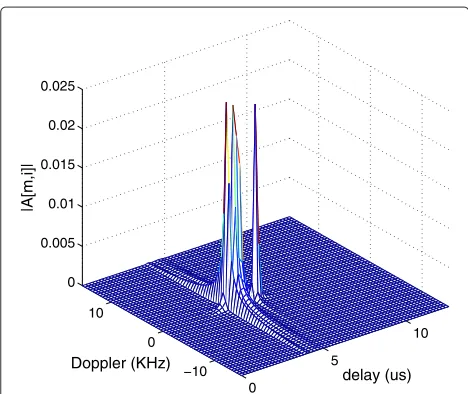
From Figure 3, the peak energy of Sh[i,θ] leaks to the near delay-Doppler area, and then its value would fade and approximate to 0 gradually. Therefore,Sh[i,θ] is approximate sparse, i.e., the channel coefficientHl,k is approximate sparse in the delay-Doppler domain. How-ever, the fading of sinc(x) and dirN(x) is slow, and a lot of values inSh[i,θ] cannot be neglected. It seriously influences the sparsity of the channel and the estimation performance of the channel.
4.2 Sparsity enhancement using the super-resolution dictionary
In real wireless channels, the time delay and Doppler fre-quency shift of non-integer times sampling points exist generally. They seriously influence the sparsity of channel coefficientHl,kin the time delay and Doppler domain and do not satisfy the prerequisite condition. Hence, how to avoid the energy leakage is a very important issue in chan-nel estimation. Essentially, the chanchan-nel energy leakage is actually introduced by channel discrete characterization, and the sparsity of the channel itself does not disappear.
0
Figure 3Modulus of the expansion coefficients for DFT basis. Since the fading of sinc(x)and dirN(x)is slow, a lot of coefficients should not be neglected which decrease the sparsity of the channel. The parameters areP=10,NCP=16,K=256, andL=16.ηq,τ/Ts,
andvqTsN0are random variables.
Therefore, if we can improve the accuracy of channel dis-crete characterization, it would greatly reduce the energy leakage. Therefore, improving the discrete accuracy of the channel impulse response reduces the energy leakage [17]. Assuming thath[n,θ] can be represented by BEM with a period ofλN0, we have on LS and obtain
min
whereS(λ)θ corresponds to 2J+1 Doppler sample point underλtimes over-sampling.
We may define S(λ)θ,m = S(λ)[−amλ+m,θ] ,. . ., S(λ) [bmλ+m,θ]] and hθ = [h[0,θ] ,. . .,h[N0−1,θ]]T,
wheream =(J+m)modλandbm = (J−m)modλ. It is easy to prove Equation 22:
S(λ)θ,m=min samples around zero from the critically sampled Doppler spectrum of them/(λN)frequency-shifted version ofhθ. So all samples (m=0, 1,. . .,λ−1) can deduce 2J + 1 Doppler frequency shift point. By replacingD(λ)m ,F(λ)m , and hθ into Equation 23, we have
S(λ)[i,θ]=
From Equations 24 and 16, we find that
dirN0
πi−vqTsN0
in Equation 16 is replaced into dirN0
can be transformed into a Dirac function. The higher the parameter λ is, the more the sample of the Doppler spectrum is. And when the posi-tion of the sample is closer to the real posiposi-tion, the problem of energy leakage would greatly be reduced. Admittedly, a part of the Doppler spectrum still results in a certain energy leakage; however, its value is very small. Letting I denote all integer set which satisfied i−λvqTsN0 ≤ i in the area of i ∈ {−J,. . .,J}, the
dirN0
Figure 4 shows the leakage effect of
dirN0
Similarly, we can apply the same method to solve the energy leakage problem in the time-delay domain [18,19]. Lastly, equivalent discrete-time baseband channel fre-quency response is given by
Hl,k=
multiple number of delay and Doppler, respectively, and Aγ,g(θ,i/N0)is the same as that in Equation 17.
Redundant dictionary U is defined by
[U]kL+l,(i+J)D+θ = e−j2π(kθ/λK−ni/λN0), [h]kL+l = Hl,k, andg (i+J)D+θ = SD[i,θ]Aγ,g(θ,i/N0). Obviously,gis
sparse according to the above analysis. So we can obtain the vector form of Equation 26:
h=Ug (27)
Especially, ifλ = 1,Uis the 2-D Fourier basis as used in Equation 18. Under the same conditions as those in Figure 3, Figure 5 shows the distribution of coefficientgin the dictionary domain.
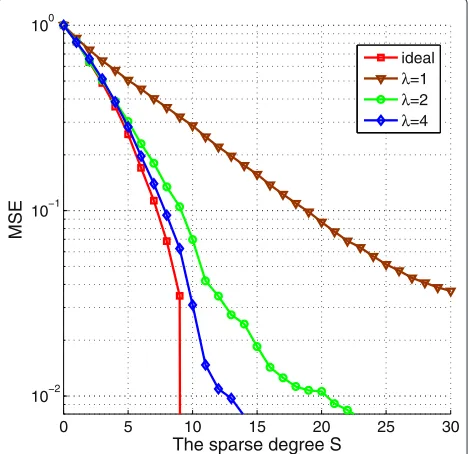
Obviously, the effective valuegin Figure 5 is less than that in Figure 3. So the channel coefficient corresponding toλ = 2 has a higher sparsity. To analyze the sparsity in the dictionary domain better, we utilize OMP algorithm to solveS-sparse approximation and obtain the mostS max-imum value ing. From Figure 6, with the increase ofS, the mean square errorE[|h− ˆhS|2] would decrease gradually and would be close to 10−1, i.e., we can obtain 90% chan-nel energy based onSstrongest atoms. Ifλis higher, the atoms that satisfy the required mean error are fewer. So we can conclude that ifλis higher, the sparsity of frequency responsehis higher in the over-complete dictionary.
4.3 The estimation of the sparse channel based on the dictionary domain
Assuming that (l,k) ∈ P, where P is the pilot set, the total number of pilot point is Q = |P|. The number of pilots must satisfy the lowest demand of compressive
−8 −6 −4 −2 0 2 4 6 8
Figure 4Comparison between dirN0
has a quicker fade speed of side lobe and a smaller value of side lobe than dirN0
0
5
10
−10 0 10 0 0.1 0.2 0.3 0.4 0.5
delay (us) Doppler (KHz)
|A[m,i]|
Figure 5Sparsity enhancement obtained with the over-complete dictionary corresponding toλ=2.The effective value is much less than that in Figure 3; the parameters are the same as those in Figure 3 except the basis.
sensing theory to represent the measurement signal with-out distortion. The literature [14] gives the limitation of the number of measurement samples required by OMP. Nm ≥KSln(Nr/δ), whereSdenotes sparsity. Commonly, K ≤ 20 is reasonable. IfS is too large, we may also set K ≈ 4 and δ ∈ (0, 0.36). OMP may reconstruct a sig-nal with 1−2δprobability. So we can select the suitable number of pilots,Q≥Nm.
According to (9), the estimation of the channel coeffi-cient in the pilot is given by
˜ Hl,k =
rl,k xl,k =
Hl,k+zl,k (28)
Leth =h(l,k)∈P,U= U(l,k)∈P be the matrix cor-responding to the pilot point, andzbe the set of˜zl,k in
(l,k)∈P. We have
h=Ug+z (29)
According to the above analysis, we can conclude that gis sparse. So Equation 27 is a standard equation of CS. Measurement matrixUis a structured random matrix which is formed by selecting a row vector of unitary matrix corresponding to the pilot point. If we select the position of the pilot uniformly and randomly and Q is large enough, the normalized matrix√1/QUhas a small constraint isometric constant with very high probability. In other words, we can obtain very good reconstruction
performance. So we can obtain Equation 30 from Equation 29.
h=x+z (30)
where=√KL/QUandx= √Q/KLg. Therefore, we may realize channel equalization based on CS theory. The following are the detailed steps:
1. Obtain the estimationH˜l,kof the channel coefficient according to Equation 28, and then combine allH˜l,kto formh˜.
2. Utilize OMP to obtain an estimationx˜ofxbased on knownh˜andaccording to Equation 30. The detail of realization refers to Algorithm 1. After rescalingx˜, we can obtain estimation value
˜
g, as well the spread coefficientSD[i,θ] corresponding to the dictionary.
3. Compute all channel coefficienth˜by utilizing Equation 27 based on knowng˜andU.
The run time of OMP mainly depends on the index set
kselected in the iteration process. We need to select the optimal atom O(D(2J+1))fromD×(2J+1)atom. So with the increase ofλ, the number of time-delay sample Dand the number of Doppler sample J would increase exponentially. However, with the increase ofλ, the chan-nel sparsity would be enhanced and the iteration times required by OMP would reduce. Lastly, it can save a certain run time.
0 5 10 15 20 25 30
10−2 10−1 100
The sparse degree S
MSE
ideal
λ=1
λ=2
λ=4
Algorithm 1 Steps of reconstitution Input:
Data vectorh˜, measurement matrix , noise vari-anceσ2
Output:
The proposed solution is xˆk obtained after k itera-tions.
1: initialize: Residual r0 = ˜h, index set 0 = ∅,
iteration counterk=0
2: while(rk2≥σ2)do
3: k=k+1
4: Find the indexλk:λk =arg max j
rk−1,ϕj,ϕj∈
5: Augment the index set and the matrix of chosen
atoms:k=k−1∪ {λk}and
k=
k−1,ϕλk
6: Solve a least squares problem to obtain a new signal
estimation:xˆk=arg min
χ y−kχ2 7: Calculate the new residual:rk=y−xˆk
8: end while
5 Simulation and analysis
In this section, we present numerical results to ana-lyze the performance of the CS-based channel estimation algorithm using the over-complete dictionary. The fol-lowing are the relating simulation parameters: carrier frequencyfc = 2 GHz, bandwidthB = 10.24 MHz, sub-carrier number K = 1, 024, the length of cyclic prefix NCP =128, and sample periodTs=0.1 ms. We may
uti-lize the channel simulation tool IlmProp [20] based on the geometrical structure of space to simulate a doubly selec-tive fading channel. The simulated frame for the OFDM block has eight symbols, i.e.,L=8. In the simulated envi-ronment, the distance between the transmitter and the receiver is 2,000 m, and 10 reflectors, in which 2 reflectors are distributed within 150 m from the transmitter, form 10 multipath clusters, which satisfy the Gaussian distribu-tion. The random speed of each path is less than 100 m/s and the acceleration is less than 20 m/s2. Assume that the noisez[n] is additive white Gaussian noise (AWGN), in which the mean is 0 and the variance is σ2. So the signal-noise ratio (SNR) of the symbol block is given by
SNR= N0−1
n=0
E|r[n]−z[n]|2 N0−1
n=0
E|z[n]|2
(31)
In addition, simulation tools are MATLAB 2009 and an Intel Core PC with a 2.8-G processor and 1.5-G RAM.
To begin with, we give the performance compari-son for a variety of algorithms under different SNR conditions. The SNR varies within −10 ∼20 dB. For
LS channel estimation, we used two different rectan-gular pilot constellations, i.e., selected uniformly 6.5% and 12.5% of all symbols for pilots, respectively. For CS-based estimation, we select randomly 6.25% of all symbols for pilots and three different basis, i.e., Fourier basis (DFT) (i.e., λ = 1) [10], iterative opti-mize basis [12], and over-complete dictionary (DIC) (λdelay = λDoppler = 2,λdelay = λDoppler = 4).
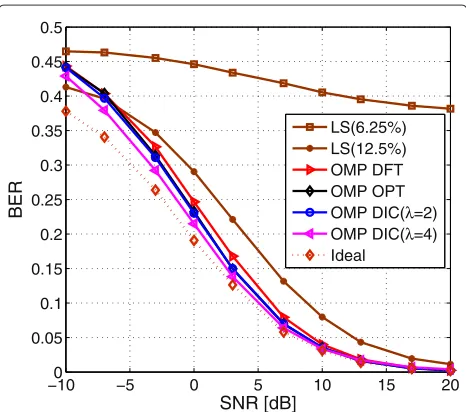
Figure 7 gives the MSE comparison of different algorithms under SNR. Figure 8 shows the bit error ratio (BER) com-parison of equalization decoding. Both figures suggest that when we only apply 6.25% resource as pilots, the per-formance of LS estimation is much bad; the reason is that the distribution of the pilot cannot satisfy the Nyquist sampling criterion. However, when OMP algorithm also applies 6.25% resource for the pilot, the performance of the channel estimation proposed in this paper is better than that of LS estimation that applies 12.5% resource for the pilot. So the utilization efficiency of the spec-trum is improved obviously. In addition, OMP algorithm on the over-complete dictionary domain has a better performance than the traditional algorithm on the delay-Doppler domain. Whenλ = 2, the performance on the over-complete dictionary domain approaches that on the iterative optimize basis. And when λ = 4, the perfor-mance on the over-complete dictionary domain is better than that on the iterative optimize basis. With the increase
−10 −5 0 5 10 15 20
−25 −20 −15 −10 −5 0 5 10 15 20 25
SNR [dB]
MSE [dB]
LS(6.25%) LS(12.5%) OMP DFT OMP OPT OMP DIC(λ=2) OMP DIC(λ=4)
−100 −5 0 5 10 15 20 0.05
0.1 0.15 0.2 0.25 0.3 0.35 0.4 0.45 0.5
SNR [dB]
BER
LS(6.25%) LS(12.5%) OMP DFT OMP OPT OMP DIC(λ=2) OMP DIC(λ=4) Ideal
Figure 8BER performance in different SNR environments.With the increase ofλ, the bit error rate is gradually reduced and reaches the ideal channel estimation.
of theλ, the BER performance of OMP algorithm using over-complete dictionary is close to that of ideal channel estimation. So the higher isλ, the better is the reconstruc-tion performance of OMP and the higher is the estimareconstruc-tion accuracy.
Although the performance of the dictionary onλ = 4 is the best, its complexity is also the highest, as shown in Table 1. Considering the reconstruction time only, itera-tive optimize basis is the optimal except for LS estimation. However, the method based on iterative optimize basis needs extra 163.8541 s to compute the optimal basis. But, in the channel estimation algorithm proposed in this paper, we can produce the dictionary by FFT. The method only enlarges the size of the reconstructed atomic set and does not need extra computation. By comparing the required time between λ = 4 and λ = 2, it can be concluded that the sparsity of the channel coefficient in the dictionary domain would be sparer with the increase of parameter λ. Meanwhile, the sparsity of the channel coefficient can also be influenced by the physical path and lower than the number of reflectors. Therefore, when
Table 1 The run time of different algorithms
Algorithm Reconstruction (s) Extra time (s)
LS (6.25%) 0.0455 0
LS (12.5%) 0.0372 0
OMP_DFT 0.4282 0
OMP_OPT 0.3017 163.8541
OMP_DIC (λ=2) 0.9661 0
OMP_DIC (λ=4) 2.9548 0
λ=2, the channel estimation method based on the super-resolution dictionary domain has a certain advantage on the algorithm performance and computation complexity.
Then, we present the performance comparison of dif-ferent algorithms under the difdif-ferent numbers of pilot symbols. Here, SNR is assumed to be 0 dB, the num-ber of pilot symbols varies within 3%∼10%, and the other parameters are the same as those in the above simula-tion. Figure 9 shows that the performance is improved with the increase of the pilot number. Under the same accuracy condition, the higher the solution in the dic-tionary domain is, the less the required number of pilot is. For example, when MSN= −5 dB and λ = 4, the required resource of pilots is only about 4%. Ifλ = 2, the percentage is about 5%. However, the method based on Fourier basis needs about 7.5% resource. Figure 10 shows the comparison under the different numbers of pilots. With the increase of pilot number, BER would be close to the performance of ideal channel estimation. In other words, under the same performance of MSE or BER, the pilot number required by DIC is less than that by DFT and OPT. Hence, the sparse channel esti-mation based on the dictionary domain can effectively reduce the number of pilots and improve the spectrum efficiency.
Lastly, to reduce the computation complexity, we may apply different over-sampling times in the time-delay domain or the Doppler domain. In a wireless chan-nel, we assumed that the random speed of each path cluster is less than 10 m/s and the acceleration is less
3 4 5 6 7 8 9 10
−10 −9 −8 −7 −6 −5 −4 −3 −2 −1 0
The number of pilots (%)
MSE [dB]
OMP_DFT OMP_OPT OMP_DIC(λ=2) OMP_DIC(λ=4)
3 4 5 6 7 8 9 10 0.18
0.2 0.22 0.24 0.26 0.28 0.3 0.32
The number of pilots (%)
BER
OMP DFT OMP OPT
OMP DIC(λdelay=λDoppler=2) OMP DIC(λdelay=λDoppler=4) Ideal
Figure 10BER performance under the different numbers of pilot symbols.An increase in either the measure values or lambda can reduce BER.
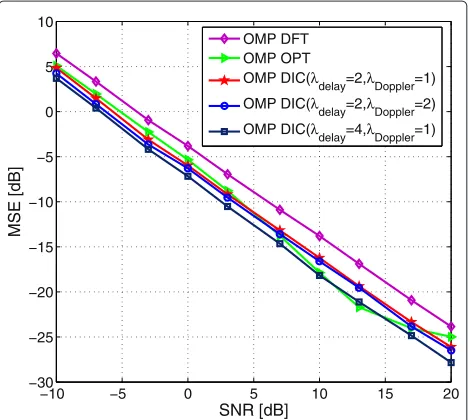
than 1 m/s2, so the Doppler influence is not much serious. The other parameters are the same as those in the first simulation. Figures 11 and 12 show that when
λdelay=4,λDoppler=1, the performance of channel
esti-mation is better than that of others. The accuracy perfor-mance on λdelay=λDoppler=2 is almost the same as that
onλdelay=2,λDoppler=1; however, the former run time is
−10 −5 0 5 10 15 20
−30 −25 −20 −15 −10 −5 0 5 10
SNR [dB]
MSE [dB]
OMP DFT OMP OPT
OMP DIC(λdelay=2,λDoppler=1)
OMP DIC(λ
delay=2,λDoppler=2)
OMP DIC(λ
delay=4,λDoppler=1)
Figure 11MSE performance using different resolution dictionaries.Whenλdelay=4,λDoppler=1, the performance of
channel estimation is the best, while the accuracy performance on λdelay=λDoppler=2 is almost the same as that on
λdelay=2, λDoppler=1; the over-sampling in the Doppler domain
cannot improve the performance very much; the channel has a mild Doppler spread.
−10 −5 0 5 10 15 20
0.05 0.1 0.15 0.2 0.25 0.3 0.35 0.4 0.45 0.5
SNR [dB]
BER
OMP DFT OMP OPT OMP DIC(λ
delay=2,λDoppler=1)
OMP DIC(λdelay=2,λDoppler=2) OMP DIC(λdelay=4,λDoppler=1) Ideal
Figure 12BER performance using different resolution dictionaries. The more sparse the channel is, the higher the degree of accuracy and the lower the BER we get.
about twice the latter, as shown in Table 2. Compared with that of the DFT and OPT, the run time of dictionary basis onλdelay=2,λDoppler=1 is only slightly more than that of
Fourier basis; however, the former performance is obvi-ously better than the latter. Considering that the Doppler influence is not much serious, we only over-sample in the time-delay domain, so we can obtain an optimal selection in both computation complexity and performance. Simi-larly, we can also apply the same method in the Doppler domain.
6 Conclusions
This paper proposes a novel estimation method of a sparse and doubly selective channel based on CS theory. The method can reduce the problem of energy leakage caused by discrete truncation and the limited bandwidth by over-sampling in the delay-Doppler domain, enhance the spar-sity of the equivalent channel in the dictionary domain, and then improve the performance of channel estimation. The results show that although the method based on the over-complete dictionary needs more computation, the estimation accuracy is improved obviously and the pilot resource is reduced very much. Lastly, compared with
Table 2 The required run time about different algorithms
Algorithm Reconstruction (s) Extra time (s)
DFT 0.4543 0
OPT 0.3210 164.4662
DIC (λdelay=2,λDoppler=1) 0.5343 0
DIC (λdelay=2,λDoppler=2) 0.9310 0
the increase of spectrum utilization, it is worth for more complexity.
Competing interests
The authors declare that they have no competing interests.
Acknowledgements
This work was supported by the Fundamental and Frontier Research Project of Chongqing (cstc2013jcyjA40034), National Natural Science Foundation of China (61301126), Program for Changjiang Scholars and Innovative Research Team in University (IRT1299), and special fund of Chongqing key laboratory (CSTC).
Received: 31 October 2013 Accepted: 12 February 2014 Published: 6 March 2014
References
1. SF Cotter, BD Rao, Matching pursuit based decision-feedback equalizers. IEEE. Acoustices Signal.5, 2713–2716 (2000)
2. MR Raghavendra, K Giridhar, Improving channel estimation in OFDM systems for sparse multipath channels. IEEE Signal Process. Lett.12(1), 52–55 (2005)
3. DL Donoho, Compressed sensing. IEEE Trans. Inform. Theory.52(4), 1289–1306 (2006)
4. EJ Candes, J Romberg, T Tao, Robust uncertainty principles: exact signal reconstruction from highly incomplete frequency information. IEEE Trans. Inform. Theory.52(2), 489–509 (2006)
5. WU Bajwa, J Haupt, G Raz, R Nowak, Compressed channel sensing. IEEE, Inform. Sci. Syst.42, 5–10 (2008). doi:10.1109/CISS.2008.4558485 6. WU Bajwa, AM Sayeed, R Nowak, Learning sparse doubly-selective
channels. Commun. Control, Comput.46, 575–582 (2008). doi:10.1109/ALLERTON.2008.4797610
7. WU Bajwa, J Haupt, AM Sayeed, R Nowak, Compressed channel sensing: a new approach to estimating sparse multipath channels. Proc. IEEE.98(6), 1058–1076 (2010)
8. CR Berger, SL Zhou, W Chen, P Willett, Sparse channel estimation for OFDM: over-complete dictionaries and super-resolution. IEEE, Signal Process. Adv. Wireless Commun.42, 196–200 (2009).
doi:10.1109/SPAWC.2009.5161774
9. CR Berger, SL Zhou, W Chen, JC Preisig, P Willett, Sparse channel estimation for multicarrier underwater acoustic communication: from subspace methods to compressed sensing. IEEE Trans. Signal Process. 58(3), 1708–1721 (2010)
10. G Taubock, F Hlawatsch, A compressed sensing technique for OFDM channel estimation in mobile environments: exploiting channel sparsity for reducing pilots. IEEE Acoustics Speech Signal Process. ICASSP-08, 2885–2888 (2008). doi:10.1109/ICASSP.2008.4518252
11. G Taubock, F Hlawatsch, Compressed sensing based estimation of doubly selective channels using a sparsity-optimized basis expansion. In Processing European Signal Processing Conference (Lausanne, Switzerland, 2008), pp. 3029–3032
12. G Taubock, F Hlawatsch, D Eiwen, H Rauhut, Compressive estimation of doubly selective channels in multicarrier systems: leakage effects and sparsity-enhancing processing. IEEE J. Select. Topics Signal Process.4(2), 255–271 (2010)
13. JA Tropp, AC Gilbert, Signal recovery from random measurements via orthogonal matching pursuit. IEEE Trans. Inform. Theory.53(12), 267–288 (2007)
14. AM Sayeed, B Aazhang, Joint multipath-Doppler diversity in mobile wireless communications. IEEE Trans. Commun.47(1), 123–132 (1999) 15. GB Giannakis, C Tepedelenliouglu, Basis expansion models and diversity
techniques for blind identification and equalization of time-varying channels. Proc. IEEE.86(10), 1969–1986 (1998)
16. I Barhumi, G Leus, M Moonen, Estimation and direct equalization of doubly selective channels. EURASIP J. Appl. Signal Process., Article ID 62831, 1–15 (2006)
17. G Leus, On the estimation of rapidly time-varying channels. European Signal Processing Conference (EUSIPCO), Vienna, Austria,12, 2227–2230 (2004)
18. CR Berger, Z Wang, J Huang, S Zhou, Application of compressive sensing to sparse channel estimation. IEEE Commun. Mag.48(11), 164–174 (2010) 19. QH Shi, Y Karasawa, Frequency-domain oversampling for OFDM systems:
exploiting inter-carrier interference and multipath diversity. Int. Symp. Commun. Inform. Technol.9, 1097–1101 (2009).
doi:10.1109/ISCIT.2009.5341017
20. GD Galdo, M Haardt, IlmProp: a flexible geometry-based simulation environment for multiuser MIMO communication. European Cooperation in Science and Technology (EURO-COST), COST 273 TD(03) 188, Prague, Czech Republic (2003)
doi:10.1186/1687-6180-2014-29
Cite this article as: Zhou et al.:A novel method for sparse channel estimation using super-resolution dictionary.EURASIP Journal on Advances in Signal Processing20142014:29.
Submit your manuscript to a
journal and benefi t from:
7Convenient online submission 7Rigorous peer review
7Immediate publication on acceptance 7Open access: articles freely available online 7High visibility within the fi eld
7Retaining the copyright to your article