A Secure Role Based Encryption of Data
Sharing for Dynamic Groups in the Cloud
Ajit N Pawar, Prof. Sonal Ftangare
M.E., Dept. of Computer, RMD Sinhgad School of Engineering, Pune, India
Assistant Professor, Dept. of Computer, RMD Sinhgad School of Engineering, Pune, India
ABSTRACT: Continuous changes in the membership of data sharing, giving security and privacy preservation are still
challenging issues, especially for an untruth cloud due to the collusion attack. It is based on the secure key distribution without assuming any secure communication channel. We propose a secure role based encryption of data sharing scheme using secure communication channel for dynamic groups in the cloud .The system provides fine grained access control for any clients who wants to access the information from cloud .It also prevents access of clients after their revocation and protect from collusion attack. Proposed system provide guarantee for secure sharing of data files when they are outsourced with double encryption and particular security key distribution mechanism. Users can achieve an effective and economical way for data sharing among group members in the cloud with efficient manner and little management cost.
KEYWORDS: Access control, privacy-preserving, cloud computing key distribution.
I. INTRODUCTION
Cloud computing provides on demand service and processing resources to the Users or devices. It is dynamic computing style in which dynamically scalable and usually virtualization resources are provided as a service over the internet. Fundamental service offered by cloud providers is data storage. Cloud servers managed by cloud providers which are not fully trusted. Users may stored data files on cloud which may be sensitive and confidential, like business plans. To preserve data privacy, a basic solution is to encrypt data files, and then upload the encrypted data into the cloud.
II. RELATED WORK
In[1] author developedOn the security of public key protocol Proposes public key encryption protocol, describes the various techniques to encrypt the public key
In [2] author developed First complete group key management scheme which can supports all these functions yet preserves efficiency. The proposed scheme is based on the new concept of access control polynomial (ACP) that efficiently and effectively support full dynamics, flexible access control with fine-tuned granularity, and concealment .New scheme is protected from various attacks from both external and internal malicious parties.
In [3] author developed Achieving secure role based control on encrypted data in cloud achieved through RBAC. RBE scheme allows RBAC policies to be apply for the encrypted data stored in public clouds. RBE-based hybrid cloud storage architecture provides facility of an organization to store data securely in a public cloud, while maintaining the sensitive information related to the organization's structure in a private cloud.
In [4] author developedOne approach to encrypt documents satisfying different policies with different keys using a public key cryptosystem such as attribute-based encryption, and proxy re-encryption is called broadcast group key management (BGKM), and then give a secure construction of a BGKM scheme called ACV-BGKM. Major advantage of the BGKM scheme is that adding users/revoking users can be performed efficiently by updating only some public information. BGKM used for an efficient approach for fine-grained encryption-based access control for documents stored in an untrusted cloud file storage.
In [5] author developed MONA proposed a new secure multi-owner data sharing scheme, for multiple groups in the cloud. They applied the group signature and dynamic broadcast encryption techniques, any cloud user can secretly share data with others. The storage overhead and encryption computation cost of our scheme are independent with the number of revoked users. Also they analyze the security of scheme with difficult proofs, and demonstrate the efficiency of scheme in experiments.
In 2013 [6] author developed the collision attack prevent on MONA system.It proposed the secure multiowner data sharing in dynamic cloudes.Previous MONA system had some lack causes some security attacks.
In [7] author developed Data distribution in cloud infrastructure provides an effective approach called Secure-Split-Merge (SSM) is introduced for the security of data. The proposed SSM scheme was it uses unique mechanism for performing splitting of data using AES 128 bit encryption key. The chunks of encrypted splits are being maintained on various group servers of different types of cloud zones. The comparative analysis shows that the proposed system gives effective outcomes as compared to various existing and traditional security standards.
In [8] author developed Security achieves against chosen-plaintext attacks using the k-multilinear Decisional Diffie-Hellman assumption.
In [9]author developed Fine-grained two-factor authentication (2FA) access control system for cloud services.proposed2FA access control system, it was an attribute-based access control mechanism implemented with the necessity of both a user secret key and a lightweight security device
III. GOALS AND OBJECTIVE
The main goals of the proposed scheme including access control, data confidentiality, anonymity and traceability and efficiency.Two requirement of access controls are first, group members are able to use the cloud resource for data operations another is unauthorized users cannot access the cloud resource at anytime, and revoked users will be incapable of using the cloud once again they are revoked.. A new type authentication system, which is highly secure, has been proposed in this system to design a secure data sharing scheme for dynamic groups in the cloud. The users can securely obtain their private keys from group manager Certificate Authorities and secure communication channels.
IV. PROPOSED SYSTEM ALGORITHMS
1) AES Algorithm :
This symmetric encryption Algorithm which are AES is an iterative rather than Festal cipher. It is based on ‘substitution–permutation network’. It comprises of a series of linked operations, some of which involve replacing inputs by specific outputs (substitutions) and others involve shuffling bits around (permutations).
Steps:
Step1: Select two Prime Numbers P and Q
Step 2: Compute N=p*q Compute φ(N)=(p-1)*(q-1) Step 3: Choose e such that 1<e and e are Co-prime Step 4: Computer a value for d such that (d *e) % φ(N)=1 Step 5: Public key is (e, N) Private Key is (d, N)
4)Horizontal Fragment:
Used for fragmentation of data file and groups. Steps:
Step 1. File is to be split go to step 2
Step 2. Input source path, destination path, Source File, no of fragments Step 3. N of= no of fragments
Size= size of source file Step 4. Fragments=size/Nof Step 5.End
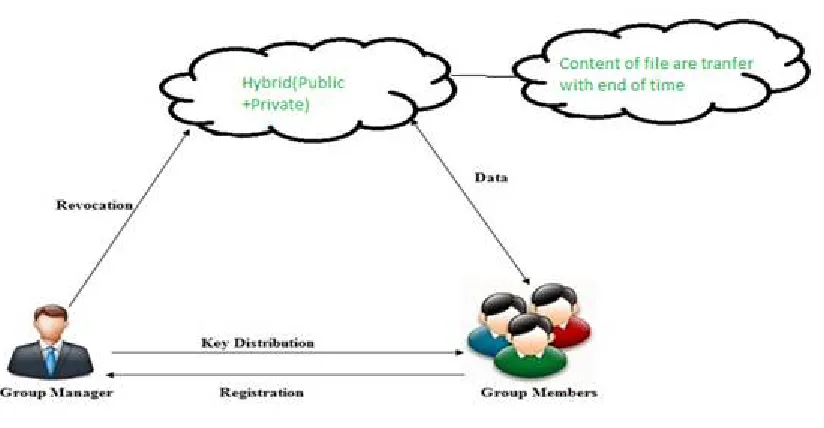
V. PROPOSED SYSTEM ARCHITECTURE
Fig proposed System Architecture
VI. ADVANTAGES OF PROPOSED SYSTEM
1)The computation cost is irrelevant to the number of revoked users in RBE scheme. Because it does not affected by how many users are revoked, the operations for members to decrypt the data files almost remain the same.
2)New approach called RBE provides role based encryption permissions. The cost is irrelevant to the number of the revoked users.
3)Users can securely obtain private keys from group manager Certificate Authorities and secure communication channels.Also, our scheme is able to support dynamic groups efficiently,when a new user registered they can store data in one of chosen group. User can efficiently use the private and public cloud storage
VII. CONCLUSION
This system is design for secure data sharing scheme, for dynamic groups in an untruth cloud. A new type authentication system, which is highly secure, has been proposed in this system. User is able to share data with others in the group without disclose identity privacy to the cloud. It also supports efficient user revocation and new user joining. User revocation can be done through a public revocation list without updating the private keys of the remaining users, and new usersvcan directly decrypt files stored in the cloud before their participation. System also provides the new double encryption technique for data security. New role based encryption provides tight authentication.
REFERENCES
[1] D. Dolev and A. C. Yao, “On the security of public key protocols,”IEEE Trans. Inf. Theory, vol. IT-29, no. 2, pp. 198–208, Mar. 1983.
[6]Z. Zhu, Z. Jiang, and R. Jiang, “The attack on mona: Secure multiowner data sharing for dynamic groups in the cloud,” in Proc. Int.Conf. Inf. Sci. Cloud Comput., Dec. 7, 2013, pp. 185–189.
[7]BurhanUl Islam Khan,Rashidah F. Olanrewaju“SSM: Secure-Split-Merge Data Distribution in Cloud Infrastructure”,in2015 IEEE Conference on Open Systems (ICOS), August 24-26, 2015, Melaka, Malaysia
[8]JieXu, Qiaoyan Wen, Wenmin Li, and Zhengping Jin, “Circuit Ciphertext-Policy Attribute-Based Hybrid Encryption with Verifiable Delegation in Cloud Computing” IEEE TRANSACTIONS ON PARALLEL AND DISTRIBUTED SYSTEMS, VOL. 27, NO. 1, JANUARY 2016
[9]Joseph K. Liu, Member, IEEE, Man Ho Au, Member, IEEE, Xinyi Huang,
Rongxing Lu, Senior Member, IEEE, and Jin Li, “Fine-Grained Two-Factor Access Control for
Web-Based Cloud Computing Services”, IEEE TRANSACTIONS ON INFORMATION FORENSICS AND SECURITY, VOL. 11, NO. 3, MARCH 2016
[10] NazatulHaque Sultan &Ferdous Ahmed Barbhuiya, “A Secure Re-Encryption Scheme for Data Sharing in Unreliable Cloud Environment,”978-1-5090-2616-6/16 © 2016 IEEE
DOI 10.1109/SERVICES.2016.16