University of Windsor University of Windsor
Scholarship at UWindsor
Scholarship at UWindsor
Electronic Theses and Dissertations Theses, Dissertations, and Major Papers
9-26-2018
Effect of Aspect Ratio on the Flow Structures Behind a Square
Effect of Aspect Ratio on the Flow Structures Behind a Square
Cylinder
Cylinder
Junting Chen
University of Windsor
Follow this and additional works at: https://scholar.uwindsor.ca/etd
Recommended Citation Recommended Citation
Chen, Junting, "Effect of Aspect Ratio on the Flow Structures Behind a Square Cylinder" (2018). Electronic Theses and Dissertations. 7507.
https://scholar.uwindsor.ca/etd/7507
This online database contains the full-text of PhD dissertations and Masters’ theses of University of Windsor students from 1954 forward. These documents are made available for personal study and research purposes only, in accordance with the Canadian Copyright Act and the Creative Commons license—CC BY-NC-ND (Attribution, Non-Commercial, No Derivative Works). Under this license, works must always be attributed to the copyright holder (original author), cannot be used for any commercial purposes, and may not be altered. Any other use would require the permission of the copyright holder. Students may inquire about withdrawing their dissertation and/or thesis from this database. For additional inquiries, please contact the repository administrator via email
Effect of Aspect Ratio on the Flow Structures Behind a Square Cylinder
By
Junting Chen
A Thesis
Submitted to the Faculty of Graduate Studies
through the Department of Mechanical, Automotive and Materials Engineering in Partial Fulfillment of the Requirements for the Degree of Master of Applied Science at the
University of Windsor
Windsor, Ontario, Canada
2018
Effect of Aspect Ratio on the Flow Structures Behind a Square Cylinder
by
Junting Chen
APPROVED BY:
______________________________________________ S.Cheng
Department of Civil and Environmental Engineering
______________________________________________ D.Ting
Department of Mechanical, Automotive and Materials Engineering
______________________________________________ R.Barron, Co-Advisor
Department of Mechanical, Automotive and Materials Engineering
______________________________________________ R.Balachandar, Co-Advisor
Department of Mechanical, Automotive and Materials Engineering
iii
Author’s Declaration of Originality
I hereby certify that I am the sole author of this thesis and that no part of this
thesis has been published or submitted for publication
I declare that, to the best of my knowledge, my thesis does not infringe up on
anyone’s copyright nor violate any proprietary rights and that any ideas, techniques,
quotations, or any other material from the work of other people included in my thesis are
fully acknowledged in accordance with the standard referencing practices. Furthermore,
to the extent that I have included copyrighted material that surpasses the bounds of fair
dealing within the meaning of the Canada copyright Act.
I declare that this is the true copy of my thesis, including any final revisions, as
approved by my thesis committee and the Graduate Studies office, and that this thesis has
iv
Abstract
In this thesis, the effect of aspect ratio on the flow past square cross-section
wall-mounted cylinders is evaluated using computational fluid dynamics. The simulations are
carried out using the Improved Delayed Detached Eddy (IDDES) turbulence model.
Three cases with different heights of the cylinder (aspect ratio = cylinder height/width =
1, 2, and 4) were studied. The IDDES prediction of the flow statistics is validated against
a set of wind tunnel experimental results from a recent report on the flow at a Reynolds
number of 12,000 for a cylinder aspect ratio of four.
It is common practise to analyse results in different horizontal and vertical planes
in the wake of the bluff body. To this end, the traditional methods use a geometrical
scaling factor such as the height/diameter of the cylinder or depth of flow. However, this
can lead to an improper analysis as one may not capture the flow properties based on the
physics of the flow. The flow characteristics can be influenced by both the proximity to
the bed and to the cylinder’s free-end. In this thesis, a new method, based on the flow
physics, is proposed to evaluate the role of aspect ratio using the forebody pressure
distribution.
Using the turbulence features and vortex identification methods, it is observed
that the flow structure is influenced by the aspect ratio. The downwash flow noticed in
the wake tends to become less dominant with increasing aspect ratio, accompanied by a
near-bed upwash flow at the rear of the cylinder. The mean and instantaneous flow field
v
elucidate their three-dimensional features. The far-wake of each flow field is visualized
vi
Dedication
To my parents, Zhi Chen and Wei Wang,
vii
Acknowledgements
This research was made possible by the facilities of the Shared Hierarchical
Academic Research Computing Network (SHARCNET: www.sharcnet.ca) and
Compute/Calcul Canada.
I would like to express my heartiest thanks to my advisors, Dr. Balachandar and
Dr. Barron, for their immense support and guiding me on every aspect throughout my
thesis work. Without their encouragement and advice, I would not have been able to
successfully complete it. I would also like to thank my committee members Dr. S. Cheng
and Dr. D. Ting.
I would also like to thank Dr. Kohei Fukuda, Dr. Vimaldoss Jesudhas and Dr.
Vesselina Roussinova for sharing their knowledge with me during my study. Also, I
would like to thank all of my colleagues, Sudharsan Annur Balasubramanian, Sachin
Sharma, Shu Chen, Subhadip Das, Nimesh Virani, Priscilla Williams, Kharuna
Ramrukheea, Chris Peirone, Yuanming Yu and Elle Mistruzzi for sharing their moments
viii
Table of Contents
Author’s Declaration of Originality ... iii
Abstract ... iv
Dedication ... vi
Acknowledgements ... vii
List of Figures ... x
Nomenclature ... xiv
Chapter 1 Introduction ... 1
Chapter 2 Literature Review and Mathematical Model ... 4
2.1 Introduction ... 4
2.2 Previous Experimental Studies ... 4
2.3 Previous Numerical Studies ... 8
2.4 Governing Equations and Turbulence Modeling Techniques ... 10
Chapter 3 Numerical Setup ... 15
3.1 Introduction ... 15
3.2 Computation Domain ... 15
3.3 Boundary Conditions ... 16
3.4 Grid ... 20
3.5 Validation ... 23
Chapter 4 Results and Discussion ... 28
4.1 General Remarks ... 28
4.2 Vortex Shedding Frequency ... 28
4.3 Time-averaged Velocity Field ... 29
4.3.1 Velocity Field in Central Planes and Side Faces ... 29
4.3.2 Velocity Field on Horizontal Planes (Traditional Method) ... 44
4.3.3 Time-averaged Pressure Distribution on the Central Plane of the Windward face ... 46
4.3.4 Time-averaged Velocity Field on Horizontal Planes (Pressure Distribution Method) . 49 4.3.5 Time-averaged Vorticity and Velocity Fluctuation on Central Planes ... 63
4.4 Instantaneous Spanwise Vorticity on Central Planes ... 68
4.5 3-D Visualization by the λ2 Criterion... 75
Chapter 5 Conclusions and Future Work ... 80
5.1 Conclusions ... 80
ix
References ... 84
x
List of Figures
Figure 2.1 Schematic of the flow structure behind a wall-mounted finite square cylinder with AR >
5 [8] ... 6
Figure 2.2 Schematic of the flow structure around a wall-mounted finite square cylinder: (a) two
symmetric spanwise vortices, (b) asymmetric spanwise vortices [3] ... 7
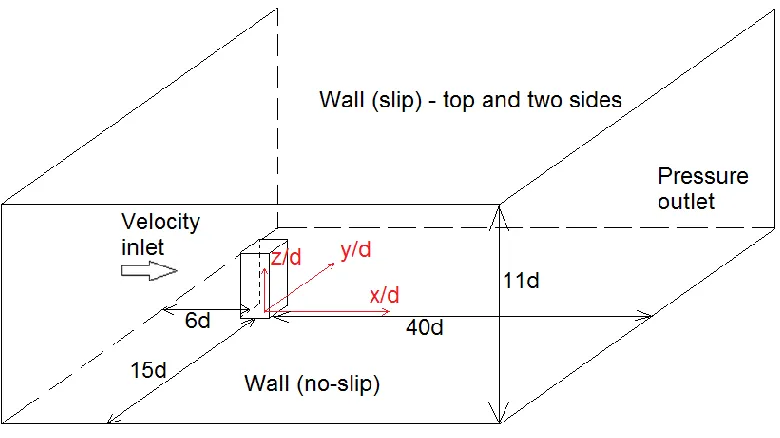
Figure 3.1 Schematic of the computation domain ... 16
Figure 3.2 Experimental results [2] compared to wall function, DNS predictions [23] and other
experimental results [24]; (a) time-averaged streamwise velocity, and (b) turbulence intensity ... 17
Figure 3.3 Comparison between k-ω SST predictions, at the cylinder location with the cylinder
removed, and the experimental results by El Hassan et al. [2]; (a) time-averaged streamwise
velocity, and (b) turbulence intensity ... 18
Figure 3.4 Streamwise velocity (left) and turbulence intensity (right) profiles plotted at the cylinder’s location, with the cylinder removed. ... 20
Figure 3.5 Illustration of the polyhedral grid on the central plane ... 21
Figure 3.6 Comparison of the time-averaged streamwise velocity (U̅/U0) and turbulence intensity
(u2/U0) with different meshes and experimental result ... 22
Figure 3.7 Validation of the current DES result (left) against the experimental result (right) by
Bourgeois et al. [9] at the centre plane y/d = 0 ... 24
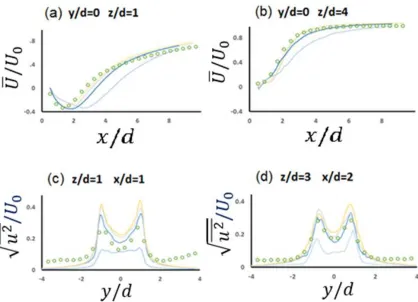
Figure 3.8 Time-averaged normalized streamwise velocity (U̅/U0) on y/d = 0 plane, behind the
cylinder at the vertical level of (a) z/d = 2 and (b) z/d = 3. ... 25
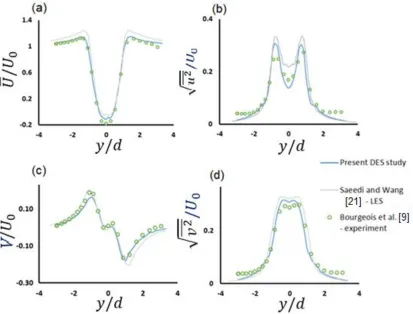
Figure 3.9 Validation of the current DES model with experimental result and an LES study on the
xi
fluctuating streamwise velocity root-mean-square(√u̅̅̅/U2 0); (c) time-averaged spanwise velocity
(V/U0); (d) fluctuating spanwise velocity root-mean-square (√𝑢̅̅̅/𝑈2 0) ... 26
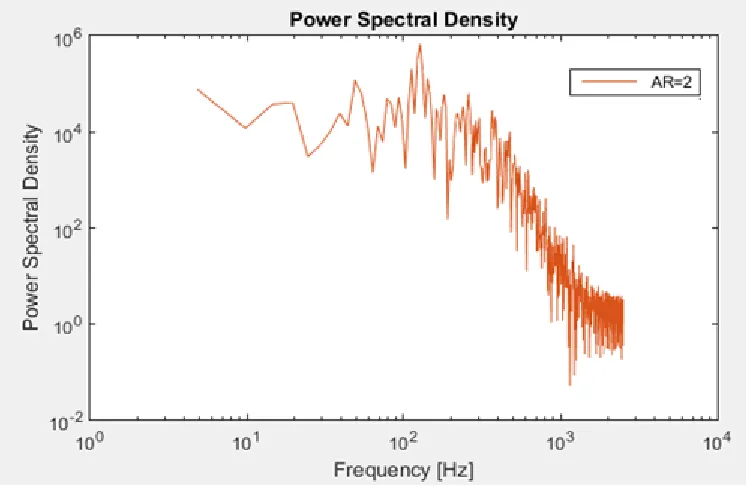
Figure 4.1 Power spectral density for AR = 2... 29
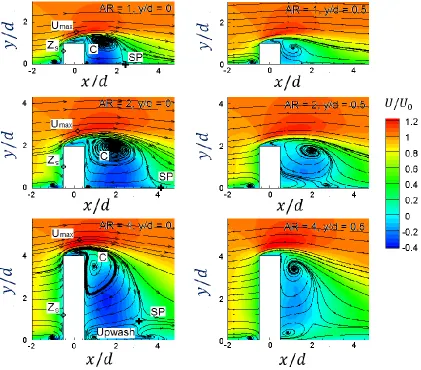
Figure 4.2 Time-averaged normalized streamwise velocity (U/U0) contours on central plane (y/d = 0) for (a) AR = 1, (b) AR = 2, (c) AR = 4; and on side-face plane (y/d = 0.5) for (d) AR = 1, (e) AR = 2, (f) AR = 4. ... 31
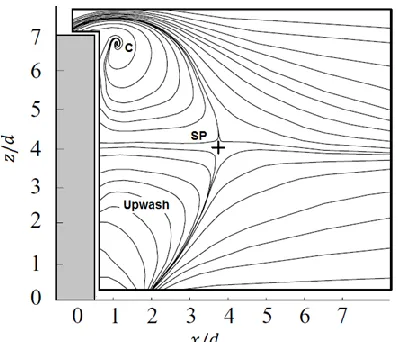
Figure 4.3 Time-averaged streamtraces for flow past a cylinder with AR = 7, (from Wang and Zhou [3]) ... 33
Figure 4.4 Time-averaged velocity vectors for flow past an immersed circular cylinder, (from Heidari [29]) ... 35
Figure 4.5 Time-averaged streamtraces of the recirculation in the flow field for (top row) AR = 1, (middle row) AR = 2, (bottom row) AR = 4 on their central planes (left column) and side-face planes (right column) ... 37
Figure 4.6 Time-averaged streamtraces for the recirculation in the flow field of AR = 4 in vertical planes (from y/d = 0 to 0.8) ... 38
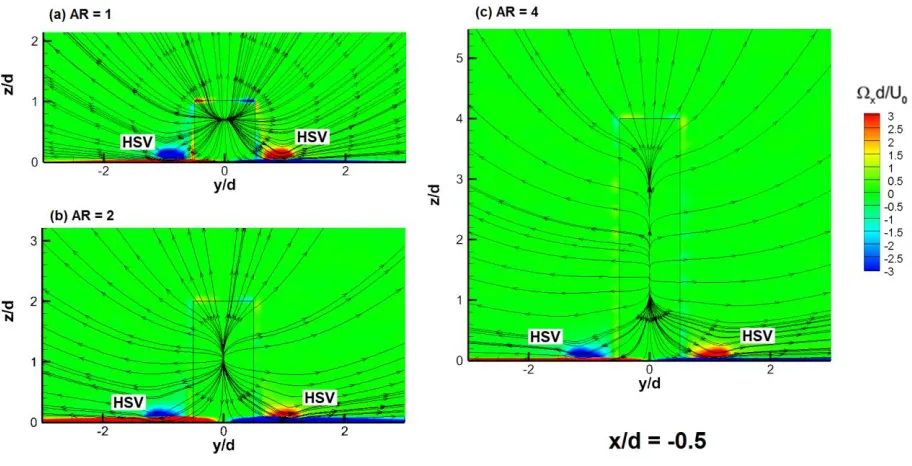
Figure 4.7 Streamtraces in the transverse plane at x/d = -0.5 ... 39
Figure 4.8 Streamtraces in the transverse plane at x/d = 0 ... 40
Figure 4.9 Streamtraces in the transverse plane at x/d = 0.3 ... 41
Figure 4.10 Streamtraces in the transverse plane at x/d = 0.6... 42
Figure 4.11 Streamtraces in the transverse plane at x/d = 1... 43
xii
Figure 4.13 Horizontal planes shaded by normalized normal velocity (W̅ /U0) taken in the cases
of AR = 1 (top row), AR = 2 (middle row), and AR = 4 (bottom row) at the vertical location of
0.25h (left column), 0.5h (central column), and 0.75h (right column). ... 46
Figure 4.14 Pressure coefficient (Cp) distribution on (a) windward face of each cylinder;
(b) derivative of the pressure coefficient with respect to vertical location (ΔCp/Δ(z/h)) ... 48
Figure 4.15 Horizontal planes through Point A, coloured by normalized streamwise velocity
(𝑈̅/𝑈0): (a) AR = 1, (b) AR = 2, (c) AR = 4 ... 50
Figure 4.16 Horizontal planes through Point A, coloured by normalized streamwise velocity
(𝑈̅/𝑈𝑠): (a) AR = 1, (b) AR = 2, (c) AR = 4 ... 52
Figure 4.17 Horizontal planes through Point A coloured by normalized x-vorticity (Ωxd/U0): (a)
AR = 1, (b) AR = 2, (c) AR = 4 ... 55
Figure 4.18 Horizontal planes through Point B, coloured by time-averaged normalized
streamwise velocity (𝑈̅/𝑈0): (a) AR = 1, (b) AR = 2, (c) AR = 4 ... 56
Figure 4.19 Time-averaged normalized streamwise velocity (𝑈̅/𝑈0) plots crossing the wake
region of each cylinder from the downstream location of x/d = 0.6 to x/d = 2.2 ... 58
Figure 4.20 Horizontal planes through Point C (left column) and Point D (right column) for AR =
4 shaded by time-averaged normalized streamwise velocity (𝑈̅/𝑈0) (top row) and normalized
normal velocity (𝑊̅ /𝑈0)) (bottom row) ... 60
Figure 4.21 Time-averaged normalized spanwise vorticity (𝛺̅̅̅̅ × 𝑑/𝑈𝑦 0) contours in the central
plane: (a) AR = 1, (b) AR = 2, (c) AR = 4 ... 63
Figure 4.22 Normalized streamwise turbulence intensity ( √𝑢̅̅̅/𝑈2 0) contours in the central plane:
(a) AR = 1, (b) AR = 2, (c) AR = 4 ... 64
Figure 4.23 Normalized normal turbulence intensity (√w̅̅̅̅/U2 0) contours in the central plane: (a)
xiii
Figure 4.24 Normalized Reynolds shear stress−𝑢𝑤̅̅̅̅/𝑈02contours in the central plane: (a) AR = 1,
(b) AR = 2, (c) AR = 4. ... 67
Figure 4.25 Instantaneous flow field for AR = 1 coloured by spanwise vorticity (𝛺̅̅̅̅ × 𝑑/𝑈𝑦 0): (a) shed vortex from the shear layer travels downstream; (b) shed vortex from the shear layer moves downward then travels downstream; (c) shed vortex from the shear layer curls and enters the near-wake ... 68
Figure 4.26 Instantaneous flow field for AR = 2 coloured by spanwise vorticity (𝛺̅̅̅̅ × 𝑑/𝑈𝑦 0): (a) shed vortex from the shear layer splits into two vortices, one travels downstream and one enters the near-wake; (b) shed vortex from the shear layer moves downward then travels downstream; (c) shed vortex from the shear layer curls and enters the near-wake ... 69
Figure 4.27 Instantaneous flow field for AR = 4 coloured by spanwise vorticity (𝛺̅̅̅̅ × 𝑑/𝑈𝑦 0): (a) shed vortex from the shear layer curls and enters the near wake; (b) shed vortex from the shear layer splits into two vortices,; (c) shed vortex from the shear layer splits into two vortices on the leeward face of the cylinder ... 71
Figure 4.28 Consecutive instantaneous flow fields for AR = 1 in the central plane with 0.001s between each field-of-view coloured by spanwise vorticity (𝛺̅̅̅̅ × 𝑑/𝑈𝑦 0) ... 72
Figure 4.29 Consecutive instantaneous flow fields for AR = 2 in the central plane with 0.001s between each field-of-view coloured by spanwise vorticity (𝛺̅̅̅̅ × 𝑑/𝑈𝑦 0) ... 73
Figure 4.30 Consecutive instantaneous flow fields for AR = 4 in the central plane with 0.001s between each field-of-view coloured by spanwise vorticity (𝛺̅̅̅̅ × 𝑑/𝑈𝑦 0) ... 73
Figure 4.31 Time-averaged λ2 iso-surface of the flow field for AR = 4 ... 78
Figure 4.32 Time-averaged λ2 iso-surface of the flow field for AR = 2 ... 78
xiv
Nomenclature
AR Aspect ratio (-)
Cp Pressure coefficient (-)
d Cylinder width (m)
dwall Distance to the nearest wall (m)
E Energy (J)
f IDDES blending function (-)
h Cylinder height (m)
k Turbulence kinetic energy (m2/s2)
p Static pressure (Pa)
P0 Atmospheric pressure (Pa)
Pstag Pressure at the stagnation point (Pa)
𝑅𝛽, 𝑅𝜔 and 𝑅𝑘 Closure coefficients in viscous damping functions (-)
Red Reynolds number based on the cylinder width (-)
Reθ Reynolds number based on the boundary layer thickness (-)
ReT Turbulent Reynolds number (-)
ST Stress tensor (Pa)
St Strouhal number (-)
t Time (s)
𝑢𝜏 Friction velocity (m/s)
𝑢, 𝑣, 𝑤 Fluctuating velocity components in x, y, z direction (m/s)
𝑈0 Freestream velocity (m/s)
𝑈𝑠 Approach velocity at the corresponding location (m/s)
Umax Maximum velocity (m/s)
𝑈𝑖 and 𝑈̅𝑖 Instantaneous and time-averaged velocity in tensor notation (m/s)
U, V, W Instantaneous velocity components in x, y, z direction (m/s)
𝑈̅, 𝑉̅, 𝑊̅ Time-averaged velocity components in x, y, z direction (m/s)
√𝑢̅̅̅̅2
𝑈0 ,
√𝑣̅̅̅̅2
𝑈0 ,
√𝑤̅̅̅̅2
xv
𝑥𝑖 Position vector in tensor notation (m)
x, y, z Cartesian axis directions (m)
z+ Normalized wall normal distance (-)
λ2 Second eigenvalue of the pressure Hessian matrix (-)
ε Turbulence dissipation rate (m2/s2)
∅, ∅̅, ∅′ A scalar quantity, time-averaged and fluctuation of this quantity
𝜌 Fluid density (kg/m3)
𝜏 ̃ Reynolds stress tensor (Pa)
𝜇 Dynamic viscosity (m2/s)
𝜇𝑇 Eddy viscosity (m2/s)
𝜐 Kinematic viscosity (m2/s)
𝜔 Specific dissipation rate (1/s)
𝛺𝑥, 𝛺𝑦, 𝛺𝑧 Vorticity in x, y, z direction (1/s)
1
Chapter 1
Introduction
A wall-mounted finite-length cylinder immersed in a flow produces a flow field
that is representative of that observed in many engineering applications in the real world,
such as wind flow past low-rise buildings, flow past electronic components and cooling
towers. The interaction between the fluid and the cylinder creates complex flow field
structures in the near wall region and in the turbulent wake behind the cylinder. The flow
structures greatly influence the performance of such a system with respect to, for example,
pedestrian comfort along a city street, heat transfer rate for electronic cooling, or
prediction of pollutant dissipation. It is also important to accurately predict the shedding
frequency of the vortices that develop behind the cylinder in order to avoid vibration
induced by resonance. Therefore, it is necessary to acquire an in-depth understanding of
wall-mounted bluff body flow in order to make improvements in practical application of
such flows.
The flow structure is mainly determined by three factors; Reynolds number (Red),
aspect ratio (AR = h/d, where h and d are the height and width of the cylinder,
respectively), and the relative boundary layer thickness (δ/d) [1]. At a low Reynolds
number, viscous forces dominate over inertial forces. In this case, the flow field tends to
be steady and very little turbulence is observed. As the Reynolds number increases,
inertial forces overcome the viscous forces and dominate the flow field. The flow field
becomes turbulent and more complex flow structures appear. El Hassan et al. [2]
experimentally studied the effect of relative boundary layer thickness on the flow field
around the square cylinder with AR = 4. They confirmed that the wake size is influenced
2
similar conclusion was found by Wang and Zhou [3]. It was concluded that as the
boundary layer thickness increases, the strength of the upwash flow behind the body is
enhanced, thereby weakening the effect of the downwash flow from the free-end of the
square cylinder.
The effect of aspect ratio of the cylinder on the flow field requires further
investigation. A critical value of AR, which is differentiated by the induced wake
structures, has been found to lie between the value of 3 and 5 [4]. Wang and Zhou [3]
showed that the flow past a cylinder with AR below the critical value is more likely to
create a symmetric arch-type wake, and that the flow past a cylinder with AR above such
value is more likely to create a wake similar to an asymmetric von Kármán vortex street.
An in-depth comparison of the flow field near the square cylinders below and
approaching the critical aspect ratio has not been established so far. In the current
research, the Reynolds number (Red) and boundary layer thickness (δ) of the incoming
flow will be fixed, and the square cylinders studied in this research have aspect ratios of 1,
2 and 4.
This research is conducted numerically with the commercial code Star-CCM+
v11.04 [5], running on the high-performance computing environment Shared Hierarchical
Academic Research Computing Network (SHARCNET). The first phase of this research
project is to validate the simulation model using the experimental results of El Hassan et
al. [2] at the cylinder aspect ratio of 4. After that, in the second phase, flow past a square
cylinder with AR = 1 and 2 are examined and compared to the square cylinder with AR =
3
The objectives of this research project are:
1. to model and validate the flow over a wall-mounted finite-length square
cylinder with the aspect ratio of four, using the Detached-Eddy Simulation
turbulence model;
2. to study the wake structure and the interaction between the vortical structures
around the square cylinder at different aspect ratios;
3. to provide an alternative method for horizontal plane selection which allows
researchers to better examine and compare the flow field around cylinders at
different aspect ratios.
This thesis consists of fourchapters. Chapter 1 provides a brief introduction to the
problem; Chapter 2 gives an overview of previous studies conducted on related problems
and discusses the turbulence model selection. Chapter 3 focuses on the numerical model
and grid setup, including the grid independence study and the validation of the model.
Chapter 4 discusses the simulation results. The time-averaged results on the vertical
planes and horizontal planes will be presented. Then, instantaneous turbulent quantities
are examined in order to gain a better understanding of the effect of aspect ratio on the
4
Chapter 2
Literature Review and Mathematical Model
2.1 Introduction
In this chapter, the relevant studies that have been conducted on this topic are
discussed. Previous experimental work has been used to obtain a general overview of the
physics of the flow field; the numerical work contributes to the model setup and provides
an understanding of the details in the flow field that was not obtained in the experiments.
The governing equations are also introduced in this chapter, along with a brief
introduction of the turbulence modeling applied to the current study.
2.2 Previous Experimental Studies
The flow over a square cylinder has been experimentally studied in terms of
evaluating characteristics of the vortical structures in the flow field. The flow structure is
mainly determined by three factors; Reynolds number based on the approach flow
velocity and cylinder width (Red), aspect ratio (AR = h/d, where h and d, are the height
and width of the cylinder, respectively), and the boundary layer thickness of the approach
flow (δ). The flow field structure around a wall-mounted cube was studied
experimentally by Castro and Robins [6]. To assess the effect of the approach flow, they
compared an incoming sheared turbulent flow with an irrotational uniform flow and
5
also found that the decay of velocity deficit behind the cube was strongly influenced by
turbulence intensity, as subsequently confirmed by Hunt et al. [7].
Lin et al. [1] performed an extensive study to determine how Red, δ and AR
influence the horseshoe vortex (HSV) system formed in front of the body for various
Reynolds numbers (200 < Red < 6,000) considering the flow over a wall-mounted
finite-height square cylinder. They identified four regimes in the HSV: a steady horseshoe,
periodic oscillation with small displacement, periodic breakaway vortex system and
irregular vortex system. This categorization was found to be strongly correlated with h/δ
and Red.
To determine the effect of the approach flow boundary layer thickness, Wang et al.
[8] studied the flow over a square cylinder with three different values of δ. They noted
the flow field to be highly three-dimensional and consisted of the vortical structures
which included the tip vortex (connected to the downwash flow), the spanwise vortex
(the von Kármán vortex street), the base vortex formed at the junction of the wall and the
cylinder base, an upwash flow and the horseshoe vortex. A cartoon illustrating the fluid
structures is shown in Figure 1. The upwash flow in the wake was found to be enhanced
with increasing boundary layer thickness, and the downwash flow near the free-end shear
layer was consequently weakened by the enhanced upwash flow. As the upwash flow
6
Figure 2.1 Schematic of the flow structure behind a wall-mounted finite square cylinder with AR > 5 [8]
Wang and Zhou [3] studied the flow past a square cylinder with various aspect
ratios for Red = 9300, δ/d = 1.35. From their experimental study, they concluded that the
size of the reverse flow zone behind the cylinder was largely dependent on the cylinder
AR when the aspect ratio was between 3 and 7. Within this range, both upwash and
downwash flow in the wake were increased with increasing AR. In their study, Wang and
Zhou [3] presented a more sophisticated model with two different configurations of the
arch-type vortex forming behind the square cylinder. An asymmetric configuration
dominated the wake when the cylinder AR exceeded a critical value (between 3 and 5),
while symmetric spanwise vortical structures were found to be dominant when the AR
7
Figure 2.2 Schematic of the flow structure around a wall-mounted finite square cylinder: (a) two symmetric spanwise vortices, (b) asymmetric spanwise vortices [3]
Bourgeois et al. [9] conducted an experimental investigation of air flow with a
thin boundary layer over a wall-mounted finite-height square cylinder. The flow field
near a square cylinder with AR = 4 was captured using a laser Doppler velocimeter
(LDV). This flow field served as a challenge problem at the CFD Society of Canada
Annual Conference in 2012, and the LDV results were used to benchmark the numerical
solutions submitted by participants. This study showed that the alternating vortex
shedding was deformed due to the free-end shear layer as it evolved downstream. The
flow field was decomposed by phase averaging, which captured the coherent and
incoherent structures in the flow field. Later, El Hassan et al. [2] continued this
investigation to study the effect of the boundary layer thickness on the wake structures.
8
thicker, similar to the observation of Wang and Zhou [3]. In the thinner boundary layer
case, the influence of the horseshoe vortex on the wake region was limited and as δ
increased, the entire wake structure was affected by the horseshoe vortex. Sumner et al.
[4] summarized the previous studies on flow past a wall-mounted finite circular cylinder
and stated that the studies on this topic are insufficient at the present time.
Sumner et al. [4] summarized the previous studies on flow past a wall-mounted
finite circular cylinder and stated that the studies on this topic are insufficient at present.
“Apart from the location of the reattachment point, the influences of Reynolds
number, aspect ratio, and relative boundary layer thickness are not well
understood… …most of the experiments in the literature have been concentrated on
cylinders of relatively low aspect ratio, AR ≤ 2, and there is a need for additional studies
at higher AR.”
- D. Sumner
2.3 Previous Numerical Studies
Shah and Ferziger [10] demonstrated the capability of utilizing the Large-Eddy
Simulation (LES) model in the flow past a wall-mounted cube with Reynolds number of
40,000. They showed that the mean and fluctuating quantities at different locations in the
flow field matched well with experimental results. Rodi [11] conducted a comparative
study on LES and Reynolds Averaged Navier-Stokes (RANS) turbulence models in the
case of flow past a wall-mounted square cylinder. All RANS models significantly
under-predicted the velocity fluctuations in the flow field. On the other hand, the LES model
9
though the unsteady RANS model could accurately predict the vortex shedding frequency.
However, although the LES calculations increased the computing time by a factor of
almost 40 compared with the RANS models, none of the LES results were entirely
satisfactory possibly due to the insufficient of resolution on the side-wall of the cylinder.
Fröhlich and Rodi [14] numerically studied the vortex shedding process using LES for
flow past a finite-height wall-mounted circular cylinder with an aspect ratio of 2.5. Their
study revealed the interaction of the separating shear layer from the side wall with that
from the free-end. The two-dimensional alternating vortex shedding was distorted as they
travelled downstream. The simulation predicted an arch-type vortex behind the cylinder.
Nishino et al. [12] conducted numerical simulation using unsteady RANS and
DES for flow past a circular cylinder placed near and parallel to the bed with various
gaps. The unsteady RANS model was not capable of predicting the ground effect while
the DES result showed a good match with experimental results, by examining the
cessation of large-scale alternating vortex shedding behind the cylinder. The authors also
noted that the vortical structures resolved in the unsteady RANS were much coarser than
those by the DES, although the same grid was employed and the same computational cost
was required for each. A significant improvement in the simulation with DES model was
displayed over that with unsteady RANS model. Nasif et al. [13]modeled the flow past a
sharp edge bluff body in a shallow open channel with DES. The flow field was visualized
by creating an iso-surface of the λ2 – criterion. Various vortical structures in the
near-wake and far-near-wake were identified by the authors.
An in-depth comparison of the flow field near the square cylinders below and
10
research, the Reynolds number (Red) and boundary layer thickness (δ) of the incoming
flow are fixed, while the aspect ratio was varied from 1 to 4. The principal objective of
this research project was to study the wake structure and the interaction between the
vortical structures around the square cylinder at different aspect ratios. The study also
focussed on developing an alternative method for horizontal plane selection to visualise
the flow field which would allow researchers to better examine and compare the flow
field around cylinders at different ARs.
2.4 Governing Equations and Turbulence Modeling Techniques
The mathematical model of fluid flow and heat transfer is developed from the
conservation of mass, Newton’s second law and the first law of thermodynamics. After
adequate treatment to these general physics laws, they become the continuity equation,
momentum equation, and conservation of energy equation. In the conservative form, they
are expressed by:
Continuity equation:
𝜕𝜌
𝜕𝑡+ 𝑑𝑖𝑣(𝜌𝑈𝑖) = 0 (2.1)
Momentum (Navier-Stokes) equations:
𝜕
𝜕𝑡(𝜌𝑈𝑖 ) + 𝑑𝑖𝑣(𝜌𝑈𝑖𝑈𝑖) = − 𝜕𝑝
𝜕𝑥+ 𝑑𝑖𝑣(𝜏 ̃) + 𝜌𝑔𝑖 (2.2)
Conservation of energy:
∂
11
The definition of the parameters in these equations is given in the Nomenclature.
Although heat transfer of flow passing a square cylinder can be studied, the current study
only focuses on the flow field structure and physics of the flow field. Therefore the
energy equation will not be discussed further.
The solution of the governing flow equations can be decomposed into
time-averaged and fluctuating components:
𝑢⃑ = 𝑈̅ + 𝑢 (2.4)
∅ = ∅̅ + ∅ (2.5)
where ∅ represents any scalar quantity, the overbar notation represents the mean value,
and the prime symbol represents the fluctuating component.
Using Equations 2.4 and 2.5, the time-averaged continuity equation and
momentum equation for incompressible flow are expressed as:
∂𝑈̅𝑖
𝜕𝑥𝑖= 0 (2.6)
𝜌𝑢̅𝑗∂𝑈̅𝜕𝑥𝑖 𝑗= − ∂𝑝̅ 𝜕𝑥𝑖+ 𝜇 𝜕 𝜕𝑥𝑗( 𝜕𝑈̅𝑖 𝜕𝑥𝑗+ 𝜕𝑈̅𝑗 𝜕𝑥𝑖) + [−𝜌 𝜕
𝜕𝑥𝑗(𝑢̅̅̅̅̅)] + 𝜌𝑔 𝑖𝑢𝑗 𝑖 (2.7)
The second last term [−𝜌𝜕𝑥𝜕
𝑗(𝑢̅̅̅̅̅)]𝑖𝑢𝑗 in the time-averaged momentum equation
(2.7) contains the fluctuating components, known as the Reynolds stresses. This term
must be computed in turbulent flow and is the main source of difficulties in modeling
such flows [15].
The most common approaches to simulate turbulent flow are Reynolds Averaged
hybrid-LES-12
RANS, known as the Detached Eddy Simulation (DES) model [16]. The definition of a
complete turbulence model is one which “can be used to predict properties of a given
turbulent flow with no prior knowledge of the turbulence structure” [17]. Although
RANS models have several options including the 0-, 1/2- and 1-equation models, only
the k-ϵ and k-ω two-equation models are considered as complete RANS models. In
addition to the transport equation for turbulence kinetic energy (k), the k-ω models
consist of a second transport equation for specific dissipation rate (ω), while k-ϵ models
consist of a transport equation for dissipation rate (ϵ). Over decades of benchmarking
these two models, the standard k-ϵ model is known to be sensitive in the near-wall region
and the standard k-ω model is sensitive to the inlet freestream turbulence properties.
Mentor [18] developed the idea of combining these two turbulence models in order to
include the advantages of each, and showed that k-ω shear stress transport (SST)
performs better than k-ϵ when an adverse pressure gradient occurs.
Since all the RANS models utilize the Boussinesq eddy viscosity assumption to
model velocity fluctuations, the value of turbulence kinetic energy is assumed to be the
same in all three directions (x, y, and z). Although this is a convenient way of modeling
turbulence and providing a robust prediction, the commonly known drawbacks of RANS
(including unsteady RANS) models are:
1. Lack of potential for further analysis of the turbulence quantities
2. Lack of accuracy when adverse pressure gradients exist (although better than k-ϵ,
k-ω SST over-predicts turbulence quantities)
The Large Eddy Simulation (LES) model explicitly resolves the large eddies in a
13
behind an LES model can be understood as follows: the large eddies in the flow field are
geometry dependent, so the Navier-Stokes equations can be solved directly, and the
smaller eddies can be modeled (with Boussinesq eddy viscosity assumption) since they
are treated as isotropic. Shah and Ferziger [10] showed that with appropriate grid
utilization, an LES model is capable of accurately simulating the flow past a
wall-mounted cube. With the LES model, details of turbulence quantities can be acquired as
opposed to RANS models in which only time-averaged information is available.
However, an LES model requires large computational resources. In order to successfully
predict the flow field with an LES model, the computational grid must be carefully
designed because of the filtering process. With an inadequate grid setup in the near-wall
region, the result of an LES simulation can potentially be much less accurate than any
RANS simulation. RANS models are commonly understood as naturally independent of
grid spacing, while LES requires the grid spacing to meet a specific standard in order to
produce meaningful results [19].
Detached Eddy Simulation (DES) is a hybrid scheme which implements a RANS
model in the near-wall region (which allows more flexibility on the grid spacing), and
employs an LES model to resolve the large unsteady eddies away from the wall. Only the
RANS models which appropriately define the turbulence length scale can be considered
in the DES model, such as Spalart-Allmaras (S-A) and k-ω SST. Spalart et al. [20]
introduced an Improved Delayed Detached Eddy Simulation (IDDES), which improves
the computation at the cells where the transition between the RANS and LES models
occurs. A blending function 𝑓 is used to switch between the selected unsteady RANS and
14
𝑓 = min[2𝑒𝑥𝑝(−9𝛼𝐼𝐷𝐷𝐸𝑆2) , 1.0] (2.8)
𝛼𝐼𝐷𝐷𝐸𝑆= 0.25 −𝑑𝑤𝑎𝑙𝑙∆ (2.9)
where 𝑑𝑤𝑎𝑙𝑙 represents the shortest distance from the specified cell to the nearest wall,
and ∆ represents the grid spacing. The value of the blending function lies between 0 and
1, where 0 indicates that the corresponding cell is LES-dominant and 1 represents
unsteady RANS-dominant.
In this research project, IDDES with k-ω SST model will be used to simulate the
turbulent flow around a wall-mounted square cylinder. IDDES is chosen over the RANS
models because:
1. The details of turbulence quantities such as velocity fluctuations are important for
analyzing the flow field structures;
2. Strong separations are expected, which is a known weakness of any RANS model.
As expected, a well-setup LES model is known to have better performance than
an IDDES model. Saeedi and Wang [21] conducted an LES study of flow past a
wall-mounted finite square cylinder with AR = 4. A small computational domain was used in
their study and the domain was meshed with 14.3 million computational cells. This
reflects that very small grid spacing was applied in the domain to satisfy the mesh
restrictions imposed by LES. Consequently, in order to keep a relatively safe
Courant-Friedrichs-Lewy number (generally smaller than 1), the time step size had to be reduced,
which means a very long period of time is required to complete the simulation. Their LES
15
adequate accuracy has been obtained with the IDDES model, while maintaining a higher
computational efficiency than the LES model.
Chapter 3
Numerical Setup
3.1 Introduction
The computational domain for any simulation should be chosen with care. The
boundaries of the domain should be placed adequately far from the cylinder in order to
eliminate the influence from the boundaries, but not so far away as to incur the
unnecessary additional computational expense. Although COST [22] provides good
standards for this setup, the process of selecting an appropriate computational domain
requires experience and testing. This chapter presents the computational domain and
boundary conditions used in this investigation, along with the meshing methods and the
grid independence study. At the end of this chapter, the computational model is validated
against the experimental results of Bourgeois et al. [9] and El Hassan et al. [2].
3.2 Computation Domain
Based on the experimental work of El Hassan et al. [2] and Bourgeois et al. [9], a
wall-mounted finite square cylinder with a width of d = 0.0127 m is selected for this
study. The air flow has Reynolds number of 12,000 based on the freestream velocity (𝑈0)
of 15 m/s and the cylinder width, with freestream turbulence intensity of 0.8% and
dynamic viscosity of 1.855 x 10⁻⁵Pa-s. The current study focuses on square cylinders with
AR = 1, 2 and 4 immersed in the flow field with the above properties.
Figure 3.1 shows a schematic of the computation domain. In this study, the origin
16
x-, y- and z-coordinate directions correspond to the streamwise, spanwise and vertical
directions, respectively. The inlet boundary is placed 6d upstream before the cylinder’s
windward surface (i.e. at x = -6.5d). Upstream distances of 10d and 20d have also been
tested, where no significant influence on the flow field was found. The two slip walls on
the side are placed 15d away (i.e. at y = ±15.5d) from each side-face of the cylinder,
maintaining a blockage ratio of 3%. The outlet boundary is placed 40d downstream (i.e.
at x/d = 40.5) of the cylinder’s leeward surface to ensure elimination of reverse pressure
gradients on the outlet boundary. The height of the domain is 11d, in order to ensure there
is an adequate distance from the free-end shear layer of the AR = 4 cylinder, so that the
streamwise velocity measured at the top wall is the same as the freestream velocity in the
experiment.
Figure 3.1 Schematic of the computation domain
3.3 Boundary Conditions
The side and top walls of the computational domain are smooth slip walls
17
walls (Dirichlet boundary condition). The outlet boundary is specified as a pressure outlet
(Neumann boundary condition), and the static pressure in each outlet cell is set at 0 Pa.
The inlet condition has to be carefully assigned to match the flow field in El
Hassan et al.’s experiment [2]. Figure 3.2 shows the boundary layer profile of the
streamwise velocity (U+= 𝑈̅/uτ) and the turbulence intensity (√𝑢̅̅̅/𝑈2 0) versus 𝑍+ =𝑧∗𝑢𝜐𝜏
at the cylinder’s location for the flow along a flat plate without the cylinder, where uτ and
𝜐 represent friction velocity and kinematic viscosity, respectively. According to El
Hassan et al. [2] and Bourgeois et al. [9], the boundary layer thickness (δ = 9.11 mm) at
this location is 72% of the cylinder width.
Figure 3.2 Experimental results [2] compared to wall function, DNS predictions [23] and other experimental results [24]; (a) time-averaged streamwise velocity, and (b)
turbulence intensity
The two experimental profiles above demonstrate good agreement with the result
of an Improved Delayed Detached Eddy Simulation (IDDES) study of flow along a flat
plate [23] as well as the log law of the wall. However, simulations using the currently
available standard RANS models show that the turbulence intensity profiles are poorly
matched at this 𝑅𝑒𝜃 value (𝑅𝑒𝜃 = 𝛿 ∗ 𝑈0/𝜐 ≈ 1000), as seen in Fig. 3.3. The peak
18
Figure 3.3 Comparison between k-ω SST predictions, at the cylinder location with the cylinder removed, and the experimental results by El Hassan et al. [2]; (a) time-averaged
streamwise velocity, and (b) turbulence intensity
In a standard k-ω model, the turbulence kinetic energy (k) is quickly diffused in
the near-wall region by an excessively large value of specific turbulence dissipation rate
(ω) [17]. This formulation is valid when 𝑅𝑒𝜃 (based on the boundary layer thickness) is
significantly greater than 10,000. When 𝑅𝑒𝜃 is relatively small, the turbulence dissipation
rate ω tends to damp out an extra amount of turbulence kinetic energy and leads to the
under-prediction of turbulence intensity by the Boussinesq approximation, as seen from
the expression
𝑇. 𝐼. = √𝑢̅̅̅/𝑈2
0= √23𝑘 (3.1)
To overcome the deficiency of the model for low 𝑅𝑒𝜃, Wilcox [17] modified the
k-ω model with three extra variables: 𝑅𝛽, 𝑅𝜔, and 𝑅𝑘. These variables are designed to
help restrict the value of specific dissipation rate at the wall while not disturbing the main
flow field. The governing equations for k and ω are modified to:
𝑈̅𝜕𝑘𝜕𝑥+ 𝑉̅𝜕𝑘𝜕𝑦= 𝑣𝑇(𝜕𝑈̅𝜕𝑥)2− 𝛽∗𝜔𝑘 +𝜕𝑦𝜕 [(𝑣 + 𝜎∗𝑣𝑇)𝜕𝑘𝜕𝑦] (3.3)
19
where 𝛼∗, 𝛼, 𝛽∗ are defined as:
𝛼∗ =𝛼0∗+𝑅𝑒𝑇/𝑅𝑘
1+𝑅𝑒𝑇/𝑅𝑘 (3.5)
𝛼 =59𝛼0+ 𝑅𝑒𝑇
𝑅𝜔
1+𝑅𝑒𝑇𝑅𝜔 (𝛼
∗)−1 (3.6)
𝛽∗= 9 100
5
18+(𝑅𝑒𝑇𝑅𝛽)4
1+(𝑅𝑒𝑇
𝑅𝛽)4
(3.7)
where the values of the constants are:
𝛽 = 3
40, 𝜎 = 𝜎∗ = 1 2, 𝛼0∗ =
1
40, 𝛼0 = 1 10
The turbulent Reynolds number ReT in these equations is defined as:
𝑅𝑒𝑇 =𝜔𝜐𝑘 (3.8)
From testing, the optimized values of 𝑅𝛽, 𝑅𝜔 and 𝑅𝑘 are:
𝑅𝛽 30
𝑅𝑘 12
𝑅𝜔 2.95
With the optimized values of 𝑅𝛽, 𝑅𝜔 and 𝑅𝑘, the k-ω model with low-Reynolds
number modification is capable of predicting the streamwise velocity and turbulence
intensity with sufficient accuracy as shown in Fig. 3.4, although the peak value of
turbulence intensity is still under-predicted by about 15%. By raising the value of 𝑅𝛽 to
20
velocity profile will be heavily affected. Although it is possible to determine the best set
of values by trial and error, a compromise has to be made because the major influence to
the flow is the bluff body, not the turbulence intensity profile of the boundary layer.
Figure 3.4 Streamwise velocity (left) and turbulence intensity (right) profiles plotted at the cylinder’s location, with the cylinder removed.
The streamwise velocity (𝑈), turbulence kinetic energy (𝑘) and specific
turbulence dissipation rate (𝜔) profiles are taken at the location 6.5d upstream of the
cylinder and mapped onto the inlet boundary of the computational domain. This ensures
that the flow has the same characteristics as the experiment at the cylinder’s location.
3.4 Grid
A polyhedral, unstructured, surface-controlled mesh is used for this study. Our tests
have shown that the polyhedral unstructured mesh allows better clustering at the cylinder
corners and proper transition from the prism layers near the surfaces. The
surface-controlled mesh yields results that are closer to the experiment than the results from a
volume-controlled mesh. The grid spacing is defined on the cylinder surface and the bed.
Ten prism layers are placed on the no-slip walls with adequate spacing to ensure more
21
computational domain have a slow growth rate outward from the wall. Figure 3.5 shows
the centre plane of the AR= 4 cylinder with the surface cell size of 1 mm.
Figure 3.5 Illustration of the polyhedral grid on the central plane
A study of grid independence provides information on the optimal cell size
relative to computational accuracy. Since DES uses an implicit time-marching scheme,
the Courant-Freidrichs-Lewy (CFL) number may exceed 1 as long as the residuals of the
governing equations converge to zero. Table 3.1 presents the parameters used for each
mesh tested in this study. Meshes 1, 2 and 3-a represent coarse, finer and finest mesh
respectively, with the same time step size of 2 x 10⁻⁴ s. Mesh 3-b was also used with the
time step size at 1 x 10⁻⁴ s to understand the effect of CFL number on the result.
22
Figs. 3.6(a) and (b) show profiles on the middle plane behind the AR = 4 cylinder
at different elevations. The profiles of Mesh 1 at all levels are significantly off from other
schemes. Mesh 2 is slightly different from Mesh 3-a, Mesh 3-b, and the experimental
result between x/d = 0.5 and x/d = 4, which encompasses the wake region. Reducing the
grid spacing from 1 mm to 0.5 mm on the cylinder’s faces provides a subtle improvement.
However, the effect of time step size is almost negligible because the velocity profiles of
Mesh 3-a and Mesh 3-b are very close to each other.
Figure 3.6 Comparison of the time-averaged streamwise velocity (𝑈̅/𝑈0) and turbulence intensity (√𝑢̅2/𝑈0) with different meshes and experimental result
In the horizontal planes, almost all mesh schemes predicted the mean velocity in
23
quantities: in Figs. 3.6 (c) and (d), √𝑢̅̅̅/𝑈2 0 was slightly over-predicted by Mesh 2, 3-a
and 3-b. It is difficult to distinguish which one amongst Mesh 2, 3-a, and 3-b is
significantly better, but all closely represents the result from Bourgeois et al.’s
experiment [9].
In conclusion, Mesh 1 is too coarse to produce a reliable and accurate result. The
results from Meshes 2, 3-a and 3-b are closer to the experimental values measured by
Bourgeois et al. [9]. Since Mesh 2 is more computationally efficient than Mesh a and
3-b due to the reduction in cell count, cylinders with AR = 2 and 4 use Mesh 2. To increase
the number of cells on the side wall of the cylinder which is smaller in size, the cylinder
with AR = 1 uses Mesh 3-a. Mesh 3-b does not show any superiority over other mesh
schemes, and it almost doubles the computational time over that of Mesh 3-a.
3.5 Validation
The experimental study of Bourgeois et al. [9] served as a benchmark in a
challenge problem at the CFD Society of Canada Annual Conference in 2012.
Subsequently, Bourgeois et al. [24] and El Hassan et al. [2] compiled the results and
conducted further studies on the flow field around the cylinder with AR = 4. The same
problem was also studied by Saeedi and Wang [21] with LES and by Saeedi et al. [26]
using DNS. The experimental results from the study by Bourgeois et al. [9] and the LES
results by Saeedi and Wang [21] were used to validate the current DES results.
Fig. 3.7 shows the streamtraces on the centre plane y/d = 0 shaded by the
streamwise velocity contour, with the DES simulation result on the left and the
24
point in both figures is located at the same level (z/d ≈ 2). Flow above the stagnation
point moves upward and reaches the leading edge of the free-end. Behind the cylinder,
the flow moves sharply downward around x/d = 3 and recirculates to the leeward side of
the cylinder at z/d = 1. An upwash flow structure beneath the recirculation bubble is
observed at x/d ≈ 3 in both figures.
Figure 3.7 Validation of the current DES result (left) against the experimental result (right) by Bourgeois et al. [9] at the centre plane y/d = 0
The time-averaged normalized streamwise velocity 𝑈̅/𝑈0 was tracked behind the
body on the middle plane at the levels of z/d = 2 and z/d = 3 as shown in Fig. 3.8. The
DES results show good agreement with Bourgeois et al.’s experimental results [9]. At
both levels, 𝑈̅/𝑈0 has zero value on the wall and then becomes negative due to the
reverse flow from the recirculation. After x/d ≈ 3, 𝑈̅/𝑈0 becomes positive again and
25
Figure 3.8 Time-averaged normalized streamwise velocity (𝑈̅/𝑈0) on y/d = 0 plane, behind the cylinder at the vertical level of (a) z/d = 2 and (b) z/d = 3.
On the horizontal plane z/d = 3, time-averaged normalized streamwise and
spanwise velocity (𝑈̅/𝑈0 and 𝑉̅/𝑈0) and root-mean-square of the fluctuation of the
streamwise and spanwise velocity (√𝑢̅̅̅/𝑈2 0 and √𝑣̅̅̅/𝑈2 0) are tracked at the location of
x/d = 2. Fig. 3.9 compares the results from the current DES study with the experimental
26
Figure 3.9 Validation of the current DES model with experimental result and an LES study on the plane z/d = 3 at the location x/d = 2: (a) time-averaged streamwise velocity
(𝑈̅/𝑈0) and (b) fluctuating streamwise velocity root-mean-square(√𝑢̅̅̅/𝑈2 0); (c) time-averaged spanwise velocity (𝑉̅/𝑈0); (d) fluctuating spanwise velocity root-mean-square
(√𝑣̅̅̅/𝑈2 0)
The current DES study shows good agreement with the experimental streamwise
and spanwise velocity profiles. At the two ends of the profiles, the values of normalized
streamwise velocity become very close to unity. The lowest streamwise velocity inside
the wake region is located at y/d = 0. At the location of x/d = 2, both DES and LES
slightly under-predict the peak streamwise velocity. This feature is also shown on the
central plane (Fig. 3.7) as a slightly extended recirculation zone in Bourgeois et al.’s [9]
experiment velocity contour. The fluctuation of streamwise and spanwise velocities
27
Overall, the mismatch is considerably low compared with the LES solution. Thus, the
current DES model has been validated and is regarded as capable of predicting the size
28
Chapter 4
Results and Discussion
4.1 General Remarks
In this chapter, the time-averaged and the instantaneous flow field characteristics
are discussed. As the fluid negotiates around the wall-mounted cylinder, it experiences
separation from three edges, the formation of the horseshoe vortex near the bed in front
of the body and formation of a wake region behind the cylinder. However, the effect of
the flow separating from the top edge of the cylinder and the effect of the bed on the
wake characteristics can vary depending on the aspect ratio. The characteristics of
interest include the dominant shedding frequency of the wake vortices, the pressure
distribution on the body, and the mean and instantaneous velocity field in the wake. The
flow field is also visualized using the 2 criterion to develop an overall picture of the
wake structure. These aspects are discussed in this chapter.
4.2 Vortex Shedding Frequency
In the simulation, probes were placed in the wake region behind the cylinder for
the purpose of tracking the spanwise velocity. Using this velocity time history, the power
spectral density was calculated, and a sample is illustrated in Fig. 4.1. The dominant peak
corresponding to the vortex shedding frequency (~120 Hz) was found to be the same for
all three values of AR. The corresponding Strouhal number (St = fd/𝑈0) is calculated to
be 0.103, which matches well with the 0.104 obtained by El Hassan et al. [2] for AR = 4.
This serves as an additional validation of the simulation results. The value of St is lower
than that measured in the flow past an infinitely long square cylinder, which is in the
range 0.125 to 0.130 [27]. However, Zdravkovich [28] observed that the downwash flow
29
formation and widens the wake, which consequently reduces the frequency of vortex
shedding. A similar effect has been recorded by other experimental researchers, e.g. [4].
The fact that the Strouhal number does not change with cylinder height is an indication
that the aspect ratio has little effect on the vortex shedding characteristics.
Figure 4.1 Power spectral density for AR = 2
4.3 Time-averaged Velocity Field
To ensure that the flow field has statistically achieved a steady state, the time
averaging of the velocity data was commenced after 100 cycles of vortex shedding. The
time-averaged results from over 60 vortex shedding cycles was calculated and is
presented in the following sections.
4.3.1 Velocity Field in Central Planes and Side Faces
The time-averaged streamwise velocity contours, with superimposed streamtraces,
on the central plane (y/d = 0) and the side-face plane (y/d = 0.5) of each cylinder are
30
aspect ratios: the presence of the horseshoe vortex (HSV), the formation of the separating
streamline at the top edge followed by the downward flow into the wake region and the
formation of the recirculation region immediately behind the body.
As the incoming flow impinges on the windward face of each cylinder, the flow
splits and a portion of the fluid moves upwards and over the free-end. There is also a
significant amount of the approach flow which moves downwards and rolls up into a
horseshoe vortex close to the bed. The horseshoe vortex can also be seen on the side-face
plane, but the vortex is somewhat reduced in size in Figs. 4.2(d), (e) and (f) as the
horseshoe vortex tube turns from the spanwise direction towards the streamwise direction
31
Figure 4.2 Time-averaged normalized streamwise velocity (𝑈̅/𝑈0) contours on central plane (y/d = 0) for (a) AR = 1, (b) AR = 2, (c) AR = 4; and on side-face plane (y/d = 0.5)
for (d) AR = 1, (e) AR = 2, (f) AR = 4.
At the cylinder’s free-end, due to flow separation, a shear layer is formed. The
magnitude of the local peak velocity (Umax/𝑈0) in this region increases as the cylinder AR
increases, albeit slightly, due to the increasing pressure difference between the windward
and leeward faces. The location of the peak velocity moves further away from the
free-end of each cylinder in the downstream and normal directions as the cylinder AR
32
Table 4.1 Magnitudes and coordinates of Umax
AR Umax/U0 x/d (z - h)/d
1 1.18 0.013 0.41
2 1.20 0.060 0.55
4 1.27 0.113 0.57
As noticed in Fig. 4.2, the downwash flow creates a recirculation in the wake
region close to the top edge of the body. The core of the recirculation is marked by “C” in
Figs. 4.2 (a), (b) and (c). The size and location of the recirculation induced by the
downwash flow vary with AR. Table 4.2 lists the coordinates of the vortex core in each
case, where the values of the streamwise and normal velocity are found to be zero, and
the local pressure is found to be a minimum.
Table 4.2 Coordinates of the vortex cores (marked as C in Figs. 4.2 (a), (b) and (c)).The experimental result [3] for AR = 7 is indicated with an asterisk)
AR x/d z/d z/h
1 1.26 1.16 1.16
2 1.73 1.93 0.97
4 0.99 3.49 0.87
7* 1.07* 6.79* 0.97*
A saddle point (indicated by SP) occurs in the flow as shown in Fig. 4.3
(extracted from [3]) for AR = 7. This figure confirms the pattern of both the recirculation
zone and the variation of the location of the saddle point with AR noticed in the present
study. The streamwise location of a saddle point in the wake indicates whether the flow
tends to move towards the body or outwards in the streamwise direction, while the
vertical location of the saddle point indicates the location where the downward-moving
flow and the upward-moving flow meet. In Figs. 4.2(a, b), the saddle point is not clearly
identifiable and is located on the bed for cylinders with AR = 1 and 2, which shows that
33
Figure 4.3 Time-averaged streamtraces for flow past a cylinder with AR = 7, (from Wang and Zhou [3])
Table 4.3 Coordinates of the saddle points
AR x/d z/d (h-z)/d
1 2.20 0.00 1.00
2 3.40 0.00 2.00
4 3.22 0.91 3.09
7* 3.70* 4.03* 2.97*
As the cylinder AR is increased from 1 to 2, the value of Umax increases as shown
in Table 4.1. This causes the separating streamline to travel farther away from the body.
The streamline eventually turns and impinges on the bed forming the recirculation region,
which causes the vortex core and the saddle point to move farther downstream from x/d =
1.26 to x/d = 1.73, and from x/d = 2.2 to x/d = 3.4, respectively. However, when AR = 4,
as indicated by the location of the Umax in Table 4.1, the streamline initially travels
upwards and then quickly turns towards the bed. This causes the vortex core to move
closer to the body (x/d = 1) and the recirculation region to become slightly smaller than
that noticed in the AR = 2 case. Correspondingly, the streamwise location of the saddle
point moves slightly towards the cylinder at x/d ≈ 3. As the cylinder AR is further
increased to 7 [3], the streamwise location of the saddle point remains roughly at the
34
the top edge of the cylinder remains the same as well. This further indicates that the size
of the recirculation region is not significantly influenced by the cylinder AR when AR is
increased above a value of 4.
The downwash flow due to the presence of the cylinder free-end restrains the
upward motion of the flow from the bed. As the cylinder AR increases to 4 in Fig 4.2 (c),
the downwash flow is not strong enough to dominate the entire wake due to the
increasing distance between the free-end and the bed. Therefore, a flow structure with an
upward movement, commonly designated by researchers as upwash (Sumner [4],
Bourgeois et al. [9]), appears in the near-bed wake region. The upwash flow structure can
also be observed Fig.4.3 from the study of Wang and Zhou [3] at AR = 7. The upwash
structure presented by Wang and Zhou [3] has its origin close to the leeward face of the
cylinder at approximately x/d = 2, as opposed to at x/d = 3.5 for AR = 4 in the present
study. The shape of the upwash structure at AR = 7 is similar to the upwash structure in
the flow field of an emergent body with AR = 11 as shown in Fig. 4.4 [29]. By
comparing the upwash structure of AR = 4 with the upwash of taller bodies, it is obvious
that the upwash flow for AR = 4 is not fully evolved due to the influence of the
35
Figure 4.4 Time-averaged velocity vectors for flow past an immersed circular cylinder, (from Heidari [29])
Fig. 4.5 presents the streamtraces of the recirculation near the free-end of the
body for AR = 1 (a and d), AR = 2 (b and e), and AR = 4 (c and f) on central planes (a, b
and c) and side-face planes (d, e and f). By closely examining the recirculation in the
central plane and the side-face plane for each case, a change in flow pattern can be found
when the cylinder AR is increased from 2 to 4. As noted by Perry and Fairlie [30], an
inward-spiral vortex commonly termed as a stable focus is seen in Fig. 4.5(c). An
outward-spiral vortex, termed as an unstable focus, is noticed in Fig. 4.5(d). In the central
plane of the cylinder with AR = 1 and 2, both recirculation vortices are identified as
unstable foci. They are consistent with the recirculation found in their respective
side-face planes. However, the recirculation of the cylinder with AR = 4 is presented as a
stable vortex in the central plane but as unstable in the side-face plane. Fig. 4.6 presents
sections of the recirculation in the case of AR = 4 from the central plane (y/d = 0) to the
plane that is 0.3d beyond the side-face plane. The cross-section of the recirculation from
inward-36
spiraling. As the field-of-view is translated from y/d = 0 to y/d = 0.3, the streamtraces are
found to be denser, which means an arbitrary fluid particle along the streamtrace takes a
longer route to enter the vortex core from the outer region. From y/d = 0.4 to y/d = 0.6
shown in Figs. 4.6(e) to (g), the cross-sections of the recirculation is outward-spiraling.
Also, the streamtraces become less dense as the field-of-view moves away from the
central plane, which is different from the observations on the planes from y/d = 0 to y/d =
0.3. For y/d > 0.6, the recirculation can no longer be captured as in Figs. 4.7(h) and (i).
The inward-spiraling vortex is considered stable since it experiences an axial expansion
strain, which amplifies its vorticity. The outward-spiraling vortex experiences an axial
37
Figure 4.5 Time-averaged streamtraces of the recirculation in the flow field for (top row) AR = 1, (middle row) AR = 2, (bottom row) AR = 4 on their central planes (left column)
38
Figure 4.6 Time-averaged streamtraces for the recirculation in the flow field of AR = 4 in vertical planes (from y/d = 0 to 0.8)
Figs.4.7-4.11 show the streamtrace pattern in the transverse (y-z) planes for each
AR from the location of the windward face of each cylinder (x/d = -0.5) to a downstream
location (x/d = 1). The transverse planes at other locations were examined, but the ones
that are presented in this section are the ones in which the streamtrace pattern shows
39
Figure 4.7 Streamtraces in the transverse plane at x/d = -0.5
Fig.4.7 shows the streamtrace pattern on the windward face of the body. The
pattern for each AR on the transverse plane shows many similarities. At AR = 1, there is
the presence of a horizontal line source around z/d = 0.7, while at the higher AR values
there is a tendency to form a vertical line source. At the near-bed level, there is a
significant curl in the streamtrace on each side of the cylinder at all three values of AR
and represents the horseshoe vortex. As will be seen in the upcoming figures, this pair of
40
Figure 4.8 Streamtraces in the transverse plane at x/d = 0
In Fig.4.8, in the transverse plane through x/d = 0, three pairs of vortices are
visible at AR = 1. There is one vortex pair on the top of the cylinder and two on the sides.
At the cylinder’s free-end, the pair of counter-rotating vortices are formed due to the
corner effect. This pair of vortices can be observed clearly in the transverse plane at x/d =
![Figure 2.2 Schematic of the flow structure around a wall-mounted finite square cylinder: (a) two symmetric spanwise vortices, (b) asymmetric spanwise vortices [3]](https://thumb-us.123doks.com/thumbv2/123dok_us/1350799.1167950/23.612.119.474.74.325/schematic-structure-cylinder-symmetric-vortices-asymmetric-spanwise-vortices.webp)
![Figure 4.4 Time-averaged velocity vectors for flow past an immersed circular cylinder, (from Heidari [29])](https://thumb-us.123doks.com/thumbv2/123dok_us/1350799.1167950/51.612.211.440.70.276/figure-averaged-velocity-vectors-immersed-circular-cylinder-heidari.webp)