Implementing Authentication, Data integrity
in Wireless Sensor Networks
Pattanashetti Vijay Iranna1, B.N.Veerappa2
M. Tech Student, Dept. of Studies in CS&E, UBDTCE, VTU, Davanegere, India1
Associate Professor, Dept. of Studies in CS&E, UBDTCE, VTU, Davanegere, India2
ABSTRACT: In wireless network environment, there are two possibilities one is centralized and other Distributed nature delivering buggy information. The centralized has base station which sends the information. Another good is Distributed nature where the data can be sent without missing but it needs security in terms of authentication, Data integrity and less communication cost. This all done by a protocol called “SDDISWSN” can be abbreviated as Secure and Discovery of Distributed Information & Spreading in Wire Sensor Networks. It implements many owner-many user.
KEYWORDS: Wireless Sensor Networks, SDDISWSN, many owner-many user policy, Authentication, Data integrity.
I. INTRODUCTION
Wireless sensor network are used to track applications of civilian or military. The WSNs are expected to process, store and sensed data on demand of the network. The network user supposed to get some information before start of network. The Wireless Sensor Network is key technology in Military, Hospital in various domains. The WSNs consists of sensor nodes. These sensor nodes are used for sensing & Actuating applications. The nodes have tendency to perceive light, humidity, vibration etc. The WSN’s due to its capability of small size and less energy requirement, The WSN can be deployed in underground, underwater & terrestrial. The WSN operate in Stationery and Mobile networks applications like remote sensing, medical health care institutions. The limited resource of nodes i.e. memory, computation, bandwidth energy makes challengeable.
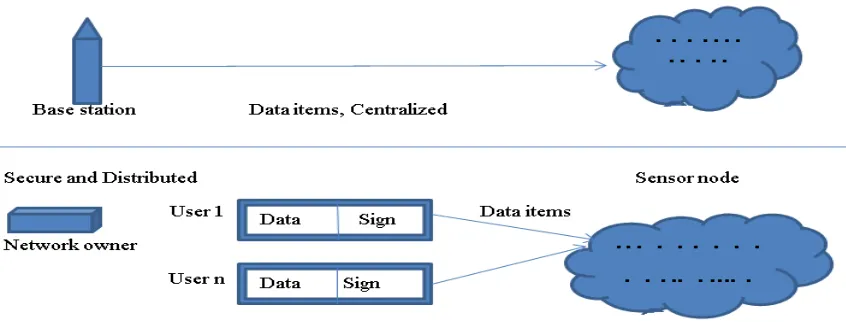
The Fig1 shows the architectural model of wireless sensor networks. This can be deployed in above environments for particular applications. In consists a network of sensor nodes forms the WSN network and Data items, base station, different users. The sensor node has memory, energy and bandwidth which make to participate actively. There are two approaches one is Centralized and Distributed. In centralized approach, the base station is responsible for sending information but it faces with a problem of single point of failure (SPOF). As base station is only one, if it fails every other modules won’t work.
Fig 1: Line separating Distributed and centralized View.
II. RELATED WORK
In[1] author proposed protocol. The protocol finds vulnerability in discovery and dissemination of information. Such vulnerability adversary updates like critical sections and denial of service. The protocol is based on assumptions like data disseminate at the source. At base station it is not compromised & is trust worthy but base station has unlimited computational power.The sensor node performs limited number of cryptographic operations.The protocol depends on Merkle hash concept. The function is divided into three layers. For equivalent to Merkle concept, there is puzzled approach.
In[2] author developed protocol called SDD. First secure and dissemination protocol. It is built, keeping in mind the security. As it is for multi-owner multi-user. It allows network owners to authorize for data to users disseminate the data. The SDD has information flows fromnetwork user to sensor node. It has four phases. Those are system initiation phase, user joining phase, Packet pre-processing phase and Sensor verification phase. The delay is reduced.
In[3] author try to find some features to add into traditional WSNs.Those are Communication, Resource, physical compromise of body networks and Mobility. For encryption one way key hash chains is used. The whole protocol functionality is divided into three phases.
In[4] author developed the protocol which satisfies features like distributed, authentication and integrity of data items, scalability etc. He valuated the protocol and analysed the same. He built several models which are Network model, Trust model and Threat model. The protocol functionality is divided into four phases. Those are system initiation phase, user joining phase, pre-packet processing phaseand packet verification phase.
III. METHODOLOGY
A. SDDISWSN
1. System initiation phase
There will be parameters like p, q are randomly initialized. From these p, q variables the Private key and
Public key will be derived. The p, q will be prime numbers. Likewise system initializes the variables Prk, Puk..
2. User joining phase
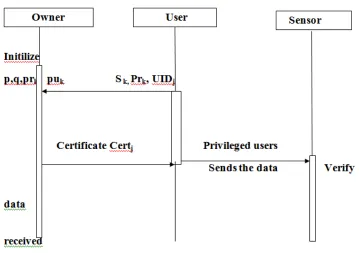
The user produces the user identification, and private key to the network owner. The owner accepts it. The user will join the phase is called as user joining phase. The owner replies with certificate. This certificate enables authentication.
3. Packet Pre-processing phase
Each packet will be signed then called as Data items. The construction of data packets forms the data items. By using hashing technique, the processing of data items takes place. Maintaining the original data is the purpose of packet pre-processing phase.
4. Packet Verification phase
The privileged sends the data to the sensor. The sensor verifies with the help of digital signatures.
IV.PSEUDO CODE
Step 1) Initialize p, q with prime numbers. Step 2) Calculate Private key, public key.
Step 3) With UID,SK, Private Keyrequest for registrationto network owner.
Step 4) On registration, the owner sends certificate to the user. Step 5) Using digital signature the packet pre-processing will be done.
Step 6) On reaching sensor node the packet will be verified and data will be updated. Step 7) End
V.RESULTS AND DOCUMENTATION
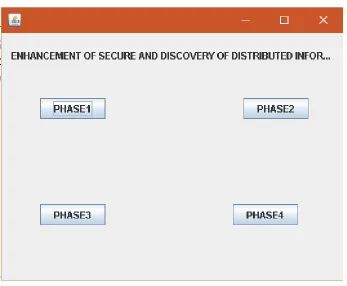
The enhancement of securediscovery of distributed information spreading in wireless sensor networks(SDDISWSN) is done through 4 phases. These phases are divided according to functionality. The Fig. 3 discusses about the same. On clicking phase1 the system initiation phase will be activated i.e. initiation of prime numbers p, q will be started. Same for all phases it will be done. That equivalent function will be performed.
The above Fig 3 Shows four buttons each has different functionality. Phase1 is the initializing the prime numbers. Similarly other phase’s different functionality. Let us see one by one. It is RSA approach which forms private key and public key is combination of numbers, special characters and letters etc.
Fig 4: Private key
It is obtained by prime numbers p, q and alphanumeric character. On initiation of variables p,q the initiation phase is over. This is unique for each data transmission.i.e. in Fig 4.
Fig 5: Public key
Similarly as that of private key, it same for is public key. The combination of Private key and Public key is unique. The two key has exponent has modulus and exponent parts and similarly has a length of 1024 bits.
Fig 6:Certificate
Fig 7: Digital Signature
The Fig 7 shows the signature i.e. digital signature. The signature is used for signing the data. Those will be signed data items which will move to destination in wireless senor networks. The digital signature is used to check data integrity. Whatever the data is to be sent, that should not be modified. To detect this data integrity, the digital signature holds good.
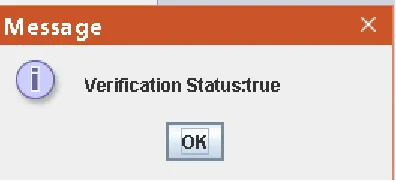
Fig 8: Verifying status
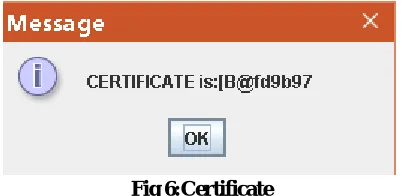
The above screen shots all are pertaining to SDDISWSN protocol. First the private key and public key is created. Then user with these values sends to owner. The owner will accept it and sends the certificate. This will be treated as authentication. Using digital signature packet verification will be done. If it is no changed then the status will be true.
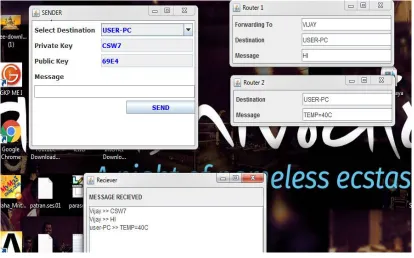
At router1 Vijay and at USER-C. it needs to select the user which are listed in the router2 if router1 is source. On selecting, there is button called continue. On clicking the continue button the information will be sent.
Fig 10: Selection of Router1 and Router2
VI. CONCLUSION
The protocol, Secure and data Discovery of Distributed Information& Spreading in WSNs (SDDISWSN) implements public key cryptography, it concludes that, security is ensured. i.e. Authentication is proved by issuing Certificates and Data integrity is proved by RSA approach to digital signature. The computation cost is high but communication is very good.
REFERENCES
1. Daojing He, Sammy Chan, Shaohua Tang, and Mohsen Guizani “ Secure Data Discovery and Dissemination based on Hash Tree for Wireless Sensor Networks” IEEE TRANSACTIONS ON WIRELESS COMMUNICATIONS, VOL. 12, NO. 9, SEPTEMBER 2013
2. S.Velmurugan, Dr. E. Logashanmugam on “Secure and Distributed Data in Wireless SensorNetwork”, 2nd International Conference on Current
Trends in Engineering and Technology, ICCTET’14
3. Daojing He, Sammy Chan, Yan Zhang,andHaomiao Yang, “Lightweight and Confidential Data Discovery andDissemination for Wireless Body Area Networks” IEEE JOURNAL OF BIOMEDICAL AND HEALTH INFORMATICS, VOL. 18, NO. 2, MARCH 2014
4. Daojing , He,Sammy Chan, Mohsen Guizani , Haomiao Yang, Boyang Zhou “Secure and Distributed Data Discovery and Dissemination in Wireless Sensor Networks”, IEEE TRANSACTIONS ON PARALLEL AND DISTRIBUTED SYSTEMS, VOL. 26, NO. 4, APRIL 2015
BIOGRAPHY
Pattanashetti Vijay Irannais a final year M.Tech student. Pursuing M.Tech from University BDT college of Engineering, Davangere(Constituent college of VTU, Belagavi) His Interests are Computer networks, Algorithms, Security and Android.