ABSTRACT
HICKS, ANDREW GREGORY. Design Tools and Data-Driven Methods to Facilitate Player Authoring in a Programming Puzzle Game. (Under the direction of Tiffany Barnes.)
Games-Based Learning systems, particularly those that use advances from Intelligent Tutoring Systems (ITS) to provide adaptive feedback and support, have proven potential as learning tools. Taking their lead from commercial games such as Little Big Planet and Super Mario Maker, these systems are increasingly turning to content creation as a learning activity and to better engage a broader audience. Existing programming puzzle games such as Light-Bot, COPS and Gidget allow users to build their own puzzles within their games. However, open-ended content creation tools like these do not always provide users with appropriate support. Therefore, player-authors may create content that does not embody the core game mechanics or learning objectives of the game. This wastes the time of both the creator and of any future users who engage with their creations. Better content creation tools are needed to enable users to create effective content for educational games.
A significant barrier to using user-authored problems in learning games is the lack of expert knowledge about the created content. Many Games-Based Learning systems take cues from ITS and use expert-developed contextual hints and content for individualized support and feedback. Data-driven methods exist to generate hints and estimate which skills particular problems may involve, but these methods require sufficient data collection and knowledge engineering to turn prior student work into hints. No prior work has shown that data-driven methods can be used within a programming game. In addition, data for user-generated levels may be very sparse, so evaluation is needed to determine if these methods can be used in this domain.
In this work, I present a set of best practices for designing authoring tools that encourage users to build gameplay affordances into their content. First, I show that requiring users to solve their own levels effectively filters some of the least desirable puzzles, including deliberately impossible or unpleasant levels. Next, I show that the quality of user-authored BOTS puzzles can be improved using level editors designed with these practices. Furthermore, I show that hints and feedback for this content can be created using data-driven methods. I also provide estimates of the amount of data needed to provide adequate hint coverage for a new level using this method. Combined, these findings form an effective framework for integrating user-authored levels into the BOTS game and provide an example of how to build a game from the ground up with user-generated content in mind.
© Copyright 2017 by Andrew Gregory Hicks
Design Tools and Data-Driven Methods to Facilitate Player Authoring in a Programming Puzzle Game
by
Andrew Gregory Hicks
A dissertation submitted to the Graduate Faculty of North Carolina State University
in partial fulfillment of the requirements for the Degree of
Doctor of Philosophy
Computer Science
Raleigh, North Carolina
2017
APPROVED BY:
James Lester David Roberts
Roger Azevedo Tiffany Barnes
BIOGRAPHY
ACKNOWLEDGEMENTS
TABLE OF CONTENTS
LIST OF TABLES . . . vii
LIST OF FIGURES. . . ix
Chapter 1 Introduction. . . 1
1.1 Research Questions . . . 3
1.1.1 Research Question Q1 . . . 3
1.1.2 Research Question Q2 . . . 3
1.1.3 Research Question Q3 . . . 4
1.2 Hypotheses . . . 4
1.2.1 Hypothesis H1 . . . 4
1.2.2 Hypothesis H2 . . . 4
1.2.3 Hypothesis H3 . . . 5
1.2.4 Hypothesis H4 . . . 5
1.3 Contributions . . . 5
1.4 Organization . . . 6
1.5 Terminology . . . 6
Chapter 2 Related Work . . . 8
2.1 Game Design . . . 8
2.1.1 Types of Gameplay and Players . . . 8
2.1.2 Gamification . . . 9
2.1.3 User-Generated Content in Entertainment Games . . . 12
2.2 Cyberlearning Systems . . . 14
2.2.1 Intelligent Tutoring Systems . . . 14
2.2.2 Novice Programming Environments . . . 15
2.2.3 Problem Posing in STEM Education . . . 16
2.2.4 User-Generated Content in Cyberlearning Systems . . . 18
2.3 User-Generated Content in BOTS . . . 21
Chapter 3 BOTS: A Serious Game For Novice Programmers . . . 23
3.1 Context . . . 23
3.2 Introduction . . . 23
3.3 Gameplay . . . 24
3.4 BOTS - Content . . . 26
3.5 Pre-Pilot Methods . . . 29
3.6 Pre-Pilot Data and Discussion . . . 29
3.7 Hypothesis & Pilot Evaluation Design . . . 31
3.8 Pilot Methods . . . 33
3.9 Pilot Results And Discussion . . . 33
Chapter 4 Filtering Low-Quality Submissions . . . 36
4.2 Methods . . . 36
4.2.1 Elements and Patterns of User Generated Content . . . 37
4.2.2 Puzzle Categorization . . . 40
4.2.3 Hypothesis and Evaluation Design . . . 45
4.3 Results and Discussion . . . 47
4.4 Conclusions . . . 51
Chapter 5 Generating Hints For A Serious Game . . . 55
5.1 Context . . . 55
5.2 Introduction . . . 55
5.3 Hint Factory . . . 56
5.4 Applying Hint Factory to BOTS . . . 57
5.4.1 State Representation in BOTS . . . 57
5.4.2 Interaction Networks . . . 58
5.4.3 Hint Selection Policy . . . 61
5.4.4 Data . . . 62
5.4.5 Analysis . . . 62
5.4.6 World States and Transitions . . . 65
5.5 Cold-Start Study . . . 67
5.5.1 Data . . . 67
5.5.2 Analysis . . . 67
5.6 Results . . . 69
5.6.1 State-Space Reduction . . . 69
5.6.2 Cold Start . . . 70
5.7 Discussion . . . 72
5.8 Conclusions . . . 73
Chapter 6 Gameplay Affordances . . . 75
6.1 Context . . . 75
6.2 Introduction . . . 76
6.3 Background . . . 77
6.3.1 Gameplay Affordances . . . 77
6.3.2 Level Editors . . . 79
6.4 Data . . . 81
6.5 Methods and Results . . . 82
6.5.1 Expert and Naive Solution Generation . . . 82
6.5.2 Overview of Level Score Improvement . . . 82
6.5.3 Direct Measurement of Improvement . . . 83
6.5.4 Expert Tagging . . . 86
6.6 Discussion . . . 89
6.7 Conclusions . . . 90
Chapter 7 Effectiveness of Gameplay Affordances . . . 91
7.1 Data . . . 91
7.3 Results . . . 93
7.4 Conclusions . . . 96
Chapter 8 Conclusions and Future Work. . . 97
8.1 Review . . . 97
8.2 Research Questions . . . 97
8.3 Hypotheses . . . 97
8.4 Contributions . . . 98
8.5 Research Question Q1 . . . 98
8.6 Research Question Q2 . . . 99
8.7 Research Question Q3 . . . 100
8.8 Hypothesis H1 . . . 100
8.9 Hypothesis H2 . . . 100
8.10 Hypothesis H3 . . . 101
8.11 Hypothesis H4 . . . 101
8.12 Conclusions . . . 101
8.13 Future Work . . . 104
BIBLIOGRAPHY . . . .106
APPENDICES . . . .119
Appendix A . . . 120
A.1 Tests and Surveys . . . 120
A.1.1 Game Engagement Questionnaire . . . 120
A.1.2 Demographic and Player Preference Questionnaire . . . 121
Appendix B . . . 123
B.1 Pre-pilot and Pilot Notes And Data . . . 123
LIST OF TABLES
Table 4.1 Number of students in each condition . . . 47
Table 4.2 Number of levels by tag, and mean quality score . . . 48
Table 4.3 Number of levels with a particular score, by condition . . . 49
Table 4.4 Looks Completable tag, by condition . . . 49
Table 4.5 Completable via Naive Solution tag, by condition . . . 49
Table 4.6 Improved via Loops or Functions tag, by condition . . . 50
Table 4.7 Contains Obvious Patterns tag, by condition . . . 50
Table 4.8 Naively Completable tag, by condition . . . 51
Table 4.9 Expertly Completable tag, by condition . . . 51
Table 4.10 Tags for levels under each condition, by publication status . . . 52
Table 4.11 Number of levels with a particular score (published) . . . 52
Table 4.12 Looks Completable tag, by condition (published) . . . 53
Table 4.13 Completable via Naive Solution tag, by condition (published) . . . 53
Table 4.14 Improved Via Loops or Functions tag, by condition (published) . . . 53
Table 4.15 Contains Obvious Patterns tag, by condition (published) . . . 53
Table 4.16 Naively Completable tag, by condition (published) . . . 53
Table 4.17 Expertly Completable tag, by condition (published) . . . 53
Table 5.1 Results of hint generation for single-player puzzles . . . 63
Table 5.2 Breakdown of Tutorial Puzzles in BOTS . . . 68
Table 5.3 Singleton Code and World States . . . 69
Table 5.4 Hint Coverage using World States, for 30 students . . . 71
Table 6.1 Count Model comparing new editors to baseline (filtered) . . . 84
Table 6.2 Zero-inflation Model comparing new editors to baseline (filtered) . . . 84
Table 6.3 Count Model comparing new editors to baseline (unfiltered) . . . 85
Table 6.4 Zero-Inflation Model comparing new editors to baseline (unfiltered) . . . 86
Table 6.5 Level Category Tags, by editor . . . 87
Table 6.6 Count Model, including tutorial completion . . . 88
Table 6.7 Zero-inflation model, including tutorial completion . . . 88
Table 7.1 Simple regression model for Condition vs. Difference in student solutions . . . 94
Table 7.2 Regression model after adding all relevant terms . . . 94
Table 7.3 Regression model after adding all relevant terms . . . 95
Table 7.4 Improved model for Condition vs. Difference in student solutions with author tutorial completion . . . 96
Table B.1 Pre-Pilot Level Notes . . . 123
Table B.1 Pre-Pilot Level Notes Continued . . . 124
Table B.1 Pre-Pilot Level Notes Continued . . . 125
Table B.1 Pre-Pilot Level Notes Continued . . . 126
Table B.1 Pre-Pilot Level Notes Continued . . . 127
Table B.3 Pre-Pilot Level Tags . . . 128
Table B.4 Pilot Level Notes . . . 129
Table B.4 Pilot Level Notes Continued . . . 130
Table B.5 Pilot Tag Legend . . . 130
Table B.6 Pilot Level Evaluations . . . 131
Table B.7 Pilot Student Responses . . . 131
Table B.8 Pilot Gameplay Data . . . 132
LIST OF FIGURES
Figure 3.1 BOTS Example Puzzle . . . 25
Figure 3.2 The level select menu. . . 26
Figure 3.3 Clicking the prompts on the right side of the level editor brings up additional listings of levels. Players looking to improve their overall medal count may find new levels to beat here. . . 27
Figure 3.4 BOTS Level Editor . . . 28
Figure 4.1 This puzzle has a clear trivial solution. . . 37
Figure 4.2 The BOTS interface. . . 38
Figure 4.3 Puzzle with obvious structural cues for optimization of the solution. . . 39
Figure 4.4 Puzzle with misleading or distracting structural cues. . . 41
Figure 4.5 Puzzle with an obvious but tedious best solution. . . 41
Figure 4.6 An example “sandbox” puzzle. . . 42
Figure 4.7 An example “power-gamer” puzzle. . . 43
Figure 4.8 An example “griefer” puzzle. . . 44
Figure 4.9 An example “trivial” puzzle. . . 45
Figure 4.10 One of the acceptable submitted but unpublished levels. . . 54
Figure 5.1 An example of the interaction network of a BOTS puzzle. . . 58
Figure 5.2 This figure shows the corresponding code from the above solutions. . . 59
Figure 5.3 Multiple different programs resulting in the same outcome. . . 60
Figure 5.4 Six of the generated hints for a simple puzzle. . . 64
Figure 5.5 These graphs show the overall performance of hint generation for code states and world states. . . 70
Figure 5.6 This graph summarizes Figure 5.5 by averaging the results of the cold-start analysis over the first four challenge puzzles. . . 71
Figure 5.7 A screenshot of challenge 1. . . 73
Figure 5.8 A screenshot of challenge 4. . . 74
Figure 6.1 The Programming editor interface. . . 79
Figure 6.2 The Building-Blocks editor interface. . . 80
Chapter 1
Introduction
As they become increasingly culturally relevant, games are being looked to as a way of improving education. Game-based learning systems are said to provide intrinsic engagement that contributes to their efficacy[Pre03; Gee07; Sha06]. Well-designed learning games allow students to work on meaningful, motivating tasks and to practice skills. Garris, Ahlers, and Driskell classified the factors that are important to games’ effectiveness for learning, identifying motivation to play and to play again as key features of the best-designed and most effective instructional games[Gar02].
CHAPTER 1. INTRODUCTION
as Mayer found, there is also a substantial amount of research where these gains are not shown. One explanation for why a game may fail to achieve the same learning gains as a traditional assignment is the extrinsic cognitive processing hypothesis. The mechanisms, story, and controls of the game, where they do not align with the learning goals, may add too many other elements for students to keep track of. The addition of game elements may thus result in cognitive overload. This was hypothesized to be the case by Mayer in his writing about the games Crystal Island and Cache-17 [Ada12; Spi11; Koe08].
Although they may have significant benefits for students, educational games can be costly to build, particularly in terms of expert time. In the Intelligent Tutoring Systems (ITS) literature, it is estimated to take around 300 hours of expert time to develop an hour of educational content for an ITS[MA02]. This estimate is insufficient for Serious Games, for several reasons. First, additional content must be developed in the form of game assets, including graphics, sounds, and other game elements. Second, additional time must be spent teaching users the mechanics, interface, and controls of the game, as well as explaining the parallels between the game and the target content. Finally, additional expert time is needed to ensure that the underlying game design aligns with the target content and does not distract from it. Many Serious Games projects are developed by small research teams with limited resources, as opposed to the larger teams available to entertainment software developers. Because of this, many Serious Games are relatively short, often comprising a single assignment’s worth of educational content.
1.1. RESEARCH QUESTIONS CHAPTER 1. INTRODUCTION
1.1
Research Questions
One strategy that may mitigate the high cost of content creation while delivering learning benefits and the ability to replay for practice is to allow users to create content in ITS and Serious Games. In addition to its usefulness for improving a game’s longevity and replayability, content creation has been shown to have significant motivational benefits, appealing to players that current gamification approaches fail to address. Boyce et al. showed that adding a creative gameplay element such as level design within a Serious Game could increase learning gains and improve motivation while appealing to players with diverse motivations to play games[Boy14]. Problem-posing systems such as Animal Watch and MONSAKUN[BB08; Hir07]demonstrated the educational potential of content creation activities. However, in order to include the designed content for reuse with future players, it must be of sufficient quality, both in terms of gameplay and educational value. If user-authored content fails to address the educational target concepts, then any time users spend playing it is effectively “off-task” time. If user-authored content is uninteresting from a gameplay perspective, users will simply not play it.
To evaluate the potential for user-authored content, I developed a game called BOTS that builds upon previous game-like novice programming environments like Logo, Light-Bot, and Scratch. By investigating user-authored content in this game, I gained insight into the broader possibilities for user-generated content in educational games and systems. The research questions guiding this work are as follows:
1.1.1 Research Question Q1
Research question Q1 is “How can non-expert student authors create high-quality levels that afford and reward the use of core mechanics in BOTS?” To answer this question I first collected and analyzed user-created levels in a simple version of the game. Based on insights from this analysis, I made iterative changes to the level editor to encourage the inclusion of “gameplay affordances” and use of advanced gameplay mechanics from later players.
1.1.2 Research Question Q2
1.2. HYPOTHESES CHAPTER 1. INTRODUCTION
a building-block based system that uses pre-built level segments to a “deep gamification” based editor that uses the main game’s mechanics. Each approach had different effects on the presence of “gameplay affordances” that afford and reward the use of the game’s core mechanics.
1.1.3 Research Question Q3
Research question Q3 is “How can existing data-driven methods for knowledge discovery and feed-back generation from Intelligent Tutoring Systems be applied to brand new user-authored levels?” To answer this question, I first adapted the Hint Factory algorithm to open-ended programming puzzles. Then, I evaluated hint coverage for several BOTS puzzles to determine how much data is needed so that hint generation works for about 80 percent of user states.
1.2
Hypotheses
To answer my research questions, I conducted a sequence of experiments evaluating different designs for the level editors available in BOTS and iteratively developed the level editor in BOTS based on the insights from each experiment. My hypotheses for these experiments are as follows:
1.2.1 Hypothesis H1
Hypothesis H1 is “Asking authors to provide solutions to their levels before publication will increase the quality of published levels and reduce the number of submitted problems with trivial, tedious, or non-existent solutions.” H1 is supported by work in Chapters 3 and 4. I conducted experiments with two versions of the game, with different level submission mechanisms, and compared the levels created by measuring the presence or absence of qualities of trivial, tedious, or non-existent solutions.
1.2.2 Hypothesis H2
1.3. CONTRIBUTIONS CHAPTER 1. INTRODUCTION
1.2.3 Hypothesis H3
Hypothesis H3 is “Authoring tools designed with creative constraints will result in authors more frequently creating levels that afford the game’s core mechanics, when compared with the original free-form authoring tool.” H3 is supported by work in Chapter 6. I developed two new level editors for BOTS based on existing methods of gamifying content creation. I then compared new levels created in these editors to levels created in previous editors, based on the presence of “gameplay affordances” in the levels as measured by the difference between expert and naive solutions.
1.2.4 Hypothesis H4
Hypothesis H4 is “Levels that contain these gameplay affordances will more frequently contain correct use of the game’s advanced mechanics in players’ solutions.” H4 is supported by work in Chapter 7. I ran an experiment where new players solved the levels created in the new level editors. I then measured how well a level’s “gameplay affordances” predicted whether observed player solutions would use an advanced game mechanic.
1.3
Contributions
By synthesizing data-driven methods from Intelligent Tutoring Systems and current research into Gamification and Game Design, I designed a system to accomplish my stated goals. With BOTS as a case study, I also developed design principles that will help future developers effectively inte-grate user content creation into Serious Games and other game-like cyberlearning systems. The contributions of this research are as follows:
1. BOTS, itself; a serious game for novice programmers that supports user-generated levels via a gamified level editor. This will be the first such system, as well as the first such system for novice programmers.
2. A novel application of Intelligent Tutoring Systems methods for knowledge discovery and hint generation to user-authored levels, and evaluation of the amount of data needed to effectively cover a user-authored problem in BOTS.
1.4. ORGANIZATION CHAPTER 1. INTRODUCTION
1.4
Organization
The remainder of this chapter presents the terminology used throughout the dissertation. Chapter 2 outlines the literature that guides the design choices for BOTS and the related work in intelligent tutoring systems, education, and games. Chapter 3 describes the BOTS game and a pilot study to learn more about what kinds of content players make when given the opportunity. Chapter 4 describes an experiment to investigate the impact of moderation types on the kinds of puzzles that players create, and provides puzzle classifications and feature tags that are used to describe (primarily undesirable) features in user-generated puzzles in the remainder of the work. Results from Chapter 4 led to implementing self-moderation, where players must solve their own puzzles before they are published, for all puzzles in BOTS. Chapter 5 illustrates that data-driven methods can be used to generate hints for user-generated puzzles in BOTS. Chapter 6 introduces two new level editors, the Programming and Building-Blocks editors, and shows that these design changes did encourage players to create more desirable content while they design levels. Chapter 7 shows that levels with higher potential for reduced lines of code actually result in more player solutions using loops and functions. Of particular interest is that the level editor type did not impact whether players solved puzzles using loops or functions. Instead, the combined potential for reducing the lines of code in the solution and the presence of obvious visual and structural cues was more predictive of whether solutions contained loops or functions. Chapter 8 reviews the research questions, confirms support for my hypotheses, and highlights the contributions of this work. Chapter 8 also provides direction for future work in BOTS and design recommendations for promoting effective user-generated content in learning games.
1.5
Terminology
The research terms used in this dissertation are defined here:
• Level
Puzzle: In this document,LevelandPuzzlerefer to individual exercises in the BOTS game.
• Level Editor: In this document, aLevel Editoris an in-game tool that can be used by players to create levels.
1.5. TERMINOLOGY CHAPTER 1. INTRODUCTION
• User-Generated Content: In this document (and in reference to BOTS),User-Generated Con-tentor UGC refers exclusively toLevelsgenerated by students.
• Puzzle Game: In this document,Puzzle Gamerefers to a single-player game where that player solves distinct stand-alone problems using discrete steps, with different solutions having varying degrees of success.
• Core Mechanics: In this document, aCore Mechanicrefers to the central idea of the game, and the mechanism players use to act upon that idea within the game. For BOTS, the Core Mechanic is optimizing programs through correct use of loops, subroutines, conditionals, and variables.
• Affordance: In this document, a level contains anAffordancefor a core mechanic if performing that core mechanic within that level improves a player’s score, and that level contains structural cues to communicate appropriate places for players to perform that core mechanic.
• Creative Constraint: In this document, aCreative Constraintrefers to a constraint imposed upon the author by the system, with the goal of encouraging or discouraging specific types of creative behavior. For example, a limit on the number of operations is a creative constraint that may encourage authors to build more optimally or to omit unnecessary structures.
• Naive Solution/Expert Solution: In this document, aNaive Solutionto a given level is a solution that only makes use of the basic movement blocks, without taking advantage of loops or functions. Such a solution may indeed follow the shortest physical path to the goal. Conversely, anExpert Solutionis a solution taking full advantage of loops and functions. Such a solution may not always follow the shortest physical path to the goal, but will use a smaller number of instructions than the Naive Solution.
Chapter 2
Related Work
In this chapter, I outline my motivations for investigating the potential of content-creation gameplay in Game-Based Learning (GBL) environments, both as an engaging gameplay mechanism and as an effective content-creation tool. To do so, I draw upon previous work from the fields of Game Design and Intelligent Tutoring Systems.
2.1
Game Design
2.1.1 Types of Gameplay and Players
To motivate the use of content creation as a gameplay activity, I look to the field of Ludology, and the game definitions that Ludological researchers have employed.
In his book Homo Ludens, Huizinga defines a game as “A voluntary activity or occupation exe-cuted within certain fixed limits of time and place, according to rules freely accepted but absolutely binding, having its aim in itself and accompanied by a feeling of tension, joy, and the consciousness that it is ‘different’ from ‘ordinary life’ ”[Hui55].
In his work on play, Caillois defines two different types of play: Paedic play and Ludic play. Paedic play can be generally described as ’make-believe’ play, loosely structured with freely shifting objectives. Ludic play involves constraining systems of rules and objectives, and can be thought of as “game play.” For Caillois, nearly all games fall under the category of ludic play. Caillois further classifies games into four categories.
• agôn, contests and competitive games
2.1. GAME DESIGN CHAPTER 2. RELATED WORK
• mimesis or mimicry, detailed simulations
• ilinix (or vertigo), games of escapism or reckless abandon
Of these four categories of games, only one is specifically focused on competition.
In work classifying player types, researchers like Bartle and Yee found that if conflicts are in fact crucial to games, there still exist players who prefer other types of play experiences[Bar96; Yee06]. Bartle defines four types of players, Socializers, Explorers, Achievers, and Killers.
• Socializers, who seek to tell stories of the game and build relationships with its players
• Explorers, who seek to explore the game’s systems and accumulate knowledge
• Achievers, who seek to gain status and overcome the game’s prescribed challenges
• Killers, who seek to overcome the game’s rules, and the other players
Of these, only Killer-type players are primarily motivated by direct conflict. Using Bartle’s types as a base, Yee defines ten motivators for players in online games: Advancement, Socializing, Discovery, Mechanics, Relationships, Role-Playing, Competition, Teamwork, Customization, and Escapism [Yee06]. Of these ten motivators, only one explicitly identifies a competition, with the others high-lighting other aspects that serve to draw players in.
In their anthology Rules of Play, Salen and Zimmerman provide a somewhat more formal defi-nition of a game: “A game is a system in which players engage in an artificial conflict, defined by rules, that results in a quantifiable outcome”[SZ04]. Both Caillois and Huizinga’s definitions, and Bartle and Yee’s taxonomies of player motivations, reject the core idea that Salen and Zimmerman explicitly include: the idea of conflict as central to ‘game-ness’. Game Design scholars have argued, variously, whether a defined conflict is crucial for games, but in popular mainstream digital games like Minecraft and The Sims[Moj11; Max00], conflicts, where present, are often challenges devised and self-imposed by the players, and not constructed by the game. This suggests that approaches to Serious Games/Game-Based Learning (GBL) design that focus on conflict and competition may fail to adequately engage some segment of their audience. Including additional styles of play in GBL, such as creative play through authoring and sharing of content, may help address this weakness.
2.1.2 Gamification
2.1. GAME DESIGN CHAPTER 2. RELATED WORK
Det13], the process of introducing game-like elements into a system for motivational purposes has found hold beyond its original scope, with games or gamified systems being created for fitness, budgeting, time management, and employee training. Many of the motivations behind gamification align with those for Serious Games.
In Deterding’s work, Gamification (or Gameful Design) is defined as “the use of Game Design elements within non-Game contexts.”[Det11b]. Alternately, Kapp’s definition of this term is “using game-based mechanics, aesthetics and game thinking to engage people, motivate action, promote learning, and solve problems.”[Kap12]. Developers of gamified systems seek to harness the incentive structures present in games to motivate users to complete otherwise tedious tasks. In Serious Games or GBL, the motivation for using a game or game-like system is typically to better engage users, with the aim of increasing learning gains or improving general attitudes towards the system or learning content.
Kapp goes further in delineating two sub-types of Gamification: Structural Gamification and Content Gamification. Structural Gamification (also referred to by Nicholson as “BLAP” gamification) [Nic12]is a method that leaves the content unchanged but “wraps” it in game elements such as badges, level progressions, achievements, and leaderboards. Gamification of this type, as currently practiced, tends to focus on disconnected reward and competition, aspects of games and play that will frequently fail to appeal to many types of players[Rob10a].
Content Gamification, in comparison, is a process that makes the content more playful via the addition of elements such as fantasy, challenge, or choice. Content-oriented approaches to gamification, such as Boyce’s “Deep Gamification,” tie motivating game elements directly to the practice of the game’s learning objective. Additionally, less mechanically focused ways of “gamifying” systems as outlined by authors like Nicholson and Boyce when discussing “Meaningful Gamification” [Nic12]or “Deep Gamification”[Boy14], respectively, can effectively engage not only competitively-oriented players, but also creatively-competitively-oriented players.
In their work, Krause et. al define another subtype, Social Gamification[Kra15]. In addition to the game-like elements above such as badges and leaderboards, Social Gamification includes social network-based gameplay similar to popular social games on mobile devices and services like Facebook. In the system the authors developed, players were able to choose an opponent they knew for a match, rather than playing against a random opponent. This element significantly increased retention, measured by the number of lessons a user completed. Users in the Social Gamification condition also had increased post-test scores, although users did not take a pre-test so this comparison is limited.
2.1. GAME DESIGN CHAPTER 2. RELATED WORK
selected tasks that are difficult for computers but relatively easy (if perhaps mundane) for humans. These tasks were then situated in a game-like framework to encourage participation and better performance from users. In “The ESP Game,” for example, players collaboratively tagged images based on their contents, with only the tags they agreed upon being accepted. This visual recognition task was considered somewhat difficult to solve from a machine learning point of view, but simple for a human. Each player’s performance was evaluated based on their ability to tag the given image with the same term as a remote human partner without communicating directly. The most commonly given terms were listed alongside the image, and could not be repeated by either player. This clever twist made the task more engaging while ensuring that tags suggested by players were more likely to be novel but recognizable elements of the image. Von Ahn’s other GWAP projects focused on tasks like language translation and identifying important regions of images. With these systems, gamification was used to provide fun and enjoyment as a “compensation” of sorts for accomplishing an otherwise tedious and unpleasant task.
However, the game mechanics added to such systems do not need to be as clever as in the ESP Game in order to motivate users. Simply adding point values to tasks in such systems has been shown to increase participation within the system[Mek13]. In Mekler et al., users performed an image-tagging task under one of four conditions. The first condition was a simple control task, with no intervention. The second was a task with a meaningful frame: that participants’ contributions would advance science by helping develop image-recognition software. The third condition was a task with a simple point reward, awarding 100 points per tag. The fourth condition combined framing and point rewards. The authors found that point rewards increased the number of tags submitted, and that when rewards were combined with framing, users were more deliberate in their tag creation, spending more time on the task. Both points and framing served to increase motivation to a similar degree, with no marked increase when both factors were combined. However, adding point rewards alone had no effect on the actual quality of tags submitted, while adding a framing device did increase the quality.
Gamification often focuses on competitive elements like points, badges, and leaderboards that encourage users to compare achievements in the system. The core idea is that users will want to achieve and retain a higher position than their friends or peers. They are therefore motivated to continue with the gamified activity whenever there is a threat of losing standing. This process is outlined in the “Gamification Loop” defined by Liu et al.[Liu11], which consists of six sequential stages:
• Challenge
2.1. GAME DESIGN CHAPTER 2. RELATED WORK
• Rewards
• Badges
• Leaderboards
• Social Status
However, the benefits of this model of gamification are fragile. The motivation can only persist within the gamified system, while the player actually cares about their standing on the leaderboard, and while they feel that their standing is threatened. If that motivation weakens players will no longer exhibit the same degree of motivation to participate.
Somewhat counter-intuitively, rewards (particularly performance- or completion-based re-wards) can actually decrease motivation and performance when improperly or carelessly applied [Dec99; Dec01; BK12]. Despite frequently being treated as “intrinsic” rewards that make the gamified activity more engaging, rewards from Structural Gamification are only intrinsic to the game elements of the system, and are extrinsic from the core task. This suggests they may be subject to the negative motivational effects outlined in Deci et al.’s metaanalysis of extrinsic rewards[Dec99]. The authors considered 128 different experiments, concluding that extrinsic rewards had a substantially negative effect on intrinsic motivation for interesting activities. Their analysis indicated that adding extrinsic rewards had a negative motivational impact on participants who were already engaged with the task. One weakness of the meta-analysis is that few of the studies reliably measured the fundamental “interestingness” of their underlying task, for example, via participant persistence in the activity
during a free choice period.
Similarly, Kathleen Tuite wrote that in systems where the “fun” of the game is provided as compensation for performing an otherwise distasteful task, learning the game and learning the task are placed at odds with each other. Specifically, users tend not to continue using the system or performing the task when given a choice when extrinsic rewards are provided and then discontinued. This results in games with reduced efficacy at both entertaining and teaching[Tui14].
2.1.3 User-Generated Content in Entertainment Games
2.1. GAME DESIGN CHAPTER 2. RELATED WORK
where players can bring customized avatars into shared worlds. More advanced content creation tools can be seen in many games, with tools like Little Big Planet’s level creator[Med08], Trackmania’s track creator[Nad04], or The Sims’ online repository of user-created objects[Max00]. User-generated content (UGC) is a boon for these games, allowing for a much wider array of content than could feasibly have been built by the development team. Additionally, users’ creativity may lead them to explore areas outside of the “expert blind spot,” creating experiences that subvert the game’s mechanisms or combine them in new and unexpected ways. For example, Super Mario Maker levels frequently make use of unusual interactions between objects never placed together in official Mario games. In both Mario Maker and Little Big Planet, players create movie-like narrative experiences despite the limited tools offered by the platformer level creator[Nin08; Med08]. Elaborate mini-games have been built by users in Minecraft through clever use of the game’s physics and “redstone” circuitry[Moj11].
One example of a successful commercial game focused on user-generated content is Nintendo’s “Super Mario Maker” for the Wii U[Nin08]. In this game, players can create levels for one of four 2-dimensional Super Mario titles using a free-form tile-based editor. When the game launched, only simple editing tools were unlocked from the beginning. As players created levels, new “shipments” of more advanced level elements were added to the interface, gradually increasing the complexity as players became more familiar with the tool itself. This slow unlocking process was derided by critics and expert users[McE15], and Nintendo swiftly released a patch drastically reducing the amount of time needed to unlock each new set of game elements by linking the unlocking process to the total number of objects placed. After the patch, players quickly learned that building a level completely full of coins would accelerate the unlocking rate. Luckily, players did not have to actually upload their coin-hoard levels to the game’s database in order to earn the rewards. This replicated a common gamification pitfall in a content creation tool; the best way of earning rewards did not align with the best (or most desirable) way of building levels.
2.2. CYBERLEARNING SYSTEMS CHAPTER 2. RELATED WORK
review from the Washington Post called the game “an engine for circulating horrible levels” based on “bad ideas and broken gimmicks”[Tho15].
It is clear that user-generated content systems must provide some form of quality control, or be overrun by hastily created, poor-quality content. Heavily UGC-based games like Little Big Planet and Spore[Med08; Max08]have designed solutions such as limiting the number of “upload slots” an individual user has, or allowing the community to vote on whether a creation is useless or offensive. However, this approach requires that unwanted content be shown to at least some users whose judgment is trusted and whose participation will continue. This may be acceptable for some applications of collaborative filtering, (movie reviews, online marketplaces) but it is undesirable for an educational tool.
Within games research, there is existing work examining how expert and novice level designers create levels, and on designing tools to assist or mimic these creators. Hullett and Whitehead described common features of levels in FPS-style entertainment games using a pattern language, and demonstrated the usefulness of such taxonomies[HW10; Hul]. This approach was then applied to describe design patterns in other genres of games such as RPGs and FarmVille-likes. These patterns were also used as objectives for procedural level generation[Smi11c; Lew12; DT13].
Procedural Content Generation (PCG) has been widely explored in the research as a solution to the same replayability problem, in educational games such as Refraction as well as entertain-ment games[Smi12; MM10; Tog10]. Tools like Tanagra and LaunchPad integrate PCG with human authoring tools, resulting in levels focused on certain objectives while retaining authorial control over the final product. To achieve this hybrid design, Tanagra constructs parts of levels in between key features specified by the author, while Launchpad procedurally generates platformer levels in direct response to player actions[Smi10; Smi11a; Smi11b].
2.2
Cyberlearning Systems
2.2.1 Intelligent Tutoring Systems
2.2. CYBERLEARNING SYSTEMS CHAPTER 2. RELATED WORK
student’s learning, presenting content that is difficult for the student to solve, while also providing the scaffolding necessary for them to solve it. This system of scaffolding that fades as the learner becomes more competent mirrors the use of flow in effective game design, as discussed earlier. An effective system should present content and feedback based on an estimation of the user’s needs and abilities, challenging them without being too frustrating.
Existing ITS often use expert-authored rules and evaluations of content and difficulty to help make these adaptations[And95]. However, building these systems takes a great deal of time and expert knowledge needed from content experts, instructional designers, and software engineers [Mur03; Bay09]. Murray estimated a 300-to-1 ratio of expert hours to hours of content for Intelligent Tutoring Systems. For systems implementing user authored or procedurally generated content, this is not feasible, since an expert would need to be continually on hand to annotate new content.
Data-driven approaches like the Hint Factory created by Stamper and Barnes[Sta08]use histori-cal data (in particular, traces of solutions to problems) to facilitate the creation of hints for future users. This allows for personalized feedback to be provided to students even on content that experts have not analyzed. In software that uses Hint Factory, as users work on problems their actions are used to build a data structure similar to a Markov Decision Process called an Interaction Network. Work by Eagle et al., defines an Interaction Network as a complex network containing data about student-tutor interactions[Eag12]. Hints can be generated from this data structure by searching the Interaction Network for users with the same or similar solution path. Based on the previous users’ actions, a potential next step can be suggested. If no user has succeeded on that path before, the system can suggest the current user try a different approach. Work by Barnes, Stamper, Eagle, and Mostafavi showed this to be a very successful way of automatically generating hints, and a Hint Factory enabled version of the Deep Thought logic tutor has been used in logic classes at UNC Charlotte and NC State University since 2001[Sta08].
2.2.2 Novice Programming Environments
2.2. CYBERLEARNING SYSTEMS CHAPTER 2. RELATED WORK
must overcome while learning the fundamental concepts of computer programming. Drag-and-drop programming interfaces are increasingly being used to introduce novices to programming, with younger students as well as in early university courses[Har14; RH12; Ker08]. Research with these environments found that while students perceived the block-based programming activity as less “authentic” compared with its text-based counterpart, they also perceived it as easier and as more fun, even when the assignments’ content was the same. Additionally, students using a block-based environment were more likely to complete assignments when compared with programming in a text-based but still scaffolded environment[WW15; PB15].
Scratch is a popular novice programming environment developed at the MIT Media Lab[Res09; ML07]. Though initially targeted at a middle-school audience, in particular youths at after-school centers in economically disadvantaged communities, Scratch has since been effectively used by the author of this work (among others) as a language for first-time programmers in introductory courses. Scratch also features a “community” site where users can share programming tips and post their projects for others to “remix.”[MHH10; Hil10].
Other environments that focus on a similar audience, and that have similar social computing goals, include the Scratch follow-up Snap[Bar12], the storytelling environment Alice[Coo00; Kel07], and Kodu GameLab by Microsoft Research[SF11], among others. These efforts have a common focus: to teach programming concepts in an environment that minimizes the syntactical errors learners can make, helping instructors focus their instruction on the core concepts rather than on syntax errors and typographical mistakes. Reducing the burden of learning new syntax has been shown to be a useful approach to teaching programming. In work with the Pre-programming Analysis Guided Programming tutor (PAGP), Jin et al. removed syntactical hurdles in favor of a focus on the core programming concepts at work[Jin08]. Students first completed a planning/analysis exercise where they organized the problem steps into sequential chunks and identified relevant variables. Using this tutor helped students avoid several common novice programming errors such as asking for input where it is not needed, or using ‘return 0’ when a value is needed.
2.2.3 Problem Posing in STEM Education
2.2. CYBERLEARNING SYSTEMS CHAPTER 2. RELATED WORK
restating problems in new ways, and identifying gaps in the author’s knowledge[Cre03]. At the same time, problem posing has been shown to increase motivation when compared to purely solving problems presented by others[DC00; Eng97]. This engagement effect is especially prominent in students who had not previously shown enthusiasm to learn math and science[Hir07].
Problem posing is a useful activity in several ways. First, problem-posing as an activity has roots in models of learning like self-directed learning and inquiry-based learning, and engages students in different ways than traditional problem-solving. Problem posing activities may also help students develop meta-cognitive skills by requiring them to think about how they would solve the problem they have posed, and how changes they make to their problem will affect the solution process. Finally, problem-posing may increase engagement and help alleviate anxiety, especially in cases where they believe their problems will be useful[Eng97].
Problem posing has been acknowledged as important to math education. In their publication of the Principles and Standards for School Mathematics, the National Council of Teachers of Math-ematics argued that students should be formulating problems, extending problems, and posing follow-up questions[Mat00]. In his overview of the research into the topic in the field of mathematics education, Silver noted that traditional psychological measurements of creativity often include a problem-posing component[Sil13].
In a study performed by Silver in 1997, 509 middle-school students were tasked with creating problems, followed by a test composed of eight questions on varying math topics, with answers and justifications required. In this study, students were first given a list of information, for example: “Jerome, Elliot, and Arturo took turns driving home from a trip. Arturo drove 80 miles more than Elliot. Elliot drove twice as many miles as Jerome. Jerome drove 50 miles.” Then students were prompted to supply three questions that could be answered from the information given. Questions were first categorized as mathematical questions, non-mathematical questions, or statements. Then, the mathematical questions were classified as solvable or not solvable. This final set of problems were then evaluated based on linguistic features to determine their complexity. In this study, nearly 80% of the students generated a mathematical question, and more than half generated only mathematical questions. More than 90% of these were solvable. Although 60% of the questions fell into the simplest linguistic complexity category (only using assignment propositions, questions like “How many?” rather than “How many more?”) 60% of the problems were also classified as mathematically complex, requiring the solver to examine two or more relationships between variables. Students tended to create questions whose responses depended on answers to prior questions, with simpler problems leading into harder ones.
2.2. CYBERLEARNING SYSTEMS CHAPTER 2. RELATED WORK
results of a problem posing experiment[AA10]. Students were asked to create a very specific type of problem, one whose solution involved adding the specific values 1/2 and 2/3. By examining the created problems, the authors were able to identify specific misconceptions common among their students (such as 1/2+2/3=3/5).
2.2.4 User-Generated Content in Cyberlearning Systems
Chi posited that one reason human tutors are so effective is that working with a human tutor creates opportunities for external construction[Chi01]. Examples of external construction include forming hypotheses or posing examples or analogies. Problem posing activities may also fall under this category. Some researchers have looked into ways of potentially alleviating the content bottleneck in ITS using user-authored problems, while others seek to implement problem-posing for the educational benefits rather than for the purposes of content generation.
Gehringer investigated student-generated learning exercises and found that student exercises were not conclusively better or worse than expert-generated exercises[GM09]. However, when students generated game-like activities as exercises, the self-reported learning of students decreased while enjoyment rose[GM09].
Work by Aleahmad et al. showed that non-expert users are competent content creators, often able to provide more understandable problem descriptions than self-described experts[Ale08]. The authors also expected that content creators would create higher-quality content when creating content targeted for a fellow user. While this was not shown to be the case, the users who created content for other users were more engaged in the content creation process than users creating content with no specific goal. They spent more time creating material and added more specific details to their problem descriptions. Though the content they created was not judged to be of higher quality from an educator’s perspective, it was not evaluated whether that content was of higher quality from a target user’s perspective.
Williams et al. created a “learnersourcing” system AXIS[Wil16]that asked learners to generate, revise, and evaluate explanations for future learners. The system then used a machine learning algo-rithm similar to existing recommendation systems to dynamically determine which explanations to present. Their results showed that this process elicited helpful explanations and enhanced learning when compared to a control condition. Additionally, the quality of crowd-sourced explanations did not differ from explanations generated by an experienced instructor.
2.2. CYBERLEARNING SYSTEMS CHAPTER 2. RELATED WORK
changes led to improved quality of peer assessments[Geh10; Geh16].
In their work, Repenning and Basawapatna defined the “Flow of Inspiration” principles necessary for successful social computing environments[Rep09; BR10; Bas10]. An environment adhering to these principles should:
• Display projects in a public forum
• View and run fellow students’ projects
• Provide feedback on fellow students’ projects
• Download and view code for any project
• Provide motivation for students to view, download, and give feedback on fellow classmates’ projects
Repenning was inspired by students’ interest in YouTube and Facebook to create a socially-oriented system called Scalable Game Design Arcade where students could create, maintain, and share living copies of their projects with others, as opposed to working on individual assignments discarded upon completion. In this system, students used a visual programming language called AgentSheets to develop and share simple copies/variations on classic video games. These students could leave feedback and ratings on each others’ submissions, and could borrow ideas from other players’ projects through a process similar to remixing. The Scalable Game Design Arcade formalized the sharing process to help track the flow of ideas between peers and discourage plagiarism. Students could download the full source of a peer’s project, modify it as they like, and re-upload it as their own.
2.2. CYBERLEARNING SYSTEMS CHAPTER 2. RELATED WORK
Animal Watch[AW03; BB08]is a pre-algebra tutor with an exotic animals theme. The tutor covers topics such as finding average, median, and mode, and conversion between units. Even though the tutor contains about 1000 developer-authored problems, the system can “run out” of appropriate problems to give a student, especially if those problems are selected problems to match a student’s proficiency. The developers studied student content creation in two studies: a pilot in 2003 and a follow-up in 2008. The pilot investigated student attitudes towards problem posing. This initial pilot had only six students. Students were excited about sharing content with their peers, and proud that their content would be online and accessible to others. At the same time, students felt that they didn’t learn much from the activity, and felt that it was easy once they got started. Additionally, the students were using an authoring interface meant for teachers, with little in the way of scaffolding or support. The authors provided examples of buggy student-created problems, such as one problem intending to calculate “175+175” but that asked “If one eagle can fly 175 miles an hour, how fast can two fly?” These types of problems illustrate the need for support during the authoring process, and filtering before created problems are shown to other users.
To further investigate this, a new interface was designed and a follow-up study was performed in 2008[BB08]. In the follow up study, 24 students enrolled in a STEM summer camp created problems based on a worksheet. Researchers then asked them to solve and rate the problems created by their peers. Based on the success of the paper intervention, a module was added to the AnimalWatch system to facilitate problem posing within the system. Using this module, students could select data about any species in the system, choose the math skills involved in the problem, and write a problem using the data and skills they selected. Students enjoyed the activity and felt that it helped them learn, and were able to create usable problems with little expert modification. However, most of the student-authored problems were below the level of the concurrent classroom work. For example, some student problems focused on simple whole-number arithmetic rather than the rational numbers and pre-algebra they were learning in class. The authors suggested that additional scaffolding might be needed to help students create problems for topics they are currently studying or struggling with. There was no formal evaluation of learning gains with respect to the authoring activity in this study.
2.3. USER-GENERATED CONTENT IN BOTS CHAPTER 2. RELATED WORK
and created an average of 5.2 problems each. The teachers using the system observed increased student motivation, and believed that the system encouraged higher-order thinking.
Even very simple problem-posing interventions have been shown to be more effective in a social or gamified framing. Chang showed that when students’ problems from an earlier problem-posing activity were to be used later in a simple quiz game, low-performing students learned more from the activity, and students in general reported higher engagement[Cha12].
Many successful Serious Games include content creation as a feature, if not a core element of the gameplay. For example, Armor Games’ Lightbot[Yar08]contains a level editor that allows players to create and share simple programming problems[Gou13]. In work with Bead Loom Game, Boyce et al. showed that including puzzle creation as another path to the game’s core concept enhanced motivation for players less interested in competition[Boy11]. Allowing users to create their own challenges is a very powerful motivator, according to research on design patterns for educational games identified by a team led by Plass at Microsoft Research. She wrote that effective educational games take advantage of the fact that “constructing things is fun and helps learning,” and that “a social component (collaboration, competition) makes games fun/engaging[PH09].”
The idea that constructing things is useful for fun and learning did not originate here, nor with Papert, but his definition of constructionism (as opposed to Piaget’s constructivism) and the groundwork laid out in LOGO and carried forward through StarLogo and Scratch among others [Res96; Res09]embodies the idea well. In his own words, “Constructionism shares contructivism’s view of learning as building knowledge structures through progressive internalization of actions[but] adds the idea that this happens especially felicitously in a context where the learner is consciously engaged in constructing a public entity, whether it’s a sand castle on the beach or a theory of the universe”[PH91].
2.3
User-Generated Content in BOTS
My approach with BOTS differs from existing approaches to scaffolded or gamified content-creation in ITS and educational games. MONSAKUN provides expert-authored building blocks for problem posing, but lacks game-like constraints designed to implicitly encourage specific design elements. AnimalWatch and Teach Ourselves provide framing devices in the form of story/theme elements and social elements, respectively, but neither of these is integrated into content creation. Instead, the user interacts with the story and social elements before and after the content creation. In BOTS, game-like elements are integrated with content creation, rather than being wrapped around it.
2.3. USER-GENERATED CONTENT IN BOTS CHAPTER 2. RELATED WORK
already mastered. Approaches that forced students to focus on the skills of interest were more successful, both at generating appropriate difficulty problems and at helping educators understand students’ skill levels and misconceptions. BOTS provides students with gamified constraintsduring
Chapter 3
BOTS: A Serious Game For Novice
Programmers
3.1
Context
This chapter describes the game design and specific gameplay mechanics in BOTS. Later chapters all use the same gameplay log format and definitions given in this chapter. Here I present my pre-pilot work that examines the first batch of user-generated levels to find common patterns in their designs. These findings motivated game design changes, as well as my first research question Q1 and hypothesis H1:
• Q1: How can non-expert student authors create high-quality levels that afford and reward the use of core mechanics in BOTS?
• H1: Asking authors to provide solutions to their levels before publication will increase the quality of published levels and reduce the number of submitted problems with trivial, tedious, or non-existent solutions.
3.2
Introduction
3.3. GAMEPLAY CHAPTER 3. INTRODUCTION TO BOTS
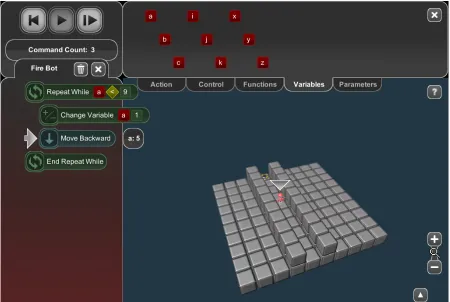
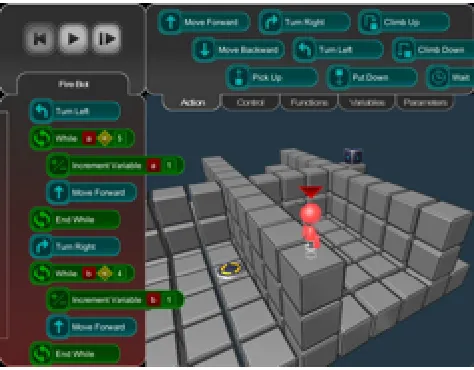
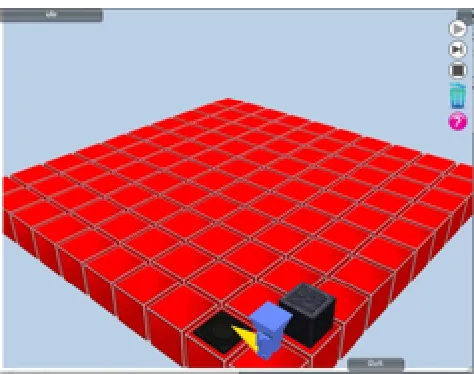
programmers writing code to navigate a simple robot around a grid-based 3D environment, as seen in Figure 3.1. The goal of each puzzle is to press several switches by placing objects or the robot on them. To program the robots, players use simple graphical pseudo-code allowing them to move the robot. Players can also repeat sets of commands using loops, and re-use entire chunks of code using functions. Each puzzle can limit the maximum number of commands, as well as the number of times each command can be used. For example, in the tutorial levels, a user may only use the “Move Forward” instruction 10 times. Within each puzzle, players’ scores depend on the number of commands used, with lower scores (and a lower number of commands to solve the same puzzle) being preferable. This encourages players to determine how to program the robot more efficiently. For example, it will be more efficient to make the robot walk down a long hallway by using a loop to repeat a single “Move Forward” instruction rather than to simply use several “Move Forward” instructions. The game’s constraints and scoring are meant to encourage players to re-use code and optimize their solutions.
In addition to the tutorial/“Story” mode, BOTS also features a “Free Play” mode, with a selection of puzzles created by other players. The game, in line with the “Flow of Inspiration” principles outlined by Alexander Repenning[Rep09], provides multiple ways for players to share knowledge through authoring and modifying content. Players are able to create their own puzzles to share with their peers, and can play and evaluate friends’ puzzles, improving on their own past solutions. The goal of this approach in BOTS is to create an environment where players can continually challenge their peers to find consistently better solutions for increasingly difficult problems.
3.3
Gameplay
3.3. GAMEPLAY CHAPTER 3. INTRODUCTION TO BOTS
Figure 3.1An example puzzle in BOTS. On the left is the robot’s program. A pointer indicates the current instruction being executed and a window describes the current state of the variables in use. Along the top of the screen are the controls for the game, as well as the toolbox containing the instructions. In this level, the robot must move backwards down a hallway. The most straight-forward solution requires nine instructions, but this user has managed to use only 3.
3.4. BOTS - CONTENT CHAPTER 3. INTRODUCTION TO BOTS
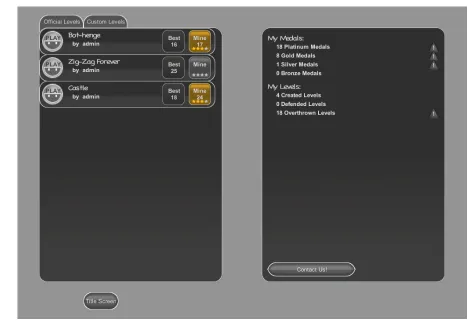
Figure 3.2Next to each level, the current best score is displayed, as well as the player’s best score. Based on how well their score compares to the ideal, players are assigned various medals.
used multiple times within a program, the user may be able to reduce their total lines of code by moving those lines to a function and calling the function instead.
Within BOTS, users are able to create new levels as well as solve levels other users have created. After a user completes a level, the solution is scored with Platinum, Gold, Silver, or Bronze based on their comparison to the current ‘best’ solution. This means that if a better solution is found, users’ medals may decrease in value, encouraging them to revisit the level and discover more optimizations for their programs.
3.4
BOTS - Content
3.4. BOTS - CONTENT CHAPTER 3. INTRODUCTION TO BOTS
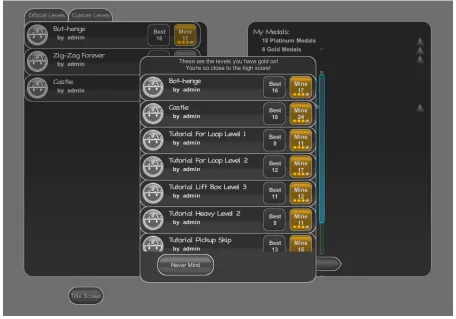
Figure 3.3Clicking the prompts on the right side of the level editor brings up additional listings of levels. Players looking to improve their overall medal count may find new levels to beat here.
• Loops and Iteration (know what the arguments are to a for loop, know how to use a for loop to repeat a command or set of commands, and know when it is appropriate to use a loop to solve a problem)
• Functions and Code Re-use (know when it is appropriate to create a function, notice opportu-nities for code re-use)
• Variables (know how variables work with loops, know how to use a variable to produce different results with the same code)
• Optimization (notice opportunities to make a solution shorter, and given a solution or set of instructions, point out ways to make the instructions simpler and cleaner)
3.4. BOTS - CONTENT CHAPTER 3. INTRODUCTION TO BOTS
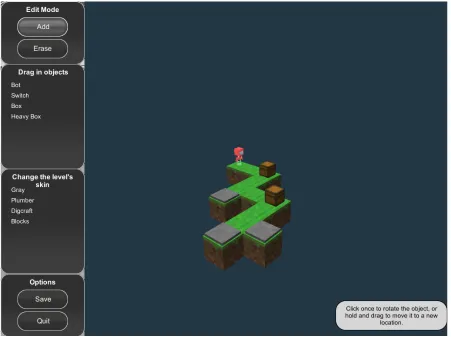
Figure 3.4The basic level editor interface in BOTS, featuring one of the available skins. Players click the edges of blocks to add new ones, using an interface similar to the popular game Minecraft. Players drag objects out of the toolbar to add them to the level.
• Conditionals (levels can have multiple parts that must be completed independently)
• Recursion (functions can be nested recursively but there is little reason to do so. With different types of puzzles this behavior could be made more useful.)
3.5. PRE-PILOT METHODS CHAPTER 3. INTRODUCTION TO BOTS
3.5
Pre-Pilot Methods
To begin my investigation into the use of user-generated content with this game, I deployed BOTS as part of a STEM workshop during multiple sessions over June 2011 at UNC Charlotte. The gameplay data collected was anonymized, so information about specific players or sessions is not available. As part of the workshop activities, participants had already used GameMaker and BeadLoom Game, other tools and activities that teach similar concepts (graphical programming and iteration, respec-tively).
During this study, each student was instructed to complete the tutorial section of the game, with guidance from the teachers. Afterward, students could complete “Free Play” levels designed by the game’s designers, complete “Custom Levels” created and shared by peers, or create new levels of their own. Creating (or playing) custom levels was completely optional during this study. Students were instructed that the best newly-created levels would be considered for inclusion in the game’s Free Play mode. After the activity’s completion, I analyzed the created levels, made informal notes on them, and selected some levels for inclusion in the game.
During gameplay, BOTS recorded two types of user logs: the User Program Log (containing the instructions the user has selected for the program) and the User Interaction Log (containing all of the user’s interactions with the GUI). These logs contained data about student solutions to existing problems. I analyzed this data to determine when and how often students used the more difficult commands such as while loops, function calls, and variable operations.
Overall, 15 students created 37 levels during the course of this workshop. To examine the created levels, I played each level, made informal notes on it, then marked whether or not the level should be kept for the next iteration of the game. After this process, I examined the compiled levels and notes, and identified common features.
3.6
Pre-Pilot Data and Discussion
Of the 37 levels created during this workshop, several exhibit common features, both desirable and undesirable. The most prominent are listed here. The notes on each created level and a recording of whether it contains each selected feature or was selected to include in the game’s next iteration, are shown in Appendix B. Only 10 of the 37 levels were selected for inclusion in the next iteration of the game.
3.6. PRE-PILOT DATA AND DISCUSSION CHAPTER 3. INTRODUCTION TO BOTS
that the robot will not interact with. Instead, an irrelevant structure forms a shape such as a maze, castle, or skyscraper. In fact, these levels are often named after the structure they contain.
The second most common feature, identified in 29 levels, isirrelevant objects. These are extra boxes that are not needed for the solution. Most commonly, this occurs in levels with a single box and a single goal. Since the goal can be activated by the robot itself, the box is unused.
The next most common feature, identified in 14 of the levels, isvision-blocking terrainused to hide a goal, box, or robot from vision when the level loads. In this initial version of BOTS, the camera was centered on the robot, so hiding an object from vision in this way is an effective way to prevent completion of the level.
On a related note, 3 levels were identified as featuringblank terrainwhere no change was made to the basic 10x10 floor present in the base level of the editor.
The next three categories are closely related. 11 each of the levels were identified as eithertrivial
orimpossible without loops or functions. The version of BOTS used in this activity imposed limits on the number of lines of code and the number of times a single line of code could be repeated. Therefore, some larger levels were actually impossible to solve. The definition of trivial used here was initially vague, so during the secondary analysis of these levels, I adopted a more rigorous definition. A level is trivial if the level can be solved using fewer than 3 unique lines of code. Three levels were identified asimpossible or self-solvingmeaning either the goal is unreachable, no goal is present, or the robot starts on top of the only goal. These levels cannot be played.
Finally, only 13 of the created levels were found to containpatterns or visual cuesfor places where loops or functions could be employed. These levels account for 8 of the 10 levels selected to be included in the next iteration.
The high ratio of low difficulty content is expected. Previous work with problem-posing activities found that a relatively large proportion of generated content will be too easy, spam-like, unwanted, or unusable[Sil13; BB08]. This pattern also holds true for UGC-centric games such as Super Mario Maker[Nin08]and Little Big Planet[Med08]. Many criticisms of these games called out the large number of trivial, malicious, or irrelevant levels[McE15; Tho15; Her15].
3.7. HYPOTHESIS & PILOT EVALUATION DESIGN CHAPTER 3. INTRODUCTION TO BOTS
3.7
Initial Hypothesis and Pilot Evaluation Design
Based on the observed patterns I decided to implement some changes in the level creation process specifically targeting these negative patterns. At the start of this research, I sought to investigate methods of filtering low-quality content out of the publicly-available user-created content pool for an educational game. Quality within entertainment games is subjective. However, in an educational environment, core learning objective and game mechanics that afford learning are important. As observed with the first iteration of BOTS, players often submit content that fails to create affordances for the game mechanics. These kinds of levels include sandbox attempts to discover what they are allowed to build, attempts to create frustrating levels, or attempts to create multiple very easy levels and solve them quickly to earn points. If this is permitted, the pool of available levels will become flooded with levels that fail to address the learning goals and fail to provide a fun experience for their players. Therefore I have specifically defined the following qualities that a level must have in order to be considered “passable”. These conditions are necessary, but not sufficient, for inclusion in the game.
First among these qualities is non-triviality. The best solution should not be an immediately apparent solution – a level’s layout should require at least three different kinds of actions, with repetition. An example of a level from the initial corpus that fails this criterion is a long hallway with a goal at the end, since it requires only two actions. Another example is a level with a goal immediately adjacent to the player’s start position. These trivial levels are unwanted because they are boring, they fill the list of levels, and they fail to address the learning goals of the game. Included in this category are levels with no goals, or no clear paths to a goal.
A second required quality is non-tediousness. The level must be completable in a reasonably short time, and have a solution that does not require an excessive number of commands. In BOTS, a level with many small irreducible tasks that are hard to simplify using a loop or function would fail this criterion. One example is a level with many straight hallways of different lengths where the lengths are not in an ascending or descending order that would facilitate using a loop. Another example of a tedious level failing this criterion is a level including scattered boxes and goals with no pattern to their placement. Both of these levels will take too long to complete, potentially causing players to lose engagement. In addition, since there are zero or few possible optimizations, these levels also do not address the learning goals of the game.