International Conference on Natural Products 2015
Full paper
Andrographolide from
Andrographis paniculata
Extract: Optimization of
Accelerated Solvent Extraction Technique.
Rabe’ah Adam, Mariani Abdul Hamid*
Instititute Bioproduct Development, Universiti Teknologi Malaysia, 81310 UTM Johor Bahru, Johor, Malaysia
*Corresponding author: [email protected]
Article history
Received :XXXXXXXX Received in revised form : XXXXXXXXXX Accepted :XXXXXXXX
Graphical abstract
Abstract
Andrographolide is main diterpenoid lactone isolated from Andrographis paniculata present mostly in the leaves and all part of the plant. It is widely use as pharmaceutical and nutraceutical formulation. In this study, andrographolide from Andrographis paniculata were extracted applying technique of accelerated solvent extraction (ASE). The extracts obtained were characterized by HPLC. The quantification method showed good linearity (r2= 0.9107) and precision (RSD < 5%) with low values of detection (LOD) and
quantification (LOQ) limits. A Box–Behnken design was used to correlate three independent variables (temperature, extraction time and number of cycles) with the amount of andrographolide extracted. The response surface methodology was applied to optimize the extraction of andrographolide by ASE. The optimal conditions were 80oC, 5 minutes and 2 cycle. The shorter time of extraction and the lower heat
energy used justify the ASE technique choice to characterize andrographolide from Andrographis
paniculata.
Keyword: Andrographis paniculata; andrograholide; ASE; Box–Behnken design; optimization
Abstrak
Andrographolide adalah lactone utama diterpenoid diasingkan daripada Andrographis paniculata
membentangkan kebanyakannya dalam daun dan bahagian tumbuhan. Ia secara meluas digunakan sebagai formulasi farmaseutikal dan nutraseutikal. Dalam kajian ini, Andrographolide dari Andrographis
paniculata telah diekstrak menggunakan teknik yang dipercepatkan oleh ekstrak pelarut(ASE). Ekstrak
yang diperolehi dicirikan oleh HPLC. Kaedah kuantifikasi menunjukkan kelinearan baik (r2= 0.9107) dan
ketepatan (RSD <5%) dengan nilai rendah pengesanan (LOD) dan kuantifikasi (LOQ) had. Reka bentuk Box-Behnken telah digunakan untuk mengaitkan tiga pembolehubah bebas (suhu, masa pengekstrakan dan beberapa kitaran) dengan jumlah Andrographolide diekstrak. kaedah gerak balas permukaan telah digunakan untuk mengoptimumkan pengekstrakan Andrographolide oleh ASE. Keadaan optimum ialah 80° C, 5 minit dan 2 kitaran. Masa yang lebih pendek daripada pengekstrakan dan penggunaan tenaga haba yang rendah telah menjadikan teknik ASE sebagai teknik yang wajar digunakan untuk mencirikan Andrographolide dari Andrographis paniculata.
1.0 INTRODUCTION
Andrographis paniculata which is known as King of Bitter is
mainly grown in South East Asia, China and India. In Malaysia, this plant is locally called Hempedu Bumi. Andrographis
paniculata leaf and stem have an extremely bitter taste.This
therapeutic herb is traditionally used for treating liver disorders, bowel complaints of children, colic pain, common cold and upper respiratory tract infection [1]. It was also claimed that the traditional application of this plant can treat allergy and inflammatory diseases[2].
In recent studies, Andrographolide known as major constituents is well incorporated with ethanol, methanol, acetone, acetic acid and pyridine and moderately incorporated with water and ether posses posses potential anti-inflammatory properties [3].
To extract and characterize the andrographolide from
Andrographis paniculata, Accelerated solvent extraction was
used in order to distribute medicinal properties from solid liquid extraction. ASE technique is basically an alternative extraction method because it uses high pressure and slightly higher temperatures that accelerates the extraction kinetics which provides higher extraction yields, less extraction time and lower solvent consumption [4].
The optimization of an extraction technique can be accomplished by using a Response surface methodology (RSM) to optimize the effects of processing parameters of extraction on the yield of Andrographis paniculata and a Box-Behnken design (BBD) for the optimization of analytical methods [5,6]. It showed a comparison between this design and composite central, three-level full factorial and Doehlert designs. These models were developed to get a good correlation between the input variables responsible for extraction and the output parameter (andrographolide content) of extraction from Andrographis paniculata.
In this study we focused on the optimization accelerated solvent extraction (ASE) techniques to improve the andrographolide characterization of Andrographis paniculata. It is done to evaluate Andrographolide content present in the leaves itself on whether it could be useful to improve isolation of andrographolide (colourless, bitter and crystalline diterpene lactone) by this newly developed extraction technique [7].
2.0 EXPERIMENTAL
2.1 Plant materials
The ground dried leaves of Andrographis paniculata were obtained from Herba Bagus Sdn Bhd, Johor. The ground
Andrographis paniculata was stored in a cool and dry
environment to prevent fungus growth.
2.2 Reagents
Purified water was prepared using Barnsted E-pure apparatus. Andrographolide standard was purchased from Sigma-Aldrich, 95% ethanol was purchased from QRëC Reagent Chemical.
2.3 Accelerated Solvent Extraction
The three gram ground dried leaves of Andrographis paniculata were extracted in absolute 95% ethanol as solvent using the ASE 100 Dionex System (Dionex Pty Ltd, Lanecove, 1595, NSW). Operating procedure was based on the built set up method 1 by Dionex with the following specifications and extraction conditions: Dionex Part No. 056780 Filter grade: D28, Size: 30mm; Temperature: 100ºC; Pressure: 1,500psi (10MPa); Heating time: 5 min; Static time: 5 min; Flush time: 60%; Purge time: 100s; Static cycle: 3; Total extraction: 30 min per sample [8]. The extracts were then filtered through a Whatman filter paper No. 1. The ethanol was evaporated using a rotary evaporator under vacuum (Biichi Rotavapor, Brinkman Company, Westbury, NY, USA). The concentrated aqueous extracts were dried in laboratory oven. The extract was dissolved in methanol (2 mL) and was filtered through a 0.45
μm filter prior to injection into the HPLC system.
2.4 Experimental design and Statistical analysis
Temperature, cycle number and time affect constituents extraction by ASE techniques. were studied using three factors, three level Box-Behnken response surface design. Process parameters, which affect the efficiency of ASE such as extraction temperature (60-100°C), Cycle number (1-3) and time (3-7 min) were investigated. Experiments (17 runs) were carried out in a single base block, of which three were replicates at the center point measuring experimental error. The level of independent variables studied and definition of dimensionless coded of the independent variables are given in Table 2. For statistical calculations, the independent variables were coded as A (coded temperature), B(coded cycle number) and C(coded time). The correspondence between coded and uncoded variables was fitted according to the linear equations showed in Table 1, which were deduced from their respective variations limits. The dependent variables were Y (andrographolide content, % w/w) .
Table 1
Process variables and their range
The experimental data were evaluated by response surface methodology using Design Expert 9. Effect of each independent variable to the response was fitted by polynomial quadratic equation, Eq. (1), which includes linear, interaction and quadratic terms:
Y = b0 + b1A+ b2B+ b3C+ b12AB+ b13AC + b23BC + b11A2
+ b22B2 + b33C2 (1)
where y is predicted response, b0 is the model constant, A, B, C
are independent variables (coded), b1, b2 and b3 are linear
coefficients, b12, b13 and b23 are cross product coefficients and
b11, b22 and b33 are the quadratic coefficients. Dependent
variables were optimized using Box Behken Design (BBD). Independent
variables
Unit Level
-1 0 1
Temperature (A) ºC 60 80 100
Cycle No (B) 1 2 3
3.0 RESULTS AND DISCUSSION
3.1 Mathematical modeling
In the present study, extraction yield of andrographolide was investigated according to BBD (17 batch experiments) and the results are shown in Table 2. Then, BBD experimental data are investigated using multi regression analysis namely the sequential model sum of squares (Table 3). From the results, second order polynomial equation was selected to represent the ASE extraction process, due to higher F-value with low p-value. The equation with coded factors was given below
Y = 24.95 − 0.74A + 0.74B + 0.68C − 4.19AB + 4.37AC
+ 2.03B2 − 3.65C2
(2) tab
where Y is extraction yield of andrographolide (% w/w); A, B and C are temperature, cycle number and extraction time respectively.
ANOVA results of the quadratic model in Table 4 indicated that the model equation derived by RSM could adequately be used to describe the extraction process under a wide range of operating conditions. As can be seen in Table 4, F-value of 13.11 implied the model was significant There is only a 0.05% chance that an F-value this large could occur due to noise. Moreover, each term in the model was also tested for significance.
Table 2
BBD experimental design with results
S. No A B C Y
1 80 3 3 22.60
2 80 2 5 25.08
3 100 1 5 31.44
4 60 3 5 32.16
5 100 2 7 25.33
6 80 2 5 25.08
7 80 2 5 22.21
8 100 2 3 15.13
9 60 2 3 27.27
10 80 1 3 21.57
11 80 2 5 23.93
12 100 3 5 24.21
13 60 2 7 19.99
14 80 2 5 25.95
15 60 1 5 22.64
16 80 1 7 22.04
17 80 3 7 24.61
Table 3
Sequential model sum of squares for extraction of yield of andrographolide
Source Sum of Squares df Mean Square F Value Prob > F Remarks
Mean 9947.01 1 9947.01
Linear 12.43 3 4.14 0.22 0.8775
2FI 147.22 3 49.07 5.32 0.0190
Quadratic 76.41 3 25.47 11.20 0.0046 Suggested
Cubic 7.56 3 2.52 1.21 0.4147 Aliased
Residual 8.36 4 2.09
Total 10198.97 17 599.94
Table 4
ANOVA result for extraction yield of andrographolide
Source Sum of Squares df MeanSquare F Value Prob > F Remarks
Model 229.46 7 32.78 13.11 0.0005 significant
A 4.43 1 4.43 1.77 0.2158
B 4.34 1 4.34 1.73 0.2205
C 3.66 1 3.66 1.46 0.2572
AB 70.22 1 70.22 28.08 0.0005
AC 76.41 1 76.41 30.55 0.0004
B2 17.41 1 17.41 6.96 0.0270
C2 56.26 1 56.26 22.50 0.0011
Residual 22.51 9 2.50
Lack of Fit 14.15 5 2.83 1.35 0.3956 not significant
Pure Error 8.36 4 2.09
Fig 1. Effect of extraction conditions on the andrographolide yield
(a
)
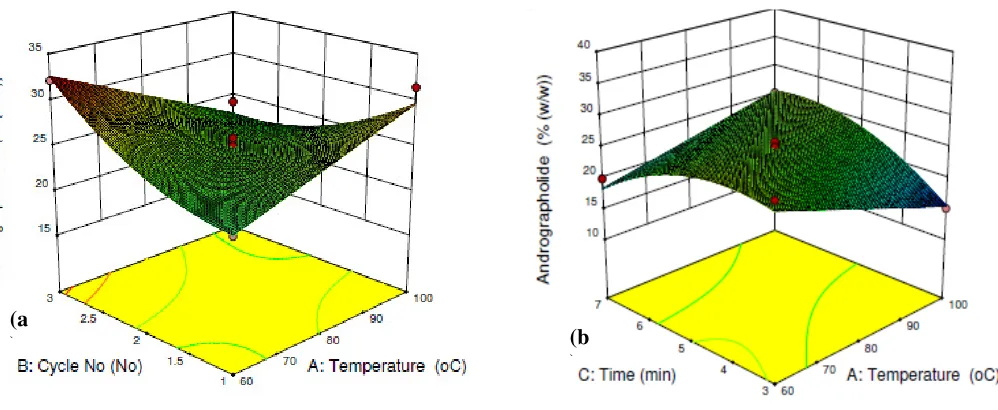
Fig 2. Response surface plots representing the effect of process variables on extraction yield
(b
)
(a
)
(b
A p-value less than 0.05 implies that the corresponding model term is significant. Moreover, individual and interactive model terms also shows the significance of the developed model.The "Lack of Fit F-value" of 1.35 implies the Lack of Fit is not significant relative to the pure error. There is a 39.56% chance that a large number of "Lack of Fit F-value" could occur due to noise. Non-significant lack of fit is good as we want the model to fit. The r2= 0.9107 shows the reproducible nature. In the present study, adequate precision value was obtained as >4, demonstrate a significant and intense correlation between the observed and predicted values. The actual and predicted pectin yields are plotted in Fig. 1.Actual values are data for each specific run from Table 3, and predicted values are produced by the model, Eq. (3). The data points on this plot lie reasonably close to the straight line and indicate that an adequate agreement between real data and the data obtained from the model [9].
3.2 Effect of extraction conditions on the andrographolide yield
In order to study the interactive effect of the process variables on the response, response surface contour plots are plotted from the developed mathematical model (Eq. (2)) and it is shown in Fig. 2. Temperature is one of the crucial parameters which influence the Fig extraction of andrographolide from Andrographis paniculata leaves. In order to investigate the effect of temperature on andrographolide yield, experiments were carried out in various power and the results are shown in Fig. 2(a). From the results, it is observed that, the andrographolide yield is increased linearly with increasing temperature to 100oC
due to the increasing linearity of cycle number from 1 to 3. Faster diffusion rates occur as a result of increasing the temperature of the extraction [10]. Diffusion rates have been shown to increase roughly upon increasing the temperature from 60°C to 100 °C.
Time is one of the important process variables for extraction of andrographolide and it is associated with the mass transfer effect. In order to examine its effect on extraction process, experiments were carried out in various extraction time and the results are shown in Fig. 2(b) and from the results, it is found that, the andrographolide yield is increased rapidly with increasing the time up to 5 min. However, lower andrographolide yield was showed after 5 min as the temperature decreasing linearly from 60oC to 100oC and it was
probably due to mass transfer effect. The use of longer time increases the capacity of solvents to solubilize analytes and improved mass transfer and, hence, increased extraction rates would result [11]. Perturbation plot for extraction yield of pectin is shown in Fig. 3 and it showed the effect of process variables on the extraction process deviation from reference point.
3.3 Multi response optimization
According to BBD results, optimal extraction conditions to obtain the maximum extraction yield of andrographolide from
Andrographis paniculata leaves is determined by Derringer’s
4.0 CONCLUSION
In the present study, extraction of andrographolide from
Andrographis paniculata leaves was investigated under
different extraction conditions such as temperature, cycle number and extraction time. Three factors at two levels BBD coupled with RSM were used to develop the second order polynomial model. Maximum extraction yield of andrographolide from Andrographis paniculata leaves was found to be as follows: temperature of 80◦C, cycle number of 2 and extraction time of 5 min. Under these optimal conditions, 25% of andrographolide was extracted. HPLC confirms the presence of andrographolide in Andrographis paniculata leaves crude extract. Results exhibited that ASE was found to be a suitable technique to extract the andrographolide from
Andrographis paniculata leaves.
Acknowledgement
The Universiti Teknologi Malaysia is thankful for the grant to Dr Mariani Abdul Hamid's project (R.J130000.7909.4H020) under NKEA Research Grant Scheme from Ministry of Agriculture and Agro-Based Industry, Malaysia (MOA) and also Ministry of Higher Education (MOHE) part of which enabled this review to be prepared. We are grateful for the contribution of all people involved in this paper preparation.
References
[1] Chao, W.-W. & Lin, B.-F., 2010. Isolation and identification of bioactive compounds in Andrographis paniculata (Chuanxinlian). Chinese medicine, 5:17.
[2] Chandrasekaran, C. V., Gupta, A. & Agarwal, A., 2010. Effect of an extract of Andrographis paniculata leaves on inflammatory and allergic mediators in vitro. Journal of
Ethnopharmacology, 129,: 203–207.
[3] Jayakumar, T. et al., 2013. Experimental and clinical pharmacology of andrographis paniculata and its major bioactive phytoconstituent andrographolide.
Evidence-based Complementary and Alternative Medicine, 2013.
[4] Li, Y. et al., 2010. Accelerated solvent extraction for GC-based tobacco fingerprinting and its comparison with simultaneous distillation and extraction. Talanta, 81: 650– 656.
[5] Balasubramanian, Sundar, James D. Allen, Akanksha Kanitkar, and Dorin Boldor. 2011. Oil Extraction from Scenedesmus Obliquus Using a Continuous Microwave System - Design, Optimization, and Quality Characterization.Bioresource Technology 102: 3396–3403. [6] Dong, C. H., X. Q. Xie, X. L. Wang, Y. Zhan, and Y. J. Yao.
2009. Application of Box-Behnken Design in Optimisation for Polysaccharides Extraction from Cultured Mycelium of Cordyceps Sinensis. Food and Bioproducts Processing 87: 139–44.
[7] Chen, Kexun, Wenhong Yin, Wencheng Zhang, and Jian Pan. 2011. Technical Optimization of the Extraction of Andrographolide by Supercritical CO2. Food and
Bioproducts Processing 89: 92–97.
[8] Rodríguez-Solana, Raquel, José Manuel Salgado, José Manuel Domínguez, and Sandra Cortés-Diéguez. 2014. Characterization of Fennel Extracts and Quantification of Estragole: Optimization and Comparison of Accelerated Solvent Extraction and Soxhlet Techniques. Industrial Crops
and Products 52: 528–36.
[9] Prakash Maran, J., V. Sivakumar, K. Thirugnanasambandham, and R. Sridhar. 2013. Optimization of Microwave Assisted Extraction of Pectin from Orange Peel. Carbohydrate Polymers 97: 703–9.
[10] Richter, Bruce E, Brian A Jones, John L Ezzell, and Nathan L Porter. 1996. Accelerated Solvent Extraction : A Technique for Sample Preparation. Anal. Chem. 68: 1033– 39.
[11] Callen, Herbert B. 1998. Thermodynamics and an Introduction to Thermostatistics, 2nd Ed. American Journal