Available Online at www.ijcsmc.com
International Journal of Computer Science and Mobile Computing
A Monthly Journal of Computer Science and Information Technology
ISSN 2320–088X
IMPACT FACTOR: 6.199
IJCSMC, Vol. 8, Issue. 9, September 2019, pg.147 – 154
Textual Feature Analysis and
Classification Method for the
Plant Disease Detection
Dilpreet Kaur
M. Tech CSE-4th
Email:- [email protected]
Under the supervision of
HOD (R&D)
Dr. S.K MITTAL
Email:- [email protected]
Introduction
Literature Review
Hase et al.[8] proposed a system used for the detection of plant diseases and classifies them using image processing technique. The main issue which was resolved by using the proposed approach was the early detection of the diseases. The approach reimburses the huge grasslands crops. The perception of human eye is not much accurate for the detection of infected plants. The diagnosis of the diseases at right time and place is very important. An android application is introduced which tells the cause and the solution of the diseases. In this method, the farmer observes the plant with their naked eyes and detects the diseases. This method is very time consuming and very expensive also. It requires the supervision of experts and it is very difficult to observe the crops in large farming areas.
kaur et al.[9]analyzed diseases caused due to fruit harvesting. A technique called image processing is used to analyze the degradation of the fruits and the crops. This analysis is based on the distortion of the crops and this distortion is detected using image processing in a very comprehensive manner. The analysis shows that approach is useful in detecting diseases within the fruits and this methodology requires very less time as compared to the other manual approach. As, the noises distorts the images so, the concept of denoising is also elaborated in this paper. The researchers concludes that the work done in this research shows that blight is very common diseases which is infecting many plants and crops.
Ranjith et al.[10] proposed a smart irrigation method which controls the irrigation supply automatically by using android application. Other than this the images are captured and forwarded to the cloud sever for further processing and compared with the infected plant images in the database. The diseases can be detected with the help of cloud server which helps the users to detect the diseases with the help of android phones from any desired location. One can control the entire irrigation system by a mobile application by using cloud server and solves the all the issues of irrigation. The irrigation system works according to the moisture content and the varying temperature. The application with the camera can be used to detect the affected part of the plant, by just capturing the photo of the affected portion and transferring them to the cloud server for further processing and detection of diseases.
Khan et al.[11] describes the machine vision framework and identifies the manifestation of plant diseases and analyzes the images in CIELab. The main objective of this purpose is to create a procedure for the detection of plant diseases by using cascading unsupervised image segmentation approaches. Additionally, RGB color model for digital images and CIELab color model for performing pre-processing step which increases the each channel timing. The researchers also introduced multilevel segmentation technique which uses expectation maximization with minimum constraint visual information loss. Various experiments were conducted and indicate that the new cascaded design outcomes a superior color segmentation with the confirmation of infected regions.
Dhaware et al.[12] proposed technique of image processing is used to discover and recognition of plant conditions. This approach provides a suggestion to the farmers for the improved framing techniques. Hence, the researchers concluded that the images of the infected plants should be captured by using mobile camera and forward it to the DSS without any additional modifications. Diseases are the major cause of reduction in agronomics in India. Farmers are facing many problems in controlling the diseases on crops and fruits. The detection of diseases at their early stages is very important task and it includes judicious diagnosis and appropriate supervision. In this paper, the researcher proposed a system which mainly focuses o the detection of plant diseases and recognition. It consists of four stages that is pre-processing, segmentation, feature extraction and classification. The researcher mainly focused on the image segmentation and classification of images.
Problem Statement
1. Issues in existing system:
The existing work is done by use of GLCM, SVM and k-mean methods are very time consuming for detects the diseases. the
analyze that SVM classifier has high complexity due to which execution time is high and low accuracy low for the
prediction analysis. GLCM algorithm is applied to analyze the text features and multiclass SVM classifier is used to classify the diseases. The basic GLCM algorithm is does not contruct the co-occurrence matrix in the efficient manner due to which textual features are not analyzed accurately. applied
2. Solution with proposed system:
The proposed or research work is based on the plant disease detection. The plant disease detection technique is based on the segmentation, feature extraction and classification. The performance of the proposed algorithm is compared with existing in terms of accuracy and execution time. The proposed Naïve bayes algorithmic rules has high accuracy and low execution time than SVM algorithm .
OBJECTIVES
1.
To study and analyze GLCM and multi-class SVM based technique for plant disease detection.
2.
Design plant disease prediction technique based on law textural and Naïve bayes classifier.3.
Implement proposed system and compared with existing in terms of accuracy, execution time.Modules
Multi classification technique is used in here
K-mean clustering is used for image segmentations.
Apply law textural features for the textural features detection.
Apply proposed Naïve Bayes technique for the display most prediction output as disease name, execution time and high accuracy.
Research Methodology
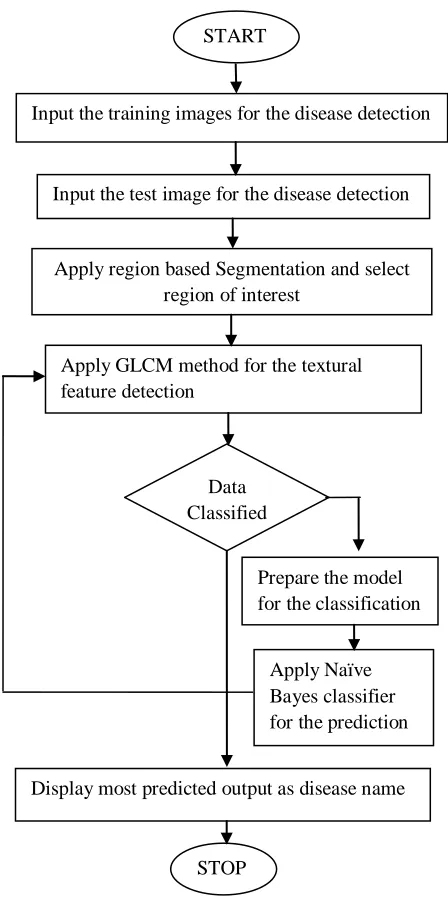
Figure 1: Proposed Flowchart
The stages depicted in the presented Flowchart are given below:
Stage 1: In the primary stage, the training pictures are used in the form of input for the identification of plant infection.
Stage 2: In the secondary stage, the characteristics of the training pictures are retrieved and amassed in the folder
Stage 3: The test picture is utilized as input and descriptions of the picture are retrieved by law texture algorithm in the third START
Input the training images for the disease detection
Input the test image for the disease detection
Apply region based Segmentation and select region of interest
Apply GLCM method for the textural feature detection
Data Classified
Prepare the model for the classification
Apply Naïve Bayes classifier for the prediction
Display most predicted output as disease name
Stage 5: In the last step, the Naïve bayes classifier is implemented in the final stage for the classification of the test picture into distinct classes in accordance with training set.
Experimental Results
To implemented the proposed technique in MATLAB and the results are evaluated by making comparisons against proposed and existing techniques in terms of different parameters.
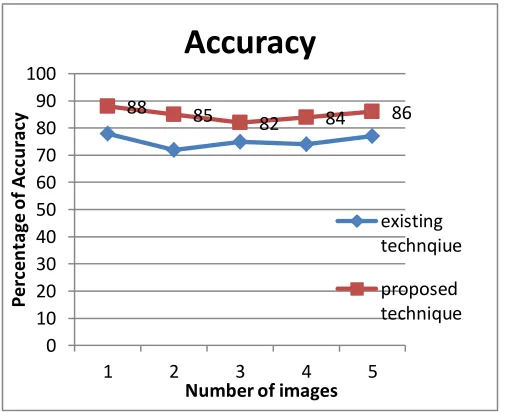
Fig 2: Accuracy Comparison
The correctness of the projected methodology is improved in compared with the accessible system as demonstrated by the figure 2. The accurateness of accessible methodology is 95 percent whereas the projected methodology gives a correctness rate of around 97 percent.
Fig 3: Execution Time Comparison
88 85
82 84 86
0 10 20 30 40 50 60 70 80 90 100
1 2 3 4 5
P erc en ta ge o f A cc u ra cy
Number of images
Accuracy
existing technqiue proposed technique 0 0.5 1 1.5 2 2.5 3 3.51 2 3 4 5
ti m e in s ec o n d s ->
Number of image ->
Execution Time
Existing Algorithm
A comparison on the basis of implemented time duration of the projected and accessible algorithmic rule is carried out for the presentation scrutiny. It’s discovered that projected algorithmic rule utilizes less implementation time than accessible algorithmic rule.
Conclusion
In the proposed research study, it’s analyzed that feature extraction, segmentation and classification are 3 essential phases of plant infection detection. The GLCM algorithmic rule is applied for the extraction of textural features in the earlier approach. The input pictures are segmented with the help of k-mean clustering. In the proposed study, The Naïve bayes classifier is utilized in place of multi-class SVM classifier for the classification of data into various classes. The performance of the proposed algorithm is compared with existing in terms of accuracy and execution time. The proposed Naïve Bayes technique rules has high accuracy and low execution time than SVM algorithm.
Future work (scope):
Following are the various prospective of this research:
1. The proposed algorithm (Naïve Bayes) can be compared with the other plant disease detection algorithms like Decision tree classification.
2. The proposed algorithm can be tested on some other datasets to analyze their performance on various helps of plants
References
[1] Sanjay B. Patil et al. “LEAF DISEASE SEVERITY MEASUREMENT USING IMAGE PROCESSING”, International Journal of Engineering and Technology Vol.3 (5), 2011, 297-301, DOI: 10.1109/ECS.2011.7090754
[2] B. Bhanu, J. Peng, “Adaptive integrated image segmentation and object recognition”, In IEEE Transactions on Systems, Man and Cybernetics, Part C, volume 30, pages 427–441, November 2000, DOI: 10.1109/5326.897070
[3] Keri Woods. ”Genetic Algorithms: Colour Image Segmentation Literature Review”, July 24, 2007, DOI: 10.1109/I2CT.2007.8226184
[4] S.Beucher, F.Meyer. “The morphological approach to segmentation: The watershed transform”, in Mathematical Morphology Image Processing, E. R. Dougherty, Ed. New York Marcel Dekker, vol. 12, pp. 433–481, January 1993, DOI: 10.1109/ICOEI.1993.8300913
[5] Vijai singh,Varsha,Prof A K Misra, “Detection of unhealthy region of plant leaves using Image Processing and Genetic Algorithm” International Conference on Advances in Computer Engineering and Applications, March 2015, DOI:10.1109/ICACEA.2015.7164858
[6] Mrunalini R. Badnakhe and Prashant R. Deshmukh, “An Application of K-Means Clustering and Artificial Intelligence in Pattern Recognition for Crop Diseases”, International Conference on Advancements in Information Technology, IPCSIT vol.20, 2011, DOI: 10.1109/ICIIECS.2011.8275901
[7] Anand.H.Kulkarni, Ashwin Patil R. K., “Applying image processing technique to detect plant diseases”, International Journal of Modern Engineering Research, Vol.2, Issue.5, pp-3661-3664, Sep-Oct. 2012, DOI: 10.1109/ICCCI.2012.8117730
[10] Ranjith, Saheer Anas, Ibrahim Badhusha, Zaheema OT, Faseela K, Minnuja Shelly, “Cloud Based Automated Irrigation And Plant Leaf Disease Detection System Using An Android Application,” International Conference on Electronics, Communication and Aerospace Technology ICECA, April 2017, DOI: 10.1109/ICECA.2017.8212798
[11] Zia Ullah Khan, Tallha Akram, Syed Rameez Naqvi, Sajjad Ali Haider, Muhammad Kamran, Nazeer Muhammad, “Automatic Detection of Plant Diseases; Utilizing an Unsupervised Cascaded Design,” International conference of Electronics, Communication and Aerospace Technology (ICECA), April 2018, DOI: 10.1109/ICECA.2017.8212798
[12] Chaitali G. Dhaware and Mrs. K.H. Wanjale, “A Modern Approach for Plant Leaf Disease Classification which Depends on Leaf Image Processing,” International Conference on Computer Communication and Informatics (ICCCI -2017), Jan. 2017, DOI: 10.1109/ICCCI.2017.8117733