Nuclear sciences: A unique contribution
to the betterment of the human condition
W. Burkart∗,†
Department of Nuclear Sciences and Applications, IAEA, Schwarzenbergplatz 6/T 18, 1030 Vienna
1
A short and partially tainted history
The sciences and applications of ionizing radiation and radioactivity only started in earnest with the discovery of X-rays by Wilhelm Roentgen in 1895, the discovery of radioactivity by Henri Bequerel in 1896, and the iso-lation and description of the two new radioactive elements polonium and radium from uranium ore pitchblende by Pierre and Marie Curie shortly thereafter. Until the end of the 19th century the powers of unstable atoms had remained hidden from all cultures, fluorescent glasses containing ura-nium salts being an exception. Even during early industrialization when silver miners encountered pitchblende1, an ore rich in uranium, this only meant misfortune, the end of silver streaks.
The study of radioactivity and ionizing radiation was an important driver in the development of physical, chemical and biological sciences in the 20th century, both for the elucidation of atomic and nuclear forces, and the de-velopment of analytical and imaging tools. Albeit there were few indus-trial or medical applications beyond X-ray imaging in the early years of
the 20th century, the public of the industrialized world developed a love
∗IAEA former Deputy Director General. †E-mail:[email protected]
1“Pech” in German has two meanings, pitch or bad luck. Hence a proper translation would have been “bad luck glitter”.
affair with this exotic new field of knowledge and phenomena. It started with fair attractions like viewing one’s own hand bones or counting the coins in the closed purse, and culminated in uranium, thorium and radium laced beauty creams and medications. First protective measures by gov-ernmental bodies concentrated on assuring that the concoctions contained the full amount of the expensive radioactivity promised in the advertise-ment.
During the first half of the last century, radiation medicine developed to become an indispensable diagnostic tool for many pathological conditions, and radiation therapy of cancer proved its use in a struggle which even now is too often lost. Some excesses occurred with the irradiation of enlarged thymus glands in children, or the radiation induction of epilation (hair loss) to combat Tinea capitis, a superficial fungal infection of the scalp, mostly in pre-pubertal children.
In the thirties and early forties, pioneering physicists like Otto Hahn, Lise Meitner, Enrico Fermi and Leo Szilard laid the theoretical and prac-tical groundwork to harness the energy of the atom, the fission energy of heavy actinide elements. The nuclear energy from splitting the heaviest or fusing the lightest elements on earth yields five to six orders of mag-nitude more energy per fission or fusion event than the differential energy of chemical bonds set free during the oxidation of hydrocarbons in com-bustion. Predictably but unfortunately, both scientists and politicians too readily explored the potential of this nuclear energy for the battle ground of World War II. They met with scientific success with the first test explosion in New Mexico in 1945. Shortly afterwards, the apocalyptic impact of a
235uranium and a238plutonium fission bomb dropped on the Japanese cities
of Hiroshima and Nagasaki, respectively, forced the end of World War II. Only fifty years after the emergence of nuclear sciences, something consid-ered earlier on a curiosity had provided humankind with the ultimate power to destroy civilisation and higher forms of life from planet earth. Nuclear had lost its innocence, especially since the emerging cold war led to an arms race dominated by nuclear weaponry. The technical breakthrough to hy-drogen bombs (fission-fusion and fission-fusion-fission bombs) allowed the posturing with atmospheric bomb tests with a maximal yield of the equiva-lent of 60 Mt of TNT, or a yield of approximately 4,000 times the Hiroshima bomb.
1957, the world powers rose above the cold war attitude and undertook gen-uine efforts to keep the genie in the bottle, at least for newcomers. The potential of nuclear power as a reliable and affordable source of electricity was established in the sixties. Today countries like France, Sweden, Switzer-land or Belgium produce from 40 to 80% of the electricity through fission reactors. In 1986, the destructive power of the atom was unleashed again; this time by human negligence and unsafe reactor design features. A power excursion accident led to the destruction of unit four of the Chernobyl power station during an poorly executed test intended to improve the safety of the reactor. A considerable part of the highly radiotoxic inventory of a large fission reactor was released into the environment. The chimney effect of the ensuing graphite fire and the absence of local rain led to a measurable con-tamination of large parts of Europe and adjacent areas. Even when some extreme claims of the radiological effects of Chernobyl can be discounted, the human suffering mainly from thousands of already occurred thyroid cancers in children, the projected protracted cancer risk in more affected cohorts in Belarus, Ukraine and the Russian Federation, and the socio-economic dam-age from evacuation and land use restriction put the case for nuclear power into question. Only the economics of fossil fuels and the recent recognition of the threat of climate change gave nuclear power a second life which will have to be driven by safe, secure and efficient novel reactors and fuel cycle concepts.
An important and unique contribution of radioactive and stable isotopes concerns the understanding of the environment. Be it live, organic and in-organic inventories or processes, nuclear tracers are available to study any developments, be it present, in a human history or geological time context. From the heat and mass flows of ocean currents to the age of the Sindone di Torino, natural radionuclides provide tracers with half-lives of a fraction of a day to primordial radionuclides with half-lives measured in billions of years. Together with the analysis of ratios of stable isotopes, the unfortu-nate Ice Man (Oetzi) who perished at the border between Italy and Austria reveals many of his secrets. The mummy’s isotopes do not only yield its
age (14C dating) but through isotope analysis of bone compartments with
2
The UN Millennium Development Goals and
the role of nuclear
The World population has reached 6.8 billion and is still growing 80 million a year, an additional Germany every twelve months. Food and water secu-rity, shelter, good health, access to education and a safe environment are fundamental elements for our quality of life. Yet these basic human needs as
put down in the UN Millennium Development Goals2 are still not available
to too many people on this globe. This calls for sustainable and science-based industrial development at an immense scale to provide the economic resources needed to raise the standard of living globally. In technologically advanced societies nuclear technologies have a much larger role to play in human development than just providing energy. Nuclear technologies offer unique tools in the quest for sustainable development and are often the best approach to gather technological and scientific information and provide so-lutions that would not otherwise be possible or practical. They are used to diagnose and treat disease, breed better crops and fight insect pests; as-sess sources of fresh water and monitor pollution. Radioactive and stable isotopes can be used to “label” materials under study. As they can be iden-tified and quaniden-tified at very low concentrations, labelling is often used in diagnostic medical tests, in studies of underground sources of water, and to trace pollutants, such as heavy metals and pesticides. Isotopes are also used in nutritional studies to follow the metabolism of vitamins and trace minerals in food supplements. Other nuclear techniques utilise radiation, to kill cancer cells, sterilize tissue grafts for burn victims, protect food against disease-causing pathogens, induce favourable genetic changes in plants, or scan body organs for anatomical or functional aberrations.
Table 1 shows some hardware investments needed to provide for the additional people per year which equals the population of Germany. At the living standard of Europe, the annual addition of housing space would be an area of the size of Luxembourg and the new railway tracks would be close
to the Earth circumference. CO2 production in Germany is 9.7 tons per
capita and year which would convert into the injection into the atmosphere of an additional 780·106 tons of CO2 per year from the 80 million people added to the world population in a single year. This is not sustainable
and even if the rich North would reduce its CO2 foot print considerably,
new forms of energy have to be deployed quickly. If we go through the UN list of Millennium Development Goals, it becomes evident that to cover
2
Table 1: Annual additional infrastructure needed for present day world population growth and projected global inventory, assuming European standard of living for all.
Global Annual Growth World Projected or “One Germany” 7 billion people
Highways [km] 12 600 1 100 000
Roadways [km] 41 300 3 610 000
Railways [km] 34 000 2 870 000
Living space [km2] 2 400 210 000
Electricity production [GW] 637 55 700
Number of power plants needed if covered by:
- Fossil fuel power plants [500 MW], 160 14 000
- Windmills [1 MW]a, equals 400 000 35 000 000
- Nuclear reactors [1 GW] 80 7 000
aAssuming an availability factor of 0.2.
even the most basic needs, the energy poor have to be provided specifically
with electricity. Food security, industrial production, education, health,
communication and transport all depend crucially on electricity. Table 2 lists the major energy sources, supplies and consumptions for today and the future. The strong reliance on fossil fuels will have to be substituted both because of the greenhouse gas problem and exhaustion of resources.
3
Electricity for an energy hungry world
Table 2: Global supply and consumption of major present day energy sources [ETJ = 1018J]. Note that for wind, hydro and nuclear, the values are for electricity, for fossil fuels and biomass for heat (IPCC estimates).
Energy Source Estimated supply Consumption Share of Supply
[ETJ] [ETJ/year] [%]*
Coal >100 000 120 25
Gas >30 000 105 22
Oil 45 000 163 33
Biomass 250/yr 46 9
Wind 600/yr 1 0.2
Hydro 62/yr 26 5
Fission >220 000 26 5
Fusion 5 000 000 000 0 0
1. The introduction of new reactor concepts operating at much higher temperatures of up to 800◦C; this would increase efficiency and create the option of hydrogen production, a potential clean fuel for trans-portation.
2. Reprocessing of spent nuclear fuel,i.e.the conversion of the majority of non-fissile238uranium into fissile239plutonium will increase the yield as compared to once through systems by a factor of 50 and more.
3. The burning of abundant 232thorium after conversion to fissile
233uranium, a concept developed in detail by Italian Nobel laureate
Carlo Rubbia and ready to be tested in a large experimental reactor.
4. Harnessing uranium from sea water which – even at the very low con-centration of 3.3 mg per m3 (3.3 ppb or 3.3 t per km3 of seawater) – would again extend fuel reserves by orders of magnitude.
5. Fusion energy relying on practically inexhaustible elements for fuel, and being able to provide the neutrons to drive the breeding of
239plutonium and 233uranium needed for 2. and 3.
Given the stakes in feeding an energy-hungry world, even the most elusive task in the list, the creation of the heat and confinement for controlled and
affordable fusion on earth is of great importance. The 15 billion ¤ to be
compared to the crude oil import bills for fossil fuels of larger countries. These monthly imports for the US only amount to the same sum as the ITER costs over 20 years. At this point, an ethical argument might be raised. Humankind mastered fusion for more military purposes with the hydrogen bomb already more than 50 years ago. It would be more than appropriate to master fusion for peaceful electricity production at least until 2052, the centennial of the first hydrogen bomb explosion in Operation Ivy on November 1, 1952, on the Enewetak Atoll of the Marshall Islands.
4
Safety, security and safeguards
In a constructive response to the somewhat tainted history of nuclear in war and power, the international community has developed a comprehen-sive framework of protection philosophies and regulations to use the power of the atom in a safe and sustainable way, and to prevent further military or terrorist use. Led by international bodies like the IAEA, the NEA/OECD and regional groups, and implemented by national regulators, most occu-pational and non-occuoccu-pational exposures and the radiological impact on the environment have been reduced to levels far below those received from natural sources of radiation exposure, such as the sun and terrestrial ra-dionuclides. Despite the human suffering and financial losses of Chernobyl and Three Mile Island, these experiences have made nuclear power pro-duction safer. The challenges from the inherent genotoxicity of ionizing radiation and the complexities of protection against invisible and odourless, but often persistent radioactivity, have led to a comprehensive safety culture which is pioneering developments in other areas of industrial production and transport. It may sound somewhat preposterous, but as the task of manag-ing large river systems in Egypt and Mesopotamia stimulated societal and cultural development, the “triple S” of safety, security and safeguards has changed our thinking and political interactions far beyond the nuclear field. Even in the most difficult phases of the cold war, the big powers sat together to keep the nuclear genie in the bottle, and from the positive experiences of tackling this issue, went on to seek solutions to the root problems of proliferation.
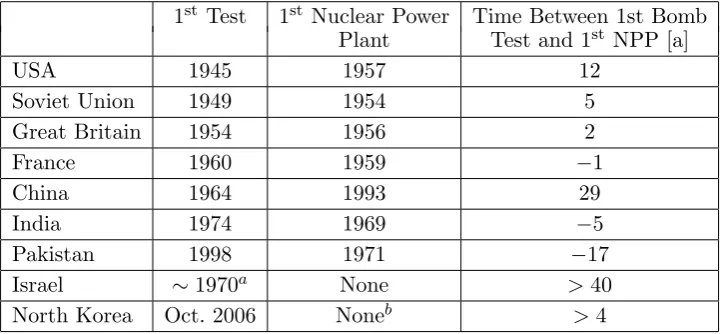
Table 3: Weapon states; first test or weaponisation as compared to the onset of nuclear electricity production.
1st Test 1st Nuclear Power Time Between 1st Bomb
Plant Test and 1st NPP [a]
USA 1945 1957 12
Soviet Union 1949 1954 5
Great Britain 1954 1956 2
France 1960 1959 −1
China 1964 1993 29
India 1974 1969 −5
Pakistan 1998 1971 −17
Israel ∼1970a None >40
North Korea Oct. 2006 Noneb >4
aEstimate of first weaponisation of plutonium based on US sources, there were no tests in Israel.
bEven if electricity production is claimed for a small reactor, this is clearly not at an economic
scale.
Even if others still have to follow, it is a case in point; with the abolition of Apartheid and the end of isolation, the root cause for needing the bomb had vanished.
Another issue, which is less accessible to scientific and technical reason-ing, is nuclear security and the threat of the misuse of radioactive materials
by non-state actors, e.g. by the explosion of a dirty bomb, more
appropri-ately defined Radiation Dispersal Device (RDD). Tens of thousands of police, fire fighters and emergency response staff have been trained to respond to scenarios like the combining of a radioactive cancer therapy source with an explosive. However, if a terrorist group would not first grind the source to powder – an acutely deadly endeavour outside a sophisticated hot cell - to mix it with the explosive, assessments show that limited radiological risks would emerge from the dispersion of radioactive material. However, due to perceptions of the media and the public, the centre of a large metropolitan area could be incapacitated for days and remediation costs could be high. For this reason RDDs are also defined as “weapons of mass disruption” to clearly distinguish them from nuclear weapons (weapons of mass destruc-tion).. Even when the threat is real and critical scenarios exist, chemical and biological agents are of greater concern. Especially the latter with the self-propagating power of viruses and bacteria are too scary to be outlined in detail for potential offenders. The writer even has some concerns that training too many to counter a hypothetical threat from RDDs, which for-tunately never materialized so far, might increase the probability of having it happen. Society is better served by adopting a proactive approach and searching for science-based solutions. In the case of cancer radiotherapy sources, developmental money could be well spent by replacing the many African radioactive60cobalt sources which save lives on a daily basis by lin-ear accelerators (LINAC). These LINACs come at considerably higher costs but the ionizing radiation can be simply switched off and no radioactivity remains.
5
Understanding the environment
Environmental radioactivity and stable isotope ratios provide us with unique tools to understand the history and dynamics of planet earth and our envi-ronment. This is as important and central for the protection of the environ-ment as radiation medicine is for health care, but not yet widely recognized by the public. Environmental radioactivity has three sources. The first one is primordial radioactivity derived from the early days of the universe.
Ex-amples are uranium, thorium and 40potassium. They all have half-lives in
the range of billions of years, but redistribution processes of shorter-lived daughter products in the uranium and thorium decay chains already pro-vide ample opportunities to study also rapid processes. Diverse and changing chemical properties of actinide oxides for which solubility depends on oxygen pressure to soluble alkaline ions, and finally noble gas radon with half-lives from seconds to days provide a splendid tool box for climate researchers, environmentalists and ecologists. The second source is due to the solar flux from the fusion reactions of our sun. This provides a large multitude of additional radionuclides for atmospheric and marine studies. Well-known radiocarbon, 14carbon, with its half-life of 5,730 years does not only per-mit to trace down welling and deep sea streams of Atlantic waters involved in the Gulf stream, but also the dating of cultural artefacts over the last 25,000 years. The third source is of anthropogenic nature. The pollution of mostly the Northern hemisphere by atmospheric bomb testing mainly in the fifties and sixties of the last century, and of large parts of Europe by the releases from Chernobyl reactor number four, provided tracers to study many elements of the food web relevant to humans. Also, quantitative
ero-sion studies were made possible by 137cesium which sticks for decades to
undisturbed top soil. The large number of radionuclides present in the en-vironment, their breath of half-lives and chemical behaviour empower the specialist to study and quantify practically any environmental process of importance to humankind.
A further extension based on mass spectrometry and more recently laser technology allows the measurement of ratios of stable nuclides.
En-richment or depletion of nuclides of hydrogen (1H/2H: a weight
differ-ence of a factor of two), carbon (12C/13C) nitrogen (14N/15N) and oxygen
(16O/18O) is dependent on temperature and number of phase transitions
(e.g. evaporation/condensation). The resulting fingerprints of water
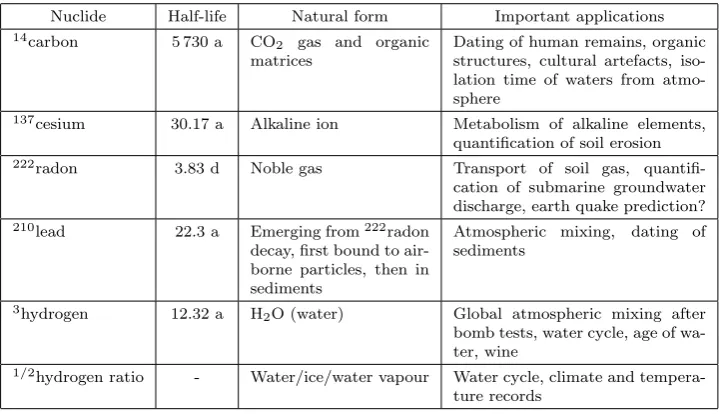
Table 4: Understanding the environment with nuclear tracers. Examples of impor-tant tracer and applications.
Nuclide Half-life Natural form Important applications 14carbon 5 730 a CO2 gas and organic
matrices
Dating of human remains, organic structures, cultural artefacts, iso-lation time of waters from atmo-sphere
137cesium 30.17 a Alkaline ion Metabolism of alkaline elements, quantification of soil erosion 222radon 3.83 d Noble gas Transport of soil gas,
quantifi-cation of submarine groundwater discharge, earth quake prediction? 210lead 22.3 a Emerging from222radon
decay, first bound to air-borne particles, then in sediments
Atmospheric mixing, dating of sediments
3hydrogen 12.32 a H2O (water) Global atmospheric mixing after bomb tests, water cycle, age of wa-ter, wine
1/2hydrogen ratio - Water/ice/water vapour Water cycle, climate and tempera-ture records
The following examples are not comprehensive but show the width of nuclear applications in environmental studies. Understanding the reservoirs and flows of carbon dioxide, the primary greenhouse gas after water vapour, that regulates the global heat balance on earth in quantitative terms is an urgent necessity for efficient mitigation or adaption to climate change.
An-thropogenic CO2 from fossil burning is devoid of 14carbon and hence can
be followed with this marker. The ocean absorbs CO2 through physical as
well as biological processes, namely through photosynthesis by microalgae (phytoplankton), ingestion of phytoplankton by microscopic animals (zoo-plankton), and eventual settling of that carbon into the abyss. The infiltra-tion of fossil carbon into the ocean, which is due to physical processes, has been tracked by ocean measurements of carbon isotopes (12C,13C and14C). These isotopic data can provide quantitative assessments,e.g.that the ocean
is currently absorbing about 2 gigatonnes per year of anthropogenic CO2,
which is about one third of the total annual anthropogenic CO2 emissions
from fossil fuel burning and deforestation.
of pollutants over time, in this case for about 150 years of industrial pol-lution. Traces from various sources of radioactive substances are found at long distances from their input. These data can be used for ocean circulation studies. 137Cesium and14carbon were determined in vertical profiles in the Southern Hemisphere covering the Atlantic, Indian and Pacific Ocean. By this technique, the vertical penetration of water masses into the ocean and the renewal time for deep ocean water from different origin can be studied. The existence of a rapid transport from surface Pacific Ocean water into the Indian Ocean was found by this method.
Considerable amounts of fresh water enter the sea through subsur-face aquifers. Estimates of this so-called submarine groundwater discharge (SGD) vary significantly between 6% and 100% of the river basin inputs which is largely due to the regional and temporal variability of SGD. SGD has received considerable attention in coastal management for several rea-sons: First, SGD is a potential freshwater resource in areas with water short-age; if SGD is composed of brackish water it may be utilised in desalinisation plants; thirdly, SGD may be associated with high contents of pollutants (nu-trients, metals, pesticides) thus effecting coastal ecosystems. Outbreaks of harmful algae blooms and contamination of coastal regions are some of the consequences. The quantification of submarine groundwater discharge helps to prevent over-exploitation of and salt water intrusion in coastal aquifers. Radium and radon measurement techniques have been developed to detect and to quantify SGD in coastal regions in view of sustainable water resource management.
6
The water cycle and climate
-15 ‰
-15 ‰
-7 ‰
-5 ‰
-3 ‰
0 ‰ -13 ‰
-16 ‰ -25‰
-10 ‰
-7 ‰ -10 ‰
-17 ‰
0-2TU 0-20TU
0-5 TU
-13 ‰
0-10TU
PRECIPITATION EVAPORATION TRANSPIRATION VAPOUR TRANSPORT
GROUNDWATER FLOW
RETURN FLOW RIVER LAKE
EVAPORATION
PRECIPITATION SURFACE
RUNOFF PERCOLATION
Figure 1: Oxygen stable isotope ratios and tritium values along the water cycle.
mass flows on the local and global level, and determine solar and infrared radiation balance and hence weather and climate. However, a proper under-standing of water cycle processes was hampered until the advent of nuclear methods which provided a powerful set of stable isotope tools for “finger-printing” various parts of the water cycle and radioactive isotope tools for
dating water. Isotope hydrology uses of natural and anthropogenic
iso-topes, both stable and radioactive, such as 2H,18O, 3H,14C etc., as tracers to study, manage and develop water resources. These are natural indicators for water flow, direction, travel times, and age of water bodies. Isotope hy-drology has considerably extended our knowledge of the water cycle beyond the information derived from water chemistry and conventional hydrological methods.
The fingerprinting is based on the fact that water molecules are made up of two different hydrogen and oxygen stable isotopes, respectively, and that the isotope ratios of water samples can be measured using a mass spectrometer. The history and pathway of water in different parts of the hydrological cycle can be followed by the abundance of the stable heavy isotopes of hydrogen (2H: deuterium) and oxygen (18O). In this way, water in different environments develops isotopic “fingerprints” with which it can be identified and its origins traced. Isotope fractionation is a change in isotopic composition in the transition of a compound from one state to another (e.g. liquid water to water vapour) or into another compound (e.g.carbon dioxide into plant organic carbon). The partitioning of isotopes between substances during reactions or processes can be used to characterize processes in the biological, geological, and hydrological realm, both past and present. Isotope fractionation is governed by the principle that lighter isotopes, or species with a lower molecular weight, will be favoured in evaporation processes and biological uptake, leaving the source material “heavier,” or with the heavier isotope more abundant. Light elements exhibit greater isotopic fractionation than heavy isotopes because the relative mass difference from additional neutrons is higher,i.e.100% between1H and2H, or 12.5% between16O and 18O. These relative differences drive stable isotope fractionation. Therefore,
isotopes especially susceptible to substantial fractionation belong to the light elements that are among the most abundant on earth: H, C, N, O, and S.
that formed them. The fundamental control on the isotopic composition of precipitation is temperature. With increasing temperature, precipitation becomes enriched in the heavier isotopes 18O and 2H, in a linear
relation-ship. Temperature affects fractionation at a rate of approximately 0.5
for every C◦ for oxygen. Similar effects are shown with increasing
eleva-tion and increased distance from the equator (both of which correspond to lower temperature). Because precipitation becomes progressively enriched in light oxygen as it moves toward the cold polar regions, polar ice
consti-tutes a reservoir of16O enriched water as compared to sea water. Because
the isotopic ratios 18O/16O and 2H/1H have a strong positive correlation with temperature, their measurements in ice cores are valuable indicators of climate variability.
Figure 1 shows ratios change as water is moving through different com-partments making up the water cycle. Stable isotopes are reported as permil values () and the figure shows how18oxygen isotope values change through the water cycle. As an example, the effect of evaporation is clearly shown on the right side of the figure where isotope values are shifted from 0 in the
ocean to −13 in the atmosphere. These stable isotope fingerprints help
us not only understand how the water cycle functions, but are also used to determine other difficult to obtain environmental and water management in-formation such as the elevation of groundwater recharge (renewal) zones so that adequate protection areas can be established. Sources and locations of subsurface water entering rivers and lakes, mixing of different groundwater bodies, and sources and depths of water utilized by plants can be identified. They can even help us to understand past and current climate patterns. It is also noteworthy that stable isotopes of other elements such as nitrogen can be used to identify sources of pollution.
In earlier times artificial radionuclides were occasionally introduced to trace a particular environmental process. Today environmental studies rely on measurements of radionuclides that are already present in the
environ-ment naturally or from human activities. Tritium, 3hydrogen, and its
systems is important because they can be large and provide quality ground-water supplies, but they have to be managed differently than systems where groundwater renewal occurs over short time scales. These have been just a few examples of the broad application of nuclear techniques to the water cycle. A key concept is that by tracking the isotopes of water, scientists can quickly obtain valuable information which would otherwise require decades of data collection or may not be obtainable at all. The use of isotopes is rapidly growing in all environmental areas and is leading to much greater insights about the complex processes that must be understood in order to address the wide variety of environmental issues facing society today. Thus again, nuclear will play a significant role in the quest to meet the UN envi-ronmental MDGs and to manage our planet in a sustainable way.
![Table 2: Global supply and consumption of major present day energy sources [ETJ= 1018 J]](https://thumb-us.123doks.com/thumbv2/123dok_us/8084927.1349165/6.595.127.474.144.295/table-global-supply-consumption-major-present-energy-sources.webp)