Monte Carlo Simulation for Statistical Decay of Compound
Nucleus
T. Kawano1,a, P. Talou, and M. B. Chadwick
Los Alamos National Laboratory, Los Alamos, NM 87545, U.S.A.
Abstract. We perform Monte Carlo simulations for neutron andγ-ray emissions from a compound nucleus based on the Hauser-Feshbach statistical theory. This Monte Carlo Hauser-Feshbach (MCHF) method calculation, which gives us correlated information be-tween emitted particles andγ-rays. It will be a powerful tool in many applications, as nuclear reactions can be probed in a more microscopic way. We have been develop-ing the MCHF code, CGM, which solves the Hauser-Feshbach theory with the Monte Carlo method. The code includes all the standard models that used in a standard Hauser-Feshbach code, namely the particle transmission generator, the level density module, in-terface to the discrete level database, and so on. CGM can emit multiple neutrons, as long as the excitation energy of the compound nucleus is larger than the neutron separation energy. Theγ-ray competition is always included at each compound decay stage, and the angular momentum and parity are conserved. Some calculations for a fission fragment 140Xe are shown as examples of the MCHF method, and the correlation between the
neu-tron andγ-ray is discussed.
1 Introduction
To perform radiation transport calculations, the probabilities in nuclear process, such as neutron in-teraction orγ-ray production, are provided as input data to the simulation. This saves computational resources a lot. However, important correlations between neutrons and γ-rays cannot be taken into account exactly. A Monte Carlo simulation of the nuclear reaction process will be able to provide fully correlated information, i.e. all the neutrons andγ-rays emitted at an event obey the energy and angular momentum conservation laws. We have been developing a technique to solve the statistical Hauser-Feshbach theory [1] by means of a stochastic method, called Monte Carlo Hauser-Hauser-Feshbach (MCHF) [2, 3]. In our previous papers, the spin-dependence in the compound nucleus decay probabilities was summed before we perform the Monte Carlo simulations, which means the angular momenta are con-served in average only. This paper describes an extension of our MCHF calculations. A computer program, CGM (Cascading Gamma-rays and Multiplicity) [4] has been developed at Los Alamos, which can be combined with other transport simulation programs as an event-generator [5]. CGM runs in both stochastic and deterministic modes with very fine energy grid. This is particularly impor-tant to understand neutron emission at very low energies. In this paper we will also discuss the neutron evaporation process that can be studied with CGM.
a e-mail:[email protected] DOI: 10.1051/
C
Owned by the authors, published by EDP Sciences, 2012 epjconf 20122104001/
CGM
Gamma-ray cascade simulation Beta-decay calculation
Nuclear Masses AW & FRDM
Statistical Decay Particle Transmission Gamma-ray Transmission Entrance Channel Optical Model (transmission generator) RIPL-3 Discrete Levels Level Density Gilbert-Cameron parameters
Spectra of gamma-ray, neutron, electron, and neutrino
for beta-decay QRPA Gamow-Teller Strength ENSDF beta-decay to low-lying states
Spectra of gamma-ray and neutron, and multiplicities from a given state deterministic, or Monte Carlo
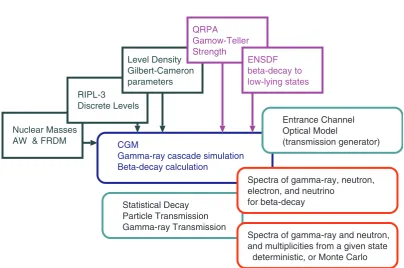
Fig. 1.Structure of the CGM code. The input quantities are shown by the boxes, and the output is shown by the two red rounded-boxes.
2 CGM
2.1 Monte Carlo Method for Statistical Model
The CGM code calculates the decay of a compound nucleus from a given excited state based on the Hauser-Feshbach formalism. CGM was developed mainly for three different purposes; (1) to study β-delayed neutron andγ-ray emission [6], (2) as an event generator in Monte Carlo radiation transport calculations, and (3) to study prompt fission neutron andγ-ray emissions [5]. The structure of this code is shown in Fig. 1.
In each application, an initial excitation energyEx of the compound nucleus (Z,A) is provided,
which may spread over different spin and parity states. In the Hauser-Feshbach theory, we calculate the transmission coefficients from all the possible final states to the compound state. The decay prob-abilities forγ-ray and neutron are given by
P(γ)dE0=
Tγ(Ex−E0)ρ(Z,A,E0)
N dE0, (1)
for theγ-ray, whereγ=Ex−E0, and
P(n)dE1=
Tn(Ex−Sn−E1)ρ(Z,A−1,E1)
N dE1, (2)
for the neutron, wheren=Ex−Sn−E1,Tn,γare the transmission coefficients,ρ(Z,A,E) is the level
density,Nis the normalization factor,E0andE1are the excitation energies in the residual nuclei, and
Snis the neutron separation energy. The normalization factor is given by
N =
∫ Ex
0
Tγ(Ex−E0)ρ(Z,A,E0)dE0
+
∫ Ex−Sn
0
Z, A
Z, A-1
S (A)
n(c)
(b)
(a)
Z, A-2
S (A-1)
n(d)
Total Excitation Energy
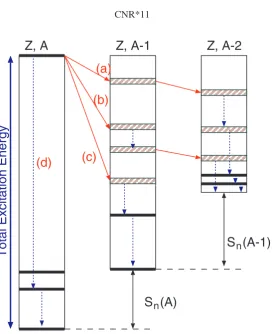
Fig. 2.Schematic picture of neutron andγ-ray emission calculation from a compound nucleus (Z,A).
In the equations above we omitted indices of quantum numbers, but the integration is performed only for the spin and parity conserved states. At low excitation energies, the integration is replaced by a sum over the discrete levels.
The neutron transmission coefficients are obtained by solving the Schr¨odinger equation for optical model potentials. CGM has an built-in optical model solver with the Koning-Delaroche global optical potential [7]. The γ-ray transmission coefficient is calculated from the γ-ray strength function in a standard manner [8]. We include E1, M1, and E2 strength functions. A pygmy resonance and a scissors mode can be included if necessary. The level densities are calculated with the composite level density formulae of Gilbert and Cameron [9] with an updated parameterization [10].
First we calculate the decay probabilitiesP(n) andP(γ) from the initial state (Z,A,Ex) (see Fig. 2)
to the all possible final states, the next state ((Z,A−1,E0x), for example) is determined by a random sampling technique. We repeat this procedure until the nucleus reaches one of the discrete levels. At each stage the decay probabilities are calculated again to limit the amount of required memory. At the discrete levels, theγ-ray cascade is calculated in the Monte Carlo manner with the branching ratios given in the database.
2.2 Variable Energy Bin Width
The Weisskopf spectrum,
f()∝exp
(
− T
)
, (4)
has an asymptotic form of when → 0. The evaporation spectrum calculated with the Hauser-Feshbach theory consists of two quantities, the neutron transmission coefficients and the level densi-ties. When the neutron energy is very low, the transmission coefficient is basically thes-wave compo-nent only,
T0=2πS0∝
√
, (5)
whereS0 is the neutron strength function. We can assume that the level density is constant within a
very narrow energy width, so that the Hauser-Feshbach evaporation spectrum has the asymptotic form of √ at very low energies, which is the same as the Maxwellian shape, √exp(−/T). This was confirmed by the variable energy bin width calculations in CGM; the neutron emission spectra have the √shape up to∼100 keV for nuclei in the medium mass range. In the higher energy region, the Hauser-Feshbach spectra are well approximated by the Weisskopf shape.
3 Results and Discussions
3.1γ-ray Energy Spectra
CGM provides a history of neutron andγ-ray emissions at each simulation. Starting from a neutron separation energy, where the neutron emission is suppressed, CGM generates a set ofγ-ray cascades for the neutron capture process. This case is similar to the DICEBOX code [13].
We calculated theγ-ray cascade from239U at 4.81 MeV excitation andJπ =(1/2)+, which
sim-ulates experimental capture γ-rays for the thermal neutron induced capture reaction on 238U. The generatedγ-rays were classified into differentγ-ray multiplicitiesm, and the energy spectra for each mwere reconstructed. The top panel of Fig. 3 shows the color-coded histogram for theγ-ray spectra (production probabilities) for the multiplicity ofm=2 ∼6. Form=1, the spectrum becomes just a delta-function at 4.81 MeV.
In this calculation, we includedγ-ray strength functions of E1, M1, and E2, as often adopted in nuclear reaction calculations. It is known that the two-step cascadem=2 is sensitive to the pygmy resonance or the scissors mode in the MeV region. In Fig. 3 lower panel shows the same calculation but a small M1 resonance (Eγ =2 MeV,Γγ =0.6 MeV, andσ0=1.2 mb [14]) was added. The spectra
for lowermchanged significantly, and the averageγ-ray multiplicity became smaller by 5%.
3.2 Sequential Neutron Emission
When the excitation energy of a compound nucleus is much higher than the separation energy, multiple neutron emission can occur. CGM calculates all the neutron andγ-ray competitions at each interme-diate state until the excitation energy becomes less than the separation energy. In the current version of CGM, we are aiming at neutron-rich nuclei, such as fission fragments, so that the charged particle channels are ignored.
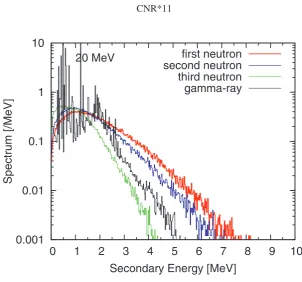
Figures 4, 5, and 6 show the calculated neutron andγ-ray energy spectra from excited140Xe at
10, 15, and 20 MeV. We performed 105 simulations, which took about 1∼2h on a single CPU. The
calculation time depends not only on the excitation energy but also the neutron separation energies and the out-gonig energy grid. As expected, the first neutron has the hardest spectrum, as the evaporation temperature becomes lower when more neutrons are emitted.
Fig. 3.Theγ-ray energy spectra from the thermal neutron capture reaction on238U for differentγ-ray multiplici-ties. The top panel calculation includes general E1, M1, and E2 strength functions, and the lower panel is the case when the scissors mode is added.
3.3 Neutron andγ-ray Correlations
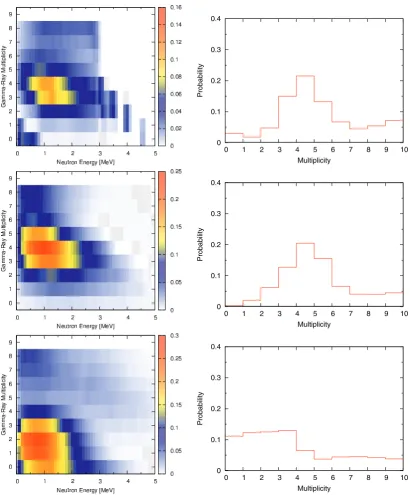
The MCHF technique allows us to study relationship between the emitted neutrons andγ-rays. These correlations are often the result of energy and angular momentum conversations. They sometimes show a nuclear structure effect too. In Fig. 7 the calculations are the same as in Figs. 4 – 6 but the results are presented in a different way — the neutron energy spectra for individualγ-ray multiplicity. The γ-ray multiplicity distribution is also shown on the right column. It does not look theγ-ray multiplicity distribution is a simple function of nuclear excitation. When the initial excitation energy is just above the sum of all neutron separation energies, the last neutron tends to leave the residual nucleus in its low-lying state, or even in its ground state, hence the averageγ-ray multiplicity becomes smaller.
0.001
0.01
0.1
1
10
0
1
2
3
4
5
6
7
8
9 10
Spectrum [/MeV]
Secondary Energy [MeV]
10 MeV
first neutron
second neutron
gamma-ray
Fig. 4.The Monte Carlo simulated neutronγ-ray energy spectra from140Xe∗at 10 MeV excitation energy. The red, blue, and green histograms are for the first, second, and third emission of neutrons, and the black histogram is for the totalγ-ray.
0.001
0.01
0.1
1
10
0
1
2
3
4
5
6
7
8
9 10
Spectrum [/MeV]
Secondary Energy [MeV]
15 MeV
first neutron
second neutron
gamma-ray
0.001
0.01
0.1
1
10
0
1
2
3
4
5
6
7
8
9 10
Spectrum [/MeV]
Secondary Energy [MeV]
20 MeV
first neutron
second neutron
third neutron
gamma-ray
Fig. 6.Same as Fig. 4 but for 20 MeV.
Gaussian-shape spin distribution,
R(J)=2J+1 2σ2 exp
{
−(J+1/2)2 2σ2
}
, (6)
was doubled, and the results are shown in Fig. 8. The averageγ-ray multiplicity becomes the difference inJbetween the compound and ground states becomes larger, while the E1 transition changes the spin by only 1~. This also impacts on the neutron emission from the compound system. When MCHF is combined with experimental data on promptγ-ray emission, we can obtain more information on nuclear reaction mechanisms that cannot be easily seen in traditional nuclear reaction experiments or simulations.
3.4 Conclusion
Fig. 7.The neutron energy spectra (left) and theγ-ray multiplicity distributions (right) from140Xe∗at 10 MeV
(top panel), 15 MeV (middle), and 20 MeV (bottom) excitation energies for eachγ-ray multiplicity. 0
0.1 0.2 0.3 0.4
0 1 2 3 4 5 6 7 8 9 10
Probability
Multiplicity
0 0.1 0.2 0.3 0.4
0 1 2 3 4 5 6 7 8 9 10
Probability
Multiplicity
0 0.1 0.2 0.3 0.4
0 1 2 3 4 5 6 7 8 9 10
Probability
Fig. 8.Same as Fig. 7, but the initial spin distribution is changed. 0
0.1 0.2 0.3 0.4
0 1 2 3 4 5 6 7 8 9 10
Probability
Multiplicity
0 0.1 0.2 0.3 0.4
0 1 2 3 4 5 6 7 8 9 10
Probability
Multiplicity
0 0.1 0.2 0.3 0.4
0 1 2 3 4 5 6 7 8 9 10
Probability
Acknowledgment
We would like to thank M. Krtiˇcka of Charles University, Prague, and J. Ullmann of LANL for valuable discussions. This work was carried out under the auspices of the National Nuclear Security Admin-istration of the U.S. Department of Energy at Los Alamos National Laboratory under Contract No. DE-AC52-06NA25396.
References
1. W. Hauser, H. Feshbach, Phys. Rev.87, 366 (1952)
2. T. Kawano, P. Talou, M. B. Chadwick, T. Watanabe, J. Nucl. Sci. Technol.,47, 462 (2010) 3. T. Kawano, P. Talou, M. B. Chadwick, S. Holloway, P. M¨oller, T. Watanabe, J. Korean Phys. Soc.
59, 785 (2011)
4. T. Kawano, S. T. Holloway, CGM, Cascading Gamma-Ray and Multiplicity, ver.3, LACC-11-018 Los Alamos National Laboratory (2011)
5. P. Talou, B. Becker, T. Kawano, M. B. Chadwick, Y. Danon, Phys. Rev. C83, 064612 (2011) 6. S. Holloway, T. Kawano, P. M¨oller, J. Korean Phys. Soc.59, 875 (2011)
7. A. Koning, J. P. Delaroche,Nucl. Phys.,A713, 231 (2003) 8. J. Kopecky, M. Uhl,Phys. Rev. C,41, 1941 (1990)
9. A. Gilbert, A. G. W. Cameron,Can. J. Phys.,43, 1446 (1965)
10. T. Kawano, S. Chiba, H. Koura,J. Nucl. Sci. Technol.,43, 1 (2006); T. Kawano, “updated param-eters based on RIPL-3,” (unpublished, 2009)
11. P. G. Young, E. D. Arthur, M. B. Chadwick, “Comprehensive nuclear model calculations: Theory and use of the GNASH code,”Proc. of the IAEA Workshop on Nuclear Reaction Data and Nuclear Reactors — Physics, Design, and Safety, Singapore: World Scientific Publishing, Ltd., for Trieste, Italy, April 15 – May 17, 1996. Eds. A. Gandini and G. Reffo, pp. 227–404 (1996)
12. R. E. MacFarlane, (private communication, 2010)