A Model of Medical Reception - the Planning and
Control of Multiple Task Work
BECKY HILL, JOHN LONG, WALTER SMITH AND ANDY WHITEFIELD
Ergonomics Unit, University College London 26 Bedford Way, London
WC1H 0AP Tel: +44 71 387 7050 Fax: +44 71 580 1100 E-mail: [email protected]
SUMMARY
1 INTRODUCTION
1.1 Applying Research Knowledge
How to ensure the applicability of the knowledge generated by its research is a persistent problem for many disciplines, including cognitive psychology. Donald Broadbent was much concerned by this problem; and in particular by the relation of cognitive theory and application in psychology (1971a). His position on the relation, however, was clear and often stated. First, he held that problems should be drawn from real and practical situations, in which human beings naturally perform. Second, he held that the best contribution to practical problems is to produce a general theory (1971b). Third, he held that the most valid general theory is one which works, that is one from which a solution to an applied problem may be derived (1971a). The work reported in this paper follows directly in the Broadbent tradition: addressing a practical situation - medical reception; attempting to construct a general theory - of planning and control of multiple tasks; and with an aim of solving, by means of the theory, an applied problem - designing user interfaces for interactive computer systems. The work, however, has also sought to advance that tradition by attempting to develop a theory which ensures better support for the solution of applied problems. The advance is based on three requirements. First, the applied problem, not just the theory, needs a technical expression. Second, the theory needs to address all aspects of the applied problem, not just the human behaviours associated with it. Third, the form and granularity of the theory need to be commensurate with the applied problem. In attempting to meet these requirements, the research reported here has sought to construct a theory more fit for the purpose of solving applied problems.
The remainder of Section 1 provides background information about medical reception and presents the framework. Section 2 describes the particular medical reception worksystem studied and the data collection and analysis methods employed. Section 3 presents the resulting model of planning and control in medical reception, including the different types of plan used by the medical reception worksystem. The extension of the framework for the planning and control of multiple task work is also described. Section 4 discusses how the model might be used in worksystem design, and Section 5 offers a summary and some conclusions.
1.2 Medical Reception (in the UK)
Informally, medical reception worksystems can be identified as those interactive systems, comprising combinations of people and office devices, which support the effective interaction between medical practitioners and their patients in medical general practices.
Jeffreys and Sachs (1983) described the emergence of medical reception worksystems in the UK. In 1966, there was a boost to the employment of receptionists and secretaries, because the Family Doctors Charter gave provision for GPs to reclaim 70% of the salaries paid to their staff. Closely related to the increasing employment of receptionists was the growth in the use of appointment systems in general practice, as an appointment system could not be implemented without the employment of receptionist staff. By 1981, over 70% of medical general practitioners in the UK employed receptionists and operated appointment systems (Drury, 1981).
General practices have begun to computerise their administration, although by the early 1980s the number was still small (Jeffreys and Sachs, 1983). As part of its recent National Health Service reforms, the UK government has attempted to increase the financial and managerial autonomy of general practitioners. This increase has included a scheme for partial reimbursement of computer costs to increase computerisation.
1.3 The Framework
Prior to the present investigation of medical reception work, the research had constructed a framework for modelling the planning and control of multiple task work (the PCMT framework), based on the work of secretarial office administration. The full details of how this framework was derived and the model constructed is reported in Smith, Hill, Long and Whitefield (1993).
The PCMT framework constituted a domain-independent expression of how worksystems perform the planning and control of multiple task work. The framework was to be further developed by studies of medical reception work and of solicitors' work. It provided a structure within which to model these different types of administrative work. This section introduces the PCMT framework, which is used in Section 3 to model the data obtained in the medical reception study.
INSERT FIGURE 1 ABOUT HERE
The PCMT framework is represented diagramatically in Figure 1. It is based on Dowell and Long's (1989) conception for an engineering discipline of HCI which expresses the HCI general design problem. The conception makes a fundamental distinction between an interactive worksystem, comprising one or more users and computers, and its domain of application, comprising the transformations carried out by the worksystem which constitute its work. The effectiveness with which work is carried out is expressed by the concept of performance which can be defined as a function of two factors: the quality of the product (i.e. how well the final state of the domain compares with its desired state as specified in the work goal); and the incurred resource costs (i.e. the resources required by the worksystem in accomplishing the work). Design problems are expressed as unacceptable levels of performance.
In the PCMT framework, a domain of application (or work domain) is made up of objects, which may be abstract or physical. Objects are defined by their attributes, which have values. The attribute values of an object may be related to the attribute values of one or more other objects. The state of an object at any time is determined by the values of its attributes. The worksystem performs work by changing the state of domain objects (i.e. by transforming their attribute values) towards their desired states as specified in the work goal.
prescriptions, medical record envelopes, etc. An example attribute of a patient object is appointment-time. Initially the appointment-time attribute has a value of none as the patient does not have an appointment booked at the surgery. Upon the worksystem booking an appointment for the patient the value of the appointment-time attribute will be transformed to the value of the time of the allocated appointment slot, for example 2 p.m..
The medical reception domain is an instance of multiple task work, since support is provided concurrently for multiple ongoing and temporally overlapping medical cases (i.e. for many patients together). In the framework, performance expresses the quality of the multiple tasks, that is how well they are carried out, and the costs of their planning and control. Performance in medical reception concerns the quality of the medical cases supported and the costs to the medical reception worksystem of providing that support.
The PCMT framework defines a number of worksystem structures for the planning and control of multiple task work. These structures are expressed at both abstract and physical levels of description. Firstly, the framework describes the worksystem's cognitive structures. These structures comprise four processes (planning, controlling, perceiving and executing processes), and two representational structures (plans and knowledge-of-tasks). The four processes support the behaviours of planning, control, perception and execution respectively. The full argument for this set of structures can be found elsewhere (Smith, Hill, Long and Whitefield, 1992) but can be summarised as follows.
which serve as resources for guiding behaviour, rather than as specifications of complete and fully-elaborated behaviour sequences, cannot ensure that goals will be achieved.
This also undermines the assumption that perception precedes planning which precedes execution. Ambros-Ingerson (1986) argued that all planning can precede execution only when:
1. The task environment is static - relevant changes in the task environment do not occur after the plan is complete; and
2. The task environment is simple enough to be practically modelled - the consequence of behaviours can be predicted sufficiently well to generate a complete and fully-elaborated behaviour sequence; and
3. The task environment is known - the planner's knowledge of the task environment can be complete before planning commences.
Most task environments studied by HCI researchers do not embody these assumptions (Young and Simon, 1987). In direct contrast, they are usually dynamic, complex and partly unknown by the planner (e.g., Hollnagel, Mancini and Woods, 1988). Execution behaviours in worksystem task environments are required to commence before plans are complete and fully-elaborated, and therefore the perception, execution and planning behaviours must be temporally interleaved - having no necessarily fixed order in which to be performed.
When performing a task, a system has to exercise control; that is, it has to select the next behaviour to be carried out at each moment (e.g., Hayes-Roth, 1985). For a system which constructs complete and fully-elaborated plans, controlling is a simple process of selecting behaviours according to the plan and initiating their execution. However, for worksystems, which employ plans as resources to guide behaviour, some more complex control behaviour is required to select execution behaviours over time - since the selection is constrained by, rather than specified by, the plan. Furthermore, if a worksystem interleaves execution behaviours with planning and perception behaviours, controlled sequencing of these behaviours is also required.
Based on the preceeding arguments, the PCMT framework describes the worksystems cognitive structures for planning and control as follows:
At the First (abstract) level of description, Plans are specifications of required
specified only generally and not at a level that is directly executable). In the case of
medical reception, for example, planning behaviours specify the required transformations and/or behaviours to support medical case objects, such as specifiying a required
transformation of the location of a repeat prescription or, specifying the sequence of worksystem behaviours that will provide a patient with an appointment.
Perception and execution behaviours are, respectively, those whereby the worksystem acquires information about the domain objects and those whereby it provides the required support for those objects. In the case of medical reception, perception
behaviours acquire information about doctors, patients, and other domain objects, such as their location and their requirements. This information appears in the knowledge-of-tasks representation. Execution behaviours to transform domain objects would include informing patients of their appointment times and writing repeat prescriptions.
Control behaviours entail deciding which behaviour to carry out next, but are more than the process of reading off the next behaviour from a complete and fully-elaborated plan. In the case of medical reception, control behaviours might decide, for example, to
perform next the execution behaviours of arranging an appointment for Patient 1, in preference to the perception behaviours of answering the telephone, or to planning behaviours of specifying how to complete a repeat prescription for Patient 2.
The second level of description of planning and control structures is physical, wherein the framework describes the distribution of the abstract cognitive structures across the physically separate user and devices of particular worksystems. The framework
therefore allows the construction of alternative models of the distribution of cognitive structures across the user and devices1, and thus it supports reasoning about allocation
of function. In medical reception, the physical worksystem is the receptionist plus devices such as an appointment book, telephone and prescription filing system. This notion of worksystem is slightly wider than that in Dowell and Long's (1989) conception, and is used here for the analysis of to-be-computerised systems.
The outline of the PCMT framework, including its domain of application, its worksystem and its performance, is now complete. The components of the framework have been informally exemplified for medical reception work. This framework has been used to analyse the medical reception data of the study whose collection is described in the next section.
1 It is assumed here (and elsewhere in the paper) that both natural and artificial systems can have cognitive
2 AN OBSERVATIONAL STUDY OF MEDICAL RECEPTION
This section describes the observational study of a medical reception worksystem. The study was intended to provide empirical support for the construction of a model of PCMT for medical reception, and in addition to develop further the PCMT framework to include planning and control of multiple tasks in a work domain additional to that of secretarial office administration.
2.1 The Nature of Medical Reception
The medical reception domain is described in terms of the PCMT framework in Section 3. In this section, the concern is with an informal description of medical reception, sufficient to justify the selection of data collection techniques.
Medical reception involves interaction with, and manipulation of, a range of physical objects, both human and non-human. These objects include patients; doctors; nurses; prescriptions; medical record envelopes; test results; and so on. But the particular physical objects involved in any patient-doctor consultation will vary both within and between patients; for example, the same patient may see different doctors, with or without different test results, X-rays, prescriptions, etc. One means to express the goal of transforming these physical objects is to postulate an abstract medical case object for each patient. The goal of the medical reception worksystem is to support this abstract medical case object effectively by ensuring that the patient can obtain the most suitable appointments and that the correct test results, medical record envelope and so on are available as needed.
This view of medical reception offers a number of characteristics which may differ from other domains. For example, receptionists deal with many patients, but for much of the time the receptionists repeatedly perform a relatively small number of tasks for those patients (e.g. make appointments, hand out test results, take repeat prescription requests). Medical reception work, therefore, seems to involve well-defined, routine sub-tasks, which may be of variable durations (since consultations may occur in one day or over several weeks). Further, the domain involves a high frequency of autonomous events, i.e. task-relevant events which occur independently of any worksystem behaviour, for example, the arrival of a patient or an incoming telephone call.
2.2 The Medical Reception Worksystem
In choosing a medical reception worksystem for study, two factors had to be respected. Medical reception work is considered confidential; i.e. patients expect their interaction with the receptionists to be as confidential as their interaction with the Doctors at the surgery. Further, the work of the medical receptionists varies with the size of the surgery, and the existence, or not, of an appointment-booking system.
For example, in a small practice (comprising one or two Doctors) during surgeries (i.e. when the doctors are seeing patients), the receptionist attends to the reception desks. If there is no appointment system, the receptionist takes charge of the work which, at group practices, is undertaken by nurses, record clerks, secretaries or a practice manager, e.g. completing vaccination forms; supplying of syringes, dressings, stationery; typing letters for hospital admissions; arranging ambulance transport. However, in a Group practice (comprising three or more doctors) most of the receptionists' time is spent at the reception desk, where they deal with: requests for surgery appointments and home visits, either by phone or in person; patients who turn up with or without appointments; telephone requests to speak to doctors and other medical health workers; registration of new patients; requests for repeat prescriptions; and a myriad of patient enquiries and complaints.
Thus, the medical reception worksystem chosen for study needed to allow access to the worksystem in such a way that the patients' privacy was maintained, and preferably be situated within a surgery where an appointment-booking system was in operation. This latter constraint was to ensure that the work of the MR worksystem was restricted to supporting the consultations between the patients and their doctors, and excluded work carried out by other staff under different circumstances (and which might therefore be considered as outside the domain of medical reception).
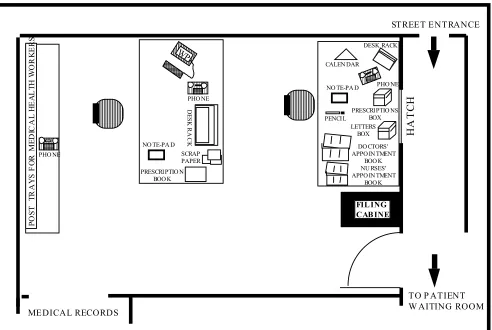
being seen. Under instruction from the receptionist, patients passed from the hatch to a waiting room before consulting with a medical practitioner. Activities performed at the front desk workstation included: booking appointments; registering new patients; and dealing with patients arriving and leaving the surgery. Activities performed at the back desk workstation included: notifying patients of their test results; preparing (and updating) medical notes for the medical practitioners; and preparing the repeat prescriptions.
INSERT FIG 2 ABOUT HERE
2.3 Data Collection
To decide the type of data collection, a preliminary analysis of the medical reception worksystem was carried out. This investigation entailed an informal observation of the worksystem for one day without recording equipment. The preliminary study revealed that the worksystem was very busy and that it would be difficult to ascertain the receptionists' activities by means of unrecorded observations. Sound recording alone would also be unsatisfactory as the important non-verbal behaviours of the receptionist would not be recorded. Therefore, it was decided to use video recording. Video recording would provide a complete representation of the behaviours and work being carried out within the study environment, over an allotted period of time. The video recording would also provide a high quality sound record and would be time-stamped. A video recording is also a permanent record, which can be analysed at length. (Due to the confidentiality of the work of medical reception which required the anonymity of the patients it was not possible to record the incoming speech of a telephone call.)
To obtain an accurate description of the work of the receptionists, video recordings were made, both during and outside surgery hours, for one morning and afternoon, in which time one pair of receptionists was relieved by another. Two video cameras were used simultaneously, one camera focused on the appointment-booking system of the front desk, while the other camera recorded the interactions within the whole reception area, including both desks. At a later date, after initial analysis, an interview was carried out with one receptionist, to obtain clarification of selected details concerning the work. The interview was informal and will not be reported here separately, as the information gathered has been incorporated into the analysis.
2.4 Data Analysis
• The task-related events that occurred e.g. telephone enquiries and patients arriving.
• The receptionists' interactions with their devices e.g. the appointment book and telephone.
• The receptionists' interactions with the doctors. • The receptionists' interactions with each other. • The receptionists' interactions with the patients.
Only the two videos recorded in the morning were analysed, because the data gathered therefrom included a sufficient amount of the data types listed above for the required analysis.
The following analysis was carried out on both videos. From the 240 minutes of video-recording, various sequences were selected for analysis, which varied in length between 13 and 62 minutes. This selection was based on the criteria that:
• the observed behaviours were interpretable (including being able to decipher a telephone call without having recorded both sides of the conversation)
• the analysed period appeared to be busy in support of medical cases (and so was presumed to include behaviours of interest)
• the data listed above occurred frequently.
The sequences varied in length because the activities being carried out at the two
workstations (front and back desks) had different durations; the front desk activities had shorter durations than the back desk activites, so that althought the sequences analysed varied in length the content of the sequences in terms of numbers of behaviours recorded did not.
The first stage of the analysis was the documentation of behaviours and task-related events, from the sequences, to a level of description considered to be at, or below, that necessary for the identification of medical reception planning and control behaviours. This documentation entailed a first description, recording all verbalisations verbatim2,
and all non-verbal behaviours of the receptionist and events in chronological sequence. This 'raw protocol' was then further analysed to identify the physical embodiments of the abstract IWS structures and physical domain objects from the PCMT framework. This process was iterative. This further analysis produced an annotated protocol which identified:
• the physical domain objects (e.g., prescription);
• the physical worksystem devices (e.g., );
• the behaviours of the receptionist.
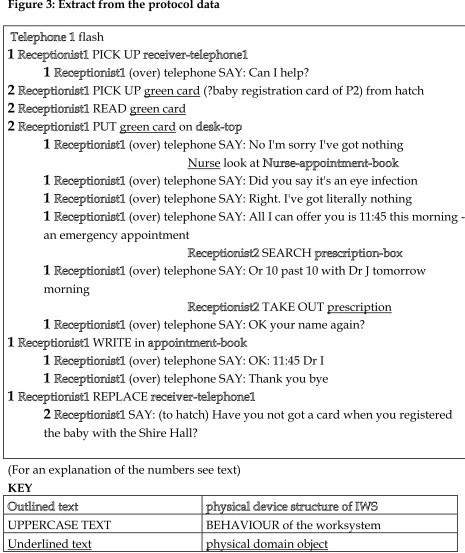
Figure 3 shows a section of the annotated protocol from the workstation of the front desk receptionist. (Space limitations preclude reporting the complete set of protocols.3) The
sequences of videotape analysed are all documented to this level of detail.
INSERT FIGURE 3 ABOUT HERE
From this further analysis, each behaviour in the protocol was then associated with a specific task. For example, in Figure 3 the left hand side number on each line refers to a specific task: Number 1 identifies worksystem behaviours involved in booking an appointment for a patient; Number 2 identifies worksystem behaviours involved in registering a new patient. With very few exceptions, all the behaviours in the protocol were associated with a single task. Some behaviours could not be associated with a specific task, because the protocol contained insufficient data or because they were isolated behaviours relating to tasks which otherwise took place outside the time period recorded or that selected for analysis.
The analysis, therefore, attempted to document relevant observable structures and behaviours of the medical reception worksystem in as much detail as possible, and identified the specific tasks in the medical reception domain to which each behaviour relates. The next section describes the medical reception model constructed from this analysis.
3 MODEL OF PCMT-MR
Section 1.3 described the framework of PCMT constructed prior to conducting the observational study outlined in Section 2. Section 3 now describes the model of PCMT-Medical Reception (MR)4 constructed by using the observations of medical reception
tasks and behaviours to instantiate the concepts of the framework.
The modelling of medical reception can be divided into two activities:
• describing the medical reception domain, including all the identified domain objects and their attributes.
• describing the medical reception worksystem, including details of the observed plans.
3 However, a complete set of protocols, comprising 20 A4 pages, is available on request from the first
author.
4 Strictly speaking, the model of PCMT-MR consists of a PCMT-framework (Section 1.3); an
Medical reception performance can then be exemplified as the relationship between the domain of medical reception, expressed as task quality and user costs, and the medical reception worksystem.
Figure 4 provides an overview of the model of PCMT-MR which is now described.
INSERT FIGURE 4 ABOUT HERE
3.1 Medical Reception Domain
Based on the PCMT framework, the medical reception domain is expressed as those objects whose transformation constitutes the work of medical reception. In the PCMT-MR model, the domain contains multiple medical case objects, each of which itself comprises four objects: a patient object; medical practitioner object(s); diagnosis object(s); and treatment object(s). The medical case objects and their component objects are all abstract. The domain contains in addition physical objects, to be described below.
Figure 4 shows all the attributes associated with the abstract domain objects. Each task constitutes the transformation of a single medical case object with respect to the values of a number of these attributes. The attributes of a medical case object which must be transformed are: appointment suitability for the patient; appointment suitability for the medical practitioner; treatment support accuracy; and diagnosis support accuracy. In order to transform the medical case object attributes, the attributes of the component-objects must be transformed. The transformations of the abstract object attributes result from the manipulation of the physical domain objects by the worksystem. Detailed examples of these attribute transformations are provided later in this section.
period of time so that details could be gathered about tasks which have a longer duration than one day. Further Studies of other medical reception domains would require the data collection to cover a long period of time to gather a richer set of data.
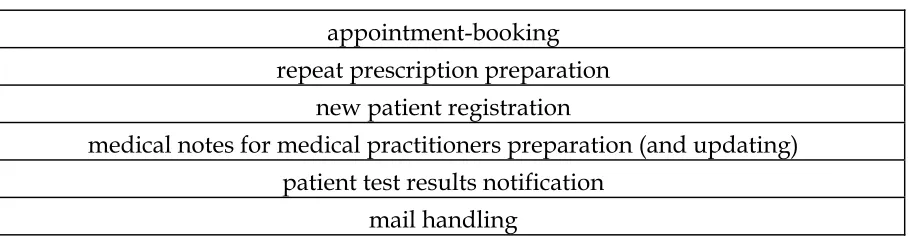
The required transformation of each medical case object can be divided into a number of sub-transformations concerning particular sets of attributes. The division of the tasks into transformations was consistent across all the tasks, in the sense that a given transformation did or could occur for any medical case. Therefore the sub-transformations can be considered generic sub-tasks. The generic sub-tasks identified here are shown in Table 1:
INSERT TABLE 1 ABOUT HERE
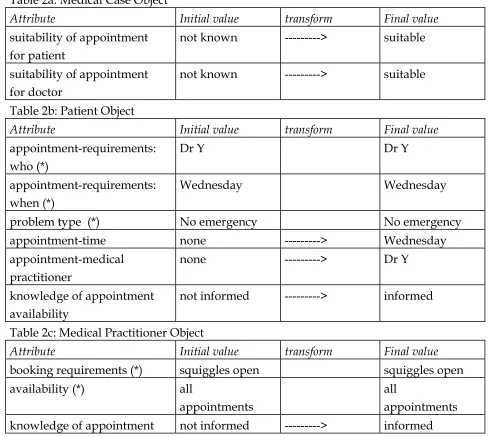
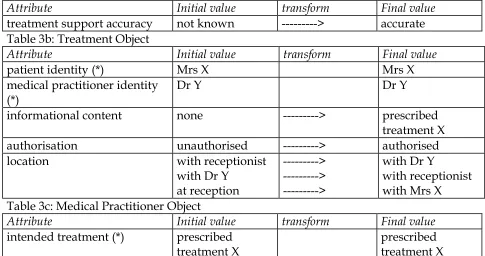
Tables 2a-4c describe the transformation of the abstract objects associated with three5 of
these generic sub-tasks: appointment-booking; repeat prescription preparation; and medical notes for medical practitioners preparation (and updating). However all the sub-tasks identified within medical reception can be described in the same way in terms of their associated set of domain object transformations, which can be derived from the domain description and the protocol descriptions of the behaviours associated with each generic sub-task.
INSERT TABLES 2a-4c ABOUT HERE
The tables show (on the left hand side), the attributes of the medical case objects and the sub-objects of patient, medical practitioner, treatment and diagnosis, and (on the right hand side), the attribute value changes for a particular example for each of the sub-tasks. To explain more clearly the transformation of attribute value changes, Tables 2a-2c, which show the attribute value changes associated with an example of appointment-booking, will now be described in more detail.
For the sub-task of appointment-booking, one of the attributes of the medical case object, which must be transformed, is suitability of appointment for the patient. To transform this attribute, the attribute values of appointment-time and appointment-medical practitioner of the patient sub-object must be transformed. The value of these attributes must then be compared with the patient's attribute values of appointment requirements to assess the suitability of the appointment for the patient, thus transforming this
attribute of the medical case object from not known to either suitable or unsuitable. For the example shown in Tables 1a-1c, the appointment booked has the desired value for the medical practitioner, that is Dr Y, and the desired time, that is Wednesday. Therefore, the suitability of appointment for the patient attribute value change of the medical case object, would be from not known to suitable.
The transformation of the abstract object attributes takes place as a consequence of the manipulations of the physical domain objects by the medical reception worksystem. To exemplify this relationship between the abstract and physical domain objects, a detailed account of the repeat prescription preparation example, described in Tables 3a-3c, will now be given in terms of the physical domain object attribute transformations.
For the sub-task of repeat prescription preparation, the medical reception worksystem has to support the accuracy of the treatment of a patient by prescription. The physical domain object to be transformed during this sub-task is a prescription. A prescription has attributes of: patient identity; doctor identity; prescribed treatment name; and Dr authorisation. At the start of the sub-task of preparation of repeat prescriptions, the physical prescription object attributes have no values, except for Dr authorisation, which has a value of not authorised. The medical reception worksystem must transform the prescription object by giving values to its attributes as required to support the treatment of the relevant patient. For the case presented in Tables 3a-3c, a patient Mrs X has requested a repeat prescription for treatment X prescribed by Dr Y. Mrs X's doctor is Dr Y. Therefore, to support this particular request the receptionist must transform the attributes of the prescription object from: Patient identity: none - Mrs X; Doctor identity: none - Dr Y; Prescribed treatment name: none - treatment X. These transformations are effected by the receptionist writing the desired attribute values onto the prescription object. The prescription object now requires authorisation by Dr Y. Thus, the receptionist will place the prescription into Dr Y's tray, for Dr Y to sign. When the prescription has been signed by the doctor, the attribute value of Dr authorisation will have been transformed from not authorised to authorised. The prescription is returned to the medical reception worksystem, where it is placed in the prescription box on the front desk, ready for collection by the Patient, Mrs X (see Figure 2).
a value of none, as when the patient requests an appointment, although they may have some desired time for their appointment (appointment-requirements: when - Wednesday), they do not know whether that appointment slot is available. They find out only when the receptionist informs them and records the appointment in the appointment book. Only then is the attribute value of appointment time transformed to the recorded appointment time. However, the attribute of appointment-requirements: when, is dispositional, as the patients' desired appointment time does not change. The receptionist needs to perceive the value of this dispositional attribute, so that they can offer the patient an appointment day which either matches the desired attribute value (Wednesday), or is the most suitable of the available appointments (e.g. Thursday). The attributes marked with an asterisk (*) in Tables 2a-4c are dispositional.
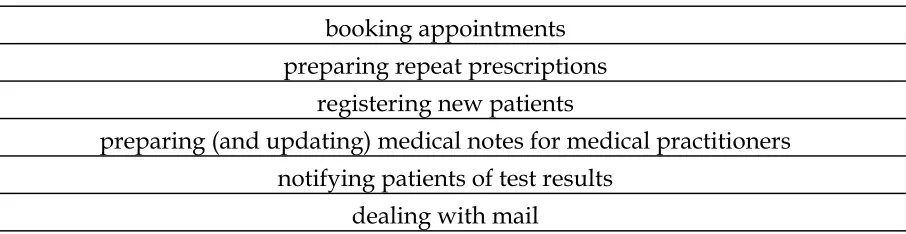
Associated with the set of identified generic sub-tasks there were a corresponding set of activities. An activity is that set of behaviours which carry out a generic sub-task.
The activities identified in medical reception are shown in Table 5:
INSERT TABLE 5 ABOUT HERE
The description of the medical reception domain as part of the PCMT-MR model is now complete. The next section describes the second part of the model - the medical reception worksystem.
3.2 Medical Reception Worksystem
The expression of the medical reception worksystem in Figure 4 shows the cognitive structures of the PCMT framework (described in Section 1.3). The relationships between the cognitive structures in Figure 4 embody the planning and control behaviours described in Section 1.3 (for more details see Smith et al, 1992b). The framework comprises four processes - planning, controlling, perceiving and executing - and two representations - plans and knowledge-of-tasks. Within medical reception, these cognitive structures were identified as follows.
• A perceiving process by which the receptionist acquires information about the medical cases and updates their knowledge of tasks. For example, perceiving information about when and with whom a patient requires an appointment.
appointment today, the receptionist will select and mentally mark a possible appointment slot in the task plan i.e. in the appointment book.
• An executing process, which transforms the attribute values of the domain objects directly. For example, informing the doctor of his appointment schedule for the morning transforms the medical practitioner object attribute of knowledge of appointment from a value of not informed to informed.
• A controlling process, which decides which of the other processes should be carried out next, based on the plans and knowledge-of-tasks. For example, having information about a patient's desired doctor for an appointment, and having updated the knowledge-of-tasks - if the desired appointment time is still not known, and the patient is readily accessible, then the controlling process may direct the perceiving process to elicit the required information from the patient, in preference to directing the perceiving process to answer a telephone ringing within the worksystem.
• A plan representation structure which embodies three plan types: the task plan; activity plan; and procedure plan.
• A knowledge-of-tasks structure which represents knowledge of relevant aspects of the work domain. For example, the required drug name for a particular repeat prescription.
These representations and processes are distributed across the receptionist and physically distinct worksystem devices. For example, the appointment book embodies part of the task plan as it contains information about the identity of the patient, the doctor, and the time and day of an appointment. The information is specific to a particular medical case, and thus to a specific task. The receptionists' mental markers (see below for details) also embody part of the task plan, as the mental markers are mental representations of available appointment times with particular doctors. These times are specific to particular medical cases and therefore to specific tasks. The telephone and the receptionist together embody a perceiving process of the worksystem. Thus as a perceiving device the telephone is activated by someone trying to contact the worksystem and therefore rings. The receptionist must then pick up the receiver of the telephone in order to complete the perceiving process of the worksystem of discovering the nature of the call and updating the knowledge-of-tasks representation, with information perceived via the telephone.
The plan representation structure in Figure 4 has been 'opened-up' to show the different types of plan identified in this study. These types will now be described in detail.
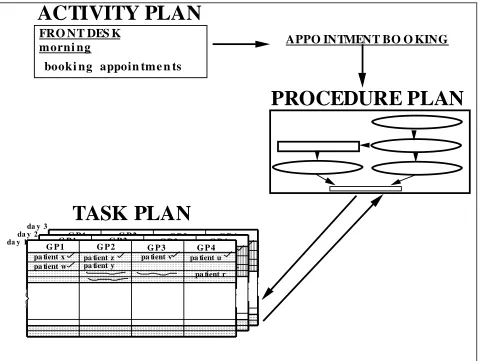
In the PCMT-MR model, plans are representations of how tasks are to be accomplished, specified to some level of completeness, some level of detail and in some format. In the study of medical reception, it was possible to identify three different types of plan employed by the worksystem. This section describes these three types in turn, and shows how they were interpreted as instances of three general types of plan: a task plan; an activity plan; and a procedure plan.
The Task Plan
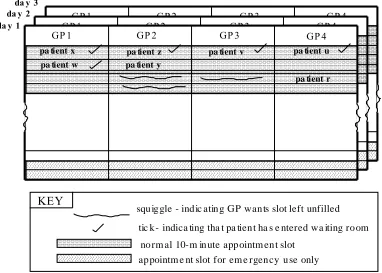
The receptionists used two appointment books (one for doctors and one for nurses) to represent and record details of patient appointments. Figure 5 schematically depicts all the information represented in the appointment book for doctors: names of patients occupying particular appointment slots; whether or not the patient had entered the waiting room; slots which were still available; slots which the medical practitioners wanted to be left open; slots which could be used in emergencies. The receptionists also used what can be called 'mental markers'; that is, they made mental notes of temporary significant appointment slots, such as the next available appointment of a particular medical practitioner or a slot which was in the process of being offered to a patient, but not yet accepted.
INSERT FIGURE 5 ABOUT HERE
In the present analysis, the appointment books, plus the associated mental markers, were regarded as plans of the medical reception worksystem, because they guided its behaviour. For example, they represented the patients whose medical notes needed to be prepared for the doctor, and the patients who should be allowed into the waiting-room. In terms of the PCMT-MR model, the appointment books were plans which represented information about domain object attribute values. Specifically, they represented information about the patient object attributes of time and appointment-medical practitioner, and the appointment-medical practitioner object attribute of availability (see Figure 4).
treatment and diagnosis objects. Further, they contained specifications of only domain object transformations and not of behaviours.
The task plan, observed in the form of patient appointment books, supported the effective performance of the multiple tasks within medical reception work by:
• giving guidance for the performance of behaviours relating to specific tasks; e.g. whether to admit Patient P1 to the waiting room, preparing medical notes for Patient P2;
• co-ordinating different tasks; e.g. ensuring that appointments were unique for each task.
The Activity Plan
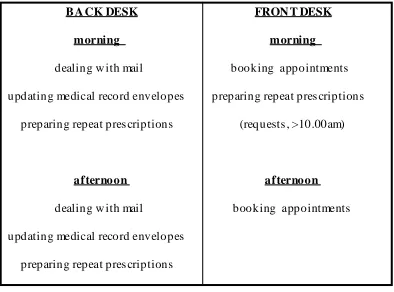
As described earlier, the medical reception worksystem carried out a number of different activities, e.g. booking appointments, preparing medical notes. From the video recording and interview, it was possible to identify that the receptionists had a shared daily schedule of activities, mentally represented, to be carried out by the front and back desk receptionists. Figure 6 shows the complete activity schedule of the observed medical reception worksystem on the day of recording. This schedule was not rigidly adhered to as many activities, such as notification of test results, were carried out in direct response to autonomous events such as patients telephoning the surgery.
INSERT FIGURE 6 ABOUT HERE
The information represented in the activity schedule was specific to the carrying out of particular activities, as opposed to particular tasks. The activity schedule was, therefore, identified as an instance of a generic type of plan - the activity plan. In general, activity plans are specifications of sequences of activities to be carried out; where each activity is a set of behaviours relating to a particular generic sub-task of the domain (see Section 3.1).
The activity plan, observed in the form of a (mentally represented) daily schedule of activities, contributed to the effective performance of tasks by:
• supporting extensive sharing of effort across separate tasks; e.g. when carrying out the activity of preparing repeat prescriptions, all of the medical notes for the patients requiring repeat prescriptions would be collected together at one time.
• co-ordinating the activities with the task-relevant changes in the domain; e.g. the activity of preparing repeat prescriptions was carried out during surgery hours, so that the prescriptions were ready for the doctors to verify and sign when the surgeries finished.
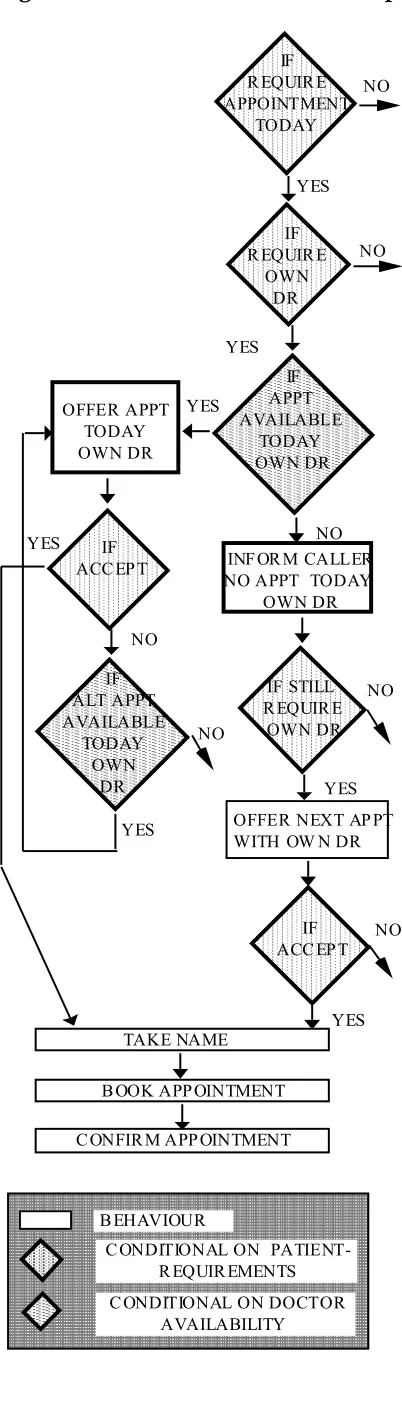
From analysis of the video recordings, supported by interviews, it was possible to identify that the receptionist performed well-established sequences of behaviours when carrying out a particular activity. Thus, the receptionists had mental routine structures, which represented information about behaviours and their contingencies for particular activities. These routine structures were identified as instances of a generic type of plan - the procedure plan. In general, a procedure plan specifies an efficient sequence of behaviours, and their contingencies, for carrying out a particular activity which relates to a generic sub-task of the domain (see Section 3.1).
There are two stages in specifying a procedure plan for a particular activity. The first stage requires the informal documentation of the procedure for carrying out a particular activity, based on the analysis of the protocols. The second stage requires a more precise description to identify clearly the worksystem behaviours and their associated domain object transformations, and to represent this information in a more structured manner.
As an illustration, the procedure plan for booking appointments is now described in detail. Informal descriptions of the other activities identified within medical reception appear in Appendix 1.
INSERT FIGURE 7 ABOUT HERE
Figure 7 shows a flow diagram of behaviours to carry out the activity of booking appointments. The conditionals imply other behaviours; for example, the first conditional in Figure 7 implies that the controlling process must initiate the behaviour of reading the contents of Knowledge-of-tasks and, if necessary, perceiving the patient's requirement for appointment time (see Figure 4). Thus, this procedure plan for booking of appointments describes the behaviours of the worksystem in terms of both the planning, control, perception and execution behaviours and the transformation of the medical case objects that constitute the generic sub-task of appointment-booking (see next Section). Figure 7 is only a small section of the procedure plan for booking of appointments; the full plan appears in Appendix 2.
The Procedure plans, inferred in the form of mental routine structures, supported the effective performance of generic sub-tasks. Specifically, medical reception task quality, in support of medical cases, was maintained by:
• providing quick responses in a domain with a very high frequency of autonomous events (patients arriving, incoming telephone calls);
• supporting shared behaviour, such that if one workstation was left unattended because a receptionist was busy, the other receptionist on that shift could take over at the unattended workstation.
Maintaining medical reception task quality by means of procedure plans was sometimes associated with higher medical reception costs (supporting shared user behaviour) and sometimes lower costs (supporting rotation of receptionists).
The Relationship between the Types of Plans
The following case of an appointment being booked illustrates the relationship between the three types of plan shown in Figure 4, and indicates how they operated in combination to guide the worksystem's behaviour.
INSERT FIGURE 8 ABOUT HERE
At the beginning of the day, the controlling process of the medical reception worksystem reads the activity plan - which specifies that receptionist R should carry out booking appointments from the front-desk during the morning (Figure 8) - and sets the parameters of the perceiving, executing and planning processes appropriately.
Later, an autonomous event occurs associated with the domain: patient P telephones the surgery requiring an appointment. The controlling process then reads from the procedure plan for booking appointments (Figure 8) which guides control decisions to activate the following sequence of behaviours:
• perception: detecting the values of patient P's attributes and updating knowledge-of-tasks with the following attribute values:
appointment-requirements-who: own Dr (Dr X) appointment-requirements-when: today
problem type: not emergency
• planning: selecting and (mentally) marking a possible appointment slot in the task plan (i.e. the appointment book): Dr X, time t
• execution: offering the selected appointment to patient P, i.e. attempt to transform P's attribute values to:
appointment-practitioner: Dr X appointment-time: time t
• perception: updating knowledge-of-tasks to register the acceptance of the appointment and patient P's name.
This description completes the PCMT-MR model, based on the protocol data of the observational study and the PCMT framework.
3.3 Extension of PCMT Framework
The investigation of medical reception has indicated that the differentiated plan types of task, activity, and procedure are generic with respect to the MR model. Abstracting away from medical reception, it is hypothesised that the three plan types are also generic at the level of the PCMT framework. They might be expected to occur in other domains of planning and control of multiple tasks. The PCMT framework, therefore has been extended to accommodate: task plans; activity plans; and procedure plans. The extension is illustrated in Figure 4, which identifies the purely PCMT components of the plan framework.
3.4 Medical Reception Performance
As reported in Section 3.2, the MR model consists of the medical reception domain of application and the medical reception multiple task planning and control worksystem. The relationship between the medical reception domain and the medical reception worksystem can be expressed as MR performance. MR performance comprises two factors. MR task quality expresses the support provided to the medical case histories, that is how well they are supported. For example, the effective performance for the sub-task of preparation of repeat prescriptions, (which transforms the medical case object attribute of treatment support accuracy), was supported by each repeat prescription being issued within 24 hours of a request being made, that is, with acceptable expedition. MR user costs express the physical and mental costs to the receptionists and devices of the medical reception worksystem in carrying out medical reception work. For example, to provide quick accurate responses to requests for appointments, in a domain with a very high frequency of appointment requests, either from patients arriving at the surgery, or from incoming calls, the mental costs to the receptionists were high. They needed to memorise, that is create a structural representation of some of the information appearing in the appointment book (time and name of doctor of available appointments), and process these appointment representations.
deal with the preparing of the repeat prescriptions, while the second could deal with the appointment-booking. MR performance is thus considered acceptable. However, if MR task quality and MR user costs are not as desired, then MR performance is not acceptable and there is a design problem. For example, in the mornings at the surgery, the number of incoming telephone calls, and patients arriving at the surgery can be very high. The front desk receptionist must deal with patients arriving at the surgery (to see the doctor, to book an appointment, to request a test result etc.) and requests for appointments through incoming telephone calls. If the receptionist is booking an appointment at the hatch, then they cannot answer the telephone, so another person at the surgery will answer the telephone. As each line is answered, if the caller requires an appointment, then they will be put on hold until the front desk receptionist can deal with them. There can be up to eight callers waiting to book appointments by telephone, and people waiting at the surgery to book appointments, and to make other requests of the receptionists. As the number of patients waiting increases, the MR task quality for the support of each medical case decreases, and the costs to the receptionists increase with the stress and confusion. MR performance would thus be considered unacceptable. The solution to the design problem would be the specification of the structures and behaviours of a medical reception worksystem whose MR performance would be acceptable.
Thus, the medical reception domain and worksystem are of necessity parts of the MR model, because both are required to express MR performance as MR task quality and MR user costs, and because MR design problems are expressed as unacceptable MR performance. Being commensurate in this way, allows the MR model to support the solution of MR design problems.
4 THE USE OF THE MODEL IN SUPPORTING THE DESIGN OF MEDICAL RECEPTION WORKSYSTEMS
specify-and-implement type of design practice is where solutions to design problems are iteratively specified and implemented until a desired implementation is achieved. Structured design methods distinguish the specification of interactive systems from their implementation, provide notations and procedures to support design, and use software tools to carry out the procedures (see e.g. Sommerville 1989).
Secondly, the research has implemented a computer simulation of the PCMT-MR model as a 'concept demonstrator' for a design tool. This simulation is written in an object-oriented discrete event simulation language called MODSIM-II. This tool is intended to show in principle how a design-oriented model might assist designers in generating and evaluating alternative medical reception worksystem configurations, by supporting the manipulation of planning and control structures and by predicting their effects on performance. By demonstrating and invesigating how the PCMT-MR model might support designers, this work aims to establish more firmly the desirable content, format and role of design-oriented models. Full details of the simulation will be reported elsewhere (Whitefield et al, manuscript in preparation). Suffice it to say here that all the components of the PCMT-MR model, including the domain and the worksystem, have been implemented in the simulation.
Thirdly, the research has mapped the concepts of the PCMT framework (and hence of the PCMT-MR model and the design tool) to the concepts used in structured design methods (the targeted type of design practice). Clear proposals exist, therefore, of how to incorporate the model into the design methods and how to represent its components for the designers. This would enhance this type of design practice through the reduction of the number of costly specify-implement cycles, by informing the specification process and introducing relevant knowledge at an early stage of design. Again, the full details of this mapping will be reported elsewhere (Whitefield et al, manuscript in preparation).
The PCMT-MR model would inform the designer of the identified plans and plan types. The designer would then need to consider whether and how the identified plans would be included in, and supported by, the new design of the worksystem. For example, the designer might consider two alternative ways to implement a procedure plan for appointment-booking. One way might involve, as the default presentation on the display screen, only the free appointment slots for each doctor; the filled appointments would be shown only when the medical receptionist requested them by some appropriate behaviour at the interface. The other way might involve, as the default presentation, all appointment slots for each doctor, both filled and free; in this case fewer free appointments will be shown on screen at any time, and the medical receptionist may need to request further appointments to be shown by some appropriate behaviour at the interface.
It would then be possible to use a design tool based on the PCMT-MR model to predict the performance of each of these proposed worksystem designs, and so prescribe a design solution, for different domains of application (i.e. for different numbers of doctors, patients, patterns of appointment requests, and so on). The (hypothetical) outcome might be as follows.
Both designs lead to the same task quality, and so meet that requirement of the design problem. That is, both designs can display on screen all the free appointments and these can therefore be offered to the patient for them to select the most suitable. Thus, the value of the medical case object attribute suitability of appointment for the patient will be transformed to suitable in both cases, and task quality will be acceptable. To transform the attribute suitability of appointment for the patient, the attribute values of appointment-time and appointment-medical practitioner of the patient sub-object must be transformed. The values of these attributes must then be compared with the attribute values of appointment requirements: who and appointment requirements: when of the patient sub-object, to determine the value of the suitability of the appointment for the patient attribute.
behaviours here include: reading the knowledge-of-tasks representation to identify the appointment requirements: who and appointment requirements: when of the patient sub-object; reading the task plan representation (displayed on the screen) to identify the availability of the medical practitioner objects (i.e. free appointments); manipulating the task plan representation to display other free appointments; and matching free appointments to the patient's requirements. On occasions when the filled appointments do need to be shown (i.e. when a patient requests a change in the time of a previously booked appointment), the receptionist will have to perform more planning behaviours to display the filled appointments and their resource costs will therefore increase.
When the proportion of appointment change requests is high, the performance of the second worksystem design (showing both filled and free appointments) is more effective. The reason is because information about filled appointments is always present, which means the receptionist has to perform the fewest number of planning behaviours to change an appointment time, which leads to low resource costs for the worksystem. But for new appointment requests, the worksystem will need to perform more planning behaviours to find a suitable appointment (because fewer free appointments are shown at any time) which will increase the resource costs for the worksystem.
The overall performance of the two designs therefore differs, and the designer could make an appropriate decision, based on information about the particular domain, which would contribute to the solution of the design problem.
This example is intended to illustrate how the PCMT-MR model, in the form of a software design tool, might provide designers of interactive computer support with predictive information about worksystem performance and so prescriptive solutions to worksystem design problems. Such a design tool is not currently available. However, the construction of a tool and its application, both based on the the PCMT-MR model, are both in principle realisable.
5 CONCLUDING COMMENTS
This paper has reported an investigation of the planning and control of multiple task work in the domain of medical reception. The outcomes of the investigation can be summarised as:
• protocol data concerning medical reception
• a model of medical reception consisting of a worksystem and its domain of application
• an illustration of the application of the model to solve a design problem associated with the performance of an interactive medical reception planning and control worksystem.
The current status of the outcomes of the investigation must be considered preliminary at this time. Data were collected concerning only one medical reception practice. Observation of additional medical practices would be necessary to verify and validate the model of medical reception. Further development of the model would seek to identify and conceptualise new phenomena and to refine the existing concepts. For the domain of application, development would provide a richer description of the object attributes, their required transformations and the relationships between those transformations. For the interactive worksystem, development would provide a richer description of planning and control structures. For performance, development would provide a wider and deeper description of resource costs incurred by the worksystems's planning and control behaviours and the task quality associated with the multiple task work carried out in the domain. Likewise, further studies of planning and control in domains other than secretarial office administration and medical reception would be necessary to confirm the framework for the planning and control of multiple task work. An investigation to this end has already been conducted into a third domain - that of solicitors' work (the data have been analysed, but not yet reported). Lastly, the computer simulation of the medical reception model needs to be developed into a software tool to support the solution of design problems associated with the performance of interactive medical reception worksystems.
carried out by the worksystem in its domain of application. Together, the worksystem and the domain of application can be used to construct an expression of MR performance, that is how well the medical reception worksystem carries out its medical reception work. Third, the form and granularity of the theory is commensurate with the applied problem (and so its solution). If the design problem is expressed as MR performance (at some desired level), then the model of the medical reception worksystem and its domain of application are of necessity commensurate with the problem, since MR performance is an expression of their relationship. Embodying the model of medical reception in a software tool will make it likewise commensurate in form for supporting the solution of design problems.
ACKNOWLEDGEMENT
The work reported herein was supported by the Joint Councils Initiative in Cognitive Science/HCI, grant no: SPG 8825634.
REFERENCES
Ambros-Ingerson, J.A. 1986. Relationships between planning and execution. Quarterly Newsletter of the Society for the Study of Artificial Intelligence and Simulation of Behaviour, 57, 11-14.
Broadbent, D.E. (1971a) Relation between theory and application in psychology. Dorchester: Dorset Press.
Broadbent, D.E. (1971b) Decision and Stress. London: Academic Press.
Dowell, J. and Long, J. (1989) Towards a conception for an engineering discipline of human factors. Ergonomics, 32, , 1513-1536.
Drury, M. (1981) The medical secretary's and receptionist's handbook 4th ed. London: Bailliere Tindall.
Hayes-Roth, B. (1985). A blackboard architecture for control. Artificial Intelligence. 26, 251-321.
Hollnagel, E., Mancini, G. and Woods, D. (1988). Cognitive Engineering in Complex Dynamic Worlds. London: Academic Press.
Jeffreys, M. and Sachs, H. (1983). Rethinking General Practice: Dilemmas in Primary Health Care. London: Tavistock.
Larkin, J.H. (1989) Display-based problem solving. In D.Klahr and K.Kotovsky (Eds) Complex Information Processing: The Impact of Herbert A. Simon. Hillsdale, NJ: Lawrence Erlbaum..
Newell, A and Simon, H. (1972) Human Problem Solving. Prentice-Hall.
Payne, S.J. (1991) Display-based action at the user interface. International Journal of Man-Machine Studies, 35, 275-289.
Sommerville, I. (1989) Software Engineering 3rd ed. Wokingham: Addison Wesley.
Smith, M.W., Hill, B., Long, J.B. and Whitefield, A.D. (1992a) The Planning and Control of Multiple Task Work: a Study of Secretarial Office Administration. In Proceedings of the Second Interdisciplinary Workshop on Mental Models. Cambridge, 74-83, in press.
Worksystems. In D.Diaper, M.Harrison and A.Monk (Eds) People and Computers VII; Proceedings of HCI '92. Cambridge University Press.
Smith, M.W., Hill, B., Long, J.B. and Whitefield, A.D. (1993) A Design-Oriented Framework of the Planning and Control of Multiple Task Work. Submitted for publication.
Suchman, L.A. (1987) Plans and situated actions. Cambridge University Press.
Figure 2 A plan view of the medical reception worksystem
FILING CABINET
PHO NE
NU RSES' APPO IN TMENT
BOO K PRESCRIPTIO NS
BOX LETTERS
BOX NO TE-PA D PHO NE
MEDICAL RECORDS
TO P ATIENT W AITING ROOM STREET ENTRANCE H A T CH PO ST T R A Y S F O R ME D IC A L H E A L T H W O R K E RS PHO NE
NO TE-PA D DO CTORS'
APPO IN TMENT BOO K DESK RACK
Figure 3: Extract from the protocol data
flash
1
PICK UP1
(over) telephone SAY: Can I help?2
PICK UP green card (?baby registration card of P2) from hatch2
READ green card2
PUT green card on1
(over) telephone SAY: No I'm sorry I've got nothingNurse look at
1
(over) telephone SAY: Did you say it's an eye infection1
(over) telephone SAY: Right. I've got literally nothing1
(over) telephone SAY: All I can offer you is 11:45 this morning - an emergency appointmentSEARCH
1
(over) telephone SAY: Or 10 past 10 with Dr J tomorrowmorning
TAKE OUT prescription
1
(over) telephone SAY: OK your name again?1
WRITE in1
(over) telephone SAY: OK: 11:45 Dr I1
(over) telephone SAY: Thank you bye1
REPLACE2
SAY: (to hatch) Have you not got a card when you registeredthe baby with the Shire Hall?
(For an explanation of the numbers see text) KEY
UPPERCASE TEXT BEHAVIOUR of the worksystem
Table 1 Generic sub-tasks
appointment-booking repeat prescription preparation
new patient registration
medical notes for medical practitioners preparation (and updating) patient test results notification
Tables 2a-2c - Appointment-booking Table 2a: Medical Case Object
Attribute Initial value transform Final value
suitability of appointment for patient
not known ---> suitable
suitability of appointment for doctor
not known ---> suitable
Table 2b: Patient Object
Attribute Initial value transform Final value
appointment-requirements: who (*)
Dr Y Dr Y
appointment-requirements: when (*)
Wednesday Wednesday
problem type (*) No emergency No emergency
appointment-time none ---> Wednesday
appointment-medical practitioner
none ---> Dr Y
knowledge of appointment availability
not informed ---> informed
Table 2c: Medical Practitioner Object
Attribute Initial value transform Final value
booking requirements (*) squiggles open squiggles open
availability (*) all
appointments
all
appointments
knowledge of appointment not informed ---> informed
Tables 3a-3c - Repeat Prescription Preparation Table 3a Medical Case Object
Attribute Initial value transform Final value
treatment support accuracy not known ---> accurate
Table 3b: Treatment Object
Attribute Initial value transform Final value
patient identity (*) Mrs X Mrs X
medical practitioner identity
(*) Dr Y Dr Y
informational content none ---> prescribed
treatment X
authorisation unauthorised ---> authorised
location with receptionist
with Dr Y at reception
---> ---> --->
with Dr Y
with receptionist with Mrs X Table 3c: Medical Practitioner Object
Attribute Initial value transform Final value
intended treatment (*) prescribed
treatment X prescribed treatment X
Tables 4a-4c - Medical Notes Preparation and updating Table 4a Medical Case Object
Attribute Initial value transform Final value
Diagnosis support accuracy not known ---> accurate
Table 4b: Diagnosis Object
Attribute Initial value transform Final value
Patient identity (*) Mrs X Mrs X
Medical practitioner identity
(*) Dr Y Dr Y
informational content Mrs X details ---> Mrs X details
location in filing room
at reception ---> ---> at reception in Dr Y's tray Table 4c: Patient object
Attribute Initial value transform Final value
intended treatment (*) prescribed
treatment X prescribed treatment X
appointment-time Wednesday Wednesday
appointment-medical
Table 5 Activities
booking appointments preparing repeat prescriptions
registering new patients
preparing (and updating) medical notes for medical practitioners notifying patients of test results
Figure 5 The Appointment Book for the Doctors - a Partial Task Plan
GP 1 GP 2 GP 3 GP 4
GP 1 GP 2 GP 3 GP 4
GP 1 GP 2 GP 3 GP 4
da y 1 da y 2
da y 3
pa tient x
pa tient y pa tient w
pa tient z pa tient v pa tient u
pa tient r
squ ig gle - ind ic atin g GP wan ts slot left unfilled
tic k - indica ting tha t pa tien t ha s e ntered wa iting ro om
no rm al 10-m in ute app ointm en t slot ap pointm e nt slot for em e rgen cy u se only
Figure 6 The Activity Plan
FRON T DESK
morning
booking appointments
preparing repeat pres criptions
(requests , >10.00am)
afternoon
booking appointments
BA CK DESK
morning
dealing w ith mail
updating medical record envelopes
preparing repeat pres criptions
afternoon
dealing w ith mail
updating medical record envelopes
Figure 7 Part of a flow chart for the procedure plan for booking appointments
C ONDITIONAL ON PATIENT- R EQUIR EMENTS C ONDITIONAL ON DOCTOR
AVAILABILITY B EHAVIOUR OFFER APPT TODAY OWN DR YES NO IF ALT APPT AVAILABLE TODAY OWN DR NO
C ONFIR M APP OINTMENT IF R EQUIR E APPOINTMENT
TODAY
YES NO
IF R EQUIR E
OWN DR
YES
NO
INF OR M CALLER NO APPT TODAY
OWN DR
YES IF STILL R EQUIR E
OWN DR NO
OFFER NEXT AP PT WITH OW N DR
YES IF
ACC EP T NO
TAKE NAME
B OOK APP OINTMENT IF
Figure 8 The relationship between plans
ACTIVITY PLAN
PROCEDURE PLAN
m orni ng
booki ng appoin tm e n ts FRO NT DES K
APPO INTMENT BO O KING
da y 2da y 3 da y 1
TASK PLAN
pa tient x
pa tient y pa tient w
pa tient z pa tient v pa tient u
pa tient r
G P1 G P2 G P3 G P4
pa tient x
pa tient y pa tient w
pa tient z pa tient v pa tient u
pa tient r
G P1 G P2 G P3 G P4
pa tient x
pa tient y pa tient w
pa tient z pa tient v pa tient u
pa tient r