Towards an Arithmetic for
Partial Computable
Functionals
Basil A. Kar ´adais
Towards an Arithmetic for
Partial Computable
Functionals
Basil A. Kar ´adais
Dissertation
an der Fakult¨at f¨ur Mathematik, Informatik und Statistik
der Ludwig–Maximilians–Universit¨at
M¨unchen
vorgelegt von
Basil A. Kar´adais
aus Thessaloniki
Zweitgutachter: Prof. Giovanni Sambin
Eidesstattliche Versicherung
Hiermit erkl¨are ich an Eidesstatt, dass die Dissertation von mir selbstst¨andig, ohne unerlaubte Beihilfe angefertigt ist.
Vasileios Kar´adais
Abstract
In English.The thesis concerns itself with non-flat Scott information systems as an
ap-propriate denotational semantics for the proposed theory TCF+, a constructive theory of higher-type partial computable functionals and approximations. We prove a defin-ability theorem for type systems with at most unary constructors via atomic-coherent information systems, and give a simple proof for the density property for arbitrary finitary type systems using coherent information systems. We introduce the notions of token matrices and eigen-neighborhoods, and use them to locate normal forms of neighborhoods, as well as to demonstrate that even non-atomic information systems feature implicit atomicity. We then establish connections between coherent informa-tion systems and various point-free structures. Finally, we introduce a fragment of TCF+and show that extensionality can be eliminated.
Auf Deutsch. Diese Dissertation befasst sich mit nicht-flachen
Dues
Mathematical research texts, according to the modern norm, bear to my mind a certain ironic resemblance to the sort of narratives you typically get when reading stories by Raymond Carver or watching films by Clint Eastwood: you’re shown the waves, but it’s the undercurrent that matters. It’s an ironic resemblance, since the modern math-ematician takes frantic care in leaving out any possible hint at the undercurrent; it’s perceived as a taboo. Mathematics after all, as we all so dutifully agree, is no art; it’s not historic, nor political, stormy love affairs, family tragedies, international financial trends or crises are all irrelevant, and so on and so forth.
Yet the undercurrent is strong, and usually manages to sneak in the text anyway. Like in the acknowledgments. So let me follow the norm.
It’s not wise to let an endeavor like this last for so long, nor, rather equivalently, is it wise to allow yourself a truly social life in the meantime: people you become thankful to accumulate at an unwieldy rate. I’ll try nevertheless.
Helmut Schwichtenberg is the one who really gave me the chance to live and work in Munich. He’s been patient and trustful all these years, he gave me a lot of leeway, and yet he was always alert and ready to spring to aid when I would get lost in all this freedom. I guess I will have to let it sink in for a while before I can tell just how much I really owe him.
I am deeply thankful to my family, my mom, my sister, and my little niece Christina who always tried to help me with my mathematical problems over the phone—if I gath-ered her suggestions in a little book, I’d get a collection of mathy fairy tales reminiscent of both Edwin Abbott and E.E. Cummings. I’m especially thankful to my father, who nevertheless won’t be reading this (as far as I know; my metaphysics is a bit rusty).
And I have to thank all people who I hold dear, like Giorgos, Thanos, Apostolos, Kostas, Brent (who also did a great job shaping up my englisch), Pavel, Ian ’n’ Leah, Sarah, Spyros, Dirk, and certainly Rhea, who’s been there when I’d otherwise be truly alone—let alone she taught me a couple of cool programming tricks. Most of these people have even had a traceable impact on the work itself, but to follow these traces would be to dive deep into the undercurrent. There are more I could mention here, but I kept it to the guys and girls that I burdened with the thesis the most, I guess.
Then the colleagues: Diana Ratiu, Lucchino Chiarabini, Bogomil Kovachev, Trifon Trifonov, Stefan Schimanski, Freiric Barral, Klaus Thiel; Florian Ranzi and Simon Huber; Parmenides Garcia Cornejo; Josef Berger; Daniel Bemb´e, Kathrin Bild, Sifis Petrakis, Kenji Miyamoto, Davide Rinaldi, and Fredrik Nordvall Forsberg; Andreas Abel, too. All of them, at one time or another, have helped, both as friends as well as scientifically.
also mention Thierry Coquand, whose few and strictly scientific remarks guided this work to an unexpected degree.
The indirect teachers too: Thomas Kuhn [26], Imre Lakatos [27], and especially Ludwig Wittgenstein’s [58], have been invaluable, instructive, and highly soothing companions whose influence ran deep throughout my research experience. It’s sad how downplayed, at times even ridiculed (see Georg Kreisel’s unfortunate [23]), such works are by the modern working mathematician, but this is I believe a topic not best suited here. These people are now dead, and aren’t going to read this text either, but hopefully somebody else who reads this will read them.
Finally, a thanks to the places: Alter SimplandZeitgeist of T¨urkenstraße; Land-hausat Tal, a.k.a. “the tree bar”;Cabaneof Theresienstraße;Flaschen¨offnerof Fraun-hoferstraße;Altes Kreuzof Falkenstraße;Gartensalonof Amalienpassage; all of them, places fit to ponder over calculations, when the office or home felt too small and the streets too open. At least, of course, up to the time when Munich was still farther east than any U.S. city and you could still have a decent smoke indoors without feeling guilty like a teenager does after sex; it’s a shame how this picturesque city’s gotten too sterile to allow for an honest way of life, but again, I guess this is a topic for some other kind of text.
Acknowledgments
I was supported by a Marie Curie Early Stage Training fellowship (MEST-CT-2004-504029) for three years. Unfortunately, I don’t know who to thank for that, other than the local MATHLOGAPS committee in Munich who trusted me with the allotted funds, and our dutiful secretary, Gerlinde Bach, who dealt with much of the dreary paperwork; for despite the outrageous bureaucratic disguise, Marie Curie funding is a blessing in most ways.
I also want to thank the people who’ve trusted me to help as a TA with their students, providing me with the means to pay my rent in my post-fellowship years: Schwichtenberg and Schuster again, and also G¨unther Krauss, Erwin Sch¨orner, Rudolf Fritsch, Michael Pr¨ahofer, Max von Renesse, Martin Hofmann, and Franz Merkl.
At this point, I would like to give a big thanks to the students too, whose trust has often been more precious and motivating than that of peers or supervisors. Clich´es are often based on truths.
That’s about it.
Contents
Abstract vii
Dues ix
Contents xi
Introduction 1
1 Atomic-coherent information systems 5
1.1 Acises and function spaces . . . 5
1.2 Ideals . . . 18
1.3 Algebraic acises . . . 28
1.4 Computability over arithmetical functionals . . . 34
1.5 Notes . . . 46
2 Matrices and coherent information systems 49 2.1 A formal matrix theory . . . 53
2.2 Algebraic matrices . . . 62
2.3 Algebraic function spaces . . . 87
2.4 Totality and density . . . 97
2.5 Notes . . . 100
3 Connections to point-free structures 105 3.1 Scott information systems . . . 105
3.2 Atomicity and coherence in information systems . . . 111
3.3 Coherent point-free structures . . . 113
3.4 Notes . . . 124
4 Elimination of extensionality 127 4.1 Heyting arithmetic in all finite types . . . 127
4.2 Elimination of extensionality in E-HAω . . . 129
4.3 Notes . . . 133
A Some domain theory 135
Bibliography 139
Introduction
In computability theory one has to deal with algorithms which are not sure to termi-nate. These algorithms naturally give rise to functionals that are definable only on the arguments for which the algorithm does terminate, that is, topartial functionals. The classical way to deal with this notion of partiality, originating in Stephen Kleene’s [21] and Georg Kreisel’s [24], is to suppose that the arguments of these functionals are them-selvestotal, in the sense that they are always defined; this approach does not prove so elegant though when one wants to develop a general theory of computation athigher
types: one needs a unified and intuitively natural way to deal with functionals, which
can accept partial arguments as well as total ones.
A more appropriate setting for this, where partiality is not introduced externally anymore, is provided by the theory ofdomains, which started with Dana Scott’s [50]: here one handles functionals which are total, in that they respond to every given ar-gument, but where the arguments themselves might be “partial”, in a sense to be ac-knowledged on the formal level: the notion of partiality should come built-in with the corresponding logical theory. The notion of approximations would then be formulated quite naturally in terms of concrete elements, characterizing the arguments at hand, as it happens for example in computations on real numbers in terms of their rational approximations.
Types and algebras
Thetype systemthat we consider in what follows builds upon “algebras”. Ahigher
typewill be formed by already given types ρ andσ as the correspondingfunction
spaceρ→σ, and everybase typeαwill be given by analgebra, that is, by a finite set
ofconstructors; every such constructorCis given with aconstructor type:
C:~ρ0→(~ρ1→α)→ · · · →(~ρr→α)→α ,
where~ρi, fori≥0, are vectors oftype variableswhich may not includeα—obviously,
our type system is defined by mutual induction1. Thearityar(C)of the constructor is defined by
ar(C)≔(~ρ0,~ρ1→α,· · ·,~ρr→α).
The arguments of type~ρ0areparametric argumentsand the arguments of type~ρi→α,
fori>0, are calledrecursive arguments.
The vectors~ρi, for alli’s, may be empty. When this is the case fori≥0, we callαa
finitary algebra; when~ρ0may not be empty but~ρiis, for alli>0, we call it
structure-finitary; in the cases where~ρi, for somei>0, are not empty, we talk of aninfinitary
1Also calledsimultaneous induction. The type system we employ in this thesis is a simplified version of
algebra. In a finitary algebra, a constructor withrrecursive arguments is simply said to have arityr. In the case of a non-parametric algebra (where~ρ0is empty), to avoid it
being empty we require that it comes with at least onenullaryconstructor, often written 0.
So, the algebraNof thenatural numberscomes with a nullary constructor 0 :N
and a unary constructorS:N→N. The algebraBof theboolean numberscomes with two nullary constructorstt:Bandff:B. The algebraOof theordinal numberscomes with a nullary constructor 0 :O, and two unary ones,S:O→Oand∪:(N→O)→O. AlgebrasNandBare finitary, butOis infinitary.
As for parametric examples, the algebraL(ρ)of lists ofρ-objects comes with a nullary constructornil:L(ρ)and a binary constructor cons :ρ→L(ρ)→L(ρ). An-other parametric example is the product algebra ρ×σ of ordered pairs of ρ- and
σ-objects, with a binary constructor(, ):ρ→σ→ρ×σ (observe here the absence
of nullary constructors). Both of these parametric algebras are structure-finitary.
Constructor expressions and partiality
A naive understanding of the structure that elements in such algebras must have comes from universal algebra (see for example in [56]). If we view the setKofall construc-tors involved in the simultaneous consideration of given algebras as a many-sorted
signature—one sort per algebra—then we can easily form thefree K-algebrain the
well-known way, namely, as the class of allK-trees(orK-terms).
In particular, supposing for example that we had to deal with the algebras
N and O, the aforementioned free K-algebra would be two-sorted, with K =
{0N,SN,0O,SO,∪O}, and among its trees one would expect to find expressions like the following2:
sortN: 0,S0,SS0,SSS0, . . .
sortO: 0,S0,SS0,SSS0, . . . ,∪(0N,0O), . . . ,∪(SS0,∪(SSS0,SS0)), . . . . Indeed, these expressions form the backbone of the carrier sets which we will use in practice; the differences will stem from the desire to allow forpartiality.
If we think of the above expressions as denoting “completed”, “total” entities, we want to allow for expressions denoting “incomplete”, “partial” entities as well; in or-der for these to be completed more information would be needed. We achieve that by introducing yet another symbol∗α for each algebraαwe consider, meaning “least
information of sortα” and behaving exactly like an extra nullary constructor, the
(par-tial) pseudo-constructor, so that, in the previous setting, we would additionally obtain
expressions like the following: sortN: ∗,S∗,SS∗,SSS∗, . . .
sortO: ∗,S∗,SS∗,SSS∗, . . . ,∪(∗N,∗O), . . . ,∪(SS∗,∪(SSS∗,SS∗)), . . . . However, since we really want to discuss computability—in other words, informa-tionon the construction and behavior of numbers, functions, and functionals that may not always be defined—the carrier sets have to be so devised, as to portray partial enti-ties in a bit more intricate way than the straightforward freeK-algebra above; namely,
2Note that the pairs(aN,bO)in expressions with the supremum constructor refer to elements of thegraph
of a sequence of ordinals, understood as amappingof typeN→O, and not to elements of the corresponding
Introduction 3
in a way that will treatconsistencyandentailment of computational informationin sat-isfactory technical detail. This calls for more structure upon our free algebras, which will be given by so calledScott information systems; for example, in algebraN, the
information token S0 is considered consistent with the tokenS∗but not toSS0, and,
in algebraO, theneighborhood(combined information){∪(0,S0),∪(S0,S0)}entails the token∪(S0,S∗)but not ∪(S0,0). One may already see that in this way we
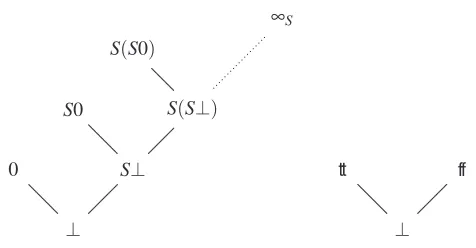
ob-tainnon-flat domains(see Figure 1.1 on page 30), as was already premised by Helmut
Schwichtenberg in [47].
Contributions to the semantics: acises, matrices, and point-free
structures
It is known (see for example [49]) that every free algebra induces a non-flat Scott information system which, as it turns out, always falls into the subclass of “coherent” information systems, where consistency can be fully described by a binary predicate. Moreover, in the special case of algebras with at most unary constructors, likeNor
B, and function spaces over them, an even simpler version of coherent information systems suffices, the ones called “atomic” in [47], where also entailment can be fully described by a binary predicate.
Non-superunary algebras like the latter, that is, algebras with at most unary con-structors, represent data types that govern a reasonably essential part of known ap-plications, and we focus onatomic-coherent information systems in Chapter 1. We introduce a version of them that we callacis, as in [47]3, but given directly as a struc-ture of tokens with two binary relations. We investigate varying notions of functions over acises, in particular token- and neighborhood-mappings versus ideals. We isolate a maximal normal form for neighborhoods. We then prove adefinability theoremfor non-superunary type systems, that is, for type systems based on non-superunary alge-bras, extending previously known results. In the end, we outline limits to our proof of definability through a characterization of non-superunary algebras bycomparability
properties.
In Chapter 2 we lose the strict atomicity demand and engage in generalcoherent
information systems. Still, the main feature of the chapter is actually the uncovering
of atomicity that hides even in these more general structures, making acises important not just because of their simplicity but also because of their fundamental role in the model. We introduce the idea of forming amatrix of tokens, and then develop amatrix
theory over acisesfor both finitary and infinitary algebras; we show that entailment
at base type is implicitly atomicby characterizing it through matrix application, since
matrices form an atomic information system. We isolate yet another normal form for base type neighborhoods, thehomogeneous normal formand prove amatrix
represen-tation theoremfor it. We then show that in the basic case of finitary algebras, base type
neighborhoods attain an even simpler normal form, theireigentoken.
Then we move on to higher types, where we single out a crucial special case of a neighborhood, theeigen-neighborhood; we show thathigher type entailment is again
implicitly atomicby characterizing it through atomic entailment on the level of
eigen-neighborhoods. We also findcanonical monotone forms for finitary neighborhoods. Finally, in way of exemplifying the introduced notions, we point the way to an intrinsic approach to the well-knowndensity theoremfor finitary type systems: we first give a
3Pronounce\‘eIsIs\to avoid sounding vulgar. We will be using the term as a proper english noun,
proof that considerably simplifies previously known proofs in settings close to ours, and then we give examples of how it may be applied.
In Chapter 3 we broaden our viewpoint to answer a simple and reasonable, yet up to this point lurking question: what kind of point-free structures correspond to the coherent information systems that we use here? Point-free topology and higher-type computability are intertwined to a considerable extent—the former providing the topo-logical understanding for the type systems of the latter—and this is a connection that ought to be made. To this end, besidesdomains, we consider two well-known point-free structures, namelyprecuslsandformal topologies, and impose furthercoherence
conditionson them that achieve the correspondence that we seek.
. . . and a contribution to the syntax: towards an arithmetic for
par-tial computable functionals
The motivation for delving so deeply into amathematical theory of coherent Scott
in-formation systems, comes from implementation considerations. The overall project is
alogical theory of arithmetic with approximationsto be implemented in aproof
assis-tant—the first steps in such a theory are described in [18]—but for such a goal one must firstly have a refined enough understanding of the model of the theory. Implementation guides one to (a) avoid using abstract domains as abstract higher-type computability theory would have it and rather turn to their tangible representation through informa-tion systems, (b) narrow one’s focus on the relevantcoherentinformation systems, and (c) try to find viewpoints within the model that present it in both intuitive and tech-nically simple ways; the premise being that the latter should lead to a simpler logical theory and thus to a simpler implementation.
This necessary process of understanding the model, that is, the mathematical theory of coherent information systems, proved enough to fill up three chapters, and for the anticipated logical theory we can afford here merely one. In Chapter 4 we provide a version of the old argument of Robin Gandy’s [12] and show howextensionality can
be eliminatedin such a theory, as one would like to have.
Organization of the material
Chapter 1
Atomic-coherent information
systems
In this chapter we concentrate on data types as simple as the natural or the boolean numbers—in general, types of objects that constructors of at most unary arity1 can build. Such objects are of well-known value application-wise, but also play a funda-mental role in the mathematical theory, as we will see in Chapter 2. To model such types we use theatomic-coherent information systems, oracises, that were introduced in [47].
Preview
The main plot of the chapter concernsdefinability for non-superunary types. In sec-tion 1.1 we go through basic facts concerning acises and their funcsec-tion spaces, and we linger a bit on a study of different notions of mappings between them. In section 1.2 we study ideals of acises from an elementary topological and category-theoretic viewpoint. In section 1.3 we show how given non-superunary algebras induce acises, state simple facts about them, and describe a normal form for their neighborhoods. In section 1.4 we prove thedefinability theorem1.46, as well as the characterization of non-superunary algebras via comparability properties in Theorem 1.50.
1.1
Acises and function spaces
Consistency and entailment as binary predicates
Anatomic-coherent information system, being a special kind of a Scott information
system, was first described in [47] as a tripleρ= (T,Con,≻)2, wherebyT is a
count-able set,Conis a nonempty set of finite subsets ofT, and≻is a binary relation, such that
1. ≻is reflexive and transitive, that is, a preorder,
1For the arity of a constructor see page 1.
2A notational convention throughout the text is thatι,α,β, γ. . . denotebase types, whereasρ, σ,
2. ∅∈Con∧
∀
a∈T{a} ∈Con,3. U∈Con⇔
∀
a,b∈U{a,b} ∈Con,4. {a,b} ∈Con∧b≻c→ {a,c} ∈Con.
Call the elements ofT tokens, ofConneighborhoods(orconsistent sets), and≻
en-tailment relationofρ, and writeU≻afor
∃
b∈Ub≻aandU≻V for∀
a∈VU≻a.Thecoherence property, stated in axiom 3 above, makes it possible to describe this
structure graph-theoretically, as a set with two binary relations. Call anacis grapha tripleρ= (T,≍,≻), wherebyT is again a countable set and≍and≻are two binary relations onT such that
1. ≍is reflexive and symmetric,
2. ≻is reflexive and transitive,
3. ifa≍bandb≻cthena≍c, for alla,b,c∈T.
Call≍aconsistency relationand writeU≍afor
∀
b∈Ub≍aandU≍Vfor∀
a∈VU≍a. Let us also call the third axiompropagation of consistency. One can see that such a graph has all≍- and≻-loops and is≍-undirected but≻-directed.
The notion of an acis graph is equivalent to the notion of an atomic-coherent infor-mation system. First, it is easy to notice that in an acis graph(T,≍,≻)it is
∀
a,b∈A
a≻b→a≍b,
by the reflexivity and propagation of consistency. Then we have the following.
Proposition 1.1. Every acis graph corresponds to an atomic-coherent information sys-tem, and vice-versa.
Proof. For the right direction, define the neighborhoods of an acis graph to be the finite
sets which have thecoherence property, that is
U∈Con≔U⊆f T∧
∀
a,b∈Ua≍b
—in graph-theoretic terms, the neighborhoods of an acis graph are exactly its finite≍ -clusters. For the left direction, define the consistency relation in an atomic-information system by
a≍b≔{a,b} ∈Con.
It is easy to check that the details hold.
This justifies our use of the term atomic-coherent information system with the meaning “acis graph”, and indeed in what follows we will not differentiate between the two.3
3For a more general discussion of atomicity and coherence in the context of Scott information systems as
1.1 Acises and function spaces 7
Basic notions and facts
So anatomic-coherent information system, or simply anacis, is a tripleρ= (T,≍,≻), where T is thecarrier, a nonempty countable set, the elements of which are called
tokens(or atoms),≍is theconsistency, a reflexive and symmetric binary relation on
T and≻is the entailment, a reflexive and transitive binary relation onT, such that
consistency propagates through entailment, that is,
∀
a,b,c∈T(
a≍b∧b≻c→a≍c).
ForU,V⊆T, writeU≍V for
∀
a∈U∀
b∈Va≍bandU≻V for∀
b∈V∃
a∈Ua≻b.The classes of(formal) neighborhoods(orconsistent sets) andideals(orelements) inρare defined respectively by
U∈Con≔(U⊆f T)∧(
∀
a,b∈U
a≍b),
u∈Ide≔
∀
a,b∈u
a≍b∧
∀
a∈u(a≻b→b∈u) .
Denote theempty ideal∅∈Ideby⊥.
Proposition 1.2. The following hold in any acis, for tokens a,a′,b,b′, neighborhoods U,U′,V,V′,W and ideals u,v:
1. a≻b→a≍b.
2. a≻b∧a′≻b′∧a≍a′→b≍b′.
3. U≻V∧U′≻V′∧U≍U′→V ≍V′.
4. U≍V∧V ≻W →U≍W .
5. U,V ∈Con→U∩V ∈Con.
Proof. The first two statements follow from reflexivity and propagation of
consis-tency. For the third statement: Suppose thatU1≻V1 andU2≻V2; this unfolds to
∀
b1∈V1∃
a1∈U1a1≻b1and∀
b2∈V2∃
a2∈U2a2≻b2; since also∀
a1∈U1∀
a2∈U2a2≍a1, bythe second statement, we obtain
∀
b1∈V1∀
b2∈V2b1≍b2, that is,V1≍V2.For the fourth statement: LetU≍V andV≻W; we haveU∪V≻UandU∪V≻ W, so by the previous statement we takeU≍W. More concretely: leta∈Uandc∈W; then there is ab∈V for whicha≍bandb≻c; propagation for tokens yieldsa≍c.
The fifth statement is direct to show.
For a set of tokensX ⊆T, define its(deductive) closure and thecone (of ideals)
above it by
X≔{a∈T |X≻a} and ∇X≔{u∈Ide|X⊆u}
respectively. Denote byConthe class of all closures of neighborhoods and by Kgl the class of all cones in the acis and writea for {a} and∇a for ∇{a}. Note that the closure of a neighborhood is finite—hence itself a neighborhood—only if the en-tailment relation is finitarily branching and well-founded; so, in general,Con*Con. Note moreover, that the cone above a set of tokens is nonempty only when the set is consistent, that is, a neighborhood.
Proposition 1.3. Let X,Y⊆T and U,V∈Con.
1. If X is finite then X∈Conif and only if X∈Ide.
2. X∪Y =X∪Y .
3. X∩Y ⊇X∩Y .
4. X=S
a∈Xa.
5. X≍Y if and only if X≍Y .
6. X≻Y if and only if X⊇Y .
7. ∇⊥=Ide.
8. U∈∇U .
9. ∇U=∇U .
10. U≍V →∇U∩∇V=∇(U∪V).
11. ∇U=T
a∈U∇a.
Simple constructs
Given an acisρ, any acis(T,≍,≻)withT ⊆Tρ,≍⊆≍ρ and≻⊆≻ρ is asub-acisof ρ. In particular, for any subsetΩ⊆Tρ, we can defineρ|Ω≔(Ω,≍ρ|Ω×Ω,≻ρ|Ω×Ω). Clearly, this is again an acis, and
Ideρ|Ω=Ideρ|Ω.
Letρ = (Tρ,≍ρ,≻ρ)andσ= (Tσ,≍σ,≻σ)be two acises. Define theirdisjoint
unionρ∪σ by
Tρ∪σ≔Tρ∪Tσ,
a≍ρ∪σb≔a≍ρb∨a≍σb,
a≻ρ∪σb≔a≻ρb∨a≻σb,
provided they have disjoint carriers, that is,Tρ∩Tσ=∅. Define theirintersectionρ∩σ
by
Tρ∩σ≔Tρ∩Tσ,
a≍ρ∩σb≔a≍ρb∧a≍σb,
a≻ρ∩σb≔a≻ρb∧a≻σb.
Define theirset-theoretic productρ⊗σ by
Tρ⊗σ≔Tρ×Tσ ,
(a1,b1)≍ρ⊗σ(a2,b2)≔a1≍ρa2∧b1≍σb2,
1.1 Acises and function spaces 9
and theircartesian productρ×σ by
Tρ×σ≔Tρ∪Tσ,
a≍ρ×σb≔(a∈Tρ∧b∈Tσ)∨(a∈Tσ∧b∈Tρ)∨a≍ρb∨a≍σb,
a≻ρ×σb≔a≻ρb∨a≻σb,
provided again thatTρ∩Tσ=∅. It is easy to check the following.
Proposition 1.4. The disjoint union, intersection, set-theoretic product and cartesian product of two acises is again an acis. Furthermore, for the corresponding ideals, the
following statements hold up to isomorphism:Ideρ⋆σ=Ideρ⋆Ideσ, for⋆∈ {⊎,∩,⊗},
andIdeρ×σ⊇Ideρ×Ideσ.
Proof. All of the cases are pretty much direct to show. We show the equality of ideals
in the set-theoretic product case. Letu∈Ideρ×σ and setuρ ≔{a∈Tρ |
∃
b(a,b)∈u}anduσ≔{b∈Tσ|
∃
b(a,b)∈u}. We show thatuρ∈Ideρ (we work similarly for the σ case): For consistency, leta1,a2∈uρ, so there is abi fori=1,2 with(ai,bi)∈u;sinceuis an ideal, it is(a1,b1)≍ρ×σ(a2,b2); by the definition of≍ρ×σ, it isa1≍ρa2.
For closure under entailment, leta∈uρ anda≻ρ a′; by the definition ofuρ, there is a
bwith(a,b)∈u; by the definition of≻ρ×σ, we have(a,b)≻ρ×σ(a′,b); sinceuis an
ideal, it is(a′,b)∈u, that is,a′∈uρ.
Conversely, letuρ∈Ideρ,uσ∈Ideσand setu≔uρ×uσ. We show thatu∈Ideρ×σ.
For consistency, let(ai,bi)∈u,i=1,2; sinceuρ anduσ are ideals, it isa1≍ρ a2and
b1≍σb2, so, by the definition of≍ρ×σ, it is(a1,b1)≍ρ×σ(a2,b2). For closure under
entailment, let(a,b)∈uand(a,b)≻ρ×σ(a′,b′); by the definition of≻ρ×σ, we get
a≻ρa′ andb≻σb′ and sinceuρ anduσ are ideals, it isa′∈uρ andb′∈uσ, that is,
(a′,b′)∈u.
For the cartesian product case: The properties of≍ρ×σ and≻ρ×σ are direct. For
the propagation of consistency, starting without loss of generality with the definition, we have:
a≍ρ×σb∧b≻ρ×σc⇔"(a∈Tρ∧b∈Tσ)∨a≍ρb∨a≍σb
∧"
b≻ρc∨b≻σc
⇔"
(a∈Tρ∧b∈Tσ∧b≻ρc)
∨(a∈Tρ∧b∈Tσ∧b≻σc)
∨"
(a≍ρb∧b≻ρc)∨(a≍ρ b∧b≻σc)
∨"
(a≍σb∧b≻ρc)∨(a≍σb∧b≻σc)
⇒(⊥ ∨(a∈Tρ∧c∈Tρ))∨(a≍ρc∨ ⊥)∨(⊥ ∨a≍σc)
def
⇔a≍ρ×σc.
Function Spaces
For our purposes, the most important construct between two acisesρ andσ is their
function spaceρ→σ= (T,≍,≻), which is defined by
T≔Conρ×Tσ,
(U,a)≍(V,b)≔U≍ρV→a≍σb,
(U,a)≻(V,b)≔V≻ρU∧a≻σb.
Proposition 1.5. The function space between two acises is again an acis.
Proof. The axioms for ≍and≻ are easy to check. For the axiom of propagation:
Suppose that(U,a)≍(V,b)and(V,b)≻(W,c); by the definition of consistency and entailment in the function space we haveU≍ρV →a≍σ bandW ≻ρV∧b≻σc;
we want to show that (U,a)≍(W,c), or equivalently thatU ≍ρ W →a≍σ c; let
U≍ρW; by the second statement of Proposition 1.2, sinceU≍ρW∧W≻ρV, we have
U≍ρV, which by the assumption of consistency inρ→σ yieldsa≍σb; propagation
of consistency inσgivesa≍σc.
The following are direct consequences of the definition of the function space.
Proposition 1.6. For a function spaceρ→σ the following hold:
1. U6≍ρV→
∀
a,b∈Tσ(U,a)≍ρ→σ(V,b).2. (U,a)≍ρ→σ(V,b)→(U,b)≍ρ→σ(V,a).
3. a≻σb→
∀
U∈Conρ(U,a)≻ρ→σ(U,b).4. V≻ρU→
∀
a∈Tσ(U,a)≻ρ→σ(V,a).Morphisms of acises
Token-mappings
Atoken-mapping f fromρtoσ is a total mappingf :Tρ→Tσ. It ismonotonewhen
a≻ρb→f(a)≻σ f(b),
consistency-preservingwhen
a≍ρb→f(a)≍σ f(b),
and ahomomorphismwhen it is both monotone and consistency-preserving. A ho-momorphism is furthermore amonomorphism,epimorphismorisomorphismwhen the token-mapping is injective, surjective or bijective respectively.
For an arbitrary token-mapping f:Tρ→Tσdefine theidealizationof f by the class
˙ııf⊆Tρ→σby
˙ııf ≔{(U,b)|
∃
a∈Tρ "
U≻ρa∧f(a)≻σb}.
For example, consider theidentity token-mappingid :Tρ→Tρ, defined by id(a)≔a;
then
1.1 Acises and function spaces 11
Another example is the constant token-mapping cnstb0 : Tρ → Tσ, defined by
cnstb0(a)≔b0, for a fixedb0∈Tσ; then
˙ııcnstb0={(U,b)|b0≻σb}.
The choice of the name stems from the following observation, due to Helmut Schwicht-enberg.
Proposition 1.7. A token-mapping f:Tρ→Tσis consistency-preserving if and only if
˙ııf∈Ideρ→σ.
Proof. For the right direction: To show consistency, let(U1,b1),(U2,b2)∈˙ııf; we want
to show that(U1,b1)≍ρ→σ(U2,b2), so letU1≍ρU2; by the definition of ˙ııf we getai’s
such thatUi≻ρai∧f(ai)≻σbi, fori=1,2; by the assumption we haveU1∪U2≻ρai,
fori=1,2, hence a1≍ρ a2; since f preserves consistency, it is f(a1)≍σ f(a2), so
Proposition 1.2(2) yieldsb1≍σb2.
To show closure under entailment, let(U1,b1)∈˙ııf and(U1,b1)≻ρ→σ(U2,b2), or,
equivalently,U2≻ρU1∧b1≻σ b2; by the definition of ˙ııf we have anawithU1≻ρ
a∧f(a)≻σb1; by the transitivity we haveU2≻ρa∧f(a)≻σb2, which is by definition
(U2,b2)∈˙ııf.
For the left direction: Let ˙ııf∈Ideρ→σanda≍ρb. Since({a},f(a)),({b},f(b))∈
˙ııf and ˙ııf is an ideal, it follows that f(a)≍σ f(b).
Clearly, ˙ııid and ˙ııcnstb0, as defined above, are ideals ofρ→ρandρ→σrespectively.
Neighborhood-mappings
It is tempting to carry the idea of idealization from the case of mappings between tokens to the case of mappings betweensets of tokens: given a mapping fromP(Tρ)
toP(Tσ), induce an ideal of the corresponding function spaceρ→σby collecting all
(U,b)’s that have an “intermediary”X⊆Tρ, that is, a set entailed byUand having an image that entailsb. Clearly, such an intermediaryXhas to be consistent, otherwise it couldn’t possibly be entailed by the neighborhoodU.
Aneighborhood-mapping f fromρtoσ is a total mapping f :Conρ →Conσ. It
ismonotonewhen
U≻ρV→ f(U)≻σ f(V),
consistency-preservingwhen
U≍ρV→ f(U)≍σ f(V),
and ahomomorphismwhen it is both monotone and consistency-preserving. A ho-momorphism is furthermore amonomorphism,epimorphismorisomorphismwhen the neighborhood-mapping is injective, surjective or bijective respectively.4
Proposition 1.8. If a neighborhood-mapping f :Conρ×σ →Conτ is
consistency-preserving then it is consistency-consistency-preserving in each component.
Proof. LetU1≍ρU2andV1≍σV2; thenf(U,V1)≍τ f(U,V2)for eachU∈Conρand
similarly f(U1,V)≍τ f(U2,V)for eachV∈Conσ.
4A neighborhood-mapping fromρtoσis nothing but atoken-mappingfromNρtoNσ, where byNρ
For an arbitrary neighborhood-mapping f :Conρ →Conσ define theidealization
of f by the class ˙ııf⊆Tρ→σby
˙ııf ≔{(U,b)|
∃
V∈Conρ "
U≻ρV∧f(V)≻σb}.
For example, consider theidentity neighborhood-mappingid :Conρ→Conρ, defined
by id(U)≔U; then
˙ııid={(U,a)|U≻ρa}.
Another example is theconstant neighborhood-mappingcnstV0 :Conρ→Conσ,
de-fined by cnstV0(U)≔V0, for a fixedV0∈Conσ; then
˙ııcnstV0={(U,b)|V0≻σb}.
Proposition 1.9. A neighborhood-mapping f : Conρ → Conσ is
consistency-preserving if and only if˙ııf∈Ideρ→σ.
Proof. We proceed similarly as in the proof of Proposition 1.7. For the right direction:
To show consistency, let(U1,b1),(U2,b2)∈˙ııf; we want to show that(U1,b1)≍ρ→σ
(U2,b2), so letU1≍ρ U2; by the definition of ˙ııf we getVi’s such thatUi≻ρVi∧
f(Vi)≻σbifori=1,2; by the assumption and Proposition 1.2(3) we haveV1≍ρV2;
since f preserves consistency, it is f(V1)≍σ f(V2), so, again by Proposition 1.2(3), it
isb1≍σb2.
To show closure under entailment, let(U1,b1)∈˙ııfand(U1,b1)≻ρ→σ(U2,b2), or,
equivalently,U2≻ρU1∧b1≻σ b2; by the definition of ˙ııf we have aV withU1≻ρ
V∧f(V)≻σb1; by transitivity and assumption we haveU2≻ρV∧f(V)≻σb2, which
is by definition(U2,b2)∈˙ııf.
For the other direction: Let ˙ııf ∈Ideρ→σ andU≍ρV. Since, for anya∈ f(U)
andb∈ f(V), it is (U,a),(V,b)∈˙ııf and ˙ııf is an ideal, it follows thata≍σ b, so
f(U)≍σ f(V).
Clearly again, ˙ııid and ˙ııcnstV0, as defined above, are ideals ofρ→ρ andρ →σ
re-spectively.
We now link neighborhood-mappings to token-mappings. Let f :Tρ →Tσ be a token-mapping. Define a mapping ınf:Conρ→Pf(Tσ)by
ınf(U)≔{f(a)|a∈U}.
Proposition 1.10. Letρ andσbe acises.
1. The mappingınf is a well-defined neighborhood-mapping fromρ toσ when f
is consistency-preserving. In this case,ınf is also consistency-preserving.
2. The mappingınf is monotone when f is monotone.
3. If f is a consistency-preserving token-mapping then˙ııf=˙ııınf .
Proof. For the first statement: LetU∈Conρ; the set ınf(U)is finite by definition,
sinceUis finite; furthermore, ifb,b′∈ınf(U), then there must exista,a′∈Ufor which
f(a) =band f(a′) =b′; butUis a neighborhood, soa≍ρa′; since f is
consistency-preserving we getb≍σb′. Now, letU≍ρV andb∈ınf(U),b′∈ınf(V); then there
1.1 Acises and function spaces 13
For the second statement: LetU≻ρV andb′∈ınf(V); by definition there exists
ana′∈V such thatf(a′) =b′; by the assumption, there must be somea∈Usuch that
a≻ρa′; setb≔ f(a)∈ınf(U); by monotonicity of f we getb≻σb′.
For the third statement: Let f :Tρ →Tσ be a consistency-preserving
token-mapping; then we have
(U,b)∈˙ııınf ⇔def
∃
V∈Conρ "
U≻ρV∧ınf(V)≻σb
def
⇔
∃
V∈Conρ
U≻ρV∧
∃
a∈Tρ
(a∈V∧f(a)≻σb)
⇔
∃
a∈TρV∈Con
∃
ρ "U≻ρV∧a∈V∧f(a)≻σb
(⋆)
⇔
∃
a∈Tρ "
U≻ρa∧f(a)≻σb
def
⇔(U,b)∈˙ııf ,
where(⋆)holds leftwards forV ≔{a}.
Closure-mappings
Given the well-foundedness of entailment in the source acis, we can move a step further and consider mappings betweenclosures Uof neighborhoods. The primary reason for this is that we can achieve a decent converse route from ideals to mappings between sets of tokens, which we cannot have in the case of token-mappings. In particular, we will establish a bijective correspondence between closure-homomorphisms fromρto
σand a class of ideals ofρ→σ, whenρhas a well-founded entailment relation.
A closure-mapping f fromρ toσ is a total mapping f :Conρ →Conσ. It is
monotonewhen
U≻ρV→ f(U)≻σ f(V),
or, equivalently by Proposition 1.2(5),
U⊇ρV→ f(U)⊇σ f(V),
consistency-preservingwhen
U≍ρV→ f(U)≍σ f(V),
and ahomomorphismwhen it is both monotone and consistency-preserving. A ho-momorphism is furthermore amonomorphism,epimorphismorisomorphismwhen the closure-mapping is injective, surjective or bijective respectively.
For an arbitrary closure-mapping f :Conρ→Conσ define theidealizationof f by
the class ˙ııf ⊆Tρ→σ by
˙ııf ≔{(U,b)|
∃
V∈Conρ "
U≻ρV∧f(V)≻σb}.
For example, consider the identity closure-mapping id :Conρ →Conρ, defined by
id(U)≔U; then
˙ııid={(U,a)|U≻ρa}.
Another example is theconstant closure-mappingcnstV0 :Conρ→Conσ, defined by
cnstV0(U)≔V0, for a fixedV0∈Conσ; then
Proposition 1.11. If f :Conρ →Conσ is a consistency-preserving closure-mapping
then˙ııf ∈Ideρ→σ.
Proof. Again, we proceed similarly as in the proof of Proposition 1.7. To show
consis-tency, let(U1,b1),(U2,b2)∈˙ııf; we want to show that(U1,b1)≍ρ→σ(U2,b2), so let
U1≍ρU2; by the definition of ˙ııfwe getVi’s withUi≻ρVi∧f(Vi)≻σbifori=1,2; by
the assumption and Proposition 1.2(3) we haveV1≍ρV2; since fpreserves consistency,
it is f(V1)≍σ f(V2), so, again by Proposition 1.2(3), we haveb1≍σb2.
To show closure under entailment, let(U1,b1)∈˙ııfand(U1,b1)≻ρ→σ(U2,b2), or,
equivalently,U2≻ρU1∧b1≻σ b2; by the definition of ˙ııf we have aV withU1≻ρ
V∧f(V)≻σb1; by transitivity and assumption we haveU2≻ρV∧f(V)≻σb2, which
is by definition(U2,b2)∈˙ııf.
Clearly again, ˙ııid and ˙ııcnstV0, as defined above, are ideals ofρ→ρ andρ →σ
re-spectively.
Now letu∈Ideρ→σ. Calluafinitely valued ideal, if for allU∈Conρ the set
mxlu(U)≔mxl{b∈Tσ|(U,b)∈u}
is finite. Denote the class of all finitely valued ideals ofρ →σ by FVIdeρ→σ. In
general
FVIdeρ→σ⊆Ideρ→σ.
It is easy to see that ˙ııid∈FVIdeρ→ρand ˙ııcnstV0∈FVIdeρ→σ.
Remark. For the sake of a counterexample, let us anticipate the arithmetical acisN→
N(see page 30); it is easy to see that{0,Sn∗ |n=0,1, . . .} ∈IdeN→NrFVIdeN→N.
For a finitely valued idealu∈Ideρ→σ, define a mapping Ihu:Conρ→Conσby
Ihu(U)≔mxlu(U).
Proposition 1.12. If u∈FVIdeρ→σ then the mapping Ihu is a well-defined
closure-homomorphism fromρtoσ.
Proof. For the well-definedness: It is easy to see that Ihuis indeed single-valued.
Fur-thermore, the class mxlu(U)is finite, sinceuis finitely valued. Now letU∈Conρ and
b,b′∈mxlu(U); we have(U,b),(U,b′)∈u; sinceuis an ideal,(U,b)≍ρ→σ(U,b′),
and sinceU≍ρU, it isb≍σb′, so mxlu(U)∈Conσ, and then mxlu(U)∈Conσ.
For the preservation of consistency: LetU,V ∈Conρ withU≍ρV and arbitrary
b∈Ihu(U)andc∈Ihu(V); by the definition of Ihuwe have(U,b),(V,c)∈u; by the definition of an ideal, (U,b)≍ρ→σ (V,c); by the consistency in ρ→σ and by the
assumption, we getb≍σc, that is, Ihu(U)≍σIhu(V).
For the monotonicity: LetU,V ∈Conρ withU ≻ρV and let c∈Ihu(V); by the
definition of Ihuwe have(V,c)∈u; by the assumption we get(V,c)≻ρ→σ(U,c)and
sinceuis an ideal,(U,c)∈u, that is,c∈Ihu(U).
Proposition 1.13. If ≻ρ is well-founded and f :Conρ →Conσ is a
1.1 Acises and function spaces 15
Proof. We have proved that ˙ııf is indeed an ideal in Proposition 1.9. It remains to
prove that it is moreover finitely valued. So letU∈Conρ and consider the setMU≔
mxl ˙ııf(U); by definition it is
MU=mxl{b∈Tσ|(U,b)∈˙ııf};
by the definition of ˙ııf, it is
MU=mxl{b∈Tσ|
∃
V∈Conρ "
U≻ρV∧f(V)≻σb},
or, since f(V)∈Conσ, by the definition of deductive closure we have
MU=mxl{b∈Tσ|
∃
V∈Conρ "
U≻ρV∧b∈f(V)};
in particular, since f(V)is the deductive closure of a neighborhood, namely, there is a
WV∈Conσsuch thatf(V) =WV, we can write
MU=mxl{b∈Tσ|
∃
V∈Conρ "
U≻ρV∧b∈WV};
by the definition of deductive closure again, it is
MU=mxl{b∈Tσ|
∃
V∈Conρ "
U≻ρV∧WV≻σb}.
Now, since ≻ρ is well-founded, the index set IU ≔{V∈Conρ|U≻ρV} is finite,
hence
MU=
[
V∈IU
mxl{b∈Tσ|WV ≻σb}=
[
V∈IU
mxlWV
is also finite, because everyWV is.
Theorem 1.14(Finitely valued ideals). Letρ,σbe acises with≻ρbeing well-founded.
The closure-homomorphisms f :Conρ →Conσ and the finitely valued ideals u∈
FVIdeρ→σare in a bijective correspondence, that is,Hom(Conρ,Conσ)FVIdeρ→σ.
Proof. We have to show that Ih and ˙ıı are mutually inverse, that is, that Ih˙ııf=f as well
as ˙ııIhu=u. For the first one we have
b∈Ih˙ııf(U)⇔def b∈mxl ˙ııf(U)
def
⇔b∈mxl{b′∈Tσ|(U,b′)∈˙ııf}
def
⇔mxl{b′∈Tσ|(U,b′)∈˙ııf} ≻σb
⇔ {b′∈Tσ|(U,b′)∈˙ııf} ≻σb
def
⇔
∃
b′∈Tσ "
(U,b′)∈˙ııf∧b′≻σb
⇔(U,b)∈˙ııf def
⇔
∃
V∈Conρ "
U≻ρV∧f(V)≻σb
mon
⇔
∃
V∈Conρ "
f(U)≻σ f(V)∧f(V)≻σb
⇔f(U)≻σb
and for the second one (U,b)∈˙ııIhu⇔def
∃
V∈Conρ "
U≻ρV∧Ihu(V)≻σb
def
⇔
∃
V∈Conρ
U≻ρV∧mxlu(V)≻σb
def
⇔
∃
V∈Conρ
U≻ρV∧mxl{b′∈Tσ|(V,b′)∈u} ≻σb
⇔
∃
V∈Conρ "
U≻ρV∧mxl{b′∈Tσ|(V,b′)∈u} ≻σb
⇔
∃
V∈Conρ "
U≻ρV∧ {b′∈Tσ|(V,b′)∈u} ≻σb
def
⇔
∃
V∈Conρ
U≻ρV∧
∃
b′∈Tσ "
(V,b′)∈u∧b′≻σb
⇔
∃
V∈Conρ "
U≻ρV∧(V,b)∈u
⇔(U,b)∈u,
as we wanted.
Finally, we link closure-mappings to token-mappings. Let f:Tρ→Tσ be a
token-mapping. Define a mapping f:Conρ→P(Tσ)by
f(U)≔{f(a)|U≻ρa}.
Proposition 1.15. Letρ andσbe acises.
1. The mapping f is a well-defined closure-mapping from ρ to σ when f is
consistency-preserving. In this case, f is also consistency-preserving.
2. The mapping f is monotone when f is monotone.
3. If f is a consistency-preserving token-mapping then˙ııf=˙ııf .
Proof. We prove the third statement, merely using the definitions. Let f :Tρ→Tσbe
a consistency-preserving token-mapping; then its closure is well-defined, and we have: (U,b)∈˙ııf ⇔def
∃
V∈Conρ "
U≻ρV∧f(V)≻σb
def
⇔
∃
V∈Conρ
U≻ρV∧
∃
b′∈Tσ
"
b′∈f(V)∧b′≻σb
def
⇔
∃
V∈Conρ
U≻ρV∧
∃
a∈Tρ "
f(a)∈ f(V)∧f(a)≻σb
def
⇔
∃
V∈Conρ
U≻ρV∧
∃
a∈Tρ "
V ≻ρa∧f(a)≻σb
⇔
∃
a∈TρV∈
∃
Conρ "U≻ρV∧V ≻ρa∧f(a)≻σb
⇔
∃
a∈Tρ "
U≻ρa∧f(a)≻σb
def
⇔(U,b)∈˙ııf ,
1.1 Acises and function spaces 17
Approximable maps
We now turn to a more traditional path. A relationr⊆Conρ×Tσ between two acises ρandσis called a(unary) approximable mapfromρtoσ, and we writer∈Apxρ→σ, if it isconsistently defined, that is,
r(U,a)∧r(U,b)→a≍σb,
and furthermore,
V ≻ρU∧r(U,a)∧a≻σb→r(V,b),
which expresses thatris closed under entailment (that is, deductively closed). Write
r(U)≔{b∈Tσ|r(U,b)}. The intuition is thatr(U,a), whererbehaves like a
black-box, means “inputUsuffices for the outputa”.
Proposition 1.16. The ideals ofρ→σ are exactly the approximable maps fromρto
σ, that is,Ideρ→σ=Apxρ→σ.
Proof. For the right direction: Letu∈Ideρ→σ. Suppose that(U,a)∈u∧(U,b)∈u;
since ideals are consistent, we have(U,a)≍(U,b); by definition this isU≍ρU→
a≍σb, that is,a≍σb. Suppose furthermore thatV≻ρU∧(U,a)∈u∧a≻σb; by the
definition of entailment in a function space we get(U,a)∈u∧(U,a)≻(V,b), which by closure under propagation yields(V,b)∈u; sou∈Apxρ→σ.
For the other direction: Let f ∈Apxρ→σ. Suppose that f(U,a)∧f(V,b). We want to show that(U,a)≍(V,b); suppose thatU≍ρV; we can then writeU∪V≻ρU∧U∪
V≻ρV; by the second property of approximable maps we get f(U∪V,a)∧f(U∪V,b);
since the first property of approximable maps yieldsa≍σb, we have proved thatU≍ρ
V→a≍σb, that is(U,a)≍(V,b). Suppose furthermore that f(U,a)∧(U,a)≻(V,b);
by the definition of entailment in function spaces we have f(U,a)∧V≻ρU∧a≻σb,
which by the second property of approximable maps gives f(V,b); so f ∈Ideρ→σ.
Application
In the following we will be largely concerned with the “application of ideals”. In general, define(set) application·:P(Tρ→σ)×P(Tρ)→P(Tσ), by
{(Xi,ai)}i∈I·Y ≔σ{ai|Y ≻ρXi}.
Proposition 1.17. For the application operation the following hold.
1. It is consistency-preserving, that is, if {(Ui,ai)}i∈I∈Conρ→σ and U ∈Conρ,
then{(Ui,ai)}iU∈Conσ, and so it is a well-defined operation onConρ→σ×
Conρ →Conσ. In particular, it is consistency-preserving as a neighborhood
mapping, that is, if{(Ui,bi)}i≍ρ→σ{(Vj,cj)}j and U ≍ρV then{(Ui,bi)}i·
U ≍σ {(Vi,ci)}i·V . Consequently, the idealization of application is an ideal,
that is,˙ıı· ∈Ide(ρ→σ)×ρ→σ.
2. It is{(Ui,ai)}i≻ρ→σ{(Vj,bj)}j if and only if, for all U ∈Conρ,{(Ui,ai)}i·
U≻σ{(Vj,bj)}j·U .
3. For all{(Ui,ai)}i∈Conρ→σ, if U≻ρV then{(Ui,ai)}i·U≻σ{(Ui,ai)}i·V .
5. Fixρ andσ. For X⊆f T
ρ→σ, Y ⊆f Tρ and Z⊆f Tσ, the relation Z=X·Y is
Σ0
1-definable.
Proof. For the first statement: It is easy to see that set application is single-valued.
Furthermore, let{(Ui,ai)}iU={ai|U≻ρUi}; we want to show that for alli1,i2∈I
it isai1 ≍σai2, so let i1,i2∈I; since{(Ui,ai)}i∈I∈Conρ→σ, it is (Ui1,ai1)≍ρ→σ
(Ui2,ai2), or, equivalently,(Ui1≍ρUi2→ai1≍σai2); by Proposition 1.2 we have what
we wanted.
Furthermore, letU≻ρUi andV ≻ρVj for someiand j; sinceU≍ρV,
Proposi-tion 1.2(3) gives usUi≍ρVj; by the definition of consistency in function spaces we get
bi≍σcj. That the idealization of application is an ideal follows from Proposition 1.9.
For the second statement: For the right direction, let {(Ui,ai)}i∈I ≻ρ→σ
{(Vj,bj)}j∈J, which by definition is
∀
j∈J∃
i∈I(Vj≻ρUi∧ai≻σbj); we want to showthat{(Ui,ai)}i·U≻σ {(Vj,bj)}j·U, which by definition is{ai|U≻ρUi} ≻σ {bj|
U ≻ρ Vj}, which is provided by the assumption. For the other way around, let
{(Ui,ai)}i·U≻σ {(Vj,bj)}j·U, or {ai |U ≻ρUi} ≻σ {bj |U ≻ρ Vj}; we have to
show that {(Ui,ai)}i∈I ≻ρ→σ {(Vj,bj)}j∈J, which by definition is
∀
j∈J∃
i∈I(Vj ≻ρUi∧ai≻σ bj); for everyl∈Jwe may putU ≔Vl and the assumption then yields
{ai|Vl≻ρUi} ≻σ{bj|Vl≻ρVj}; sinceVl≻ρVi, there is ak∈Isuch thatVl≻ρUk
andak≻σbl.
For the third statement: LetU ≻ρV; due to transitivity of entailment we have
∀
i"
V ≻ρUi→U≻ρUi
, which proves what we need. For the fourth statement, we have
{(Ui,ai)}i∈I·U
def
={a|
∃
V∈Conρ
∃
i∈I
"
U≻ρV∧V≻ρUi∧ai≻σa}
={a|
∃
i∈I
"
U≻ρUi∧ai≻σa}
def
={ai|U≻ρUi}
def
={(Ui,ai)}i∈I·U.
For the last statement, we write
Z=σ{(Xi,ai)}i∈I·Y⇔Z=σ{ai|Y ≻ρXi}
⇔a∈Z↔
∃
i∈I
a=ai∧
∀
b∈Xi
∃
c∈Y
c≻ρb
.
SinceX,Y andZare finite, this is aΣ0
1-expression.
1.2
Ideals
In this section we make a minimal exposition of topological as well as category-theoretic aspects of the collection of ideals of a given acis.
Topological spaces
We recall basic notions and facts that we will use later. LetPbe a (nonempty) set of
pointsandT a collection of subsets ofP. The couple(P,T)is atopological space
1.2 Ideals 19
• the empty subset as well as the universal set is inT, that is,∅,P∈T.
• the collectionT is closed under finite intersection, that is, ifX1, . . . ,Xn∈T then
T
1≤i≤nXi∈T.
• the collectionT is closed under arbitrary union, that is, ifX1, . . . ,Xn, . . .∈T
thenS
iXi∈T.
An open setXis aneighborhoodof a pointpifp∈X.
A topological space(P,T)is aKolmogorov spaceif it satisfies theT0-separation
axiom:
p.q→
∃
X∈T(p∈X∧q
<X)∨(q∈X∧p<X)),
and aHausdorff spaceif it satisfies theT2-separation axiom:
p.q→
∃
X,Y∈T p∈X∧q∈Y∧X∩Y=∅.
Abasisfor T is a family{Ui}i∈I⊆T ofbasicopen sets that can provide a union
decomposition for every nonempty open set:
∀
X∈TX=
[
{U|U∈ {Ui} ∧U⊆X}.
Fact 1.18. Let(P,T)be a topological space andB⊆T. The following are equiva-lent:
1. The familyU is a topological basis.
2. For every point of the space and every neighborhood of the point there is a set in
U which contains the point and is a subset of its neighborhood:
∀
p∈P,X∈T(p∈X→U
∃
∈U(p∈U∧U⊆X)).3. Every point of the space belongs to some set inU:
∀
p∈PU
∃
∈U p∈U,and whenever a point belongs to two sets inU, there is a third set inU which
contains it, which is a subset of the other two:
∃
U,V∈U p∈U∩V →W∈
∃
U(p∈W∧W⊆U∩V).Let(T,≥)be an ordered set. TheAlexandrov topology(T,T≥)on(T,≥)is defined
by theupward closedsubsets ofT:
X∈T≥≔
∀
a,b∈T(a∈X∧b≥a→b∈X).
Let(P,T)and(P′,T′)be two topological spaces. Acontinuous mapping f from (P,T)to(P′,T′)is a mapping f :P→P′whose inverse preserves openness, that is, such that ifX∈T′then f−1(X)∈T.
Fact 1.19. A mapping f :(P,T)→(P′,T′)is continuous if and only if its inverse
preserves openness on basic sets, that is, if and only if, for a baseB′in P′, f−1(U)∈T