Available Online at www.ijcsmc.com
International Journal of Computer Science and Mobile Computing
A Monthly Journal of Computer Science and Information Technology
ISSN 2320–088X
IMPACT FACTOR: 5.258
IJCSMC, Vol. 5, Issue. 5, May 2016, pg.01 – 09
Digital Watermarking Algorithm
using DWT Technique
Sumedh P. Ingale
1, Prof. C. A. Dhote
2¹Prof. Ram Meghe Institute Of Technology and Research, Badnera, Amravati Sant Gadgebaba Amravati University, Amravati, Maharashtra, India –444701
²Prof. Ram Meghe Institute Of Technology and Research, Badnera, Amravati .Sant Gadgebaba Amravati University, Amravati, Maharashtra, India – 444701
1
Abstract: Digital watermarking has become a promising research area to face the challenges created by the rapid growth in distribution of digital content over the internet. To prevents misuse of this data Digital watermarking techniques are very useful, In which a Secret message called as a watermarks which could be a logo or label, is embedded into multimedia data which again could be used for various applications like copyright protection, authentication, and tamper detection etc.. Based on the requirement of the application the watermark is extracted or detected by detection algorithm to test condition of the data. This paper presents another approach for watermarking image and extracting it for authentication purposes
Keywords— Digital watermarking, DWT
I.
INTRODUCTION:
Thus these digital signature embedding approaches are useful in authenticating ownership claims and protecting proprietary hidden information and discourage unauthorized copying and distribution of images over the internet and also make sure a digital picture has not been altered [2][3]
II.
LITERATURE REVIEW:
The basic model of any Digital watermarking consists of two parts first the watermark embedding and the watermark extraction.[4] but with different method used for embedding and extraction ,There are four factors used to classify digital watermarking techniques
1)Robustness: It is a measure watermarks ability against attempts to image modification and manipulation.
2)Imperceptibility: A watermark is imperceptible if the original cover signal and the marked signal are perceptually indistinguishable
3)Capacity: It is the measure of how much information is added into the host image.
4)Embedding method : These are mostly classified into to type according to domain in with embedding is done, first is spatial domain and other is frequency domain.
Application of Digital watermarking can be found used in for copyright protection image authenticity fingerprinting ,medical application and broadcasting monitoring[5][6]
III.
DISCRETE WAVELET TRANSFORM:
Compared to spatial domain techniques [7],frequency-domain watermarking techniques proved to be more effective with respect to achieving the imperceptibility and robustness requirements of digital watermarking algorithms [8]. Commonly used frequency-domain transforms include the Discrete Wavelet Transform (DWT), the Discrete Cosine Transform (DCT) and Discrete Fourier Transform (DFT). However, DWT has been used in digital image watermarking more frequently due to its excellent spatial localization and multi-resolution characteristics, which are similar to the theoretical models of the human visual system. Further performance improvements in DWT-based digital image watermarking algorithms could be obtained by increasing the level of DWT
A discrete wavelet transform (DWT) is any wavelet transform for which the wavelets are discretely sampled [9]. It is useful for processing of non-stationary signals. In transform small waves which are called wavelets of varying frequency and limited duration are used as mother wavelet .. Wavelets are created by translations and dilations of a fixed function called mother wavelet. Wavelet transform provides both frequency and spatial description of an image DWT is the multi resolution description of an image the decoding can be processed sequentially from a low resolution to the higher resolution .
The DWT splits the signal into high and low frequency parts. The high frequency part contains information about the edge components, while the low frequency part is split again into high and low frequency parts. The high frequency components are usually used for watermarking since the human eye is less sensitive to changes in edges[11] .
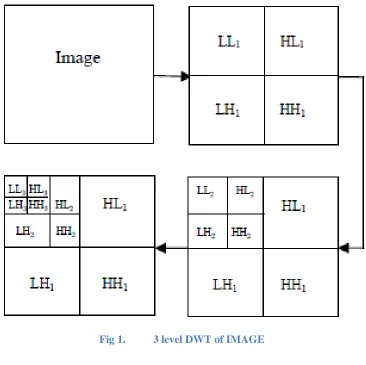
this band into the four sub-bands – LL3, LH3, HL3, HH3. This results in 10 sub-bands per component. LH1, HL1, and HH1 contain the highest frequency bands present in the image tile, while LL3 contains the lowest frequency band and the approximate image.[10]
Following figure shows a 3 level DWT transform of an image .
Fig 1. 3 level DWT of IMAGE
IV.
PROPOSED SCHMES
:
The watermarking schemes proposed here is also based on DWT technique. Where the benefits of DWT are taken into consideration in choosing the most proper sub band for watermark embedding in order to provide both robustness and imperceptibility.
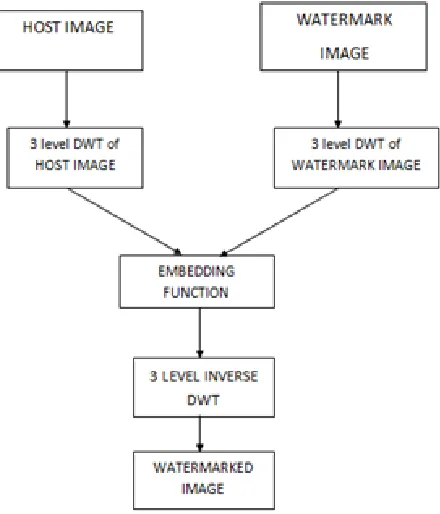
Embedding algorithm
:For embedding we need a host image and a watermarked image
Step 1: First level DWT is performed on the host image to decompose it into four sub bands LL1, HL1, LH1 and HH1.
Step 2: The second level DWT is performed on the LL1 sub band to get four smaller sub bands LL2, HL2, LH2 and HH2.
Step 3: The third level DWT is performed on the LL2 sub band to get four smaller sub bands LL3, HL3, LH3 and HH3.
Step 5: The second level DWT is performed on the LL1 sub band to get four smaller sub bands wLL2, wHL2, wLH2 and wHH2.
Step 6: The third level DWT is performed on the LL2 sub band to get four smaller sub bands w LL3,w HL3,w LH3 and wHH3.
Step7: A embedding function is used to add the two sub bands are added with a embedding formulae with value 'a' as in is as follows:
new LL3=LL3+ a*wLL3
Step8:Now Inverse DWT is performed using the sub bands newLL3,LH3,HL3,HH3 to get image new LL2.
Step 9: Inverse DWT is performed using the sub bands newLL2,LH2,HL2,HH2 to get image new LL1. Step10: Inverse DWT is performed using the sub bands newLL2,LH1,HL1,HH1 to get the watermarked image
now we get the watermarked image that can be used for various purposes.
Fig 2. Embedding Algorithm
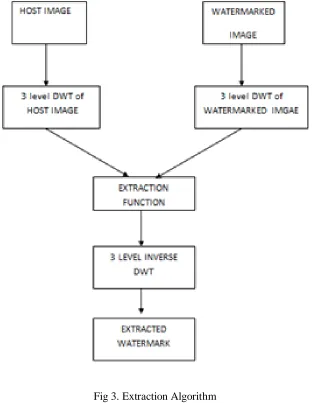
Extraction algorithm
:for extraction host image and watermarked images are used :
Step 1: First level DWT is performed on the host image to decompose it into four sub bands LL1, HL1, LH1 and HH1.
Step 2: The second level DWT is performed on the LL1 sub band to get four smaller sub bands LL2, HL2, LH2 and HH2.
Step 3: The third level DWT is performed on the LL2 sub band to get four smaller sub bands LL3, HL3, LH3 and HH3.
Step 4: First level DWT is performed on the watermarked image to decompose it into four sub bands nLL1, nHL1, nLH1 and nHH1.
Step 6: The third level DWT is performed on the LL2 sub band to get four smaller sub bands n LL3,n HL3,n LH3 and nHH3.
Step7: Then following extracting is performed to get wLL3 with the extraction formulae with same value of 'a' as in embedding
wLL3= new LL3-LL3/ a
Step 8 :Apply inverse DWT on wLL3 with all other sub bands ( LH ,HL, HH ) equal to zero to get wLL2
Step 9: Repeat step 8 two times each level to get the extracted watermarks.
Fig 3. Extraction Algorithm
V.
Experimental Result:
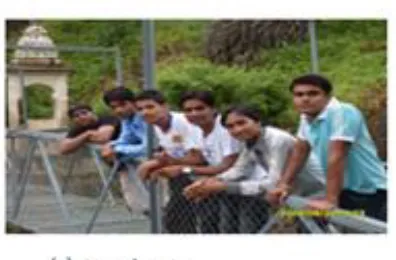
To implement this technique we have used two RGB .jpg images as host and
watermark . Both the images are of equal size of 256X256 and implemented the
algorithm in MATLAB.
Fig Cover Image & Watermark Image
WATERMARKED IMAGES:
0
a=0.5 a=0.3
a=0.1 a=0.09
0
a=0.03 a=0.01