Characterizing Collision and Second-Preimage Resistance in
Linicrypt
∗Ian McQuoid† Trevor Swope∗ Mike Rosulek∗
July 24, 2020
Abstract
Linicrypt (Carmer & Rosulek, Crypto 2016) refers to the class of algorithms that make calls to a random oracle and otherwise manipulate values via fixed linear operations. We give a charac-terization of collision-resistance and second-preimage resistance for a significant class of Linicrypt programs (specifically, those that achieve domain separation on their random oracle queries via nonces). Our characterization implies that collision-resistance and second-preimage resistance are equivalent, in an asymptotic sense, for this class. Furthermore, there is a polynomial-time procedure for determining whether such a Linicrypt program is collision/second-preimage resis-tant.
1
Introduction
Collision resistance and second-preimage resistance are fundamental properties of hash functions, and are the basis of security for hash-based signature schemes [10,11,4,7], which are a promising approach for post-quantum security.
We give a new way to reason about and characterize the collision resistance and second-preimage resistance of a large, natural class of programs, in the random oracle model. Specifically, we charac-terize these properties for the class ofLinicrypt programs, introduced by Carmer & Rosulek [5]. Roughly speaking, a Linicrypt program is one where all intermediate values are field elements, and the only operations possible are fixed linear combinations, sampling uniformly from the field, and calling a random oracle (whose outputs are field elements). Many of the most practical crypto-graphic constructions are captured by this model: hash-based signatures and block cipher modes, to name a few.
Carmer & Rosulek showed that such programs admit an algebraic representations that is amenable to reasoning about programs’ cryptographic properties. Specifically, they showed a polynomial-time algorithm for deciding whether two Linicrypt programs induce computationally indistinguishable distributions. They also demonstrated the feasibility of using a SAT solver to automatically synthesize Linicrypt programs that satisfy given correctness & security constraints, by successfully synthesizing secure Linicrypt constructions of garbled circuits.
Our work follows a similar path, showing that collision properties can also be characterized cleanly in terms of the algebraic representation for Linicrypt programs. Our characterization holds for programs in which distinct oracle queries have the formH(t1;·), H(t2;·), . . . fordistinct nonces
ti.
∗
Authors partially supported by NSF award #1617197.
†
We introduce an algebraic property of Linicrypt programs called a collision structure, which completely characterizes both second-preimage resistance and collision resistance. The presence of a collision structure in a programP can be detected in polynomial time (in the size ofP’s algebraic representation).
Theorem 1 (Main Theorem). Let P be a deterministic Linicrypt program with distinct nonces, making noracle queries. Let Fbe the underlying field (and range of the random oracle). Then the
following are equivalent:
1. There is an adversary A making q oracle queries that finds collisions with probability more than (q/n)2n/|F|.
2. There is an adversary A makingq oracle queries that finds second preimages with probability more than(q/n)n/|F|.
3. There is an adversary A making at most 2n oracle queries that finds second preimages with probability 1.
4. P either has a collision structure or is degenerate. (See main text for definitions)
We emphasize that the theorem statement refers tostandard security properties(i.e., secu-rity against arbitrary, computationally unbounded algorithms that make only a polynomial number of queries to the random oracle) of Linicrypt constructions. We are notin a heuristic model that considers Linicrypt adversaries.
Our results show that second-preimage resistance and collision resistance are equivalent, in an asymptotic sense (i.e., considering only whether a quantity is negligible or not). However, as might be expected, it is quadratically easier to find collisions than second preimages, due to birthday attacks. Our concrete bounds reflect this. In practice, reducing security to second-preimage resistance rather than collision resistance can result in constructions with 50% smaller parameters; e.g., [6,8,2].
Addendum July 2020: We thank Catherine Meadows for pointing out a bug in how we defined the notion of a “degenerate” program (Definition 4). We have repaired the definition in this updated version. The fix did not involve changing any theorem statements.
1.1 Related Work & Comparison
Bellare & Micciancio [1] discuss the collision resistance of the functionH∗(x1, . . . , xn) =H(1;x1)⊕ · · ·⊕H(n;xn), whereHis collision-resistant. Indeed, this function is naturally modeled in Linicrypt
over a field GF(2λ). They show that this function fails to be collision-resistant if n is allowed to
vary with the input (in particular, whenn≥λ+ 1). Our characterization shows that an adversary making q oracle queries breaks collision resistance with probability bounded by (q/n)2n/2λ since the function lacks a “collision structure.” These two results are not in conflict, since our bound is meaningless when n≥λ+ 1. In short, the Linicrypt model is best suited for programs whose only dependence on the security parameter is the choice of field, but where (in particular) the number of inputs and calls toH are fixed constants.
Another related work is that of Wagner [13], who gives an algorithm for a generalized birthday problem. The problem (translated to our notation) is to find x1, . . . , xk such that H(x1)⊕ · · · ⊕
H(xk) = 0. The case of k = 2 corresponds to the well-known birthday problem. One can see
there is likely to exist some solution to the problem. Wagner’s focus is on the algorithmic aspect of actually identifying the appropriate candidates. In Linicrypt, all adversaries are considered to be computationally unbounded but bounded in the number of queries to the random oracle H. As such, our results do not provide any upper/lower bounds on attack complexity (other than in random oracle query complexity).
Black, Rogaway, and Shrimpton [3] categorize 64 ways to construct a compression function (suitable for Merkle-Damg˚ard hashing) from an ideal cipher, building on prior work by Preneel, Govaerts, and Vandewalle [12]. These constructions can be thought of as GF(2λ)-Linicrypt pro-grams that use only XOR (e.g., linear combinations with coefficients of 0 or 1 only). However, the reasoning is tied to the ideal cipher model rather than the random oracle model, as in Linicrypt (see Section 5.3 for more information). We leave it as interesting future work to extend results in Linicrypt to the ideal cipher model, and potentially re-derive the characterization of BRS from a linear-algebraic perspective.
2
Preliminaries
We write scalar field elements as lowercase non-bold letters (e.g., v ∈ F). We write vectors as lowercase bold letters (e.g.,q∈Fn). We write matrices as uppercase bold letters (e.g.,M ∈
Fn×m).
We write vector inner product as q·v, and matrix-vector multiplication asM×v orM v.
2.1 Linicrypt
The Linicrypt model was introduced in [5]. We present a brief summary of the model and its important properties.
A Linicrypt program (over fieldF) is one in which every intermediate value is an element ofF,
and the program is a fixed, straight-line sequence of the following kinds of operations:
• Call a random oracle (whose inputs/outputs are field elements).
• Sample a random field element.
• Combinine existing values using a fixed linear combination.
The sequence of operations (including choice of arguments to the oracle, coefficients of linear com-binations, etc) is entirely fixed. In particular, these cannot depend on intermediate values in the computation.
The only source of cryptographic power in Linicrypt is the random oracle, whose outputs areF
-elements. We therefore require the size of the field |F|to be exponential in the security parameter λ. Since the field depends on the security parameter, we sometimes write F = Fλ to make the
association explicit.
If the field depends on the security parameter, then the program does too (since it is parameter-ized by specific coefficients of linear combinations). One can either consider a Linicrypt program to be a non-uniform family of programs (one for each choice of field / security parameter), or one can fix all coefficients in the program from Fe which is a subfield of every Fλ (for example, a program
that uses only {0,1} coefficients can be instantiated over any field GF(2λ)). Our treatment of security is concrete (not asymptotic), so these distinctions are not important in this work.
We can reason about Linicrypt programs in the following algebraic way. Let P be such a program, and let v1, . . . , vn denote all of its intermediate variables. Say the first k of them are
an input variable, the result of a call to the oracle, or the result of sampling a field element. All variables can therefore be expressed as a fixed linear combination of base variables.
Let vbase denote the vector of all base variables. For each variable vi, let ri denote the vector
such thatvi =ri·vbase. For example, for base variables,riis a canonical basis vector (0s everywhere
except 1 in one component).
Suppose the output of P consists of vn−l+1, . . . , vn. Then the output matrix of P is defined
as: M def=
rn−l+1
.. . rn
. This matrix captures the fact thatP’s output can be expressed asM×vbase.
Each oracle query in P is of the form “vi :=H(t;vi1, . . . , vim),” wheretis a string (e.g., nonce)
and i1, . . . , im < i are indices, all fixed as part ofP. For each such query we define an associated
oracle constraintc=
t,
ri1
.. . rim
,ri
. In other words, an oracle constraint (t,Q,a) captures the
fact that if the oracle is queried as H(t;Q×vbase), then the response is a·vbase. When t is the
empty string, we often omit it from our notation and simply writeH(·) instead of H(;·).
Thealgebraic representationofP isP = (M,C), whereM is the output matrix ofP andC
is the set of all oracle constraints. Indeed, these two pieces of information completely characterize the behavior of P (as established in [5]).
Example. In this work we focus on deterministic Linicrypt programs. One such example is given below. Its base variables are (v1, . . . , v5, v7).
PH(v
1, v2, v3):
v4:=H(foo;v1)
v5:=H(bar;v3)
v6:=v4+v5+v2
v7:=H(foo;v6)
v8:=v7+v1
return (v8, v5)
⇒ v1 v2 v3 v4 v5 v6 v7 v8 =
1 0 0 0 0 0
0 1 0 0 0 0
0 0 1 0 0 0
0 0 0 1 0 0
0 0 0 0 1 0
0 1 0 1 1 0
0 0 0 0 0 1
1 0 0 0 0 1
v1 v2 v3 v4 v5 v7
Hence, the algebraic representation ofP is:
M =
1 0 0 0 0 1
0 0 0 0 1 0
; C=
foo,[1 0 0 0 0 0],[0 0 0 1 0 0],
bar,[0 0 1 0 0 0],[0 0 0 0 1 0]
,
foo,[0 1 0 1 1 0],[0 0 0 0 0 1]
2.2 Security Definitions
Definition 2. Let P be a Linicrypt program over a family of fields F = (Fλ)λ. Then P is
(q, )-collision-resistant (in the random oracle model) if for all q-query adversaries A, Pr[ColGame(P,A, λ) = 1]≤, where:
ColGame(P,A, λ):
instantiate a random oracle H:{0,1}∗×(Fλ)∗ →Fλ
(x,x0)← AH(λ)
return (x6=x0)∧(PH(x) =PH(x0))
Definition 3. Let P be as above (with k inputs). P is (q, )-2nd-preimage-resistant (in the random oracle model) if for allq-query adversaries A, Pr[2PIGame(P,A, λ) = 1]≤, where:
2PIGame(P,A, λ):
instantiate a random oracle H:{0,1}∗×(Fλ)∗ →Fλ
x←(Fλ)k
x0 ← AH(λ,x)
return (x6=x0)∧(PH(x) =PH(x0))
3
Characterizing Collision-Resistance in Linicrypt
We now present our main technical result, which is a characterization of collision-resistance for Linicrypt programs.
In order to simplify the notation, we present the results for the special case of Linicrypt programs that make 1-ary calls to H. That is, every call to H is of the formH(t;v) for a single v ∈ F (note that Linicrypt supports more general calls of the form H(t;v1, . . . , vk)). With this
simplification, every oracle constraint has the form (t,q,a) whereq is a simple vector (rather than a matrix as in the most general form).
This special case simplifies the notation required to express our theorems/proofs, but does not gloss over any meaningful complexity. Later in Section 5.1 we discuss what minor changes are necessary to extend these results to the unrestricted general case.
3.1 Easy Case: Degeneracy
Some Linicrypt programs allow easy collisions. Consider the program PH(x, y) = H(x+y). An
obvious collision in P is PH(x, y) = PH(x+c, y−c) for any c 6= 0. This program does not use
its inputs x or y individually, but depends only on x+y. Put differently, the program can be written as the composition of alossy linear function(x, y7→x+y) and another Linicrypt program (z 7→ H(z)). No program of this form can be collision-resistant, since it suffices to simply find a collision in the lossy linear function.
Definition 4. Let P = (M,C) be a deterministic Linicrypt program with n base variables. In the algebraic representation,P’s variables are associated with canonical basis vectorsr1, . . . ,rn(ri has
0s everywhere except a 1 in the ith component). We say thatP is degenerate if
span(r1, . . . ,rn)6⊆span
{q|(t,q,a)∈ C} ∪ {a|(t,q,a)∈ C} ∪rows(M)
Proof. The right-hand-side of the expression in Definition 4 considers all vectors in P’s algebraic representation. These vectors are generally expressed in terms of the basis B = {r1, . . . ,rn} =
{e1, . . . ,ek} ∪ {a|(t,q,a)∈ C}, representing the base variables inP with theei’s being the input
ofP in canonical-basis form. If P is degenerate, then the vectors in its algebraic representation do not actually span this space.
Consider the matrix AP, for some Linicrypt program P, whose rows are comprised of each
vector in the set {q|(t,q,a)∈ C} ∪ {a|(t,q,a)∈ C} ∪rows(M). We can considerAP×vbase for
P(x) on some given inputx=
e1
e2
.. . ek
·vbase. AP×vbase then determines concrete values for queries,
answers, and outputs inP. If two distinct inputsx,x0 exist such thatAP×vbase =AP×v0basethen
certainly x0 is a preimage of P(x) as they both produce the same output — indeed, P(x0) even makes the exact same queries toH! These instances arise exactly whenAP×vbase−AP×v0base=
AP ×(vbase−v0base) = 0 which occurs when the kernel ofAP has dimension greater than 0.
If P is degenerate, then the span of the rows of AP does not contain all the basis vectors: B 6⊆span(rows(AP)). In this case, the matrixAP has a non-trivial kernel.
To find a concrete set of preimages for a degenerate linicrypt programP(x) we can consider the projectionBP of ker(AP) ontoAP’s input space. The projection can be constructed by embedding
thek×k identity matrix Ik×k into the k×n0 matrix (where k is the number of input vectors to
P and nis the number of base vectors of P).
BP =Ik×k 0
Then we may find a class of preimages degenerate(P) = BP ·ker(AP). For each vector δ ∈ degenerate(P) we have thatP(x) =P(x+δ).
Applying this idea to the previous example PH(x, y) = H(x+y), we arrive at the matrices
AP =
1 1 0
0 0 1
, BP =
1 0 0
0 1 0
with BP·ker(AP) =
c·
1
−1
:c∈F
as we would expect.
3.2 Running Example: An Interesting Second-Preimage Attack
Consider the example program below. In fact, it is the example from Section 2.1 but with the nonces omitted and most intermediate variables unnamed:
PH(x, y, z):
w:=H(x) +H(z) +y return H(w) +x, H(z)
Suppose we are given x, y, z and are asked to find a second preimage x0, y0, z0 with PH(x, y, z) =
PH(x0, y0, z0). Here is how to do it:
1. The second component ofP’s output isH(z). Since we cannot hope to find a second preimage directly in H, we must setz0 =z.
2. The key insight is to now setw06=warbitrarily (hence, why we gave this value a name). We make a promise to choosex0, y0 so that w0 =H(x0) +H(z0) +y0.
4. It is time to fulfill the promise thatw0 =H(x0) +H(z0) +y0. Sincew0, x0, z0 are already fixed, we can solve fory0.
Note that we are guaranteed that (x, y, z) 6= (x0, y0, z0) since the two computations of P lead to different intermediate valuesw6=w0 (andP is deterministic).
Perspective. This example is representative of how second preimages can be computed in arbi-trary Linicrypt programs. Given an inputxforPH, we compute a second preimagex0 by focusing
on the oracle queries that PH(x) andPH(x0) will make:
1. Designate some of the oracle queries to take the same values in both PH(x) and PH(x0).
In our example, we decided that the oracle query H(z) would take the same values in both computations.
2. Identify the first query that we will assign different values in the two computations. Set the input to this query arbitrarily inPH(x0). In our example, we identify theH(w) query to take
on different values and setw0 6=w arbitrarily.
3. Repeatedly make followup oracle queries as they become possible, while using linear algebra to solve for other intermediate values. In our example, we callH(w0), which allows us to solve forx0, which allows us to call H(x0), which allows us to solve fory0.
3.3 Collision Structures for Finding Second Preimages
We have given a rough outline of how (we claim) Linicrypt second preimages must be found. The next step is to formalize what is required of P in terms of its algebraic representation.
In step 2 above, we identify a query whose input will be chosen arbitrarily. Suppose that query corresponds to constraint (t,q,a). Since this is the first value that is fixed differently in PH(x)
and PH(x0), we must have q linearly independent of the vectors that are already fixed by step 1.
Otherwise it would not be possible to find two consistent values for this query.
In steps 2 and 3 above, we repeatedly query H, and we have written the attack outline to suggest we never get “stuck.” One way we could get stuck is to make some query H(x0) for the first time, when we have already fixed (either directly or indirectly) what H(x0) must be. If this is the case, then we cannot succeed with probability better than 1/|Fλ|. To avoid this case, every query we make in steps 2 & 3 of the outline must correspond to a constraint (t,q,a) where a is linearly independent of the values that have already been fixed.
The following definition formalizes these algebraic intuitions:
Definition 6. Let P = (M,C) be a Linicrypt program. A collision structure for P is a tuple (i∗;c1, . . . , cn), where:
1. c1, . . . , cn is an ordering of C, and we write ci = (ti,qi,ai).
2. qi∗6∈span
{q1, . . . ,qi∗−1} ∪ {a1, . . . ,ai∗−1} ∪rows(M)
3. For j ≥i∗: aj 6∈span
{q1, . . . ,qj} ∪ {a1, . . . ,aj−1} ∪rows(M)
Connecting to the previous intuition, a collision-finding attack will let oracle queriesc1, . . . , ci∗−1
be the same in both executionsPH(x) andPH(x0). Thenc
i∗is the first oracle query that the attack
find 2 query values that are consistent with the previously fixed values. Property (3) captures the fact that from this point forward, no query should be forced to result in an output value that has already been fixed.
Running example. We now revisit the running example from before, to illustrate a collision structure for it. The base variables of this program are x, y, z, H(x), H(z), H(w). Below is the algebraic representation of this program, with the oracle constraints arranged to show a collision structure (we do not write the empty nonces of the oracle constraints):
x y z H(x) H(z) H(w)
M =
h 1 0 0 0 0 1 i
0 0 0 0 1 0
q1 = [ 0 0 1 0 0 0 ]
H(z)
a1 = [ 0 0 0 0 1 0 ]
qi∗ =q2 = [ 0 1 0 1 1 0 ]
H(w) =H(y+H(x) +H(z))
ai∗=a2 = [ 0 0 0 0 0 1 ]
q3 = [ 1 0 0 0 0 0 ]
H(x)
a3 = [ 0 0 0 1 0 0 ]
This ordering of queries is indeed a collision structure since:
• q2 is linearly independent of all vectors above it in this diagram.
• a2 is linearly independent of all vectors above it in this diagram.
• a3 is linearly independent of all vectors above it in this diagram.
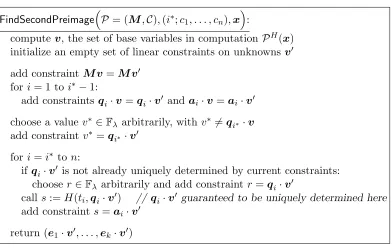
Second-preimage-finding algorithm. In Figure 1 we give an algorithm that finds second preimages by following the intuitive strategy above, from a given collision structure.
Lemma 7. If a collision structure (i∗;c1, . . . , cn) exists for P, and P is not degenerate, then the
second-preimage resistance of P is comprehensively broken. Specifically, let A refer to
FindSecondPreimage(P,(i∗;c1, . . . , cn),·). Then:
Prh2PIGame(P,A, λ) = 1i= 1
Proof. Given x, the goal is to compute a second preimage x0. The computation of PH(x0) has a
certain set of base variablesv0, and it suffices to compute those instead sincex0= (e1·v0, . . . ,ek·v0).
The attack FindSecondPreimage fixes one linear constraint of v0 at a time, until v0 is completely determined.
It suffices to show the following about the behavior of FindSecondPreimage:
1. It computes a different set of base variablesv0 than those ofPH(x).
2. It never adds incompatible (unsatisfiable) linear constraints onv0.
3. Values v0 are consistent with H. Namely, if (t,q,a)∈ C, thenH(t;q·v0) =a·v0.
4. By the end of the computation, enough constraints have been added to completely determine v0.
FindSecondPreimage
P = (M,C),(i∗;c1, . . . , cn),x
:
computev, the set of base variables in computationPH(x)
initialize an empty set of linear constraints on unknownsv0
add constraint M v=M v0 fori= 1 to i∗−1:
add constraintsqi·v=qi·v0 and ai·v =ai·v0
choose a value v∗ ∈Fλ arbitrarily, withv∗6=qi∗·v
add constraint v∗ =qi∗·v0
fori=i∗ ton:
ifqi·v0 is not already uniquely determined by current constraints: choose r∈Fλ arbitrarily and add constraintr =qi·v0
calls:=H(ti,qi·v0) // qi·v0 guaranteed to be uniquely determined here
add constraint s=ai·v0
return (e1·v0, . . . ,ek·v0)
Figure 1: Method for computing second preimages
• The constraints onv0 that are added forM and in the first for-loop are self-consistent — by construction they already have a valid solution inv.
• The constraint involvingqi∗ is compatible with the previous constraints since qi∗ is linearly
independent of the previous constraint vectors {q1, . . . ,qi∗−1} ∪ {a1, . . . ,ai∗−1} ∪rows(M),
by the collision structure property.
• Similarly, a constraint involvingqi fori≥i∗ (if-statement within last for-loop) is only added in the case thatqi is linearly independent of the previous constraint vectors.
• The constraint involvingaiin the second for-loop is consistent sinceaiis linearly independent
of existing constraint vectors, again by the collision structure property.
Regarding property 3: for oracle constraints ci with i < i∗, consistency with H is ensured by
agreeing with the existing values v. For constraintsci with i≥i∗, consistency is guaranteed since
the second for-loop actually calls H to determine the consistent way to constrain ai·v0.
Property 4 follows from the fact that P is not degenerate. We can see thatM×v0,q·v0, and a·v0 are fixed/determined by the end of the computation, for all (t,q,a) ∈ C. Non-degeneracy implies that the input ofP (and hence all base variables) is uniquely determined.
3.4 Efficiently Finding Collision Structures
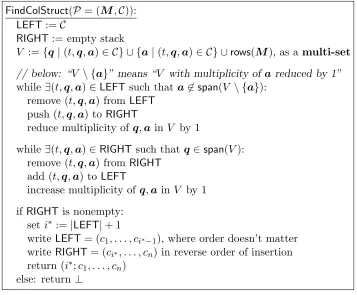
In this section we show that it is possible to efficiently determine whether a Linicrypt program has a collision structure, by analyzing its algebraic representation. The algorithm for finding a collision structure is given inFigure 2.
FindColStruct(P = (M,C)): LEFT:=C
RIGHT:= empty stack
V :={q|(t,q,a)∈ C} ∪ {a|(t,q,a)∈ C} ∪rows(M), as amulti-set
// below: “V \ {a}” means “V with multiplicity of areduced by 1”
while ∃(t,q,a)∈LEFT such thata6∈span(V \ {a}): remove (t,q,a) from LEFT
push (t,q,a) toRIGHT
reduce multiplicity ofq,ain V by 1
while ∃(t,q,a)∈RIGHTsuch that q∈span(V): remove (t,q,a) from RIGHT
add (t,q,a) to LEFT
increase multiplicity ofq,a inV by 1
ifRIGHT is nonempty: seti∗ :=|LEFT|+ 1
write LEFT= (c1, . . . , ci∗−1), where order doesn’t matter
write RIGHT= (ci∗, . . . , cn) in reverse order of insertion
return (i∗;c1, . . . , cn)
else: return ⊥
Figure 2: Method for finding collision structures in a Linicrypt program.
Proof. Some useful invariants in FindColStruct are that at any time, LEFT∪RIGHT=C and V is a multiset of the vectors appearing in rows(M) andLEFT. Note that FindColStruct works in two phases: it starts with all oracle queries in LEFT and in the first phase moves some to RIGHT. In the second phase, it moves some of the oracle queries back into LEFT.
(⇒) First, we argue that if FindColStruct(P) = (i∗;c1, . . . , cn) 6=⊥, then this output is indeed
a collision structure. Write each oracle constraint ci asci = (ti,qi,ai).
• At the time the second while-loop terminates, we must have qi∗ 6∈ span(V) since otherwise
ci∗ would have been moved to LEFT. But V ={q
1, . . . ,qi∗−1} ∪ {a1, . . . ,ai∗−1} ∪rows(M),
so this establishes one of the required properties of a collision structure.
• Forj≥i∗, consider the time at whichcj is about to be added toRIGHTin the first while-loop
(i.e., the point that the while loop body is entered). At that point, LEFT={c1, . . . , cj}, so
V contains{q1, . . . ,qj} ∪ {a1, . . . ,aj} ∪rows(M). Since the while-loop condition is fulfilled,
we have
aj 6∈span(V \ {aj}) =span
{q1, . . . ,qj} ∪ {a1, . . . ,aj−1} ∪rows(M)
which is the other condition required for a collision structure.
(⇐) For the other direction, suppose (i∗, c1, . . . , cn) is some collision structure forP. We will
show that the algorithm adds ci∗, . . . , cn to RIGHTin the first phase, but does not move ci∗ back
The fact thatci∗, . . . , cnare added toRIGHTin the first phase is essentially the converse of what
was shown above. For example, the collision structure property is that an 6∈span
{q1, . . . ,qn} ∪
{a1, . . . ,an−1} ∪rows(M)
, implying that cn can trigger the while-loop and be added to RIGHT
immediately. Note that even if other constraints are added toRIGHT in this phase, it only makes V smaller, so only causes the condition to check a smaller span than in the collision-property definition. A simple inductive argument establishes thatci∗, . . . , cnare eventually added toRIGHT.
Since{ci∗, . . . , cn} ⊆RIGHTafter the first phase, we must haveLEFT⊆ {c1, . . . , ci∗−1}after the
first phase. We want to show thatci∗ is never placed back intoLEFT. For the sake of contradiction,
suppose not. Define S to be a set of indices such that LEFT={ci |i∈S} at the timeci∗ is about
to be moved into LEFT. Thenqi∗ ∈span(rows(M)∪ {qi,ai |i∈S}). We can then write:
qi∗ = X
j∈S
αjqj +
X
j∈S
βjaj+γM
For j > i∗, the constraint cj was previously inRIGHT and was moved back into LEFT. The only
way to be moved back intoLEFT is forqj to be in the span of other vectors already in LEFT(and hence already on the right-hand side of this expression). Hence, without loss of generality we can remove the terms involving qj forj > i∗, to obtain:
qi∗ =
X
j∈S\{i∗,...,n}
α0jqj +X
j∈S
β0jaj+γ0M
Letj∗ be the highestj ∈S for whichβj0 6= 0. There are two cases.
Case j∗ < i∗: Then all of the nonzero terms qj,aj on the right-hand side have subscript less
thani∗. This contradicts the fact (from the original collision structure) thatqi∗ 6∈span(rows(M)∪ {qj,aj |j < i∗}).
Case j∗ > i∗: We can solve foraj∗ in the above expression, yielding:
aj∗=− 1
β0j∗
X
j∈S\{i∗,...,n}
α0jqj−qi∗+ X
j∈S\{j∗}
βj0aj+γ0M
But now all nonzero qj and aj terms on the right-hand side have subscript less than j∗. This
contradicts the fact (from the original collision structure) thataj∗ 6∈span({q
j |j < j∗} ∪ {aj |j <
j∗} ∪rows(M)).
In either case we have a contradiction to the claim that ci∗ is moved back intoLEFT. Since the
algorithm terminates with at leastci∗∈RIGHT, it outputs some valid collision structure.
3.5 Breaking Collision Resistance implies Collision Structure
So far our discussion has centered around the relationship between collision structures and second-preimage resistance. We now show that if P fails to be even collision resistant (in the random oracle model), then it has a collision structure. The main approach is to observe the oracle queries made by an arbitrary attacker (who computes a collision), and “extract” a collision structure from these queries.
The results in this subsection hold only for the following subclass of Linicrypt programs. In Section 5.2 we discuss specifically why the results are restricted to this subclass.
Definition 9. Let P = (M,C) be a Linicrypt program, with C = {(t1,q1,a1), . . . ,
Lemma 10. Let P be a deterministic Linicrypt program with distinct nonces that makes n oracle queries. Let A be an oracle program that makes at mostN oracle queries. If
Pr[ColGame(P,A, λ) = 1]>
N n
2n
/|Fλ|
or if Pr[2PIGame(P,A, λ) = 1]>
N n
n
/|Fλ|
thenP either has a collision structure or is degenerate.
Proof. Without loss of generality, we can assume the following aboutA:
• Let (x,x0) be the two preimages from the games (in 2PIGameAgets xas input and givesx0 as output; in ColGameA outputs bothx and x0). We assume that AH has made the oracle
queries thatPH(x) andPH(x0) will make. In ColGamethis can be achieved by modifyingA
to run these two computations as its last action. In 2PIGamethis can be achieved by having
ArunPH(x) as its first action and PH(x0) as its last action.
• Anever repeats a query toH. This can be achieved by simple memoization. Note that when
A runs, say, PH(x0) as its last action, some of those oracle queries may have been made
previously.
• AH can actually output (v,v0), where v is the set of base variables in the computation of PH(x), andv0 the base variables inPH(x0). This is because the base variables are computed
during the process of running PH(x) andPH(x0).
Note that the base variables have the following property. Let c = (t,q,a) be one of the oracle constraints of P. Then the computation PH(x) (and hence AH as well) at some point makes an
oracle query H(t,q·v) and gets a response a·v.
From these assumptions, whenever A outputs a successful collision there exist well-defined mappings T, T0:C →Nsuch that:
• For every constraintc= (t,q,a)∈ C, theT(c)th query made byAH is the one corresponding
to oracle constraintc in the computation of PH(x). In other words, it is the query in which
AH “decided” whatq·v should be (and learned whata·v was as a result of the query).
• Similarly, the T0(c)th query made by AH is the one corresponding to oracle constraint c in
the computation ofPH(x0). This is the query in which q·v0 was determined.
How many possible mappings (T, T0) are there ifAmakesN oracle queries? LetNibe the number of
oracle queries thatAmakes which have nonceti. Since the nonces are distinct, we havePiNi≤N.
There are onlyNi choices for howT orT0 can mapT(ci). Hence there are at mostQni=1Ni2possible
(T, T0) mappings. However, in the2PIGame, the mappingT is completely fixed since we assumeA
performs the computationPH(x) as its first action. In that case, there are only Qn
i=1Ni choices of
the mapping T0. These products are maximized when each Ni =N/n, so we get an upper bound
of (N/n)2n possible (T, T0) mappings in the ColGameand (N/n)n mappings in the2PIGame. Applying the pigeonhole principle and uniting both cases from the statement of the lemma (collision game and second preimage game), there is aspecific (T, T0) such that:
For the rest of the proof, we condition on the event that A computes a collision while using this specificmapping (T, T0). This is without loss of generality by makingA, as its final action, output
⊥ if it observes that some different mapping is used. Hence we can view the association between oracle calls ofP and Aas fixed a priori. That is, we can know in advance that a particular oracle call of Awill determine the value of q·v (or q·v0) for a specificq.
For some c∈ C, if T(c) = T0(c), then we call c convergent. In this case, PH(x) andPH(x0)
make the same c-query and receive the same output. In other words, under such a mappingT, T0, adversary AH will choose that q·v =q·v0. If T(c) 6=T0(c), we call c divergent — PH(x) and
PH(x0) make differentc-queries, i.e.,q·v6=q·v0.
If allc∈ C are convergent, then two distinct inputsxand x0 cause P to make identical oracle queries and give identical output. HenceP is degenerate, and we are done. We continue assuming that some query is divergent, and will conclude that P has a collision structure.
Define finish(c) = max{T(c), T0(c)}. Note that since P has distinct nonces, an oracle query made byA cannot be associated with more than onec∈ C. Hencefinish is an injective function.
We obtain a collision structure forP as follows. Order the oracle constraints inCas (c1, . . . , cn),
where all of the convergent queries come first, followed by the divergent queries ordered by increasing finish time. Let i∗ be the index of the divergent query with earliest finish time. Then:
• i∗≤i ⇔ci is divergent
• i∗≤i < j ⇔ finish(i)<finish(j)
Claim 11. (i∗;c1, . . . , cn) is a collision structure for P.
In the following, we write each oracle constraint ci asci= (ti,qi,ai).
For j < i∗, the query cj is convergent so we have qj ·v = qj ·v0 and aj ·v = aj ·v0. Since
the outputs of the two executions of P are also identical, we also have M v = M v0. Since ci∗ is
divergent, we have qi∗·v6=qi∗·v0. From this we conclude that:
qi∗ 6∈span
{q1, . . . ,qi∗−1} ∪ {a1, . . . ,ai∗−1} ∪rows(M)
.
This is the first property required of a collision structure. It remains to show that for all i > i∗,
ai 6∈span
{q1, . . . ,qi} ∪ {a1, . . . ,ai−1} ∪rows(M)
.
Suppose for contradiction that the above is false, and that we actually have:
ai=
X
j≤i
αjqj+
X
j<i
βjaj+γM
Focus on the moment when A has asked its finish(ci)th query and is awaiting the response from
H. By symmetry, supposefinish(ci) =T0(ci), so that this query is on qi·v0; the result of the query
will be assigned to ai·v0. At this moment:
• All queries cj for i∗ ≤ j < i are finished. This means that the oracle queries of AH have
already determinedqj·v,aj·v,qj·v0, andaj·v0. Further, the queries (but not responses)
of oracle constraint ci have been fixed as well — these values areqi·v and qi·v0.
• ai·v has already been fixed, since this happened at timeT(ci)< T0(ci). Butai·v0 is about
Now consider the expressionai·(v0−v):
ai·(v0−v) =
X
j≤i
αjqj·(v0−v) +
X
j<i
βjaj·(v0−v) +γM(v0−v)
Forj < i∗we know that querycj is convergent. This implies thatqj·(v0−v) = 0 andaj·(v0−v) = 0.
We also know thatM(v0−v) = 0, in the case thatAH is successful generating a collision. Cancelling
these terms gives:
ai·(v0−v) = i
X
j=i∗
αjqj·(v0−v) + i−1 X
j=i∗
βjaj ·(v0−v)
Isolating ai·v0 gives:
ai·v0 =−ai·v+ i
X
j=i∗
αjqj·(v0−v) + i−1 X
j=i∗
βjaj·(v0−v)
But all terms on the right-hand side have already been fixed, while the term on the left is chosen uniformly inF. So equality holds with probability 1/|Fλ|. This contradicts the assumption that A
succeeds with strictly greater probability.
3.6 Putting Everything Together
Our main characterization shows that second-preimage resistance and collision resistance coincide for this class of Linicrypt programs, in a very strong sense:
Theorem 12. Let P be a deterministic Linicrypt program with distinct nonces, making n oracle queries. Then the following are equivalent:
1. There is an adversary A making N oracle queries such that
Pr[ColGame(P,A, λ) = 1]>
N n
2n
/|Fλ|.
2. There is an adversary A making N oracle queries such that
Pr[2PI(P,A, λ) = 1]>
N n
n
/|Fλ|.
3. There is an adversary A making at most 2noracle queries such that
Pr[2PIGame(P,A, λ) = 1] = 1.
4. P either has a collision structure or is degenerate.
Corollary 13. The collision resistance (equivalently, second-preimage resistance) of deterministic, distinct-nonce Linicrypt programsP can be decided in polynomial time (in the size of P’s algebraic representation).
4
A Simple Application
We can illustrate the use of our main theorem with a simple example application. Suppose we have access to a random oracle which is compressing by a factor of 2-to-1. In the Linicrypt notation, this would be an oracle that takes 2 field elements (and the oracle nonce) as input and produces one field element as output — H : {0,1}∗×F2 → F. If we require a collision resistant function
that compresses byk-to-1 (for some fixedk), the following natural Merkle-Damg˚ard-style iterative hash comes to mind:
PH(x
1, x2, . . . , xk):
y1 :=x1
y2 :=H(2;y1, x2)
y3 :=H(3;y2, x3)
.. .
yk:=H(k;yk−1, xk)
returnyk
The algebraic representation of this program is:
x2 x3 · · · xk y1 y2 y3 · · · yk−1 yk
M = [ 0 0 · · · 0 0 0 0 · · · 0 1 ]
Q2 =
h 0 0 · · · 0 1 0 0 · · · 0 0 i
1 0 · · · 0 0 0 0 · · · 0 0
a2= [ 0 0 · · · 0 0 1 0 · · · 0 0 ]
Q3 =
h 0 0 · · · 0 0 1 0 · · · 0 0 i
0 1 · · · 0 0 0 0 · · · 0 0
a3= [ 0 0 · · · 0 0 0 1 · · · 0 0 ]
.. .
Qk=
h 0 0 · · · 0 0 0 0 · · · 1 0 i
0 0 · · · 1 0 0 0 · · · 0 0
ak= [ 0 0 · · · 0 0 0 0 · · · 0 1 ]
We have numbered the oracle constraints so that constraint (i,Qi,ai) corresponds to the statement
“yi :=H(i;yi−1, xi)” inP.
To determine whether this program is collision-resistant, we execute the FindColStruct algo-rithm.Initially all oracle constraints start in the setLEFT, andRIGHTstarts out empty. The first loop in FindColStruct moves oracle constraints from LEFT to RIGHT whenever their ai value is
linearly independent of all other vectors appearing in LEFT (the multiset of vectors is represented as the variable V inFindColStruct).
In this program, every ai vector is zeroes everywhere except for a 1 corresponding to the “yi”
column. Also note that ak is identical to M, and ai (for i < k) appears as the first row of Qi+1
(see the example with a2 and Q3 above). In other words, every ai is always in the span of other
vectors appearing in LEFT, so no oracle constraint will ever be added toRIGHT.
5
Extensions, Limitations, Future Work
5.1 Generalizing to Higher Arity
For simplicity our results were proven for Linicrypt programs in which all oracle calls have arity 1. That is, H : {0,1}∗×F → F, and all oracle constraints have the form (t,q,a) where q is a
single row. This reflects a program that always queries the oracle as H(t;v) where v is a single field element.
More generally, Linicrypt allows calls to H with multiple field elements as arguments. This leads to oracle constraints of the form (t,Q,a) where Q is now a matrix. We briefly discuss the changes necessary to support such programs. Basically, whenever the definitions (of degeneracy & collision structure) or algorithms (to find a second preimage or to find a collision structure) refer toq, the analogous condition should hold with respect to all rows of Q.
The generalized definition of degeneracy (Definition 4) is that:
span(e1, . . . ,ek)6⊆span
[
(t,Q,a)∈C
rows(Q)
∪ {a|(t,Q,a)∈ C} ∪rows(M)
The generalized definition of collision structure (Definition 6) requires the following change:
2. rows(Qi∗)6⊆span
rows(Q1)∪ · · · ∪rows(Qi∗−1)∪ {a1, . . . ,ai∗−1} ∪rows(M)
3. Forj≥i∗: aj 6∈span
rows(Q1)∪ · · · ∪rows(Qj)∪ {a1, . . . ,aj−1} ∪rows(M)
Specifically, for item (2) it is enough if any rowofQi∗ is not in the given span.
In the FindSecondPreimage algorithm (Figure 1), there are times when the algorithm chooses qj·v0arbitrarily. This happens when such a constraint would be linearly independent of the existing constraints on v0. In the analogous generalized case, we might have only some of the rows of Qj linearly independent of the existing constraints. In that case, some of the components of Qj×v0 are already fixed. We obviously cannot choose these arbitrarily — only the unconstrained positions inQj ×v0 are fixed arbitrarily. One can verify that the algorithm only attempts to arbitrarily fix some values if there is some row ofQj linearly independent with existing constraints on v0.
In the FindColStruct algorithm (Figure 2) we let V now contain Q-matrices as well as simple a-vectors. Then we overload notation so that span(V) considers the span of all of the rows of all matrices/vectors inV. The second “while” condition is modified as follows:
while∃(t,Q,a)∈RIGHTsuch that rows(Q)⊆span(V)
In other words, (t,Q,a) is moved fromLEFTtoRIGHTifall rows of Qare spanned by V.
With these modifications, all proofs in Section 3 go through with straight-forward modifica-tions.
5.2 Why the Restriction to Distinct Nonces?
The main characterization holds for Linicrypt programs with distinct nonces. It is instructive to understand why the results are limited in this way. Specifically, where do we use the property of distinct nonces?
nonces are distinct, a query made by A can only be associated with a unique oracle constraint c∈ C. When the nonces are not distinct, a single query ofAcan serve double-duty and correspond to two oracle constraints ofP. This indeed causes the argument to break down.
We illustrate with the two example Linicrypt programs:
P1H(x, y) =H(2, H(1, x))−H(3, y)
P2H(x, y) =H( H( x))−H( y)
The first has distinct nonces and is indeed collision resistant (it has no collision structure). The second program is not collision-resistant, because PH
2 (x, H(x)) = 0 for all x. In other words,
(x, H(x)) and (x0, H(x0)) constitute a collision.
When given inputs of this form,P2 makes duplicate queries — bothH(H(x)) (the outermost
H-call) andH(y) receive the same argument. In our previous proofs, we would observe the adversary making such a query, which would have to be associated with two distinct oracle constraints.
Another way of seeing what happens is that in the algebraic representation of P2, the base
variables H(x) and y correspond to independent vectors. In this case, the adversary’s choice of inputs causes these vectors to coincide, and this has the effect of “collapsing” two oracle queries.
Interestingly, it is possible to give an ad-hoc argument that P2 is second-preimage resistant.
When x and y are chosen uniformly, this has the effect of keeping the vectors (in the algebraic representation) corresponding toH(x) and y independent. We can then argue that the adversary doesn’t make any oracle query that is associated with two distinct queries ofP2, so the reasoning of
our main theorem also applies in this case. Hence,P2 demonstrates that our main characterization
is different for Linicrypt programs with non-distinct nonces.
5.3 Random Oracle vs Ideal Cipher
A natural application of collision resistance would be the constructions of collision-resistant hash functions from an ideal cipher [12, 3]. It should be possible to use Linicrypt to reason about constructions in the ideal cipher model, although it would require non-trivial modifications. We could interpretE(k, m) asH(E, k, m) andD(k, c) asH(D, k, c). The constraint thatD(k, E(k, m)) = m adds some extra structure that must be reflected in the algebraic representation. For example, if a program P makes a query c = E(k, m), we must consider the adversary’s ability to make this forward query but also its ability to make the corresponding backwards query D(k, c). Both forward/backwards queries must be considered before deeming the pair of queries E(k, m) and D(k, c) unreachable.
We do not foresee the transition to ideal cipher model to be particularly problematic. However, the specific analysis of [3] shows several constructions of hash functions from ideal ciphers where theround functions are not collision-resistant, and yet their use in a Merkle-Damg˚ard construction gives a collision-resistant result. So far, the theory of Linicrypt is not developed enough to reason about programs with looping constructs, as in an iterated hash function (despite the fact that such reasoning happens to be tractable for the specific example in Section 4).
References
[2] D. J. Bernstein, D. Hopwood, A. H¨ulsing, T. Lange, R. Niederhagen, L. Papachristodoulou, M. Schneider, P. Schwabe, and Z. Wilcox-O’Hearn. SPHINCS: Practical stateless hash-based signatures. In E. Oswald and M. Fischlin, editors, EUROCRYPT 2015, Part I, volume 9056 ofLNCS, pages 368–397. Springer, Heidelberg, Apr. 2015.
[3] J. Black, P. Rogaway, and T. Shrimpton. Black-box analysis of the block-cipher-based hash-function constructions from PGV. In M. Yung, editor,CRYPTO 2002, volume 2442 ofLNCS, pages 320–335. Springer, Heidelberg, Aug. 2002.
[4] J. N. Bos and D. Chaum. Provably unforgeable signatures. In E. F. Brickell, editor,
CRYPTO’92, volume 740 ofLNCS, pages 1–14. Springer, Heidelberg, Aug. 1993.
[5] B. Carmer and M. Rosulek. Linicrypt: A model for practical cryptography. In M. Robshaw and J. Katz, editors,CRYPTO 2016, Part III, volume 9816 ofLNCS, pages 416–445. Springer, Heidelberg, Aug. 2016.
[6] E. Dahmen, K. Okeya, T. Takagi, and C. Vuillaume. Digital signatures out of second-preimage resistant hash functions. PQCrypto, 5299:109–123, 2008.
[7] S. Even, O. Goldreich, and S. Micali. On-line/off-line digital schemes. In G. Brassard, editor,
CRYPTO’89, volume 435 ofLNCS, pages 263–275. Springer, Heidelberg, Aug. 1990.
[8] A. H¨ulsing. W-OTS+ - shorter signatures for hash-based signature schemes. In A. Youssef, A. Nitaj, and A. E. Hassanien, editors, AFRICACRYPT 13, volume 7918 of LNCS, pages 173–188. Springer, Heidelberg, June 2013.
[9] R. Impagliazzo. A personal view of average-case complexity. InProceedings of the Tenth Annual Structure in Complexity Theory Conference, Minneapolis, Minnesota, USA, June 19-22, 1995, pages 134–147. IEEE Computer Society, 1995.
[10] L. Lamport. Constructing digital signatures from a one-way function. Technical Report SRI-CSL-98, SRI International Computer Science Laboratory, Oct. 1979.
[11] R. C. Merkle. A digital signature based on a conventional encryption function. In C. Pomer-ance, editor, CRYPTO’87, volume 293 of LNCS, pages 369–378. Springer, Heidelberg, Aug. 1988.
[12] B. Preneel, R. Govaerts, and J. Vandewalle. Hash functions based on block ciphers: A syn-thetic approach. In D. R. Stinson, editor,CRYPTO’93, volume 773 ofLNCS, pages 368–378. Springer, Heidelberg, Aug. 1994.