Efficient Provably-Secure
Hierarchical Key Assignment Schemes
Alfredo De Santis, Anna Lisa Ferrara, and Barbara Masucci
Dipartimento di Informatica ed Applicazioni, Universit`a di Salerno, 84084 Fisciano (SA), Italy {ads, ferrara, masucci}@dia.unisa.it
Abstract
Ahierarchical key assignment schemeis a method to assign some private information and encryption keys to a set of classes in a partially ordered hierarchy, in such a way that the private information of a higher class can be used to derive the keys of all classes lower down in the hierarchy.
In this paper we design and analyze hierarchical key assignment schemes which are provably-secure and support dynamic updates to the hierarchy with local changes to the public infor-mation and without requiring any private inforinfor-mation to be re-distributed.
• We first consider the problem of constructing a hierarchical key assignment scheme by using as a building block a symmetric encryption scheme. We propose a new construc-tion which is provably secure with respect to key indistinguishability, requires a single computational assumption, and improves on previous proposals.
• Then, we show how to reduce key derivation time at the expense of an increment of the amount of public information, by improving a previous result.
• Finally, we show how to construct a hierarchical key assignment scheme by using as a building block a public-key broadcast encryption scheme. In particular, one of our constructions provides constant private information and public information linear in the number of classes in the hierarchy.
Keywords: Access control, key assignment, provable security, efficient key derivation.
1
Introduction
The hierarchical access control problem is defined in a scenario where the users of a computer system are organized in a hierarchy formed by a certain number of disjoint classes, calledsecurity classes. A hierarchy arises from the fact that some users have more access rights than others. For example, there are several situations where supervisors have all the privileges to control the tasks of their subordinates, while the subordinates have no privileges at all to access the supervisors’ tasks. Similar situations abound in other areas, particularly in the government and military.
the TA, to compute the key assigned to any class lower down in the hierarchy. Subsequently, many researchers have proposed different schemes that either have better performances or allow insertions and deletions of classes in the hierarchy (e.g., [4, 21, 23, 27, 28, 29, 31]). A detailed classification of many schemes in the literature has been recently provided by Crampton et al. [13], according to several parameters, such as the memory requirements for public and private information, the complexity of key derivation, the complexity of handling dynamic updates to the hierarchy, and the resistance to collusive attacks. Atallah et al. [4] first addressed the problem of formalizing security requirements for hierarchical key assignment schemes. They proposed a first construction based on pseudorandom functions and a second one requiring the use of a symmetric encryption scheme secure against chosen-ciphertext attacks. Their constructions also manage with dynamic changes to the hierarchy, such as insertion and deletion of classes.
In this paper we design and analyze hierarchical key assignment schemes which are provably-secure and efficient. We consider security with respect to key indistinguishability, which corre-sponds to the requirement that an adversary is not able to learn any information about a key that it should not have access to, i.e., it is not able to distinguish it from a random string having the same length. We propose two constructions for hierarchical key assignment schemes. Both constructions support updates to the access hierarchy with local changes to the public information and without requiring any private information to be re-distributed. The first construction, which is based on symmetric encryption schemes, is simpler than the one proposed by Atallah et al. [4], requires a single computational assumption, and offers more efficient procedures for key deriva-tion and key updates. We also focus on improving efficiency of key derivaderiva-tion in hierarchical key assignment schemes. Such a problem has been recently considered by Atallah et al. [4, 5], who proposed two different techniques requiring an increment of public information. We show how to further reduce key derivation time by improving one of their techniques. Finally, we show how to construct a hierarchical key assignment scheme by using only a public-key broadcast encryp-tion scheme. In particular, by plugging in the scheme proposed by Boneh et al. [9] we obtain a hierarchical key assignment scheme offering constant private information and public information linear in the number of classes.
The paper is organized as follows: in Section 2 we review the definition of hierarchical key assignment schemes. In Section 3 we show how to construct a hierarchical key assignment scheme using as a building block a symmetric encryption scheme, whereas, in Section 4 we consider the problem of reducing the number of steps required to perform key derivation in hierarchical key assignment schemes. In Section 5 we show a construction based on public-key broadcast encryption schemes. In Section 6 we conclude the paper by showing a comparison between our constructions and previous work.
2
Hierarchical Key Assignment Schemes
Consider a set of users divided into a number of disjoint classes, calledsecurity classes. A security class can represent a person, a department, or a user group in an organization. A binary relation ¹ that partially orders the set of classes V is defined in accordance with authority, position, or power of each class in V. The poset (V,¹) is called a partially ordered hierarchy. For any two classes u and v, the notation u ¹ v is used to indicate that the users in v can access u’s data. Clearly, since vcan access its own data, it holds that v¹v, for anyv∈V. We denote byAv the
representationof the graphG∗, that is, the directed acyclic graph corresponding to the transitive and reflexive reduction of the graph G∗ = (V, E∗). Such a graph G has the same transitive and reflexive closure of G∗, i.e., there is a path (of length greater than or equal to zero) from v to
u in G if and only if there is the edge (v, u) in E∗. Aho et al. [1] showed that every directed graph has a transitive reduction which can be computed in polynomial time and that such a reduction is unique for directed acyclic graphs. In the following we denote by Γ a family of graphs corresponding to partially ordered hierarchies. In the following we denote by Γ a family of graphs corresponding to partially ordered hierarchies. For example, Γ could be the family of the rooted trees, the family of the d-dimensional hierarchies [31, 5], etc.
A hierarchical key assignment scheme for a family Γ of graphs, corresponding to partially ordered hierarchies, is defined as follows.
Definition 2.1 A hierarchical key assignment scheme for Γ is a pair (Gen, Der) of algorithms satisfying the following conditions:
1. The information generation algorithm Gen is probabilistic polynomial-time. It takes as inputs the security parameter 1τ and a graphG= (V, E) in Γ, and produces as outputs
(a) a private information su, for any class u∈V;
(b) a key ku, for any classu∈V;
(c) a public informationpub.
We denote by (s, k, pub) the output of the algorithm Gen on inputs 1τ and G, where sand
k denote the sequences of private information and of keys, respectively.
2. The key derivation algorithm Der is deterministic polynomial-time. It takes as inputs the security parameter 1τ, a graphG= (V, E) in Γ, two classes u∈V and v∈A
u, the private
information su assigned to class u and the public information pub, and produces as output
the key kv assigned to class v.
We require that for each classu∈V, each class v∈Au, each private information su, each
key kv, each public information pubwhich can be computed by Gen on inputs 1τ and G, it
holds that
Der(1τ, G, u, v, su, pub) =kv.
A hierarchical key assignment scheme is evaluated according to several parameters, such as the amount of secret data that needs to be distributed to and stored by users, the amount of public data, the complexity of key derivation, the complexity of key updates due to dynamic changes to the hierarchy, the resistance to collusive attacks. As regards as the complexity of key derivation, we are interested both in the number and in the type of operations needed to derive a key. Moreover, notice that in Definition 2.1 we have not specified the structure of the public informationpuband of the graphG. In order to improve the efficiency of key derivation,puband
G could be structured in such a way that, whenever classu performs key derivation to compute the key of a classv∈Au, it does not need to input the algorithmDerwith the wholepubandG,
but only with those parts of them involved in the computation. As regards as the complexity of key updates, due to dynamic changes to the hierarchy, we would like to allow the insertion and deletion of classes or edges in the hierarchy, without requiring the TA to re-distribute any private information.
a coalition of all users in the set Fu = {v ∈ V : u 6∈ Av}, corresponding to all users which are
not allowed to compute the keyku. We consider security with respect tokey indistinguishability.
Such a requirement, first introduced by Atallah et al. [4], formalizes the fact that the adversarial coalition is not able todistinguisha key, that should not be accessible by any user of the coalition, from a random string of the same length. We consider a static adversary STATu which wants to attack a classu∈V and which is able to corruptallusers inFu. We define an algorithmCorruptu
which, on input the private information s generated by the algorithm Gen, extracts the secret valuessvassociated to all classes v∈Fu.We denote bycorrthe sequence output byCorruptu(s).
Two experiments are considered. In the first one, the adversary is given the key ku, whereas, in
the second one, it is given a random stringρ having the same length asku. It is the adversary’s
job to determine whether the received challenge corresponds to ku or to a random string. We
require that the adversary will succeed with probability only negligibly different from 1/2. If A(·,·, . . .) is any probabilistic algorithm then a ← A(x, y, . . .) denotes the experiment of runningA on inputsx, y, . . .and lettingabe the outcome, the probability being over the coins of
A. Similarly, if X is a set thenx←X denotes the experiment of selecting an element uniformly from X and assigningx this value. If wis neither an algorithm nor a set then x←wis a simple assignment statement. A function ²:N →R isnegligible if for every constantc >0 there exists an integer nc such that ²(n)< n−c for all n≥nc.
Definition 2.2 [IND-ST] Let Γ be a family of graphs corresponding to partially ordered hierar-chies, let G = (V, E) be a graph in Γ, let (Gen, Der) be a hierarchical key assignment scheme for Γ and let STATu be a static adversary which attacks a class u. Consider the following two experiments:
ExperimentExpIND−1
STATu(1τ, G) ExperimentExp IND−0 STATu(1τ, G) (s, k, pub)←Gen(1τ, G) (s, k, pub)←Gen(1τ, G)
corr←Corruptu(s) corr←Corruptu(s)
d←STATu(1τ, G, pub, corr, k
u) ρ← {0,1}length(ku)
returnd d←STATv(1τ, G, pub, corr, ρ) returnd
The advantage of STATu is defined as
AdvIND STATu(1
τ, G) =|P r[ExpIND−1 STATu(1
τ, G) = 1]−P r[ExpIND−0 STATu(1
τ, G) = 1]|.
The scheme is said to be secure in the sense of IND-ST if, for each graph G = (V, E) in Γ and each u ∈ V, the function AdvINDSTATu(1
τ, G) is negligible, for each static adversary STAT
u whose
time complexity is polynomial in τ.
In Definition 2.2 we have considered a static adversary attacking a class. A different kind of adversary, the adaptive one, could also be considered. Such an adversary is first allowed to access all public information as well as all private information of a number of classes of its choice; afterwards, it chooses the classuit wants to attack. In [6] it has been proven that security against adaptive adversaries is (polynomially) equivalent to security against static adversaries. Hence, in this paper we will only consider static adversaries.
3
A Construction based on Symmetric Encryption Schemes
based scheme would be to assign a keyku to each classu∈V and a public informationp(u,v), for
each edge (u, v) ∈ E, corresponding to the encryption of kv with the key ku. This would allow
any user in a class u to compute the key kv held by any class v lower down in the hierarchy,
by performing distG(u, v) decryptions, where distG(u, v) denotes the length of the shortest path
between u and v in G. Such a scheme belongs to the family of iterative key encrypting key assignment schemes (IKEKAS), defined by Crampton et al. [13], where each user is required to store a single secret value, corresponding to its key, and |E| values are made public. As regards as the security of the schemes, it depends on the security properties of the underlying encryption scheme. It is not difficult to show that, by using an encryption scheme which is secure with respect to a non-adaptive chosen plaintext attack, we obtain a key assignment scheme which guarantees security against key recovery. Such a security requirement corresponds to the fact that an adversary is not able to compute a key that it should not have access to (see [6] for a formal definition).
Unfortunately, the simple solution described above is not secure with respect to key indistin-guishability. Indeed, consider an adversary attacking a classu and corrupting a classv such that (u, v) ∈ E. The adversary, on input a challenge ρ, corresponding either to the key ku or to a
random value, is able to tell ifρcorresponds to the encryption keyku simply by checking whether
the decryption of the public value p(u,v) with keyρ corresponds to the key kv held by class v. In
the following we show how to construct a hierarchical key assignment scheme which is provably-secure with respect to key indistinguishability and allows dynamic updates to the hierarchy with local changes to the public information only.
The idea behind our construction, referred in the following as the Encryption Based Con-struction (EBC), is to avoid the attack described above by never using the key assigned to a class to encrypt the keys assigned to other classes. In particular, in the EBC each classu∈V is assigned a private informationsu, an encryption keyku, and a public informationπ(u,u), which is
the encryption of the keyku with the private information su; moreover, for each edge (u, v)∈E,
there is a public value p(u,v), which allows classu to compute the private informationsv held by
class v. Indeed, p(u,v), consists of the encryption of the private information sv with the private
informationsu. This allows any user in a classuto compute the key kv held by any classv lower
down in the hierarchy, by performingdistG(u, v) + 1 decryptions. We will show that an adversary
attacking a classu is not able to distinguish the keyku from a random string of the same length
unless it is able to break the underlying encryption scheme. Before describing our construction, we first recall the definition of a symmetric encryption scheme.
Definition 3.1 Asymmetric encryption schemeis a tripleΠ = (K,E,D)of algorithms satisfying the following conditions:
1. The key-generation algorithmK is probabilistic polynomial-time. It takes as input the secu-rity parameter 1τ and produces as output a string key.
2. The encryption algorithm E is probabilistic polynomial-time. It takes as inputs 1τ, a string
key produced by K(1τ), and a message m ∈ {0,1}∗, and produces as output the ciphertext
y.
3. Thedecryption algorithmDis deterministic polynomial-time. It takes as inputs 1τ, a string
keyproduced byK(1τ), and a ciphertexty, and produces as output a messagem. We require
that for any stringkey which can be output by K(1τ), for any messagem∈ {0,1}∗, and for
Let Γ be a family of graphs corresponding to partially ordered hierarchies. LetG= (V, E)∈Γ and let Π = (K,E,D) be a symmetric encryption scheme.
AlgorithmGen(1τ, G)
1. For any classu∈V, letsu← K(1τ) andku← {0,1}τ;
2. Let s and k be the sequences of private information and keys, respectively, computed in the previous step;
3. For any two classes u, v ∈ V such that (u, v) ∈ E, compute the public information p(u,v) =
Esu(sv);
4. For any classuin V, compute the public informationπ(u,u)=Esu(ku);
5. Letpubbe the sequence of public information computed in the previous two steps; 6. Output (s, k, pub).
AlgorithmDer(1τ, G, u, v, s u, pub)
1. Consider a path (w0, w1), . . . ,(wm−1, wm)∈E, fromu=w0 tov=wm.
For any i = 1, . . . , m, extract the public value p(wi−1,wi) from pub and compute the private
informationswi=Dswi−1(p(wi−1,wi));
2. Extract the public value π(v,v) frompuband output the keykv=Dsv(π(v,v)).
Figure 1: The Encryption Based Construction (EBC).
The Encryption Based Construction is described in Figure 1.
The EBC associates a public value p(u,v) to each edge (u, v) ∈ E, as well as a public value
π(u,u) to each class u ∈ V. In order to simplify the analysis of the scheme, in the following we
consider the public valueπ(u,u) as it were associated to an additional edge connecting the classu
to a dummy classu0. This will enable us to consider all public information as values associated to
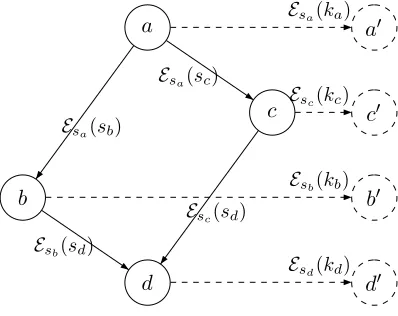
the edges of a hierarchy. Figure 2 illustrates a partially ordered hierarchy along with the public information associated by the EBC to the edges of the hierarchy, as well as those associated to additional edges, which are represented by dashed lines.
3.1 Analysis of the Scheme
In this section we first show that the security property of the EBC depends on the security property of the underlying encryption scheme. Afterwards, we evaluate the performances of the EBC with respect to several parameters, such as space requirements for public and private information storage and computational requirements for key derivation and key updates.
Before analyzing the security of the EBC we first need to define what we mean by a secure symmetric encryption scheme. We formalize security with respect toplaintext indistinguishability, which is an adaption of the notion ofpolynomial securityas given in [20]. We consider an adversary
A= (A1, A2) running in two stages. In advance of the adversary’s execution, a random keykey
is chosen and kept hidden from the adversary. During the first stage, the adversaryA1 outputs a
triple (x0, x1, state), wherex0andx1 are two messages of the same length, andstateis some state
information which could be useful later. One message betweenx0andx1is chosen at random and
a Esa(ka) a0
Esa(sc)
b Esb(kb) b0
Esb(sd)
c Esc(kc) c0
d Esd(kd) d0
Esa(sb)
Esc(sd)
Figure 2: A partially ordered hierarchy along with the public information associated by the EBC.
state and has to determine whether y is the encryption of x0 or x1. Informally, the encryption
scheme is said to be secure with respect to a non-adaptive chosen plaintext attack, denoted by
IND-P1-C0in [25], if every polynomial-time adversaryA, which has access to the encryption oracle only during the first stage of the attack and has never access to the decryption oracle, succeeds in determining whether y is the encryption of x0 orx1 with probability only negligibly different
from 1/2.
Definition 3.2 [IND-P1-C0] Let Π = (K,E,D) be a symmetric encryption scheme and let τ be a security parameter. Let A= (A1, A2) be an adversary that has access to the encryption oracle only during the first stage of the attack and has never access to the decryption oracle. Consider the following two experiments:
Experiment ExpIND−P1−C0−1
Π,A (1τ) Experiment Exp
IND−P1−C0−0
Π,A (1τ)
key← K(1τ) key← K(1τ)
(x0, x1, state)←A
Ekey(·)
1 (1τ) (x0, x1, state)←A
Ekey(·)
1 (1τ)
y←Ekey(x1) y←Ekey(x0)
d←A2(1τ, y, state) d←A2(1τ, y, state)
return d return d
The advantage of A is defined as
AdvINDΠ,A−P1−C0(1τ) =|P r[ExpΠIND,A−P1−C0−1(1τ) = 1]−P r[ExpINDΠ,A−P1−C0−0(1τ) = 1]|.
The scheme is said to besecurein the sense ofIND-P1-C0if the advantage functionAdvINDΠ,A−P1−C0(1τ) is negligible, for any adversary A whose time complexity is polynomial in τ.
Theorem 3.3 If the encryption scheme Π = (K,D,E) is secure in the sense ofIND-P1-C0, then the EBC is secure in the sense of IND-ST.
Proof. Let G = (V, E) be a graph in Γ, let u ∈ V and let Gu = (Iu, Eu) be the subgraph of
G induced by the set of vertices Iu ={v ∈ V : there is a path from v touinG}. W.l.o.g., let
(u1, . . . , um), whereum≡u, be any topological ordering of the vertices inIu and let (e1, . . . , eh−1)
be the sequence of edges inEu such thatei = (uα, uβ) precedesej = (uγ, uδ) if and only if either
u1
u3
u2
u e5 u0
e2
e1
e4 e3
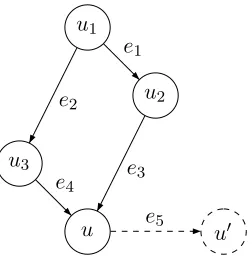
Figure 3: A topological sorting of the classes inIuand corresponding sequence of edges.
Let STATu be a static adversary attacking classu. In order to prove the theorem, we need to
show that the adversary’s views in experimentsExpINDSTAT−u1 andExp
IND−0
STATu are indistinguishable. In particular, we prove that such views are both indistinguishable from the adversary’s view in the experimentExp∗u, defined as follows:
ExperimentExp∗u(1τ, G) (s, k, pub∗
)←Gen∗
(1τ, G)
corr←Corruptu(s)
d←STATu(1τ, G, pub∗, corr, k
u) returnd
The algorithmGen∗ differs fromGenfor the way part of the public informationpub∗is computed. Indeed, the public valueπ(u,u)associated to classuis computed as the encryptionEsu(ρ), whereρ is randomly chosen in{0,1}τ, whereas, the public value associated to each edgee
i = (uα, uβ)∈Eu
is computed as the encryptionEsuα(ri), wherer1, . . . , rh are randomly and independently chosen values in {0,1}τ.
We will first show that the adversary’s views in experimentsExpINDSTAT−u1 andExp
∗
uare
indistin-guishable. We construct a sequence of h+ 1 experiments Exp11u, . . . ,Exp1hu+1, all defined over the same probability space, where the first and the last experiments of the sequence correspond to ExpIND−1
STATu and Exp
∗
u. In each experiment we modify how the view input to STATu is
com-puted, while maintaining the view’s distributions indistinguishable among any two consecutive experiments. For anyq= 2, . . . , h, experimentExp1qu is defined as follows:
ExperimentExp1qu(1τ, G) (s, k, pubq)←Genq(1τ, G)
corr←Corruptu(s)
d←STATu(1τ, G, pubq, corr, k u) returnd
The algorithm Genq used inExp1q
u differs from Gen for the way part of the public information
pubq is computed. Indeed, for any i = 1, . . . , q −1, the public values associated to the edge
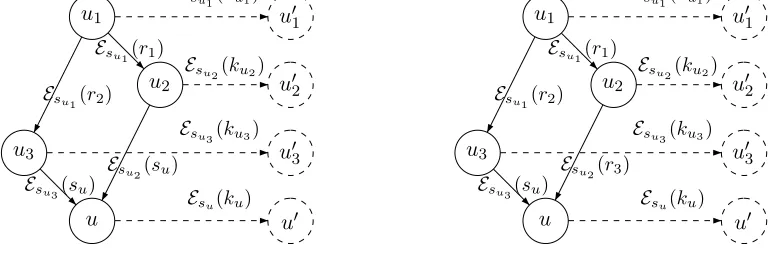
ei = (uα, uβ) is computed as the encryption Esuα(ri), where r1, . . . , rq−1 are randomly and in-dependently chosen values in {0,1}τ. Figure 4 illustrates two consecutive experiments on the
u1 u01
Esu1(ku1)
Esu1(r1) Esu1(r2)
u3 u03
Esu3(ku3)
Esu3(su)
u2 E u02
su2(ku2)
u Esu(ku) u0
Esu2(su)
u1 u01
Esu1(ku1)
Esu1(r1) Esu1(r2)
u3 u03
Esu3(ku3)
Esu3(su)
u2 E u02
su2(ku2)
u Esu(ku) u0
Esu2(r3)
Figure 4: The left hand side illustratesExp13u while the right hand side illustratesExp14u.
In the following we show that, for anyq= 1, . . . , h, the adversary’s view in theq-th experiment is indistinguishable from the adversary’s view in the (q+ 1)-th one.
Assume by contradiction that there exists a polynomial-time distinguisher Bq which is able
to distinguish between the adversary STATu’s views in experiments Exp1qu and Exp1qu+1 with
non-negligible advantage. Notice that such views differ only for the way the public information associated to the edge eq = (a, b) is computed. We show how to construct a polynomial-time
adversaryA= (A1, A2) which usesBqto break the security of the encryption scheme Π = (K,E,D)
in the sense of IND-P1-C0. In particular, the algorithm A1, on input 1τ, randomly chooses two
messages x0, x1 ∈ {0,1}τ and associates x1 either to the key ku, if (a, b) = (u, u0), or to the
private information sb, otherwise. All other keys and private information are chosen at random.
Moreover, A1 constructs all public values associated to the outgoing edges of class a, with the
exception of the edge (a, b), making queries to the encryption oracle Esa(·). The sequences s,k, and pub0 of all private information, keys, and public values constructed by A1, along with the
values x0 and x1 are saved in the state information state. Formally, the algorithm A1 is defined
as follows:
Algorithm AEsa(·)
1 (1τ)
x0, x1, ka← {0,1}τ foreach classv∈V \ {a}
sv← K(1τ),kv ← {0,1}τ if(a, b) = (u, u0)thenk
u←x1
elsesb←x1
foreach edge (a, v)6= (a, b)
p(a,v)← Esa(sv)
pub0
←public values constructed above
state←(s, k, pub0, x
0, x1)
return(x0, x1, state)
Let y be the challenge for the algorithm A, corresponding to the encryption of either x0 or
x1 with the unknown key sa. The algorithm A2, on input 1τ, y, and state, constructs the view
for the distinguisher Bq as follows: it first extracts from s the private information corr held by
corrupted users, by using the algorithm Corruptu(s). Then, it computes the public values not
included in pub0, in order to obtain the sequencepub. In particular, the public value associated
to the edge eq = (a, b) is set equal to the challenge y. Finally, A2 outputs the same output as
Algorithm A2(1τ, y, state)
letstate= (s, k, pub0
, x0, x1)
corr←Corruptu(s)
//construction of missing public values if(a, b) = (u, u0
)thenπ(u,u)←y
elsep(a,b)←y
foreach edge (v, z)6∈ {e1, . . . , eq}
p(v,z)← Esv(sz)
fori= 1, . . . , q−1
ri← {0,1}τ letei= (v, z)
p(v,z)← Esv(ri)
foreach edge (v, v0)
6
= (a, b)
π(v,v)← Esv(kv)
d←Bq(1τ, G, pub, corr, x1)
returnd
Notice that if y corresponds to the encryption of x1, then the random variable associated to
the adversary’s view is exactly the same as the one associated to the adversary view in experiment
Exp1qu, whereas, if ycorresponds to the encryption ofx0, it has the same distribution as the one
associated to the adversary’s view in experimentExp1qu+1. Therefore, if the algorithm Bq is able
to distinguish between such views with non negligible advantage, it follows that algorithm A is able to break the security of the encryption scheme Π = (K,E,D) in the sense of IND-P1-C0. Contradiction.
By using similar arguments we can also show that the adversary’s views in experiments
ExpIND−0
STATu and Exp
∗
u are indistinguishable. In particular, we construct a sequence of h
exper-iments Exp01u, . . . , Exp0hu, all defined over the same probability space, where the first and the last experiments of the sequence correspond to ExpINDSTAT−u0 and Exp
∗
u. In each experiment we
modify the way the view of STATu is computed, while maintaining the view’s distributions in-distinguishable among any two consecutive experiments. For any q = 2, . . . , h−1, experiment
Exp0qu is defined as follows:
ExperimentExp0qu(1τ, G) (s, k, pubq)←Genq(1τ, G)
corr←Corruptu(s)
ρ← {0,1}τ
d←STATu(1τ, G, pubq, corr, ρ) returnd
Notice that, for any q = 2, . . . , h, in experiment Exp1qu, the last input of STATu coincides with the value ku used by Genq to compute the public information π(u, u) = Esu(ku), whereas, in experimentExp0qu, the last input ofSTATu corresponds to valueρrandomly chosen in {0,1}τ,
which is different from the decryption of π(u, u) with the private information su.
The proof that the existence of a polynomial-time distinguisher which is able to distinguish be-tween the adversary’s views in two consecutive experiments implies the existence of a polynomial-time adversary which breaks the security of the encryption scheme Π = (K,E,D) in the sense of
IND-P1-C0 is the same as the one shown before. This concludes the proof.
wants to compute the key held by a classv∈Au is required to performdistG(u, v) + 1 decryption
operations.
Notice that the number of decryption operations needed for key derivation could be reduced at the expense of an increment of the amount of public information. The idea behind the new construction, referred in the following as the modified EBC, is to add the value π(z,v) =Esz(kv) to the public information pub, for any edge (z, v) ∈ E. This allows any user in a class u ∈ V
to compute the key held by a class v ∈ Au by performing distG(u, v) decryption operations.
Indeed, consider the shortest path from utov and let z be the direct predecessor ofv on such a path; it follows thatdistG(u, z) =distG(u, v)−1 decryptions are needed to compute the private
information held byz, whereas, one decryption is needed to obtainkv from the public valueπ(z,v).
However, the modified EBC requires 2|E|+|V| public values. Regarding as the security of the scheme, it is easy to see that the same technique used in Theorem 3.3 can be used to prove that the modified EBC is secure in the sense ofIND-ST.
Finally, we notice that the technique we have used to turn the simple encryption based scheme described at the beginning of Section 3 into the EBC could be used as well to turn some other schemes offering security against key recovery in schemes which guarantee security in the sense of IND-ST. For example, one could use such a technique starting from the pseudorandom based construction proposed by Atallah et al. [4].
3.2 Handling Dynamic Changes
In the following we show how to manage changes to the hierarchy, such as additions and deletions of classes and edges, in the EBC. Unfortunately, the EBC supports insertions, but not deletions, of classes and edges in the hierarchy without re-distributing private information to the classes affected by such changes. Indeed, whenever an edge (u, v) is removed fromE, the private information held by any class lower down uneeds to be changed, since users in classu already knows it. However, it is possible to extend the EBC in order to allow additions and deletions of classes and edges, with local changes to the public information only.
The idea behind the extended construction, referred in the following as theDynamic Encryp-tion Based ConstrucEncryp-tion (DEBC), is to avoid the re-distribution of private information, whenever deletions of classes or edges occur, by never allowing a class to compute the private information of another class lower down in the hierarchy. This can be done by assigning each class u an ad-ditional value ηu, which plays the role of anintermediate key. Such a value is encrypted with the
private information su and the resulting encryption, denoted byω(u,u) is made public and allows
any user in classuto compute its keyku, as well as the intermediate keyηv associated to any class
v lower down in the hierarchy. The scheme requires |V| additional public values and allows any user in a class u to compute the key kv held by any classv ∈Au, by performingdistG(u, v) + 2
decryptions. The Dynamic Encryption Based Construction is described in Figure 5.
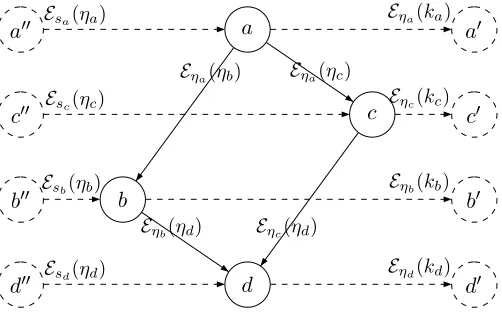
The additional public value ω(u,u) associated by the DEBC to each class u ∈ V could be considered as it were associated to an additional edge connecting a dummy nodeu00to the classu. Figure 6 illustrates a partially ordered hierarchy along with the public information associated to the edges of the hierarchy, as well as those associated to additional edges, which are represented by dashed lines.
Regarding as the security of the scheme, it is easy to see that the same technique used in Theorem 3.3 can be used to prove that the DEBC is secure in the sense ofIND-ST.
Let Γ be a family of graphs corresponding to partially ordered hierarchies. LetG= (V, E)∈Γ and let Π = (K,E,D) be a symmetric encryption scheme.
AlgorithmGen(1τ, G)
1. For any classu∈V, letsu← K(1τ) andku← {0,1}τ;
2. Let s and k be the sequences of private information and keys, respectively, computed in the previous step;
3. For any classu∈V, letηu← K(1τ);
4. For any two classes u, v ∈ V such that (u, v) ∈ E, compute the public information p(u,v) =
Eηu(ηv);
5. For any classuin V, compute the public informationω(u,u)=Esu(ηu) andπ(u,u)=Eηu(ku);
6. Letpubbe the sequence of public information computed in the previous two steps; 7. Output (s, k, pub).
AlgorithmDer(1τ, G, u, v, s u, pub)
1. Extract the public information ω(u,u) from pub and compute the intermediate key ηu = Dsu(ω(u,u)).
2. Let (w0, w1), . . . ,(wm−1, wm), wherew0=uandwm=u, be a path from utov.
For anyi= 1, . . . , m, extract the public valuep(wi−1,wi)frompuband compute the intermediate
keyηwi =Dηwi−1
(p(wi−1,wi));
3. Extract the public value π(v,v) frompuband output the keykv=Dηv(π(v,v)).
Figure 5: The Dynamic Encryption Based Construction.
Insertion of an edge. Let (u, v) be an edge to be inserted inE. Such an update can be managed by the TA by adding the public value p(u,v)=Eηu(ηv) to the public information pub.
Deletion of an edge. Let (u, v) be an edge to be deleted from E. In order to forbid users belonging to class u from computing any key which can be computed by class v, for any
z∈Av, the TA has to choose a new keykz ∈ {0,1}τ and a new intermediate keyηz← K(1τ),
whereas, there is no need to change the private information sz. On the other hand, in
order to allow authorized users to compute such new values, the TA has to update the public information pub, as follows: for any z ∈ Av, it first recomputes the public values
ω(z,z) =Esz(ηz) andπ(z,z)=Eηz(kz); then, for any edge (w, z)∈E, it recomputes the public valuep(w,z)=Eηw(ηz).
Insertion of a class. Letube a class to be inserted inV along with new incoming and outgoing edges. First, the TA computes a private informationsu, a key ku and an intermediate key
ηu for classu. Afterwards, it computesω(u,u)=Esu(ηu) andπ(u,u) =Eηu(ku) and adds them to the public informationpub. Finally, the TA adds the edges by using the above procedure for edge insertions.
a
Eηa(ηb) Eηa(ηc)
a0 Eηa(ka)
a00 Esa(ηa)
b b0
b00 Eηb(kb)
Eηb(ηd)
Esb(ηb)
c c0
c00 Esc(ηc) Eηc(kc)
d d0
d00 Esd(ηd) Eηd(kd)
Eηc(ηd)
Figure 6: A partially ordered hierarchy along with the public information associated by the DEBC.
The DEBC requires |E|+ 2|V| public values; on the other hand, each class has to store a single secret value, corresponding to its private information. As for key derivation, the number of decryption operations required by a class u∈V to compute the key held by a classv ∈Au is
distG(u, v) + 2.
Notice that the number of decryption operations needed for key derivation could be reduced at the expense of an increment of the amount of public information. The idea behind the new construction, referred in the following as themodified DEBC, is to add the valuesω(u,w)=Esu(ηw) and π(z,v) = Eηz(kv) to pub, for any (u, w) ∈E and (z, v) ∈ E. This allows any user in a class
u∈V to compute the key held by a classv∈Au by performingdistG(u, v) decryption operations.
However, the modified DEBC requires 3|E|+ 2|V|public values. Regarding as the security of the scheme, it is easy to see that the same technique used in Theorem 3.3 can be used to prove that the modified DEBC is secure in the sense of IND-ST.
In the following we compare the DEBC with the scheme proposed by Atallah et al. [4] with respect to the number of operations needed to perform dynamic updates to the hierarchy. In their scheme, the insertion of an edge requires the TA to perform one pseudorandom evaluation and two encryption operations, whereas only one encryption operation is required in the DEBC. Regarding as the deletion of an edge (u, v) ∈ E, the scheme in [4] requires the TA to choose a new label and to perform 2· |Av|pseudorandom function evaluations, as well|Xz|pseudorandom
function evaluations and 2·|Xz|encryption operations, whereXz={w∈V : (w, z)∈E}. On the
other hand, in the DEBC the TA has to choose two new values and to perform 2· |Av|encryption
operations, as well as |Xz| encryption operations. For the insertion of a class u, along with its
incoming and outgoing edges, the scheme in [4] requires the TA to generate two random values and to perform two pseudorandom function evaluations, whereas, in the DEBC the TA has to choose three new values and to perform two encryption operations. Moreover, both schemes also use the procedure for edge insertions, for each incoming and outgoing edge. Finally, in both schemes the deletion of a class reduces to the execution of the procedure for the deletion of each outgoing edge from the deleted class.
To summarize, the DEBC improves on the scheme proposed by Atallah et al. [4] because its security is based on a single computational assumption and offers more efficient procedures for key derivation and key updates, since such procedures involve essentially half the number of operations required by the scheme in [4].
used as well to turn some other schemes, which do not allow dynamic updates to the hierarchy without re-distributing any private information, in schemes which allow such updates with local changes to the public information only. For example, one could use such a technique staring from the pseudorandom based construction proposed by Atallah et al. [4].
4
Improving Key Derivation Time
In both schemes described in Section 3, as well as in those proposed by Atallah et al. [4], the number of steps that a class u has to perform, in order to compute the key of another class
v lower down in the hierarchy, is proportional to the length of the shortest path from u to v. Atallah et al. [4, 5] analyzed the problem of reducing key derivation time by modifying the graph representing the hierarchy, in order to reduce its diameter. To this aim in [4] they proposed some constructions to add additional edges, called shortcut edges, to the hierarchy. Such a technique, referred to as theshortcutting technique, has already been used in frameworks quite different from access control.
In Section 4.1 we translate to the access control framework existing results concerning the shortcutting technique and outline the limits of such a technique. An immediate consequence is that for a totally ordered hierarchy of n classes, the number of steps needed to perform key derivation cannot be reduced to three with the addition ofO(n) shortcut edges, as claimed in [5]. Indeed, the number of edges to be added in order to reach diameter three is Θ(n·log logn), as we will show in Section 4.1.
In Section 4.2 we review a different technique proposed in [5] to reduce the diameter of a hierarchy. Such a technique, referred in the following as the shortcutting and point-inserting technique, makes use of the concept of dimension of a poset and consists of the addition of dummy vertices, as well as new edges, to the hierarchy. The idea is to obtain a new hierarchy such that there exists a path between two classes u and v in the old hierarchy if and only if there exists a path between u and v in the new one. The addition of dummy vertices results in a smaller number of new edges to be added to the hierarchy. However, dummy vertices are used only for performance reasons and there are no real classes corresponding to them. The technique is recursive and uses the one-dimensional case, corresponding to a totally ordered hierarchy, as the basis of the recursion. We point out that the number of dummy classes and new edges added by such a technique in a hierarchy with nclasses and dimensiond, in order to reduce key derivation time to 2d+ 1, isO(n·d·(logn)d−1·log logn) and not O(n·d·(logn)d−1) as claimed in [5].
Finally, in Section 4.3 we show how to further reduce key derivation time by improving the shortcutting and point-inserting technique. Our technique performs a further shortcutting of the graph obtained by the technique in [5] and allows key derivation time to be independent ond.
4.1 The Shortcutting Technique
The shortcutting of a directed graph G = (V, E) consists into inserting additional edges, called shortcut edges, in E without changing the transitive closure of G. The goal is to obtain another directed graph, called a shortcut graph, having a smaller diameter than G. Atallah et al. [4] showed two constructions to add shortcut edges to tree hierarchies with n classes. The former allows the diameter of the shortcut graphs to be reduced toO(log logn) by addingO(n) shortcut edges, whereas, the latter allows the diameter to be reduced to three by adding O(nlog logn) shortcut edges.
of V belong to a given semigroup (S,◦) and one is interested in answering queries of the form “what is the value ofvi◦vi+1◦ · · · ◦vj−1◦vj?” for any 1≤i≤j≤n. As noticed by Thorup [36],
the shortcutting technique has been later rediscovered by other authors [3, 7]. In the following we translate to our scenario the main existing results concerning the shortcutting technique when applied to particular kinds of graphs. We start discussing chains, then we analyze trees and finally general graphs.
Chains. By using the techniques proposed by Yao [39] in 1982 we can add shortcut edges to a
chain (v1, . . . , vn) of n vertices. The techniques proposed by Alon and Schieber [3] in 1987 and
Bodlaender et al. [7] in 1994 are essentially the same as the ones proposed by Yao, but their description is easier to illustrate and treats the case of constant diameter in a more detailed way. Given a parameter ` ≥ 1, Alon and Schieber established both upper and lower bounds on the minimum number of shortcut edges to be added to the chain in order to obtain a shortcut graph with diameter at most `. Their construction, on input a chain (v1, . . . , vn), results in a shortcut
graph having diameter at most `, with the addition of C(`, n) shortcut edges to the chain. We will see later that such a construction is the best possible when `is a constant.
• Case `= 1: For anyi= 1, . . . , n−1 and any j≥i, add the shortcut edge (vi, vj). Clearly,
C(1, n) =O(n2).
• Case `= 2: The algorithm works as follows:
1. Ifn≥4, then
(a) Partition the chain (v1, . . . , vn) in two consecutive subchains T1 = (v1, . . . , vdn/2e)
andT2 = (vdn/2e, . . . , vn) having one vertex in common;
(b) Forj= 1, . . . ,dn/2e −1, add the shortcut edge (vj, vdn/2e);
(c) For h=dn/2e+ 1, . . . n, add the shortcut edge (vdn/2e, vj);
(d) Apply the construction recursively to the subchainsT1 and T2.
The number of shortcut edges added by the algorithm is given by the recurrence
C(2, n) =
(
0 ifn≤3;
C(2,dn/2e) +C(2,bn/2c) +O(n) otherwise;
whose solution isC(2, n) =O(n·logn).
• Case`≥3: Before describing the construction, we need to define two very rapidly growing functionsA(i, j) andB(i, j), related to the Ackermann’s function (see [33]):
A(0, j) = 2j, forj≥1, A(i,0) = 1, for i≥1,
A(i, j) = A(i−1, A(i, j−1)) for i, j≥1,
and
B(0, j) = j2, forj≥1, B(i,0) = 2, fori≥1,
B(i, j) = B(i−1, B(i, j−1)) fori, j≥1.
logarithmic functionlog∗n, which, for all values ofnless than 265,536, corresponding to much more than the number of atoms in the universe, does not exceed 5. The iterated logarithm function log∗nis defined to be the number of times the logarithm function must be applied in succession, starting with argument n, before the result is less than or equal to 1, i.e., log∗n= min{i≥0 : log(i)n≤1}, where
log(i)n=
n ifi= 0,
log(log(i−1)n) ifi >0 and log(i−1)n >0,
undefined ifi >0 and log(i−1)n≤0 or log(i−1)nis undefined.
The first five values ofw(·, n) are the following: w(0, n) =dn/2e, w(1, n) =d√ne, w(2, n) = dlogne, w(3, n) =dlogdlognee,andw(4, n) = log∗n.Next values ofw(·, n) can be computed as follows: w(i, n) = min{j:w(j)(i−2, n)≤1}, wherew(1)(i, n) =w(i, n) andw(j)(i, n) =
w(i, w(j−1)(i, n)),forj≥2.
The construction for`≥3 works as follows:
1. Ifn≥`+ 2, then
(a) Let k =w(`−2, n) and partition the chain (v1, . . . , vn) into f =dn/ke ≥2
sub-chainsT1, . . . , Tf ofkvertices each, where any two consecutive subchains have one
vertex in common and the last subchain can contain less thankvertices. For i= 1, . . . , f−1, let Ti = (v(i−1)k−i+2, . . . , vik−i+1) and letTf = (v(f−1)k−f+2, . . . , vn);
(b) For anyi= 1, . . . , f−1,and anyj= (i−1)k−i+3, . . . , ik−1+i, add the shortcut edges (v(i−1)k−i+2, vj) and (vj, vik−i+1). For any j = (f−1)k−f+ 3, . . . , n, add
the shortcut edges (v(f−1)k−f+2, vj) and (vj, vn);
(c) Apply the construction recursively to the subchains T1, . . . , Tf.
(d) LetEP be the set containing the endpoints of each subchain. Apply the construc-tion for`−2 to the chain whose vertices are the elements ofEP.
The number of shortcut edges added by the algorithm is given by the recurrence
C(`, n) =
(
0 ifn≤`+ 1;
dn/ke ·C(`, k) +C(`−2,dn/ke) +O(n) otherwise;
whose solution is C(`, n) = O(n·`·w(`, n)). For example, C(3, n) = O(n·log logn) and
C(4, n) =O(n·log∗n).
For constant `≥2, the above construction is optimal. Indeed, Alon and Schieber [3] showed that the minimum number of shortcut edges to be added to a chain ofnvertices in order to obtain a shortcut graph with diameter at most`is
Cmin(`, n) = Ω(n·w(`, n)). (1)
Moreover, they showed that, by adding O(n) shortcut edges, the diameter of the resulting shortcut graph is Ω(log∗n). The parameters of known constructions for a chain of n vertices are summarized in Figure 7, where log∗n, log∗∗n, etc., correspond to the so called milky way functions in [7].
Trees. In 1987 Chazelle [10], as well as Alon and Schieber [3], considered free trees, i.e.,
achieved with the addition of m ≥ n shortcut edges is Θ(α(m, n) + m−nn+1), where α denotes the inverse of the Ackermann’s function defined by Tarjan [33]. An equivalent result that lends itself well to parallelization and allows an algorithmically simpler proof has been achieved by Thorup [36]. The idea behind Chazelle’s construction for a free tree T is the following: Choose an integer 1≤k≤n and partition the tree intop subtreesT1, . . . , Tp, such that eachTi contains
a number ni of nodes, where k/3 < ni ≤ k. Such a partition can be easily computed by using
a well known result also appearing in [26]. Then, the subtrees T1, . . . , Tp are considered as the
super nodes of a free tree. This allows the classification of any path inT as either falling entirely within a super node or stretching over several super nodes. The algorithm is recursively called on each super node; moreover, the super nodes become connected with the addition of shortcuts. Chazelle’s result was also shown to hold for directed trees [35]. Given a forest withnvertices and height h, Thorup [36] showed how to obtain a shortcut graph having diameter three by adding
O(n·log logh) shortcut edges. The problem of adding shortcut edges to chains and trees was also considered in [7], where a detailed treatment of the case of constant diameter was given. The parameters of known constructions are summarized in Figure 7.
Diameter Minimal number
` of shortcut edges
1 Θ(n2)
2 Θ(n·logn) 3 Θ(n·log logn) 4 Θ(n·log∗n) 5 Θ(n·log∗n) 6 Θ(n·log∗∗n) 7 Θ(n·log∗∗n) 8 Θ(n·log∗∗∗n)
etc. etc.
O(log∗n) Θ(n)
Figure 7: Minimal number of shortcut edges to be added to chains and trees withn vertices in order to obtain a shortcut graph with diameter`.
General Graphs. Thorup [34] conjectured that for any directed graph G = (V, E) one can
obtain a shortcut graph with diameter polylogarithmic in |V|, i.e., (log|V|)O(1), by adding at most|E|shortcut edges. He also showed his conjecture to be true for planar directed graphs [35]. However, Hesse [22] gave a counterexample to Thorup’s conjecture. He showed how to construct a direct graph requiring the addition of Ω(|E| · |V|1/17) shortcut edges to reduce its diameter below Θ(|V|1/17). By extending his construction to higher dimensions, it is possible to obtain graphs
with|V|1+² edges that require the addition of Ω(|V|2−²) shortcut edges to reduce their diameter.
All constructions described in this section can be used to reduce key derivation time in hierar-chical key assignment schemes. However, the result by Hesse [22] implies that key derivation time cannot be reduced essentially below Ω(|V|2) for some kinds of graphs by adding only shortcut
edges.
4.2 The Shortcutting and Point-Inserting Technique
V whose intersection is (V,¹). It can also be seen as the smallest nonnegative integerdfor which each u ∈ V can be represented by a d-vector (xu,1, . . . , xu,d) of integers such that u ¹ v if and
only if xu,i ≤xv,i, for any i= 1, . . . , d, and any u, v ∈V. There are efficient algorithms to test
if a poset has dimension 1 or 2, but the problem of determining if a poset has dimension 3 is NP-complete [38]. A poset has dimension one if and only if it is a total order.
Given a poset (V,¹) with dimensiondandnvertices, Atallah et al. [5] proposed an algorithm to add new edges, as well as dummy vertices, to the corresponding hierarchy. Their construction is recursive and for the base case d= 1, corresponding to a totally ordered set, i.e., a chain of
n vertices, uses the following algorithm: Partition the vertices of the chain into d√ne regions, where each region containsd√nevertices, with the exception of the last region, which can contain less vertices; let S be the set consisting of each d√ne-th vertex of the chain, including the last one. Any two vertices vi, vj ∈ S such that i < j are connected by a shortcut edge. Moreover,
a shortcut edge between any two vertices vi 6∈ S and vj ∈ S (vi ∈S and vj 6∈ S, respectively),
whose distance is shorter thand√ne, is added. Atallah et al. [5] claimed their algorithm results in a shortcut graph having diameter equal to three with the addition of at most O(n) shortcut edges. However, since no shortcut edge is added between any two vertices vi, vj 6∈ S inside the
same region, the diameter of the resulting graph is not three, but essentially d√ne. If we want the diameter of the shortcut graph to be equal to three, we may recursively call the algorithm on each region, as done by the algorithm for`= 3 described in Section 4.1; the recursion bottoms up when each region contains at most four vertices, since in this case the diameter is already equal to three and no more shortcut edges need to be added. It is easy to see that the above algorithm results in the addition of Θ(n·log logn) shortcut edges. Moreover, if we want the diameter of the shortcut graph to be at most three, we need to add at least Ω(n·log logn) shortcut edges, because of (1).
For the case d≥2, the input consists of a set of n points in the d-dimensional space. Such points correspond to thed-vectors associated to the vertices of the poset (V,¹) and are not con-nected by edges. LetM be a (d−1)-dimensional hyperplane perpendicular to thed-th dimension;
M partitions the set of vertices V into two sets V1 and V2, whereV1 is the set of points that are
on the smaller side of the hyperplane, according to the d-th coordinate. Let V10 and V20 be the projections of the points in V1 and V2 on M. A new edge from every point of V10 (resp., V2) to
its corresponding point ofV1 (resp.,V20) is added. Then the algorithm is recursively executed on
the two sets of points V1 and V2. Finally, the (d−1)-dimensional problem on the set of points
V10∪V20 is solved by using the algorithm for dimension d−1. According to Atallah et al. [5], the above construction results in a graph having diameter equal to 2d+ 1, with the addition of at most O(n·d·(logn)d−1) new edges and dummy vertices. However, their computations take in account the number of shortcut edges added to a chain ofn vertices, which, as noticed before, is not O(n), but Θ(n·log logn). According to the correct result for the chain, the number of new edges and dummy vertices added by their algorithm is thus O(n·d·(logn)d−1·log logn). In the following we show how to further reduce key derivation time. Our technique performs a further shortcutting of the graph obtained by Atallah et al.’s technique and allows key derivation time to be independent on d.
4.3 Reducing the Diameter in the Shortcutting and Point-Inserting Technique
Yao [39] and described in Section 4.1. The construction for the cased≥2 is described in Figure 8. The input is a set ofn d-dimensional points corresponding to the vertices inV; for each vertex
v∈V, letPv(d) be the corresponding point and letV(d)={Pv(d):v ∈V}.
Let (V,¹) be a poset with dimensiond≥2, letV(d)be the set of points in the vectorial representation
of the Hasse diagram associated to (V,¹) and based on itsdtotal orders, and let`≥1. 1. If|V(d)
|= 1, then outputV(d).
2. If|V(d)
| ≥2, compute a (d−1)-dimensional hyperplaneM perpendicular to thed-th dimension that partitions the set of points inV(d)into two sets V(d)
1 andV (d)
2 ofbn/2canddn/2epoints,
respectively, whereV1(d)is the set on the smaller side of the hyperplane (according to thed-th coordinate). Such points are projected onM. Denote byPv(d−1) the projection ofPv(d) onM. LetV1(d−1)andV
(d−1)
2 be the projections ofV (d) 1 andV
(d) 2 .
3. Ifd= 2, use the construction of Section 4.1 on the chain whose vertices are the points in the set V(1), in order to obtain a shortcut graph G(1) = (V(1), E(1)), having diameter at most `.
The set of dummy points added by the algorithm isD(1) =
∅ (no dummy points are added). 4. If d ≥ 3, recursively call the algorithm on the set of points in V(d−1) = V(d−1)
1 ∪V (d−1) 2 ,
corresponding to a (d−1)-dimensional hyperplane; letG(d−1) = (V(d−1)∪D(d−1), E(d−1)) be
the corresponding output. 5. LetD(d)=V(d−1)
∪D(d−1).
6. LetE(d)=E(d−1).
7. Add edges between points in V(d)and corresponding projections:
(a) For each pointPv(d)∈V1(d), add an edge (P (d−1)
v , Pv(d)) toE(d). (b) For each pointPv(d)∈V2(d), add an edge (P
(d)
v , P(d
−1)
v ) toE(d). 8. Add shortcut edges between points in V(d)and dummy points:
(a) For each edge (Pu(d−1), Pv(j))∈E(d−1), add an edge (Pu(d), Pv(j)) toE(d). (b) For each edge (Pu(j), P(d
−1)
v )∈E(d−1), add an edge (Pu(j), Pv(d)) toE(d). 9. Recursively call the algorithm on the two sets of points inV1(d) andV
(d) 2 .
10. Output the graphG(d)= (V(d)∪D(d), E(d)).
Figure 8: The Improved Shortcutting and Point-Inserting Technique.
The numberDP(n, d) of dummy points added by the ISPIT isDP(n, d) = 2·DP(dn/2e, d) +
DP(n, d−1) + Θ(n), where DP(n,1) = 0 andDP(1, d) = 0. Indeed, in order to constructG(d), the algorithm adds n dummy points, corresponding to the projections of the points in V(d) on the (d−1)-dimensional hyperplaneM, plusDP(n, d−1) dummy points for the construction of
G(d−1), and then is recursively called on the two sets V(d) 1 and V
(d)
2 . The solution of the above
called on the two sets V1(d) and V2(d). Clearly, the solution of T(n, d), as well as the diameter of the graph G(d), depends on the the number T(n,1) of shortcut edges added by the construction
of Section 4.1. If T(n,1) = Θ(n), then T(n, d) = O(n·d·(3 logn)d−1). On the other hand, if
T(n,1) = Θ(n·log logn), then T(n, d) = O(n·d·(3 logn)d−1 ·log logn) and the diameter of the graph G(d) is three, i.e., it is independent on d. It is easy to see that, for any two vertices
u, v∈V such that u¹v, there exists a path from Pv(d) toPu(d) inG(d) which has length at most
the diameter of the graphG(1) obtained by solving the 1-dimensional problem onV(1).
Compared to the technique in [5], the ISPIT allows a further reduction of the diameter, but in each recursive call, it adds at most three times the number of new edges added by that algorithm. In the following we show a trade-off between the number of edges added by the ISPIT and the diameter of the resulting graph. The idea behind the construction is the following: Assume the 1-dimensional problem is solved by adding Θ(nlog logn) shortcut edges. For each
j = 2, . . . , d, the j-dimensional problem could be solved either with the technique in [5] or with ours. Let 1 ≤t ≤d and assume, for example, that for j = 2, . . . , t, the technique in [5] is used to solve the j-dimensional problem, whereas, our technique is used to solve the problems with dimensions from t+ 1 to d. It is easy to see that the graph resulting by the above construction has diameter 2t+ 1. Moreover, the number of new edges added by the modified algorithm is
O(3d−t·n·t·(logn)d−1·log logn).
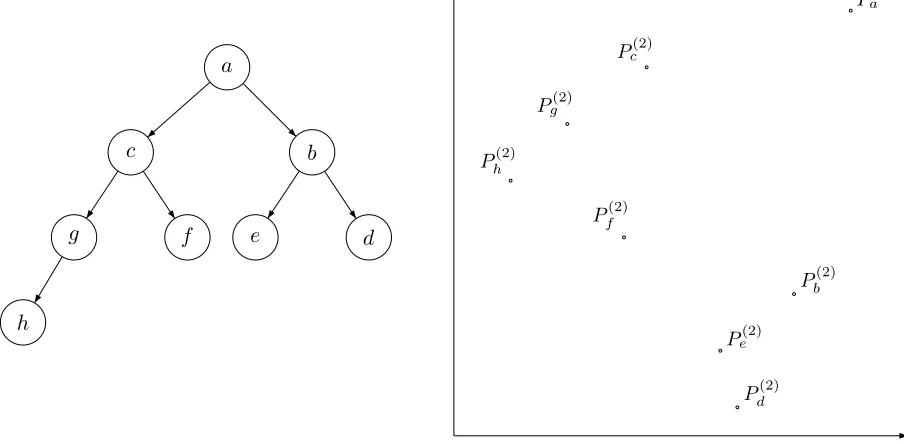
An Example of the New Technique. For the reader’s convenience, in the following we illustrate how the ISPIT works for the cased= 2. Consider the hierarchy represented on the left hand side of Figure 9. The vectorial representation of the hierarchy is represented on the right hand side of Figure 9.
a
c b
g f e d
h
Pa(2)
Pc(2)
Pg(2)
Ph(2)
Pf(2)
Pb(2)
Pe(2)
Pd(2)
Figure 9: A hierarchy with dimensiond= 2 and its vectorial representation.
Notice that if a point Pv(2)= (xv, yv) dominates another point Pu(2) = (xu, yu) in the vectorial
representation, i.e., ifxu < xv and yu < yv, then there is a path from vertex v to vertexu in the
on the chain of dummy points.
Pa(1) Pa(2)
Pc(1)
Pc(2)
Pg(1)
Pg(2)
Ph(1) Ph(2)
Pf(1) Pf(2)
Pb(1) Pb(2)
Pe(1)Pe(2)
Pd(1) Pd(2)
Pa(1) Pa(2)
Pc(1)
Pc(2)
Pg(1)
Pg(2)
Ph(1) Ph(2)
Pf(1) Pf(2)
Pb(1) Pb(2)
Pe(1)Pe(2)
Pd(1) Pd(2)
Figure 10: Dummy points corresponding to the projections of two-dimensional points and shortcut graph obtained by the construction of Section 4.1, for`= 2, on the chain of dummy points.
The left hand side of Figure 11 shows the new edges, represented by dashed lines, added by the ISPIT in step 7. Finally, the right hand side of Figure 11 shows the shortcut edges added by the ISPIT in step 8. New edges and points added in recursive calls of the algorithm are not represented.
Pa(1) Pa(2)
Pc(1)
Pc(2)
Pg(1)
Pg(2)
Ph(1) Ph(2)
Pf(1) Pf(2)
Pb(1) Pb(2)
Pe(1)Pe(2)
Pd(1) Pd(2)
Pa(1) Pa(2)
Pc(1)
Pc(2)
Pg(1)
Pg(2)
Ph(1) Ph(2)
Pf(1) Pf(2)
Pb(1) Pb(2)
Pe(1)Pe(2)
Pd(1) Pd(2)
5
A Construction based on Broadcast Encryption Schemes
In this section we show how to construct a hierarchical key assignment scheme using as a building block a broadcast encryption scheme. A broadcast encryption scheme allows a sender to broadcast an encrypted message to a set of users in such a way that only legitimate users can decrypt it. Broadcast encryption schemes can be either public key or symmetric key based. In the symmetric key setting, only a trusted authority can broadcast data to the receivers. In contrast, in the public key setting a public key published by a trusted authority allows anybody to broadcast a message. We first recall the definition of a public-key broadcast encryption scheme [9].
Definition 5.1 A public-key broadcast encryption scheme for a set U of users is a triple of algorithms (Set, Enc, Dec) satisfying the following conditions:
1. The setup algorithm Set is probabilistic polynomial-time. It takes as input a security pa-rameter 1τ and the set of users U and produces as output a private key sku, for each user
u∈ U, and a public key pk.
2. The encryption algorithm Enc is probabilistic polynomial-time. It takes as inputs 1τ, a subset X ⊆ U, and the public key pk, and produces as output the a pair (Hdr, k), where
Hdr is called the broadcast header and k is a encryption key. Let m be a message to be broadcast in such a way that only users in X are allowed to obtain m and let y be the encryption ofm under the symmetric keyk. The broadcast message consists of(X, Hdr, y), where the pair(X, Hdr) is called the full broadcast header andyis called the broadcast body.
3. The decryption algorithm Dec is deterministic polynomial-time. It takes as inputs 1τ, a
subsetX⊆ U, a useru∈X and its private key sku, a broadcast header Hdr, and the public
key pk, and produces as output the key k. Such a key can be used to decrypt the broadcast bodyy in order to obtainm.
We require that for all subsetsX⊆ U, all usersu∈X, all public keys and private keys which can be output by Set(1τ,U), all pairs (Hdr, k), which can be output by Enc(1τ, X, pk), we have that
Dec(1τ, X, u, sku, Hdr, pk) =k.
In the following we show how to construct a hierarchical key assignment scheme using as a building block a public-key broadcast encryption scheme. The idea behind our construction, referred in the following as theBroadcast Encryption Based Construction (BEBC), is to compute the private and public information by using the broadcast encryption scheme; more precisely, the public information will contain a broadcast header Hdru, which corresponds to an encryption of
the key ku, for each class u∈V. Such a broadcast header can be decrypted by all classes in the
set Iu ={v∈V : there is a path from v tou inG}, allowing them to compute the keyku. The
Broadcast Encryption Based Construction is described in Figure 12.
5.1 Analysis of the Scheme
In this section we first show that the security property of the BEBC depends on the security prop-erty of the underlying broadcast encryption scheme. Afterwards, we evaluate the performances of the BEBC with respect to several parameters, such as space requirements for public and private information storage and computational requirements for key derivation and key updates.
Let Γ be a family of graphs corresponding to partially ordered hierarchies. LetG= (V, E)∈Γ and let (Set, Enc, Dec) be a public-key broadcast encryption scheme for users inV.
AlgorithmGen(1τ, G,)
1. Run Set(1τ, V) to generate a public keypk and a secret keysk
u for anyu∈V; 2. For each classu∈V, letsu=sku;
3. For each classu∈V, runEnc(1τ, I
u, pk) to obtain the pair (Hdru, ku);
4. Let s and k be the sequences of private information and keys computed in the previous two steps;
5. Letpubbe the sequence constituted by the public keypk along with the headerHdru, for any
u∈V;
6. Output (s, k, pub).
AlgorithmDer(1τ, G, u, v, s u, pub)
1. Extract the public keypk and the headerHdrv frompub. 2. Outputkv=Dec(1τ, Iv, u, su, Hdrv, pk).
Figure 12: The Broadcast Encryption Based Construction.
is defined through a game between an adversaryAand a challenger. According to the capabilities of the adversary and the security goal, several types of security notions for public-key broadcast can be defined. We consider the definition ofsemantic security given by Boneh et al. [9], where the adversary is not allowed to issue decryption queries to the challenger. Different notions of security, such as chosen ciphertext securitycan be found in [18, 9, 24]. We consider the following game:
• Initialization. Algorithm A outputs a setX⊆ U of receivers that it wants to attack.
• Setup. The challenger first runsSet(1τ,U) to obtain a private keysku for each user u∈ U
and a public key pk. Afterwards, it gives the public key pk and all private keys skv for
which v6∈X toA.
• Challenge. The challenger runsEnc(1τ, X, pk) to obtain (Hdr, k). Then, it picks a random bitb∈ {0,1}, setskb =k and choosesk1−b as a random key. The challenge (Hdr, k0, k1) is
given to A.
• Guess. Algorithm Aoutputs its guess b0 ∈ {0,1} forband wins the game ifb=b0. The advantage of the adversary Ais defined as
AdvA,U(1τ) =|P r[b0=b]−1/2|.
Definition 5.2 Let (Set, Enc, Dec) be a public-key broadcast encryption scheme for a set U of users. The scheme is said to be semantically secure if the function AdvA,U(1τ) is negligible, for
any adversary A whose time complexity is polynomial in τ.