ID-ABE: Incorporating ID-based Revocation,
Delegation, and Traceability Capabilities into
Attribute-Based Encryption
Abstract—Ciphertext Policy Attribute-Based Encryption (CP-ABE) has been proposed to implement fine-grained access con-trol. Data owners encrypt data with a certain access policy so that only data users whose attributes satisfy the access policy can decrypt the ciphertext. A user can be automatically assigned an access privilege based on whether his/her attributes satisfying a given access policy described by attributes and their logical relations. In order to provide more flexible policy-based access control, attribute-policy-based revocation approaches had been proposed to provide the NOT logic on attributes to allow attribute-based revocation. However, previous solutions increase the attribute management overhead when considering each user’s ID as an attribute for more precise revocations at the individual user-level. To address this issue, in this research article, an ID-ABE scheme is presented, where a user’s ID is incorporated into the key generation procedure allowing user-ID-based revocation. In addition to ID-based revocation, ID-ABE also presents a hierarchical identity structure to build a delegation framework to enable group-based revocation. Furthermore, ID-ABE can be used to counter blackbox attack, where malicious users can misuse their attributes and private keys in blackmarket by selling their private keys protected by a temper-proof blackbox device. In the end, we also evaluate the performance of the proposed scheme in terms of computation, storage and communication overhead, which shows the practical value of the solution for secure data sharing applications.
I. INTRODUCTION
The literature proposes a diversity of access control systems supporting policies including basic access control lists [1], cryptographically-enforced capabilities [2], group-based [3], role-based [4] and attribute-based controls [5]. Most of these approaches rely on a fully-trusted access monitoring server to implement policy checking, which are not suitable for some practical applications, such as cloud computing where the cloud servers may not be fully trusted. Secure data sharing in these application scenarios pushes the development and usage of new cryptographic schemes in supporting ac-cess control models in a cloud-based data sharing service model. Among these cryptographic schemes, Ciphertext Policy Attribute-Based Encryption (CP-ABE) [6] is regarded as one of promising technologies and is a natural fit for building an attribute-based access control (ABAC) [7] architecture to support secure data sharing features such as policy-based data access control.
In CP-ABE scheme, each user is assigned a set of attributes based on his/her role and capabilities, which are used as public keys. The data owner can enforce data access control by encrypting the data with a data access policy expressed by
apolicy treestructure that is composed by a set of attributes and their logic relations (e.g., AND, OR, k out of n, etc.). The encrypted data can be placed on a public cloud storage server. A user can decrypt the ciphertext only if his assigned attributes can satisfy the logic enforced among attributes to reach the root of the policy tree. This approach is promising in that the access control policies are incorporated into the ciphertext naturally and there is no need for a trusted third-party to enforce the data access control during the run-time any more.
Using attributes to present data access policies is a very flexible and scalable approach when data owners do not have a clear picture about who have been included in a desired policy confined group (called policy group, i.e., described by a policy tree). However, one major drawback of using attributes is the introduced attributes management overhead when the data access requires the accuracy at the user-level,
e.g., excluding specific users from a policy group. To this end, a scheme enabling negative logic (NOT) has been proposed by Yamadaet. al [8], where a user can be revoked based on his assigned attributes or his ID that is regarded as a unique attribute. Revoking attributes is not desirable when precise user revocation is needed since excluding an attribute may also revoke other users due to the lack of priori membership information of a policy group. Additionally, considering users’ ID as an attribute has practical issues, i.e., complicated at-tribute management due to significantly increased the number of attributes.
In this paper, we present a new ID-based ABE approach called ID-ABE to achieve precise user-level revocation. The salient feature of ID-ABE is incorporating a user’s ID into his ABE private key. The encryption algorithm works by two integrated functions: (1) specify attribute literals in conjunc-tive/disjunctive normal forms as a policy tree structure to cover the recipients of the target policy group; (2) revoke unauthorized users by incorporating their identities into the ciphertext. In this way, only users whose attributes satisfy the policy tree structure and meanwhile are not revoked by the data owners can decrypt the ciphertext.
not always online since the revocation list is always initiated by the data owner and the ciphertext is already incorporated the revocation information. Moreover, it overcomes the at-tributes exploration problem when considering a user’s ID as an attribute. (b) Delegation: ID-ABE provides a hierarchical delegation framework established to manage users’ IDs and assigned attributes. The delegation approach not only reduces the management overhead by distributing the key management tasks to multiple delegators, but also provides a scalable framework to revoke a large group of users by revoking their delegator’s ID. (c)Traceability:ID-ABE can trace users who misuse their attributes or private keys. For example, a user may use BlackBox attack [9] by selling a part of (or his whole) private key protected by a temper-proof device on a black market. Using ID-ABE, the malicious user can be easily identified by any user through a standard input/output testing on the blackbox, which allows law enforcement and data source providers to easily trace users who misuse their allocated private keys.
A. Research Contributions
Our contributions are summarized as follows:
• ID-ABE provides an integrated approach to nicely incor-porate users’ ID into user’s key generation procedure and eases the attribute management.
• ID-ABE not only supports revocation of individual users but also is able to effectively revoke all the users within the same delegation domain.
• ID-ABE supports key-generation delegation, where a domain authority is responsible for generating private keys for all the users within its management domain. • We have proved that the presented ID-ABE construction
is secure based on the proposed security definition. • The performance evaluation demonstrates that the
ID-ABE scheme is practical for cloud-based data sharing applications.
B. Arrangement of the paper
The remainder of this paper is organized as follows. In section II, we introduce some preliminaries used in the fol-lowing sections. In section III, we show the system model and the formal definition of ID-ABE together with its security definition. In section IV, we discuss a trivial but insecure construction as well as a basic construction of the simplified ID-ABE scheme. In section V, on the basis of the construction in section IV, we present constructions of the ID-ABE scheme. In section VI, delegable ID-ABE constructions are described. In section VII, we evaluate the efficiency of the proposed schemes. Section VIII discusses the related work. Finally, section IX concludes the paper.
II. PRELIMINARIES ANDASSUMPTIONS
In this section, we present the definition ofaccess structure,
linear secret sharing schemes,bilinear map, as well as the M-q-parallel-BDHE assumption used in the following sections.
A. Access Structure
Access Structure [10]. Let {P1, P2, . . . , Pn} be a set of parties. A collection A ⊆ 2{P1,P2,...,Pn} is monotone
if ∀B, C: if B ∈ A and B ⊆ C then C ∈ A. An access structure is a collection A of non-empty subsets of
{P1, P2, . . . , Pn},i.e.,A⊆2{P1,P2,...,Pn}\{∅}. The sets in A
are defined as authorized sets, and sets that do not belong to Aare defined as unauthorized sets.
B. Linear Secret Sharing Schemes
Linear Secret Sharing Schemes (LSSS) [10]. A secret sharing scheme Π over a set of parties is called linear over Zp if the following two conditions are satisfied:
• the shares for each party form a vector overZp;
• a share-generating matrix for Π has ℓ rows and n columns. For alli= 1, . . . , ℓ, theithrow ofM, we define
ρ(i)as the party labeling row i. For the column vector v= (s, r2, r3, . . . , rn), wheres∈Zp is the shared secret
and r2, r3, . . . , rn ∈ Z are randomly chosen numbers,
thenM vis the vector ofℓshares of the secretsaccording toΠ, where the share(M v)i belongs to partyρ(i).
As shown in [10], every linear secret sharing-scheme ac-cording to the above definition also enjoys the following linear reconstruction property.
Definition 1 (Linear reconstruction). Assume that Π is an LSSS for the access structure A. Define S ∈ A as an authorized set and I ⊂ [1, l] as I = {i : ρ(i) ∈ S}. Then, constants {wi ∈ Zp}i∈I can be derived in polynomial time such that such that for valid shares {λi} of any secret s we have∑i∈Iwiλi=s.□
C. Bilinear Map
Definition 2 (Bilinear Map). Let G1, G2 and GT be multi-plicative cyclic groups of prime order p. Let g1 and g2 be generator ofG1andG2respectively. A bilinear map is a map
e:G1×G2→GT with the following properties:
• Computable: there exists an efficiently computable algo-rithm for computing e;
• Bilinear: for all u ∈ G1, v ∈ G2 and a, b ∈ Zp,
e(ua, vb) = e(u, v)ab; For any u ∈ G1, v
1, v2 ∈ G2, e(u, v1v2) =e(u, v1)·e(u, v2);
• Non-degenerate: e(g1, g2)̸= 1;
The bilinear map is called symmetric, if G1 and G2 are a same group denoted byG. Letgdenote the generator of G.□
D. Security Assumption
Modified (decisional) q parallel Bilinear Diffie-Hellman Exponent problem is similar to the Decisional Parallel Bilinear Diffie-Hellman Exponent (q-parallel BDHE ) problem [6]. The definition is as follows.
random generator g of G. Choose a, s, b1, b2,· · ·, bq ∈ Zp at random. Given
y={g, gs, ga,· · · , g(aq), , g(aq+2),· · · , g(a2q),
∀1≤j≤q ga/bj,· · ·, ga
q/b
j, , gaq+2/bj, ..., ga2q/bj,
∀1≤j≤q ga·s/bj,· · · , g(a
q·s/b j)},
it is hard for a Probabilistic Polynomial Time (PPT) adversary to distinguish e(g, g)aq+1s ∈ G
T from a random element R chosen from GT. An algorithm B that outputs z ∈ {0,1} has advantage ϵ in solving the M-q-parallel-BDHE problem defined as above if the follwing equation holds
|Pr[B(y, T =e(g, g)aq+1s) = 0]−Pr[B(y, T =R) = 0]| ≥ϵ.
□
The M-q-parallel-BDHE assumption holds if the advan-tage ϵ of any PPT adversary B to solve the M-q -parallel-BDHE problem is a negligible function of the security pa-rameter.
Theorem 1. The Modified (decisional) q parallel Bilinear Diffie-Hellman Exponent assumption generically holds.
III. SYSTEMMODEL ANDDEFINITIONS
In this section, we first show the system model and then present the definition of the proposed ID-ABE scheme as well as its security model.
A. System Model
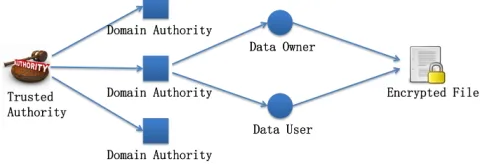
As shown inFig. 1, the system under consideration includes four types of parties: the trusted authority, several domain authorities, data owners and data users. The data owners encrypt their data with a certain access policy. Data users whose attributes satisfy the access policy could decrypt the ciphertext. Each data owner or data user is managed by a certain domain authority. Each domain authority is managed by its parent domain authority or the trusted authority. The trusted authority is the root authority and is responsible for managing top-level domain authorities.
Fig. 1 System Model.
B. Algorithm Definition
The ID-ABE scheme consists of the following four algo-rithms:
• Setup(λ,U). The setup algorithm takes security param-eter λand attribute universeU as inputs. It outputs the public parameters PKand a master secret keyMSK.
• KeyGen(MSK,S,ID). The key generation algorithm takes master secret key MSK, a set of attributes S that describe the private key, and an identityID as inputs. It outputs the private keySK.
• Encrypt(PK,(M, ρ),M,ID). The encryption algo-rithm takes the public parameters PK, the LSSS matrix
Mand its corresponding mappingρto each attribute, the messageM and the revoked identity setID. It outputs the ciphertextCT.
• Decrypt(CT,SK). The decryption algorithm takes the ciphertextCTand the private keySKas inputs and outputs the messageMif the attributes of the secret key holder satisfy the access policy on the ciphertextCT.
If we enable private key delegation, there would be two types of key generation algorithms. The first one generates private key for the domain authority and the second generates private key for the users.
C. Security Model
In our system, the root trusted authority could be fully trusted by all the users and domain authorities. The users might collude together in order to obtain access privilege which they do not have separately. In addition, we need to consider stronger adversaries whose attributes satisfy the attribute access policy of the challenge ciphertext but whose identity is in the revoked identity set. The ID-ABE security model is formalized by the game between a challenger and an adversaryAbelow.
• Init: The adversary A commits to the challenge access structure A∗ and the revoked identity set ID∗ and send this to the challenger.
• Setup: The challenger runs the setup algorithm. The master secret key MSK is kept secret and the public parametersPKare given to the adversaryA.
• Phase1: The adversary A makes repeated private key queries(Si,IDi)i∈[1,q1] where ifSi satisfies A
∗then the identityIDi=ID∗.
• Challenge: The adversary submits two equal length mes-sages M0 and M1. In addition, the adversary gives a challenge LSSS access structure A∗ = (M∗, ρ∗) and a setID∗ of revoked identities such thatID∗ must include all identities that were queried. The challenger picks up a random coin b, and encrypts Mb under the access structure A∗ and the revoked identity set ID∗. Then the challenge ciphertextCT∗ is sent toA.
• Phase2: Repeat Phase1 with the restriction that the queried sets of (Si,IDi)i∈[q1+1,q] where if Si satisfies
A∗ then the identityID
i=ID∗.
• Guess: The adversary outputs a guess bitb′ of b. Define AdvA=|Pr[b′=b]−1
2|as the advantage of the adversary
Awinning the game.
If the private keys of all the users are generated by the root trusted authority, then the security model above is complete. Whereas, if private key generation capability is delegated by the root trusted authority to some domain authorities, we need to consider what if the secret information used to generate the private keys are leaked. In particular, we need to ensure that if a domain authority is attacked successfully, all the private keys generated by this domain authority cannot be used to decrypt the ciphertext generated after this time point any more. We will discuss this in section VI.
Theorem 2 (BlackBox Attack Security). The ID-ABE pro-vides linear searching complexity to identify malicious users deploying BlackBox attacks.
The proof of Theorem 2 is trivial. Here, we only provide simple security analysis for using ID-ABE scheme to counter BlackBox attacks. Except for unauthorized data access pre-vention, our ID-ABE scheme can detect malicious authorized users. As discussed in the introduction, a malicious user may sell a part of (or his whole) private key protected by a temper-proof device on a black market to make profits. Traditional CP-ABE schemes suffer from this problem since each attribute might be shared by multiple users. While in our scheme, all the assigned attributes are linked together with a user’s identity in his private key. In this way, whenever a user sells his access privilege using a blackbox, any user such as law enforcement or data source providers can perform checking to identify the misused keys and their owners. The checking can be done by simply encrypting a message with the encryption scheme each time revoking one ID with the most general access structure,
i.e., Attr1∨Attr2∨· · ·∨Attr|U|. If the blackbox cannot decrypt a certain ciphertext, then we could assert that the corresponding ID incorporated in the ciphertext is the ID of the malicious user. The computation complexity is linear proportional to the number of users in the whole system and we can make sure that the malicious user could be detected.
IV. BASICCONSTRUCTIONS
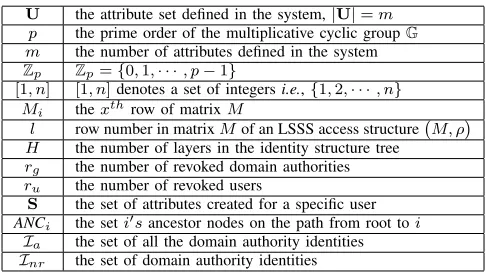
The simplest case of ID-ABE system model is that there is only one authority,i.e., the trusted authority. The private keys of all the users are generated by the trusted authority directly. There is no any domain authorities. Thus, ID-ABE only needs to support revocation of particular users rather than revocation of multiple users in a batch. We start from this simplest case at first, then step further to construct ID-ABE schemes with multiple domain authorities, and finally construct ID-ABE supporting private key generation delegation. The notations used in our constructions are presented below.
A. Trivial Construction
Since CP-ABE schemes and identity-based revocation schemes have been proposed, a straight-forward two-step ap-proach to constructing an identity revocable CP-ABE scheme can be described as follows
• Step 1: Enforcing CP-ABE-based access control by ap-plying the CP-ABE scheme [6], [11].
TABLE I Notations.
U the attribute set defined in the system,|U|=m p the prime order of the multiplicative cyclic groupG
m the number of attributes defined in the system Zp Zp={0,1,· · ·, p−1}
[1, n] [1, n]denotes a set of integersi.e.,{1,2,· · ·, n} Mi thexthrow of matrixM
l row number in matrixMof an LSSS access structure(M, ρ) H the number of layers in the identity structure tree
rg the number of revoked domain authorities
ru the number of revoked users
S the set of attributes created for a specific user ANCi the seti′sancestor nodes on the path from root toi
Ia the set of all the domain authority identities
Inr the set of domain authority identities
• Step 2: Enforcing the identity-based revocation scheme [12] over the CP-ABE ciphertexts generated inStep 1. The inner layer of CP-ABE insures the access policy en-forcement while the outlier layer of identity-based revocation provides the functionality of identity-based user revocation. Therefore, this construction is a qualified one from the per-spective of functionality. However, this constructions suffers from collusion attacks. For example, a data ownerCencrypts a file under access structure A with revoked identity set including userB whose attributes satisfyA. There is another userA whose identity is not included in the revoked identity set but whose attributes do not satisfy the access structure. AandB could collude to decrypt the ciphertext even though they do not have the access privilege separately. The process is as follows. First, since A is not revoked, so he/she could obtain the CP-ABE ciphertext. Second, B has the attributes satisfying the access structure, so the plaintext can be obtained. Therefore, the above trivial construction is not secure.
B. One-ID-One-Authority ID-ABE
The reason that trivial construction above does not work is that the identity and attributes of a user are separated, thus making it possible to combine identities and attributes of different users together. To this end, a feasible approach is to embed the identity and attributes together into each user’s private key. Based on this idea, in this section, we show a scheme OO-ID-ABE for the basic case: one authority,i.e., the trusted authority and one identity revocation. We prove that this construction is secure in terms ofDefinition 4. The four algorithms are presented as follows.
Setup(λ,U): The Setup algorithm chooses a group G
of prime order p (decided by the security parameter λ), a generator g , andmrandom group elements h1, h2,· · ·, hm
that are associated with the m attributes in the system. In addition, it chooses random exponentsα, b∈Zp.
The public key is published as
PK=(g, gb, gb2, e(g, g)α,{hbx}x∈U).
MSK={α, b} is the master secret key.
KeyGen(MSK,S,ID): The KeyGen algorithm chooses a randomt∈Zp and generates the private keySK for userID
Encrypt(PK,(M, ρ),M,ID):M is an ℓ×nmatrix and
ID ={ID′} whereID′ is the revoked identity. The Encrypt
algorithm chooses a random vectorv= (s, y2,· · ·, yn)∈Znp.
These values will be used to share an encryption exponents. Fork∈[1, ℓ], it calculatesλk=v·Mk. The ciphertext of the
messageMis
CT = (C, C0,C,ˆ (M, ρ),ID), where
C=Me(g, g)αs,
C0=gs,
ˆ
C={Ck∗=gb·λk, C′
k = (g b2·ID′
hbρ(k))λk}k ∈[1,ℓ].
Decrypt(CT,SK): CT is the input ciphertext with access structure (M, ρ) and SK is a private key for an attribute set
S. Suppose that S satisfies the access structure and define
I⊂[1, ℓ] as I={i: ρ(i)∈S}. Let {ωi ∈ Zp}i∈I be a set of constants such that if {λi}are valid shares of any secrets according to M, thenΣi∈Iωiλi =s. If the identity IDof the
private key holder is not equal to ID′, we can get the value A. The decryption algorithm then divides out this value from C and obtains the message M.
A = e(C0,K)
(∏i∈I[e(Kρ(i),C∗i)·e(L,Ci′)]ωi)1/(ID−ID ′)
= e(gs, gαgb2t)/(∏
i∈I[e((gb·IDhρ(i))t, gb·λi)
·e(g−t,(gb2·ID′hbρ(i))λi)]ωi)1/(ID−ID′) = e(gs, gα)·e(gs, gb2t)/(∏i∈I[e(gb·ID·t, gb·λi)
·e(ht ρ(i), g
b·λi)·e(g−t, gb2·ID′·λi)
·e(g−t, hb·λi
ρ(i))]
ωi)1/(ID−ID′) = e(g, g)αs·e(g, g)b2st
·1/(∏i∈I[e(g, g)b2tλi(ID−ID′)]ωi)1/(ID−ID′) = e(g, g)αs·e(g, g)b2st
/(∏i∈Ie(g, g)b2tλ
iωi) = e(g, g)αs·e(g, g)b2st
/e(g, g)b2t∑i∈Iλiωi = e(g, g)αs.
Theorem 3. Suppose the M-q-parallel-BDHE assumption holds. Then no PPT adversary can selectively break the OO-ID-ABE scheme with a challenge access structure (M∗, ρ∗), where the size of M∗ isℓ∗×n∗ andℓ∗, n∗≤q.
V. ID-ABE CONSTRUCTIONS
In this section, we will extend the basic OO-ID-ABE scheme to construct schemes with more complicated func-tionalities. In particular, in the first subsection we construct a scheme supporting both one particular user revocation and one domain authority revocation, so that all the users managed by the revoked domain authority can be revoked all at once. Then we extend this scheme to support revocation of multiple users and multiple domain authorities in the next subsection.
A. One-ID-Multi-Authority ID-ABE
Let us assume that the height of the identity structure tree is known in advance, which is set to be H. The trusted authority is on the0th layer.
Setup(λ,U): The Setup algorithm chooses a group Gof prime order p, a generator g, and random group elements
{hbx}x
∈U,{hbxi}x∈U,i∈[1,H] that are associated with the m attributes. It also chooses random exponentsα, b∈Zp.
The public key is published as
PK=(g, gb, gb2, e(g, g)α,{hbx}x∈U )
.
MSK={α, b} is the master secret key.
KeyGen(MSK,S,ID): ID =(IDHa, IDu
)
and IDia(i ∈
[1, H])is the identity of theithlayer ancestor domain
author-ity ofIDuin the identity structure tree. TheKeyGenalgorithm
chooses a random t∈Zp. If in the identity structure tree the
parent domain authority of the user is on the ith (i < H)
layer, thenIDha =IDia(i < h≤H). The generated private
key is as follows
SK= (K=gαgb2t, Kxa, Kxu, L=g−t), where
Kxa ={Kxia= (gb·IDiahix) t}
∀x∈S,i∈[1,H],
Kxu={(gb·IDuhHx+1) t}
∀x∈S.
Encrypt1(PK,(M, ρ),M,ID): This is the algorithm for revoking a particular user. M is an l ×n matrix. ID =
{(ID′a,ID′u)}, where ID′a is the parent domain authority of
ID′u in the identity structure tree. TheEncrypt algorithm first chooses a random vector v = (s, y2,· · ·, yn) ∈ Znp. These
values will be used to share an encryption exponent s. For k ∈[1, l], it calculates λk =v·Mk. Then, for message M,
the ciphertext is
CT= (C, C0,Cˆa,Cˆu,(M, ρ),ID), where
C=Me(g, g)αs,
C0=gs,
ˆ
Ca ={Cka∗ =g b·λk, C′
ka= (g
b2·ID′ahb·H ρ(k))
λk}k ∈[1,l],
ˆ
Cu={Cku∗ =g b·λk, C′
ku= (g b2·ID′
uhb·(H+1)
ρ(k) )
λk}k ∈[1,l],
M, thenΣi∈Iωiλi =s. If the condition IDa ̸=ID′a∨IDu̸= ID′u holds, we calculate Aa or Au
Aa =
∏
i∈I[e(Kρ(i)Ha, Cia∗)·e(L, Cia′ )]
ωi IDa−ID′a = (∏i∈I[e((gb·IDahH
ρ(i))
t, gbλi)
·e(g−t,(gb2·ID′ahH·b
ρ(i))
λi)] ωi IDa−ID′a = (∏i∈I[e(gb·IDa·t, gbλi)·e(hH·t
ρ(i), g
bλi)
·e(g−t, gb2·ID′a·λ
i)·e(g−t, hH·b·λi
ρ(i) )] ωi IDa−ID′a = (∏i∈I[e(g, g)b2tλi(IDa−ID′a)]
ωi IDa−ID′a = ∏i∈Ie(g, g)b2tλiωi
= e(g, g)b2t∑i∈Iλiωi = e(g, g)b2ts,
Au =
∏
i∈I[e(Kρ(i)u, Ciu∗)·e(L, Ciu′ )]
ωi IDu−ID′u = e(g, g)b2ts.
We can get the value e(g, g)αs by evaluating e(C0,K)
Aa or
e(C0,K)
Au . The decryption algorithm then divides out this value from C and obtains the messageM.
Encrypt2(PK,(M, ρ),M,ID): M is an l ×n matrix.
ID = {(ID′a, h)} if a domain authority is revoked. The
Encrypt algorithm first chooses a random vector v = (s, y2,· · ·, yn)∈ Znp. These values will be used to share an
encryption exponents. Fork∈[1, l], it calculatesλk=v·Mk.
Then, for message M, the ciphertext is
CT= (C, C0,Cˆa,(M, ρ),ID),
where
C=Me(g, g)αs,
C0=gs,
ˆ
Ca={Cku∗ =g b·λk, C′
ku= (g b2·ID′
ahb·h
ρ(k))
λk}k ∈[1,l].
Decrypt2(CT,SK):CTis the input ciphertext with access structure (M, ρ)andSKis a private key for a setS. Suppose thatSsatisfies the access structure and letI⊂[1, l]be defined as I={i:ρ(i)∈S}. Let{ωi∈Zp}i∈I be a set of constants such that if{λi}are valid shares of any secretsaccording to M, thenΣi∈Iωiλi =s. If the conditionIDu̸=ID′u holds, we
calculate Au as in Decrypt1.
Theorem 4. Suppose the M-q-parallel-BDHE assumption holds. Then no PPT adversary can selectively break the OM-ID-ABE scheme with a challenge access structure (M∗, ρ∗), where the size of M∗ isℓ∗×n∗ andℓ∗, n∗≤q.
B. Multi-ID-Multi-Authority ID-ABE
In this section, we show how to revoke multiple users and multiple domain authorities. For description simplicity, here we setH = 1. It is easy to extend this construction toH >1.
Setup(λ,U): The Setup algorithm chooses a group G of prime order p, a generator p andm random group elements
{hbx}x
∈U that are associated with the m attributes in the system. It also chooses random exponents α, b∈Zp.
The public parameters are:
PK=(g, gb, gb2, e(g, g)α,{hbx}x∈U )
.
The master secret key isMSK={α, b}.
KeyGen(MSK,S,ID): ID =(IDHa, IDu
)
and IDia(i ∈
[1, H])is the identity of theithlayer ancestor domain author-ity ofIDuin the identity structure tree. TheKeyGenalgorithm
chooses a random t∈Zp. If in the identity structure tree the
parent domain authority of the user is on the ith (i < H)
layer, thenIDha =IDia(i < h≤H). The generated private
key is as follows
SK= (K=gαgb2t, Kxa, Kxu, L=g−t), where
Kxa ={Kxia= (gb·IDiahxi)t}∀x∈S,i∈[1,H],
Kxu={(gb·IDuhHx+1) t}
∀x∈S.
Encrypt(PK,(M, ρ),M,ID,h): Denote the set of re-voked domain authorities by IDa = {(ID′hja, hj)}j∈[1,ra]. The set of revoked user identities is denoted by IDu = {(ID′a,j,ID′u,j)}j∈[1,ru], where ID
′
u,j is managed by domain
authorityID′a,j.ID=IDa∪IDu and|IDa|+|IDu|=ra+
ru=r. LetM be anl×nmatrix. The algorithm first chooses
a random vectorv= (s, y2,· · · , yn)∈Znp. These values will
be used to share the encryption exponent s. For x ∈ [1, l], it calculates λx = v·Mx. The algorithm chooses random
µ1, ..., µra, µ′1, ..., µ′ru ∈ Zp such that µa = µ1+...+µra, µu=µ′1+...+µ′ru. It generates the ciphertext
CT= (C, Ca0, Cu0,Cˆa,Cˆau,Cˆu),
where
C=Me(g, g)αsµ, whereµ=µa+µu
Ca0={Ca =gsµa, Ca,j=gsµj}j∈[1,ra]
Cu0={Cu,j=gsµ
′ j}j
∈[1,ru]
ˆ
Ca={Cka,j∗ =g
b·λkµj, C′
ka,j= (g b2·ID′a,hj
hb·hj
ρ(k))
λkµj}j∈[1,ra]
k∈[1,l] ,
ˆ
Cau={Ckau,j∗ =g
b·λkµ′j, C′
kau,j= (g b2·ID′
a,jhb·H
ρ(k))
λkµ′j}j∈[1,ru]
k∈[1,l] ,
ˆ
Cu={Cku,j∗ =gb·λkµ
′ j, C′
ku,j = (gb
2·ID′
u,jhb·(H+1)
ρ(k) )
λkµ′j}j∈[1,ru]
k∈[1,l] .
holder or the SK holder him/herself is revoked, then we first calculate Aas follows
A = ∏i∈I∏ra
j=1[e(Kρ(i)hja, C ∗
ia,j)·e(L, Cia,j′ )]
ωi IDhj a−ID′
hj a = ∏i∈I∏rj=1[e((gb2·IDhj ahhj
ρ(i))
t, gb·λiµj)
·e(g−t,(gb2·ID′hj ahb·hj
ρ(i))
λiµj)] ωi IDhj a−ID′
hj a = ∏i∈I∏ra
j=1[e(g
b2·IDhj a·t
, gb·λiµj)
·e(g−t, gb2·ID′hj a·λiµj )]
ωi IDhj a−ID′
hj a = ∏i∈I∏ra
j=1[e(g, g)
b2tλiµj(IDhj a−ID′hj a) ]
ωi IDhj a−ID′
hj a = ∏i∈I(∏ra
j=1e(g, g)
b2tλ
iµj)ωi = ∏i∈I(e(g, g)(∑raj=1µj)b2tλi)ωi = e(g, g)b2t∑raj=1µj∑i∈Iλiωi = e(g, g)b2stµa.
Aa= e(Ca,K)
A =e(g, g)
αsµa. For particular user revocation part. Ru1 ⊂ Ru, where Ru1 = {(ID′a,j,ID′u,j))|ID′a,j ̸= IDa}. Ru2 ⊂ Ru where Ru2 = {(ID′a,j,ID′u,j))|ID′a,j = IDa∧ID′u,j̸=IDu}. We calculateAu1 andAu2 as follows
Au1= ∏
i∈I ∏
j∈Ru1[e(Kρ(i)Ha, C
∗
iau,j)e(L, Ciau,j′ )]
ωi IDHa−ID′a,j =e(g, g)b2st∑j∈Ru1µ
′ j,
Au2= ∏
i∈I ∏
j∈Ru2[e(Kρ(i)Ha, C
∗
iu,j)e(L, Ciu,j′ )]
ωi IDHa−ID′a,j =e(g, g)b2st
∑
j∈Ru2µ′j. Then we have:
Au =
∏
j∈Ru1e(Cu,j,K)
Au1 ·
∏
j∈Ru2e(Cu,j,K)
Au2
= e(g, g)αsµu.
We could obtain the message by evaluating e(g,gC)αsµ, where e(g, g,)αsµ=A
g·Au.
Theorem 5. Suppose the M-q-parallel-BDHE assumption holds. Then no PPT adversary can selectively break the MM-ID-ABE scheme with a challenge access structure (M∗, ρ∗), where the size of M∗ isℓ∗×n∗ andℓ∗, n∗≤q.
VI. DELEGABLEID-ABE CONSTRUCTIONS
The constructions above can support revocation for each individual user as well as domain authorities (i.e., delegators); however, the trusted authority has to generate the private key for each user, which incurs the following drawbacks. First, the trusted authority has to generate the private key for each user. Second, the trusted authority must verify proofs of each user’s attributes and also must establish secure channels to transmit the private keys. Therefore, the trusted authority becomes a bottleneck in the system. To this end, in this section, we propose delegable ID-ABE schemes,which allows the root trusted authority to delegate private key generation and attributes checking to some domain authorities. Similar to section V, we first present a construction supporting one user and one domain authority revocation and then extend this construction to support multiple users and multiple authorities.
A. One-ID-Multi-Authority ID-ABE
Let us assume that the height of the identity structure tree is known in advance, which is set to be H. The trusted authority is on the0th layer.
Setup(λ,U): The Setup algorithm chooses a group Gof prime order p, a generator g, and random group elements
{hbx}x
∈U,{hbxi}x∈U,i∈[1,H] that are associated with the m attributes. It also chooses random exponentsα, b∈Zp.
The public key is published as
PK=(g, gb, gb2, e(g, g)α,{hbx}x∈U,{hbx}x∈U )
.
MSK={α, b} is the master secret key.
KeyGenforDA(SKia,S(i+1)a,ID(i+1)a): This is an
algo-rithm generating secret key for a domain authority ID(i+1)a,
which is at the (i + 1)th layer. This algorithm is run by an ith level domain authority with identity IDia with secret
delegation key SKia as follows: SKia=
(
gαgb2tia, gs−jd1tia, g−tia,(gbsjahb
x) tia,
gbsja, h
x, gbtia, htxia, h btia
x , sia
)x∈Sia
j∈ANCi∪i.
Based on the attribute setS(i+1)a(s.t.,S(i+1)a ⊂Sia),IDia
sends the keySKia→(i+1)a toID(i+1)a.
SKia→(i+1)a =
(
gαgb2tia, gs−ja1tia, g−tia,(gbsjahb
x) tia,
gbsja, h
x, gbtia, htxia, h btia
x , s(i+1)a
)x∈S(i+1)a
j∈ANC(i+1)a .
ID(i+1)a randomly selects t′ ∈ Zp and computes its own
secret key as follows, wheret(i+1)a =tia+t′: SK(i+1)a=
(
gαgb2t(i+1)a, gs−ja1t(i+1)a, g−t(i+)a,(gbsjahb
x) t(i+)a,
gbsja, h
x, gbt(i+1)a, h t(i+1)a
x , h
bt(i+1)a
x , s(i+1)a
)x∈S(i+1)a
j∈ANC(i+1)a∪(i+1),
where some updated items are calculated as follows: gαgb2t(i+1)a=gαgb2tia·(gb2)t′,
gs−ja1t(i+1)a=gsja−1tia·(gs−ja1)t′, g−t(i+1)a=g−tia·g−t′, (gbsjahb
x)
t(i+1)a= (gbsjahb
x)
tia·(gbsja·hb
x) t′,
(gbs(i+1)ahb
x)
t(i+1)a= (gbtia·gbt′)s(i+1)a·hbtia
x ·h bt′ x ,
gbs(i+1)a= (gb)s(i+1)a, gt(i+1)a =gtia·gt′, ht(i+1)a
x =htxia·ht
′
x,
hbt(i+1)a
x =hbtxia·(hbx)t
′ .
KeyGen(MSK,S,ID): ID =(IDHa, IDu
)
and IDia(i ∈
[1, H])is the identity of theithlayer ancestor domain
author-ity ofIDuin the identity structure tree. TheKeyGenalgorithm
chooses a random t∈Zp. If in the identity structure tree the
layer, then IDha =IDia(i < h≤H). The generated private
key is as follows
SK= (K=gαgb2t, Kxa, Kxu, L=g−t), where
Kxa={Kxia= (gb·IDiahix) t}
∀x∈S,i∈[1,H],
Kxu={(gb·IDuhHx+1) t}
∀x∈S.
Encrypt1(PK,(M, ρ),M,ID): This is the algorithm for revoking a particular user. M is an l ×n matrix. ID =
{(ID′a,ID′u)}, where ID′a is the parent domain authority of
ID′u in the identity structure tree. The Encryptalgorithm first chooses a random vector v = (s, y2,· · · , yn) ∈ Znp. These
values will be used to share an encryption exponent s. For k ∈ [1, l], it calculatesλk =v·Mk. Then, for message M,
the ciphertext is
CT= (C, C0,Cˆa,Cˆu,(M, ρ),ID), where
C=Me(g, g)αs,
C0=gs,
ˆ
Ca={Cka∗ =g b·λk, C′
ka= (g b2·ID′
ah(H)·b
ρ(k) )
λk}k ∈[1,l],
ˆ
Cu={Cku∗ =g b·λk, C′
ku= (g b2·ID′
uh(H+1)·b
ρ(k) )
λk}k ∈[1,l],
Decrypt1(CT,SK):CTis the input ciphertext with access structure (M, ρ)andSKis a private key for a setS. Suppose thatSsatisfies the access structure and letI⊂[1, l]be defined as I={i:ρ(i)∈S}. Let{ωi∈Zp}i∈I be a set of constants such that if{λi}are valid shares of any secretsaccording to M, thenΣi∈Iωiλi =s. If the condition IDa ̸=ID′a∨IDu̸= ID′u holds, we calculate Aa or Au
Aa =
∏
i∈I[e(Kρ(i)Ha, Cia∗)·e(L, Cia′ )]
ωi IDa−ID′a = (∏i∈I[e((gb·IDah
ρ(i)H)t, gbλi) ·e(g−t,(gb2·ID′ahb
ρ(i)H) λi)]
ωi IDa−ID′a = (∏i∈I[e(gb·IDa·t, gbλi)·e(ht
ρ(i)H, g bλi)
·e(g−t, gb2·ID′a·λ
i)·e(g−t, h′b·λi
ρ(i))] ωi IDa−ID′a = (∏i∈I[e(g, g)b2tλ
i(IDa−ID′a)] ωi IDa−ID′a = ∏i∈Ie(g, g)b2tλiωi
= e(g, g)b2t∑i∈Iλiωi = e(g, g)b2ts,
Au =
∏
i∈I[e(Kρ(i)u, Ciu∗)·e(L, Ciu′ )]
ωi IDu−ID′u = e(g, g)b2ts.
We can get the value e(g, g)αs by evaluating e(C0,K)
Aa or
e(C0,K)
Au . The decryption algorithm then divides out this value from C and obtains the messageM.
Encrypt2(PK,(M, ρ),M,ID): M is an l ×n matrix.
ID = {(ID′a, h)} if a domain authority is revoked. The Encrypt algorithm first chooses a random vector v = (s, y2,· · ·, yn)∈ Znp. These values will be used to share an
encryption exponents. Fork∈[1, l], it calculatesλk =v·Mk.
Then, for messageM, the ciphertext is
CT= (C, C0,Cˆa,(M, ρ),ID),
where
C=Me(g, g)αs,
C0=gs,
ˆ
Ca={Cku∗ =g b·λk, C′
ku= (g b2·ID′
ahb
ρ(k)h) λk}k
∈[1,l].
Decrypt2(CT,SK):CTis the input ciphertext with access structure(M, ρ)andSK is a private key for a setS. Suppose thatSsatisfies the access structure and letI⊂[1, l]be defined as I={i:ρ(i)∈S}. Let{ωi∈Zp}i∈Ibe a set of constants such that if{λi}are valid shares of any secretsaccording to M, thenΣi∈Iωiλi=s. If the conditionIDu̸=ID′uholds, we
calculateAu as inDecrypt1.
Theorem 6. Suppose the M-q-parallel-BDHE assumption holds. Then no PPT adversary can selectively break the OM-ID-ABE scheme with a challenge access structure (M∗, ρ∗), where the size ofM∗ is ℓ∗×n∗ and ℓ∗, n∗≤q.
B. Multi-ID-Multi-Authority ID-ABE
In this section, we show how to revoke multiple users and multiple domain authorities. For description simplicity, here we setH = 1. It is easy to extend this construction toH >1.
Setup(λ,U): The Setup algorithm chooses a group Gof prime order p, a generator pand m random group elements
{hbx}x
∈U,{hbxi}x∈U,i∈[1,H] that are associated with the m attributes in the system. It also chooses random exponents α, b∈Zp.
The public parameters are:
PK=(g, gb, gb2, e(g, g)α,{hx}xb ∈U,{hbxi}x∈U,i∈[1,H] )
.
The master secret key isMSK={α, b}.
KeyGen(MSK,S,ID): ID =(IDHa, IDu
)
and IDia(i ∈
[1, H])is the identity of theithlayer ancestor domain author-ity ofIDuin the identity structure tree. TheKeyGenalgorithm
chooses a random t∈Zp. If in the identity structure tree the
parent domain authority of the user is on the ith (i < H)
layer, thenIDha =IDia(i < h≤H). The generated private
key is as follows
SK= (K=gαgb2t, Kxa, Kxu, L=g−t), where
Kxa ={Kxia = (gb·IDiahxi)t}∀x∈S,i∈[1,H], Kxu={(gb·IDuhx)t}∀x∈S.
Encrypt(PK,(M, ρ),M,ID,h): Denote the set of re-voked domain authorities by IDa = {(ID′hja, hj)}j∈[1,ra]. The set of revoked user identities is denoted by IDu = {(ID′a,j,IDu,j′ )}j∈[1,ru], where ID
′
u,j is managed by domain
authorityID′a,j.ID=IDa∪IDu and|IDa|+|IDu|=ra+
ru=r. LetM be anl×nmatrix. The algorithm first chooses
a random vectorv= (s, y2,· · · , yn)∈Znp. These values will
it calculates λx = v ·Mx. The algorithm chooses random
µ1, ..., µra, µ′1, ..., µ′ru ∈ Zp such that µa = µ1+...+µra, µu=µ′1+...+µ′ru. It generates the ciphertext
CT= (C, Ca0, Cu0,Cˆa,Cˆau,Cˆu),
where
C=Me(g, g)αsµ, whereµ=µa+µu
Ca0={Ca=gsµa, Ca,j =gsµj}j∈[1,ra] Cu0={Cu,j=gsµ
′ j}j
∈[1,ru] ˆ
Ca ={Cka,j∗ =g
b·λkµj, C′
ka,j= (g b2·ID′a,hj
hρ(k)hj)
λkµj}j∈[1,ra]
k∈[1,l] , ˆ
Cau={Ckau,j∗ =g
b·λkµ′j, C′
kau,j = (g
b2·ID′a,jh
ρ(k)H)λkµ
′
j}j∈[1,ru]
k∈[1,l] , ˆ
Cu={Cku,j∗ =g
b·λkµ′j, C′
ku,j = (g b2·ID′
u,jh
ρ(k))λkµ ′
j}j∈[1,ru]
k∈[1,l] .
Decrypt(CT,SK): CT is the input ciphertext with access structure (M, ρ)andSKis a private key for a setS. Suppose thatSsatisfies the access structure and letI⊂[1, l]be defined as I={i:ρ(i)∈S}. Let{ωi∈Zp}i∈I be a set of constants such that if{λi}are valid shares of any secretsaccording to M, thenΣi∈Iωiλi=s. If neither the domain authority ofSK
holder or the SK holder him/herself is revoked, then we first calculate Aas follows
A = ∏i∈I∏ra
j=1[e(Kρ(i)hja, Cia,j∗ )·e(L, Cia,j′ )]
ωi IDhj a−ID′
hj a = ∏i∈I∏rj=1[e((gb2·IDhj ah
ρ(i))t, gb·λiµj)
·e(g−t,(gb2·ID′hj ahb ρ(i)hj)
λiµj)] ωi IDhj a−ID′
hj a = ∏i∈I∏ra
j=1[e(g
b2·IDhj a·t
, gb·λiµj)
·e(g−t, gb2·ID′hj a·λiµj)] ωi IDhj a−ID′
hj a = ∏i∈I∏ra
j=1[e(g, g)
b2tλiµj(IDhj a−ID′hj a) ]
ωi IDhj a−ID′
hj a = ∏i∈I(∏ra
j=1e(g, g)
b2tλ
iµj)ωi = ∏i∈I(e(g, g)(∑raj=1µj)b2tλi)ωi = e(g, g)b2t∑raj=1µj∑i∈Iλiωi = e(g, g)b2stµa.
Aa= e(Ca,K)
A =e(g, g)
αsµa. For particular user revocation part. Ru1 ⊂ Ru, where Ru1 = {(ID′a,j,ID′u,j))|ID′a,j ̸= IDa}. Ru2 ⊂ Ru where Ru2 = {(ID′a,j,ID′u,j))|ID′a,j = IDa∧ID′u,j̸=IDu}. We calculateAu1 andAu2 as follows
Au1= ∏
i∈I ∏
j∈Ru1[e(Kρ(i)Ha, C
∗
iau,j)e(L, Ciau,j′ )]
ωi IDHa−ID′a,j =e(g, g)b2st
∑ j∈Ru1µ
′ j,
Au2= ∏
i∈I ∏
j∈Ru2[e(Kρ(i)Ha, C
∗
iu,j)e(L, Ciu,j′ )]
ωi IDHa−ID′a,j =e(g, g)b2st
∑ j∈Ru2µ
′ j. Then we have:
Au =
∏
j∈Ru1e(Cu,j,K)
Au1 ·
∏
j∈Ru2e(Cu,j,K)
Au2
= e(g, g)αsµu.
We could obtain the message by evaluating e(g,gC)αsµ, where e(g, g,)αsµ=A
g·Au.
Theorem 7. Suppose the M-q-parallel-BDHE assumption holds. Then no PPT adversary can selectively break the MM-ID-ABE scheme with a challenge access structure (M∗, ρ∗), where the size ofM∗ is ℓ∗×n∗ and ℓ∗, n∗≤q.
Theorem 8. Suppose the M-q-parallel-BDHE assumption holds. Then no PPT adversary can selectively break the MM-DID-ABE scheme with a challenge access structure(M∗, ρ∗), where the size ofM∗ is ℓ∗×n∗ and ℓ∗, n∗≤q.
VII. PERFORMANCEEVALUATION
In this section, the four schemes proposed in this paper are evaluated in terms of their computation, storage, and communication performance. The evaluation is performed in two parts: First, we analyze the performance complexity of the presented schemes by comparing with the original CP-ABE scheme. Second, we implement these schemes with the PBC library [13]. We conduct a computation performance evalua-tion and compare these scheme with the CP-ABE scheme.
A. Complexity Analysis
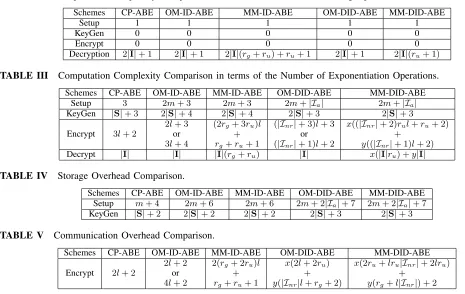
Following the notations provided in TABLE I, a compar-ative analysis is carried out among the OM-ID-ABE scheme, MM-ID-ABE scheme, OM-DID-ABE scheme, MM-DID-ABE scheme, as well as the original CP-ABE scheme. There are four types of time-consuming operations: pairing, exponentia-tion, multiplication and inversion, included in the five schemes. According to [14], the pairing and exponentiation operations are the dominant costs. Therefore, we utilize the number of pairing and exponentiation operations as metrics for compu-tation complexity of each scheme. TABLE II and TABLE III describes the asymptotic complexities of the setup, key generation, encryption and decryption algorithm respectively. In this comparison, we assume that the height of the identity structure tree is 2, i.e.,H = 1. In addition, for the delegable ID-ABE, the key generation for domain authority is system overall computation overhead, therefore is not included here.
1) Computation Complexity Analysis: In the setup algo-rithm of all the five schemes, only one pairing operation, which is incurred by the evaluation of the value of e(g, g)α.
In CP-ABE, the number of exponentiations in the setup algorithm is 3. In both OM-ID-ABE scheme and MM-ID-ABE scheme, m+ 3 exponentiation operations are needed. While in the two delegable schemes, more exponentiation operations are needed because of the private key generation delegation functionality and resistance against domain authority imper-sonation as discussed in the security proof part of delegable schemes.
TABLE II Computation Complexity Comparison in terms of the Number of Pairing Operations.
Schemes CP-ABE OM-ID-ABE MM-ID-ABE OM-DID-ABE MM-DID-ABE
Setup 1 1 1 1 1
KeyGen 0 0 0 0 0
Encrypt 0 0 0 0 0
Decryption 2|I|+ 1 2|I|+ 1 2|I|(rg+ru) +ru+ 1 2|I|+ 1 2|I|(ru+ 1)
TABLE III Computation Complexity Comparison in terms of the Number of Exponentiation Operations.
Schemes CP-ABE OM-ID-ABE MM-ID-ABE OM-DID-ABE MM-DID-ABE Setup 3 2m+ 3 2m+ 3 2m+|Ia| 2m+|Ia|
KeyGen |S|+ 3 2|S|+ 4 2|S|+ 4 2|S|+ 3 2|S|+ 3
Encrypt
2l+ 3 (2rg+ 3ru)l (|Inr|+ 3)l+ 3 x((|Inr|+ 2)rul+ru+ 2)
3l+ 2 or + or +
3l+ 4 rg+ru+ 1 (|Inr|+ 1)l+ 2 y((|Inr|+ 1)l+ 2)
Decrypt |I| |I| |I|(rg+ru) |I| x(|I|ru) +y|I|
TABLE IV Storage Overhead Comparison.
Schemes CP-ABE OM-ID-ABE MM-ID-ABE OM-DID-ABE MM-DID-ABE Setup m+ 4 2m+ 6 2m+ 6 2m+ 2|Ia|+ 7 2m+ 2|Ia|+ 7
KeyGen |S|+ 2 2|S|+ 2 2|S|+ 2 2|S|+ 3 2|S|+ 3
TABLE V Communication Overhead Comparison.
Schemes CP-ABE OM-ID-ABE MM-ID-ABE OM-DID-ABE MM-DID-ABE
Encrypt
2l+ 2 2(rg+ 2ru)l x(2l+ 2ru) x(2ru+lru|Inr|+ 2lru)
2l+ 2 or + + +
4l+ 2 rg+ru+ 1 y(|Inr|l+rg+ 2) y(rg+l|Inr|) + 2
domain authority identity is embedded in the key component for each attribute.
For the encryption algorithm, the computation cost in terms of pairing is the same for CP-ABE, OM-ID-ABE, MM-ID-ABE, OM-DID-ABE and MM-DID-ABE. The same as the key generation algorithm, exponentiation operations dominate the cost. In the encryption algorithm of both CP-ABE and OM-ID-ABE scheme, the number of exponentiation operations is 2l+ 3 when revoking a domain authority and 3l+ 4 when revoking a particular user. In MM-ID-ABE, the number of exponentiation operations is(2rg+ 3ru)l+rg+ru+ 1, where
rg denotes the number of revoked domain authorities andru
denotes the number of revoked particular users. In the OM-DID-ABE scheme, the number of exponentiation operations is (|Inr|+ 3)l+ 3 if only one particular user is revoked, and is (|Inr|+ 1)l+ 2 if only one domain authority is revoked. While for the MM-DID-ABE scheme, if only multiple users are revoked then x = 1, y = 0; if only multiple domain authorities are revoked then x= 0, y = 1; if there are both multiple users and multiple domain authorities revoked then x= 1, y= 1.
In CP-ABE, the number of pairing needed for decryption is 2|I|+ 1, where I is the set of users’ attributes used in the process of decryption. The decryption algorithm of the OM-ID-ABE and OM-DID-ABE scheme requires the same number of pairing operations as the CP-ABE scheme. Whereas the number increases to be 2|I|(rg + ru) +ru + 1 and
2|I|(ru + 1) respectively since there are multiple users or
domain authorities revoked. The numbers of exponentiations
in CP-ABE, OM-ID-ABE, MM-ID-ABE, OM-DID-ABE and MM-DID-ABE are|I|,|I|,|I|(rg+ru),|I|andx(|I|ru) +y|I|
respectively, where the meaning of x, y is the same as in
TABLE II.
2) Storage and Communication Overhead Analysis: We evaluate the storage and communication overhead separately. The main storage overhead comes from the setup algorithm and key generation algorithm. The communication overheads come from the ciphertext generated by the encryption algo-rithm.TABLE IVandTABLE Vsummarize the storage and communication overhead of the five schemes.
The storage overhead in the setup algorithm of the CP-ABE scheme is m+ 4. In OM-ID-ABE and MM-ID-ABE, it is 2m+ 6 because of the public parameters generated for the domain authorities. Whereas, in the OM-DID-ABE and MM-DID-ABE schemes, to resist against impersonation problem of the domain authorities, the storage overhead is2m+ 2|Ia|+ 7. In CP-ABE, the overhead of storing the private key is|S|+2. In OM-ID-ABE and MM-ID-ABE, it is2|S|+ 2. In OM-DID-ABE and MM-DID-OM-DID-ABE, the private key storage is2|S|+ 3. The size of ciphertext of the CP-ABE scheme is 2l+ 2. The ciphertext size of OM-ID-ABE is2l+ 2when revoking a domain authority and4l+ 2when revoking a particular user. The ciphertext size of ID-ABE, OM-DID-ABE and MM-DID-ABE is2(rg+ru)l+rg+ru+ 1,x(2l+ 2ru) +y(|Inr|l+
rg+ 2) and x(2ru+lru|Inr|+ 2lru) +y(rg+l|Inr|) + 2
respectively, where the meaning of rg, ru, x and y are the
same as the above.
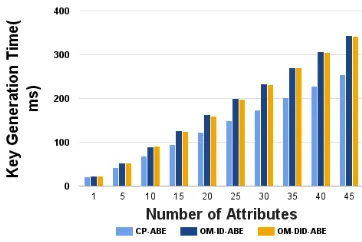
ID-ABE schemes incurs more computation overhead com-pared to the original CP-ABE scheme. The costs for the one identity revocable scheme OM-ID-ABE are almost the same as the CP-ABE scheme. The costs for the one identity revocable scheme OM-DID-ABE, some additional costs are brought because of impersonation resistance and the functionality of delegable private key generation. When there are multiple identities included in the revocation list, the computation overhead is proportional to the number of revoked identities. Although some times the computation overhead is high, the new functionalities and properties brought by our scheme are useful in cloud-based secure data sharing applications.
Fig. 2 Relations between the amount of attributes and time consumption for setup.
Fig. 3 Relations between the amount of attributes and time consumption for key generation.
VIII. RELATEDWORK A. Attribute Based Access Control
Traditionally, access control is based on the identity of a user, either directly or through predefined attributes types,e.g., roles or groups assigned to that user. However, practitioners have noted that this access control approach usually needs cumbersome management and identity, groups and roles are not sufficient in expressing the access control policies in the real world. Therefore, a new approach which is referred to as attribute-based access control (ABAC) is proposed [15]. With
Fig. 4 Relations between the amount of attributes and time consumption for encryption.
Fig. 5 Relations between the amount of attributes and time consumption for decryption.
ABAC, whether a user’s request is granted or not is decided by the attributes of the user, selected attributes of the object and environment conditions that can be globally recognized. Compared with role-based access control, ABAC provides the following nice properties. First, ABAC is more expressive; Second, ABAC enables access control policy enforcement without prior knowledge of the specific subjects. Because of its flexibility, ABAC is nowadays the fastest-growing access control model [7], [16], [17].
B. Attribute Based Encryption and Revocation