IJISET - International Journal of Innovative Science, Engineering & Technology, Vol. 6 Issue 3, March 2019 ISSN (Online) 2348 – 7968
www.ijiset.com
98
IoT based Classroom Automation using
Zigbee
Rathy G. A
P1
P
Associate Professor, EE&CE Department, NITTTR, Chennai, India
Email: 35TU[email protected]U35TP
1
Sivasankar P. Assistant Professor, EE&CE Department, NITTTR, Chennai, India
P2 .
Email: 35TU[email protected] UPU
2
ABSTRACT
In today’s world of automation, Internet of Things( IoT) is gaining a lot of importance and is becoming more popular day by day; The IoT, is a system of interrelated computing devices, mechanical and digital machines, objects or people that are provided with unique identifi-ers (UIDs) and the ability to transfer data over a network without requiring human or human-to-computer interaction. This paper focuses on designing Class Rooms Automation System (CRAS) by installing smart internet connected devices in the classroom. Zigbee and Cortex M3 are used to design and control the entire class room automation system.
13T
Keywords:13T IoT, Zigbee, sensors, WiFi, classroom
automa-tion, IEEE 802.15.4, Cortex M3, CRAS, SAS
1.0 INTRODUCTION
In the digital era of technology, the involvement of ma-chines and automation of process are done by human beings. IoT provides connectivity of devices in same network which are in sync with one another, allowing them to send and receive data
ZigBee is the most popular industry wireless mesh net-working standard for connecting sensors, instrumentation and control systems. It is a specification for communica-tion in a wireless personal area network (WPAN). ZigBee and IEEE 802.15.4 are low data rate wireless networking standards that can eliminate the costly and damage prone wiring in industrial control applications. Fig1. shows Example ZigBee network. Control equip-ment can be placed anywhere and still communicate with the rest of the system. It can also be moved, as the net-work does not look into the physical location of a sensor,
pump or valve. The benefits of ZigBee technology ap-plications include:
• Home and office automation • Industrial automation • Medical monitoring • Low-power sensors • HVAC control
Fig1. Example ZigBee network
Nowadays as new smart sensors are available in the digi-tal market, it simplifies the automation process. With the help of smart sensors, Zigbee and CortexM3 controller it is proposed to develop a classroom automation system which automates the Electrical appliances such as lights fans etc. to minimize the power consumption. Also cor-tex M3 and Zigbee are playing a vital role to recognize the entry of human beings and detect the movements of them to improve the safety of the laboratory.
2.0 LITERATURE REVIEW
Yasodharan (2018) has used IoT for energy efficient Environmental Conditions recognizing and supervising Classroom automation using Arduino. This gives a vast advantage on the smart Classroom systems using Internet of Things. This project helps teachers present in the classroom to allow them to control the classroom using android application in the Android smart phone.
controlling and monitoring of loads is done using a smartphone via an android application. The android ap-plication has features such as password protection, avail-ability of different modes of operation, real-time power monitoring and controlling the loads using switch or voice control.
Aishwarya Kumar(2016) a solar charged smart inverter that uses WiFi technology to inform the user of the bat-tery voltage as well as the run time of the loads which the user chooses to run. This work uses MSP430F55291P microcontroller
Anisha Gupta(2015) design and implementation of an Ethernet-based intelligent automated system for conserv-ing electrical energy usconserv-ing a INTEL GALILEO 2nd gen-eration development board, which can be used in large organizations like a University or an office. This work on automation, so that the electrical devices and switches can be remotely controlled and monitored without any human intervention. It uses the available infrastructure in a classroom that includes surveillance camera and Ether-net connectivity so as to minimize the cost criteria. From the above various literature survey it is observed that automation is implemented for collecting the data and monitoring the system using different controllers. Now in this paper, the automation process is designed and implemented using the latest cortex M3 controller and Zigbee network for monitoring and controlling the electrical appliances connected with smart sensors. This will improve the safety aspects and minimize the power consumption of the automated classroom.
3.0 PROPOSED CLASSROOM AUTOMATION SYSTEM(CRAS)
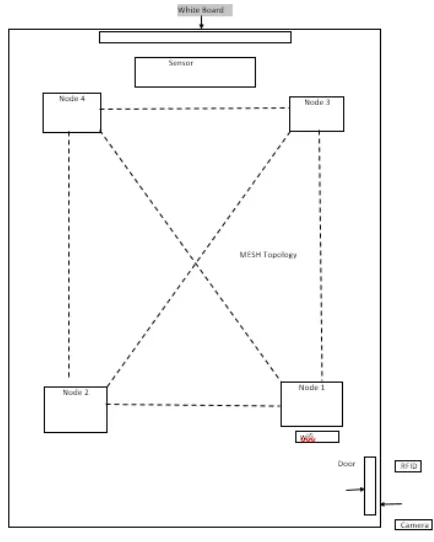
The proposed classroom automation is aimed to improve the authenticated entry to classroom/laboratory by intro-ducing RFID reader system. Similarly, the power con-sumption of the automated system will be improved us-ing PIR sensor, RTD Temperature sensor. Zigbee and Cortex M3 controller are used to maintain room tem-perature at a particular set point defined by the adminis-trator. Also Zigbee protocol standard integrated with cortex M3 will enable the administrator to control the electrical appliances of the classroom remotely. The lay-out of the classroom automation system is shown in Fig 2.
The system consists of four nodes connected in the mesh topology. These nodes are referred as routers. Each router has a ZIGBEE and WiFi which enable node to node communication. Cortex M3 controller monitors
stalled at the door. A person entering has to swipe the RFID card so that door opens. A camera is also placed at the door to enable face recognition at the classroom en-trance. PIR sensors and temperature sensors are installed to detect the motion and to read the temperature to re-duce the power consumption.
Fig 2. Layout of the system
4.0 DESIGNINING OF THE CRAS
The step by step design details of CRAS are explained below:
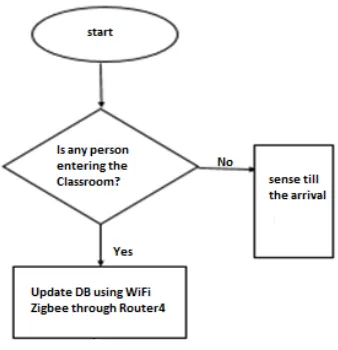
Step1: A person entering the classroom by swiping the RFID card. This is communicated through Wifi to the Router no 4 to update the database which is explained through flow chart shown in Fig 3.
Radio Frequency Identification (RFID) refers to a wireless system comprised of two components: tags and readers. The reader is a device that has one or more antennas that emit radio waves and receive signals back from the RFID tag. Tags, which use radio waves to communicate their identity and other information to nearby readers, can be passive or active. Passive RFID tags are powered by the reader and do not have a battery. Active RFID tags are powered by batteries.
IJISET - International Journal of Innovative Science, Engineering & Technology, Vol. 6 Issue 3, March 2019 ISSN (Online) 2348 – 7968
www.ijiset.com
100
RFID tags can also be integrated with electronic compo-nents, such as sensory material, Analog to Digital Con-verter (ADC), and Micro Controller Unit (MCU) to make an integrated sensor module. The RFID tag is used as a communication interface for data transmission. Pas-sive RFID sensors harvest the RF energy from RF radia-tion to power the circuit and complete the sensing func-tion, then save the data in the RFID chip to be accessed by RFID readers, which is described in and the passive sensing is of interest for data collection in remote sens-ing and RFID
Fig 3. Flow chart to sense a person at the door
In this work RFID reader and tags are used to avoid unauthorized access to the classroom as well as the lab. This also helps to develop automated Student At-tendance System (SAS).This SAS will record student entry time as well as the exit time which simplifies the role of teachers in maintaining the attendance. Whenever the student enters in to the classroom/lab it will immedi-ately communicated to the administrator/teacher using Zigbee based WiFi router.
Step 2: A person leaving the classroom by swiping the RFID card. This is communicated through Wifi to the Router no 4 to update the database which is explained through flow chart shown in Fig 4.
Fig 4. Person leaving the classroom
The communication between the routers are held with the help of Zigbee and WiFi. ZigBee is an open, global wireless standard developed to address the unique needs of low-cost, low-power wireless M2M networks. It is a specification to suit the high level communication Protocol. This Protocol is used to create PANS (Low Power digital radio). Low-Powered, Zigbee devices often transmit data over longer distances by passing data through intermediate devices to reach more distances creating a mesh network.
tially like router.The Coordinator & Router can allow other devices to join the net work, and can route data. After an end device joins a router or coordinator, it must be able to transmit or receive RF data through that router or coordinator only.
In this work, XBee Pro is used which is the heart of the classroom automation system. Xbee-Pro is a low power sensor network Wireless module. It provides reli-able delivery of data between devices.The Operating frequency is 2.4 ghz It is used in Indoor application range whose range is 300 feet(90 m).The Outdoor ap-plication range is upto 1 mile(1600 m) . It transmits a power output is 60mw. RF Data rate is 250,000 Bps. Serial interface data rate is 1200 Bps to 250 KBps. It is 20 pin IC and operates at a supply voltage range is 2.8 v to 3.4 volt. Xbee-Pro supports IEEE 802.15.4 Standard of wireless communication. This standard was developed to provide a framework and the lower layers in the OSI model for low cost, low power wireless connectivity networks.
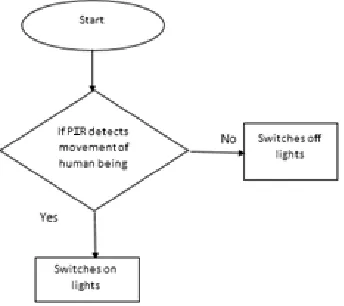
Step 3: Whenever PIR sensor detects the movement of the person it will switch on the lights. If no movement is sensed for more than 5 minutes it automatically switches off the light. Fig 5. Illustrates the flow diagram of motion detection
Fig 5. Flow chart for motion detection using PIR sen-sor
PIR sensor detects a human being moving around within approximately 10m from the sensor. This is an average value, as the actual detection range is between 5m and 12m. PIR are fundamentally made of a pyro electric sen-sor, which can detect levels of infrared radiation. The
a signal I/O pin. Once the sensor warms up the output will remain low until there is motion, at which time the output will swing high for a couple of seconds, then re-turn low. If motion continues the output will cycle in this manner until the sensors line of sight of still again. The PIR sensor has two calibration parameters, time delay and sensitivity level. These two parameters will be useful to calibrate the required time delay and the accuracy to detect the motion. These can be adjusted according to the requirement.
Step 4: Whenever any student /teacher enters the class-room/lab, the respective data will be transmitted to the administrator system through routers. The information will update the attendance data base. The cortex M3 con-troller will sense the room temperature through RTD when any entry occurs inside the classroom
If the temperature of the room as detected by the temper-ature sensor is less than 28 οC the fans are switched off. If the temperature is more than 28 οC as detected by the RTD, the data is given to the cortex M3 controller which in turn gives the command to turn on the fan as shown in Fig.6. The cortex-M3 controller is a high performance 32-bit controller, which offers the significant benefits to the developers. The ARM architecture is a ‘Harward architecture’ which offers separate data and instruction buses for communicating with the ROM and RAM memories. It consist a 3-stage pipeline to fetch, decode and execute the instructions sequentially. The Cortex processor is a cost sensitive device which is used to re-duce the processor area and has extensive improving interrupt handling and system debug capabilities.
Fig 6. Flow chart for temperature control
IJISET - International Journal of Innovative Science, Engineering & Technology, Vol. 6 Issue 3, March 2019 ISSN (Online) 2348 – 7968
www.ijiset.com
102 5.0 Experimental setup of CRAS
An experimental set up was made with four nodes named as Router 1, Router 2, Router 3, Router 4. Communica-tion between these nodes are done by the Xbee Pro
The Cortex M3 controller does the control of checking the temperature inside the classroom/ Laboratory, and turns on /off the fans. The fans are also turned on/ off by reading the temperature through RTD. The PIR sensor is used to detect the motion to switch on/off the lights. Zigbee and WiFi are enabling for the router communica-tion.
After implementing the mesh topology using four Rout-ers,the details of the students and teachers will be col-lected and stored in administrator system. The presence of a person and the room temperature will be continuous-ly monitored and respective data will be updated in the data base. The available data in the database will be ac-cessed remotely through IoT gateways. Similarly these electrical appliances can be controlled remotely any-where in the world through the principles of IoT. In this way IoT based Classroom Automation using Zigbee is implemented to save energy and improve the security systems of any classroom.
Conclusion
The experimental setup “IoT based Classroom Automa-tion using Zigbee” has been installed and the setup is working effectively. If no movement detected for more than 5 minutes CRAS switches off the lights. If the tem-perature goes beyond the setpoint controller will switch on the fans. RFID increases the security and updates theSAS. The IoT gateway and cloud will enable the re-motecontrol of electrical appliances of the classroom.
REFERENCES
1. Yasodharan R et.al.(2018 ) IoT based Classroom Automation using Arduino" Published in International Journal of Trend in Scientific Research and De-velopment (ijtsrd), ISSN: 2456-6470, Volume-2 | Issue-2,February2018,
URL: http://www.ijtsrd.com/papers/ijtsrd9404.pdf
2. Siddhai Naik et.al (2017) Improvisation of smart home automation using hybrid sources 7th Interna-tional Conference on Power Systems (ICPS) Pu-ne,IndiaISBN Information:Electronic ISBN: 978-1-5386-1789-2
3Anisha Gupta ; Punit Guta ; Jasmeet Chhabra(2015) published IoT based power efficient system design us-ing automation for classrooms in the Third Interna-tional Conference on Image Information Processing (ICIIP)INSPEC Accession Number: 15804818
4. Archana N. Shewale and Jyoti P. Bari, "Renewable Energy Based Home Automation System Using ZigBee", IJCTEE Volume 5, Issue 3, June 2015.
5. Alphy John, I.Bildass Santhosam, ―Home Energy Management System Based On Zigbee‖, International Journal of Inventive Engineering and Sciences (IJIES) ISSN: 2319–9598, Volume-2, Issue-4, March 2014
6.M.G. Golzar, Co. AsanPardazan, H.R. Tajozzakerin, "A New Intelligent Remote Control System for Home Automation and Reduce Energy Consump-tion", Mathematical/Analytical Modelling and Com-puter Simulation (AMS), 2010.