968
Exploit the Tail Time to Save Radio Resource in Heterogeneous
Wireless Networks
Deenu Mol.A1, Janet Felicia Ranjani.S2 and Kabilan.S3
1
Computer Science and Engineering, Angel College of Engineering and Technology, Tirupur, Tamilnadu, India
2
Information Technology, Angel College of Engineering and Technology, Tirupur, Tamilnadu, India
3 Computer Science and Engineering, Angel College of Engineering and Technology,
Tirupur, Tamilnadu, India
Abstract
Cellular Network consists of land areas divided into shape of hexagons called cells, that process communication between mobile devices. Mobile phones have become an extensive device among people in daily life, few of its limitations are range, bandwidth, security standards, power etc. Since smartphones consumes more power and radio energy during internet access especially in 3G and 4G technologies. The 3G technology is known to be the Universal Mobile Telecommunication System that contains the work of RRC protocol which is responsible for the release of radio resource. A scheme called Tail Theft has been deployed that transfers request during tail time. The scheme includes two virtual tail timers to identify the tail time, and Dual Queue Scheduling Algorithm for storing and sending the requests, in order to reduce the battery energy and radio resource. The future work includes the process of saving Radio Resource in Heterogeneous Wireless Networks, and the techniques anticipated are use of Power Aware Routing Protocol for sending data in Adhoc networks, an API to make use of wasted resource and to invoke Fast Dormancy. Simulation is done and performance analysis graph is evaluated.
Keywords: Application Programming Interface, Third
Generation ,Fourth Generation, Radio Resource Control Protocol.
1. Introduction
1.1
Cellular Networks
A cellular network or mobile network is a wireless network distributed over land areas called cells, each served by at least one fixed-location transceiver, known as a cell site or base station. In a cellular network, each cell uses a different set of frequencies from neighboring cells, to avoid interference and provide guaranteed bandwidth within each cell.When joined together these cells provide radio coverage over a wide geographic area. This enables a
large number of portable transceivers (e.g., mobile phones, pagers, etc.) to communicate with each other and with fixed transceivers and telephones anywhere in the network, via base stations, even if some of the transceivers are moving through more than one cell during transmission.
1.2
UMTS
It provides wide band wireless network with increased clarity where data is sent through packet switching and voice calls that are interpreted through circuit switching. Its services include global roaming and apart from voice communication it provides fast communication and data transfer, high speed internet access, multimedia messages and 3D gaming etc. It can transfer up to 2000kbps terrestrial and 2500kbps in satellite of data. The architecture used by 3G is Universal Mobile Telecommunication System. It is based on Wideband Code Division Multiple Access with its bandwidth range of 5MHz.
UMTS was developed by 3rd Generation Partnership Project, 3G technologies that is based on WCDMA (Wide band Code Division Multiple Access) that uses orthogonal variable spreading factor codes and the bandwidth is 5MHz that is divided into 15 slots. The frequency bands for UMTS are 1885- 2025 MHz uplink and 2110-2200MHz downlink.
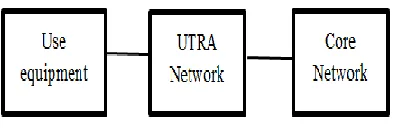
969 Fig 1.2 UMTS Networks
1.3
UTRAN Network
It consists of the UE the UTRAN consists of several RNS (Radio Network Subsystems) that does ciphering and deciphering, handover control, radio resource management etc. where each are controlled by RNC (Radio Network Controller) it consists of several components called Node B. The core network that comprises of the gateway to the other network, offers inter system handover and performs location management if there is connection between the equipment and the UTRAN. The UMTS has subdivided architecture domains the user equipment domain assigned to single user and provides all functions needed to access the services, mobile equipment used for radio transmission, infrastructure domain offers all UMTS services, access network domain that performs the access network dependent functions, serving network domain functions used by user for accessing UMTS services, transit network domain and home network domain.
Fig 1.3 UTRAN Network
1.4 AD HOC Network
Ad hoc network is Infrastructure less and share radio channel. They have distributed routing and frequent path breaks due to mobility. Bandwidth reservation requires complex medium access control protocols likewise they have many features and some issues are to be addressed for successful commercial deployment even though widespread use exists in defense. They are quick and economically less demanding deployment. Some of them include military applications, collaborative and distributed computing, emergency operations etc.
1.5 Heterogeneous Wireless Network
They are the combination of various different infrastructure based network and with different operating system and working methodology and components.
2. Related Works
2.1 Top: Tail Optimization Protocol for Cellular
Radio Resource Allocation
Design of TOP is to eliminate the tail time whenever possible. It is interfaced with the phone and the Radio Access Network by analyzing the inter arrival time of the sessions and uses fast dormancy for the immediate release of radio resource release. Focused on UMTS architecture and implemented with application traces and uses RRC state machine for each UE device to manage radio resource. Determine the state promotion and demotion. TOP is an application layer protocol that bridges the gap between the application and fast dormancy. The key challenges include change to the operating system, and implication of multiple concurrent connections using fast dormancy.
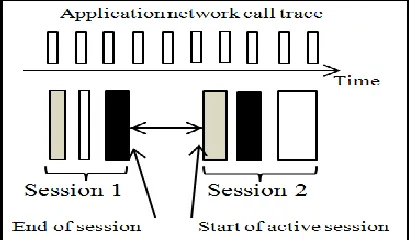
Fig 1.4 Delay between packet session
2.1.1 TOP Approach
970 Its demerits include poorly used fast dormancy includes
node promotion and long delay of the users data transfer. Various versions of fast dormancy used may also increase the difficulty in implementation. It can be used for application that has limited users. Network characteristics and devices mobility causes change in inter arrival time and increase in signaling overhead. Mis-prediction can lead to increased promotion overhead due to predicting a short ITT less than TT to be a long ITT greater than TT, or lead to missing opportunities for tail removal due to predicting a long ITT to be short.
2.1.2 TOP Addresses the Key Issues
To propose a simple interface for applications to leverage the fast dormancy features to predict the ITT. It is more challenging for user-interactive applications such as Web browsing. The process is initialized by using cellular traces collected from a large UMTS carrier. With reasonable predictions accuracy, TOP saves overall tail time of 60%.
It discuss about the radio resource management technique by reducing the tail overhead. It uses an adaptive fast dormancy algorithm where it determines the traffic inactivity of the device and maximizes the signaling of fast dormancy. By controlling the false alarm by formulating the stochastic approximation approach for UMTS networks to save battery energy. The required size of the traffic traces varies upon the complexity use of the network application.
2.2 Adaptive Fast Dormancy for Energy Efficient
Wireless Packet Data Communication
The fast dormancy request sent from the mobile can detect the end of connection. Once the inactivity timer expires the algorithm makes a request to the network that maintains two timers for each application. Stochastic approximation framework tool used to find the zero of a function to control false alarm. In network AFD will reduce the connection duration to save battery where small duration takes more radio resource.
It proposes a method of decreasing the overall signaling of fast dormancy at unwanted states. The traffic is studied and the packet data transfer is taken place in case of delay between the data session the algorithm immediately invokes the fast dormancy for the immediate mount to IDLE state. In-order to wait for the inactivity timers to expire the system wastes time and resources to process next transmission.
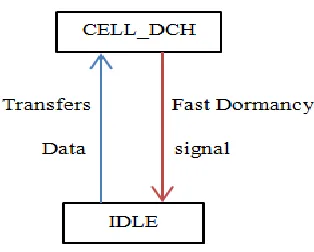
Fig 2.2 Fast Dormancy
2.3 Performance –Aware Energy Optimization
This work designed an efficient online scheduling algorithm to save maximum amount of energy during tail time and during transmission time called PerES algorithm to evaluate a better performance to save energy in phones. The algorithm is mainly used to reduce the tail energy and the ramp energy especially while downloading data from various browsers. Various technological analyses is given based on their energy consumption.
2.3.1 Scheduling Process and Design
The scheduling decisions are made for each time slot to gain a long time of benefit as it requires no future information of the traffic activity. In-order to schedule the applications, they are grouped by their profile type or by their weight or user preference. Applications are fixed with deadlines and thus use a queue management to solve the delay.
2.4 Traffic- Aware Techniques to Reduce 3g/Lte
Wireless Energy Cinsumption
Like 3G/LTE are also drains the battery in mobile devices. Battery power is wasted when the mobile devices are in unwanted active state when there is no traffic. The paper presents the technique for studying the traffic pattern of the network traffic patterns and determining the start and end of burst time of the traffic. It is implemented with the design of two algorithms implemented for two carriers known to be Active and Idle algorithm.
2.4.1 Algorithm Approach
971 design of two algorithms Make Idle helps to predict the
end of session. Make Active algorithm to delay the start of a new session by activating multiple sessions that can decrease the amount of signaling overhead. The main design is to put the radio state into idle mode when more bursts are predicted. The system design consists of a control module inside the device to predict the burst. One path connected with the Fast Dormancy and other path with socket layer connected in turn with the mobile application.
2.5 An Algorithm for Efficient Power Control Using
Network Coding In MANET
They use a power-aware routing protocol for choosing the high power node to transfer the data. They use two algorithms called minimum battery cost and min-max battery cost, by means of analyzing each nodes battery level for choosing the node to send data to the destination. They use Multipoint-Relay Selection, where the data are sent from single source to the destination by several paths.
They use a Co-operative Analog Network Coding Algorithm. The user’s co-ordinate shared the resources among the nodes for the favor of enhancing the quality of information.
The disadvantage of Multipoint-Relay Selection as the algorithm used gets multiple copies of the data at the destination node from different paths from the same source node.
2.6 DEAR: A Device and Energy Aware Routing
Protocol for Heterogeneous Adhoc Networks
Embedding low and high powered nodes for the purpose of utilizing their energy. Here we use high powered node to transfer data and forward the traffic. They make use of Energy Aware Routing protocol in Heterogeneous Networks. The protocol is said to be energy aware of their power status of the nodes that are participating in the data communication network.
The drawbacks of this process cannot be used in the application to proceed and process with the mobile network. They calculate the performance metrics of the protocol and the performance evaluation and the set of nodes.
3. Methodology:
3.1 Power Aware Routing Protocol:
Use of Power aware Routing Protocol we can lessen the energy that is been used for data transmission by choosing a gateway. A Relay node for effective and efficient data transmission.
3.2 Identify the inter arrival time:
By building an Application Programming Interface with a threshold that identifies certain code paths, that shows the start and end of network session. That helps in identifying the delay between the packet sessions. By fixing the threshold for t seconds. If the delay exceeds the t seconds the resource wasted can be used for data prefetching and data sending and receiving, if the delay is below t seconds Fast Dormancy is invoked.
Fig 3.2 Delay between packet session
3.3 Fast Dormancy UMTS State Switching
This technology was introduced to 3G UMTS to save the current consumption of the device by switching between different mobile device activities states on the air interface. When transferring data, the mobile is in CELL_DCH state and uses the high speed channels to transmit and receive data. The UE sends a Signalling Connection Release Indication (SCRI) message to RNC without IE “SCRI Cause”. By doing this the UE requests a release of signalling connections and move to Idle state. Then network puts the connection in idle state in which the physical connection is removed while the IP address is kept. While the handsets in idle state then there is a delay up to 2.5s to establish a channel to do data exchange. But in CELL_PCH the downlink does not have to be observed continuously, only the paging channel must be checked every now and then to make sure incoming connections can be established. So this state is efficient as staying in idle state and the signalling connections stays in place. And the delay to establish a channel to do data exchange is only 0.9s.
4. Simulation Result
972 The different infrastructure networks is designed with
Cellular networks and UMTS networks and Ad hoc Networks.
4.2 Power Aware Routing Protocol:
High power node is chosen as the gateway to communicate with the other networks. By using a relay node as an intermediate node to transfer data between the source and sink.
4.3 Fast Dormancy:
As the delay between two consecutive packet sessions is lesser than the threshold Fast Dormancy is invoked to put the devices network into idle state.
4.4 Data transmission:
If the delay is larger than the threshold the resource is used for data transmission.
9. Conclusions
The system proposed an AARP based security protocol against privacy attacks in the MANET. Especially, the approach effectively prevents the data from potential damages due to data attackers and this also protects data by using updated revocation function. We proposed ECDH based anonymous authentication roaming protocol that supports efficient revocation of naturally expired credentials. It relies on the underlying newly designed group signature scheme which can bind the expiry time to the secret key of every user. With this new feature, expired keys are no longer needed to be included in the revocation list since the authentication token generated by those keys will be invalid. This results in a significant efficiency improvement for revocation checking, due to the elimination of the expired keys in the revocation list.
References
[1] Zhang, D. Yaoxue Zhang. Yuezhi Zhou. and Hao Liu. (2014) ‘Leveraging the Tail Time for Saving Energy inCellular Networks’, IEEE Transactions on Mobile Computing, Vol. 13, No. 7.
[2] Athivarapu et al, P, K. (2012) ‘RadioJockey: Mining program executionto optimize cellular radio usage’, in Proc. Int. Conf. MobiCom, Istanbul, Turkey, pp. 101–112.
[3] Balasubramanian, N. Balasubramanian, A. and Venkataramani, A. (2009) ‘Energy consmption in mobile phones: A measurement study andimplications for network applications’, in Proc. IMC, Chicago, IL, USA, pp. 280– 293.
973 Survey of Energy-Efficient Wireless Communications”
IEEE Communications Surveys & Tutorials,Vol. 15, no. 1.
[5] Falaki, H, Lymberopoulos, D. and R. Mahajan. ‘A first look at traffic on smartphones’, in Proc. IMC, Melbourne, VIC, Australia.
[6] Hossein Falaki. Dimitrios Lymberopoulos. Ratul Mahajan. Srikanth Kandula. Deborah Estrin. (2010) ‘A First Look at Traffic on Smartphones’ IMC’10, Melbourne, Australia.
[7] Jochen Schiller, ‘Mobile Communications’.
[8] Qian et al. (2010) ‘TOP: Tail optimization protocol for cellular radioresource allocation’, in Proc. IEEE ICNP, Kyoto, Japan, pp. 285–294.
[9] Yuheng Huang. Bongyong Song. and Samir Soliman, S. (2013) ‘Adaptive Fast Dormancy for Energy Efficient Wireless Packet Data Communications’, IEEE ICC 2013 - Wireless Networking Symposium, QUALCOMM Technologies, Inc.5775 Morehouse Drive, San Diego, CA 92121.