Available online: https://journals.pen2print.org/index.php/ijr/ P a g e | 49
A Mobile Agent Model For Management Information
System
B.M.G. Amosa, M.A. Hameed, T.A. Ramoni, and A.A. Olorunlomerue
Department of Computer Science, Federal Polytechnic Ede. Nigeria [email protected]
Abstract: Management Information Systemsrepresent a managerial approach to information systems
concepts and applications. Computers have become
pervasive in every aspect of our lives. Mobile agent paradigm is an emerging and exciting paradigm for Management Information System. Reasons are the inefficiencies associated with more traditionally distributed systems such as client-server applications in terms of latency, bandwidth, vulnerability to network disconnection, mobility etc. The main problems like scaling, integrating and staffing (security expert) are expected of this study to decrease. The study aims to develop Mobile Agent for MIS for quick and adequate operation enhancement. Mobile agent technology helps design wide range of adaptive, flexible applications with non -permanent connections by adding mobility to code, machine based intelligence, improved network and database possibilities. The adoption of Mobile Agent System Model in this study has shown the strength of an agent on information retrieval. Apart from these, the Mobility of Mobile Agent Architecture has been used as a concept for searching and
retrieving information among categorized MIS
databases available on a network. The system was designed using JAVA as its frontend and MySQL which is the control and management of the data call for database management system (DBMS) which also handle structured data that will store information submitted as its backend. This language was chosen because of its wealth of compatibilities and features for developing applications. Regardless of the available tools, management information system with mobile agent is a system that will enhance better achievement of result.
Keywords: Mobile, Mobility, Agent, Information, Management, Mobile Agent, MIS, database, Model.
I. INTRODUCTION
Management information system provides information for users with similar needs. The main purpose of Management Information Systems (MIS) is to provide managers with the information they need to take decisions and solve problems. Information systems comprise hardware and software, telecommunications, human resources,
procedures and corporate databases, which include data generated by transaction processing [1]. Every organization has to take decisions on many issues that arise on a regular basis, whether weekly, monthly, or quarterly, for which certain information is required. Management Information System provides clearly structured reports with all the necessary information to take these structured decisions.
Given the complexity of information processing and the varying degrees or levels into which data and processes can be structured, depending on the problem or issue, several categories of information systems are required to deal with all the organization's information needs. Different types of information systems must be developed to meet the whole gamut of information needs in a company: systems for processing transactions, management information systems and decision support systems. According to [2], the activities of management information system in organizations keep on growing from time to time due to fast development of the organizations. These areas can benefit from the information technology tool called Mobile agent because the ways mobile agent is being used to develop computer applications shows that every activity, organization n cooperation, companies, hospitals etc. need to be engaged with mobile agent to ensure proper management, decision making.
In computer science, a mobile agent is a composition of computer software and data which is able to migrate (move) from one computer to another autonomously and continue its execution on the destination computer. In reality, the mobile agent is the code/object on move which travels in its itinerary within the network of connected nodes [3].
Available online: https://journals.pen2print.org/index.php/ijr/ P a g e | 50 where to move. Movement is often evolved from
RPC methods. Just as a user directs an Internet browser to "visit" a website (the browser merely downloads a copy of the site or one version of it in the case of dynamic web sites), similarly, a mobile agent accomplishes a move through data duplication. When a mobile agent decides to move, it saves its own state (process image), transports this saved state to the new host, and resumes execution from the saved state.
A mobile agent has the following properties: state, implementation, interactions and a unique identifier [4]. The state abstracts the agent functionality and represents the agent in the system. Agent implementation defines its behavior and interactions enable the agent to reason about its environment and to co-operate. A unique identifier is needed to address the agent globally. The agent can also have metadata related to its operation and interactions, such as security and privacy attributes. Management information systems encompass all the computer systems and networks that organizations use to track their operations. Over the years, the scope of MIS has expanded beyond just referring to accounting applications, and it now covers the full range of business intelligence applications and can also include the hardware that runs them and the staff that keeps them working. While MIS has common benefits, it also has common problems. The problems are:
a. Scaling MIS: Very large MIS infrastructures can handle varying organizational sizes relatively easily, since the difference between a very large business and an extremely large one is relatively minimal, all things considered. At the other end of the extreme, systems that run on a single computer for a very small business can also serve those organizations well with tools that are easy to use. The challenges come in the middle, where an organization is changing in size and scope and might outgrow its MIS software.
b. Integrating MIS: The power of management information systems also carries the challenge of getting an organization's workers to buy into them. The customer relationship management programs that many companies use to help manage their sales forces are an excellent example of this. CRM software allows companies to maintain extensive databases of information on every customer and prospect. However, to take advantage of them, customer service and sales representatives must report their activities within the software, and managers must be able to use that data. Frequently, the process breaks down.
c. Staffing: Security Expert: For management information systems to work, they need skilled staff. At the high level, MIS requires business professionals who understand how to use technology to drive business goals. Keeping the system running and safe from intruders takes server administrators, network engineers, and security experts and help desk personnels. While some areas of information technology have an adequate labor pool, others are prone to worker shortages, making it challenging, expensive or both to find skilled workers to keep management information systems working.
The objective of this study is to develop a management information system with mobile agent technique.
II. RELATED LITERATURES
a. Mobile Agent
A mobile agent is a program that is autonomous and can move through a heterogeneous network under its own control, migrating from a host to host and interacting with other agents. It decides when and where to migrate. It can execute at any point or suspend its execution, move to another host and continue its execution on that host. Mobile agents have certain features such as autonomy, mobility, goal driven, temporarily continuous, intelligence, cooperation, learning, reactivity etc. Because of these features, they are well adapted to the domain of mobile computing [5]. For instance, a mobile agent can move from a PDA to Internet to collect interested information for the user. Since it is on the network and does not have to transfer the multiple requests/responses across the low bandwidth connection, it can access necessary resources efficiently. Further, sudden connection losses will not affect the agent since it is not in continuous contact with the mobile device. An agent can perform its tasks even if the mobile device is disconnected from the network. Upon the reconnection of mobile device to the network, agent will return to it with results. Alternatively, a network application can dispatch a mobile agent onto the mobile device. The agent acting on behalf of the application interacts with the user regardless of whether or not mobile device is connected [6].
Available online: https://journals.pen2print.org/index.php/ijr/ P a g e | 51 scalability of the applications because of their ability
to move work to an appropriate location [7].
b. Migration of an Agent
In [8] and [9] mobility allows the transfer or migration of a mobile agent to another host, as well as the resumption of execution at the new host. The execution state is migrated with the code in order for the computation to resume at the destination. According to the amount of detail captured in the state, we can classify agent migration into two types: strong and weak.
i. Strong migration is the ability of an agent to migrate to a network, carrying the code and execution state, where the state includes the program counter, saved processor registers, and local variables, which correspond to variables allocated in the stack frame of the agent's memory space, global variables. These correspond to variables allocated in the heap frame. The agent is suspended, marshaled, transmitted, un-marshaled and then restarted at the exact position where it was previously suspended on the destination node without loss of data or execution state.
ii. Weak migration is the ability of an agent to migrate to a network, carrying the code and partial execution state, where the state is variables in the heap frame, e.g., instance variables in object-oriented programs, instead of its program counter and local variables declared in methods or functions. The agent is moved to and restarted on the destination with its global variables. The runtime system may explicitly call for the special agent methods. Strong migration can overcome the weak migration, but it is a minority. It is because the execution state of an agent tends to be large and the marshaling and transmitting of the state over a network need heavy processing. Moreover, like the latter, the former cannot migrate agents that access the computational resources only available in current computers, e.g., input and output equipment and networks.
c. Management Information System In Karim [10], Management Information System is an integrated user-machine system for providing information to support the operations, management, analysis, and decision-making functions in an organization. It can be defined as information systems that provide information for users with similar needs. The main purpose of Management Information Systems is to provide managers with the information they need to take decisions and solve problems. Management Information Systems are supported by corporate databases, which include data generated by transaction processing. Every organization has to take decisions on many issues
that arise on a regular basis, whether weekly, monthly, or quarterly, for which certain information is required. One example is the monthly breakdown of sales figures on a client by client basis. Because the decision-making processes are clearly defined, the information needed to take decisions can easily be identified. An administrative information system can therefore prepare regular reports on which to base these decisions; these reports are prepared and presented in a previously designed format. Thus, these systems provide support for structured decisions, since administrators know beforehand which factors should be taken into account in the decision-making process and the Management Information System provides clearly structured reports with all the necessary information to take these structured decisions.
In addition, management sends information and data to the MIS (MIS inputs), which are processed by information processors specially designed to provide output in the form of documents and reports to management groups at strategic, tactical and operational levels, as well as to the environment. The database contains data from the accounts information system and also incorporates data from the environment. Managers define the company’s objectives, and set targets, plans and standards. These plans and standards provide another type of input to the MIS, establishing the bases on which control and feedback can operate. The software uses the database to produce its regular reports. The MIS output should be relevant information sent in the right way to the right person at the right moment. This information must be carefully selected to help the decision-making processes at strategic, technical and operational levels (management). This output is used by those responsible for resolving the company’s problems.
III. RESEARCH METHODOLOGY AND
DESIGN OF MOBILE AGENT
A qualitative research approach is employed in the realization of the objective of this study, this research applied theoretical methodology of study of existing related works, and analysis of peculiar factors to the study - Mobile Agent for Management Information System.
a. Architecture the Mobile Agent System
Available online: https://journals.pen2print.org/index.php/ijr/ P a g e | 52 the mobile agent system can also be categorized as
comprising of backend and frontend engines. The backend engine comprises of the server machine and nodes that are considered to be static. The frontend is the software-based interface, which creates the environment for creating and launching the mobile agent and is dynamic in nature. The architecture of the proposed mobile agent is as conceptualized in Figure 1. The platform for the take-off of the Agent Monitor at the server host and the platform for its landing at the target workstations are their respective operating systems. At the server host, the Agent Monitor is created and equipped with the code, data, and other necessary parameters and dispatched to the target workstations in the network. The Agent Monitor then navigate autonomously through the network from the server end and interact with the host operating system of the target workstations, and it's utility programs as it processes the desired information. The Agent Monitor moves from one workstation to another while carrying along intermediate results. The results obtained by the mobile agent after successful visits to a set of target workstations are transferred to the server, which are displayed on its screen or printed out for the purpose of external analysis, interpretation, policy formulation and decision making by the Network System Administrator.
The design of the Agent Monitor has three major components namely: Inputs: the input to the Agent Monitor is the target machine identity, Agent Monitor, and Output report. Figure 1 shows the overall system architecture of the proposed Mobile Agent System. The diagram shows how the components are logically and functionally related. The design is such that the admin/user log on to the Mobile Agent for Management Information System. The overall functional structure of the framework is summarized as follows: the system is installed on the user system; this application can be installed and may not be installed in the network server system because it is made to be operated by the IT personnel in charge of the organization database. The personnel in charge logs on with the username and password generated by the administrator, authentication is performed here, and if the user entry does not match, then he/she will be denied access. If the data match, then the user is given an option to operate on the MIS info. The user collects all necessary information and fill it inside the provided forms according to the information collected, then after all the necessary information had been collected, the user submits it and stored in the database and later search for and retrieve by self or by another system/node in the network.
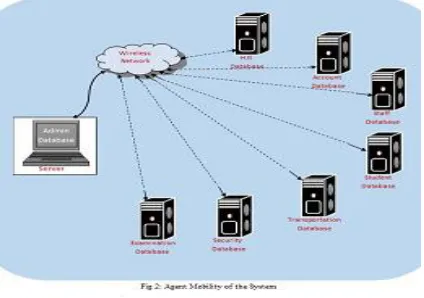
b. Mobility of the Mobile Agent System
Available online: https://journals.pen2print.org/index.php/ijr/ P a g e | 53 c. The Use Case Analysis of the Model
The structure of the proposed model can be identified using the model analysis which includes use - case diagram, class-based elements, and the behavioral elements. The use-case scenario of the infrastructure to be developed in this research is presented in Figure 3 showing the CMIS user, application server, class activity for the service registry and the system administrator.
Fig. 3. Case Diagram for Management Information System Mobile Agent
IV. CONCLUSION
In this study a Mobile Agent Model for trust evaluation that is specifically designed for general application for MIS operations in an organization has been presented. Also, the Mobility of Mobile Agent Architecture has been used as a concept for searching and retrieving information among categorized MIS databases available on a network. The study emphasizes that in computer science, a mobile agent is a composition of computer software and data which is able to migrate (move) from one computer to another autonomously and continue its execution on the destination computer. In reality, the mobile agent is the code/object on move which travels in its itinerary within the network of connected nodes. This system is designed and implemented as a centralized system that will improve the activities of Management Information System in various organization to enhance effective handling of each
categorized database or records. The use of Mobile Agent with MIS will enhance better performance and fast retrieving of information from another node in the network. The study does not cover the area of biometrics database hosting and some other aspect, so for further study or research, we recommend the inclusion of biometric and hosting of database.
REFERENCE
[
[1] Lapiedra, R.A (2012): Introduction to Management Information Systems - UJI –
http://dx.doi.org/10.6035/Sapientia63
[2] Druzdze M. J. & Flynn R. R. (2002): “Decision Support Systems, Decision Systems Laboratory, School of Information Sciences and Intelligent Systems Program” University of Pittsburgh, Pittsburgh, PA 15260 http://www.sis.pitt.edu/_dsl
[3] Singh, Y., Gulati, K. & Niranjan, S. (2012). “Dimension and Issues of Mobile Agent Technology”, International Journal of Artificial Intelligence & Applications (IJAIA), Vol. 3, No. 5, pp.11
[4] Teemu, L., Jose, A. L., Yoshito, T., Kaoru, S. & Jukka, R. (2015). Mobile crowdsensing with mobile agents. DOI 10.1007/s10458-015-9311-7. 12.
[5] Dejan Milojicic, 2009: “Mobile agent applications” Hewlett Packard Laboratories.
[6] Alf, Sørensen & Indal, (2011): “A Mobile Agent Architecture for Heterogeneous Devices” D ept. of Computer and Information Science, Norwegian University of Science and Technology, N-7491 Trondheim, Norway. [7] Smith, D.C., Cypher, A and Spohrer, J. (2008)
“Programming Agents without a programming
language”. Communications of the ACM 37 (7) pp 55-67. [8] Akinyokun, O.C., Ekuewa, J.B. & Arekete, S.A. (2014).
Development of Agent-based system for monitoring software resources in a network environment. Artificial Intelligence Research. Vol 3, No 3,pp. 62 – 74
[9] Amosa, B.M.G., Sobowale A.A., Adepoju Temilola, Hammed, M.A., and Onyeka Ndidi. (2017). An Agent Based System for Monitoring Loan Defaulters in Commercial Banks. Academic Journal of Science.Vol., 7
No2 pp. 45-54. [10] Karim, A.J. (2011) The significance of management
information systems for enhancing strategic and tactical planning. JISTEM. J.Inf.Syst. Technol. Manag. (Online) Vol.8 No. 2. https://doi.org/10.1590/S1807-17752011000200011
[11] El-Gamal, Y., Khalid E. and Magdy, S. (2007). “A Comparative Performance Evaluation Model of Mobile Agent Versus Remote Method Invocation for Information Retrieval.” World Academy of Science, Engineering, and
Technology: pp. 286-291.