A Cryptographic Study of Tokenization Systems
Sandra D´ıaz-Santiago, Lil Mar´ıa Rodr´ıguez-Henr´ıquez and Debrup Chakraborty
Department of Computer Science, CINVESTAV-IPN, Av. IPN 2508 San Pedro Zacatenco, Mexico City 07360, Mexico
[email protected],[email protected], [email protected]
Abstract. Payments through cards have become very popular in today’s world. All businesses now have options to receive payments through this instrument, moreover most organizations store card information of its customers in some way to enable easy payments in future. Credit card data is a very sensitive information and theft of this data is a serious threat to any company. Any organization that stores credit card data needs to achieve payment card industry (PCI) compliance, which is an intricate process where the organization needs to demonstrate that the data it stores is safe. Recently there has been a paradigm shift in treatment of the problem of storage of payment card information. In this new paradigm instead of the real credit card data a token is stored, this process is called “tokenization”. The token resembles the credit/debit card number but is in no way related to it. This solution relieves the merchant from the burden of PCI compliance in several ways. Though tokenization systems are heavily in use, to our knowledge, a formal cryptographic study of this problem has not yet been done. In this paper we initiate a study in this direction. We formally define the syntax of a tokenization system, and several notions of security for such systems. Finally, we provide some constructions of tokenizers and analyze their security in the light of our definitions.1
1 Introduction
In our digital age, credit cards have become a popular payment instrument. With increasing popularity of business through internet, every business requires to maintain credit card information of its clients in some form. Credit card data theft is considered to be one of the most serious threats to any business. Such a breach not only amounts to a serious financial loss to the business but also a critical damage to the “brand image” of the company in question.
The Payment Card Industry Security Standard Council (PCI SSC), which was founded by the major payment card brands, is an organization responsible for the development and deployment of various best practices in ensuring security of credit card data. In particular, PCI SSC has developed a standard called the PCI Data Security Standard (PCI DSS) [11] which specifies security mechanisms required to secure payment card data. PCI DSS dictates that organizations, which process card payments, must protect cardholder data when they store, transmit and process them. The actual requirements specified by PCI DSS are elaborate and complex. To obtain PCI compliance, a merchant needs to provide documentation on the usage and security policies regardingallsensitive information stored in its environment. PCI compliance is considered to be necessary for any business to acquire the confidence of its customers. Moreover, a business which has suffered theft of sensitive information while not being compliant can be subject to hefty amounts of fines from the government in some countries.
Traditionally credit card numbers have been used as a primary identifier in many business processes in the merchant sites. We quote from a document by Securosis [17]:
As the standard reference key, credit card numbers are stored in billing, order management, shipping, customer care, business intelligence, and even fraud detection systems. Large retail organizations typically store credit card data in every critical business processing system.
Thus, in merchant sites, credit card numbers are scattered across their environment. This makes it very difficult for a merchant to formulate security policies and provide necessary documentation to obtain PCI compliance.
But, in most systems where credit card numbers are stored, the data itself is not required, and the system would function as well as before if the credit card numbers are replaced by some other information which would “look like” credit card numbers. This observation has lead to a paradigm shift in the way security of credit card numbers are viewed: instead of securing sensitive data wherever it is present it is easier to remove sensitive data from where it is not required. This basic paradigm has been implemented usingtokens. Tokens are numbers which represent credit cards but are unrelated to the real credit card numbers.
There have been numerous industry white papers and similar documents which try to popularize tok-enization and discuss about the possible solutions to the toktok-enization problem [16, 17, 19, 15]. PCI SSC has also formulated its guidelines regardingtokenization [12]. But to our knowledge a formal cryptographic analysis of the problem has not been done. Even it is not clear what basic cryptographic objects should be used and in what way, to achieve the goals of tokenization.
SMALLDOMAINENCRYPTION. One obvious solution for securing credit card numbers in a merchant site is to encrypt them. But as we stated, a typical merchant site heavily depends on the credit card numbers for its functioning, even it index data based on credit card numbers. Hence, a strict requirement for applying encryption is that the cipher should look like a credit card number, so that for using encryption one does not require to change the database fields where these numbers are stored. This necessity opened up an interesting problem. A typical credit card number consists of sixteen (or less) decimal digits, if this is treated as a binary string, is about 53 bits long. This is much less than the block size of a typical block cipher (say AES). Thus, direct application of a block cipher to encrypt would result in a considerable length expansion, and it would not be possible to encode the cipher into sixteen decimal digits.
The general problem was named by Voltage Security as format preserving encryption (FPE), which refers to an encryption algorithm which preserves the format of the message. Formally, if we consider
X
to be a message space which contains strings from an arbitrary alphabet satisfying certain format,D
andK
be finite sets called the tweak space and key space respectively, then a format preserving encryption scheme is formally defined to be a functionFP:K
×D
×X
→X
, such that for everyd∈D
andK∈K
,FPK(d,·):X
→X
is a permutation. And FP should provide security as that of a tweakable strong pseudorandom permutation (SPRP). Designing such schemes for arbitraryX
is a challenging and interesting problem. In particular given a SPRP on{0,1}n, designing a SPRP for a message space{0,1}t, wheret<nis difficult.There have been some interesting solutions to this problem, but none of them can be considered to be efficient [1, 2, 5, 7, 10, 18].
A credit card number encrypted by an FPE scheme can act as a token. Such a solution is also provided by Voltage Security [19]. To the best of our knowledge, this is the only solution to the tokenization problem with known cryptographic guarantees. But again, there does not exist a formal security model for tokenization, and it has been contested that a token which is an encryption of the credit card data may not be considered as a safe token as there exists a possibility that the token can be inverted to get the original data [17].
OURCONTRIBUTION. We study the problem of tokenization from a cryptographic viewpoint, the main
Point of
Tokenization System
PAN
Server
Merchant Environment
Sale
Application Token
Card Vault
Encrypted Channel
Tokenizer/ Detokenizer
PAN & Token
Issuer
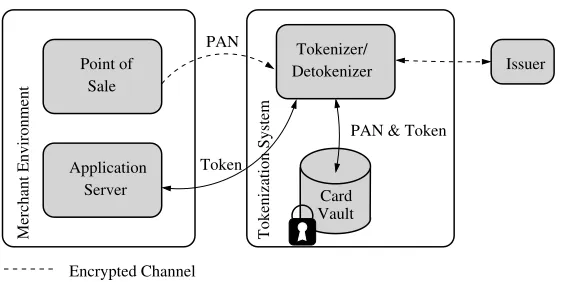
Fig. 1: Architecture of the tokenization system.
system, and develop a syntax for the problem. The syntax follows closely the recommendation of the PCI SSC, and it is general enough to accommodate various implementation options. Further, we develop a se-curity model for the problem in line with concrete provable sese-curity. We propose three different sese-curity notionsIND-TKR,IND-TKR-CV, andIND-TKR-KEY, which depend on three different threat models. We am-ply discuss the adequacy of these new notions of security in practical scenarios.
Finally, we propose some constructions of tokenization systems, and prove their security in the proposed security models. We propose three generic constructions namely TKR1, TKR2 and TKR2a and discuss how these constructions can be instantiated with existing cryptographic primitives.TKR1is a construction which just uses a format preserving encryption to generate tokens.TKR2andTKR2aare similar but both are very different fromTKR1. In the constructionsTKR2andTKR2awe demonstrate how the problem of tokenization can be solved both securely and efficiently without using FPE. BothTKR2andTKR2a uses off the shelf cryptographic primitives, in particular we show how to instantiate them using ordinary block ciphers, stream ciphers supporting initialization vectors (IV) and physical random number generators. We also prove security of our constructions in the proposed security models.
2 Tokenization Systems: Requirements and PCI DDS Guidelines
The basic architecture of a tokenization system is described in Fig. 1. In the diagram we show three separate environments: the merchant site, the tokenization system and the card issuer. The basic data objects of interest are the primary account number (PAN), which is basically the credit card number and the token which represents the PAN. A customer communicates with the merchant environment through the “point of sale”, where the customer provides its PAN. The merchant sends the PAN to the tokenizer and gets back the corresponding token. The merchant may store the token in its environment. At the request of the merchant the tokenizer candetokenizea token and send the corresponding PAN to the card issuer for payments.
We show the tokenization system to be separated from the merchant environment, this is true in most situations today, as the merchants receive the service of tokenization from a third party. But it is also possible that the merchant itself implements its tokenization solution, and in that case, the tokenization system is a part of the merchant environment.
1. A method for token generation:A process to create a token corresponding to aprimary account num-ber(PAN). In [12] there is no specific recommendation regarding how this process should be imple-mented. Some of the mentioned options are encryption functions, cryptographic hash functions and random number generators.
2. A token mapping procedure: It refers to the method used to associate a token with a PAN. Such a method would allow the system to recover a PAN, given a token.
3. Card-Vault:It is a repository which usually will store pairs of PANs and tokens and maybe some other information required for the token mapping. Since it may contain PANs, it must be specially protected according the PCI DSS requirements.
4. Cryptographic Key Management:This module is a set of mechanisms to create, use, manage, store and protect keys used for the protection of PAN data and also data involved in token generation.
The PCI guidelines for tokenization are quite vague (this has been pointed out before in many places in-cluding [16]), and it is difficult to make out what properties tokens and tokenization systems should posses for functionality and security. We state two basic requirements for tokens and tokenization systems. We assume that tokenization is provided as a service, thus multiple merchants utilize the same system for their tokenization needs.
1. Format Preserving:The token should have the same format as that of the PANs, so that the stored PANs can be easily replaced by the tokens in the merchant environment. It has been said that in some scenarios it may be important that the tokens can be easily distinguished from that of the PANs. For example, most credit card numbers have a Luhn checksum [8] of zero. One can make tokens containing same number of digits as that of the PAN but the Luhn checksum should be 1. Such a distinguishing criteria may make audits easier.
2. Uniqueness: The token generation method should be deterministic. As stated before, the application software in the merchant side uses the PAN for indexing, thus the tokens for a specific PAN should be unique, i.e., if the same PAN is tokenized twice by the same merchant then the same token should be obtained. Moreover, in a specific merchant environment two different PANs should be represented by different tokens.
3 Cryptographic Preliminaries and Notations
GENERALNOTATIONS. The set of allnbit strings would be denoted by{0,1}n. We shall sometimes
con-sider strings over an arbitrary alphabetAL, forY ∈AL∗, by|Y|AL we will denote the number of characters in the stringY. IfAL={0,1}, andX is a string overAL, then we will use|X|to denote the length ofX in bits. IfAis a finite set, then #Awill denote the cardinality ofA. If X,Y are strings,X||Y will denote the concatenation ofX andY. ForA∈ {0,1}∗,formatn(X) =X
1||X2||. . .||Xm, where|Xi|=n, for 1≤i≤m−1
and 0≤ |Xm|<n. IfX∈ {0,1}∗is such that|X| ≥`, thentake`(X)will denote the`most significant bits of
X. For a non negative integeri≤2n−1,binn(i)will denote thenbit binary representation ofi, and for any n-bit stringX,toInt(X)will denote the integer represented by the stringX.
Unless mentioned otherwise, whenever we refer to resources of an adversary we would mean: the number of oracle queries made by it and its running time.
PSEUDORANDOM FUNCTIONS AND PERMUTATIONS. For finite setsAandB, byFunc(A,B)we would mean the set of all functions mappingAtoB, andPerm(A)would denote the set of all permutations onA(i.e., all bijective functions mappingAtoA). If A={0,1}nandB={0,1}`, then we would denoteFunc(A,B) by
Func(n, `)andPerm(A)byPerm(n).
Consider the mapF:K×D→RwhereK,D,R(commonly called keys, domain and range respectively) are all non-empty and K and R are finite. We view this map as representing a family of functions F =
{FK}K∈K, i.e., for eachK∈K,FKis a function fromDtoRdefined asFK(X) =F(K,X). For everyK∈K, we callFKto be an instance of the familyF.
LetF:K×D→Rbe a family of functions. We define the prf-advantage of an adversary
A
in breaking FasAdvprfF (
A
) =Pr[K
$
←K:
A
Fk(·)⇒1]−Pr[ρ←$ Func(D,R):
A
ρ(·)⇒1] .Similarly, ifE:K×D→Dis a family of permutations, we define the prp-advantage of an adversary
A
in breakingEasAdvprpE (
A
) =Pr[K
$
←K:
A
EK(·)⇒1]−Pr[π←$ Perm(D):
A
π(·)⇒1] .Atweakable enciphering scheme (TES)is a function
E
:K×T×M
→M
whereKis the key space,T is the tweak set, andM
is the message space and for everyK∈KandT ∈Twe have thatE
(K,T,·) =E
TK(·)
is a length preserving permutation. We define theprp advantage of an adversaryf
A
asAdvprpf E (
A
) =Pr[K
$
←
K
:A
EK(·,·)⇒1]−Pr[π←$ PermT(n):
A
π(·,·)⇒1],
wherePermT(
M
)is the set of length preserving tweak indexed permutations onM
. If the message spaceM
={0,1}n, thenE
is called a tweakable block cipher.DETERMINISTIC CPA SECURE ENCRYPTION. Let E:K×T×
M
→ C be a deterministic encryption scheme with key space K, tweak space T, message spaceM
and cipher space C. We define the det-cpa advantage of any adversaryA
, which does not repeat any query asAdvdet-cpaE (
A
) =Pr[K
$
←
K
:A
EK(·,·)⇒1]−Pr[A
$(·,·)⇒1] ,where $(., .)is an oracle, which on input(d,x)∈T×Mreturns a random string of the size of the cipher-text ofx.
4 A Generic Syntax
1.
X
, a finite set ofprimary account numbersor PAN’s.X
contains strings from a suitable alphabet with a specific format.2.
T
, a finite set of tokens.T
also contains strings from a suitable alphabet with a specific format. It may be the case thatT
=X
.3.
D
, a finite set of associated data. The associated data can be any data related to the business process2. 4. CV, the card-vault. The card-vault is a repository where PAN’s and tokens are stored, which may havea special structure for the ease of implementation of the token mapping procedure. In our syntax we shall use the CV to represent a state of the tokenization system. Whenever a new PAN is tokenized, possibly both the PAN and the generated token are stored in theCV, along with some additional data. Disregarding the structure of theCV, we consider that “basic” elements ofCVcomes from a setY. 5.
K
, a key generation algorithm. A tokenization system may require multiple keys, all these keys aregenerated through the key generation algorithm.
6. TKR, the tokenizer. It is the procedure responsible for generating tokens from the PANs. We consider the tokenizer receives as input: theCVas a state, a keyKgenerated by
K
, some associated datadwhich comes from a setD
, and a PANx∈X
. An invocation ofTKRoutputs a tokentand also changes theCV. Thus, other thant,TKRalso produces an element fromYwhich is used to update theCV. We use the square brackets to denote this interaction. We formally seeTKRas a functionTKR[CV]:K
×X
×D
→T
×Y. For convenience, we shall implicitly assume the interaction of TKRwithCV, and we will useTKR(1)K (x,d)andTKR(2)K (x,d)to denote the two outputs (in
T
andY, respectively) ofTKR.7. DTKR, the detokenizer which inverts a token to a PAN. As in case of tokenizer, we denote a detok-enizer as a functionDTKR[CV]:
K
×T
×D
→X
∪ {⊥}. For detokenization also, we shall implicitly assume its interaction withCVand forK∈K
,d∈D
andt∈T
, we shall writeDTKRK(t,d)instead ofDTKR[CV](K,t,d).
A tokenization procedureTKRK should satisfy the following:
– For everyx∈
X
,d∈D
andK∈K
,DTKRK(TKR(1)K (x,d),d) =x.– For everyd∈
D
, andx,x0∈X
, such thatx6=x0,TKR(1)K (x,d)6=TKR(1)K (x0,d).The second criteria focuses on a weak form of uniqueness. We want that two different PANs with the same associated data should produce different tokens, we do not disallow the case where two different PANs with different associated data have the same tokens. This requirement is clear if we consider the associated data dto be an identifier for a merchant. We do not want that a single merchant obtains the same token for two different PANs, but we do not care if two different merchants obtain the same token for two different PANs.
5 Security Notions
We define three different security notions, which consider three different attack scenarios:
1. IND-TKR: Tokens are only public. This represents the most realistic scenario where an adversary has access to the tokens only, and the card-vault data remains in-accessible.
2In our view, irrespective of other possible identifiers, the associated data should contain an identifier of the merchant. Thus if
ExperimentExp-IND-TKRA 1. The challenger selectsK←$ K
2.Q←0/.
3.foreach query(x,d)∈X×DofA, 4. the challenger computes
t←TKR(K1)(x,d), and returnsttoA. 5. Q←Q∪ {(x,d)}
6.untilAstops querying
7.Aselects(x0,d0),(x1,d1)∈(X×D)\Q and sends them to the challenger
8. The challenger selects a bitb← {$ 0,1}
and returnst←TKR(K1)(xb,db)toA. 9. The adversaryAoutputs a bitb0. 10.Ifb=b0output1else output0.
ExperimentExp-IND-TKR-CVA 1. The challenger selectsK←$ K 2.Q←0/.
3.foreach query(x,d)∈X×DofA, 4. the challenger computes
(t,c)←TKRK(x,d), and returns(t,c)toA. 5. Q←Q∪ {(x,d)}
6.untilAstops querying
7.Aselects(x0,d0),(x1,d1)∈(X×D)\Q and sends them to the challenger
8. The challenger selects a bitb← {$ 0,1}
and returns(t,c)←TKRK(xb,db)toA. 9. The adversaryAoutputs a bitb0. 10.Ifb=b0output1else output0.
ExperimentExp-IND-TKR-KEYA 1. The challenger selectsK←$ K
2.Q←0/.
3.foreach query(x,d)∈X×DofA, 4. the challenger computes
t←TKR(K1)(x,d), and returnsttoA. 5. Q←Q∪ {(x,d)}
6.untilAstops querying
7.Aselects(x0,d0),(x1,d1)∈(X×D)\Q and sends them to the challenger
8. The challenger selects a bitb← {$ 0,1}
and returnst←TKR(K1)(xb,db)andKtoA. 9. The adversaryAoutputs a bitb0.
10.Ifb=b0output1else output0.
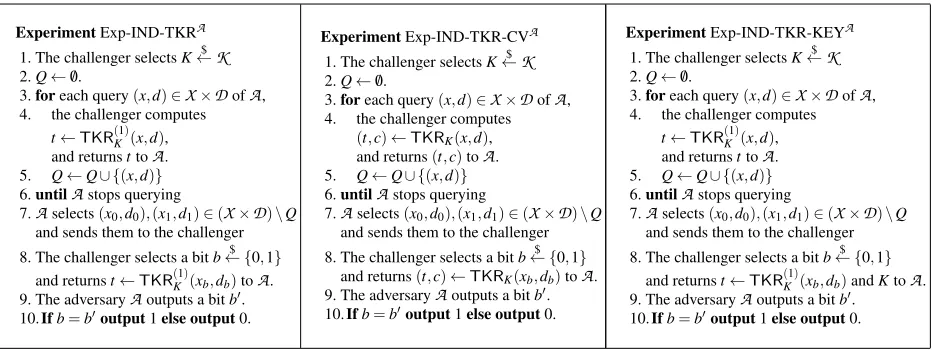
Fig. 2: Experiments used in the security definitions:IND-TKR, IND-TKR-CVandIND-TKR-KEY
2. IND-TKR-CV : The tokens and the contents of the card-vault are public. This represents an extreme scenario where the adversary gets access to the card-vault data also.
3. IND-TKR-KEY: This represents another extreme scenario where the tokens and the keys are public.
We formally define the above three security notions based on the notion of indistinguishability, as is usually done for encryption schemes. Three experiments corresponding to the three attack scenarios dis-cussed above are described in Figure 2. Each experiment represents an interaction between a challenger and an adversary
A
. The challenger can be seen as the tokenization system, which in the beginning selects a random key from the key space and instantiates the tokenizer with the selected key. Then (in lines 3 to 6 of the experiments), the challenger responds to the queries of the adversaryA
. The adversaryA
in each case queries with(x,d)∈X
×D
, i.e., it asks for the outputs of the tokenizer for pairs of PAN and associated data of its choice. Finally,A
submits two pairs of PANs and associated data to the challenger. The challenger selects one of the pairs uniformly at random and providesA
with the tokenizer output for the selected pair. The task ofA
is to tell which pair was selected by the challenger. IfA
can correctly guess the selection of the challenger then the experiment outputs a 1 otherwise it outputs a 0. This setting is very similar to the way in which security of encryption schemes are defined for a chosen plaintext adversary.Definition 1. LetTKR[CV]:
K
×X
×D
→T
×Ybe a tokenizer. Then the advantage of an adversaryA
in the sense ofIND-TKR,IND-TKR-CVandIND-TKR-KEYare defined asAdvind-tkrTKR (
A
) =
Pr[Exp-IND-TKRA ⇒1]−
1 2 ,
Advind-tkr-cvTKR (
A
) =
Pr[Exp-IND-TKR-CVA ⇒1]−
1 2 ,
Advind-tkr-keyTKR (
A
) =
Pr[Exp-IND-TKR-KEYA ⇒1]−
1 2 , respectively.
From the definitions, it is obvious that IND-TKR-CV=⇒IND-TKR and IND-TKR-KEY=⇒IND-TKR, but IND-TKR6=⇒IND-TKR-CVandIND-TKR6=⇒IND-TKR-KEY. ThusIND-TKR-CVandIND-TKR-KEYare strictly stronger thanIND-TKR.
ADEQUACY OF THE NOTIONS. We discuss some of the characteristics and limitations of the proposed definitions next.
1. IND-TKRrefers to the basic security requirement for tokens. It adheres to the informal security notion for tokens as stated in the PCI DSS guideline for tokenization. It models the fact that tokens and PANs are un-linkable in a computational sense, if the key and card-vault are kept secret. Thus, if a merchant adopts a tokenization scheme provided by a third party, which is secure in theIND-TKRsense then this will probably relieve it from PCI compliance. As in this case the merchant does not own the card-vault or the keys, and the burden of security involved with the keys and the card-vault lies with the provider who offers the tokenization service.
2. TheIND-TKR-CVis a stronger notion. If a tokenization system achieves this security, then it implies that tokens and PANs are un-linkable even with the knowledge of the card-vault. This in turn implies that the contents of the card-vault are not useful (in a computational sense) to derive a relation between PANs and tokens. Thus, it provides security both to the tokenization service provider and the merchant who use this service.
3. IND-TKR-KEYis a stronger form of theIND-TKRnotion. Some public documents like [17] it has been stressed that encryption is not a good option for tokenization, as in theory there exists the possibility that a token can be inverted to obtain the PAN. If tokens are generated using a “secure” encryption scheme, then it is infeasible for any “reasonably efficient” adversary to invert the token without the knowledge of the key. But, this computational guarantee does not seem to be enough for users. The IND-TKR-KEYdefinition aims to model this paranoid situation, where linking the PANs with tokens becomes infeasible even with the knowledge of the key. Note inIND-TKR-KEYwe still assume that the card-vault is inaccessible to an adversary.
4. All the definitions follow the style of a chosen plaintext attack. The definitions may be made stronger by giving the adversary additional power of obtaining PANs corresponding to tokens of its choice. But in this application, we think such stronger notions are not applicable.
In the following two sections we discuss two class of constructions for tokenizers. The first construction
6 ConstructionTKR1: Tokenization Using FPE
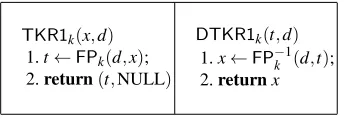
The constructionTKR1is described in Figure 3.TKR1uses an FPE scheme FP:
K
×D
×X
→T
in an obvious way to generate tokens, assuming thatT
=X
.TKR1k(x,d) 1.t←FPk(d,x); 2.return(t,NULL)
DTKR1k(t,d) 1.x←FP−1k (d,t); 2.returnx
Fig. 3: TheTKR1tokenization scheme using a format preserving encryption schemeFP.
For security we assume thatFPk()is a tweakable pseudorandom permutation with a tweak space
D
and message spaceT
. Note, that this scheme does not utilize a card-vault and thus is stateless. The scheme is secure both in terms ofIND-TKRandIND-TKR-CV. We formally state the security in the following theorem.Theorem 1. 1. LetΨ=TKR1be defined as in Figure 3, and
A
be an adversary attackingΨin the IND-TKRsense. Then there exists agpr p adversaryB
such thatAdvind-tkrΨ (
A
)≤Advprpf FP(B
),where
B
uses almost the same resources as ofA
.2. LetΨ=TKR1be defined as in Figure 3, and
A
be an adversary attackingΨin theIND-TKR-CVsense. Then there exists agpr p adversaryB
(which uses almost the same resources as ofA
) such thatAdvind-tkr-cvΨ (
A
)≤Advprpf FP(B
).The first claim of the Theorem is an easy reduction where we design a prp adversary
B
which runsA
and finally relate the advantages of the adversariesA
andB
. The second claim directly follows from the first, as in the constructionTKR1, there is no card-vault, thus anIND-TKR-CVadversary forTKR1do not have any additional information compared to anIND-TKRadversary. The proof is provided in the Appendix A.1.This scheme can be instantiated using any format preserving encryption scheme as described in [1, 5, 2, 10, 7, 18]. We discuss more on the impact of security and efficiency for specific instantiations in Section 8.
7 ConstructionTKR2: Tokenization Without Using FPE
Here we propose a class of constructions which avoids the use of format preserving encryption. Instead of a permutation on
T
which we use for the previous construction, we assume a primitive RNT(), which when invoked (ideally) outputs a uniform random element inT
. This primitive can be keyed, which we will denote byRNT[k](), wherekis a uniform random element of a pre-defined finite key spaceK
.RNT()can also be realized by using a keyed cryptographic primitive fk, such instantiations would be more specificallydenoted byRNT[fk](). We define the rnd advantage of an adversary
A
attackingRNT()asAdvrndRN(
A
) =Pr[k
$
←
K
:A
RNT[k]()⇒1]−Pr[A
$T()⇒1]Where $T()is an oracle which returns uniform random strings from
T
. The task of a rnd adversaryA
is to distinguish betweenRNT[k]()and its ideal counterpart when oracle access to these schemes are given toA
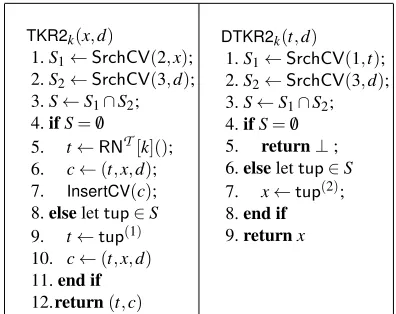
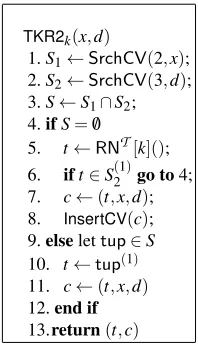
. We describe a generic scheme for tokenization in Figure 4, which we call as TKR2that usesRNT(). For the description we consider that the card-vault CV is a collection of tuples, where each tuple has 3 components(x1,x2,x3), wherex1,x2,x3are the token, the PAN and associated data respectively. For a tupletup= (x1,x2,x3), we would usetup(i)to denotexi. Given a card-vaultCV we also assume procedures to
search for tuples in theCV.SrchCV(i,x)returns those tuplestupinCVsuch thattup(i)=x. IfSbe a set of tuples, then byS(i)we will denote the set of thei-th components of the tuples inS.
TKR2k(x,d)
1.S1←SrchCV(2,x); 2.S2←SrchCV(3,d); 3.S←S1∩S2; 4.ifS=0/
5. t←RNT[k](); 6. c←(t,x,d); 7. InsertCV(c); 8.elselettup∈S
9. t←tup(1)
10. c←(t,x,d)
11.end if
12.return(t,c)
DTKR2k(t,d)
1.S1←SrchCV(1,t); 2.S2←SrchCV(3,d); 3.S←S1∩S2; 4.ifS=0/ 5. return⊥; 6.elselettup∈S
7. x←tup(2); 8.end if
9.returnx
Fig. 4: TheTKR2tokenization scheme using a random number generatorRNT().
As it is evident from the description in Figure 4, the detokenization operation is made possible through the data stored in the card-vault, and the detokenization is just a search procedure. Also, the determinism is assured by search.
Correctness:A limitation of theTKR2scheme is that it may violate the property of uniqueness. It is not guaranteed thatTKR2k(x,d)6=TKR2k(x0,d0)when(x,d)6= (x0,d0). As discussed before, for practical pur-poses a weak form of uniqueness is required, i.e., forx6=x0, for anyd∈
D
, TKR2(x,d)6=TKR2(x0,d). This requirement stems from the fact that a specific merchant with associated datad, may use the tokens as a primary key in its databases. Thus ifd6=d0, it can be tolerated thatTKR2(x,d) =TKR2(x0,d0), for any x,x0∈X
.Let us assume thatRNT()behaves ideally. Ifqunique tokens have been already generated with a specific associated datad, the probability that the(q+1)thtoken (generated with associated datad) is equal to any
of theqpreviously generated tokens is given byq/#
T
. Thus, this probability of collision increases with the number of tokens already generated. If the total number of tokens generated by the tokenizer for a specific associated data is much smaller than the size of the token space (which will be the case in a practical scenario) this probability of collision would be insignificant3. But, still the uniqueness can be guaranteedby an additional search as shown in Figure 5. WhereRNT()is repeatedly invoked unless a token different from one already produced is obtained. Following the previous discussion, ifqis small compared to #
T
, the expected number of repetitions required until a unique token is obtained would be small. The detokenizationTKR2k(x,d)
1.S1←SrchCV(2,x); 2.S2←SrchCV(3,d); 3.S←S1∩S2; 4.ifS=0/
5. t←RNT[k](); 6. ift∈S(21)go to4; 7. c←(t,x,d); 8. InsertCV(c); 9.elselettup∈S
10. t←tup(1)
11. c←(t,x,d)
12.end if
13.return(t,c)
Fig. 5: ModifiedTKR2to ensure uniqueness
corresponding to the modified tokenization scheme described in Figure 5 remains the same as described in Figure 4.
We formally specify the security of TKR2 later in this section, but it is easy to see thatTKR2is not secure in theIND-TKR-CVsense, as in the card-vault the PANs are stored in clear, hence if the card-vault is revealed then no security remains. This can be fixed by encrypting the tokens in the card-vault. To achieve security in terms ofIND-TKR-CV, any CPA secure encryption can be used to encrypt the PANs stored in the card-vault. Note that for the encrypted PAN to be stored in the card-vault the format preserving requirement is not required. We modifyTKR2toTKR2ato achieve this. We discuss the details ofTKR2next.
ModifyingTKR2toTKR2a:For this modification, the structure of the card-vault is a bit different than for TKR2. In this case, each tuple contains two components. The first being the encryption of the token and the second the encryption of the PAN. We additionally use a deterministic CPA secure encryption (supporting associated data) schemeE:K×
D
×M
→C, with key spaceK
, tweak (associated data) spaceD
and message spaceM
. We assume thatT
=X
=AL∗, whereALis an arbitrary alphabet, such that #AL≥2. We fixa,b∈ALand define the message spaceM
ofEto beM
={a||x:x∈X
}[{b||t:t∈T
}.TKR2ak1,k2(x,d)
1. z←Ek1(d,a||x);
2. S←SrchCV(2,z); 3. ifS=0,/
4. do
5. t←RNT[k2](); 6. t0←Ek1(d,b||t);
7. whileSrchCV(1,t0)6=0;/ 8. c←(t0,z);
9. InsertCV(c); 10. elselettup∈S
11. t00←tup(1)
12. t0←E−1k
1(d,t
0)
13. c←tup; 14. parset0asb||t; 15. end if
16. return(t,c)
DTKR2ak2(t,d)
1. t0←Ek1(d,b||t);
2. S←SrchCV(1,t0); 3. ifS=0/
4. return⊥; 5. elselettup∈S
6. z←tup(2); 7. x0←E−1k
1(d,z);
8. parsex0asa||x; 9. end if
10. returnx
Fig. 6: TheTKR2atokenization scheme.
7.1 RealizingRNT[k]
The heart of the proceduresTKR2 and TKR2a is the keyed primitive RNT[k], which can be realized by standard cryptographic objects. We discuss here a specific realization which uses a pseudorandom function f :
K
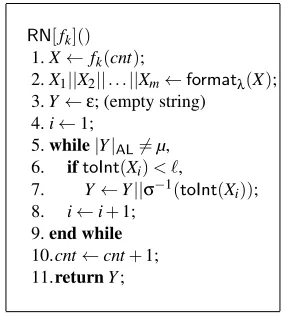
×ZN → {0,1}L, where L and N are sufficiently “large”, the exact requirements for N andL willbecome clear later. We call the constructionRN[fk]()and it is shown in Figure 7.
For the construction shown in Figure 7, we assume that
T
contains strings of fixed length µfrom an arbitrary alphabetAL. Let #AL=`, and λ=dlg`e. Let σ:AL→ {0,1,2, . . . , `−1} be a fixed bijection.The variablecntcan be considered as a state of the algorithm and it maintains its values across invocations. The basic idea behind the algorithm is to generate a “long” binary string using fk(cnt)and divide the string
RN[fk]() 1.X←fk(cnt);
2.X1||X2||. . .||Xm←formatλ(X);
3.Y←ε; (empty string) 4.i←1;
5.while|Y|AL6=µ,
6. iftoInt(Xi)< `,
7. Y←Y||σ−1(toInt(Xi)); 8. i←i+1;
9.end while
10.cnt←cnt+1; 11.returnY;
into blocks ofλbits. If the integer corresponding to a block is less than`then it is accepted otherwise it is discarded. The accepted blocks are encoded as elements inAL.
ChoosingLandN:Let us define,p=Pr[y← {$ 0,1}λ:toInt(y)< `] = ` 2λ >
1
2.Thus, if we assume that the output of fk()is uniformly distributed then anXi passes the test in line 6 (of Figure 7) with probability p.
Thus the expected number of times the while loop will run is at most 2µ. Thus,L=3µλ, will be sufficient
for all practical purposes.
Note that each invocation of RN[fk]()increases the value ofcnt by 1. Thus the value ofN should be
a conservative upper bound on the number of timesRN[fk]() needs to be invoked.N=280−1, should be
sufficient for all practical purposes.
If fk is a PRF thenRNT[fk]is secure in the rnd sense. We formally state this security property in the
following theorem.
Theorem 2. Let
A
be an arbitrary adversary attackingRN[fk](as described in Figure 7) in the rnd sense.Then there exists a prf adversary
B
(which uses almost the same resources as ofA
) such thatAdvrndRN[f
k]()(
A
)≤Advprf
fk (
B
). (2)This theorem asserts that as long as fk()is a PRF, the construction achieves the desired security in the rnd
sense.
7.2 Candidates for fk():
fk()can be instantiated through standard symmetric key primitives. We discuss three options below:
1. Stream cipher: Modern stream ciphers, such as those in the eStream [14] portfolio, take as input a short secret key Kand a short initialization vector (IV) and produce a “long” and random looking string of bits. LetSCK:{0,1}`→ {0,1}Lbe a stream cipher withIV, i.e., for every choice ofKfrom a certain
pre-defined key space
K
,SCKmaps an`-bitIV to an output string of lengthLbits. The basic idea of security is that for a uniform randomK and for distinct inputsIV1, . . . ,IVq, the stringsSCK(IV1), . . . ,SCK(IVq)should appear to be independent and uniform random to an adversary. This is formalized by requiring a stream cipher to be a PRF. See [3] for further discussion on this issue. Thus, a stream cipher with the above security guarantees can be used to instantiate fk.
2. Block cipher: A block cipherE:
K
× {0,1}n→ {0,1}ncan also be used to construct fkas follows.
fk(cnt)
1.m← dL/ne; 2.Y ←binn(cnt); 3.W←Ek(Y);
4.Z←Ek(W)||Ek(W⊕binn(1))|| · · · · · · ||Ek(W⊕binn(m−1));
5.returntakeL(Z)
The above construction is same as the counter mode of operation, and ifEkis assumed to be a PRF then
Proposition 1. Let
B
be an arbitrary prf adversary attacking fk()who asks at most q queries, then onecan construct a prf adversary
B
0for EK()such that,B
0asks at most mq queries andAdvprff (
B
)≤AdvEprf(B
0) +m2q22n .
3. True random number generator:We end this discussion with another possible interesting instantiation ofRN(). The specific construction that we depicted in Figure 7 basically uses a stream of random bits generated through a pseudorandom function. Currently there has been a lot of interest in designing physical true random number generators. Such generators harvests entropy from its “environment” and generates random streams with some post processing. It has been claimed that such generators are “true random number generators” (TRNG). Such a generator can be used to designRN() as in Figure 7 by replacing fk()with a TRNG, and by selecting suitable blocks from the generated stream according to
the format requirements of
T
. As a TRNG is key-less, thus this would lead to a key-less construction ofRN, we call such an instantiation asRN[TR]. As such a generator gives us “true randomness”, hence for any adversary
A
,AdvrndRN[TR]=0.From now onwards, where it is necessary, we will denoteTKR2instantiated withRN[fk]andRN[TR]
byTKR2[fk]andTKR2[TR]respectively. Similar convention would be followed forTKR2a.
7.3 Realizing Ek(d,x)
As discussed previously,Ek(·,·)is used to encrypt the PAN, and the encryption is stored in the card-vault
within the tokenization system. We do not require this encryption to be format preserving. Here we discuss two instantiations ofEusing a secure block cipherE. If the block length ofE isn, then both the proposed constructions have{0,1}n as their cipher space, and
X
andD
as their message space and tweak space,respectively. For the constructions we assume some restrictions on
X
andD
, but these restrictions would be satisfied in most practical scenarios.LetE :
K
× {0,1}n→ {0,1}n be a block cipher. As we defined before, letX
contain strings of fixedlengthµfrom an arbitrary alphabetALwhere #AL=`andλ=dlg`e. Let #
D
=`1andλ1=dlg`1e. Letn1 andn2be positive integers such thatn1≥µλ,n2≥λ1andn1+n2=n. Note that for practical choice ofAL,D
,µandn, suchn1,n2can be selected. LetpadX :X
→ {0,1}n,padD:D
→ {0,1}n,pad1:ALµ→ {0,1}n1 andpad2:D
→ {0,1}n2 be injective functions.E1K(d,x) 1.z1←pad1(x); 2.z2←pad2(d); 3.z←EK(z1||z2); 4.returnz
E1−1K (d,z)
1.y←EK−1(z); 2.z1←taken1(y);
3.x←pad−11 (z1); 4.returnx
E2K(d,x) 1.z1←padX(x); 2.z2←padD(d);
3.z←EK(z1⊕EK(z2)); 4.returnz
E2−1K (d,z)
1.y←EK−1(z); 2.z2←padD(d); 3.x←y⊕EK(z2); 4.returnx
Fig. 8: The two instantiations ofEK.
the associated datadare suitably formatted to anbit string and this formatted string is encrypted using the block cipher.E2is same as the construction of a tweakable block cipher proposed in [9]. IfEK is a secure
block cipher in the prf sense then bothE1K andE2K are det-cpa secure, we state this formally next.
Proposition 2. Let
A
be an arbitrary det-cpa adversary attackingE1, who asks at most q queries, never repeats a query, and runs for time at most T , then there exists a prf adversaryB
such thatAdvdet-cpaE1 (
A
)≤AdvprfE (B
), andB
also asks exactly q queries and runs for time O(T).Proposition 3. Let
A
be an arbitrary det-cpa adversary attackingE2, who asks at most q queries, never repeats a query, and runs for time at most T , then there exists a prf adversaryB
such thatAdvdet-cpaE2 (
A
)≤AdvprfE (B
) +2q2
2n ,
and
B
also asks exactly q queries and runs for time O(T).The above propositions suggests that E1has a better security bound compared toE2, and forE2 two block cipher calls are required for each encryption, whereas only a single block cipher call is required for
E1. The formatting requirements are more stringent for E1, where asE2 can be applied to any message space
X
and tweak spaceD
, where #X
≤2nand #D
≤2n.7.4 Security ofTKR2andTKR2a
The following three theorems specify the security ofTKR2andTKR2a.
Theorem 3. Let Ψ∈ {TKR2,TKR2a} and
A
be an adversary attacking Ψin the IND-TKRsense. Then there exists a RND adversaryB
(which uses almost the same resources as ofA
) such thatAdvind-tkrΨ (
A
)≤AdvrndRN(B
)Theorem 4. LetΨ=TKR2a and
A
be an adversary attackingΨin theIND-TKRsense. Then there existadversaries
B
andB
0(which use almost the same resources as ofA
) such thatAdvind-tkr-cvΨ (
A
)≤AdvrndRN(B
) +Advdet-cpaE (B
0) +(q+1)22s+1 where s is the size of the shortest element in the cipher space ofE.
Theorem 5. LetΨ∈ {TKR2[TR],TKR2a[TR]}and
A
be an arbitrary adversary attackingΨin the IND-TKR-KEYsense. ThenAdvind-tkr-keyΨ (
A
) =0IND-TKR IND-TKR-CV IND-TKR-KEY
TKR1 √ √
TKR2[fk] √
TKR2[TR] √ √
TKR2a[fk,E]
√ √
TKR2a[TR,E] √ √ √
Table 1: Summary of Security
8 Discussions
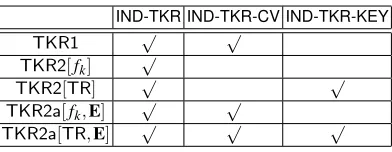
SECURITY. The security properties of the various schemes as stated in the previous security theorems are
summarized in Table 1. The security theorems in all cases are to be interpreted carefully. We note down some relevant issues below.
InTKR1the security is gained from the security of the format preserving encryption. The schemeFP
used inTKR1 is required to be a tweakable pseudorandom permutation with the message/cipher space
T
and the tweak spaceD
. It is important to note that various instantiations ofFPcan give different security guarantees. Most of the known FPE schemes can only ensure security (in provable terms) when the number of queries made by an adversary is highly restricted. For example, the security claim of the scheme based on Feistel networks discussed in [4] becomes vacuous when the number of queries exceeds 2#T/4, whereas the scheme in [10] can tolerate up to 2#T−ε queries whereεis inversely related to the number of rounds inthe construction. Some recent constructions in [7, 13] achieve much better bounds, specially in [13] almost #
T
queries can be tolerated for the bound to be meaningful. As #T
can be much smaller than the typical domain of a block cipher (2n, forn=128), thus the exact security guarantees are important in this context.Note, that for a typical scenario we consider credit card numbers of sixteen decimal digits then #
T
≈253. In the construction of TKR2andTKR2athe security bounds are better. IfRN[fk]is instantiated as inFigure 7, and in turn fkis constructed using a block cipher, then using Proposition 1 and Theorem 3, for any
IND-TKRadversary
A
who asks at mostqqueries, we haveAdvind-tkrΨ (
A
)≤m 2q22n +εq,
whereΨ∈ {TKR2,TKR2a}andεq is the maximum prf advantage of any adversary (who asks at most q
queries) in attacking the block cipherE. Note that,nis the block length of the block cipher used to construct fk. And m depends on #
T
, as per the description of the block cipher based construction in Section 7.2,m=L/n, and we discussed that it would be enough if we takeL=3µλ, whereµis the length of each token
where the tokens are treated as strings inALandλ=dlg #ALe. Thus, the security bound is less sensitive on #
T
. The bound only becomes vacuous when mq is of the order of 2n/2. A similar bound holds forAdvind-tkr-cvTKR2a[f
k](
A
), when a block cipher based construction for fk is used.The IND-TKR-KEY definition is meant to model the property of independence of the tokens with the keys, and this represents a quite strong notion of security. The constructionsTKR2[fk]andTKR2a[fk]do
EFFICIENCY. The efficiency ofTKR1depends on the efficiency of theFPscheme. As discussed there are various ways to instantiateFPwith varying amount of security and efficiency. Also, most schemes with provable guarantees are far inefficient than standard block ciphers.
The efficiency of TKR2andTKR2awould be dominated by the search procedure. Asymptotically, if #
T
=N, then tokenization and detokenization would take O(lgN) time. But the hidden constant would depend on how efficiently the search has been implemented and how powerful the machine is (mainly in terms of memory). We discussed more about this in Section 9.9 Experimental Results
We performed some preliminary experiments to determine the efficiency and functionalities of the proposed constructions in a practical environment. All experiments reported used the following computing resources:
CPU:Four-core i5-2400 Intel processor (3.1GHz).
OS:Ubuntu 12.04.4 LTS.
DataBase:PostgreSQL 9.2.6
Compiler:gcc 4.7.3
We implemented bothTKR2[fk]andTKR2a[fk], instantiated withRN[fk](described in Figure 7), where
fkwas instantiated with block cipher based construction described in Section 7.2.
We implemented the card-vault in a PostgresSQL database. For TKR2 we considered the card-vault to be a relation with three attributes: the token (TKN), the associated data (ASD) and the PAN. For this construction the primary key is composed by the token and the associated data. ForTKR2awe considered the card-vault to be a relation with two attributes EPAN and ETKN, representing the encrypted PAN and token respectively. We encrypt these data using the constructionE1described in Section 7.3. In this case ETKN was considered as the primary key.
For implementation of fk()we used AES with 128 bit key, and the implementation was done by using the
new Intel AES-NI instruction set, which provides a very efficient and secure implementation of the AES. We assumed that
X
contains strings of 16 characters where each character is a decimal digit, andT
=X
. Thus, in accordance to our notations introduced before, we hadµ=16,AL={0,1. . . ,9}, thusλ=dlg(#AL)e=4,and
X
=T
=ALµ.The reported times are based on an −O3optimized code. The time was measured by first measuring the number of cycles necessary for a specific operation using therdtscinstruction. This cycle counts we converted to real time using the processor frequency.
We summarize our experiments and the results below:
1. The first experiment was to verify how many block cipher calls are necessary for each call of fk()and
the efficiency of RNT[fk]. In Section 7, we discussed that if the range of fk is{0,1}L, thenL≤3λµ
would be sufficient. Note, that the number of block cipher calls required for each invocation of fk is
m=dL/λe. We made 1000000 independent calls to fk, and in all cases, in each call we required at most
two block cipher calls. In fact in only 5% of the cases two calls were necessary. In all others only one call was sufficient. The average time required for each invocation ofRNT[fk]was 0.1 microseconds.
unique. Thus, in a practical scenario, where the card-vault would be stored in a database, the uniqueness test (as included in the description in Figure 5) is not required to be explicitly included. Once a token is generated and when the system tries to insert it in the database, if the uniqueness condition is violated then the database would generate an error message, and then the process may be repeated until a unique token is generated.
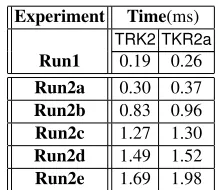
3. Finally we measured efficiency of the tokenization proceduresTKR2andTKR2a. In Table 2 we sum-marize the results, which are described as below:
– Run1denotes the average time required to generate one token, including the insertion in the card-vault. But here primary keys in the card-vault relations are not specified, i.e., this run does not do any uniqueness test. The average is computed over 1000000 tokens.
– Run2denotes the scenario where the primary keys are specified, i.e., the database checks for the uniqueness. As it is obvious, in this case the time required to tokenize (including the insertions in the card-vault) would increase with the current size of the card-vault. To measure this difference we divided this run into five different runs which we callRun2a,Run2b,· · ·,Run2e. For Run2a
we started with an empty card-vault, and generated 1000000 tokens. In Run2bwe started with a card-vault already containing 1000000 tokens, and we generated 1000000 more tokens. Similarly, in runsRun2c,Run2dandRun2e, we started with a card-vault containing 2000000, 3000000 and 4000000 tokens, respectively. In each run we generated 1000000 more tokens. The Table 2 shows the average time required for generating one token for each scenario.
Experiment Time(ms)
TRK2 TKR2a
Run1 0.19 0.26
Run2a 0.30 0.37
Run2b 0.83 0.96
Run2c 1.27 1.30
Run2d 1.49 1.52
Run2e 1.69 1.98
Table 2: Summary of the experimental results: The descriptions ofRun1,Run2a,· · ·Run2eare provided in the text.
The basic component for bothTKR2andTKR2ais the procedureRNT, as mentioned, a call toRNT, costs only 0.1 micro seconds. But the times reported in Table 2 (which are in milliseconds) are more realistic, and it shows that the database insertions dominate the cost of tokenization. Thus, further optimization in this regard may be possible. But, still our experimental results confirms that the schemes proposed in this work can be implemented and used in a real tokenization environment.
10 Conclusion
light of our security definitions and also provided some preliminary experimental results. We plan to per-form a more rigourous efficiency comparison of the proposed schemes with the existing FPE schemes in near future.
References
1. M. Bellare, T. Ristenpart, P. Rogaway, and T. Stegers. Format-preserving encryption. In M. J. J. Jr., V. Rijmen, and R. Safavi-Naini, editors,Selected Areas in Cryptography, volume 5867 ofLecture Notes in Computer Science, pages 295–312. Springer, 2009.
2. M. Bellare, P. Rogaway, and T. Spies. The FFX mode of operation for format-preserving encryption. NIST submission, February 2010.http://csrc.nist.gov/groups/ST/toolkit/BCM/documents/proposedmodes/ffx/ffx-spec.pdf. 3. C. Berbain and H. Gilbert. On the security of IV dependent stream ciphers. In A. Biryukov, editor,FSE, volume 4593 of
Lecture Notes in Computer Science, pages 254–273. Springer, 2007.
4. J. Black and P. Rogaway. Ciphers with arbitrary finite domains. In B. Preneel, editor,CT-RSA, volume 2271 ofLecture Notes
in Computer Science, pages 114–130. Springer, 2002.
5. E. Brier, T. Peyrin, and J. Stern. BPS: a format-preserving encryption proposal. NIST submission, 2010. Available athttp: //csrc.nist.gov/groups/ST/toolkit/BCM/documents/proposedmodes/bps/bps-spec.pdf.
6. CardHub. Number of credit cards and credit card holders, 2012. Available at http://www.cardhub.com/edu/ number-of-credit-cards/.
7. V. T. Hoang, B. Morris, and P. Rogaway. An enciphering scheme based on a card shuffle. In R. Safavi-Naini and R. Canetti, editors,CRYPTO, volume 7417 ofLecture Notes in Computer Science, pages 1–13. Springer, 2012.
8. ISO/IEC 7812-1. Identification cards-identification of issuers-part 1: Numbering system, 2006.
9. M. Liskov, R. L. Rivest, and D. Wagner. Tweakable block ciphers. In M. Yung, editor,CRYPTO, volume 2442 ofLecture
Notes in Computer Science, pages 31–46. Springer, 2002.
10. B. Morris, P. Rogaway, and T. Stegers. How to encipher messages on a small domain. In S. Halevi, editor,CRYPTO, volume 5677 ofLecture Notes in Computer Science, pages 286–302. Springer, 2009.
11. PCI Security Standards Council. Payment card industry data security standard version 1.2, 2008. Available athttps://www. pcisecuritystandards.org/security_standards/pci_dss.shtml.
12. PCI Security Standards Council. Information supplement: PCI DSS tokenization guidelines, 2011. Available athttps: //www.pcisecuritystandards.org/documents/Tokenization_Guidelines_Info_Supplement.pdf.
13. T. Ristenpart and S. Yilek. The mix-and-cut shuffle: Small-domain encryption secure against n queries. In R. Canetti and J. A. Garay, editors,CRYPTO (1), volume 8042 ofLecture Notes in Computer Science, pages 392–409. Springer, 2013.
14. M. J. B. Robshaw and O. Billet, editors.New Stream Cipher Designs - The eSTREAM Finalists, volume 4986 ofLecture Notes
in Computer Science. Springer, 2008.
15. RSA White paper. Tokenization: What next after PCI, 2012. Available at http://www.emc.com/collateral/ white-papers/h11918-wp-tokenization-rsa-dpm.pdf.
16. Securosis White Paper. Tokenization guidance: How to reduce pci compliance costs, 2011. Available athttp://gateway. elavon.com/documents/Tokenization_Guidelines_White_Paper.pdf.
17. Securosis White Paper. Tokenization vs. encryption: Options for compliance, 2011. Available athttps://securosis.com/ research/publication/tokenization-vs.-encryption-options-for-compliance.
18. E. Stefanov and E. Shi. Fastprp: Fast pseudo-random permutations for small domains. IACR Cryptology ePrint Archive, 2012:254, 2012.
19. Voltage Security White paper. Payment security solution - processor edition, 2012. Available athttp://www.voltage.com/ wp-content/uploads/Voltage_White_Paper_SecureData_PaymentsProcessorEdition.pdf.
A Deferred Proofs
A.1 Proof of Theorem 1
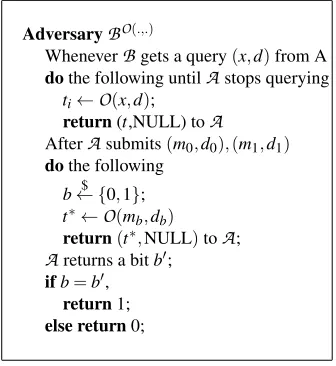
randomly chosen keyk, or a random permutation chosen uniformly at random from the set of all tweak index permutations from
T
toT
.B
with its oracle provides the environment toA
and simulates the experiment EXP-IND-TKRATKR1as shown in Figure 9.AdversaryBO(.,.)
WheneverBgets a query(x,d)from A
dothe following untilAstops querying
ti←O(x,d);
return(t,NULL) toA
AfterAsubmits(m0,d0),(m1,d1)
dothe following
b← {$ 0,1};
t∗←O(mb,db)
return(t∗,NULL)toA;
Areturns a bitb0;
ifb=b0,
return1;
else return0;
Fig. 9: AdversaryBfor the proof of Theorem 1
We assume without loss of generality that
A
does not repeat queries, asA
knows thatTKR1is a deter-ministic scheme, hence it does not gain anything by repeating a query.It is easy to see that if the oracle
O
(., .)ofB
isFPk(., .), thenB
O provides the perfect environment forA
as in EXP-IND-TKRATKR1. Hence,Pr[k←$
K
:B
FPk(.,.)⇒1] =Pr[EXP-IND-TKRATKR1⇒1]. (3)
Also,
Pr[π←$ PermD(
T
):B
π(.,.)⇒1]≤12, (4)
as, when
O
(., .)is a uniform random tweakable permutation onT
, for each of its queriesA
gets uniform random elements inT
, thusb0whichA
outputs is independent ofbwhich is selected byB
.Hence from equations (3) and (4), we have
Advfprp
FP(
B
)≥Pr[EXP-IND-TKRATKR1⇒1]− 1 2,and hence
Advind-tkrTKR1 (
A
)≤Advprpf FP(B
),AdversaryBO(.)
WheneverBgets a query(d,x)fromA dothe following untilAstops querying
z1←pad1(x);
z2←pad2(d);
z←O(z1||z2);
return(z)toA Areturns a bitbtoB;
returnb;
Fig. 10: AdversaryBfor the proof of Proposition 2.
A.2 Proof of Proposition 2
To prove this proposition, we construct a prf adversary
B
(shown in Fig. 10) which runs an arbitrary adver-saryA
who attacks the encryption schemeE1 in the det-cpa sense.B
being a prf adversary has access to an oracleO
which can be either be the block cipherEk or a functionρ, chosen uniformly at random fromFunc(n).
We can easily see that if the oracle of
B
is the block cipherEkthenPr[k←$ K:
B
Ek(·)⇒1] =Pr[k←$K
:A
E1(·,·)⇒1]. (5)As
A
never repeats a query, so if the oracle ofB
is a random functionρ, then for each queryA
gets a uniform randomnbit string as a response. Thus,Pr[ρ←$ Func(n):
B
ρ(·)⇒1] =Pr[A
$(·,·)⇒1] (6)Thus from the equations above, and the definition of the det-cpa advantage of
A
and the prf advantage ofB
, we obtainAdvdet-cpaE1 (
A
) =AdvprfE (B
).u t
A.3 Proof of Proposition 3
As in the proof of Proposition 3, we construct a prf adversary
B
(shown in Fig. 11) which runs an arbitrary adversaryA
who attacks the encryption scheme E2. AdversaryB
has access to an oracleO
which can be either a secure block cipherEkor a pseudorandom functionρ, chosen uniformly at random fromFunc(n).We can easily see that if the oracle of
B
is the block cipherEkthenPr[k←$ K:
B
Ek(·)⇒1] =Pr[k←$K
:A
E2(·,·)⇒1] (7)To analyze the situation when the oracle of
B
is a random function, we consider the game G0shown in Figure 12. The game G0 describes a function Choose-ρ(), which acts as a random function. It returnsAdversaryBO(.)
WheneverBgets a query(d,x)fromA dothe following untilAstops querying
z1←padX(x);
z2←padD(d);
z←O(z1⊕O(z2));
returnztoA Areturns a bitbtoB;
returnb;
Fig. 11: AdversaryBfor the proof of Proposition 3.
same input. It does this by maintaining a tableρof outputs that it has already returned. Additionally in the
setDOM, it maintains the points on which it has been queried. The function sets the bad flag to true if it is queried twice on the same input.
AsChoose-ρacts like a random function, hence it is immediate that
Pr[ρ←$ Func(n):
B
ρ(·)⇒1] =Pr[A
G0⇒1] (8)Now, we do a small change in gameG0, i.e., we remove the boxed entry in the functionChoose-ρ, we
call this changed game asG1. Notice that gamesG1andG0are identical until the flagbadis set totrue, hence we have
Pr[
A
G0⇒1]−Pr[A
G1⇒1]≤Pr[A
G1setsbad] (9) Also in gameG1, the functionChoose-ρ, returns random strings for any input it gets, thusA
when interactswithG1gets random strings in{0,1}nin response to its queries. Hence,
Pr[
A
$(·,·)⇒1] =Pr[A
G1⇒1]. (10)Now, we do some small syntactic changes in the gameG1to obtain the gameG2, also shown in Fig-ure 12. GameG2is only syntactically different fromG1. InG2random strings are returned immediately as a response to a query of
A
, and later in the finalization phase appropriate values are inserted in the multisetDom, note asDomis a multiset hence there can be several instances of the same element present here. As, there is no way that
A
can distinguish betweenG1andG2, hencePr[
A
G1⇒1] =Pr[A
G2⇒1], (11)also
Pr[
A
G1setsbad] =Pr[A
G2setsbad]. (12)Thus, using equations (8), (9), (10), (11) and (12) we get
Pr[ρ←$ Func(n):
B
ρ(·)⇒1] =Pr[A
G0⇒1]≤Pr[
A
G1⇒1] +Pr[A
G1sets bad]≤Pr[
A
G2⇒1] +Pr[A
G2sets bad]Game G0,G1 function Choose-ρ(X)
Y← {$ 0,1}n;
ifX∈DOMthen bad←true
Y←ρ[X]
else
ρ[X]←Y
Dom←Dom∪ {X}
end if returnY Initialization
bad←false;
Dom=0;/
Query Phase
For a query(d(i),x(i))ofAdo the following
z(1i)←padX(x(i));
z(2i)←padD(d(i));
ifz(2i)=z(2j)for some j<ithenµ(i)←µ(j) else µ(i)←Choose-ρ(z(2i))
end if
λ(i)←z(1i)⊕µ(i)
z(i)←Choose-ρ(λ(i)) returnz
GameG2 Query Phase
For a query(d(i),x(i))ofA, do the following
z(i)← {$ 0,1}n
returnz(i)
Finalization fori→1 toq
z(1i)←padX(x(i));
z(2i)←padD(d(i));
ifz(2i)=z2(j)forj<ithen µ(i)←µ(j)
else
µ(i)← {$ 0,1}n
Dom←Dom∪ {z(2i)}
end if
λ(i)←z(1i)⊕µ(i) Dom←Dom∪ {λ(i)}
endfor
if there is a collision inDomthen
bad←true
Fig. 12: GamesG0, G1, G2used for the proof of Proposition 3.
LetCOLLDbe the event that there is a collision in the multisetDomin gameG2, then from the descrip-tion of gameG2, we have
Pr[
A
G2setsbad] =Pr[COLLD]Now we concentrate on finding an upper bound for Pr[COLLD]. The elements present inDomared’s andλ’s. LetDom=Qd∪Qλ, whereQd⊆ {d
(i): 1≤i≤q}, andQ λ={λ
(i)=z(i)⊕µ(i)|1≤i≤q}. Note, that the way the gameG2is designed, all elements inQdare distinct, thus there can be no collision
among two elements inQd. Additionally we claim the following
Claim 1 For1≤i,j≤q, i6=j,Pr[λ(i)=λ(j)]≤1/2n.
Proof. We have two cases to consider:
Case 1. Ifd(i)=d(j), thenx(i)6=x(j), as
A
does not repeat any query. This makesz(i)6=z(j). According to the gameG2, ifd(i)=d(j), thenµ(i)=µ(j). Thus we haveλ(i)6=λ(j). Thus, making Pr[λ(i)=λ(j)] =0.Case 2. Ifd(i)6=d(j), thenµ(i)andµ(j)are uniform and independent random elements in{0,1}n, thus making
Pr[λ(i)=λ(j)] =Pr[z1(i)⊕µ(i)=z1(j)⊕µ(j)] = 1
Claim 2 For any d∈Qd and anyλ∈Qλ,Pr[λ=d]≤1/2
n.
Proof. Anyλ∈Qλis a uniform random string in{0,1}n, and is independent of anyd∈Qd.
Now, as #Qd≤qand #Qλ=q, using Claims 1, 2 and the union bound, we have
Pr[COLLD]≤ 1 2n
q 2
+q
2
2n <
2q2 2n .
Now, using the definition of det-cpa advantage of
A
and equations (7) and (13), we have the proposition. u tA.4 Proof of Theorem 3
Note that the token generation algorithm for both TKR2 and TKR2a are the same, the only difference between the two procedures is the structure and content of the card-vault. Hence the proof of security in IND-TKR sense for bothTKR2andTKR2aare same, as in case of IND-TKR security the adversary does not have access to the contents of the card-vault.
The structure of the proof is same as the proof of Theorem 1. We assume an arbitrary adversary
A
which attacksTKR2in IND-TKR sense, and we construct a rnd adversaryB
which attacksRNT[k]usingA
.B
has an oracleO
, which is eitherRNT[k]for a random key, or $T(), which on each invocation returns a random element inT
.B
responds to queries ofA
as follows. FirstB
initiates with an empty card-vault and then perform the query phase, which in fact is the procedureTKR2kin Figure 5. Only when a call toRNT[k]()is required, it is replaced by a call to its oracleO
. AfterA
stops querying and outputs the challenge pair(m0,d0),(m1,d1),B
selects a bitbuniformly at random from{0,1}and providesA
witht computed by followingTKR2k()(the call toRNT[k]()replaced by a call to
O
). FinallyA
outputs a bitb0, and ifb=b0, thenB
outputs 1 else outputs a 0. Note that the challenge pair(m0,d0),(m1,d1), is different from any previous query ofA
.From the above description it is clear that if the oracle
O
(., .)ofB
isRNT[k](), thenB
is performing experiment EXP-IND-TKRATKR2. HencePr[k←$
K
:B
RNT[k]()⇒1] =Pr[EXP-IND-TKRATKR2⇒1]. (14)
Otherwise, i.e. if the oracle
O
(., .)ofB
is $T()then,Pr[
B
$T()⇒1]≤12. (15)
As in this case the output that
B
provides toA
is independent of(m0,d0),(m1,d1). From equations (14), (15) we have,AdvrndRN(
B
)≥Pr[EXP-IND-TKRATKR2⇒1]−1 2, and from the definition of IND-TKR advantage ofA
it followsAdvind-tkrTKR2 (
A
)≤AdvrndRN(B
).A.5 Proof of Theorem 4
For this proof we use the sequence of games. The three gamesEXPA0,EXPA1 andEXPA2 are described in Figure 13. Each game depicts the interaction of an IND-TKR-CV adversary with a tokenization procedure. In all the three games we assume that the adversary
A
does not repeat a query in the query phase, and the queries presented in the challenge phase are also distinct from the queries made in the query phase. Also, to keep things simple in terms of notations, without loss of generality we assume that the ciphertext space Cof the encryption algorithm Econtains strings of lengths. The proof can be made to work without this restriction. We describe the three different games briefly next:1. In gameEXPA0,
A
interacts withTKR2a, instantiated byRNT[k2]()andEk1(·,·), wherek1 andk2 are chosen uniformly at random from the respective key spacesK
1andK
2. The game is designed with the assumption that,A
does not repeat a query.2. GameEXPA1 is almost same as the gameEXPA0. The differences are as follows:
– Here the encryption schemeEk1(·,·), is no more used. Instead, each call toEk1(·,·)is responded by a random string from C. To maintain the same behaviour ofEk1, a setRan1 is maintained to keep track of the values already returned as output, and it is ensured that the same value is not returned for two different inputs.
– In the gameEXPA0, in lines 11 to 14 and 53 to 56 it is ensured that a distinct token istreturned for each distinct(x,d). This is done by a search in the card-vault (see lines 14 and 56), as the card-vault contains encryption of the tokentwith associated datad. As in the gameEXPA1, a real encryption scheme is not used, so this search is not possible. Hence a setTokis maintained which contains pairs of tokens and associated data(t,d)and the uniqueness of tokens is ensured using this setTok. 3. GameEXPA2 is obtained from gameEXPA1 by replacingRNT[k2]()by a procedure which on each
invo-cation returns a random element in
T
. This game also used the setsRan1 andTokto ensure injectivity and the uniqueness of the tokens.It is easy to see thatEXPA0 is a restatement of the experiment Exp-IND-TKR-CVA in Figure 2. Hence,
Pr[Exp-IND-TKR-CVA ⇒1] =Pr[EXPA0 ⇒1]. (16)
Also we make the following claims:
Claim 3 There exists a det-cpa adversary
B
forEsuch thatPr[EXPA0 ⇒1]−Pr[EXPA1 ⇒1]≤Advdet-cpaE (
B
) +(q+1)2
2s