IJEDR1602050
International Journal of Engineering Development and Research (www.ijedr.org)282
Comparative Analysis between Ordinary Brick
Masonry and Cavity Wall
1Grishma Thaker, 2Shyam Doshi 1 Assistant Professor, 2Assistant Professor,
1 Civil Engineering Department, 2Civil Engineering Department 1 Chhotubhai Gopalbhai Patel Institute of Technology, Bardoli, India.
________________________________________________________________________________________________________
Abstract - Simply stated, a cavity wall is two walls of masonry, separated by a cavity of varying dimension. The masonry walls may consist of solid brick, structural clay tile, or concrete masonry units and are bonded together with masonry ties. Cavity walls are not new, they have been observed in ancient Greek and Roman structures. At the Greco Roman town of Pergamum, on the hills overlooking the Turkish town of Bergama, a stone wall of cavity type construction still exists. All materials required are usually available locally, which eliminates costly shipping charges and untimely postponements. Cavity walls are energy efficient when considering the life cycle cost of a building. Description of the properties of cavity walls, including structural properties, water penetration resistance, fire resistance, and thermal and sound transmission properties are included. Recommendations for cavities, flashing, expansion joints, ties and other related subjects are covered. Also covered plan of normal masonry wall & cavity masonry wall and their estimation and costing.
Index Terms - Cavity wall, masonry work, brick masonry, cost estimation.
________________________________________________________________________________________________________
I.INTRODUCTION
A cavity or ‘hollow’ wall consists of two masonry leaves tied together but separated by a continuous airspace. The outer leaf acts as a ‘protective skin’ against the elements, principally driving rain. It works in conjunction with the inner leaf which serves as a dry construction to carry the interior finishes. The two leaves need to be tied together for structural stability and to help carry the loads imposed on them by upper floors and the roof. The cavity serves to keep the two leaves apart, preventing damp from passing through from the outside to the inside of the wall. The cavity can therefore protect any woodwork or other decorative linings in contact with the inner leaf from damp and decay. It also allows for the evaporation of any condensation or rainwater which penetrates the outer leaf and ensures a more even temperature inside the building.
The efficiency of cavity walls makes them ideal for use when constructing houses or buildings in colder climates. Cavity walls have a heat-flow rate that is 50 percent that of a solid wall. Loss of heat can be reduced greatly by the cavity, which results in lower heating bills while being less detrimental to the environment.
Advantages of Cavity Wall over Solid Masonry
Possible reduction in the amount of masonry used in construction,
Improved thermal insulation is obtained from them.
Protection against rain penetration.
Various journal papers were studied for the cavity wall like Rodrigues, et al [1], H. Hens, et al [2], A. Bekkouche, et al [3], Achilles N et al [4], Kamble A, et al [5], Arsenovic M, et al [6], Hens, H et al [7], Newman, A et al [8], Standaert P et al [12], among a very large number of researchers. Furthermore various c a s e s t u d i e s w e r e a l s o s t u d i e d o f many researchers. For example, Northern Ireland’s housing colony, Solid Wall Insulation in Scotland, etc.
The main purpose of this study is to study about cavity masonry wall, benefit of cavity wall, application and properties of cavity masonry wall, comparison of normal masonry wall and cavity masonry wall for selected residential plan.
II.PROPERTIES OF CAVITY WALLS
Structural Properties
Properly designed, detailed and constructed cavity walls may be used in any building requiring load bearing or non-load bearing walls. The increased flexibility by the separation of the wall and the use of metal ties permits more freedom from differential movement between the walls. The structural behaviour of cavity walls is complex because of the interaction of the wall, ties and support conditions. Typically, the inner wall of a cavity wall is designed to support the weight of floors, roofs and live loads. The outer wall is mainly non-load bearing.
Resistance to Moisture Penetration
IJEDR1602050
International Journal of Engineering Development and Research (www.ijedr.org)283
system, so that any moisture which does penetrate the exterior wall will run down the back face of the exterior wall to the bottom of the cavity where it is diverted to the outside by flashing and weep holes. Rain Screen Walls
Cavity walls can also be designed as pressure-equalized rain screen walls. This wall system provides compartmented air spaces with vents at the top and bottom of the cavity allowing wind pressures to equalize between the cavity and the exterior. In theory, the outer wall is essentially an open rain screen that eliminates water penetration due to air pressure differences. Although pressure-equalized rain screen walls can provide increased resistance to water penetration, they are more difficult to design, detail and construct. They are typically used in projects located in areas which receive high volumes of wind-driven rain and when resistance to water penetration is of prime concern.
Condensation
Although moisture penetration due to wind-driven rain may be a major concern, condensation may also be a problem in certain climates and occupancies. Differences in humidity between inside and outside air will cause vapor flow within the wall and, unless controlled, this vapor may condense within the wall under certain temperature conditions. This condensation may contribute to efflorescence when soluble salts are present, corrosion of metal ties or disintegration of the masonry units.
Thermal Properties
Heat losses and heat gains through masonry walls can be minimized by the use of cavity wall construction. The separation of the exterior and interior wall by the cavity eliminates or reduces thermal bridging and allows a large amount of heat to be absorbed and dissipated in the outer wall and cavity before reaching the inner wall and the building interior.
Thermal Mass
Brick masonry exhibits superior thermal mass, that is, the ability to store and slowly release heat at a later time. These properties help shift the peak heating or cooling loads to off-peak times and reduce the peak temperatures. Passive solar design can be used in conjunction with cavity wall construction to take full advantage of masonry's thermal mass properties. Solar design techniques, such as the use of building orientation, day lighting and thermal mass, can provide both comfort and energy savings for the owner and occupants.
Fire Resistance
Fire resistance ratings of brick masonry cavity walls range from 2 to 4 hr, depending upon the wall thickness and other factors (see Table 4). Due to their high fire resistance properties, brick walls make excellent fire walls or building separation walls for compartmentation in buildings.
Sound Transmission
Resistance to transmission of sound in masonry construction is accomplished in two ways: the use of heavy massive walls or the use of discontinuous construction. The cavity wall employs both techniques, i.e., the massiveness of the two masonry wall plus the partial discontinuity of the cavity. In cavity wall construction, the air space provides a partial isolation of the two walls Sound on one side of a cavity wall causes vibration of a wall. Because of the separation and cushioning effect of the air space and the massiveness of the masonry, the vibration is dampened and greatly reduced. A 10-in. (250 mm) brick cavity wall with brick backing has a Sound Transmission Class (STC) rating of 50, which is usually sufficient for substantially reducing typical outside noises entering the building through the wall.
III.MATERIALS
Cavity walls do not require special masonry units. Conventional ones are employed although metallic instead of bonding units tie the masonry together. The outer part of the cavity wall is usually brick masonry. The inner wall may also be of brickwork, but it is often constructed of structural clay tile, concrete blocks, or plain or reinforced concrete.
In this cavity wall construction Indian Standard bricks (19cm X 19cm X 9cm) are used. Cement used of 43 grade in masonry wall as well as cavity wall construction materials. Fine river bed sand obtained from Vyara, Gujarat, India is used as a fine aggregate. Using above mentioned materials is used in cement mortar of 1:6.
During construction of a cavity wall the inner and outer parts are anchored by metal ties laid in the horizontal mortar joints. They are arranged in a definite pattern. It is essential that the air space be kept continuous and not bridged by mortar or other material that will allow water to pass across the cavity. In this work S-type wall ties (Fig.1) are
IJEDR1602050
International Journal of Engineering Development and Research (www.ijedr.org)284
IV.ANALYSIS AND RESULT
This section summarizes the methodology adopted in this study. A simple ground floor plan of residential is selected as shown in Fig. 2. Estimation for construction work and its rate analysis is done using standard methods. Around the structure cavity wall is constructed and its analysis for material estimation for different components of resident and rate analysis is done.
Figure 2. Cavity wall masonary plan
Quantity estimation and Rate analysis
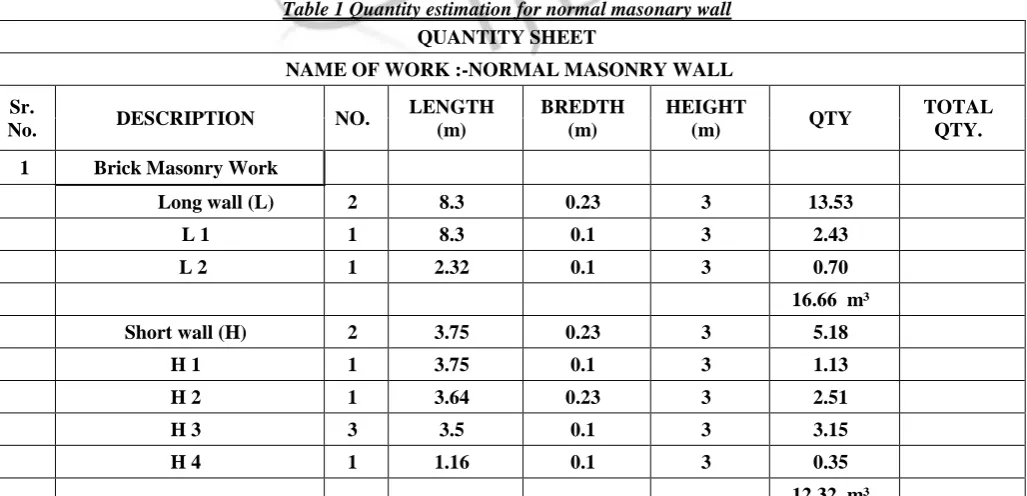
Estimation for normal masonary wall plan is given in table 1. For quantity estimation of selected residential plan long wall – short wall method is used. After obtaining estimation of material quantity rate analysis for particular construction is done. Rate analysis for different work is shown in table 2.
Table 1 Quantity estimation for normal masonary wall
QUANTITY SHEET
NAME OF WORK :-NORMAL MASONRY WALL
Sr.
No. DESCRIPTION NO.
LENGTH (m)
BREDTH (m)
HEIGHT
(m) QTY
TOTAL QTY.
1 Brick Masonry Work
Long wall (L) 2 8.3 0.23 3 13.53
L 1 1 8.3 0.1 3 2.43
L 2 1 2.32 0.1 3 0.70
16.66 m³
Short wall (H) 2 3.75 0.23 3 5.18
H 1 1 3.75 0.1 3 1.13
H 2 1 3.64 0.23 3 2.51
H 3 3 3.5 0.1 3 3.15
H 4 1 1.16 0.1 3 0.35
IJEDR1602050
International Journal of Engineering Development and Research (www.ijedr.org)285
28.98 m³
2 Deduction
Doors
D1 4 1 0.1 2.1 0.84
D2 2 0.75 0.1 2.1 0.32
Opening 2 1.19 0.1 3 0.71
Windows 3 1.5 0.23 1.4 1.45
3.32 m³
3.32 m³
Total Brick Masonry = 28.98 - 3.32 m³
= 25.66 m³
Table 2. Rate analysis for normal brick masonary wall C.M. 1:6
RATE ANALYSIS SHEET
NAME OF WORK :- NORMAL BRICK MASONRY WALL C.M. 1:6
Sr. No. Particulars
Quantity/ Rate
Rs .
Per. Amount
Number
1 Materials
Bricks
( 19 CM X 9 CM X 9 CM ) 12830
Nos. 5 1 64150.00
Cement 35 beg 300 beg 10500.00
Sand 7.26 m³ 800 m³ 5808.00
Sundries 100.00
Material cost Rs. 80558.00
2 Labour
Mistry 0.5 500 day 250.00
Mason 7 800 day 5600.00
Male coolie 7 250 day 1750.00
Female coolie 7 200 day 1400.00
Bhistie 2 250 day 500.00
Sundries 100
Labour cost Rs. 9600
Material + Labour cost Rs. 90158.00
Add 1.5% water charges Rs. 1352.37
Add 10% contractors profit Rs. 9015.80
Rate for 25.66 m³ Rs. 100526
Number of bricks for 25.66 m³ of brick work :-
25.66 / ( 0.20 X 0.10 X0.10 )
IJEDR1602050
International Journal of Engineering Development and Research (www.ijedr.org)286
Mortar required for 25.66 m³ of brick work.
Materials for 1:6 C.M. brick work.
Volume of dry mortar = 25.66X0.33 = 8.46 m³
Cement:- (1/7)X8.46 =(8.46/0.035)=35 bag
Sand:- (6/7)X8.46 = 7.26 m m³
Table 3. Quantity estimation for Painting work
QUANTITY SHEET
NAME OF WORK :-NORMAL MASONRY WALL
Sr. No. DESCRIPTION NO. LENGTH
(m)
BREDTH (m)
HEIGHT
(m) QTY
TOTAL QTY.
Painting work
1 Kitchen 2 3.61 3 21.66
2 3.12 3 18.72
2 Bed Room 2 3.49 3 20.94
2 3.12 3 18.72
3 Living Room 2 3.61 3 21.66
2 4.32 3 28.32
4 Opening 2 2.16 3 12.96
2 2.12 3 12.72
5 Stair 2 3.65 3 21.90
2 1.74 3 10.44
6 Varandah 1 3.5 3 10.50
2 0.84 3 5.04
203.58
m2
Deduction
Doors
D1 4 1 2.1 8.40
D2 2 0.75 2.1 3.15
Opening 2 1.19 3 7.14
Windows 3 1.5 1.4 6.30
24.99
m2
178.59 m2
Total Painting Work is 178.59 m2 1.58
= 1922.4 Sq. ft.
=1922.4 X 17
=32680 Rs.
IJEDR1602050
International Journal of Engineering Development and Research (www.ijedr.org)287
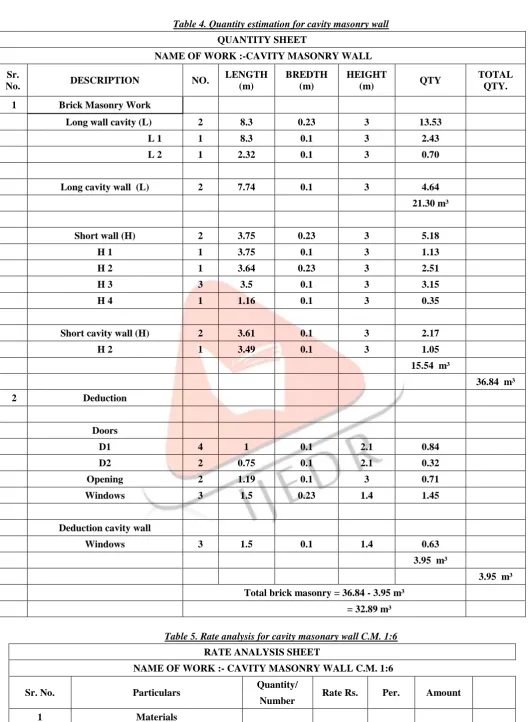
Table 4. Quantity estimation for cavity masonry wall
QUANTITY SHEET
NAME OF WORK :-CAVITY MASONRY WALL
Sr.
No. DESCRIPTION NO.
LENGTH (m)
BREDTH (m)
HEIGHT
(m) QTY
TOTAL QTY.
1 Brick Masonry Work
Long wall cavity (L) 2 8.3 0.23 3 13.53
L 1 1 8.3 0.1 3 2.43
L 2 1 2.32 0.1 3 0.70
Long cavity wall (L) 2 7.74 0.1 3 4.64
21.30 m³
Short wall (H) 2 3.75 0.23 3 5.18
H 1 1 3.75 0.1 3 1.13
H 2 1 3.64 0.23 3 2.51
H 3 3 3.5 0.1 3 3.15
H 4 1 1.16 0.1 3 0.35
Short cavity wall (H) 2 3.61 0.1 3 2.17
H 2 1 3.49 0.1 3 1.05
15.54 m³
36.84 m³
2 Deduction
Doors
D1 4 1 0.1 2.1 0.84
D2 2 0.75 0.1 2.1 0.32
Opening 2 1.19 0.1 3 0.71
Windows 3 1.5 0.23 1.4 1.45
Deduction cavity wall
Windows 3 1.5 0.1 1.4 0.63
3.95 m³
3.95 m³
Total brick masonry = 36.84 - 3.95 m³
= 32.89 m³
Table 5. Rate analysis for cavity masonary wall C.M. 1:6
RATE ANALYSIS SHEET
NAME OF WORK :- CAVITY MASONRY WALL C.M. 1:6
Sr. No. Particulars Quantity/ Rate Rs. Per. Amount
Number
1 Materials
IJEDR1602050
International Journal of Engineering Development and Research (www.ijedr.org)288
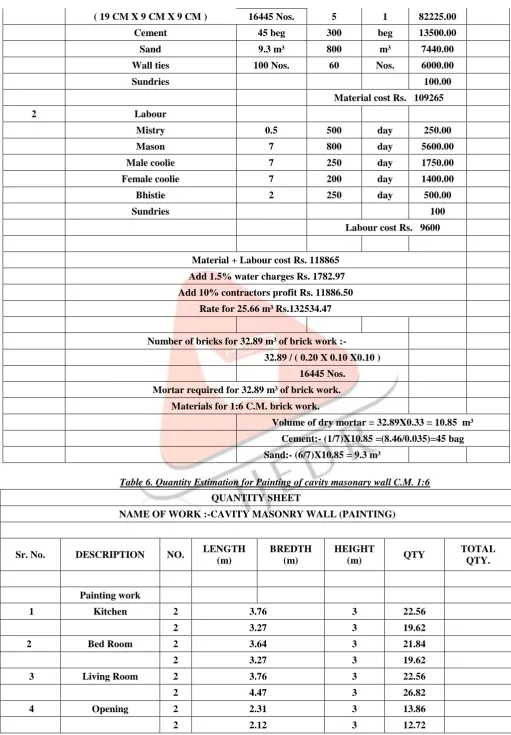
( 19 CM X 9 CM X 9 CM ) 16445 Nos. 5 1 82225.00
Cement 45 beg 300 beg 13500.00
Sand 9.3 m³ 800 m³ 7440.00
Wall ties 100 Nos. 60 Nos. 6000.00
Sundries 100.00
Material cost Rs. 109265
2 Labour
Mistry 0.5 500 day 250.00
Mason 7 800 day 5600.00
Male coolie 7 250 day 1750.00
Female coolie 7 200 day 1400.00
Bhistie 2 250 day 500.00
Sundries 100
Labour cost Rs. 9600
Material + Labour cost Rs. 118865
Add 1.5% water charges Rs. 1782.97
Add 10% contractors profit Rs. 11886.50
Rate for 25.66 m³ Rs.132534.47
Number of bricks for 32.89 m³ of brick work :-
32.89 / ( 0.20 X 0.10 X0.10 )
16445 Nos.
Mortar required for 32.89 m³ of brick work.
Materials for 1:6 C.M. brick work.
Volume of dry mortar = 32.89X0.33 = 10.85 m³
Cement:- (1/7)X10.85 =(8.46/0.035)=45 bag
Sand:- (6/7)X10.85 = 9.3 m³
Table 6. Quantity Estimation for Painting of cavity masonary wall C.M. 1:6
QUANTITY SHEET
NAME OF WORK :-CAVITY MASONRY WALL (PAINTING)
Sr. No. DESCRIPTION NO. LENGTH
(m)
BREDTH (m)
HEIGHT
(m) QTY
TOTAL QTY.
Painting work
1 Kitchen 2 3.76 3 22.56
2 3.27 3 19.62
2 Bed Room 2 3.64 3 21.84
2 3.27 3 19.62
3 Living Room 2 3.76 3 22.56
2 4.47 3 26.82
4 Opening 2 2.31 3 13.86
IJEDR1602050
International Journal of Engineering Development and Research (www.ijedr.org)289
5 Stair 2 3.65 3 21.90
2 1.74 3 10.44
6 Varandah 1 3.65 3 10.95
2 0.84 3 5.04
207.93 m2
Deduction
Doors
D1 4 1 2.1 8.40
D2 2 0.75 2.1 3.15
Opening 2 1.19 3 7.14
Windows 3 1.5 1.4 6.30
24.99 m2
182.94 m2
Total Painting Work is 182.94 m2
= 2001.44 Sq. ft.
= 2001.44 X 17
= 34025 Rs.
Quantity estimation for Plaster of Paris as per painting work for Cavity wall which is 2001.44 Sq. ft. and its cost is 14 Rs. per Sq.ft. = 2001.44 X 14 = 28020 Rs.
Summary of results
Construction cost for Normal masonry and Cavity masonry wall.
Painting cost for 20 years Normal masonry wall and Cavity masonry wall.
Normal masonry wall for painting Cavity masonry wall for painting
Cost is 32680 Cost is 34025
Painting done at every 5 years Painting done at every 10 years 32680*4 = 130720 Rs. 34025*2 = 68050 Rs.
Total Cost of Normal Masonry Total Cost of Cavity Masonry
Wall for Painting (20 years) = 130720 Rs. Wall for Painting (20 years) = 68050 Rs.
POP cost for 20 year normal masonry & cavity masonry wall
Normal masonry wall area Cavity masonry wall area
= 1922.4 sq. ft. = 2001.44 sq. ft.
Per sq. Fit = 14 Rs. Per sq. Fit = 14 Rs.
Cost = 14*1922.4 = 26913 Rs. Cost = 14*2001.44 =28020 Rs. POP done at every 5 years POP done at every 10 years 26913*4 = 107652 Rs. 28020*2 = 56040 Rs.
Total Cost of Normal Masonry Total Cost of Cavity Masonry
Wall for 20 years = 338898 Rs. Wall for 20 years = 259913 Rs. COST DIFFERENCE = 78985 Rs.
Normal masonry wall
Total Qty. = 25.66 m 3
Construction cost = 100526 Rs.
Cavity Masonry wall Total Qty. = 32.89 m3 Construction cost = 126534 Rs.
For 1m 3
3 wall ties require For 32.89m
3
100 wall ties require Cost of 1 wall ties is 60 Rs.
Cost of wall tie = 60*100 = 6000 RS. Total cost = 132534 Rs.
Cost of fiber glass wool per sq. meter = 100 Rs. Cost = 32.89*100 = 3289 Rs.
IJEDR1602050
International Journal of Engineering Development and Research (www.ijedr.org)290
V.CONCLUSIONS
At basic level initial cost of cavity wall higher than normal wall.
But, as per comparisons for long term cavity wall is more economical than normal masonry wall.
It maintains the temperature inside the room and does not allow drastic changes in the room.
In cavity wall there is no need for making conceal wiring.
Water supply can be installed in cavity wall
Cavity masonry wall is more fire resistance than normal masonry wall.
We conclude that in country like India cavity wall is more effective because India being a peninsular it’s more area is connected with ocean so there is a moist climatic conditions prevailing in India.
Cavity wall can be constructed up to three floor height. We can consider as drawback of cavity wall construction.
In this study fiber glass wool is used as insulating material for cavity wall, instead of this one can use other material like glass wool, mineral wool or cavity closer.
VI.REFERENCES
[1] A. Moret Rodrigues, L. Aelenei, (2009), “Thermal performance of a naturally ventilated cavity wall” International journal of energy research.
[2] H. Hens, A. Janssens, W. Depraetere, J. Carmeliet and J. Lecompte (2007), “Brick Cavity Walls: A Performance Analysis Based on Measurements and Simulations” by In Journal of Building Physics 31; 95
[3] S. M. A. Bekkouche, T. Benouaz, M. K. Cherier, M. Hamdani1, M.R. Yaiche, N. Benamrane (2013),“Thermal resistances of air in cavity walls and their effect upon the thermal insulation performance” by, International journal of energy and environment, Volume 4, Issue 3.
[4] Achilles N. Karagiozis and Hartwig M. Kuenzel, (2009) “The Effect of Air Cavity Convection on the Wetting and Drying Behavior of Wood-Frame Walls Using a Multi-Physics Approach” in Journal of ASTM International, Vol. 6, No. 10.
[5] Mr. Abhijeet Kamble, S. Bhosale, M. M. Wagh, (2015),“Experimental Analysis and Performance Evaluation of Cavity Walls with Burnt Brick for Building Envelop” International Research Journal of Engineering and Technology, Volume: 02 Issue: 03 June-2015.
[6] Milica Arsenovic, Zeljko Lalic & Zagorka Radojevic, (2010) “Clay brick walls thermal properties” International Journal of Modern Manufacturing Technologies ISSN 2067–3604, Vol. II, No. 1 / 2010.
[7] Hens, H. and Mohamed, F.A. (1995). “Heat-air-moisture Design of Masonry Cavity Walls: [8] Theoretical and Experimental Results and Practice”, ASHRAE Transactions, 101(1), 607–626.
[9] Hens, H., Roels, S. and Desadeleer, W. (2005). Glued Concrete Block Veneers with Open Head Joints: Rain Leakage and Hygrothermal Performance, Proceedings of the 7th symposium on Building Physics in the Nordic Countries, Reykjavik, p. 670.
[10] Newman, A., Whiteside, D. and Kloss, P. (1982a). Full-scale Water Penetration Tests on Twelve Cavity Fills-Part 1. Nine Retrofit Fills, Building and Environment, 17(3), 175–191.
[11] Newman, A., Whiteside, D. and Kloss, P. (1982b). Full-scale Water Penetration Tests on Twelve Cavity Fills, Three Built-in Fills, Building and Environment, 17(3), 193–207.
[12] TNO (1980). Research on Rain Penetration and Condensation Effects in Cavity Walls, Filled with Polystyrene Foam and Mineral Fibre, Report B80-129, 1980 (in Dutch).
[13] Standaert P., (1985), Thermal Bridges: A Two and Three-dimensional Analysis, Proceedings of the Thermal Performance of the Exterior Envelopes of Buildings III, Florida.
[14] Bouchar, A. (2008). Steady state theoretical model of fired clay hollow bricks for enhanced external wall thermal insulation, Building and Environment, Vol.43, pp.1603–1618.