Directed Evolution of Adeno-associated Virus Targeting Heart and Skeletal muscle
By
Vivian Xu
Principle Investigator: Xiao Xiao
Biology Faculty Advisor: Terry Furey
Senior Honors Thesis
Department of Biology
University of North Carolina at Chapel Hill
April 2015
Approved:
Research Advisor:
Xiao Xiao, Ph.D.
Abstract
The goal of this project is to engineer gene vectors that target a single tissue type,
especially striated muscles. A random library of adeno-associated virus (AAV) was constructed
by shuffling the capsid genes of AAV serotypes 1 to 9, and the resulting chimeric genes were
screened for muscle specificity by direct in vivo panning. Viruses expressed high in muscles
were collected, and the process was repeated to construct chimeric AAV library. To further
improve specificity, in vitro biopanning was done on three types of cultured cells that represent
kidney, liver and muscles. For the desirable features, selection was based on infection rate,
preferably high in muscle but low in liver. Using AAV2 as a standard, three reconstructed AAV
were found to be expressed at higher frequencies in myotubes with comparable or lower
frequencies in hepatocytes. These recombined AAV would be further selected in vivo through
tail vein injection in mice to identify the virus that was the most specific to muscles.
Introduction
Gene therapy has been the frontier of modern medicine to treat a wide range of diseases,
from inherited diseases, like cystic fibrosis and hemophilia, to cancer, tissue regeneration and
many others (Qiao et al. 2012). The vectors for gene delivery can be divided into two groups:
non-viral and viral vectors. Non-viral vectors include liposomes, naked DNA, microbubbles,
nanoparticles and polymers. Some examples of viral vectors are adenoviruses, adeno-associated
virus (AAV), retroviruses and lentiviruses (Luo et al. 2015). The requirements for long-term
gene delivery are the efficient entry into the cells, stable vector genomes, lack of vector toxicity,
requirements, but viral vector AAV has been considered a promising candidate. In fact, 5.3% of
gene-therapy-related clinical trials in the world have utilized AAV vectors mainly for the genetic
diseases gene therapy (Murlidharan et al. 2014).
AAV as A Vector
AAV is non-enveloped, helper-dependent parvovirus that is about 25 nm in diameter. Its
small size helps the virus to navigate through the blood stream and enter cells efficiently. AAV
can transfect both dividing and non-dividing cells, so its range of application is wide (Luo et al.
2015). In comparison to adenovirus or plasmid-based gene delivery AAV has stable DNA
genome, and gene expression is prolonged after a single delivery (Hammoudi et al. 2015). In fact,
the longest transgene expression so far belongs to an AAV-mediated human factor IX gene in
muscles that expressed for 10 years (Luo et al. 2015). Unlike other viral vectors, AAV is not
known to cause any diseases, and it elicits immune response minimally (Zinn and Vandenberghe
2014). For all the above reasons, AAV is an attractive tool for gene delivery. Three scientific
developments have further enabled AAV to transfer genes: the ability to cross-package AAV
vectors, or to produce pseudotyped viruses (Rabinowitz et al. 2002; Gao et al. 2002), the
construction of helper plasmid containing only the essence of adenovirus (Ad) that propagates
AAV (Xiao et al. 1998), the identification of inverted terminal repeat (ITR) as the primary
element required for productive infection and the generation of vectors (Xiao et al. 1997). These
discoveries make it possible to produce recombinant AAV (rAAV) that packages therapeutic
genes with minimal contamination of the wild-type virions (Murlidharan et al. 2014).
Muscular dystrophies are characterized by the progressive degeneration of multiple
muscle groups. Duchnene muscular dystrophy (DMD) is a recessively inherited disease that
happens 1 in 3500 male live births (Odinaka and Nwolisa 2014). It has an early on set, usually
before 3 years of age, and death occurs in the mid to late twenties. DMD is caused by a mutation
in the dystrophin gene on the X chromosome, leading to a lack of functional dystrophin in
muscle fibers. There are no currently available cures, but various therapeutic approaches are
under study. While pharmaceutical therapy uses chemical or biochemical substances to restore
dystrophin or to alleviate the syndromes, gene therapy offers a more permanent solution by
introducing a transgene coding full-length or partial dystrophin complementary DNA in muscles
(Pichavant et al. 2014).
Muscular dystrophy gene therapy requires efficient body-wide muscle gene transfer and
AAV has effective and stable transduction in striated muscles, but one challenge in
AAV-mediated gene delivery is broad tissue tropism (Yang et al. 2011). AAV naturally evolve into
multiple serotypes that target various cell types. For example, AAV4 targets heart and lung, and
AAV 9 targets central nervous system and peripheral tissues. However, transduction of
non-target organs is common in systemic gene transfer. Liver is at particular danger, because large
amount of blood is filtered by the liver every moment, and what is carried in the blood is likely
to stay at this filtering organ. As a result, liver is among the most commonly infected tissue in the
body. This not only reduces the efficiency of transduction to specific cell populations, but
presents potential safety concerns on ectopic gene expression (Luo et al. 2015; Yang et al. 2011).
Since there are no natural serotypes that targets heart and muscles with high specificity, directed
evolution is utilized to synthesize suitable AAV vectors.
Xiao lab has devoted much energy to engineer gene vectors that efficiently target striated
muscles after systemic delivery. Researcher Lin Yang constructed a random chimeric AAV
capsid gene library by DNA shuffling which is a method of random fragmentation followed by
PCR reassembly to introduce or exchange new genetic mutations (Yang et al. 2011).The capsid
genes of AAV serotypes 1 to 9 were amplified and mixed in equal ratio. After the genes were cut
by DNase and purified by agarose gel electrophoresis, the fragments were reassembled by DNA
polymerase. The random capsid genes were incorporated into plasmid backbones containing
AAV2 Rep gene and inverted terminal repeats. An infectious AAV library was finally produced,
using the self-packaging technique developed by Müller et al (2003).
According to Yang L. et al., in vitro panning based on cultured cell lines has been used
before, but gene therapy requires the AAV vectors to confront more complicated physiological
environment in bodies, including serum proteins, endothelial barriers, extracellular matrix barrier
and many others (2011). Thus to better mimic application environment, in vivo bio-panning was
employed to assess the infection rate. The chimeric AAV was injected into adult mice via tail
vein. Limb skeletal muscles and liver were collected three days after injection. Capsid genes
enriched in muscles were received by PCR amplification, and the products were reshuffled and
selected for a second time in vivo. The chimeric AAV library consists of capsid genes retrieved
again from muscles (Yang et al. 2009). Based on the work done by Xiao lab, the goal of this
paper is to select appropriate chimeric capsid genes for muscle gene therapy. Desirable AAV
vectors are expected to deliver genes to cardiac or skeletal muscles efficiently, with low
Materials and Methods
Chimeric Recombinant AAV vectors
Chimeric capsids genes were incorporated into packaging plasmids. The construction of
AAV reporter vector plasmids pAAV-CMV-GFP and pAAV-CMV-LacZ has been described in
Qiao et al (2011). Recombinant AAV vectors were generated by triple-plasmid transfection
technique (Xiao et al. 1998).
Vector Genome Copy Number Determination
Viral DNA was extracted with DNeasy blood and tissue kit (Qiagen, cat. No. 69506).
Vector copy number was determined with a 7300 real-time PCR system (Applied Biosystems).
TaqMan assay for AAV vector was developed as described in Qiao et al. (2012).
Differentiation of C2C12
C2C12 cells were thawed in 37oC water bath, and then cultured in growth media that
contained DMEM, 10% fetal bovine serum and penicillin-streptomycin. When C2C12 cells
reached 50% confluence, media was changed to differentiation media that consisted of DMEM,
2% horse serum and penicillin-streptomycin.
Transduction of 293, Huh7 and C2C12 by AAV vectors
A hundred microliter of shuffled or AAV2 vectors containing either GFP or Lac-Z
reporter genes were inoculated onto 293 (human embryonic kidney) and Huh7 (a liver cancer
cell line). Virus was washed off after twelve hours of infection. C2C12 cells were transduced at
procedure was used as that for 293 and Huh7, but with vectors containing Lac-Z only, because
GFP was found to be an inefficient reporter.
Infection rate analysis
Forty-eight hours after the addition of AAV, cells that were infected with GFP-carrying
vectors were photographed. Cells infected with Lac-Z-carrying vectors were collected and
quantitatively analyzed using Galacto-light Plus (Applied Biosystems).
Results
Figure 1. GFP expression of AAV2 and HH27 in Huh7. Microscopic photographs were taken 48
Reporter gene, GFP, was used in 293 and Huh7 cells. A few shuffled AAV appeared to
infect Huh7 slightly less than AAV2, for example HH27, but the expression of GFP was so low
that it was hard to tell the difference of infection determinately (Figure 1). There was too much
background light and little infected cells, and the results were not very informative. GFP does
not seem to be a suitable reporter gene in this case, so it was not used in the transduction of
C2C12 done after that of 293 and Huh7.
Lac-Z, on the other hand, provides much more information. The protein was collected 48
hours after transduction, and measured quantitatively. The amount of Lac-Z protein was
calibrated to 10^6 copies of virus. Virus genome concentrations of crude lysates were measured
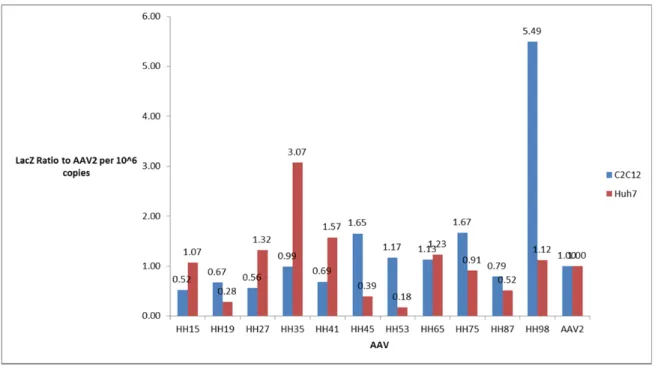
by dot blot. A normalized graph was constructed by dividing the amount of Lac-Z measured in
cells infected with chimeric AAV by that in wtAAV2 (Figure 2).
Figure 2. Lac-Z expression of twelve shuffled AAV in ratio to WT AAV2 in C2C12 and Huh7.
Virus genome concentrations of crude lysates were measured by dot blot. The values were
divided by that of AAV2 to obtain the ratios.
Since only muscle-specific AAV was desired, those vectors that infect C2C12 at a high
rate, but Huh7 at a low rate were selected. Thus HH45, 53 and 98 are of particular interest. In
comparison with AAV2, HH45 infects Huh7 at 39% and HH53 at 18% of the efficiency of
AAV2, while their infections of C2C12 were moderately higher than AAV2, one at 1.65 and the
other at 1.17. On the other hand, HH98 infected C2C12 almost six times better than AAV2 did
(5.49), while kept infection of Huh7 at comparable level with AAV2 (1.12). Thus HH45, 53 and
98 were selected for further investigation.
Discussion
Through panning in cultured cells, three chimeric AAV capsid genes are selected out
from a library of twelve. As the real battle ground and the verdict for AAV as a vector is inside
bodies, in vivo panning will be done to determine transduction efficiency of the three candidates
selected. HH45, 53 and 98 will be tested directly in mice. The capsid genes would again be used
to engineer recombinant AAV that carry Lac-Z reporter genes. CB promoter will be used in the
place of CMV, because the CMV promoter shuts off quickly in liver and therefore is not reliable
to evaluate liver expression. Viruses will be made and injected into mice through tail-vein for a
systemic delivery. Two to three weeks after infection, organs will be collected, sliced and stained
to see the rate of infection of each chimeric AAV capsid genes. If HH45, 53 and 98 are
expressed highly in muscles and weakly in liver, they will be suitable vectors for the treatment of
Besides the HH library constructed by virus retrieval from heart and muscles, Xiao lab
has other capsid libraries with different tissue focus. The same technique can be employed to
develop vectors specific to other targets. By increasing specificity and de-targeting liver, the
technique of directed evolution enables a broader and safer application of AAV for gene therapy.
In addition to vector selection, chimeric AAV capsid genes are also analyzed to trace the
origins of each segment. The composition of capsid genes can be paired with the results from
concentrated panning to discover the specific mutations that lead to the change of transduction in
certain tissues. The combination of the two projects will create a table that matches mutations
with desired tissue tropism, which will enable individual tailoring of AAV for gene therapy.
Acknowledgement
It is with great pleasure for me to express my appreciation to a number of individuals
who have helped me either directly or indirectly in this project as well as the thesis.
I would like to thank all the professors and students I have encountered in the Department
of Biology and Eshelman School of Pharmacy. I thank Prof. Xiao Xiao and Dr. Zhenhua Yuan
who trusted me with this project and advised me in my laboratory work for the past year. I thank
my collegues in Xiao lab, Prof. Juan Li, Prof. Chunping Qiao, Dr. Bin Xiao, Dr. Hui Zheng and
Dr. Tao Bian for the support and guidance.
I also thank Prof. Mohanish Deshmukh, who first brought me into research for his help
with not just biology work but also in life. I sincerely appreciate Dr. Beth Knight, Dr. Vijay
Swahari and Ayumi Nakamura for training me and guiding me in the path of scientific
I would also like to thank my boyfriend Xiyuan Ge for the companionship and
understanding.
Finally, I would like to thank my parents, Yi Gu and Jing Xu, for all the support provided.
Bibliography
Gao G.P. et al. (2002). Novel adeno-associated viruses from rhesus monkeys as vectors for
human gene therapy. Proc. Natl. Acad. Sci. U.S.A. 99 (18): 11854–11859.
Hammoudi N, Ishikawa K, and Hajjar RJ (2015). Adeno-associated virus-mediated gene therapy
in cardiovascular disease. Curr Opin Cardiol 30 (00): 1-7.
Luo J. et al.(2015). Adeno-associated virus-mediated cancer gene therapy: Current status. Cancer
Letters 356: 347-356.
Murlidharan G., Samulski R.J., and Asokan A. (2014). Biology of adeno-associated viral vectors
in the central nervous system. Frontiers in Molecular Neuroscience 7: 1-9.
Müller O.J. et al. (2003). Random peptide libraries displayed on adeno-associated virus to select
for targeted gene therapy vectors. Nat Biotech 21: 1040-1046.
Odinaka K. K. , and Nwolisa E.C. (2014) Challenges in the management of the child with
Duchenne muscular dystrophy in a resource poor setting:a case report. The Pan African Medical
Journal.19:227
Pichavant C. et al. (2011). Current status of pharmaceutical and genetic therapeutic approaches
to treat DMD. Molecular therapy 19 (5): 830-840.
Qiao, C. et al. (2011). Liver-specific microRNA- 122 target sequences incorporated in AAV
vectors efficiently inhibits transgene expression in the liver. Gene Ther. 18: 403– 410.
Qiao C. et al. (2012). Single Tyrosine Mutation in AAV8 and AAV9 Capsids Is Insufficient to
Enhance Gene Delivery to Skeletal Muscle and Heart. Human Gene Therapy Methods: Part B 23:
Rabinowitz, J.E. et al. (2002). Cross-packaging of a single adeno-associated virus (AAV) type 2
vector genome into multiple AAV serotypes enables transduction with broad specificity. J. Virol.
76: 791-801. doi:10.1128/JVI.76.2.791-801.2002
Xiao X., et al. (1997). A novel165-base-pair terminal repeat sequence is the sole cis requirement
for the adeno-associated virus life cycle. J. Virol. 71: 941–948.
Xiao X., Li J., and Samulski R.J.(1998). Production of high-titer recombinant adeno-associated
virus vectors in the absence of helper adenovirus. J. Virol. 72: 2224–2232.
Yang L, Li J, and Xiao X. (2011). Directed Evolution of Adeno-Associated Virus (AAV) as
Vector for Muscle Gene Therapy. In: Duan D.S., editor. Muscle Gene Therapy Methods and
Protocols. New York (NY): Springer: 127-140.
Yang L. et al. (2009). A myocardium tropic adeno-associated virus (AAV) evolved by DNA
shuffling and in vivo selection. Proc. Natl. Acad. Sci. U.S.A 106 (10): 3946-3951. doi:
10.1073/pnas.0813207106
Zinn E, and Vandenberghe L.H. (2014). Adeno-associated virus: fit to serve. Curr Opin Virol 8: