1
Operational Risk of Insecurity using Control Self Risk Assessment
and Linear Programming
Ezekiel Awhigbo Bulus & Monday Osagie
*Adenomon
Department of Statistics, Nasarawa State University, Keffi, Nigeria *Corresponding Author: [email protected] ; +2347036990145
Abstract
This research work focused on the risks we are faced with on our day to day activities, either
directly or indirectly, which can gradually accumulates and results to communal crisis, religious
crisis, socio-economic agitations and tribal crises. Nasarawa Eggon Local Government Area of
Nasarawa State was used as case study and a well structure close–ended questionnaire was used
for data collection as it relates to Controlled Self Risk Assessment (CSRA) and linear
programming technique was used to analyze. The results proved that many of this processes
were neglected in these communities, making them to be prone to incessant communal crisis.
The study recommend that Government should strongly, as a matter of urgency address the
unemployment rate, distribution of political position, schools, primary health care and equip
security personnel with the modern technology facilities, which happen to record the highest risk
level.
Keywords:
Risk, Security, Linear programming, Nasarawa Eggon and CSRA1.0 Introduction
Insecurity has overwhelmed our homes, communities, local Government, states and up to the
national level, through so many means of which some are known to us while some are not, these
insecurities occur sometimes as a result of our carelessness, lack of discipline, refusal to accept
2
and enforce the lay down laws that govern the people and poor knowledge concerning security.
Jennifer et al (2007), describe the causes of insecurity to includes politics and elections, that is,
the shift to democratic governance, the rise of armed groups, oil, ethnicity and religion, and
poverty which are the major issues that represent dividing lines in communities that have led to
heightened tensions between and within groups. But to say that groups or individuals are fighting
over any single issue is too simple-minded. At the heart of many of these conflicts is access to
resources and control over the distribution of benefits. This struggle for resources has led to a
broad sense of opportunism, and the pursuit of self-help strategies across the country. Also
according to Olabanji et al (2004) reveals that, an increase over time, which constitutes serious
threat to lives and properties, hinders business activities and discourages local and foreign
investors, all which stifles and retards Nigerian’s socio-economic development. This rising wave
of insecurity has not abated but has assumed a dangerous position which is threatening the
corporate existence of the country as one geographical entity. In light of the aforementioned
works, we found it necessary as residents of these areas to embark on this study as a prompt
response to security challenges that have befallen our land in recent times. Jacob et al (2012)
referred in fairness, that insecurity is not a problem that is unique to Nigeria but rather it has
geographical spread across the globe. In addition, the United States, United Kingdom and many
countries of the world faced similar challenges of insecurity within their borders on a daily basis.
But the difference between these nations and Nigeria according to Adejumo (2011) is how they
manage and responds to these threats. Unfortunately, the speed with which evil is growing in
Nigeria and the merciless ways that lives of innocent ones are being wasted are worrisome.
People are burdened on a daily basis with psychological and emotional trauma resulting from
3
Previous studies such as Adeleke (2013) viewed insecurity as a hydra headed monster which
security agents in Nigeria appear incapable of handling and said also that the power shift from
the northern hegemony to a minority geo-political zone of South-south is currently on top in the
list of issues that are instigating groups and individuals against the interests of the state. Other
causes of insecurity challenges include intra/inter-party rancor; porous boundaries;
unemployment, jobs racketeering and illiteracy. In view of these situations of insecurity in
Nigeria, this study intended to use a risk management technique and mathematical model
approach to come up with the possible means that can minimize some of these risks.
1.1 Control Self Risk Assessment (CSRA)
This is one of the tools that was develop by Gulf (1987) to evaluate control processes of the
operational of staff, to pick out risk areas in a process, which is mostly used in our financial
industries. CSRA is a process whereby risk inherent business unit’s activities and associated
controls are identified, subject to corrective action plan, appropriately documented and reported.
A comprehensive Control Self Risk Assessment covers controls over the effectives of its process
to ensure compliance with the applicable laws and regulations. It can be apply as tool in homes,
communities, societies, and local government with special interest in Nasarawa Eggon local
government area of Nasarawa State.
2.0 Literature Review
Eme et al (2011) study the Challenges of Insecurity in Nigeria in a thematic exposition, in their
research they examine the concept of insecurity and its various manifestation using vital
examples. It goes further to establish the need to check the rising threats to lives and property
across Nigeria and the poor living conditions of many Nigerians. The work identifies the
4
Nigeria’s democracy is endangered as political intolerance, and economic frustration gather
momentum in the form of assassinations, intimidations, threats and hostage across Nigeria. Jide
et al (2012), examines that the Boko Haram’s campaign targets security formations and churches
in several parts of the North. Also, they have also turned their attacks on institutions like, the
media and universities etc. From being an obscure movement confined to north-eastern Nigeria,
the Boko Haram has emerged as the most palpable threat to the polity’s continued peace and
development. Not only do the persistent attacks of the sect create widespread insecurity and fear,
the prevalent dread of the militant sect has stifled normal processes of trade and investments as
well as the performance of routine security functions. and concludes by positing that for the
terror to be won, the citizenry must see it as their fight and not just as an individual. Christina et
al (2010) Study the overall rise in numbers of security incidents and the shifting of insecurity has
been much discussed in the humanitarian literature. According to them 2006 report Providing
Aid in Insecure Environments concluded that, ‘the level of risk in highly insecure environments
has been effectively transferred from UN agencies and international organizations to
international NGOs, and from international NGOs to their national staff and local partners. Their
report provides additional evidence by looking at patterns of security events from 1996 to 2010
that affected different types of humanitarian workers, categorized by origin, provider
organization, and gender.
3.0 Model formulation
Suppose Nasarawa Eggon Local Government has seen the need to improve the security of lives
and properties, however the number of process that will be used to pick out these risk will be,
Satisfactory (L), Needing improvement and (M), and Unsatisfactory (H). Let Lt1, Lt2, ..., Ltk,
5
Improvement, and Ht1, Ht2, ...,Htk be the number of Unsatisfactory Risk, in each community in
Nasarawa Eggon Local Government. Suppose that (I) is the number of Inherent (I) Risk in the
process tool and (R) is the number of Residual (R) Risks in the process tool in the community.
Let d1, d2,... ,dk, be the number of community whom will benefit from the Control Self Risk
-Assessment (CRSA) tool testing in the Local Government. The objective is to know the present
value of Risk in each community in line with Korve et al. (1996).
Let X1, X2, ..., Xk the number of communities to be examined in the Nasarawa Eggon Local
Government respectively, suppose that the government policy decision is specific to the
minimum Risk they are to manage or bear, then the objective will check then the minimum value
in each community and then compare it with the government minimum value. The linear
programming problem is formulated in line with as
Minimize
Process CRSA Number Risk Rate of Risk
Satisfactory Risk Lt1, Lt2,...,Ltk L
Needing Improvement Mt1, Mt2,..., Mtk M
Unsatisfactory Risk Ht1, Ht2, ...,Htk H
Inherent Risk It1, It2, …..., Itk I
Residual Risk Rt1, Rt2, ..., Rtk R
6
Subject to:
For j = 1, 2, 3 ………..k
0 ≤ Xi ≤ 1 for all h, m, l, I, r ≥ 0
Where Htj, Mtj, Ltj, Itj, Rtj, are the number of satisfactory process, needing improvement
process, Inherent Risk, Residual Risk, and h, m, l, I, r is the number of Satisfactory process,
Needing Improvement process, Inherent Risk, Residual Risk in the communities.
3.1 Linear programming
According to Business Dictionary, Linear programming is a mathematical techniques used in
computer modeling to find the best possible solution in allocating limited resources (energy,
machines, materials, money, personnel, space, time, etc) to achieve maximum profit or minimum
cost. However, it is applicable where only all relationships are linear and can accommodate only
a limited class of cost functions. For problem involving more complex functions, another
7
Leonid Kantorovich (1912-1986) and the U.S Economist C. Koopmans (1910-1986), on the
basis of the work of the Russian Mathematician Andrew Nikolaevich Kolmogorov (1903-1987).
According to the Wolframmathworld, Linear programming, is also knows as linear optimization,
is the problem of maximizing or minimizing a linear function over a convex polyhedron
specified by linear and non-negativity constraints. Simplistically, linear programming is an
optimization of an outcome based on some set of constraints using a linear mathematical model.
Linear programming is introduce in mathematics as linear programming, which find a vector x
which minimizes a quantity cx subject to the constraints mx > b and xi ≥ 0 for
X = (x1, …, xn).
Linear programming falls within convex optimization theory and is also consider to be an
important of operational research. Linear programming is extensively used in business and
economics, but may also be used to address some certain engineering problems.
Linear programming can be solved using the simplex method (wood and Dantzig 1949,) which
runs along polytope ridges of the visualization solid to find the best answer, Khachian (1979)
found a polynomial time algorithm. A much more polynomial time algorithm was found by
Karmarkar (1984). This method goes through the middle of the solid (making it a so called
interior point method), and then transfer warps. Arguably interior points method was knowing as
early as (1960) in the form of the barrier functions methods, but the media hype accompanying
Karmarkars announcement led to this method receiving a great deal of attention.
The origin of minimization problem is stated formally in a result of the von Neumann Duality
principles, after the American mathematician John von Neumann (1903 - 1957).
W = c1x1 + c2x2………. + cnxn Subject to
8 .
. .
am1x1 + am2x2 + ………... + amnxn ≥ bm
Where xi ≥ 0 and bi ≥ 0 to solve this problem we solve the following steps:
1. Form the augment matrix for the given system of the inequalities and add a bottom row
consisting of the coefficients of the objective functions
a11 a12 ……….. a1n : b1 a21 a22 ……….. a2n : b2 .
.
am1 am2 ……….. amn : bm
………..
c1 c2 ……… cn : 0
2. Form the transpose of the matrix.
a11 a12 ……….. a1n : c1
a21 a22 ……….. a2n : c2
. . .
am1 am2 ……….. amn : mm
………..
b1 b2 ……… bn : 0
3. Form the Dual maximization problem corresponding to the transposed matrix.
That is, find the maximum of the objective function given by
z = b1y1 + b2y2 + ………. + bmym
Subject to the constraints
9 .
. .
a1ny1 + a2ny2 +……….. + amnym ≥ cn
where y1 ≥ 0, y2 ≥ 0, ………….., and ym ≥ 0.
4
Apply the simplex method to the maximization problem. The maximum value of z will be the minimum value of w. Moreover, the values of x1, x2, ..., xn and will occur in the bottom row ofthe final
simplex tableau, in the columns corresponding to the slack variables.
4.0 Material and Method
In this aspect of the study, the procedures for building the Control Self Risk Assessment model
was discussed. An operational Risk model of insecurity in Nasarawa Eggon Local Government
Using Control Self Risk Assessment (CSRA) and simplex method for minimization technique of
linear programming case was developed as an extension of Korve et al (1996). The processes
indices considered to be asses in the research work are Employment, Education, Laws, Police
Station, Schools, Social amenity and infrastructure, Laws reform agencies, Primary health care
clinic and Dialogue. A comprehensive Control Self Risk Assessment Process tool was
formulated and was used to assess some few communities in the Nasarawa Eggon Local
Government, and pick out those possible Risk areas that have trigger out the recent crisis in the
local government and some part of the state.
The data was collected as follow: For the inherent Risk, that is, before accessing a particular
index, from the outlook, structural appearance or hearing, one can record it to be either
satisfactory, needing improvement or unsatisfactory, depending on how you see the appearance,
10
facility, equipment and interviewing the personnel working there to see whether the risk is also
satisfactory, needing improvement or unsatisfactory. Thereafter you sum up the number of
satisfactory, needing improvement and unsatisfactory risk before which is known as Inherent risk
and also sum up the satisfactory, needing improvement and unsatisfactory risk after which is also
known as Residual risks to form the matrices (details are presented in the appendix).
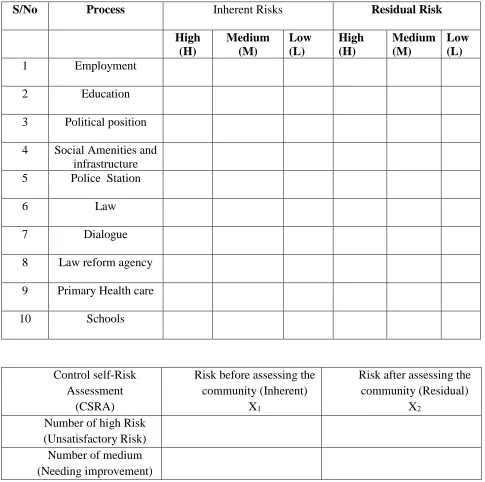
Table 1: Risk Assessment Form
S/No Process Inherent Risks Residual Risk
High (H)
Medium (M)
Low (L)
High (H)
Medium (M)
Low (L)
1 Employment
2 Education
3 Political position
4 Social Amenities and infrastructure 5 Police Station
6 Law
7 Dialogue
8 Law reform agency
9 Primary Health care
10 Schools
Control self-Risk Assessment
(CSRA)
Risk before assessing the community (Inherent)
X1
Risk after assessing the community (Residual)
X2 Number of high Risk
(Unsatisfactory Risk)
Number of medium
11
Number of low Risk
(which is satisfactory)
An operational Risk model of insecurity in Nasarawa Eggon Local Government Using Control
Self Risk Assessment (CSRA) and simplex method for minimization technique of linear
programming case was developed as an extension of Korve et al (1996).
5.0 Discussion of Results
In the Operational Risk Model, the Control Self Risk Assessment (CSRA) pick out those
possible risk areas and formed a parameter in a form of a matrix, then the simplex method of
linear programming technique was used to get the present minimum risk values in each
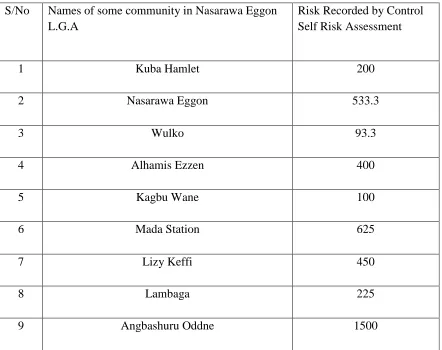
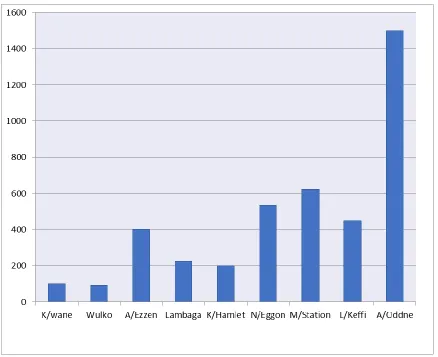
community as recorded in the table 2 below and figure 1 below. in the case of Angbashuru Odne
which recorded the highest risk value from the analysis correlate with the information recorded
during accessing the community, the community was known to experienced consists violence
and attack for quite a long period of time till the time of this research work alongside Mada
station and others community with high level of tension that violence can escalate at any time.
As earlier stated that this work became a necessity to check the risk level in this community
through the indices mentioned above which actually shown that so many of these indices which
is meant to keep and sustain rules and regulation among the people, were seriously neglected as
they gradually wear out. This research work agreed with Jennifer et al (2007) whose stated in
their work the major causes of insecurity that led to high tensioned in communities today are the
rise of armed groups, ethnicity, religion, and poverty which can be liken to say, that the indices
that should prevent this from existing or happening in our communities today were over looked
12
boldly say that those rules and regulation they are merely songs in our mouth today but they are
no longer in practice in our communities.
Table 2: The result value analysis of risk recorded during the research is as follow.
S/No Names of some community in Nasarawa Eggon L.G.A
Risk Recorded by Control Self Risk Assessment
1 Kuba Hamlet 200
2 Nasarawa Eggon 533.3
3 Wulko 93.3
4 Alhamis Ezzen 400
5 Kagbu Wane 100
6 Mada Station 625
7 Lizy Keffi 450
8 Lambaga 225
9 Angbashuru Oddne 1500
13
Fig 1:
The Graphical Representation of the Risk value6.0 Conclusion and Recommendations
This model was able to pick out those possible risk areas that causes the inter-tribal crisis,
ethno-religious crisis, socio-economic agitations, ethnic militias, boundary disputes, cultism and
criminality also as a result hindering economic activities, tourism, and good democratic political
system in some communities in the local government ranging from unemployment, Poor
Educational system, Social amenity and Infrastructure, Lack of Police Station and scarcity of
security personnel, Lack and Poor Primary Health Care Clinic, etc. The Model should be used as
14
each community to know the insecurity level, so that the policies maker, such as Government,
Non-Governmental Organization etc should give attention to those communities that have more
of security challenges in time of distribution of resources and allocation of budgetary.
In line with the results, The government should strongly address the unemployment, distribution
of Political position, schools and primary health care issues which was noticed during the
research work to have the highest risk record that contribute to insecurity in most of the
communities. The Government, Non-Governmental organization (NGO) and other Civil Society
Groups should consider using this models which is easier and less cause for the Operation. Also
Government should focus, trace the possible risk areas and resources should be directed to places
with high risk of insecurity.
REFERENCES
Adeleke A.(2013): Insecurity: A Threat to Human Existence and Economic Development in Nigeria. Public Policy and Administration Research, 3(6):1-6.
Adejumo, A.A. (2011). The problems and challenges of insecurity in Nigeria. Retrieved 22.07.2014 from
http://newsdiaryonline.com/tok_security.htm
Agena, A. (2004): White Paper– intelligent solutions for quantifying Operational Risk Agena Ltd.
Andrew N. K. (1986): Probability theory. www.britannica.com
Bssel Committee on Banking Supervision (2003): The New Bassel Accord. BIS Bassel Switzerland.
Christina, W. & Larissa, N. (2013): Operating in Insecurity Shifting patterns of violence against humanitarian aid providers and their staff (1996-2010). Insecurity Insight Report 13-19s
Eme, O. I & Anthony, O. (2011): the challenges of insecurity in Nigeria, Interdisciplinary journal of contemporary research in business 3(8).
Eme, O. I. & Jide, I (2012): The Cost of Boko Haram Activities in Nigeria. Arabian Journal of Business and Management Review 2(2)
15
Gulf C. (1987): https:/en.m.wikipedia.org/wiki/control_self-assessment.
Gyongyyer D. (2012): Socio-Economic Uncertainty and violent conflicts MICROCON John Von Neumann. (1950), Duality Theorem, University of Berlin.
Jacob, O. & Andrew, A. O. (2015): Terrorism and Insecurity in Nigeria: Moral, Values and Religious Education as Panaceas. Journal of Education and Practice, 6(11): 1-8
Jennifer, M. H & Jonas, H. (2007): Small Arms, Armed Violence and Insecurity in Nigeria: The Niger Delta in Perspective. Graduate Institute of International Studies, Geneva.
Khachaian G. (180): Linear Algorithms. Journalof Algorithms, 1(1): 1 -13
Leonid V. K. (1960): Mathematical Method of Organizing and Planning Production. Management Science 6(4): 366 – 422.
Narendra K. (1984): A New Polynomial Time Algorithms for Linear Programming. Combinatorica, 4(4): 375 - 395
Olabanji, O.E & Ese, U. (2014): Insecurity and Socio-Economic Development in Nigeria. Journal of Sustainable Development Studies. Journal of Sustainable Development Studies, 6(1): 40-63
Okoli, A. & Atelhe, G. A. (2014): A Political Ecology of Herder/Farmer Conflicts in Nasarawa State, Nigeria. American International Journal of Contemporary Research 4(2).
Onifade, C. Imhonopi, D. & Urim U M. (2013): Addressing the Insecurity Challenge in Nigeria and the Imperative of Moral Values and Virtue Ethics, Global Journals Inc (USA) paper 67.
Robert, B. (2007): National summit on Americas Silent Epidemics. Washington, DC.
Salau, E. S. & Attah, A. J. (2012): A Socio-Economic Analysis of Urban Agriculture, American International Journal of Contemporary Research 1(1): 17-29
Tjalling K. (1986): Linear Regression Analysis of Economist Time Series. Wikipidia.
Umar, M. (2012): Lecture Note on Operational Research, Department of Mathematical sciences, Nasarawa State University Keffi, Nigeria.
16
APPENDIX
NASARAWA EGGON LOCAL GOVERNMENT AREA PROCESS FOR CONTROL SELF RISK
ASSESSMENT (CRSA)
PROCESS SUB PROCESS RISK DISCRIPTION INHERENT RISK H/M/L
CONTROL DISCRIPTION
TEST STEPS RESIDUA RISK H/M/L
Employment Seventy five (75%) percent’s of people living here have to
be employed
Unemployment usually result to some form of crime rate and violent agitator, it’s breed discount against the state and any incident may trigger violent
demonstration and social unrest which may result in loss of life and property also as a result of unemployment social security is jeopardize. It also instigate electoral violence and become automatic threat to social, economic and political security.
Proper supervision and adequate resources should be invented to support employment base across the Area, and there should be increase allocation of national budget for employment promotion activities.
Government should increase effort to facilitate greater access of operators in the formal sector to the means of production through land and improve management technology.
Verity that out of hundred percent (100%) of people in each community how many are workers.
Education There should be primary and secondary schools in every
community in the Area. We should have literate people
If people are not educated it will serve as a barrier to social development work with individual and groups in the community. It will cause inability and incapacity of individual
Adequate and conscious effort should be made to ensure improvement in the education and training provided to young people with a greater focus on vocational skills and
17
in each community. and group of all ages due to their exposure. Their action will not improve their quality of life; central to this is their inability to participate in democratic process.
training. People should be trained to acquire
transferrable high skills highly meeting the current economic trend.
Primary Health care clinic
Each community should be provided with a well equip clinic
The absent of health care or inadequate facility of health in a community will give access to different kind of disease like the polio, disability, Hepatitis B.A and C, meningococcal disease, invasive
pneumococcal infection, which may lead to death and also challenges in time of birth delivery that also result to loss of life and will make people not to have interest to any democratic process due to negligence of the
authority.
A well equip structure should be put in place. Professional and expert should be employ to manage it, also
immunization should be introduce against feature disability
Verify, if the
communities have a well primary health care clinic
political position
Each community have to be consider in time of political sharing
Unequal or inappropriate distribution of political position may instigate dispute, grudge in the heart of individual which can also result to
community crisis
Proper distribution of political position should be done with a highly consideration of the majority, minority, tribally and religiously.
18 Social amenity
and
infrastructure
There should be infrastructure to communities
Absent of infrastructure deny community of public benefit, private sector from inventing, as a result of poor road network, rather they are expose to disease such as cholera, typhoid, riches, stomach pains as a result of dirty water.
There should be road, water supply and
electricity to allow stable economic activities
It should be verify whether the communities have access to road, pipe water, and electricity
Dialogue A justified dialogue on issue that seem to be complicat-ed
This involve disrespect and an attitude not ready to listen to one talk, also not ready to address diversity and division among tribes and religious
There should be dialogue among the community on dispute issues through their chief head
It should be verify that did they enter dialogue in times of dispute.
Law There should be law guiding communit-ies.
Ineffectiveness of law give rise to sexual abuse, drug abuse especially
marijuana, stealing, killing, fighting and so many form of criminal act that result in insecurity of life and properties
There should be law that conveys social changes and shapes various form of life style.
19 Law reform
agencies
Communities should regulate law guiding them
Failure in reforming the law will result to
inadequate application of the existent law in time run as changes will be taking place in the communities as a result it may fail in imposing a appropriate punishment to some offences which can cause conflict among the individual, groups, tribes, and religious.
Communities should have their law reform agencies with the responsibility of monitoring the operation of the law and proposing and reforming of the law as changes occurs in the communities.
The communities should be verify to know if they have law reform
agencies.
Police station There should be a police station in each community
The absent of police station will result to break down of rules, less
privilege will be deny their right, and dehumanize people.
Police station should be site in each community to avert the breakdown of rules and regulation, to protect and defend the less privilege there right.
It should be verified that each community have a police station
Schools Each community should have Nursery, Primary and Secondary schools
Lack of schools in a community or society will give ways for illiteracy, restricting people from social life and adopting the primitive and cultural way norms that hinders
civilization as a result will under develop the
community, society and environment and at times may result to violence due to miss understanding that can easily occur in there mist
Each community should be provided with nursery, primary and secondary schools to eliminate illiteracy from the communities
It should be verify that each community have nursery, primary, secondary schools and a well equip, quality and quite a number of staff.
20
S/No Process Inherent Risk Residual Risk
High (H) Medium (M) Low (L) High (H) Medium (M) Low (L)
1 Employment
2 Education
3 Political position 4 Social Amenities and infrastructure 5 Police Station
6 Law
7 Dialogue
8 Law reform
agency
9 Primary Health
care
21
This is the analysis of one the community
The test for KUBA HAMLET community
Control self Risk Assessment
(CSRA)
Risk before assessing the community (Inherent) X1
Risk after assessing the community (Residual) X2
Number of high Risk (Unsatisfactory Risk)
5
4 Number of medium
(Needing improvement) 2
4 Control self Risk Assessment
(CSRA)
Risk before assessing the community (Inherent) X1
Risk after assessing the community (Residual) X2
Number of high Risk (Unsatisfactory Risk)
Number of medium (Needing improvement)
Number of low Risk
22 Number of low Risk
(which is satisfactory) 3 2
Number of satisfactory Risk after assessing is 2
Number of needing improvement Risk after assessing is 4
Number of unsatisfactory Risk after assessing is 4
Hence to calculate the value of risk present in this community I use the simplex method of Linear Programming.
Let x1 and x2 represent the number of inherent risk and residual risk given by;
Min: 4X1 + 4X2 ...Objective function
Subject to the constraints
To get the solution variables, we take the percentage value of each process.
5/4 x 100 = 125
2/4 x 100 = 50
3/2 x 100 = 150
To proceed, let x1 and x2 represent the number of inherent risk and residual risk given by;
Min : 4x1 + 4x2 ……… Objective
5x1 + 4x2 ≥ 125
2x1 + 4x2 ≥ 50
23 Where x1 ≥0 and x2 ≥ 0
Solution
We augment the matrix corresponding to the minimization problem above
5 4 : 125 2 4 : 50 3 2 : 150 ……… 4 4 : 0
Next, we form the transpose of this matrix by interchanging its rows and columns.
5 2 3 : 4
4 4 2 : 4
………..
125 50 150 : 0
thus our dual maximization problem will be
Max : 125x1 + 50x2 + 150x3 Dual objective function
5x1 + 2x2 + 3x3 ≤ 4
4x1 + 2x2 + 2x3 ≤ 4
24 Solution
Multiply the dual objective function by -1
Max : - 125x1 - 50x2 - 150x3
5x1 + 2x2 + 3x3 ≤ 4
4x1 + 2x2 + 2x3 ≤ 4
Bas. variable x1 x2 x3 s1 s2 b
Departing S3 - 125 -50 -150 0 0 0 ↑
New Row 1
OR1/3 = 5/3 2/3 3/3 1/3 0/3 4/3
NR1 = 5/3 2/3 1 1/3 0 4/3
NR2 = OR2 – 2NR1
4 4 2 0 1 4 -
s1
s2
5 2 3 1 0 4
25
10/3 4/3 2 2/3 0 8/3
NR2 = 2/3 8/3 0 -2/3 1 4/3
NR3 = OR3 – (-150)NR1
- 125 -50 -150 0 0 0
-
- 250 -100 -150 -75 0 -200
125 50 0 75 0 200
Basic variable x1 x2 x3 s1 s2 b
S3 125 50 0 50 0 200
x1 x2
Interpretation
From this final tableau, we see the present value of Risk in this community from Row s3 to be 200.
To verify our minimization objective function of Inherent and Residual Risk
Min : 4x1 + 4x2
X3
s2
5/3 2/3 1/3 1/3 0 4/3
26 Substitute the value of s1 and s1 from the final tableau
Min : 4x1 + 4x2
4(50) + 4(0)
200 + 0