Acknowledgements: The authors sincerely thank the Regional University Forum for Capacity Building in Agriculture (RUFORUM) for funding the project. Our appreciation also goes to the participating farmers for their welcoming nature and genuine responses. We are also grateful to our field supervisors and enumerators during data collection process.
Climate
Change
and
Variability:
Farmers’
Perception, Experience and Adaptation Strategies in
Makueni County, Kenya
Kirina T. Kitinya (Department of Land Resource Management and Agricultural Technology, University of Nairobi, P.O. Box 29053 – 00625 Nairobi)
Richard N. Onwonga (Department of Land Resource Management and Agricultural Technology, University of Nairobi, P.O. Box 29053 – 00625 Nairobi)
Cecilia Onyango (Department of Plant Science and Crop protection, University of Nairobi, P.O. Box 29053 – 00625 Nairobi)
Joseph P. Mbuvi (Department of Land Resource Management and Agricultural Technology, University of Nairobi, P.O. Box 29053 – 00625 Nairobi)
Geoffrey Kironchi (Department of Land Resource Management and Agricultural Technology, University of Nairobi, P.O. Box 29053 – 00625 Nairobi)
411
Author(s)
Kirina T. Kitinya
Department of Land Resource Management and Agricultural Technology, University of Nairobi, P.O. Box 29053 – 00625 Nairobi
Richard N. Onwonga
Department of Land Resource Management and Agricultural Technology, University of Nairobi, P.O. Box 29053 – 00625 Nairobi
Email:
Cecilia Onyango
Department of Plant Science and Crop protection, University of Nairobi, P.O. Box 29053 – 00625 Nairobi
Joseph P. Mbuvi
Department of Land Resource Management and Agricultural Technology, University of Nairobi, P.O. Box 29053 – 00625 Nairobi
Geoffrey Kironchi
Department of Land Resource Management and Agricultural Technology, University of Nairobi, P.O. Box 29053 – 00625 Nairobi
Climate
Change
and
Variability:
Farmers’
Perception, Experience and Adaptation Strategies in
Makueni County, Kenya
Abstract
A better understanding of climate change and variability (CCV) from the farmer’s perspective is a key to prioritizing measures to address and prepare for its consequences. A survey involving 150 farmers was thus conducted in Makueni County, Kenya to document farmers’; perception, experience and adaptation strategies to CCV. About 86% of farmers perceived CCV as a major challenge with 53% indicating that significant changes in climate would manifest in 10-20 years. Significant changes in rainfall amounts and distribution had occurred over the years and were rated by 60% of farmers as the frequently experienced aspect of CCV. About 33% of farmers had heard of but not used decision support tools (DST) to inform their agricultural activities. Workshops and seminars were reported by 67% of farmers as principal sources of information on CCV. Additionally, 50% of farmers relied on traditional knowledge for weather prediction. Only 20% of farmers had alternative strategies; agroforestry and growing drought tolerant crops particularly sorghum and cowpea, to minimize effects of CCV. Another 67% of farmers prioritized; terracing, ridging and water harvesting as adaptation strategies to minimize negative effects of CCV. The farmers were thus aware of CCV and through experience, backed with traditional technical knowledge, had gained prerequisite skills for addressing its negative effects. Nevertheless farmers’ agricultural practices could be improved by use of forecasted weather data and application of DST. Consequently enhancing farmers’ preparedness to tackle challenges posed by CCV.
Keywords: Arid and semiarid lands; climate change and variability; decision support tools, Traditional Technical knowledge
Introduction
Climate change and variability and its impacts have been reported in various research studies carried out across the world (IPCC 2001, Hulme et al., 2002, Titus et al., 2009). The anticipated impacts of climate change will manifest in the form of; floods, storms, prolonged droughts and increased atmospheric temperature (IPCC 2007). The consequences
will have far reaching adverse impacts on human health, food security, economic activities, physical infrastructure, natural resources, and the environment (UNDP 2007).
412 projected that under a range of climatic scenarios, there will be an increase of 5-8 percent of arid and semiarid land (IPCC 2007). These scenarios coupled with the relatively warmer climate (UNESCO 2007, Galvin et al., 2001), low per capita incomes, inadequate preparedness by most African governments and poor current information and slow technology change (Mendelsohn 2000), widespread poverty, recurrent droughts, inequitable land distribution and over dependence on rain-fed agriculture (IPCC, 1998; Hulme 1996) makes Africa the most vulnerable in terms of mitigation and adaptation to climate change.
Forecasts suggest that, by the end of the 21st century, climate change will have had substantial impact on agricultural production (Slater et al, 2007) with pronounced consequences in the dryland regions of Africa, typically dependant on rain-fed Agriculture and its human population far poorer than those in higher rainfall areas (World Bank, 2000; Galvin et al. 2001; Mahindra et al., 2008). Studies in most of the semi-arid economies show that agriculture’s GDP and farmers’ incomes closely mirror rainfall variation (World Bank, 2008; GoK 2005) and that yields from rain fed agriculture is estimated to reduce by 50% by the year 2020 (IPCC, 2007).
The advancement of research on climate change and variability (CCV) and its impacts on agriculture particularly in dry land areas has played a key role in development of both tactical and strategic means to buffering the impacts associated CCV. However less emphasis has been laid on farmer’s perception, experience and adaptation strategies as a basis for informing development of sustainable approaches to minimize the risks imposed by climate change and variability (Suri 2009). This study thus tended to assess farmers’ perceptions, experiences, and adaptation strategies with a view of enhancing and prioritizing the farmers’ preparedness to minimize the effects of climate change and variability.
Materials and Methods
Site description
The survey was carried out in five administrative locations of Makueni County, Eastern Kenya. Makueni County (1o 50’S, 37o40’E, Elevation 1,155 m above sea level) is located about 200km South of Nairobi and lies within agro ecological zone 5 (AEZ 5) in the semi-arid region of eastern Kenya (Jaetzold and Schmidt, 1983). The main soils are highly weathered (Ferralsols), light textured, permeable and relatively less erodible (ICRA, 1996; Jaetzold and Schmidt 1983). The average rainfall ranges (bimodal in distribution) between 800-1200 mm per year for upper zones and 200-900 mm per year for the lower zones. The area receives mean annual rainfall of 231 mm and 361 mm during long and short rain seasons, respectively. The short rains are evenly distributed, reliable and thus more effective than the long rains. Average annual temperature is 22.5oC and the ratio of precipitation to potential evapotranspiration is 35%. Most of the farmers are small-holder practicing both livestock and crop (maize, beans, pigeon pea and cowpea) production with the latter mainly rainfed.
Farmer selection and Questionnaire administration
413
Data analysis
The data collected was analyzed using the Statistical Package for the Social Sciences (SPSS Version 16). Appropriate statistical procedures for description of frequencies, percent and means were used.
Results and Discussion
Challenges faced by farmers in crop production
The challenges faced by the farmers with respect to crop production were low soil fertility, low quality seeds and seedlings, labour scarcity and lack of or inadequate inputs (Figure 1). CCV in the form of erratic and inadequate rains constituted 58% of the challenges the farmers encountered (Figure 1) making it the most important
Figure 1: Challenges encountered by farmers in crop production
According to Kibet (2011), Kenya’s agriculture is mainly rain-fed and is entirely dependent on the bimodal rainfall in most parts of the country. A large proportion (80%) of the country is semi-arid and arid with frequent droughts and crops failures in one out of every three seasons. He further cited; Climate change, Extension services, Use of outdated technology, pest and diseases, use of inputs, soil nutrient deterioration and poor infrastructure as the challenges facing the Kenya Agricultural sector. Challenges that, generally mirrors those cited by the farmers in the study area (Figure 1).
Perception and experience on climate change and variability
Perceptions on climate change and variability: The perception of farmers on CCV was found to be influenced by their social economic status as depicted from their source of income (Figure 1). The effects of climate change on agricultural production were rated high (15%) to very high (78%) by the farmers (Figure 2) and are reflective of the sources of income. The farmers who rated climate change and variability effects as very high were those whose main source of income was farming, whereas those with alternative income sources were not much concerned with CCV.
Lack of inputs Crop pests & diseases
Low soil fertility Lack of rains
Unpredictable/inadequate rainfall
What challenges do you/have you experienced in crop production?
40.0%
30.0%
20.0%
10.0%
0.0%
414
Figure 2: Source of income and rating of climate change
These observations imply that the more dependent a person is on agriculture as a source of income the greater the sensitivity to climate related changes. This observation is also in agreement with Grothmann and Patt (2005) who noted that the more one is likely to be affected by a given factor, the higher the attention given to it. The high rating of climate change by farmers who depended on farming solely as their source of income is therefore attributable to the fact that any factor, in this case climate change, that lowered crop
production posed a threat to their livelihood and hence considered a serious risk.
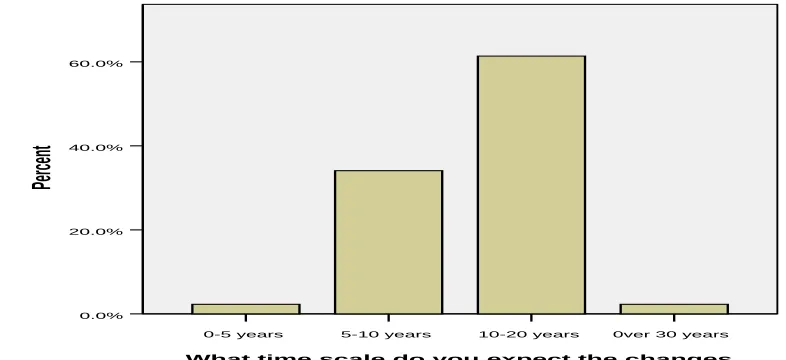
About 60% of farmers predicted that pronounced changes in CCV would be felt in 10-20 years’ time (Figure 3). The prediction was based on the current weather unpredictability that in the recent years had shown a significant incremental cumulative effect. These estimates were mostly based on the rainfall amounts and distribution, also considered the major impediment to agricultural production.
Figure 3: Timeframe for the anticipated changes
No Yes
Is farming your main source of income?
80.0%
60.0%
40.0%
20.0%
0.0%
Percent
80.0%
60.0%
40.0%
20.0%
0.0%
Rated
hi
gh
rat
ed very h
igh
How
do
you
rat
e clim
ate ch
ange as an
issue?
0ver 30 years 10-20 years
5-10 years 0-5 years
What time scale do you expect the changes 60.0%
40.0%
20.0%
0.0%
415 When asked further on the causes of CCV, about 95% of the farmers attributed the same to deforestation which nonetheless they partly contributed to. Inconceivably though, the key responsibilities of curtailing this practice was largely seen as a government duty by the same farmers. This fact is also reinforced by Gardner and Stern (1996) assertion that people’s perceptions of environmental risks suggest that people perceive little personal control over global and regional environmental problems.
Farmers’ experience and sources of information on CCV: Nearly all the farmers had experienced CCV in one form or the other. Majority of the farmers (75%) though were experiencing declining crops yields and were congruent on the fact that CCV, especially onset and offset of rain seasonally or annually contributed greatly to their decline. Close to 95% of the farmers experienced CCV majorly
in terms of prolonged droughts and infrequent rainfall, other aspect like change in wind direction or rising temperatures were less mentioned.
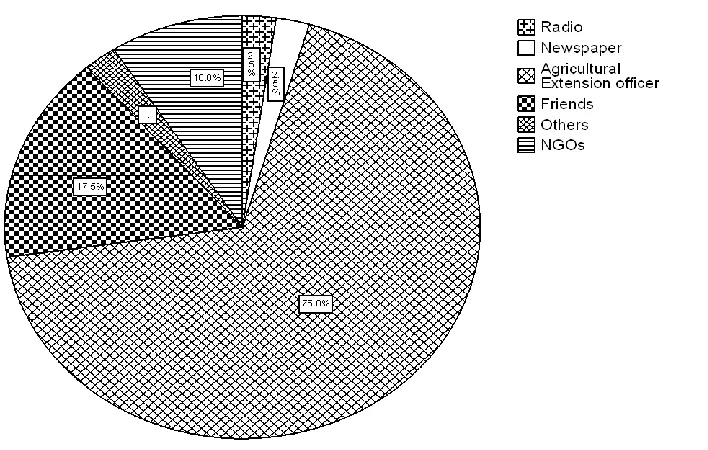
It was evident that personal experience and information from different sources was critical and informed decision making in farmers’ agricultural activities. Agricultural extension workers (75%) and friends/neighbours (17%) were the main sources of information (Figure 4) cited by the farmers. The high rating of the agricultural extension workers as their main source of information is partly due close and regular interaction, a position also supported by other workers (Luseno 2003; Goddard et al., 2010). Print and digital broadcasting medium were less used by farmers due to claims of accessibility, cost with some requiring sources of power to run.
Figure 4: Sources of information for farm decision making
The other sources of information on CCV were Radios and Non Governmental organizations (NGOs). These findings are in agreement with those of Recha et al. (2008) whose study
416
Traditional weather forecasting vs. CCV: The respondents had an elaborate means of weather forecasting. About 35% of the farmers preferred using frogs as a means of predicting weather. The migration of croaking frogs into dry fields was an indication that rain was nearby. Other prominent techniques involved observation of the sky for either clouds or stars with 20% preferring this method. An anchor ring surrounding a certain cluster of stars in galaxy was a pre indication of good rains.
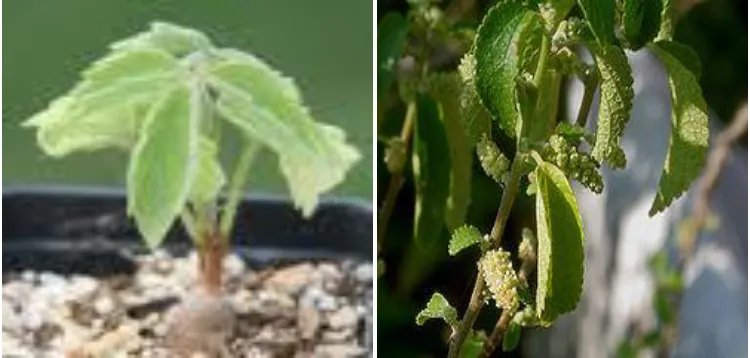
Farmers would start conserving livestock feed when the stars were dull as that was a sign of poor rains. A swarm of bees towards the northern direction was also synonymous with onset of rains. Use of plants was the most favoured method as reported by 50% of the farmers. Tuber plants were commonly used for example shooting of Ngalatumia (Cyphostemma orondo - Photo 1) and Malamwaka, (Acalypha fruticosa - Photo 2) plants meant rains were just about.
Photo 1: Ngalatumia (Cyphostemma orondo) Photo 2: Malamwaka (Acalypha fruticosa)
The survey findings shows that about 50% percent of the farmers favoured predictions made through monitoring of these tuber plant’s phenology followed by observation of frog’s behavior (Figure 5). It is worth noting that these
techniques are unique to this particular region and sometimes they could be used either singly or in combination with other techniques qualitative in nature (Rengalakshmi, 2005).
Figure 5: Indigenous techniques used in predicting weather
23.68%
50.0%
15.79% 10.53%
417 Luseno et al (2003) reported that, though Traditional Technical Knowledge (TTK) are common for most communities in East Africa, the type employed by a particular group depends on the objective and locality for example pastoralist in Northern Kenya, an area also classified as arid and semiarid lands prefer predictions based on sky observation as reported by 30% of the respondents. The use of plants was not favoured in Northern Kenya and was reported by just 11% converse to the findings of the current study where about 50% of the farmers preferred plant based predictions. These techniques though simple required a lot of skills for accurate predictions. Their application was however reported to be on the decline particularly in the study region.
The decline in use of TTK may be attributed to the fact that it has become increasingly difficult for the local experts to anticipate weather patterns, a situation some linked to CCV. The same trend was reported by Luseno et al. (2003)
who studied various TTK used by pastoralists in Northern Kenya. The current CCV has in a way interfered with the patterns of behavior/ phenology among predictors/indicators used particularly in plants and animals.
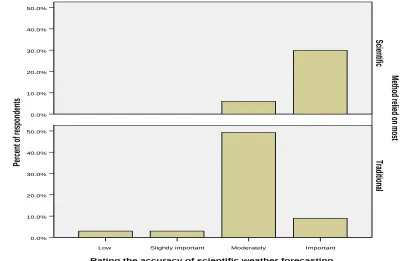
Frequency of use and Reliability of traditional weather forecasting methods: To figure out the reliability and use of traditional techniques of weather forecasting, the farmers were required to indicate whether they had heard of and/or relied on the traditional weather forecasting techniques. Close to 98% of the respondents had heard of and/or used traditional weather forecasting technique. About 60% of the farmers reported that they accurately predicted weather patterns through these indigenous techniques. However, on reliability, half of the respondents exhibited considerable confidence in traditional methods and relied on them in making decisions regarding their agricultural activities, the remaining half opted for modern methods (Figure 6).
Figure 6: Reliability and accuracy of Traditional vs. Modern weather forecasting
The reasons for more and more reliance on modern weather forecasting techniques were variously reported. About 30% of the farmers reported that, environmental degradation
induced by the current CCV has made unroutine and complexed, the specific behavior aspects of the frogs and bees that were relied upon for weather forecasting. Consequently
Important Moderately
Slightly important Low
Rating the accuracy of scientific weather forecasting 50.0%
40.0%
30.0%
20.0%
10.0%
0.0%
Percent
of re
spondents
50.0%
40.0%
30.0%
20.0%
10.0%
0.0%
Traditiona
l
Scient
ific
Method reli
418 credibility of these methods was suspect as they are subject to seasonal and/or yearly variation.
Notwithstanding, the 50% of respondents who would rather continue relying on indigenous techniques mentioned dissemination and communication of weather forecast products as the key barrier, quite often the scientific forecast are presented by Meteorologist in a language not easily understood by most of the farmers. Knowledge on important aspect of weather especially onset of rains was said (by 95% of the farmers) to be critical to inform decision making in carrying out their agricultural activities particularly sowing (Wafula 1995).
Decision support tools (DSTs): In contrast to other aspects of CCV that farmers were required to provide, information on DSTs was not easily provided but nonetheless helped raise the curiosity of their application. About 40% of the farmers showed some zeal and willingness to utilize them if more information and demonstrations on their working were conducted. Notwithstanding most farmers were however skeptical about the application of DST as a source of information for informed decision making regarding their agricultural activities. A parity 8% of the farmers felt the best way to boost adoption of DST was through participatory research which would offer active learning experience on their working. This is an area that needs further exploring given the inadequacy of agronomic experiments to provide the much needed solutions to boosting agricultural productivity in the midst of CCV (K.P.C. Rao, personal communication)
Adaptation strategies to Climate change and variability
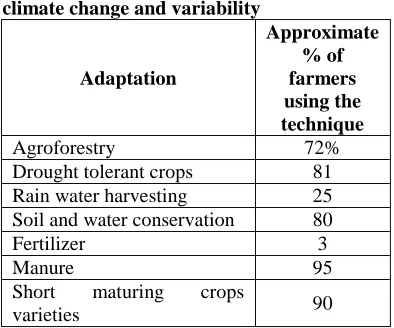
Most of the farmers interviewed had a lot of experience in farming, over 70% claimed to have practiced farming for more than 20 years. Close to 90% of the farmers had experienced declining yields attributed to either erratic or rain failure. To counter the observed and anticipated effects of CCV, the farmers were found to be using various strategies (Table 1).
Table 1: Current adaptation strategies to climate change and variability
Adaptation
Approximate % of farmers using the technique
Agroforestry 72%
Drought tolerant crops 81 Rain water harvesting 25 Soil and water conservation 80
Fertilizer 3
Manure 95
Short maturing crops
varieties 90
419
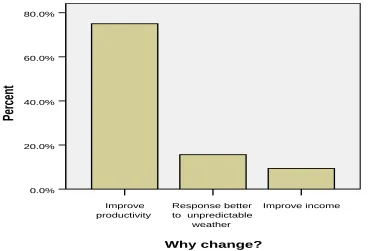
Figure 7: Reasons for changing farming systems
Income was placed third as the reason behind wanting to shift farming practices, as it was only a priority to just 10% of the farmers. Majority of the farmers were small scale farmers most of whom were food insecure. It thus looks normal for farmers to seek for technologies to improve their productivity ensuring food security before thinking of commercial aspects of farming (Suri 2009). The aftermath of this process is that with time it is expected that even those who employed strategies that are aimed at boosting incomes may not be favoured by the changing climatic conditions. The situation may lead to a sustained condition of poverty and thus an increasing farmers’ vulnerability.
Conclusion
The farmers were aware and conscious of CCV and viewed it as a real risk to their livelihood more so to those who depend solely on farming. Further changes in CCV were predicted in the short and long term. Farmers employed various traditional techniques to predict weather patterns although on the decline due to changes in phenology of common predictor elements. The need for modern weather forecasting
techniques aided by DSTs will thus provide a better alternative. Training of farmers on important aspect of weather especially onset of rains is critical to inform decision making in their agricultural production. Introduction of DST to farmers through participatory research would also offer active learning experience on their working.
Agro-forestry, drought tolerant and short maturing crop varieties were the commonly preferred adaptation strategies to CCV. These strategies are central in developing tactical and strategic measures to cushion farmers against the potential impact of climate change and variability.
References
Galvin, K. A., Boone, R. B., Smith, N. M., & Lynn, S. J. (2001) ―Impacts of climate variability on East African pastoralists: linking social science and remote sensing‖, Climate Research, Vol. 19(1), pp. 161–172.
Gardner, G. T., Stern, P. C. (1996) ―Environmental problems and human behaviour‖, Allyn and Bacon (Second edition, Boston: Pearson Custom Publishing, 2002).
Improve income Response better
to unpredictable weather Improve
productivity
Why change?
80.0%
60.0%
40.0%
20.0%
0.0%
420
GoK (Government of Kenya) (2005) Arid Lands Resource Management Project II Strategic Plan (2005–2009). ALRMP (Arid Lands Resource Management Project), Office of the President, Nairobi, Kenya.
Grothmann, T., Patt A. (2005) Adaptive capacity and human cognition: The process of individual adaptation to climate change and Global Environmental Change 15, 199–213. Hulme, M. (1996) ―Climate change and Southern Africa: an exploration of some potential impacts and implications in the SADC region‖, Climatic Research. Unit and WWF Int. p.104
Hulme, M., Jenkins, G. J., Lu, X., Turnpenny, J. R., Mitchell, T. D., Jones, R. G., Lowe, J., Murphy, J. M., Hassell, D., Boorman, P., McDonald, R. and Hill, S. (2002) ―Climate Change Scenarios for the United Kingdom: The UKCIP02 Scientific Report, Tyndall Centre for Climate Change Research‖, School of Envirnmental Sciences, University of East Anglia, Norwich, UK, ICRA (1996) ―A participatory study of farmers constraints, opportunities and research needs in the hilly masses of Eastern Kenya‖, International Centre for development oriented Research in Agriculture, Wegeningen, The Netherlands.
IPCC (1998) ―The Regional Impacts of Climate Change: An Assessment of Vulnerability‖, Special Report of IPCC Working Group II [Watson, R.T., M.C. Zinyowera, and R.H. Moss (eds)]. Intergovernmental Panel on Climate Change, Cambridge Univer. Press, Cambridge, United Kingdom and New York, NY, USA p. 517 IPCC (2001) Climate Change 2001: Mitigation - Contribution of Working Group III to the Third Assessment Report of the Intergovernmental Panel on Climate Change (IPCC) [Metz, B., O. Davidson, R. Swart, and J. Pan (Eds.)]. Cambridge University Press, Cambridge, 700 pp.
IPCC (2007) Climate change: Impacts, adaptiona dn vulnerability. Summary for policy makers. IPCC 4th assessment report, International Panel on Climate Change, Cambridge University Press, Cambridge UK. Jaetzold R. and Schmidt, H. (1983) ―Farm management‖, handbook of Kenya, Vol. IIC Eastern Province. Natural conditions and farm
management information. Ministry of Agriculture, Nairobi, Kenya.
Kibet C. (2011) ―Major Challenges facing Kenyan Agricultural sector‖, Innovations in Extension and advisory services. International Conference, Nairobi Kenya 15-18th November 2011. http://extensionconference2011.cta.int Luseno, W. K. (2003) ―Assessing the Value of Climate Forecast Information for Pastoralists: Evidence from Southern Ethiopia and Northern Kenya‖, World Development, Vol. 31(9), pp. 1477–1494
Mahendra M. Shah, Günther Fischer and Harrij van Velthuizen (2008) ―Food Security and Sustainable Agriculture The Challenges of Climate Change in Sub-Saharan Africa‖, International Institute for Applied Systems Analysis A-2361 Laxenburg, Austria.
Mendelsohn, R. (2000) ―Efficient Adaptation to Climate Change‖, Climatic Change, Vol. 45, 583-600.
Mendelsohn, R. (2009) ―The Impact of Climate Change on Agriculture in Developing Countries‖, Journal of Natural Resources Policy Research, Vol. 1, pp. 5-19.
Onyango, M., Ouma, Gilbert., Ogallo Laban. (2010) ―Science of the elders: famous for their rainmaking skills, Kenya's Nganyi are working with scientists to forecast the weather‖, Publication: Alternatives Journal.
Recha, C. W., Shisanya, C. A., Makokha, G. L., Ngugi, R. K. (2008) ―Perception and use of climate forecast information amongst smallholder farmers in semi-arid Kenya‖, Asian Journal of Applied Sciences, Vol. 1(2), pp. 123-135.
Rengalakshmi, R. (2005) ―Folk Biological Classification of Minor millet Species in Kolli Hills, India‖, J. Ethnobiol. Vol. 25(1), pp. 59-70.
Slater, R., Peskett, L., Ludi, E. and Brown, D. (2007) ―Climate change, agricultural policy and poverty reduction-how much do we know‖, Natural Resource Perspectives No. 109. Overseas Development Institute, pp: 1-6. http://www.fanrpan.org/ documents/d00417/. Suri, T. (2009) ―Understanding Farm-Level Technology Adoption: Lessons Learned From Cimmyt'S Micro Surveys In Eastern Africa‖, CIMMYT Economics Working Paper 03-07. http://purl.umn.edu/46552.
421
Thieler, and S. J. Williams (2009) ―Coastal Sensitivity to Sea-Level Rise: A Focus on the Mid-Atlantic Region‖, Final Report—Synthesis and Assessment Product 4.1. A report by the U.S. Climate Change Science Program and the Subcommittee on Global Change Research. Washington, DC: U.S. Environmental
Protection Agency, 320 pp.
http://www.climatescience.gov/Library/sap/sap 4-1/final-report/
UNDP (2007) Human Development Report 2007/2008: Fighting climate change; Human Solidarity in a Divided World. Accessible at http://hdr.undp.org/en/reports/ global/hrdr 2007-2008.
UNESCO (2007) Review report on drought and desertification, Fifth Meeting of the African Committee on Sustainable Development. Wafula, B. M. (1995) ―Applications of Crop Simulation in Agricultural Extension and Research in Kenya‖, .J. Agricultural systems
Vol. 49, pp. 399-412.
World Bank (2000) Entering the 21st Century: World Development Report 1999/2000. Oxford University Press: New York.