Feature Selection for Finding a Stable
Set of Features in High-dimensional
Data
Sadegh Salesi Mousaabadi
A thesis submitted in partial fulfillment of the requirements for the degree of Doctor of Philosophy in Computer Science
School of Science and Technology Nottingham Trent University
Evolutionary Computation (EC) algorithms have proved to work well for fea-ture selection because they are powerful search techniques and can produce multiple good solutions. However, they suffer from some limitations for real-world applications. Firstly, ECs require high computation time as they eval-uate many solutions at each iteration. Secondly, a classifier is usually used as their fitness function which causes the selected subset to perform well only on the utilised classifier (e.g. classifier-bias). Lastly, ECs, as stochastic search methods, return a different final subset in different runs which poses a problem for finding a stable set of features (e.g. stability issue). To address computa-tion time and classifier-bias limitacomputa-tions, this thesis proposes a new two-stage selection approach called filter/filter in which two filter feature selection algo-rithms are combined. In the first stage, a ranking algorithm forms a reduced dataset by selecting the most informative features from the original dataset. In the second stage, the reduced dataset is fed to a novel EC algorithm to select final feature subset. This new EC algorithm is a Tabu search hybridised with an Asexual Genetic Algorithm called TAGA. TAGA benefits from new search components and solution representation which can effectively reduce computation time. To select a classifier-unbiased final subset, a statistical cri-terion is used as the fitness function which evaluates the subset independent of any classifier. Experiments show that the proposed filter/filter requires an acceptable computation time and selects more classifier-unbiased features compared to the state-of-the-arts. To find a stable set of features, a novel Generalisation Power Index (GPI) is proposed to analyse the generalisation power of final subsets of an EC in several runs. Generalisation power refers to performance capability of a subset over wide range of classifiers.
achieves near optimal accuracy when used to train various classifiers. To ex-amine the suitability of the proposed methods for real-world applications, the filter/filter approach and GPI are integrated to select a stable set of features for METABRIC breast cancer subtype classification problem. Experimental results show that this integration not only can address the limitations of ECs for a real-world biomedical feature selection problem but it performs better than alternatives methods.
The completion of PhD studies is a special milestone achievement in one’s aca-demic life of higher education. This is now the time to express my thanks and
appreciations toward the people who greatly influenced my research journey. Primary thanks go to my director of studies Dr. Georgina Cosma because of her dedication in guiding and supporting me throughout the course of research.
Dr Cosma has always allowed me a complete freedom to define and explore my own directions in research. I am so grateful and proud to be guided under her supervision as I have learnt a lot from her, not only research and academic
skills but also teamwork and managing skills which will be beneficial to both my academic career and personal life.
I would like to thank Nottingham Trent University for awarding me a Vice
Chancellor’s scholarship to pursue my studies and for financially supporting me to attend conferences and summer schools to develop my academic knowledge. I also would like to thank my supervisory team Prof. David Brown, Prof. Graham Pockley and Prof. Graham Ball for all their support and advice.
Special thanks must go to my parents for all their unconditional support and encouragement in my whole life. I also wish to thank my brother Mohammad, my sister Elahe, and my best friend Li Jia for supporting me during my PhD
studies.
The contents of this thesis are a result of my own work, and it contains nothing that is based on collaborative research. No part of the work contained in
this thesis has been submitted for any degree or qualification at any other university. Parts of chapters 4 and 5 have been submitted to journals and they are currently under review. Parts of chapter 5 have been published in a
conference proceeding [105].
Abstract i Acknowledgements iii Declaration iv List of Abbreviations i 1 Introduction 1 1.1 Overview . . . 1 1.2 Problem definition . . . 3
1.3 Aims of the research . . . 6
1.4 Objectives of the research . . . 7
1.5 Description of the work/contributions . . . 8
1.6 Thesis outline . . . 11
2 Literature Review 14 2.1 Introduction to feature selection . . . 14
2.2 Feature selection methods . . . 15
2.3 Evolutionary computation algorithms for feature selection . . . 18
2.3.1 Overview . . . 18
2.3.2 Genetic algorithms . . . 19
2.3.3 Tabu search . . . 27
2.4 Hybrid feature selection methods . . . 30
2.5 Methods for combining subsets of features . . . 32
2.5.1 Aggregation methods for combining subsets of features . 32 2.5.2 Frequency-based methods for combining subset of features 33 2.6 Generalisation power analysis for feature selection . . . 35
2.7 Mutual information for evaluating feature relevancy . . . 35
2.7.1 Mutual information estimation . . . 36
2.7.2 Minimum-Redundancy Maximum-Relevance (mRMR) . . 38
2.7.3 mRMR for feature selection . . . 39
2.8 Conclusion . . . 40
3 Problem Demonstration of Evolutionary Computation-based Algorithms for Feature Selection 42 3.1 Introduction . . . 42
3.2 Methodology . . . 43
3.2.1 GA as a test case EC algorithm . . . 43
3.2.2 Classifiers and validation approaches . . . 44
3.2.3 The sample dataset . . . 44
3.2.4 Experimental setup . . . 44
3.2.5 Stability measure . . . 45
3.2.6 Classifier-bias analysis approach . . . 46
3.3 Computation results and discussion . . . 46
3.3.1 Stability analysis . . . 46
3.3.2 Computation time analysis . . . 47
3.3.3 Classifier-bias analysis . . . 48
4 TAGA: Tabu Asexual Genetic Algorithm Embedded in a Fil-ter/Filter Feature Selection Approach for High-dimensional
Data 52
4.1 Introduction . . . 52
4.2 TAGA components . . . 54
4.2.1 Solution representation . . . 54
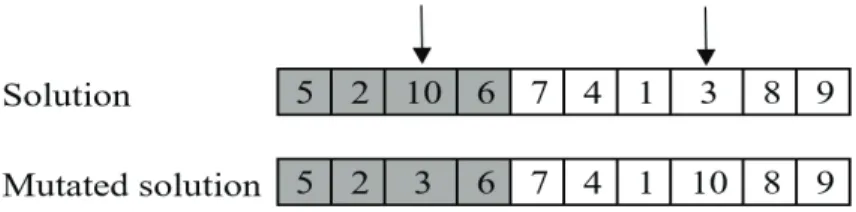
4.2.2 Proposed heuristic mutation operator . . . 54
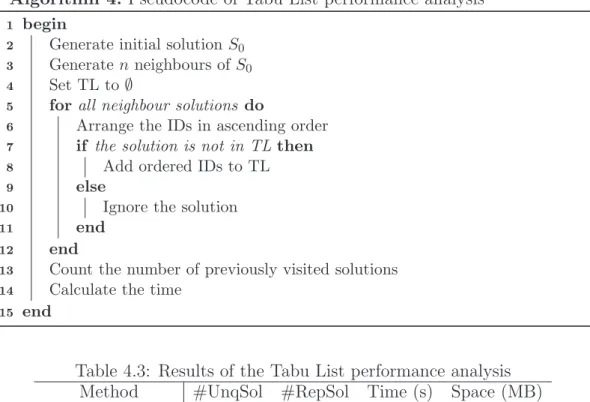
4.2.3 Tabu list design . . . 56
4.2.4 Framework of TAGA for feature selection . . . 58
4.3 Experimental design . . . 62
4.3.1 Benchmark methods . . . 62
4.3.2 Datasets and parameter settings . . . 65
4.4 Results and discussion . . . 67
4.4.1 Results of TAGA components . . . 67
4.4.2 Comparison of TAGA with greedy search algorithms . . 73
4.4.3 Comparison of TAGA with other feature selection algo-rithms . . . 76
4.4.4 Classifier-bias analysis . . . 83
4.4.5 Running time analysis . . . 84
4.5 Conclusion . . . 85
5 A Generalisation Power Approach for Evolutionary Computation-based Feature Selection 87 5.1 Introduction . . . 87
5.2 Proposed generalisation power analysis approach . . . 88
5.3.2 Datasets and classifiers . . . 92
5.3.3 Benchmark methods for combining subsets of features . . 92
5.4 Results and discussion . . . 94
5.4.1 Comparing the performance of GPI with benchmark al-gorithms . . . 94
5.4.2 Running time analysis . . . 100
5.5 Conclusion . . . 101
6 Application of methods to Breast Cancer type classification 104 6.1 Introduction . . . 104
6.2 Experimental design . . . 107
6.2.1 Experiment methodology . . . 107
6.2.2 Data preparation . . . 108
6.2.3 Benchmark methods . . . 110
6.2.4 Learning algorithms and evaluation metric . . . 112
6.3 Results and discussion . . . 113
6.4 Conclusion . . . 115
7 Conclusions, Discussion and Future Work 117 7.1 Conclusions and discussion . . . 117
7.2 Future work . . . 121
Bibliography 123
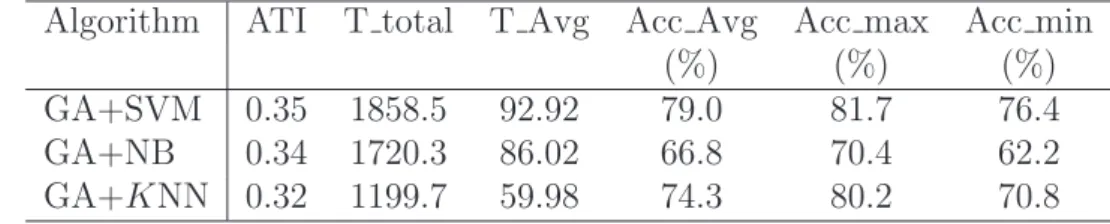
3.1 EC-based algorithms stability and high computation time
prob-lem demonstration results . . . 47
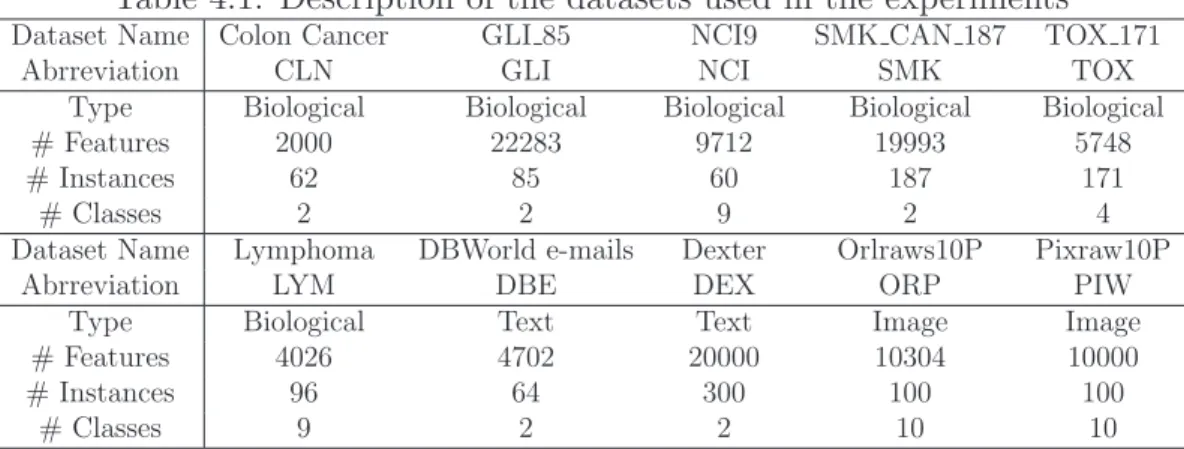
3.2 Results for demonstrating EC-based algorithm Classifier-bias issue 49 4.1 Description of the datasets used in the experiments . . . 64
4.2 Parameters settings of the EC algorithms . . . 64
4.3 Results of the Tabu List performance analysis . . . 69
4.4 Performance comparison of various versions of TAGA over re-duced datasets . . . 71
4.5 Mutation operators performance analysis adjusted ρ-value for Wilcoxon post-hoc pairwise comparison. . . 73
4.6 Comparison of TAGA with greedy search algorithms over re-duced datasets . . . 74
4.7 Comparison of TAGA with other feature selection algorithms over reduced datasets . . . 79
4.8 TAGA classifier-bias analysis (%) . . . 84
4.9 TAGA running time analysis in seconds . . . 85
5.1 Description of datasets used in experiments . . . 92 5.2 Comparison of GPI with other algorithms over four classifiers . 97 100
6.1 The number of samples corresponding to each subtype . . . 108 6.2 Comparison of TAGA-GPI with other methods over METABRIC
dataset. For each classifier and selection method, the values in parentheses is the number of selected features by each algorithm and the cell values are the classification accuracy. The last col-umn reports the average of the classification accuracies for each algorithm. . . 115
1.1 Thesis structure . . . 13
2.1 Three types of feature selection. (a) Filter (b) Wrapper (c) Embedded (adopted from [123]) . . . 15
2.2 Flowchart of EC algorithms (adopted from [63]) . . . 18
2.3 Flowchart of a typical GA. (adopted from [87]) . . . 20
2.4 Two Genetic operators (a) Crossover operator, (b) Mutation operator (adopted from [4]). . . 20
2.5 Flowchart of the Tabu Search procedure (adopted from [3]) . . . 28
4.1 Diagram of TAGA embedded into filter/filter framework . . . 53
4.2 Solution representation used in TAGA. . . 54
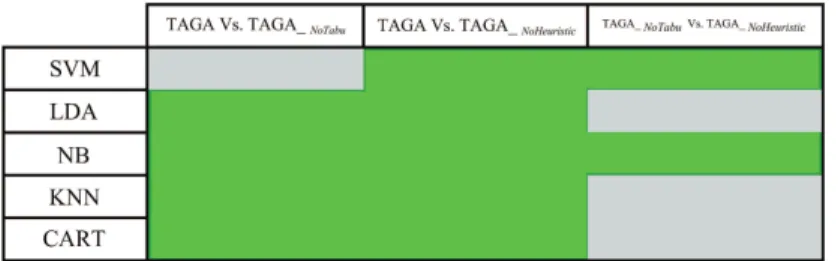
4.3 Representation of the proposed heuristic mutation operator used in TAGA 55 4.4 Analysing the effectiveness of the proposed components. Re-sults of the Wilcoxon tests for each classifier. The green boxes indicate a significant difference. . . 72
4.5 Comparing TAGA with Greedy search algorithms using the Friedman test and the Wilcoxon post-hoc analysis applied on the average of the accura-cies. The y-axis is the classification accuracy difference and x-axis indicates the names of the compared algorithms. . . 77
4.7 Comparing TAGA with other feature selection algorithms using the Fried-man test and the Wilcoxon post-hoc analysis applied on the average of the accuracies. The y-axis is the classification accuracy difference and x-axis
indicates the names of the compared algorithms. . . 80
4.8 Comparing TAGA with other feature selection algorithms. Results of the
post-hoc tests for each classifier. . . 81
5.1 Comparing GPI with other algorithms using the Friedman test and the Wilcoxon post-hoc analysis for each classifier. The y-axis is the classification accuracy difference and the x-y-axis indi-cates the names of the compared algorithms. . . 98 5.2 Comparing GPI with other algorithms using the Friedman test
and the Wilcoxon post-hoc analysis applied on the average of the accuracies. The y-axis is the classification accuracy difference and the x-axis indicates the names of the compared algorithms. 99 5.3 Comparing GPI with OTHER algorithms using the Friedman
test and the Wilcoxon post-hoc analysis for CART classifier. The y-axis is the classification accuracy difference and the x-axis indicates the names of the compared algorithms. . . 99
6.1 Experimental methodology flowchart . . . 107
6.2 Percentage plot of subtypes in METABRIC dataset . . . 109
ACC Accuracy
AGA Asexual Genetic Algorithm AI Artificial Intelligence
ASU Arizona State University ATI Average Tanimoto Index BE Backward Elimination
CART Classification And Regression Trees
CGA a Customised Genetic Algorithm for feature selection CPU Central Processing Unit
CSCoefficient Compactness-Separation Coefficient EC Evolutionary Computation
GA Genetic Algorithm
GPI Generalisation Power Index
KNN K Nearest Neighbour
LDA Linear Discriminant Analysis LOOCV Leave-One-Out Cross-Validation
LS Local Search
MI Mutual Information
ML Machine Learning MLP Multi-Layer Perceptron
mRMR Minimum Redundancy-Maximum Relevance
NB Na¨ıve Bayes
NP-hard Non-deterministic Polynomial-time hardness PCA Principal Component Analysis
PGA Parallel Genetic Algorithm
QPFS Quadratic Programming-based Feature Selection RVM Relevance Vector Machine
SFS Sequential Forward Selection
SPECMI Spectral relaxation Conditional Mutual Information SVM Support Vector Machine
TAGA Tabu Asexual Genetic Algorithm TGA Tabu Genetic Algorithm
TL Tabu List
TS Tabu Search
UCI University California Irvine
Introduction
1.1
Overview
In machine learning and data mining, a dataset is usually described by a group of features and samples. Due to availability of sophisticated data collection tools, there are usually a large number of features to be taken into considera-tion when building a machine learning model, including many irrelevant and redundant features. Irrelevant and redundant features negatively influence the performance of machine learning models in terms of training time, which is mainly caused by the curse of dimensionality [47]. Therefore, to build up a reliable machine learning model which is able to process the data in an accept-able computation time, to improve learning accuracy, and to facilitate a better understanding of the learning model, a feature selection process is needed. Feature selection mainly focuses on selecting a subset of features which can efficiently describe the input data, whilst reducing the effects of redundant and irrelevant features and the impact these have when building machine learning models – hence using a subset of features but still provide good prediction results [51].
Feature selection is a non-deterministic polynomial-time hardness (NP-hard) problem with a large complex solution space [6]. Because, firstly, since the number of features in the optimal feature subset is not known in advance, the dimension of the search space cannot be reduced to feature subset with certain number of features. Secondly, since the features may have complementary or contradictory interactions with each other, the decision space is non-separable [50].
A variety of search techniques have been applied to feature selection includ-ing exhaustive search, greedy search, heuristic search, and random search [31, 77, 75]. However, due to the global search potential and heuristic guide-lines, Evolutionary Computation (EC) techniques have recently received much attention from the feature selection community [128]. Many of EC methods select a small number of important features, produce higher accuracy, and generate small models that are efficient on unseen data. Consequently, EC techniques have now become important methods for handling high dimensional feature selection [132].
The paradigm of EC algorithms consist of stochastic search algorithms inspired by the process of Darwinian theory of natural selection [85, 32, 39]. The EC algorithms often start with a population of solutions. When applying EC for feature selection, each individual of the population represents a subset of features which is a potential solution to feature selection problem. The quality of the subsets are evaluated using the fitness criterion and then an iterative process is used to improve the solutions.
The motivation for applying ECs to the feature selection problems is that, unlike conventional feature selection methods that perform a local, greedy search in the space of candidate solutions and produce local optimal solutions, ECs are robust, adaptive search techniques, they can perform a global search
in the solution space, and they tend to better deal with attribute interactions than greedy methods [44, 33, 95, 43]. However, applying EC methods on high-dimensional data feature selection problems is still a challenge in the field of feature selection which is the primary motivation for this research project.
1.2
Problem definition
Feature selection approaches utilise a search technique to find the best feature subsets that optimise an evaluation criterion. Search techniques for feature selection can be separated in three categories [128]: exhaustive, heuristic, and EC methods. Exhaustive algorithms thoroughly search the entire subset space and hence, they become costly in terms of computation time for datasets which comprise a large number of features. Heuristic algorithms make locally opti-mal choices with the aim of finding a global optimum amongst local optima. However, heuristic methods lack of a global search strategy and consequently, they are usually trapped into local optima [119, 26]. Therefore, EC techniques are able to better solve feature selection problems because they benefit from a global search strategy and heuristic guidelines.
EC algorithms are powerful search techniques that do not need domain knowl-edge, do not make any assumptions about the search space, and can produce multiple good solutions. However, their application to real-world feature se-lection problems has been limited due to their high computation time and the stability issue.
To deal with large datasets, particularly high-dimensional data, EC algorithms require high computation time because they are iterative algorithms and in each iteration, they need to evaluate many subsets. In terms of the stability issue, EC algorithms are stochastic search algorithms and they reach different
solutions whenever they are run. This poses a problem to find the best subset of features. For more information on EC techniques for feature selection the readers are referred to [128, 132].
To resolve the computation time limitation of EC algorithms for feature se-lection, most of the existing EC-based large-scale feature selection approaches employ a two-stage approach called filter/wrapper [17]. In the first stage, a filter method, which statistically evaluates feature subsets in terms of intrinsic correlation between features in the subset, is utilised to find most discrimi-nating features and to reduce the dimensionality of the feature space. In the second stage, a wrapper algorithm, in which the classification performance of a machine learning algorithm (e.g. classifier) is used to evaluate feature sub-sets, is employed to find the best candidate subset from the features identified in the first stage. Filter and wrapper feature selection methods are discussed further later in Section 2.1.
When employing a wrapper algorithm in the second stage, hybrid methods typically are biased toward the classifiers used [91]. A wrapper method has an embedded classifier and its objective is to find the best subset of features that achieves highest classification accuracy for a specific classifier[91]. The limitation of this is that the performance of the wrapper approaches depend on the classifier. In particular, choosing a different classifier will return a different subset of features, and this increases the complexity of finding the optimum subset of features from those returned by the algorithm over the various iterations. Therefore, when developing a feature selection algorithm, it is important to develop an algorithm for which the selected features can provide acceptable performance over a range of classifiers (herein, this is named as the classifier-bias issue). This is of significant importance particularly in cases where the best classifier for the data at hand is not known in advance and the
selected subset can be used to evaluate the performance of different classifiers without the need to repeat the feature selection process for each classifier. Another limitation of EC algorithms for feature selection is that due to the randomness in their nature [28], a different ‘best feature subset’ solution is returned every time they are run, and this is known as the stability issue [128]. Stability issue can pose significant problems for the application when a specific set of features is sought after to construct prediction models. However, instability of EC algorithms has provided them with an advantage over other searching strategies. Because, unlike exhaustive and heuristic search strategies which are deterministic methods and provide a single final subset, EC techniques are able to produce multiple high quality final subsets in different runs which provide more options to search for an optimal or near optimal subset [128].
A solution to stability issue is to apply a further selection process on a set of subsets obtained from different runs of an EC algorithm to select the best subset. Existing solutions include typical aggregation [15] (e.g. intersection and union) and frequency-based methods [108]. However, these methods do not consider the performance of a classifier in their selection process and they can select a feature subset which when utilised to train a classifier can lead to poor classification accuracy. Classifier-based aggregation [16] is an alternative method, which uses the performance of one classifier to select the best subset of features. This approach may result in a biased subset with poor performance over various classifiers known as lack of generalisation power.
1.3
Aims of the research
This thesis focuses on developing solutions for addressing the limitations of EC algorithms for feature selection problems, specifically related to stability and computation time. Therefore, the main goals and the challenges which were identified during this research and need to be addressed are as follows:
• Computation time: EC algorithms are costly in terms of computation time as they need to assess a large number of solutions at each iteration. Therefore, this thesis investigates solutions to reducing the computation time needed by EC algorithms in finding optimal subsets of features from high-dimensional datasets. The selected features will be utilised for constructing machine learning models.
• Classifier-bias: EC-based algorithms are mostly embedded into a wrap-per framework which uses the classification wrap-performance of a classifier (e.g. accuracy) to evaluate feature subsets. This can result in a final selected subset of features which is classifier-biased, meaning that the selected subset is only applicable for the specific classifier and may lead to a poor performance if applied to other classifiers – this is also known classifier-bias issue [91]. Hence, alternative evaluation metrics need to be considered as the fitness function for EC-based algorithms and new ones need to be proposed as necessary.
• New solution representations and search components: The dominant EC solution representation in the domain of feature selection is a binary representation which is followed by binary search operators. However, binary representation is not applicable to all types of evaluation metrics (e.g. information theory based metrics) and consequently new solution representations and search operators need to be developed.
• Stability issue: Stabilising EC algorithms involves removing their stochas-tic components which damages their random search nature. Therefore, this thesis rather concentrates on developing a method which is capable to find a stable set of features amongst all final subsets of an EC-based feature selection algorithm over several independent runs.
1.4
Objectives of the research
To address the limitations and challenges of EC techniques for feature selection discussed above, the following objectives are defined:
• Objective O1: Develop an EC-based feature selection algorithm which benefits from new solution representation and search components to re-duce computation time taken by EC algorithms for finding optimal or near optimal subsets of features within high-dimensional datasets for building machine learning models.
• Objective O2: Develop a solution to address classifier-bias problem asso-ciated with EC algorithm embedded into wrapper frameworks for which the selected features are biased toward the utilised classifier. The pro-posed solution will select the features independent of the classification performance of any classifier and therefore, the selected feature will be able to provide acceptable performance over wide range of classifiers.
• Objective O3: Develop a solution to the stability issue [128] associated with the challenge of finding the best subset of features over several runs, when EC algorithms are adopted for feature selection tasks. A solution would be based on a Generalisation Power Index (GPI) which measures the performance of feature subsets in terms of generalisation power over
multiple classifiers.
• Objective 04: Evaluate the performance of the proposed algorithms on a real-world case study in particular the METABRIC breast cancer dataset. METABRIC dataset contains a large number of features and many samples, and the proposed algorithms are applied to METABRIC dataset in order to find the best biomarkers for detecting breast cancer subtypes.
1.5
Description of the work/contributions
The first contribution of this thesis (Objective O1) proposes a solution to the high computation time of EC algorithms as well as to the classifier-bias problem (Objective O2) of filter/wrapper methods. This proposed solution is a two-stage algorithm that combines a novel EC-based filter algorithm with another filter algorithm (e.g. Fisher score [82]) to create a filter/filter approach. The filter/filter approach here has a two-fold aim.
In the first stage, it reduces the size of the original dataset and as the result reduce the computation time required by EC algorithm to process the reduced dataset in the second stage. In the second stage, the EC algorithm benefits from a statistical evaluation metric (fitness function) which leads to select a final subset which is not classifier-biased and is able to provide high gener-alisation power over a range of classifiers. Next, the stages of the proposed approach are explained in detail.
In the first stage of the proposed filter/filter algorithm, the Fisher score feature selection algorithm [82], which is computationally cost effective, is applied to reduce the complexity of the datasets and to filter out the most promising features which are then fed to the next stage. In the second stage, a novel
EC-based feature selection algorithm called Tabu Asexual Genetic Algorithm (TAGA) is developed and applied to the reduced datasets in the previous stage. TAGA is an enhanced EC algorithm which needs considerably less computation time compared to its type and also utilises a statistical fitness function which obviates the limitation of wrapper/filter approaches in terms of classifier-bias. TAGA, is a string type long-term memory Tabu Search (TS) [48], with a new effective solution storing and restoring scheme, hybridised with an integer-coded Asexual Genetic Algorithm (AGA) [21] as the local search in order to provide new search directions for the algorithm. Moreover, a Sequential For-ward Selection (SFS) procedure is added to AGA to enhance and accelerate the performance of the algorithm. AGA benefits from a new solution represen-tation in order to steer the searching process more efficiently and works only based on a mutation operator and lacks a crossover operator.
The reasoning behind using AGA is the fact that a suitably designed mutation operator is sufficient to guide the searching process in order to find high quality solutions and therefore, removing crossover operator can increase the speed of classical GAs. Finally, the information theory-based minimum redundancy-maximum relevance (mRMR) [98] criterion is used as the fitness function of TAGA (rather than the output of a classifier which is used in filter/wrapper methods) to evaluate the subsets in terms of relevance and redundancy. In this way, not only the selected subsets are not classifier-biased (and hence the classifier bias issue is addressed) but also, the possibility of selecting corre-lated features in the same subset is reduced. Experiments were carried out on various high-dimensional datasets including image data, text data, and bio-logical data. The quality of the selected subsets were evaluated using different classifiers. The experimental results demonstrate that the proposed algorithm outperforms the conventional and state-of-the-art feature selection algorithms
in most cases.
The second contribution is to address the stability limitation (Objective O3) of existing EC algorithms when applied to feature selection. This thesis pro-poses a novel generalisation power analysis approach based on a Generalisation Power Index (GPI) which measures the quality of a feature subset when applied to a range of classifiers taking into consideration classifiers optimal accuracy. The proposed approach finds the subset which is of the highest quality in terms of generalisation power (e.g. optimal subset) from a pool of many output fea-ture subsets. These subsets were output by an EC algorithm in several runs and which are considered to be stable sets of features.
In feature selection, the quality of a subset can be measured through discrim-ination power and generalisation power. The discrimdiscrim-ination power of a subset provides the classifier with an ability to approximate decision boundaries in the feature space and consequently, it results in optimal classification accuracy achievable by the classifier. The term generalisation power refers to the per-formance capability of a subset to achieve optimal accuracy when used to train various classifiers. According to these two terms, an optimal subset is able to provide enough discrimination power to any classifier in order to achieve their optimal classification performance. Therefore, this approach is able to analyse the output subsets of an EC algorithm in several independent runs in terms of their generalisation power on a range of classifiers and to select the subset with the highest generalisation power as the best subset. Computation results confirm that GPI has outperform alternative methods in finding a stable set of features which achieves optimal or near optimal accuracy when used to train various classifiers.
In order to test the applicability of the proposed methods in previous ob-jectives for real-world problem (Objective O4), the TAGA embedded into a
filter/filter framework (objectives 1 and 2) and the GPI (objective 3) are com-bined to select a stable set of features for METABRIC breast cancer subtype classification problem. The results show that the combination of these two algorithms performs better than alternatives methods and is able to cover the limitations of ECs for a real-world biomedical feature selection problem.
1.6
Thesis outline
The thesis structure is illustrated in Fig 1.1 and an overview of the thesis structure is also provided below.
• Chapter 2 provides an overview of concepts in feature selection, discusses applications of EC algorithms for feature selection, identifies challenges encountered by EC algorithms for feature selection and discusses limita-tions of existing methods.
• Chapter 3 demonstrates the issues and limitations of EC-based rithms for feature selection using a simple GA as an EC test case algo-rithm and a small dataset.
• Chapter 4 describes the first contribution of the thesis, a novel EC-based feature selection algorithm called Tabu Asexual Genetic Algorithm (TAGA). TAGA has been embedded into a new two-stage hybrid frame-work called filter/filter approach to deal with high computation time of EC methods as well as the classifier-bias limitation of existing fil-ter/wrapper methods.
• Chapter 5 describes the second contribution of the thesis, a novel gener-alisation power analysis approach based on a Genergener-alisation Power Index
(GPI) that measures the performance of feature subsets in terms of gen-eralisation power over multiple classifiers.
• Chapter 6 describes the application of the proposed contributions, i.e. the TAGA algorithm and the generalisation power analysis approach de-veloped in Chapters 4 and 5 respectively, applied to the METABRIC microarray dataset as a real-world case-study. The case-study is con-cerned with using the proposed approaches for finding the best subset of biomarkers for detecting breast cancer types.
• Chapter 7 summarises the steps which have been taken in this thesis to address the limitation of EC algorithms for feature selection, describes contributions and objectives of the thesis, and provides suggestions future work.
Fi gu re 1. 1: T h es is st ru ct u re
Literature Review
This chapter provides an overview of concepts in feature selection and discusses applications of EC algorithms for feature selection. Challenges encountered by EC algorithms for feature selection and the limitations of existing methods to deal with these challenges are also discussed in this chapter.
2.1
Introduction to feature selection
Real-world data has become high dimensional which, as a result, consists of a large number of features and samples. However, not all features are essential for constructing machine learning models (e.g. classifiers) since many of the features are redundant or even irrelevant. Redundant and irrelevant are two distinct notions; since one relevant feature may be redundant in the presence of another relevant feature with which it is strongly correlated [51]. The cen-tral premise when using a feature selection technique is that the data contains some features that are either redundant or irrelevant, and can thus be removed without incurring much loss of information [12]. Nevertheless, it is a challeng-ing process for an algorithm to identify the best combinations of features from
Figure 2.1: Three types of feature selection. (a) Filter (b) Wrapper (c) Embedded (adopted from [123])
high-dimensional datasets which contain a large number of features and a small sample size. Therefore, feature selection is the process for automatic selection of the most relevant features required for modelling and other machine learn-ing tasks. Feature selection reduces the inputs required to construct machine learning models and this consequently reduces the complexity of the models in terms of time and computational processing power required by the model to learn the data [51]. Generally, feature selection techniques are used for four reasons: 1) simplification of models to make them easier to interpret by users [58], 2) shorter training times, 3) avoiding the curse of dimensionality, and 4) enhancing generalisation by reducing overfitting [12].
2.2
Feature selection methods
Traditional feature selection methods are commonly presented in three main categories based on how they combine the selection algorithm and the model building. These categories are: filter, wrapper, and embedded [17], and are illustrated in Figure 2.1.
feature, according to their correlation with other features and the target vari-able, and then the features with the highest scores are selected [104]. Be-cause filter approaches are classifier-independent, the selected feature is not classifier-biased and provides high generalisation power over a wide range of classifiers. In addition, they have low computational complexity and they are easily applicable to high dimensional datasets. One important limitation of filter methods is that in highly correlated datasets, a redundant subset of fea-tures may be selected and consequently, when the selected subset is used for training a classifier it may prove not to be a good subset of features after all [51].
Wrapper approaches search through the space of all possible feature subsets and use the performance of a classifier to evaluate the usefulness of feature subsets and select the one that maximises the accuracy of the classifier [68]. Compared to filter approaches, the performance of wrapper approaches is often higher in terms of accuracy, but they require high computational efforts for high dimensional data as they may need to check all possible combination of feature subsets. Moreover, the selected subset is biased toward the particular classifier used and may show poor classification performance over other classifiers [24]. Embedded approaches [17] rank features during the training process of a clas-sifier and thus simultaneously determine both the optimal features and the parameter tuning of the classifier to achieve higher accuracy. In fact, embed-ded methods learn which features best contribute to the accuracy of the model while the model is being constructed and therefore, the feature selection al-gorithm is integrated as part of the learning alal-gorithm. Embedded strategies are computationally less expensive than wrapper approaches as they do not require running exhaustive search over all subsets and they mostly evaluate each feature individually based on the score calculated during tuning classifier
parameters. However, similar to wrapper methods, embedded methods are dependent on the performance of a classifier and thus they may still be com-putationally expensive for high dimensional data and the selected subset may be biased toward the particular classifier used.
Hybrid feature selection approaches have recently emerged and these are known to be more suitable for high dimensional problems, compared to the traditional approaches (filter, wrapper, and embedded) [17]. Hybrid methods combine the best properties of filters and wrappers [61] and benefit from sub-algorithms and therefore are considered more robust when compared to traditional approaches [17, 78].
A typical hybrid feature selection method, also called filter/wrapper, consists of two stages. In the first stage, a filter method is used in order to find most discriminating features and to reduce the dimensionality and complexity of the feature space. In the second stage, a wrapper algorithm is employed to find the best candidate subset from the features identified in first stage. Employ-ing a wrapper algorithm in the second stage, typical hybrid methods inherit classifier-bias property of wrappers. In particular, choosing a different classi-fier will return a different subset of features, and this increases the complexity of finding the optimum subset of features. Therefore, when developing a fea-ture selection algorithm, it is important to develop an algorithm for which the selected features can provide acceptable performance over wide range of classifiers.
2.3
Evolutionary computation algorithms for
feature selection
2.3.1
Overview
EC techniques have recently received much attention from the feature selection community [128] as many EC methods select a small number of important features, produce higher accuracy, and generate small models that are efficient on unseen data. Consequently, EC techniques have now become important methods for handling high dimensional feature selection [132]. As shown in Figure 2.2, EC algorithms often start with an initial population of solutions. When EC algorithms are applied for feature selection, each individual of the population represents a subset of features which is a potential solution to feature selection problem. The quality of the subsets are evaluated using a fitness criterion and then an iterative process is used to improve the solutions.
2.3.2
Genetic algorithms
Genetic algorithms (GAs) are categorized as a part of EC which is an area of Artificial Intelligence (AI). GAs are inspired by Darwin theory of natural selection, and were first introduced and developed by Holland [54]. The GAs are population-based optimisation algorithms and each individual of the pop-ulation is a solution for the problem. The variables of the solution are encoded into the chromosomes which are formed by a list of genes. A fitness func-tion is also needed to measure the fitness of the encoded solufunc-tions. The GA starts with an initial population and the chromosomes compete against each other to survive. In each generation, some chromosomes are randomly selected, with a tendency towards fitter chromosomes, as the parents for reproduction and recombination to generate offspring (new solutions) which comprise the next generation. The mechanism by which the GAs generate offspring are: Crossover and Mutation. By the means of crossover operator, GAs typically search for advantageous patterns in the existing elite solutions to improve the quality of solutions even further. Furthermore, mutation operators are usually used to diversify the pool of solutions. In Figures 2.3 and 2.4 the search-ing process flowchart of a typical GA and its genetic operators are presented respectively.
Genetic Algorithm Solution Representations for Feature Selection
The dominant GA solution representation in the literature is binary string in which 1 shows the corresponding feature is selected and 0 means not selected [128]. Accordingly, binary search operators have been proposed in order to steer the search process. Many different approaches have been proposed in order to improve the performance of the GA in terms of solution representation and search operators. Li et al. [73] proposed a dynamic Adaboost learning
Figure 2.3: Flowchart of a typical GA. (adopted from [87])
Figure 2.4: Two Genetic operators (a) Crossover operator, (b) Mutation operator (adopted from [4])
with feature selection based on parallel GA. The proposed algorithm uses a bio-encoding scheme in which the chromosomes are composed of two strings, one binary-encoded string to show selected features and the second one is a real-number encoding method which represents the weight of the features. Genetic operators consist of two parts: operators for the binary-coded chro-mosome part and for the real-valued coded one, which are typical both binary and real-valued swap mutation and two-point crossover operators. Winkler et al. [126] developed a new representation for GA composed of one binary part for feature selection and a real-valued part for parameter optimisation which is able to discover optimal feature subset and optimal parameter values for a Support Vector Machine (SVM) classier using typical binary and real-valued genetic operators.
Souza et al. [112] developed a co-evolutionary Genetic Multilayer Perceptron (MLP) for feature selection which used three-level representation. The layers indicate feature selection, the neurons pruning, and the MLP architecture, re-spectively. Typical binary genetic operators are applied to guide the search process. It appears that the binary coded representation is the most common GA solution representation in the literature, followed by binary genetic opera-tors. In binary representation, the selected features are determined by binary values and therefore subsets with different number of features are generated and compared. However, binary representation may not be applicable in cases when mRMR is used as GA fitness function because mRMR value is highly size-dependent and is comparable for the subsets with the same number of features. Therefore integer-coded solution representation seems more suitable for mRMR.
Integer-coded solution representationshave also been studied for feature selection. Jeong et al. [59] suggested a new GA with an integer-coded
solu-tion representasolu-tion which is able to further reduce the dimensionality of high dimensional data. In this representation, the length of each chromosome is equal to the number of desired features. In cases where the index of a feature appears more than once, a SFS operator is used to find alternative features. A similar approach was used by Ludwig et al. [79] where a GA with an integer-coded representation is combined with mRMR as fitness function. A potential limitation in [79] and [59] is that both algorithms work based on the crossover operator and suffer from the absence of a proper mutation operator which is important in generating diverse solutions. Because most of feature indexes are not present in the solutions, designing a swap mutation is difficult and conse-quently, the mutation is replaced with a SFS-like procedure to repairs faulty solutions. This SFS-like procedure however is only used to repair the solutions and therefore is unable to provide the search process with diverse solutions. Consequently, to address the limitation of the available integer-coded repre-sentation for GA, a novel reprerepre-sentation that can reduce the dimensionality of the search space as well as a new genetic operators which are able to effectively steer the search process will be needed.
Asexual genetic algorithm
There is another version of GA in which the algorithm lacks of crossover opera-tor and works only based on mutation operaopera-tor which is called Asexual Genetic Algorithm (AGA) [22]. The AGA employs the survival of the fittest principle in an asexual reproduction scheme [7]. The development of this type of GA has been based on three assumptions [7]. Firstly, the success of any type of metaheuristic, from point-based to population-based, depends on the trade-off which it makes between intensification and diversification, with diversification aiming at exploring new regions, and intensification aiming at searching the
high quality regions already distinguished. Secondly, the mechanism of mu-tation by which the population is manipulated as well as the combinations of different mutation operators can highly affect the trade-off between intensifi-cation and diversifiintensifi-cation. Thirdly, biased-mutations with a tendency towards fitter solutions can play a twofold role in the sense of contributing to both intensification and diversification. In other words, using a biased-mutation not only can diversify the search process, but it also can guide the search to-wards high quality solutions. The application of AGA in different scientific fields has shown its advantages over the classical version of GA. Canto′ et al.
[21] presented an AGA and applied the algorithm in finding the global max-imum in functions composed of two variables and also parameter estimation in astronomy by minimisation of the chi-square. The results show that their algorithm needs less parameter tuning effort and is computationally less ex-pensive than the standard version of GA and can converge to optimal or near optimal solutions in just a few generations. Chakroborty and Mandal [23] used a mutation-based GA to solve various types of the vehicle routing problem. The computation results reveal that their algorithm is fast and gives optimal or near optimal solutions with minimal computation effort. Amirghasemi and Zamani [7] developed a hybrid algorithm of AGA and TS for solving job shop scheduling problem called TGA. The effectiveness measurement of TGA indi-cates its coverage of the search space and its intensification on exploring high quality solutions. However, there are some limitations in their work. Firstly, they have used a short-term memory tabu list which length is randomly set in each iteration. One drawback of short-term memory tabu list is that the length of the tabu list may significantly affect the performance of the algorithm which necessities tuning the length of the tabu list. Nevertheless, there is still no effective method to properly determine the length of the tabu list [38].
Fur-thermore, even if the length is properly tuned, the short-term memory tabu list may still trap into local optima. Secondly, their proposed tabu list storing strategy stores both the solutions and the moves. This storing strategy may require high computational effort to check whether a solution is in the tabu list. Thirdly, in the proposed algorithm, the new solutions are first generated and their fitness values are calculated through the fitness function and finally, their existence in the tabu list is check. However, a better strategy is to first check if the solutions are in the tabu list before calculating their fitness values which may significantly reduce the computational efforts. Lastly, the mutation operator is only applied on the best solution in the generation to explore its neighbourhood only. However, this results in exploring limited regions of the search space. Sometimes, mutating bad solutions will lead the search process into the regions with higher quality solutions [35].
As explained in subsection 2.3.2, integer-encoded solution representation is the suitable representation for GA when mRMR is the fitness function. Un-like other combinatorial problems with integer-encoded representation (e.g. scheduling and routing problems) for which the entire sequence of integers is the solution, part of the sequence is the solution for feature selection problems. In a crossover operator, information obtained from two parents are combined to generate new offspring. For feature selection, the parents are the subsets (part of the sequence) which contain small portion of entire features, few features in some cases. Therefore, recombination of the parents with limited feature diversity will most likely result in generating new solutions which are already discovered or are faulty containing the same features. Because these repeti-tive and faulty solutions will require high computational effort to be fixed or tabued (in cases if a tabu list is used), removing the crossover operator from GA may reduce the computation time of the entire algorithm without having
negative impact on the its performance.
Parallel GA for feature selection
GAs are computationally time consuming because they search through a large set of solutions to find optimal solutions. Parallel processing techniques can be used to improve the efficiency of GAs by exploiting the simultaneity of cal-culations performed in genetic algorithms [116]. Parallelising a GA for feature selection necessities parallelising other comparing algorithms in the same man-ner for a fair performance comparison. However, algorithm parallelisation is part of the parallel processing and its impact for feature selection needs to be investigated in the context of parallel processing. Because of the importance of algorithm parallelisation in terms efficiency, the application of Parallel GA (PGA) and its advantages and challenges are briefly explained in this section. The main idea of Parallel GA (PGA) is to split the entire population into several subpopulations and evolve all the subpopulations simultaneously on multiple processors [27]. A PGA actually uses various GAs running on sep-arate processors to process one part of the population (subpopulation), with or without communication between the processors. PGAs divide the popu-lation into a few large subpopupopu-lations and genetic operators are carried out within the subpopulation on multiple processors. After several generations, individuals from different subpopulations will be exchanged and form the new subpopulations for further evolution. The following are some works which have applied PGA in the context of feature selection.
Chen et al. [27] developed a coarse-grained parallel genetic algorithm to si-multaneously optimise the feature subset and parameters for SVM. The com-putation results demonstrates that the developed algorithm has been able to find optimal feature subset and parameters for SVM in significantly shorter
time when compared to a generic GA. Mokshin et al. [88] proposed a parallel genetic algorithm is to solve feature selection problem of production enter-prise functioning. Their proposed PGA was implemented to search for the best number of parallel evolutionary paths. The effectiveness of the proposed approach was examined in comparison with results of typical feature selection algorithm including Fisher score and multiple determination coefficient. The computation results confirmed the superiority of the proposed algorithm over other algorithms in terms of prediction and speed. However, their computation experiments appear to have been performed unfairly as the other competing algorithms were not of state-of-the-art and most likely, a generic GA would also outperform them. Furthermore, the other algorithms were not parallelised in the same manner as their proposed PGA, and their computation results were obtained from a standard version.
Soufan et al. [111] developed an online filter/wrapper feature selection plat-form based on the parallel GA to reduce the computation time required for feature selection. The performance of the proposed platform was compared with other available feature selection tools both parallel and non-parallel ones (such as WEKA [52], and FST3 [109]). The computation results show superi-ority of their platform over other tools in terms of classification performance. However, in terms of computation time, the platform has not been able to compete against other tools (some of which were non-parallel) for some cases. PGAs can increase the diversity of population and significantly reduce compu-tation time [118]. However, there exist some limicompu-tations in their applications which need to be taken into account. Algorithm parallelisation may need a complicated programming because it needs deep understanding of the algo-rithm procedures to find the parts that can actually be parallelised [14]. PGA may include redundant computation in which processors explore the same
re-gions of the search space. To avoid redundant computation, a communication process is needed for synchronising processors tasks. However, synchronisation is a sequential component which may impose significant limit on the amount of parallelisation [113]. Parallelisation may be less efficient when the iterations are less expensive in terms of processing time [106]. It may be because the time spent to manage redundant computation is much higher than the time if the algorithm is run sequentially.
2.3.3
Tabu search
Tabu Search (TS) was introduced by Fred Glover [48] as a general iterative metaheuristic that guides a local heuristic search procedure to explore the solu-tion space for solving combinatorial optimizasolu-tion problems. Local Search (LS) algorithms take a potential solution to a problem and generate its immediate neighbours (i.e. the solutions that are similar to the original solution except for very few minor details) with the aim of finding an improved solution. How-ever, LS methods have a tendency to become stuck in suboptimal regions or on plateaus where many solutions are equally fit.
A unique characteristic of TS is embodied in its exploitation of a memory, which records information about solutions and guides the moves from one solution to another. Therefore, the objective of TS is to prevent an embedded local search procedure from returning to recently visited areas (i.e. cycling) and escapes from local optima by using a Tabu List (TL) which incorporates attributes of explored solutions and therefore are forbidden to search in the future.
Two important components of TS are intensification strategies and diversifica-tion strategies [124]. Intensificadiversifica-tion strategies are based on modifying choice rules to encourage moves to the solutions previously found good in order to
search the attractive regions more thoroughly. Diversification strategies, on the other hand, encourage the search process to examine unvisited regions and to generate solutions that differ in various, significant ways from those seen before. Figure 2.5 present the procedure of a typical TS algorithm.
Figure 2.5: Flowchart of the Tabu Search procedure (adopted from [3])
There are several recent works which have applied TS in the context of feature selection. Huerta et al. [56] proposed a two stage gene selection approach for microarray datasets. At the first stage, several statistical filter methods are combined to select most informative genes and then, these genes are fed to the second stage.
In the second stage, a hybrid algorithm composed of Tabu Search, Genetic Algorithm and SVM is used to find the best feature subset. Wang et al. [122] developed a hybrid wrapper feature selection algorithm for gene expression data which incorporates imperialist competition algorithm to perform global
search, Tabu Search to conduct fine-tuned search, and Support Vector Machine as the classifier. Cui et al. [29] suggested an optimisation technique based on Tabu search and Compactness-Separation Coefficient(CS Coefficient) to per-form dimensionality reduction and calculate optimal feature reduction number for image data. To verify the accuracy of classification,SVM and Relevance Vector Machine (RVM) classifiers were used.
Various types of tabu lists for feature selection
The memory structures also know as Tabu List (TL) used in TS can roughly be divided into three categories [48]: short-term, intermediate-term, long-term. Short-term and intermediate-term TS have been applied in different applica-tions of feature selection [56, 124, 29]. Nevertheless, one drawback of using short-term and intermediate-term memory TL is to determine the number of maintained recent moves also known as the length of TL.
The length of the TL must be delicately tuned. However, existing theoretical research to determine the length of the TL is still insufficient in practice [38]. Even if the length of the TL is properly tuned, a TL with a finite size still cannot guarantee that the search procedure will not be trapped into local optima.
In fact, short-term and intermediate-term structures tend to be too local and spend most, if not all, of their time in a restricted portion of the search space. The negative consequence of this fact is that, although good solutions may be obtained, one may fail to explore the most interesting parts of the search space and thus end up with solutions that are still quite far from optimal solutions. Therefore, a long-term memory TS can relieve the problems caused by the short-term and intermediate-term memory.
TL [46], such as a frequency memory, in which one records the entire solu-tions or moves generated during the search process. Long-term memory TSs are computationally expensive. It is mainly because in Long-term TS, unlike short-term and intermediate term in which TL is reset periodically, TL length is set on infinite and consequently becomes huge during the search process. Therefore, checking whether a move is in the TL is a time consuming task. To the best of our knowledge, application of long-term TS in the context of feature selection is limited.
Wang et al. [124] developed a hybrid feature selection approach using a long-term memory TS and probabilistic neural networks. In their algorithm, the TL length is set to infinite and the best solution in each iteration is added to TL. The results on various datasets show the superiority of their algorithm compared to previous works. However, their computation results show that the running time of the algorithm for small size datasets is expensive which makes the algorithm infeasible for high dimensional data. To cope with the complexity problem of long-term structures, one approach could be saving the solutions in the TL using an effective encoding scheme which accelerates the storing and restoring process. However, the proposed method by Wang et al. [124] lacks of any encoding scheme and the solutions are stored in their original binary representation.
2.4
Hybrid feature selection methods
In a hybrid method, two or more feature selection algorithms are sequentially combined which are usually of different conceptual origin [17]. Although in theory, combining two feature selection algorithms from the same type (e.g. filter/filter) is practical, the proposed approaches in the literature have mainly
focused on combination of filter methods with wrapper ones. Dowlatshahi et al. [36] proposed a three-stage filter/wrapper feature selection algorithm for microarray data.
In the first stage, multiple filter algorithms are used in order to find high ranked features according to their relevance. In the second stage, the features are ranked again and the ranking is used to weight the probability of selecting each feature. In the third stage, Competitive Swarm Optimization algorithm which uses the performance of K nearest neighbours (KNN) classifier as the fitness function is applied to find optimal subset from the weighted features. Lu et al. [78] developed a feature selection algorithm hybridisation of mu-tual information maximisation as the filter stage and an adaptive GA as the wrapper algorithm which uses extreme learning machine classifier as the fitness function. Hancer [53] suggested a hybrid differential evolution approach which combines filter and wrapper approaches through an improved information the-oretic and local search-KNN mechanism in a fuzzy framework in order to deal with both continuous and discrete data. Mafarja and Mirjalili [81] proposed a hybrid algorithm in which two incremental hill-climbing techniques as filter methods are hybridised with the Binary Ant Lion optimiser combined with
KNN classifier as the wrapper method. Adair et al. [1] developed a hybrid filter/wrapper based on Mutual Information and Iterated Local Search called MRMR-ILS which uses KNN and SVM classifiers as fitness function to eval-uate the performance of the proposed algorithm over three Brain Computer Interface datasets.
Filter/wrapper approaches accelerate the feature selection process and ben-efit from the advantages of both filter and wrapper methods [57]. However, wrapper-based algorithms suffer from lack of generalisation power and the selected subset is biased toward the classifier used (See section 2.6). The
lim-itation of wrapper approaches is that choice of feature set is dependent on the performance of the classifier. Using the wrapper approach, the selected feature subset may not be suitable when changing the classifier embedded in the wrapper approach, and therefore, the feature selection process will need to be repeated as it is in integral stage of the wrapper approach. The feature se-lection approaches should not only concentrate on classification performance, but also on finding stable and robust subsets [17].
2.5
Methods for combining subsets of features
This section provides an overview of the existing methods in the literature which combine several feature subsets into a single subset.
2.5.1
Aggregation methods for combining subsets of
fea-tures
Aggregation methods are one type of ensemble methods for feature selection that are able to combine the output subsets of one or multiple feature selection algorithms [15]. Typical methods to combine subsets of features are Union and Intersection [15]. Intersection selects the features which appear in all subsets, whereas Union combines the unique features in a set of subsets. Both methods have been applied in the context of feature selection.
Viegas et al. [121] proposed a Genetic Programming approach for feature se-lection of high dimensional data in which several metrics are independently employed to measure the quality of subsets and at the end, Intersection and Union methods combine the subset of features obtained using each of those metrics as fitness function. Hsu et al. [55] developed a hybrid feature selection in which a filter algorithm is independently combined with an EC-based
wrap-per. In this approach, several filter algorithms are independently employed in the hybrid framework and at the end, Intersection is used to combine out-puts. Tsai and Hsiao [117] combined multiple feature selection methods for stock prediction using Union, Intersection, and multi-intersection approaches. In this approach, three well-known feature selection methods including Princi-pal Component Analysis (PCA), GA and Classification And Regression Trees (CART) are executed independently and the outputs are combined.
Although Intersection might seem a logical approach (if a feature appears in all subsets, it must be highly relevant), it can lead to very restrictive sets of features (an empty set in the worst case) which may result in removing most informative features. On the other hand, Union selects a subset with a large number of features. This approach produces better results than Inter-section [5] however; the selected subset may still contain noisy and redundant features. Another important issue associated with both the Intersection and Union methods is that they do not consider classification performance of the features as a subset member [15]. The simplest approach to this would be to randomly choose a subset as the baseline and then add to the baseline the features which would improve classification performance [16]. However, this approach requires high computational cost for large data. Moreover, the subset selected by this approach is biased to the classifier used and lacks of generalisation over other classifiers.
2.5.2
Frequency-based methods for combining subset of
features
In a set of feature subsets, the frequency of a feature indicates total number of occurrence of the feature in the subsets [108]. The frequency of a feature across
subsets can be an indicator of the relevance of a feature, such that features with higher frequency are considered to be more relevant than others given that they have frequently appeared in the subsets. In a set of subsets obtained from the outputs of an EC in different runs, it can be inferred that the features with higher frequency have been good quality features and that is why the EC algorithm has consistently selected them.
Few works in the literature have applied frequency-based approach to combine feature subsets. Bonilla-Huerta et al. [18] developed a two stage feature selec-tion algorithm for microarray data in which statistical methods are combined a hybrid EC-based composed of GA and TS. At the end, a frequency analysis is applied on final subsets in different runs to generate a subset with most frequent features. Yousefpour et al. [130] proposed a frequency-based inte-gration approach for sentiment analysis problem which integrates the subsets obtained through a hybrid algorithm composed of a filter and an EC-based wrapper in several runs. Pan [94] proposed a frequency-based approach for feature selection in which several ranking algorithms are employed to initially rank the feature and based on the rankings, a frequency list is created. The frequency list is then used to select most frequent features as the final subset. However, the main problem with frequency-based approaches is that these approaches do not consider the classification performance of the features in conjunction with other features in a subset. Hence, a subset of features that consists of highly frequent features might not result in good classification per-formance after all.
2.6
Generalisation power analysis for feature
selection
Generalisation power enables the selected subset to be trainable over wide range of classifiers [91] without having to repeat the feature selection process to find the best subset for each classifier. Despite the importance of this topic, to the best of our knowledge, only one paper has investigated the application of generalisation power in the context of feature selection. Naghibi et al. [91] proposed an approach to analyse the generalisation power of the subsets in which multiple classifiers are used to obtain the classification performance of the subsets and optimal subset of one classifier is used to train other classifiers. However, this approach only examines and cannot measure the generalisation power of subsets. There is a need for methods which can measure the gener-alisation power of subsets over multiple classifiers. Good genergener-alisation power will facilitate the selection of an optimal or near optimal subset which can achieve optimal or near optimal accuracy when used to train any classifier.
2.7
Mutual information for evaluating feature
relevancy
The features of a dataset can be considered to fall into one of three different categories: strongly relevant features, weakly relevant features and irrelevant features [131]. While the strongly relevant features must be included in the optimal subset, the weakly relevant features are not always necessary but may become necessary for an optimal subset at certain conditions. To determine the relevance properties of the feature space, the Mutual Information (MI) concept was first introduced in [19]. In probability theory and information theory [107],
the mutual information of two random variables is a measure of the mutual dependence between the two variables. More specifically, it quantifies the amount of information obtained about one random variable through observing the other random variable. Given two random variablesXandY, their mutual information I(X;Y) is defined in terms of their probability density functions
p(x),p(y) and p(x,y) for x∈X and y∈Y:
I(X;Y) = Z Z p(x, y)log(p(x, y)) p(x)p(y) dxdy (2.1) I(X;Y) = X x∈X X y∈Y p(x, y)log(p(x, y)) p(x)p(y) (2.2) where 2.1 and 2.2 are for continuous and discrete data, respectively. In the case of discrete x and y, it is easy to calculate I(x, y). However, when at least one of the variables is continuous, it becomes difficult to compute their mutual information. To overcome this problem, a data discretisation method needs to be incorporated in the process. A density estimation method such as Parzen window [97] (e.g. kernel density estimation) is one of the commonly used alternatives to estimate mutual information. Parzen window is a non-parametric way for estimating the probability density function of a random variable.
2.7.1
Mutual information estimation
Margolin et al. [83] proposed an mutual information estimator using Gaus-sian Parzen window and copula-transformation method which is employed for mutual information estimation in this thesis. Parzen method requires two im-portant definitions: window (kernel function) and window width (bandwidth).
Let R be a hypercube centred at z where the length of the edge of the hy-percube is denoted by h, called bandwidth. Hence, the volume V is defined as V = h2 for a 2-dimensional square, and V = h3 for a 3-dimensional cube
and so on forn-dimensional space. The kernel function characterises the local probability density function around each observation. There is a variety of kernel functions but for the sake of speed, a computationally efficient Gaus-sian kernel function [11] is used. Given a set of two-dimensional samples,
~zi ≡
xi, yi , i = 1, ..., n.Let G(.) denote the kernel function with bandwidth
h so that: G(~z−~zi h ) = 1 |~z−~zi| h ≤ 1 2, 0 otherwise. (2.3)
Further, k, the total number observations falling within the region R is ex-pressed as: k= n X i=1 G(~z−~zi h ) (2.4)
Then the kernel density approximation of the probability density function of
~z is calculated as follows: p(~z) = 1 n n X i=1 1 h2G( ~z−~zi h ) = k V n (2.5)
With p(x) and p(y) being the marginal of p(~z), the MI is:
I(X, Y) = 1 n n X i=1 log p(xi, yi) p(xi)p(yi) (2.6)
The MI is re-parameterisation invariant [83] therefore, the copula-transformation (i.e., rank-order) [60] is employed to transform x and y before MI estimation task. The range of the transformed variables is between 0 and 1, and their marginal probability distributions are uniform. This decreases the influence
of arbitrary transformations involved in data pre-processing and removes the need to consider position-dependent kernel widths, h, which might be prefer-able for non-uniformly distributed data [83].
2.7.2
Minimum-Redundancy Maximum-Relevance (mRMR)
Peng et al. [98] proposed information theory based relevance and redundancy criteria to determine the characteristics of a feature subset. In particular they defined the relevance of a feature subset S as:
Rel= 1
|S | X
xi∈S
I(xi;C) (2.7)
Where|S |denotes the number of features in the subset Sand I(xi;C) is
mu-tual information between target class C and the ith variable in fea
![Figure 2.1: Three types of feature selection. (a) Filter (b) Wrapper (c) Embedded (adopted from [123])](https://thumb-us.123doks.com/thumbv2/123dok_us/380519.2542064/30.892.200.736.128.384/figure-types-feature-selection-filter-wrapper-embedded-adopted.webp)
![Figure 2.2: Flowchart of EC algorithms (adopted from [63])](https://thumb-us.123doks.com/thumbv2/123dok_us/380519.2542064/33.892.361.573.657.944/figure-flowchart-ec-algorithms-adopted.webp)
![Figure 2.3: Flowchart of a typical GA. (adopted from [87])](https://thumb-us.123doks.com/thumbv2/123dok_us/380519.2542064/35.892.362.570.166.543/figure-flowchart-typical-ga-adopted.webp)
![Figure 2.5: Flowchart of the Tabu Search procedure (adopted from [3])](https://thumb-us.123doks.com/thumbv2/123dok_us/380519.2542064/43.892.305.629.281.711/figure-flowchart-tabu-search-procedure-adopted.webp)