American Education Research Association
Research on Schools, Neighbourhoods and Communities: Towards Civic
Responsibility
24-28 March 2008 New York
Community Knowledge in Formation: Narrative Learning
for Indigenous Children
Neil Hooley and Maureen Ryan
Victoria University
Melbourne Australia
Contact:
Neil Hooley
School
of
Education
Victoria
University
PO
Box
14428
Melbourne
Australia
8001
61
3
9919
4407
(T)
61
3
9919
4646
(F)
Community Knowledge in Formation: Narrative Learning for
Indigenous Children
Neil Hooley and Maureen Ryan Victoria University
Melbourne Australia
When it is understood that personal, familial, social, cultural and organisational stories are temporal arrangements of the way things are and that these taken for
granted stories can be re-scripted, there is the potential for change and transformation in personal lives, classroom situations and social and organisational
settings. (Beattie, 2000)
Abstract
Indigenous education in Australia has not been successful for two main reasons. First, there has not been a close and respectful relationship established between schools and their local Indigenous communities so that the purpose, process and outcomes of schooling can be constantly discussed and refined. Second, the white curriculum has found it extremely difficult to incorporate Indigenous knowledge, history and culture so that school subjects can relate to daily community life. Both problems stem from a highly conservative view of schooling and society. Australian Indigenous peoples make up only a very small proportion of the population and many schools will only have a small number of Indigenous students enrolled, if at all. Teachers may feel that they lack appropriate background knowledge when working with Indigenous children and may be uncertain of how to transform the white curriculum so that it is more culturally inclusive. This chapter describes the development of narrative curriculum and the identification of exemplars of knowledge so that the regular programs offered by neighbourhood schools can be respectful of Indigenous knowledge and ways of knowing, It suggests community learning circles as the main organisational
arrangement to enable the participation of Elders, family members and children in democratic school life.
Indigenous education in Australia
Indigenous families who aspire to have their children succeed in the dominant white Australian curriculum, or in a curriculum that is more culturally inclusive, face many problems of entrenched disadvantage and institutional ignorance. Accordingly, this project has attempted to develop curriculum constructs to meet diverse cultural need through investigating the development, implementation and theorising of democratic and inclusive narrative curriculum. Portfolios of student narrative work from one Indigenous school have been compiled, from which exemplars of practice and knowledge have been identified. Such exemplars embody community understanding, history and culture and provide key aspects of the curriculum for ongoing
Australian primary and secondary schools continue to explore with varying degrees of success how to best meet the learning needs of Indigenous children. In urban, regional and remote locations involving Indigenous peoples, teachers work within a complex environment that includes language, cultural, educational and social priorities. The aspirations of the local Indigenous community must be respected and enacted while at the same time the formal requirements of government must be met. This paper arises from the work of one Indigenous school in Australia which, in meeting this challenge, is introducing the concept of narrative inquiry across its curriculum. The concept of narrative inquiry involved sees students discussing and documenting their lives by looking backwards and forwards, inwards and outwards, by considering their personal views and how they might further investigate their thoughts and directions. In school settings, story telling and the more structured process of narrative is a systematic way of recognising the culture of students and their families, of ordering experience and of reflecting on meaning. The work in progress suggests how narrative can benefit Indigenous and non-Indigenous children alike in all schools.
Generally speaking, Indigenous peoples from around the globe are clear that
schooling for their children should be based on community interest, respect the place of Elders, strengthen local culture and history, emphasise learning from the land and enable language development and communication (Hughes 2004). Kunoth-Monks (2007, p. 7) has argued that ‘without land we are nothing and the combination of land and culture provides us with the ‘compass’ of life.’ Primary schools may find these principles easier to facilitate than at the secondary level. Such ideas however underpin a broad approach to inquiry learning that many neighbourhood schools have
attempted to implement for many years. If this remains a difficult task however, then a range of innovative strategies needs to be employed that link the principles of Indigenous knowing with the regular practices of schools.
Perspectives regarding theoretical framework
Partington (2002) has outlined a number of models that have characterised Indigenous education in Australia. He has termed these models of separate schooling,
deficit/assimilation, culture, empowerment, two-way schooling and partnership. Partington suggests that the move to cultural models for the provision of education represented a landmark in Indigenous education. It has also been noted that little evidence exists to suggest that modest curriculum revisions alone will provide for the inclusion of ‘non-dominant knowledge’ (Ladwig & Amosa, 2004). While these models did not ensure empowerment of Indigenous people, they did at least
acknowledge the validity of the culture of the people. There will always be a tension between the requirements of the European state as translated by principals and teachers and the cultural aspiration of local communities. The role of the individual teacher and teaching teams is central and extremely complicated here, as they attempt to find ways of making progress with European knowledge such as literacy and numeracy, while at the same time recognising the cultural imperatives and framework within which they work.
that usually involve a heavy proportion of pre-determined knowledge such as mathematics will need to consider which concepts are absolutely essential for inclusion. Adequate space for experiment and discussion in cycles of practice and reflection will be required. Building links between the cultural and material basis of knowledge and the formalisms of school knowledge will be a difficult and uncertain process over long time frames for all school communities.
Bricolage and concrete learning
In his studies of the culture, language and mythologies of native peoples of South America, the anthropologist Claude Levi-Strauss discussed the notion of ‘prior science’ and ‘science’ societies. He suggested that the French concept of ‘bricolage’ might be useful here in understanding how myths and legends are used to help explain the physical and social worlds. He pointed out that a ‘bricoleur’ is like a traveller who does odd jobs and who works with what is at hand in pursuing and solving a wide range of problems. The bricoleur ‘uses devious means compared to those of a craftsman’ (Levi-Strauss, 1966, pp. 16-17) and further:
The characteristic feature of mythical thought is that it expresses itself by means of a heterogeneous repertoire which, even if extensive, is nevertheless limited. It has to use this repertoire however whatever the task in hand because it has nothing else at its disposal. Mythical thought is therefore a kind of intellectual bricolage, which explains the relation which can be perceived between the two.
Levi-Strauss appears to be saying here that mythical thought involves a set of events and experiences that are brought to bear on particular issues, regardless of the nature of those issues, to assist the participants in relating to them. This could be similar to using whatever tools are available in the toolbox regardless of their application, for instance using a screw driver to hammer in a nail. This may be a ‘devious’ means, but the craftperson would be aware of other solutions. An advantage for the bricoleur is that non-traditional approaches can be used to tackle specific problems and that the rules and regulations that may have been raised around such issues do not constrain practical activity. These insights of Levi-Strauss are suggesting that ‘prior science’ and ‘science’ societies can be grappling with similar questions, but that the myths and legends of the former constitute the only toolbox that is available uninformed by the theories and generalisations of the latter.
and detected in their mythologies and stories. It is a combination of concrete and formal thinking that can be depicted in the narratives told by children and adults alike, Indigenous and non-Indigenous, that can expose meaning and understanding.
Narrative mode of inquiry
According to Connelly and Clandinin (2006). ‘Arguments for the development and use of narrative inquiry come out of a view of human experience in which humans, individually and socially, lead storied lives.’ If this is so, then the school curriculum needs to ensure that narrative forms of knowing are included for all children along with those approaches that are more empirically oriented. Based on the writing of Clandinin and Connelly (2000), the work reported here has developed a systematic four-dimensional approach towards narrative curriculum. As Rigney (2006, p. 42) points out, we hope that narrative can support the project of Indigenist research ‘to chart our own political and social agendas for liberation from the colonial domination of research and society.’
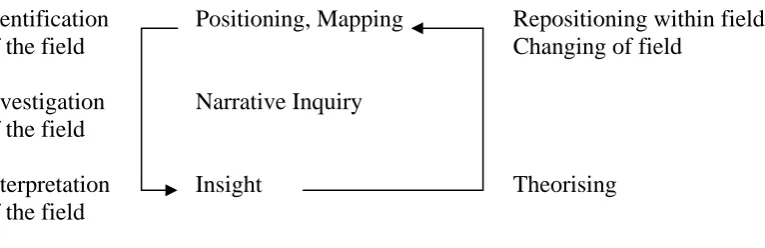
The methodology involves students in cycles of looking backwards and looking forwards, looking inwards and looking outwards, thinking about the ideas we have at present and how we might go about changing current circumstances to take our understanding forward. This might seem to be a complicated process for school students, but it is congruent with the inquiry learning views of Dewey (1963, 1997) that have informed the work of Clandinin and Connelly. Figure 1 below (Hooley, 2007) theorises the overall research process of narrative located within the field of Indigenous knowing.
Figure 1. Schematic representation of overall research process
Identification Positioning, Mapping Repositioning within field
of the field Changing of field
Investigation Narrative Inquiry of the field
Interpretation Insight Theorising of the field
A further aspect of this theoretical frame involves the criticism of narrative inquiry being a subjective rather than rational activity. While human events will always be interpreted and reinterpreted and the accuracy of description can always be contested, it may be that the establishment of cycles of inquiry over time are necessary to ensure that situations portrayed are as credible and sensible as possible. In considering the issue of narrative rationality, Conle (2007) has suggested that the Theory of
Habermas, Conle (2007, p. 179) advises that the ‘assumption of rationality … offers a standpoint from which to make judgements and issue critiques. Narrative inquiry, I propose, also falls into this type of communicative action.’
The question of communicative rationality is a significant issue when Indigenous and non-Indigenous people are working together. For example, Indigenous mythology, story and oral history may be discounted or doubted by non-Indigenous colleagues in formal and informal associations. Native title claims in Australia must show a
continuous relationship with the land since European settlement, a process that is difficult for courts to accept without written records. Indigenous notions of time may also combine past and present into a ‘now,’ where events such as violent encounters and massacres and the removal of children from their Indigenous families may be very difficult to date using a European calendar. Depending on the particular project being undertaken, it may be that initial discussions form the context within which meaning is pursued and that many cycles of conversation are required before a consensus is achieved about a specific chronicle.
Approach to learning and evidence
Under the narrative arrangement shown above (Figure 1) as applied in schools, students design projects that relate closely to an issue of community interest such as the natural environment or important events that have occurred. Documentary
evidence is collected that could include newspaper articles, photographs and personal accounts from family members. In sharing and discussing this material, students become involved in considering their past and how this relates to their present. By scaffolding this discussion, teachers assist students in considering their personal viewpoints, how this might differ from the views of others and what is required to substantiate their ideas. Finally, a new program or cycle of investigation is planned and implemented to gather a new range of evidence to support the development of ideas that have sprung from the initial consideration.
This approach to learning through narrative is applicable for all students, whether Indigenous or non-Indigenous. In a significant discussion, Attwood (2005) raises questions about the nature of oral history regarding European settlement in Australia and how the lack of written documentary evidence can often be used to discredit Indigenous accounts. Attwood (2005, p. 182) suggests that European historians need to have a much better understanding of how Indigenous peoples come to agreement on their own knowledge and history and ‘whether new forms of historical narrative are required in order to represent these.’ Identical considerations apply in school. There is a serious question of course as to how Indigenous (and other) peoples ensure that their stories are accurate and consistent over long periods of time (Clendinnen, 2006). Sveiby and Skuthorpe (2006, p. 55) contend that ‘a story was always linked to learning tracks, parts of the land itself and often also to animals, none of which
knowledge to be negotiated. Proposed by Kuhn (1971) in his exploration of the philosophy of science, an exemplar of knowledge can be thought of as an expression of ideas, principles, practices, understandings and agreements that enable a particular community to interact and coalesce. Exemplars exist for farmers and athletes,
engineers and entertainers, teachers and truck drivers. They are formal and informal and evolve over time as conditions alter. They can be written down, or exist via ceremony, stories and artistic form as communities exchange views and experience. Appendix 1 shows a draft exemplar from the theme of ‘family’ that has arisen from research in Australia but has not been finalised or endorsed as yet by Indigenous colleagues. It outlines eight possible characteristics of knowledge (vertical axis) and four possible indicators of knowledge (horizontal axis). Appendix 2 takes the ‘Ideas and Knowledge’ characteristic from the ‘family’ matrix, gives detailed examples and links to the regular Australian curriculum. This shows the embeddedness of literacy, numeracy and ICT with Indigenous knowledge and experience in a two-way format. The matrices can be used by teachers as the basis of curriculum, act as a guide for teachers and be compiled by students as part of their program. It is intended that each matrix can be accessed electronically and be linked to actual student work.
The argument being put here does not result in a ‘Balkanisation’ of the curriculum, where Indigenous and non-Indigenous cultures are separated. Rather, the notion of two-way inquiry learning (Hooley, 2002) seeks to respect and recognise different cultures so that connections can be found and new ideas confronted by the class as a whole. There are two key aspects around which mathematics and other classrooms need to be organised to allow this to happen. First, the major organising idea is that of collaborative inquiry learning where groups of learners negotiate projects of their own interest and second, the role of the teacher involves working with students guiding, connecting and expanding ideas as the occasion warrants. When the concept of circle arises, the teacher judges when and how it is appropriate to extend the idea of area to that of circle, when the concept of ratio occurs, the teacher decides when and how it is appropriate to introduce census data, when the concept of gram is raised, the teacher judges when and how to ask about the weight of a drawing pin. Prompts and
conversation pieces like these are chosen by the teacher to link personal knowledge with new and challenging ideas, to link ideas that are important from a cultural and community perspective to ideas valued by other cultures and perspectives. In talking about health and disease for example, Trudgen (2000) had to find personal experience of the local Indigenous people to explain why they needed to take the prescribed tablets every day. If this was not done, the particular health issues remained confusing and further evidence of the mysterious and secret knowledge of whitefellas. Similar links need to be found to make whitefella mathematics understandable as well.
Emerging issues and viewpoints
Participation in narrative learning should benefit both students and teachers. Beattie (2001, p. 123) comments that ‘Through their efforts to create classroom and school communities where students learn to become full participants, these teachers
and how pathways to learning can be constructed. Rather, a mutual approach to narrative inquiry is required enabling teachers and students to investigate and reflect on their personal narratives and stories so that learning is grounded in a legitimate community of practice. Artefacts, exemplars and portfolios enable learning to be demonstrated and discussed and provide the basis for new narratives, or new learning, to be built.
Including the notion of two-way inquiry learning into a broad schema of narrative inquiry for Indigenous children will hopefully enable the school curriculum to respect and identify cultural connections. More work needs to be done on elaborating the different components of narrative inquiry and of incorporating the understandings of Indigenous peoples elsewhere. In discussing a ‘four directions’ model for Lakota and Dakota education in the United States, Fenelon and DeBeau (2006, pp. 39-43) show how mainstream studies (mathematics, science, social studies, language arts) can relate to traditional culture through the themes of nations, peoples, societies and treaty relations. Interestingly, they suggest seven ‘ways to see’ that link very closely to the narrative inquiry approach outlined above. Our work in Australia will be enriched by the concepts of looking above and below, to the sky and the earth and conceptualising the deep meaning of these processes:
:
After we orient ourselves to the Four Directions, as in the content areas, we look above, traditionally, discovering cultural ways, through story telling and oral traditions including our histories as native peoples. Then we look
downward to the esrth, the land, all of the environment, the very soil we walk upon, are born from and return to when we finish our life cycles. Finally, after orienting ourselves to the four directions and to the sky and the earth, we are fully prepared to look inward, knowing much more through our experiences, understanding our spirituality and our sense of self in relation to the world. The construction of knowledge exemplars as a practical outcome of narrative inquiry enables Indigenous children to give respect to local communities and to local history and culture as the basis of meaning. This does not deny or exclude important
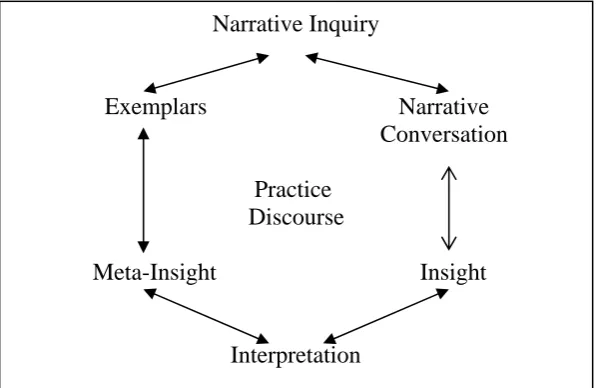
Figure 2. Exemplar process
Narrative Inquiry
Exemplars Narrative Conversation Practice
Discourse
Meta-Insight Insight
Interpretation
Educational and research importance of the study
Investigating narrative inquiry as both school curriculum and as research
methodology brings together the key features of practitioner research (Anderson & Herr, 1999). Its significance lies in the concept of qualitative research itself and implications arising for changed professional practice across different cultural settings. Research as described in this paper is understood to be the approaches followed by various communities as they pursue knowing to support, clarify and guide community interest. Some social groupings such as the scientific and
educational may have a more individual, formal and regulated approach to this task, while others such as Indigenous communities may adopt procedures that are more collective, informal and discursive as experience and understandings change. This study seeks to identify approaches and practices that extend across and are acceptable in different cultural settings and which are therefore available for the pursuit of mutual outcomes.
Based on the narrative research process, the study also aims to contribute towards the understandings and development of educational practice regarding the inclusion of learners from cultural settings in programs and activities of formal learning involving the dominant curriculum. Tonkinson (2007, p. 41) describes this friction aptly as ‘the dynamics of cultural difference and the exercise of autonomy.’ While initiated from direct experience over recent years by substantial problems associated with the education of Indigenous children in regular programs, the study also draws upon linking themes and principles from both science and education. The work so far is promising in its potential benefit for all learners, Indigenous and non-Indigenous alike. In this way, we hope to make a significant contribution to the process of national reconciliation in Australia. As communities come together to resolve important issues of common concern, they consolidate and deepen understanding of each other and open up the possibility of further narratives including counter
In Yothu Yindi we bring together music, ceremony, lyrics and technology from two cultural traditions into a fusion which produces something new and different.
Our approach to narrative inquiry has exactly this outcome in mind.
References
Amosa, W. & Ladwig, J. G. 2004. Examining Non-Dominant Cultural Perspectives in Pedagogical Practice, paper presented at the Annual Conference of the
Australian Association for Educational Research, November.
Anderson, G. L. & Herr, K. 1999.The New Paradigm Wars: Is There Room for Rigorous Practitioner Knowledge in Schools and Universities? Educational
Researcher, vol. 28, no. 5 (June-July), pp. 12-21+40.
Attwood, B. 2005. Telling The Truth About Aboriginal History, Allen & Unwin, Australia.
Beattie, M. 2000. Narratives of Professional Learning: Becoming a Teacher and Learning to Teach, Journal of Educational Inquiry, vol. 1, no. 2, pp. 1-23. Beattie, M. 2001. The art of learning to teach: Pre-service teacher narratives, Merrill
Prentice Hall, New Jersey and Ohio.
Boden, M. 1994. Piaget 2nd Edition, Fontana, London.
Clandinin, D. J. 2005. Lives in School: The Interwoven Lives of Children and Teachers, paper presented at the Biennial Conference of the Australian Curriculum Studies Association, Queensland, September.
Clandinin, D. J. & Connelly, F. M. 2000. Narrative Inquiry: Experience and story in narrative research, Jossey-Bass Publishers, San Francisco.
Clendinnen, I. 2006. The History Question: Who Owns the Past? Quarterly Essay, Black Inc, Melbourne.
Conle, C. 2007. The Rationality Of Narrative Inquiry, in Conle, C., Blanchard, D., Burton, K., Higgens, A., Kelly, M., Sullivan, L. & Tan, J., The Asset Of Cultural Pluralism: An Account Of Cross-Cultural Learning In Pre-Service Teacher Education, Nova Science Publishers Inc, New York, pp. 177-187.
Connelly, M. & Clandinin, J. 2006, quoted in Clandinin, D. J., Pushor, D. & Orr, A. M. 2007. Navigating sites For Narrative Inquiry, Journal of Teacher Education, vol. 58, no. 1, pp. 21-35.
Fenelon, J. V. & LeBeau, D. 2006. Four Directions for Indian Education: Curriculum Models for Lakota and Dakota Teaching and Learning, in Abu-Saad, I. & Champagne, D. (Eds) Indigenous Education and Empowerment: International Perspectives, AltaMira Press, London and New York, pp. 21-68.
Habermas, J. 1984. The Theory of Communicative Action. Volume 1. Reason and the rationalisation of society, Beacon Press, Boston.
Hooley, N. 2002. Two-way enquiry learning: Exploring the interface between Indigenous and non-Indigenous knowing, Victoria University of Technology, Melbourne.
Hooley, N. 2007. Recognising The Power of Story: Narrative Prospects for
Democratic Practitioner research, paper presented at the Annual Conference of the British Educational Research Association, Institute of Education University of London, September.
Hughes, P., More, A. J. & Williams, M. 2004. Aboriginal ways of knowing, Paul Hughes, Adelaide.
Kuhn, T. 1970. The structure of scientific revolutions 2nd edition, University of Chicago Press, Chicago.
Kunoth-Monks, R. 2007. Land and culture: necessary but not sufficient for the future. Identity in the 21st Century, Kgoonjook: Journal of Australian Indigenous Issues, no. 30, pp. 7-11.
Levi-Strauss, C. 1966. The Savage Mind, The University of Chicago Press, Chicago. Partington, G. 2002. Conceptual frameworks for Indigenous education: review and
analysis, paper presented at the National Indigenous Education conference, Townsville, Queensland, July.
Rigney, L-I. 2006. Indigenist Research and Aboriginal Australia, in Kunnie, J. E. & Goduka, N. I. (Eds) Indigenous Peoples’ Wisdom and Power: Affirming Our Knowledge Through Narratives, Ashgate, Great Britain, pp. 32-48.
Sveiby, K-E. & Skuthorpe, T. 2006. Treading Lightly: The hidden wisdom of the world’s oldest people, Allen & Unwin, Australia.
Tonkinson, R. 2007. Aboriginal ‘Difference’ and ‘Autonomy’ Then and Now: four Decades of Change in a Western Desert Society, Anthropological Forum, vol 17, no. 1, pp. 41-60.
Trudgen, R. 2000. Why Warriors Lie Down and Die, Aboriginal Resoruce and Development Services Inc., Darwin.
Appendices
Appendix 1. Exemplar Matrix: Family
Indicator 1
Family and
country
Indicator 2
Importance
of family
Indicator 3
Community
Events
Indicator 4
Work
Community
theme
Connection
with country
Kinship Health Survival
Community
culture
Story by
Elders
Story by
Elders
Community
well-being
Sharing
resources
Artefacts
Newspaper
article
Photographs Interview
on
film
Implements
used
Ideas and
knowledge
Place of
river in
community
Influence of
family in
community
Indigenous
food
Interacting
with white
community
Links to
curriculum
Local history
Geography
Local history Science
Local history
Appendix 2. Exemplar: Family
Ideas and Knowledge
Explanation Example 1 Example 2 Example 3 Example 4