Human Rights Mainstreaming in the World Health Organization: A Comparative Study of Regional Offices
Maximillian Seunik
Honors Thesis
Department of Health Policy and Management Gillings School of Global Public Health University of North Carolina at Chapel Hill
April 10, 2015
Approved:
I.
Introduction
In 1997, United Nations (UN) Secretary-General Kofi Annan mandated the full mainstreaming of human rights into all of the organization’s principal activities and programs as a “cross-cutting” approach. This call spurred the development of an
increasingly shared understanding of human rights among UN agencies including within the World Health Organization (WHO). While WHO played an early leadership role in the development of international legal obligations, the agency abandoned rights-based approaches to health for much of its history.
Only recently is the organization returning to human rights and attempting a more systematic mainstreaming of health-related rights. In this effort, WHO refers to human rights standards drawn from international and regional human rights treaties, court decisions, and the general comments and recommendations issued by UN human rights treaty-monitoring bodies. Under a human rights-based approach, these sources and the human rights principles contained therein should structure WHO policy
recommendations and form legal platforms for action that address global health challenges (WHO, 2013). Indeed, it is only through the ‘deliberate infusion’ of human rights into all activities and organs that organizations may successfully mainstream human rights (Oberleitner, 2007).
explanatory processes such as the development of “General Comments,” CESCR has international legal authority to interpret state obligations pursuant to the right to health. While in recent years WHO language appears committed to mainstreaming international human rights legal instruments as developed by the CESCR and other UN bodies, the organization continues to struggle to move from rhetoric to reality and realize its constitutional mandate to ensure “the enjoyment of the highest attainable standard of health is one of the fundamental rights of every human being.” Despite recognized faltering progress towards an effective human rights policy, WHO increasingly
articulates rights as being central to its operations and mandate. This struggle is starkly reflected in the uneven progress in realizing a human rights-based approach within the agency itself.
within the agency’s regional health governance bodies as they negotiate human rights landscapes largely independent of Geneva. This begs the question: To what extent has human rights rhetoric been translated into rights-based structures, policies and programs in each of the agency’s regional offices?
Research Questions:
1. How has each of the six WHO regional offices integrated human rights into their structure, policies and programs?
2. What factors and processes drive and impede the implementation of human rights mainstreaming within WHO regional offices?
II.
Literature Review
The World Health Organization and its Regional Offices
The World Health Organization, as part of the newly ascendant United Nations system, emerged from the ashes of the Second World War as a response to the
recognition that global leadership to protect individual freedoms from the tyranny of the state was desperately needed. In the post-war negotiations that established the United Nations, the topic of international health cooperation came to the fore (Meier, 2009, p. 8). A series of international conferences, unprecedented cooperation among states, and a provision in the nascent United Nation’s Charter led to the thematic outline that would give rise to WHO. As scholars from the period note, “the moment had clearly arrived for the creation of a single world-wide inter-governmental organization for health which would embrace all the activities and functions of the past, the present and the future” (N. M. Goodman, 1952, p. 153). After much political maneuvering, WHO was created on April 7, 1948 with Geneva, Switzerland designated as the agency’s global headquarters. From its inception, WHO was intended to be an autonomous organization free from the politics that hamstrung its predecessor, the Health Office of the League of Nations. Despite original aspirations to institutional independence, external political forces quickly and permanently shaped the agency’s organizational structure, health equity mandate, and implementation of human rights for health (Meier, 2009, p. 204).
the highest standard of health. WHO constitutional language lays the groundwork for the agency “to act as the directing and coordinating authority on international health work.” Moving beyond merely preventing the spread of disease, scholars have noted negotiators intended to empower the agency to realize the underlying determinants of health through policy leadership, technical assistance, and the establishment of the individual’s human right to health (Meier & Onzivu, 2014). In working towards this aim, the agency is composed of three principle organs: the World Health Assembly, a legislative body made up of representatives from each member state; the Executive Board, a technical subset of the Assembly; and, the Secretariat, which includes the Director General’s Office.
Additionally, the agency contains several specialty units (HIV/AIDS, Policy and
Emergencies, Family, Women’s and Children’s Health) and six Regional Offices, each of which has its own Regional Director and several sub-units contained therein.
Throughout the negotiations that created WHO, the need for specialized Regional Offices was affirmed. However, a complex and fragmented pre-war global health
landscape complicated their foundation. The agency’s constitution allows Regional Offices to be created ex nihilo or, much more controversially, through the integration of preexisting regional bodies. Article. 44 of the WHO Constitution provides for the
creation of new regional organizations, “The Health Assembly may, with the consent of a majority of the Members situated within each area so defined, establish a regional
organization to meet the special needs of such an area.” Additionally, Art. 54 establishes the terms under which existing international health governance structures can be
existence… shall in due course be integrated with the Organization.”
Designating regional arrangements proved the most controversial of any topic discussed at the First World Health Assembly—the venue for member states to negotiate the terms of WHO organizational structure. The United States, for instance, was reluctant to allow the Pan-American Sanitation Bureau (PASB)—headquartered in Washington, D.C. and the primary vehicle for American health diplomacy in the Americas—to be absorbed entirely by the nascent WHO (N. M. Goodman, 1952). Nevertheless, after much debate and strong support from other governments in the Americas, it was agreed that PASB would continue its separate existence with eventual progressive integration into WHO (N. M. Goodman, 1952). This unique dynamic set the stage for modern
organizational hierarchies and relationships within WHO. Even today, Regional Offices effectively operate as inter-governmental organizations unto themselves with a
considerable level of autonomy.
details of regionalization occurred in 1951 with the emergence of six distinct WHO Regional Offices—Southeast Asia, Eastern Mediterranean, Western Pacific, the
Americas, Africa, and Europe. As predicted, the WHO Secretariat gradually relinquished authority to these regional authorities with scholars commenting that this “converted [the Secretariat] into advisers without power of decision” (Berkov, 1957, p. 104). Indeed, Regional Office autonomy in many policy-making areas combined with shifting regional political priorities has stymied attempts at global WHO leadership on a variety of levels, including in human rights.
Understanding Human Rights within WHO
Broadly speaking, human rights are moral norms that the international community articulates through the development of legal standards that impose responsibilities on state and non-state actors to respect, protect, and fulfill entitlements (Mann et al., 1994). However, the term is contentious, often used in unspecific ways, and is increasingly interpreted as a means of justifying any moral or value-based agenda. Throughout this study, the concept of “human rights” will be referred to regularly and it is worth clarifying how the term will be used.
human right depends on an individual’s philosophical, political and religious orientation and is highly contextual. Beyond this, the human rights positions that some academics, politicians, non-governmental organizations, and laypeople vocalize and defend as entitlements are often perspectives that few would agree upon. Scholars have noted that this dynamic weakens and demeans the entire concept of human rights and that a global understanding of human rights should instead be emphasized (Oestreich, 2007, p. 20). It is not the intention of this study to add to the confusion with yet another definition. Instead, emphasis will be placed initially on how WHO itself understands and articulates human rights. After further analysis and data collection, that emphasis will shift to identifying how WHO Regional Offices themselves understand and use human rights.
Academics have disagreed on the content and parameters of the human right to health, the human right most important to WHO. At various times, thinkers have proposed, among others, a right to health care, a right to the underlying determinants of health, a right to health status, and a right to human flourishing as the strongest approach to guaranteeing health as a human right (Lakin, 2001). However, the WHO Constitution clearly begins by defining health as “a state of complete physical, mental and social well-being” (WHO, 1946). This is often interpreted as the most authoritative starting point for the human right to health. Article 25 of the Universal Declaration of Human Rights (UDHR) elaborates on the right and Article 12 of the International Covenant of
detrimental state action. These treaties include the Convention on the Elimination of All Forms of Racial Discrimination of 1965, the Convention on the Elimination of All Forms of Discrimination against Women of 1979, and the Convention on the Rights of the Child of 1989.
Most recently, the Committee on Economic, Social and Cultural Rights, the UN treaty body responsible for implementing, interpreting and monitoring ICESCR,
published General Comment 14. The statement is extensive and intended to fully
demarcate the content to the international right to health.1 It enshrines a clear recognition of the importance of the right to health, stating:
“Health is a fundamental human right indispensable for the exercise of other human rights. Every human being is entitled to the enjoyment of the highest attainable standard of health conducive to living a life in dignity.”
Clearly influenced by the WHO Constitution, the Committee broadens the definition provided by the first paragraph of Article 12 and ensures that the right to health not be
1 See: The Right to the Highest Attainable Standard of Health, U.N. Doc. E/C, Dec. 4, 2000, ICESR
General Comment 14 (2000)
The International Covenant on Economic, Social and Cultural Rights (ICESCR)
Article 12
1. The States Parties to the present Covenant recognize the right of everyone to the enjoyment of the highest attainable standard of physical and mental health. 2. The steps to be taken by the States Parties to the present Covenant to achieve the full realization of this right shall include those necessary for:
(a) The provision for the reduction of the stillbirth-rate and of infant mortality and for the healthy development of the child;
(b) The improvement of all aspects of environmental and industrial hygiene;
(c) The prevention, treatment and control of epidemic, endemic, occupational and other diseases;
confined to the right to health care and that it encompasses the socio-economic
determinants that affect the ability of people to lead healthy lives. Importantly, General Comment 14 references the work and influence of WHO, even reaffirming that the agency take due account of the right to health in its programs and leadership. Lakin (2001) interprets the many references as evidence that “the Committee considers a close working relationship with the WHO to be a necessary component of monitoring and developing the right to health.”
evolving demands of organizations (Alvarez, 2001, pp. 104–110). This perspective coupled with the broad mandate of the WHO Constitution offers considerable latitude to the agency in deciding what constitutes its human rights-based approach.
The agency’s complex and nuanced relationship with human rights has provoked scholarship and a healthy share of criticism. Lakin (2001) notes that WHO’s first
activities were to provide scientific and technical advice with little heed paid to the right to health and other rights. She critiques a perceived lack of a discernible strategy to bolster agency programs that goes beyond a pervading desire to avoid politically controversial subjects. More generally, WHO has not sought to influence the normative development of the right to health and the agency “has given minimal support to the various human rights treaty bodies” (Lakin, 2001, p. 137). Other scholars, too, sharply criticize WHO for ignoring international law as a means of advancing its constitutional mandate (Aginam, 2005). Meier (2009) carefully traces the underlying public health discourses that led to the development and evolution of the right to health in WHO through analyses of historical political, legal, and medical discourses. He concludes that WHO faced limitations in translating public health discourse into human rights law and vice versa, which vitiated the agency’s ability to develop and implement human rights in a meaningful way.
Human rights were seen as introducing distracting politics into objective health discourse. Building on these ideas, Meier (2010) argues that WHO’s historical lack of interest in harnessing international law for global health translates to particular disinterest in adopting a human rights-based approach to public health (Meier, 2010).
Other perspectives focus less on the agency’s historical failures and more on future opportunities for and challenges to human rights promotion. Scholars note that neo-liberalist health reforms in the global South, trade liberalization and limited technical capacity in WHO Regional Offices pose continued challenges to WHO human rights leadership (Onzivu, 2011). Despite these limitations, evolving mechanisms offer opportunities for WHO to better promote human rights. Hope for these efforts may be drawn from WHO successes at meeting challenges in other realms, such as the fight against smallpox, polio, tetanus, and other ailments (Onzivu, 2011). Beyond this, it is important to recognize that WHO recognizes and formally articulates how global health policies and programs impact the enjoyment of human rights, linking rights abuses to poor health outcomes (WHO, 2002). Some evidence points to renewed enthusiasm at the global and regional levels to strengthen the human rights unit and collaborate within the United Nations system, especially with the Office of the High Commissioner for Human Rights (WHO & OHCHR, 2008).
address criticisms of WHO’s governance of global health challenges (Onzivu, 2011, pp. 227–228). While the actions of the WHO Secretariat and the agency’s poor historical track record have provoked analysis, intra-agency understandings of human rights remain poorly understood. As mentioned previously, the organizational hierarchy of WHO facilitates a large degree of autonomy for Regional Offices, allowing the bodies to act as independent global health actors in many settings. Recent literature has only begun to delve into the subject. Meier and Onzivu (2014) highlight the creation of human rights officer positions in each regional secretariat and note the disparity in human rights success among regions, but do not offer much analysis of the factors that underpin achievement.
Mainstreaming Human Rights and a ‘Human Rights-Based Approach’
Kofi Annan’s 1997 call for all UN agencies to adopt a ‘cross-cutting’ approach to human rights was a departure from the 1945 model where UN bodies developed
specialized and independent understandings of human rights. Instead, Annan offered a universal mainstreaming approach common to all UN agencies irrespective of technical specialization (Oberleitner, 2008). Though, while Annan sought to cultivate a singular understanding of mainstreaming, its substantive definition remains contentious. Broadly speaking, mainstreaming human rights within an organization refers to the ‘deliberate infusion’ of human rights into all activities, organs, and policies (Oberleitner, 2007). Drawing on understandings solicited from all UN agencies, UNESCO defines this human rights-based approach instead as “… the formulation of goals and implementation
processes in human rights terms” (Frankovits, 2006). More explicitly, the Office of the High Commissioner for Human Rights understands “the process of human
While the intent of human rights mainstreaming is easily expressed, the process itself is widely misunderstood and lacks procedural clarity, even amongst technocrats. Often, opposing or competing understandings of human rights complicate how
organizations implement rights-based approaches. Scholars note that successful implementation is determined by whether human rights are incorporated as a
comprehensive legal framework that delineates entitlements, duties, and responsibilities or simply as an additional variable introduced to preexisting policies and programs (Oberleitner, 2008). It is clear that moving beyond ‘do good, feel good’ rhetorical exercises requires meeting the “far-reaching legal and practical implications” of human rights mainstreaming (Oberleitner, 2007, p. 105). From a practical perspective,
mainstreaming human rights is a demanding process—requiring training staff, remapping bureaucratic systems, changing mindsets, acquiring human rights expertise in
implementation, monitoring and evaluation programs, and much more.
As Oberleitner (2007, 106) notes, human rights mainstreaming follows a winding road, challenged by a variety of institutional factors, including: “the great range of actors in the UN system; uncertainties on how to integrate legal norms into policy- and
communities focused on traditions and cultural practices that run contrary to human rights norms; the belief by technical staff that mainstreaming will not prove more
effective than established practices; the lack of NGO partners and affiliates with adequate human rights experience; and much more.
Two recent works offer the most compelling scholarship on human rights mainstreaming within inter-governmental organizations (IGOs) like WHO. Oestreich’s 2007 Power and Principle: Human Rights Programming in International Organizations describes how three UN-related IGOs mainstreamed human rights. Through a small-N comparative case study, Oestreich compares the efforts of the United Nations Children’s Fund (UNICEF), the World Bank, and WHO. Although limited by a small sample size, the study hypothesizes factors that contribute to the adoption of human rights by IGOs commensurate with theoretical models: agency independence, external learning and the influence of epistemic communities of professionals, organizational interests vis-à-vis stakeholder desires, and the power of principles ideas.
In his analysis of WHO, Oestreich focuses on consistent environmental pressure and the departure of ‘true believeers’ including the ?late Jonathan Mann, a physician of considerable repute in the early fight against HIV/AIDS and an administrator for WHO, as factors that debilitated the rights agenda at WHO (Oestreich, 2007, p. 118). Tracing WHO history, he identifies several other factors that impede human rights
to cooperate with states by politically charging the agency’s work. According to Oestreich, “the most striking lesson of the current state of human rights within WHO might be the clear need for leadership at the top of the organization to bring about effective change” (Oestreich, 2007, p. 155). Despite noting the central importance of leadership, Oestreich fails to comment on WHO Regional Offices and the ways in which Regional Directors independently advance human rights-based agendas. In such a
thorough case study, this is a major shortcoming.
Similarly, Oberleitner (2007)’s book Global Human Rights Institutions provides a cursory analysis of human rights mainstreaming in several IGOs, including WHO. The author focuses on the gap between WHO rhetoric and reality. While lauding recent action on human rights, including greater cooperation with the UN Special Rapporteur on the Right to Health, the appointment of human rights advisors, and a new health and human rights focused publication series, the author concludes that transitioning from rhetoric to reality will require the joint cooperation of member states and the agency’s leadership (Oberleitner, 2007, p. 127). Once again, the study overlooks the successes and failures encountered by WHO regional health governance structures. Indeed, a scholarly analysis comprehensive of the Regional Offices would offer a more interesting, complete and nuanced perspective on human rights mainstreaming in WHO and other IGOs.
organizational structures are the ideal medium to stretch the boundaries of knowledge and contribute meaningfully to an evolving field in which much has yet to be explored.
III.
Methods
I. Research Objective
The goal of the study is to ask questions and draw conclusions of theoretical interest for purposes of explanation. Accordingly, a focus is placed on identifying variables with some leverage for policymakers to enable them to influence future regional health governance outcomes. I employ a qualitative approach grounded in both documentary analysis and semi-structured stakeholder interviews.
II. Research Design
The study uses a qualitative multiple case-study design that allows for structured, focused comparison between WHO regional offices through holistic, single-unit analysis (Yin, 2014, p. 50). The study design meets the burden for Lijphart’s definition of an inductive case study, whereby new variables and causal mechanisms are inductively identified (Lijphart, 1975). To reiterate, this study will address two primary research questions:
1. How has each of the six WHO regional offices integrated human rights into their structure, policies and programs?
mainstreaming within WHO regional offices?
Analysis of germane documents from or about each regional office primarily informs the first research question. Semi-structured interviews with key human rights stakeholders in each office setting lend clarity to both the first and second line of investigation. Categories and dimensions of inquiry were drawn from the theoretical framework, previous literature and the research problem. Within each case, the results of the document analysis and semi-structured interviews lead to the development of intra-case themes presented in the form of a new theoretical framework. Compared across cases, the dimensions of inquiry and emergent theories will inform the comparative case method as a whole. Analyses incorporate replication, not sampling logic, with data
collection tools designed to arrive at conclusions of theoretical interest (Yin, 2014, p. 57).
III. Research Methods and Data Sources
A) The Comparative Case Method
The comparative case method is ideal for assessing the process of human rights mainstreaming in the six differentiated but similar contexts of WHO regional offices. Case studies, as a research strategy, focus on understanding the dynamics present within single settings (Eisenhardt, 1989). Multiple case studies allow for the amalgamation of these dynamics to search for cross-case patterns. The methodology lends itself well to theory development, allowing researchers to achieve high conceptual validity and
and increase capacity for understanding causal complexity (George & Bennett, 2005, p. 75).
For the purposes of this study, the “population” is the six WHO regional offices (Southeast Asia, Eastern Mediterranean, Western Pacific, the Americas, Africa, and Europe or SEARO, EMRO, WPRO, PAHO, AFRO, EURO). The study sought to select a sample of regional offices based on theoretical, not statistical, significance (Eisenhardt, 1989, p. 537). As Pettigrew (1988) noted, given a limitation on the number of cases that can be studied, it is important to select cases in which the process of interest is
“transparently observable.” Several obstacles in scheduling and availability of key informants within WHO Regional Offices also contributed to the selection strategy. Working closely with Dr. Benjamin Mason Meier, the research team leveraged
professional and personal contacts to secure key informants from three offices: PAHO, AFRO, and SEARO. These three offices make up the three primary case studies under evaluation.
B) Document Analysis
Documents were gleaned from the Internet, WHO online cataloguing services, and through key-informants who often had access to internal documents or grey literature. Additionally, the researcher collaborated with WHO librarians in Geneva, Switzerland and Brazzaville, Republic of the Congo to locate and analyze older (non-digitized) data. Advisor Benjamin Mason Meier’s personal contacts working at the intersection of health and human rights in WHO settings were also particularly helpful in providing guidance.
Merriam notes that “using documentary data is not much different from using interviews or observations” (Merriam, 2009, p. 150). Data collection remains guided by the same theoretical framework and I took to heart the recommendation to “keep an open mind” and “[be] open to any possibility [for] serendipitous discovery.” Regardless of its origin, all data was adequately authenticated through cross-referencing different
catalogues and online databases. Through the development of organizational matrices, I contextualized information and developed theoretical chain of events underlying the decision-making processes regarding human rights mainstreaming in each regional office.
Yin (2014) recommends researchers establish narrative compilations—or
structured use of tags, key words and basic database management, a revolving personal database of material was formed, facilitating thematic analysis.
C) Semi-structured interviews
Best practices for conducting interviews will be adapted from Merriam’s (2009) Qualitative Research: A Guide to Design and Implementation in which she highlights important interview techniques, including detail on asking good questions, establishing rapport and neutrality, and developing effective key-informant guides. Great care was taken to identify the complexities in the interaction between interviewer and respondent. This ensured a more informed analysis of interview data.
Semi-structured interviews were held over the telephone and over Skype with WHO staff in roles related to human rights mainstreaming to collect qualitative data on the factors and processes that drive human rights promotion in each office. Occupying a middle ground between rigidly structured interviews inappropriate for this type of qualitative inquiry and unstructured interviews, the format allowed for flexibility in exploring the complex nuances of human rights promotion in WHO regional offices (Merriam, 2009, p. 91). An emphasis was placed on exploring ideas as they arose, leading to discussions guided by the results of the document analysis and theoretical framework (Merriam, 2009, p. 89).
interviews was conducted via e-mail. A general key-informant guide was developed in conjunction with the theoretical framework and then adjusted slightly to fit the
parameters of each regional office.
Chart 1: Key Informants for Study
Name Position Office
Mr. Javier Vasquez Human Rights Advisor PAHO
Mr. Davison Munodawafa Acting Focal Point AFRO
Ms. Benedicte Briot Human Rights Advisor SEARO
Ethical Considerations
It is important to predict the unanticipated effects of interviewing in particular and ensure respondents feel respected and comfortable (Merriam, 2009, p. 231). In the context of this study, I took care to not overlay my personal feelings about the human issues possibly at stake (Merriam, 2009, p. 231). Additionally, the future dissemination of this research will take place within the context of previously agreed upon parameters.
Ensuring that strict ethical guidelines frame scholarship is a critical component of certifying the trustworthiness of the study. To contribute valuable information to the field that is believable and truthful, I sought to ensure internal validity through triangulation, checking interviewees, and clarifying research biases and assumptions (Merriam, 2009, p. 234). As Merriam (2009) notes, “The best a researcher can do is to be conscious of the ethical issues that pervade the research process and to examine his or her own
philosophical orientation vis-à-vis these issues.”
Instruments:
The primary interview guide (Merriam, 2009; Yow, 1994) consisted of 10 questions (Appendix A), and was based partly on prior literature (especially Meier & Ayala, 2014, Oberleitner, 2008, and Oestretich 2007). For each individual case study, questions were adapted for context. However, the spirit behind questions across cases remained similar to facilitate cross-case analyses.
The study addressed the following topics:
• Regional office leadership support for human rights; • Regional legislative body support for human rights; • Influence of Member States;
• Relationship between human rights unit and regional human rights bodies; • Relationship with civil society organizations;
• Importance of technical (legal) expertise; • Relationship with WHO HQ;
• Defining human rights success.
IV.
Findings:
Factors & Related Literature Review:
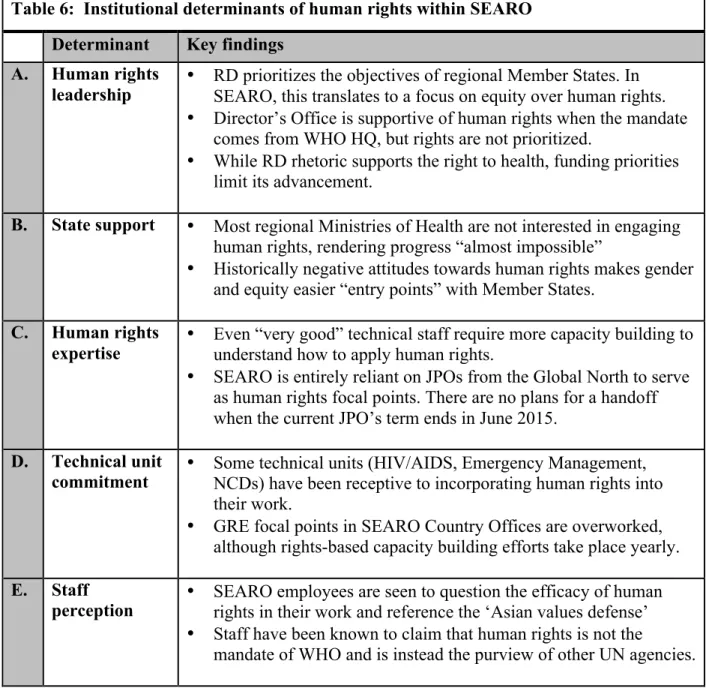
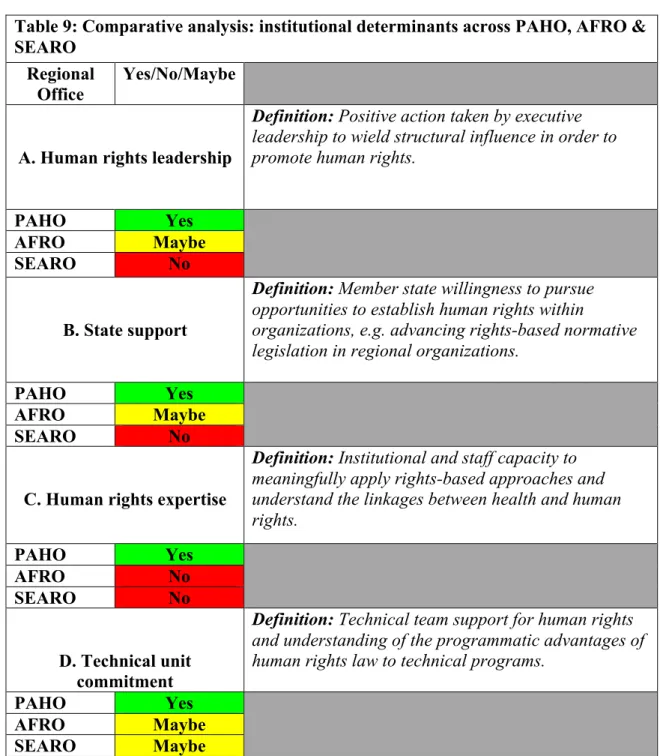
In seeking to isolate the institutional determinants that influence the
implementation of human rights in regional health governance, this study refers to the most recent literature on the subject. In particular, reference is made to Meier & Ayala's 2014 analysis of the Pan American Health Organization and subsequent review of the structural factors leading to the Bureau’s application of human rights. The study yielded four factors that the authors hypothesized as generalizable to other global health
institutions implementing rights-based agendas:
a) Human rights leadership; b) State support for human rights; c) Legal expertise;
d) Technical unit commitment;
After careful consideration and analyses of more recent data from PAHO and the inclusion of data from two additional WHO regional office settings, the institutional determinants and subsequent theoretical frameworks have shifted. While the contexts that gave rise to the changes will be explored later within the case studies, it is important to note that the institutional determinants have become:
a) Human rights leadership; b) State support for human rights; c) Human rights expertise; d) Technical unit commitment;
To better explain these determinants and their implications, this study refers to prior literature to contextualize data and situate findings within a broader narrative on global health governance.
Human rights leadership
Robert Cox’s essay on the ‘executive head’ is one of the most cited
understandings of leadership within international organizations. In underlining the importance of leadership, Cox is clear: “the quality of leadership may prove to be the most critical single determinant of the growth in scope and authority in an international organization.” Within the context of international organizations, executive leadership can create new consensus among stakeholders and levy both formal and informal powers to shift institutional frameworks (Cox, 1969). Acting as a bridge, these executive
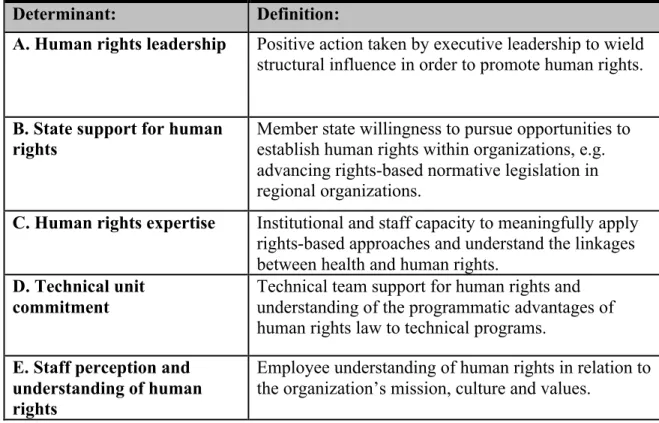
Table 1: Definitions of institutional determinants of human rights mainstreaming in regional health governance
Determinant: Definition:
A. Human rights leadership Positive action taken by executive leadership to wield structural influence in order to promote human rights.
B. State support for human
rights Member state willingness to pursue opportunities to establish human rights within organizations, e.g. advancing rights-based normative legislation in regional organizations.
C. Human rights expertise Institutional and staff capacity to meaningfully apply rights-based approaches and understand the linkages between health and human rights.
D. Technical unit commitment
Technical team support for human rights and understanding of the programmatic advantages of human rights law to technical programs.
E. Staff perception and understanding of human rights
influencers can shift dialogue within organizations. Leadership has become a central explanatory factor for organizational change, especially in breaking new ground on human rights within the United Nations system,
Within the UN system, Secretariat leadership has long been viewed as a key factor influencing organizational promotion of human rights best exemplified over the term of UN High Commissioner for Human Rights Mary Robinson from 1997 to 2002 (Robinson, 2006). Robinson refocused the position from administration to advocacy, realigning the global human rights agenda to carry out Kofi Annan’s mainstreaming mandate. However, leadership from the top is not only a form of “norms
entrepreneurship,” whereby a small group of committed individuals work to introduce new organizational platforms, but also a valuable mechanism of structural influence (Kamradt-Scott, 2004). Thoughtful leadership can introduce long term strategies and build new organizational cultures, even at the expense of short-run political capital (Zaleznik, 2008). Leveraging these many facets, the varied supports provided by
organizational leadership allows human rights to flourish even within technically focused organizations such as WHO (Meier & Ayala, 2014).
The relationship between the WHO Secretariat and leadership reveals several issues facing international institutions and the place of leadership in particular. WHO operates within a complex international system replete with a Rolodex of influential stakeholders including private and public financiers, bickering member states, and a continually narrowing political operating space. The executive head—at both the
bolster member state institutional confidence, and forge alliances (Harman, 2011). Success in these areas builds legitimacy. Legitimacy empowers executive leadership to set agendas and influence strategy and direction. These contributing factors to leadership were critical in ensuring the successes and failures of previous WHO Secretariat-level efforts to advance rights-based health reforms (Meier, 2013).
Similarly, within WHO regional offices, the support of the local executive head— the Regional Director—provides a crucial platform from which to advance rights-based agendas. Indeed, “the most striking lesson of the current state of human rights within WHO might be the clear need for leadership at the top of the organization to bring about effective change” (Oestreich, 2007, p. 155).
State support for human rights:
In international organizations where states wield decision-making authority, divisions over the issue of human rights can halt progress on advancing rights-based agendas (Sarfaty, 2009). For instance, despite widely acknowledged commonalities between the Millennium Development Goals and human rights commitments, UN Member States effectively separated these themes to serve their political interests
engaging states and winning their support.
This ties in to emerging ideas where intergovernmental organizations are seen to serve as venues for interstate socialization. State participation in forums that promote human rights can have dramatic and positive effects on states’ human rights practices (Greenhill, 2010). In fact, in multilateral environments that promote interaction between governments, states copy and learn from forms of behavior exhibited by other. States may therefore come to respect human rights as the consequence of a “logic of
appropriateness” model, rather than one based on “logic of consequences” (March & Olsen, 2004). Thus, compliance with human rights becomes the norm, and not merely an attempt to appease the most powerful states in the system.
These tendencies underscore the importance of state human rights ‘champions’ operating at the regional level for human rights successes. Within WHO, scholars have identified that transitioning from rhetoric to reality for human rights requires the joint cooperation of member states and the agency’s leadership (Oberleitner, 2007).
Human Rights Expertise:
Legal component:
Over the past several decades, there has been increased activity around formalizing human rights and legalizing their presence internationally and within international institutions more generally (Jinks, 2002).When legal scholars discuss legalization, they often refer to the notion used within international relations literature. Namely, that legalization pertains to a type of institutionalization characterized by three components; obligation, precision, and delegation (Abbott, Keohane, Moravcsik, Slaughter, & Snidal, 2000). By the same reckoning, legalization describes “a particular set of characteristics that institutions may (or may not) possess.” However, more recently, scholars have reimagined this understanding in the context of international organizations. Specifically, a more precise understanding of legalization focuses on the extent to which norms are perceived as having a “legal” status, often in relation to existing legal systems such as the international human rights regime (Sarfaty, 2009).
For WHO and its regional offices, the benefits of legalization include bolstering the credibility of normative commitments, increasing compliance with international norms, and providing a highly rationalized method of resolving interpretive
disagreements and incongruities (Jinks, 2002). However, the increased legalization of human rights within the UN system must be met with increased legal capacity in the settings required to translate legal norms into policies and programs. Legal expertise, therefore, provides a path through which human rights move from rhetoric to
Organizations that do not invest in legal capacity have been perceived as less effective at implementing human rights law (Oestreich, 2007, pp. 46–48). Scholars have pointed specifically to legal expertise as an essential component of aligning
organizational policies with human rights mainstreaming (Oberleitner, 2007). Lawyers and legal staff are essential in translating human rights law into rights-based policies, especially with recent trends towards institutional contexts with higher degrees of
legalization (Taylor, 1992). Conversely, in international organizations where lawyers are not empowered to work on issues of human rights, outcomes are seen to suffer (Sarfaty, 2009). In the context of regional global health governance, human rights success means building staff capacity to translate public health standards into public policy, and institutionalizing rights-based legislation.
That said, human rights are not merely legal concepts, although this framing has been effective in the context of other technical international institutions (Sarfaty, 2009). In critiquing “entirely law-dependent views of human rights,” Amartya Sen also
emphasizes the normative and ethical dimensions instead (Amartya Sen, 2001). These secondary dimensions are of primary importance in understanding non-legal dimensions of human rights expertise.
Non-legal component:
promoting rights that often resonate more deeply than discussions based on legal
standards (Flowers, 2000). Further, educational and training activities are easily adapted to local and organizational contexts, providing entry points for deeper learning congruent with preexisting frameworks of analysis (Tibbitts, 2002). While often admonished as an exercises in futility, simply raising awareness about human rights where understanding is lacking is associated with an increased willingness to engage on rights issues and change organizational cultures (Mihr, 2009). Training, education and capacity building is
nevertheless an effective means of improving human rights expertise.
Within international organizations, human rights capacity building has led to variety of positive outcomes for both participants and the organization. For instance, scholars have linked rights-based trainings at both the global and country level to
improved human rights outcomes (Nelson & Dorsey, 2003). Within the context of WHO, capacitating staff in children’s rights has been particularly successful. Through an
prepared national workshops in Lebanon and Morocco following a regional training on children’s rights.
Technical unit commitment:
Staff perception and understanding of human rights:
Working at the individual level, small groups of people or individuals within organizations working together are able to affect, change and realign institutional norms. When new norms are introduced into an organization, their ultimate adoption depends largely on their fit with the preexisting institutional culture. In international technical organizations such as WHO and World Bank, employees from different professional groups often have distinct interpretive frames that they use to define the norm, analyze its relevance to the organization’s mission, and then apply it in practice (Sarfaty, 2009). For effective internalization and eventual adoption, staff must adapt norms to existing organizational values and practice—that is, they must “vernaculize” norms (Sarfaty, 2009). Conversely, staff can obstruct mainstreaming efforts by declining to participate in human rights programs they do not feel align with their technical training (Oestreich, 2007).
At the individual level, “true believers” are able to support organizational efforts at reform and build coalitions to overcome internal obstacles to human rights (Oestreich, 2007). The quintessential example is the late Jonathan Mann, a physician of considerable repute in the early fight against HIV/AIDS and an administrator for WHO. He is credited with helping to bring about an human rights paradigm shift, seeking to change elements of WHO bureaucracy that stymied rights promotion (Mann et al., 1994). Successful transformation, then, is made viable not only through “the extent to which organizational forms are participatory, but also whether changes in legal and regulatory contexts
Kamradt-Scott (2004) theorizes about norms entrepreneurship within WHO. Specifically, he explores how a small group of committed individuals within WHO introduced a new norm in global communicable disease control. Accessing “norm life cycle” theory, Kamradt-Scott traces how norms emergence through entrepreneurs and organizational platforms that push a norm over a tipping point whereby the new norm is accepted. In order for norms to gain traction within a broader context, they must be adopted by certain “critical states” who become de facto norm leaders (Finnemore & Sikkink, 1998, p. 901). Other stages in the process include the norms cascade, where governments adopt norms without external pressure, and the internalization of norms whereby its acceptance becomes unconscious (Kamradt-Scott, 2004). In the WHO context, leadership from the Director General and Secretariat effectively negotiated resistance, existing organizational culture, and bureaucracy to bring about norm change on a global level. The success of these norms entrepreneurs in changing WHO
Case Study I: The Pan American Health Organization (PAHO/AMRO)
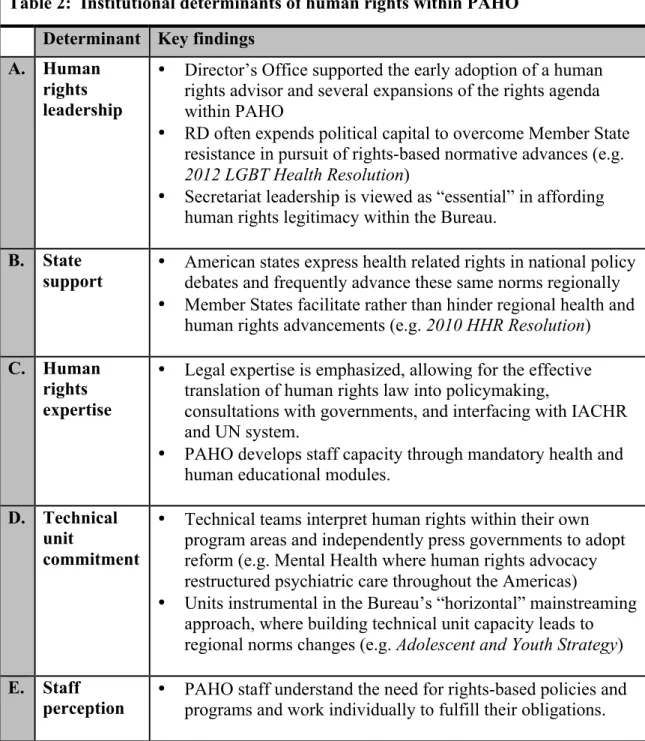
Table 2: Institutional determinants of human rights within PAHO Determinant Key findings
A. Human rights leadership
• Director’s Office supported the early adoption of a human
rights advisor and several expansions of the rights agenda within PAHO
• RD often expends political capital to overcome Member State
resistance in pursuit of rights-based normative advances (e.g. 2012 LGBT Health Resolution)
• Secretariat leadership is viewed as “essential” in affording
human rights legitimacy within the Bureau. B. State
support • American states express health related rights in national policy debates and frequently advance these same norms regionally
• Member States facilitate rather than hinder regional health and
human rights advancements (e.g. 2010 HHR Resolution) C. Human
rights expertise
• Legal expertise is emphasized, allowing for the effective
translation of human rights law into policymaking,
consultations with governments, and interfacing with IACHR and UN system.
• PAHO develops staff capacity through mandatory health and
human educational modules. D. Technical
unit
commitment
• Technical teams interpret human rights within their own
program areas and independently press governments to adopt reform (e.g. Mental Health where human rights advocacy restructured psychiatric care throughout the Americas)
• Units instrumental in the Bureau’s “horizontal” mainstreaming
approach, where building technical unit capacity leads to regional norms changes (e.g. Adolescent and Youth Strategy) E. Staff
I. History and Origin of the Pan American Health Organization, WHO’s Regional Office for the Americas
The Americas is an anomaly among WHO Regional Offices, serving as both the health agency for the Organization of American States (OAS) and, after the founding of WHO following the Second World War, the WHO Regional Office for the Americas as the Pan-American Health Organization (PAHO). The Regional Office is also the oldest permanent international health body in the world. First established in December 1902 as the Pan American Sanitary Bureau (PASB), the agency sought to control communicable diseases, coordinate quarantine regulations across the Americas, and ensure the health security of regional trade to ensure the free flow of goods and services. Headquartered in Washington, D.C., the Bureau advanced health regulations to protect public health, forming the basis for future international action in this area (Cueto, 2007).
While other WHO regions lacked autonomous regional health structures, PASB was well established, well funded and well entrenched in the region’s geopolitical
makeup (Calderwood, 1963). Pressure from the United States and the PASB Director led to arrangement unique to the Americas; states in the Hemisphere would contribute to both WHO and PASB (Hyde, 1951). This set the stage for continued independence and, in 1958, the Bureau took up a new name: the Pan American Health Organization. Serving a dual mandate as both the WHO Regional Office for the Americas and the specialized health agency of the OAS, these unique historical circumstances would allow the Office to independently advance rights-based approaches to health. Representing 35 member states (not including two observer states, four associate members and three participating states), PAHO brings together every country in North and South America. Headquartered in Washington, D.C.
II. Health, Human Rights and the Development of PAHO Governance
imperative for public health.2 This grounding forms the basis for past and present PAHO human rights activity.
However, most regional bodies reflect the value sets and objectives of their Member States and the Regional Office for the Americas is no exception. In this regard, the incorporation of human rights into regional health governance was influenced by the promulgation of human rights as a cultural norm throughout the Western Hemisphere (Meier, 2009). Despite the linguistic, cultural and institutional diversity of the region, nations of the Americas have commonly prioritized health rights and developed explicit legal and implementation measures to guarantee these rights nationally (PAHO, n.d.-c). Interestingly, the ideals of social medicine, which include a focus on the social
determinants of health, found an early purchase in the region. Influencing healthcare delivery models across the Americas, social medicine values shaped industrial, housing, and economic reforms (Allende, 2006). PAHO encouraged these developments, urging regional governments to address social inequalities and examine health from the perspective of development (Pan American Sanitary Conference, 1947). Most importantly for the purposes of this study, the Bureau capitalized on this momentum. Emphasizing the clear links between social medicine, inequality and the human right to health in policymaking, a distinct American rights-based narrative began to emerge.
Regional dynamics played a marked role in the rapidity with which regional governments accessed health related human rights. As an example, Argentina amended its constitution the year following the establishment of the Universal Declaration of
2 See: The 1978 American Convention on Human Rights and 1988 Protocol of San Salvador, which
Human Rights to include social obligations on the right to health (Von Bogdandy, Mac-Gregor, & Antoniazzi, 2010). Other states in Latin America and the Caribbean followed suit and the right to health is now formally enshrined in the constitutions of a majority of PAHO member states (Leary, 1994). Advancing human rights priorities nationally, states in the Americas increasingly began to evaluate PAHO governance as an opportunity to reflect these rights-based social values at a regional level.
Throughout the course of the 20th century, PAHO regional leadership was firm: in the Americas, health is regarded as a right. This recognition and the influence of rights developments in national contexts drove discussion on how to incorporate human rights standards and instruments to the Bureau’s technical projects. Writing in a 1973 Special Issue of World Health, PAHO’s Director opened the issue by arguing:
“We regard [health] as a goal for each person and as a means to achieve collective well-bring. This enormous conceptual evolution—a reflection of scientific achievements and of the work of men, women, institutions, and governments—gives due priority to our plans, whose ultimate aim is making health a right and duty of all, not a privilege of some” (Horwitz, n.d.)
However, despite taking a clear stance on health and human rights, these words would prove largely empty. PAHO took little interest in the 1978 Declaration of Alma-Ata and regional leadership failed to articulate regional public health objectives in a manner congruent with human rights (Meier, 2009).
the operationalization of individual rights, PAHO adopted a rights-based approach to the crisis in partnership with the WHO Secretariat, PAHO country offices and civil society organizations (Connor, 1989). These efforts would make up the bedrock for future rights-based practice. Technical units within PAHO accessed human rights law to reform
national health systems, especially around issues of mental health (Meier & Ayala, 2014). In this way, human rights were incorporated “horizontally,” with technical unit practice motivating regional leadership action. Convening a diverse set of stakeholders to influence Member State public health practice, PAHO began to champion rights-based advocacy (Levav, Restrepo, & de Macedo, 1994). Interfacing with the Inter-American Commission on Human Rights, the Bureau paired legal capacity with technical expertise to propose rights-based reforms in mental health policy, indigenous rights, child health, violence against women, and access to medicines. In a manner decidedly different than both the WHO Secretariat and other Regional Offices, PAHO carved out its own path to mainstream human rights principles throughout the organization.
III. Mainstreaming Human Rights into PAHO Policies and Programs
In mainstreaming health-related rights in the Americas, the Bureau would (a) encourage technical collaboration, (b) capacitate Member States through trainings, (c) integrate with regional human rights system on public health issues, and (d) advance rights-based developments regionally, including through PAHO’s governing bodies. The study’s key informant for this case study was Javier Vasquez, Human Rights Advisor to PAHO’s Legal Counsel.
Developing in tandem, WHO and PASB both assembled human rights teams in the late 1990s with a stated goal of working together to advanced rights-based approaches to global and regional health governance (Bureau & Organization, 2001). Within PAHO, the human rights advisor was housed within the PASB Legal Department and worked under the legal counsel and in collaboration with other Departments and technical units to quietly mainstream human rights (Vásquez, 2004). Concretizing the importance of human rights in this way, a fixed position allowed the Bureau to mobilize resources and support the efforts of the health and human rights advisor in liaising with the WHO Secretariat and working independently across Member States.
A key feature of PAHO’s human rights mainstreaming efforts has a high degree of collaboration between the human rights team and the Bureau’s technical units.
Through partnerships with academic institutions,3 the human rights team has organized a series of internal trainings for Regional Office staff. Introducing all staff to the linkages between health and human rights, these trainings include guest lectures by the UN
Special Rapporteur on the right to health and online training modules (PAHO, n.d.-a). As a result of these capacitating efforts, Bureau technical staff have been introduced to the practical value of human rights mainstreaming and learn to operationalize rights-based approaches within their substantives foci. In particular, PAHO human rights staff
emphasize the potential for human rights to provide a framework to measure success and clarify responsibility. Viewed in terms of “relationship-building,” the human rights team
3 i.e. the Washington College of Law at American University, the Centers for Law and Public’s Health
critically examines technical team needs and builds credibility by framing collaboration in terms of those needs.
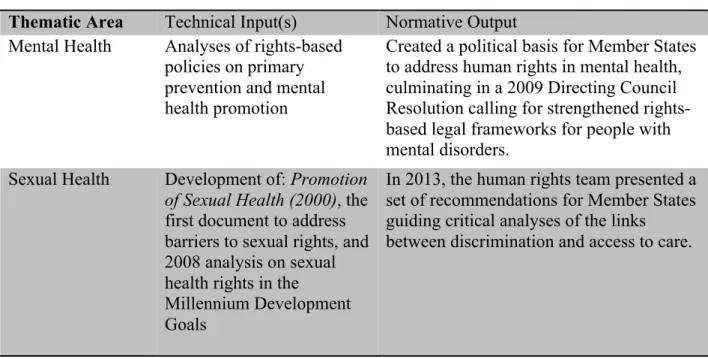
Technical units also collaborate with the human rights team to publish and disseminate documents addressing the intersection of health and human rights. One technical unit is selected annually to apply a rights-based approach to their program of work. Together, these reports form a series of 13 PASB technical documents that present over 10 years of “human rights themes,” paving the path for corresponding human rights resolutions in the Bureau’s Directing Council. Specifically, resolutions have addressed the mentally ill, elders, persons with disabilities, maternal mortality and morbidity, gender equality and violence against women, HIV/AIDS, indigenous peoples, and adolescent and child health (Meier & Ayala, 2014). Several highlights from this process are summarized in Table 3 below. Note that the table is not exhaustive.
Table 3: Technical units collaboration and rights-based developments Thematic Area Technical Input(s) Normative Output Mental Health Analyses of rights-based
policies on primary prevention and mental health promotion
Created a political basis for Member States to address human rights in mental health, culminating in a 2009 Directing Council Resolution calling for strengthened rights-based legal frameworks for people with mental disorders.
Sexual Health Development of: Promotion of Sexual Health (2000), the first document to address barriers to sexual rights, and 2008 analysis on sexual health rights in the
Millennium Development Goals
In 2013, the human rights team presented a set of recommendations for Member States guiding critical analyses of the links
Adolescent Health Collaboration between the human rights team and two technical units on the report, Adolescent and Youth Regional Strategy and Plan of Action 2010-208.
The plan of action (2009) and strategy (2008) recommended within the report was passed by the Directing Council and provides a roadmap for member states to improve adolescent health through a rights-based approach grounded in the UN Convention on the Rights of the Child.
These human rights inputs and resulting outputs at the political and national level served to steadily build support from technical units. Alongside gender and equity, the diffusion of human rights norms through this “horizontal” approach provided the premise for normative advancements that would otherwise be politically unfeasible. For instance, PAHO is leading the world’s global health agencies in rights-based approaches to LGBT health—a controversial topic throughout much of the world. In 2013, the Directing Council approved resolution CD52.R6 entitled Addressing the Causes of Disparities in Health Service Access and Utilization for Lesbian, Gay, Bisexual, and Trans (LGBT) Persons. Rooted in the same strategy used to advance human rights within previous technical foci of the Bureau (refer to previous table).
work of technical units on the area as an entry point to a broader resolution on LGBT health. Despite operating in a region where LGBT rights are far from universally
acknowledged, the strategy provides strong evidence for the importance of collaboration with technical units in advancing even politically difficult rights-based policies.
Importantly, the resolution is likely to serve as a future starting point for strengthening the concept of gender, human rights and sexual orientation in regional health practice.
B) Bolstering member state human rights capacity
PAHO has taken an active interest in building capacity among Member State governments for health and human rights. Through close coordination with the Bureau’s country offices, the human rights team and technical units disseminate guidance on applying international human rights instruments, conduct technical trainings for
government officials, and, when requested, advise different government sectors on how to integrate human rights standards nationally (Meier & Ayala, 2014). Trainings are grounded in Jonathan Mann’s tripartite framework and promote a uniform understanding of human rights, even as the trainings are adapted to suit national needs (PAHO, n.d.-b). PAHO is also structured trainings in consultation with other UN agencies, civil society organizations, and Inter-American organs. Several highlights from this process are summarized in the table below. Note that the table is not exhaustive.
Table 4: PAHO capacity building in the Americas
Thematic Area Participants Training Summary Mental Health PAHO Member
State government stakeholders, e.g. Paraguay.
PAHO offered human rights training for public health officials.
Adolescent Health Collaborative effort
with WHO, UNICEF, the University of
Southern California, and Save the
Children for local country stakeholders
Training takes the form of daylong exercises that develop local strategies on building
understanding of the right to health. Following, participants develop plans to apply the right, which the Bureau includes in monitoring national progress.
Tobacco PAHO Member
State health officials.
The human rights team and tobacco control program carry out joint country workshops across PAHO Member States that train health authorities on rights-based approaches to reduce tobacco consumption. Follow up and technical support is provided to governments drafting tobacco control legislation.
C) Integration & relationship with the Inter-American Human Rights System
The Inter-American Commission on Human Rights (IACHR) is an autonomous organ of the organization of OAS and serves alongside the Inter-American Court of Human Rights (“the Court”) as one of the primary institutions within the Inter-American Human Rights System (IAHRS). The Bureau’s human rights team interacts with IACHR in several ways: informal dialogue, formal testimony, and providing written opinions on public health issues of concern to IAHRS. Serving as a bridge between PAHO’s public health and human rights expertise, the Bureau’s legal office (which houses the human rights team) is able to leverage this position to advance health and human rights regionally (Meier & Ayala, 2014).
regional human rights agreements.
D) Advancing human rights regionally through PAHO governance
The Bureau’s efforts to mainstream human rights in the region began with increased collaboration with technical units and continued through the provision of training to Member States and interfacing with the Inter-American Human Rights System. Adding to this, PAHO Member States have also sought to codify a legislative basis for regional human rights activities through the PAHO Directing Council—the legislating organ of the Bureau. In particular, the Directing Council adopted the 2010 Resolution on Health and Human Rights, a legislative roadmap guiding the Bureau’s response to the region’s increasing demand for technical cooperation on human rights issues (PAHO, n.d.-c). Introduced by Argentina and endorsed by North American states, the Directing Council unanimously adopted the resolution.
Reflecting on more than 10 years of effort in mainstreaming human rights in policies and programs, the Resolution on Health and Human Rights urged:
• Member States – strengthen the technical capacity of health
authorities to implement international human rights
instruments, support law and policy reforms to incorporate human rights, and promote the right to health with
policymakers and civil society organization.
• PAHO – cooperate with UN and OAS human rights systems,
train Bureau technical staff on rights-based issues, collaborate with non-governmental actors to protect human rights, and promote rights based practices among Member States.
expanded its relationship with academic institutions, the private sector, civil society and social actors. Additionally, new legislative and administrative protocols have been developed to disseminate international human rights instruments across the region. This creates a new platform to facilitate technical collaboration between the Bureau and a variety of branches of Member State governments—including the judiciary. In Peru, this increased mandate set the stage for PAHO support of a new protocol on therapeutic abortions. The 2010 Resolution broadened the human right team’s ability to consult, capacitate and build partnerships across Peru’s government—including with both the health authority and congress. Similarly, the mandate catalyzed increased activity on mental law reform in Argentina.
Success of these emerging governance structures, however, also rests on the willingness of regional leadership to ensure human rights is present in governing body documents and practice. Particularly through agenda setting processes, PAHO Regional Directors have by and large consistently ensured human rights remains a primary area of Bureau engagement (Meier & Ayala, 2014). Additionally, the Regional Director
empowers the Secretariat and Bureau teams to interact with non-traditional actors in advancing rights-based practice such as collaboration with the UN Special Rapporteur on the Right to Health. Similarly, PAHO leadership plays a crucial role in supporting
Finally, human rights mandates such as those enshrined in the 2010 Resolution owe their existence to Member State champions who use political capital to promote norms. Most recently, the leadership of the United States, as aforementioned, was crucial in the adoption of the 2012 Resolution on LGBT Health. Accessing institutional
Case Study II: Regional Office for Africa (AFRO)
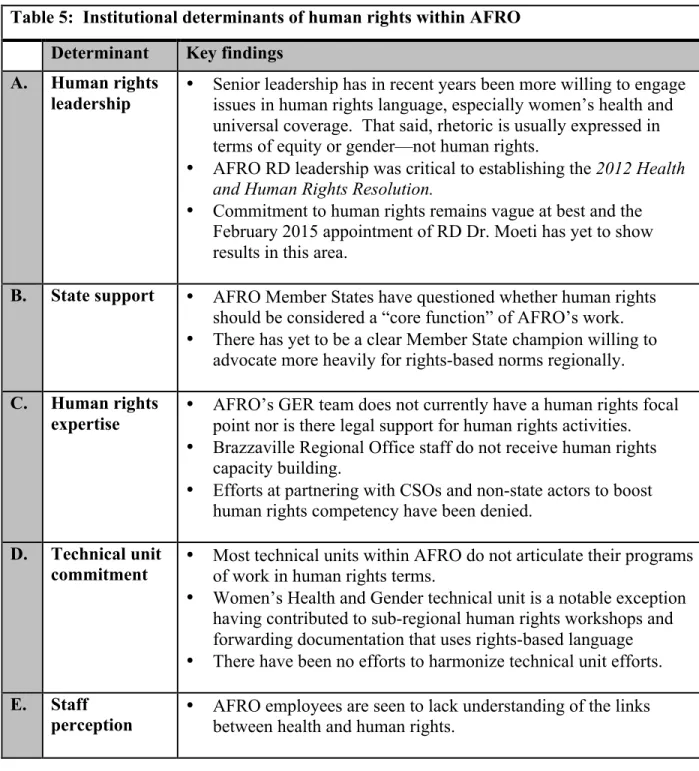
Table 5: Institutional determinants of human rights within AFRO Determinant Key findings
A. Human rights
leadership • Senior leadership has in recent years been more willing to engage issues in human rights language, especially women’s health and universal coverage. That said, rhetoric is usually expressed in terms of equity or gender—not human rights.
• AFRO RD leadership was critical to establishing the 2012 Health
and Human Rights Resolution.
• Commitment to human rights remains vague at best and the
February 2015 appointment of RD Dr. Moeti has yet to show results in this area.
B. State support • AFRO Member States have questioned whether human rights
should be considered a “core function” of AFRO’s work.
• There has yet to be a clear Member State champion willing to
advocate more heavily for rights-based norms regionally. C. Human rights
expertise • AFRO’s GER team does not currently have a human rights focal point nor is there legal support for human rights activities.
• Brazzaville Regional Office staff do not receive human rights
capacity building.
• Efforts at partnering with CSOs and non-state actors to boost
human rights competency have been denied. D. Technical unit
commitment • Most technical units within AFRO do not articulate their programs of work in human rights terms.
• Women’s Health and Gender technical unit is a notable exception
having contributed to sub-regional human rights workshops and forwarding documentation that uses rights-based language
• There have been no efforts to harmonize technical unit efforts.
E. Staff
I. Origins of the African Regional Office of the World Health Organization
The Africa Regional Office (AFRO) of WHO was established in 1951 intending to unite both colonial powers and African states in a joint effort to improve health
outcomes across Sub-Saharan Africa. Brazzaville, the present day capital of the Republic of the Congo and then French colony (not to be confused with its larger neighbor Congo-Kinshasa), was selected as the headquarters of the office. On July 23, 1952 WHO
Director General Dr. Brock Chisholm and the French Secretary of State for Foreign Affairs Mr. Maurice Schumman signed the office into existence (Samba, 2004). Building on the legacy of the work of the International Office of Public Hygiene and the League of Nations Health Organization in Africa, global powers intended to create the first truly pan-African health organization.
European colonial powers reframed health discourse in terms of “development,” rather than “civilization” (Cooper, 2002).
From the end of colonial rule in the late 1950s to the late 20th century, AFRO expanded its mandate. Focusing on eradicating infectious diseases, improving nutrition, and developing the health infrastructure of newly independent African states (Cornia & Mwabu, 1997). The Regional Office and other active international health organizations also facilitated continued health links between colonial powers and their former colonies. The AFRO region would continue to expand its membership to eventually include the 46 Sub-Saharan states of the African continent with the exception of Somalia and inclusion of Algeria (see appendix C). South Sudan became WHO’s newest and youngest member state after its independence from Sudan in July 2011. The addition of these member states would herald the beginning of an expansion in AFRO’s mandate alongside a marked transition in regional leadership.
With the appointment of Dr. Ebrahim Malick Samba of Gambia to the post of Regional Director in the late 1990s, AFRO would begin to approach new program areas, including an initial foray into human rights topics. As a clinician and public health expert, he led a pan-West African effort to combat onchocercias (river blindness) earning