323
Entropy as a Proxy for Gap Complexity in Open Cloze Tests
Mariano Felice Paula Buttery
ALTA Institute Computer Laboratory University of Cambridge
Cambridge, UK
{mf501,pjb48}@cam.ac.uk
Abstract
This paper presents a pilot study of entropy as a measure of gap complexity in open cloze tests aimed at learners of English. Entropy is used to quantify the information content in each gap, which can be used to estimate com-plexity. Our study shows that average gap entropy correlates positively with proficiency levels while individual gap entropy can cap-ture contextual complexity. To the best of our knowledge, this is the first unsupervised information-theoretical approach to evaluating the quality of cloze tests.
1 Introduction
Fill-in-the-gap orclozetest exercises are common means of assessing grammar and vocabulary in the realm of English as a Foreign Language (EFL). The most common example is themultiple choice question, which presents the student with a gapped sentence and a set of possible answers from which the right one is to be selected. These are referred to as closed cloze questions, since the answer is limited to the alternatives given. On the contrary,
open cloze questions do not provide predefined options, so the student must produce an answer from scratch.
Generating these exercises is a laborious process, since they must be carefully designed to ensure they test the desired learning objective and do not confuse or present trivial questions to the student. For this reason, choosing the optimal locations in a sentence to insert the gaps and defining a suitable set of answer options becomes crucial, especially when exercises are generated automatically.
In this paper, we focus on open cloze tests and show how entropy can be used to assess the com-plexity of each gap in the text. Entropy is shown to provide insights into the expected difficulty of the
question and correlate directly with the target pro-ficiency level of the exercises. Exploiting this in-formation should thus facilitate the automatic gen-eration of more reliable open cloze exercises.
2 Related Work
Work on automated cloze test generation has mostly focused on multiple choice questions and distractor selection (Mitkov and Ha,2003;Sumita et al., 2005;Brown et al., 2005; Lee and Seneff, 2007; Lin et al., 2007; Smith et al., 2010; Sak-aguchi et al., 2013). Conversely, there has been little work on open cloze tests. Pino et al.(2008) describes a strategy to generate open cloze ques-tions using example sentences from a learners’ dictionary. Sentences are chosen based on four lin-guistic criteria: (grammatical) complexity, well-defined context (collocations), grammaticality and length. Further work improved on this method by providing hints for the gapped words (Pino and Es-kenazi,2009).
Malafeev(2014) developed an open source sys-tem to emulate open cloze tests in Cambridge En-glish exams based on the most frequent gapped words. Expert EFL instructors found the gen-erated gaps to be useful in most cases and had difficulty differentiating automated exercises from authentic exams. More recently, Marrese-Taylor et al. (2018) trained sequence labelling and clas-sification models to decide where to insert gaps in open cloze exercises. The models achieved around 90% accuracy/F1when evaluated on manually
cre-ated exercises.
Electronics firms, for example, expect to have only six months after they have introduced a new product before a rival company produces a efficient or cheaperalternative.
−→ ←−
wide more more
variety very energy
lot less is
quarter is as
line and less
... ... ...
Figure 1: An example calculation of candidate answers for a gap using the left and right context (in red). Candidate words are ranked from the most to the least probable.
tion, we use only the top 100 most probable words when computing entropy for each gap.
4.1 Results
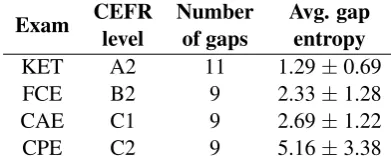
Table 1 shows information about our gold stan-dard tests, including CEFR levels, number of gaps and average gap entropy. The average gap entropy correlates positively with CEFR levels, suggesting that entropy increases with proficiency levels.
We then computed the average gap entropy for each of the 10 automatically generated tests per exam and compared them to the gold standard. Results are shown inTable 2.
Unlike the handcrafted gold standard, the auto-matically generated tests were produced randomly by a machine with no knowledge of test design so we would expect automatic gaps to be often in-serted in inconvenient locations within the text, yielding lower quality tests. This hypothesis is verified by looking at the average gap entropy for the automatic tests, which is much higher than for the gold standard in the majority of cases (77.5%). This supports our intuition that entropy can be used to discriminate between good and bad gaps and, consequently, between good and bad tests.
We noticed that automatically generated tests for CPE tend to have lower entropy than the gold standard, contradicting our assumption in princi-ple. However, we do not believe that these lower values indicate better tests but rather that they de-viate from the expected difficulty for this profi-ciency level. In fact, we would expect high-quality tests to have average gap entropy around that of the gold standard tests, not too far below or over this reference value. Based on this premise, better automated tests can be constructed by controlling the entropy of gaps in the text, in line with previ-ous work byLee et al.(2019).
Exam CEFR Number Avg. gap
level of gaps entropy
KET A2 11 1.29±0.69
FCE B2 9 2.33±1.28
CAE C1 9 2.69±1.22
CPE C2 9 5.16±3.38
Table 1: Characterisation of our gold standard data.
4.2 Analysis
We looked at the gaps with the lowest and highest entropy to analyse how these values relate to the surrounding contexts. Table 3 shows the gaps in our gold standard tests with the lowest and highest entropy.
First, we found that gaps with the lowest en-tropy correspond mostly to exams at low CEFR levels while those with the highest entropy corre-spond to the highest CEFR level. This confirms our initial finding that entropy correlates directly with proficiency levels.
Second, we observed that gaps with low entropy are very restricted in context and built around very simple grammatical structures or vocabulary, mak-ing it easy to figure out the answers. On the other hand, gaps with high entropy are part of more complex grammatical structures and require longer context or understanding in order to be solved. This explains why our language model is unable to estimate the right answers for complex gaps, leading to higher entropy.
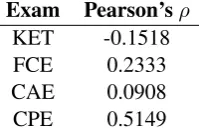
Finally, we investigated the correlation between entropy and the number of valid answers per gap. Pearson correlation for gaps in our gold standard tests is reported inTable 4. Contrary to our intuition, there is no consistent relationship between entropy and the number of valid answers per gap in our gold standard: KET shows negative correlation while CPE shows moderate positive correlation. We hypothesise that this is due to a limitation of the language model used in this preliminary study, which is unable to estimate the right word probabilities for gaps in complex contexts for the reasons described above. Using a more sophisticated language model should ameliorate this problem.
en-Exam Average gap entropy per test
1 2 3 4 5 6 7 8 9 10
KET 5.40 3.47 3.63 3.73 4.22 4.18 4.60 4.33 4.74 4.34
FCE 4.53 7.13 6.12 4.30 2.23 4.01 2.45 3.93 4.18 5.67
CAE 4.70 4.66 3.57 2.68 3.26 4.38 2.79 5.08 5.07 4.82
CPE 6.58 3.91 2.72 4.43 5.02 4.18 5.83 5.46 4.02 3.26
Table 2: Average gap entropy for the automatically generated tests. Values lower than the gold standard are marked in bold.
Exam Gap in context Entropy Answers
FCE ..., apart some minor mechanical problem... 0.01 from
KET But is some good news! 0.23 there / here
KET this okay? 0.43 is
CPE ... modern robots are dumb automatons, of striking up relationships with their human operators.
8.40 incapable
CPE Phones and computers have already shown the to which people can develop relationships with...
8.65 extent / degree
CPE Although sophisticated to assemble cars... 9.66 enough
Table 3: Example gaps with the lowest and highest entropy.
Exam Pearson’sρ
KET -0.1518
FCE 0.2333
CAE 0.0908
CPE 0.5149
Table 4: Correlation between entropy and the number of valid answers per gap.
tropy a suitable unsupervised evaluation measure for gaps in open cloze tests and encourages future work beyond this pilot study.
5 Conclusion and Future Work
This work investigated the use of entropy as an evaluation measure for gaps in open cloze EFL tests. Our study revealed that the average gap entropy of a test correlates positively with profi-ciency levels, so easier tests will contain gaps with lower entropy. A comparison between randomly generated tests and the handcrafted gold standard tests showed that the former had much higher en-tropy in general, confirming our intuition that gerating random gaps is not optimal and that en-tropy can be used to discriminate between good and bad tests.
We also investigated the correlation between en-tropy and the number of valid answers per gap but results showed no consistent relationship, most likely due to the limitations of the n-gram
lan-guage model used in this preliminary work. How-ever, entropy was found to be a suitable proxy for gap complexity, which can be used to control the automatic generation of open cloze tests. Future work will address the limitations in this pilot study and investigate entropy on a larger sample.
References
Lisa Beinborn, Torsten Zesch, and Iryna Gurevych. 2014. Predicting the difficulty of language profi-ciency tests. Transactions of the Association for Computational Linguistics, 2:517–529.
Lisa Beinborn, Torsten Zesch, and Iryna Gurevych. 2015. Candidate evaluation strategies for improved difficulty prediction of language tests. In Proceed-ings of the Tenth Workshop on Innovative Use of NLP for Building Educational Applications, pages 1–11, Denver, Colorado. Association for Computa-tional Linguistics.
Lisa Marina Beinborn. 2016. Predicting and Manip-ulating the Difficulty of Text-Completion Exercises for Language Learning. Ph.D. thesis, Fachbereich Informatik, Technische Universitt Darmstadt, Darm-stadt, Germany. PhD thesis.
Kenneth Heafield. 2011. KenLM: Faster and smaller language model queries. In Proceedings of the Sixth Workshop on Statistical Machine Translation, pages 187–197, Edinburgh, Scotland. Association for Computational Linguistics.
Ji-Ung Lee, Erik Schwan, and Christian M. Meyer. 2019. Manipulating the difficulty of c-tests. CoRR, abs/1906.06905.
John Lee and Stephanie Seneff. 2007. Automatic generation of cloze items for prepositions. In Eighth Annual Conference of the International Speech Communication Association, pages 2173– 2176, Antwerp, Belgium.
Y. Lin, L. Sung, and M. Chen. 2007. An auto-matic multiple-choice question generation scheme for english adjective understanding. In Workshop on Modeling, Management and Generation of Prob-lems/Questions in eLearning, pages 137–142. 15th International Conference on Computers in Educa-tion (ICCE 2007).
Alexey Malafeev. 2014. Language exercise generation: Emulating cambridge open cloze. Int. J. Concept. Struct. Smart Appl., 2(2):20–35.
Edison Marrese-Taylor, Ai Nakajima, Yutaka Matsuo, and Ono Yuichi. 2018. Learning to automatically generate fill-in-the-blank quizzes. In Proceedings of the 5th Workshop on Natural Language Pro-cessing Techniques for Educational Applications, pages 152–156, Melbourne, Australia. Association for Computational Linguistics.
Ruslan Mitkov and Le An Ha. 2003. Computer-aided generation of multiple-choice tests. InProceedings of the HLT-NAACL 03 Workshop on Building Edu-cational Applications Using Natural Language Pro-cessing, pages 17–22.
Irina Pandarova, Torben Schmidt, Johannes Hartig, Ahc`ene Boubekki, Roger Dale Jones, and Ulf Brefeld. 2019. Predicting the difficulty of exercise items for dynamic difficulty adaptation in adaptive language tutoring. International Journal of Artifi-cial Intelligence in Education.
Juan Pino and Maxine Eskenazi. 2009. Measuring hint level in open cloze questions. InTwenty-Second In-ternational FLAIRS Conference, pages 460–465.
Juan Pino, Michael Heilman, and Maxine Eskenazi. 2008. A selection strategy to improve cloze question quality. Intelligent Tutoring Systems for Ill-Defined Domains: Assessment and Feedback in Ill-Defined Domains., page 22.
Keisuke Sakaguchi, Yuki Arase, and Mamoru Ko-machi. 2013. Discriminative approach to fill-in-the-blank quiz generation for language learners. In Pro-ceedings of the 51st Annual Meeting of the Associa-tion for ComputaAssocia-tional Linguistics (Volume 2: Short Papers), pages 238–242, Sofia, Bulgaria. Associa-tion for ComputaAssocia-tional Linguistics.
Claude Elwood Shannon. 1948. A mathematical the-ory of communication. The Bell System Technical Journal, 27(3):379–423.
Adam Skory and Maxine Eskenazi. 2010. Predicting cloze task quality for vocabulary training. In Pro-ceedings of the NAACL HLT 2010 Fifth Workshop on Innovative Use of NLP for Building Educational Applications, pages 49–56, Los Angeles, California. Association for Computational Linguistics.
Simon Smith, P. V. S. Avinesh, and Adam Kilgarriff. 2010. Gap-fill tests for language learners: Corpus-driven item generation. In Proceedings of ICON-2010: 8th International Conference on Natural Lan-guage Processing, pages 1–6. Macmillan Publishers.
Eiichiro Sumita, Fumiaki Sugaya, and Seiichi Ya-mamoto. 2005. Measuring non-native speak-ers’ proficiency of english by using a test with automatically-generated fill-in-the-blank questions. InProceedings of the Second Workshop on Building Educational Applications Using NLP, EdAppsNLP 05, pages 61–68, Stroudsburg, PA, USA. Associa-tion for ComputaAssocia-tional Linguistics.