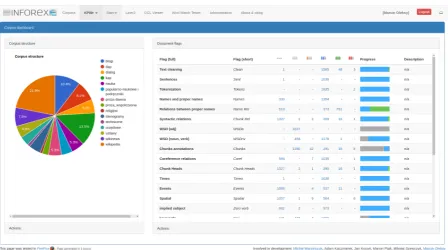
Figure 1: Corpus overview
2.7 Document Visualisation
Inforex can handle documents in two formats: plain text and XML. For XML documents it is possible to display their content in a visually for-mated way. This allows to highlight the document structure what improves the user experience while browsing and annotating documents. Sample visu-alizations of different types of documents are pre-sented in Figure3.
2.8 Document Description
Inforex supports four types of information units which can be used to describe documents content:
1. Metadata — an information unit which is assigned to whole document (author name, document creation time, source, etc.).
2. Annotation — an information unit which is assigned to a sequence of words in the doc-ument content. Each annotation is described with a category (categories can be organized in a hierarchy) and a set of attributes. The set of attributes depends on the semantic inter-pretation of the annotation category. For in-stance, for named entities it can be a lemma, for temporal expressions it can be a normal-ized value of the expression and for event mentions it can be an event modality.
3. Relation — an information unit which is as-signed to a pair of annotations. It is a directed link between two annotations of some cate-gory.
4. Frame — an information unit which is as-signed to a set of annotations. Frame consists of a set of annotations with roles assigned to them. This type of structure can be used for event annotations (LCD,2005).
3 Recent Improvements
In the following sections we present the recent ma-jor improvements of Inforex system.
3.1 Modern Layout
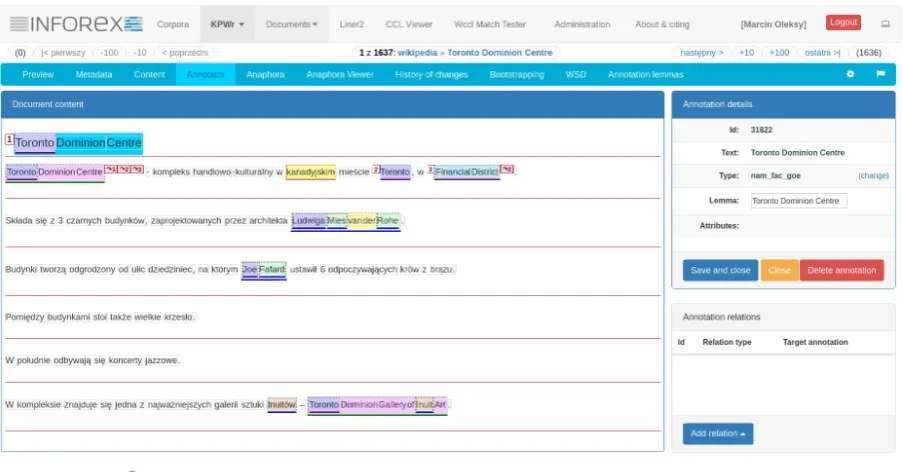
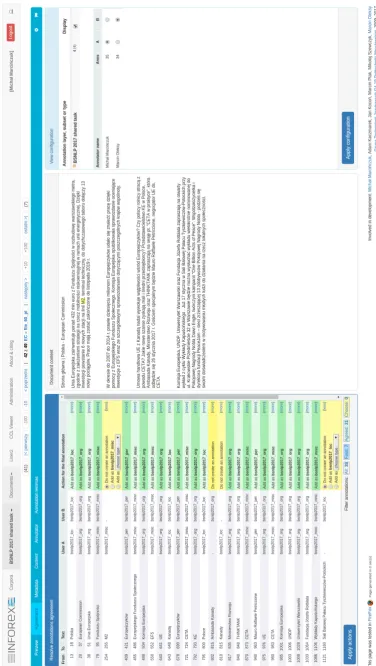
Figure 2: Document annotation view
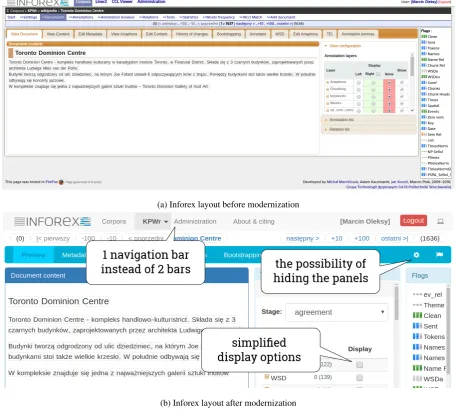
layout is presented in Figure4.
3.2 Annotation Agreement
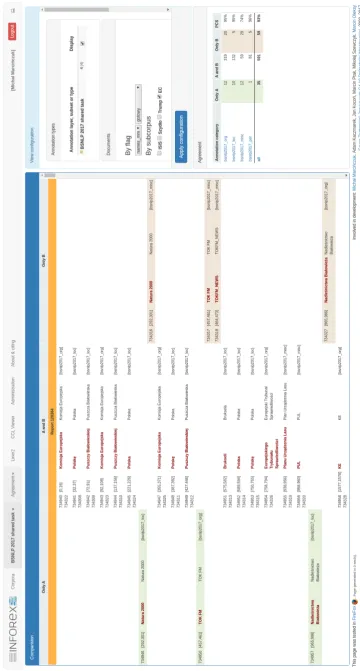
Reliability is a key value in the creation of a good quality corpora for learning and testing of NLP tools. The current version of Inforex en-ables simultaneous and independent annotation of the same text sample by more than one annota-tor. Moreover, the annotation process coordina-tor may keep track of inter-annotacoordina-tor agreement between two raters thanks to theAgreement mod-ulewhich uses Positive Specific Agreement (PSA) measure (Hripcsak and Rothschild, 2005) to cal-culate the reliability (see Figure5). View config-uration gives the opportunity to define annotation layers, subsets or categories, users and set of doc-uments that have to be analysed. The coordina-tor may also specify a comparison mode: whether the system has to take into consideration the an-notation boundaries only or boundaries and cat-egories. It may also include annotation lemmas. Inter-annotator agreement is a very important in-dicator of the annotation guidelines clearness or cohesion. Keeping track of changes of the inter-annotator agreement between subsequent annota-tion iteraannota-tions helps to improve the quality of the annotation guidelines. Agreement module makes that process easier and faster.
Inforex system also supports the curation of
the annotation process (see Figure 6). The cu-rator can make choice between two different an-notators choices, or even reject consistent but in-correct annotations. Thanks to that module sev-eral Gold Standard projects were performed e.g. Polish Coreference Corpus (Ogrodniczuk et al., 2015) for definite descriptions annotation and Pol-ish Spatial Texts corpus for the annotation of dy-namic spatial expressions.
4 Applications
In the following sections we present several prac-tical applications of the Inforex system.
4.1 KPWr
(a) Facebook conversation.
(b) Wikipedia article. (c) Hebrew document.
Figure 3: Sample documents visualizations
TimeML was added. These categories refer to a date, time of a day, duration and frequency of an event. Annotation lemmas perspective was used to provide normalized temporal expressions, reveal-ing that the term ’lemma’ in Inforex may func-tion as a broad concept. The Annotator perspec-tive from the system also supports event annota-tion (Marci´nczuk et al., 2015). There are seven coarse-grained categories of events, i.e. action, state, reporting, perception, aspectual, intensional action and intensional state. The categorization was based on the TimeML guidelines with some modifications. It also involved creation of a new annotation scheme. The flexibility in adding new annotation layers (setting the new annotation cate-gories) is one of the most important features. The possibility of establishing relations between anno-tated fragments is not less relevant. It was cru-cial e.g. for spatial expressions annotation. Its main goal was to extract different ways of dis-tributing spatial information throughout a sentence by reviewing the lexical and grammatical signals of various relations between objects (Marci´nczuk et al.,2016).
4.2 European Legal Texts
As practice shows, although Inforex was primar-ily developed for Polish language, that it can also be used to work with documents written in other languages. Inforex features and functionalities are useful e.g. in examining current EU official lit-erature related to territorial development and ur-ban planning. Authors of this analysis first up-loaded EU Territorial Policy Documents 2007-20168to CLARIN-PL DSpace repository and then imported it to the Inforex system. The corpus was divided into 4 subcorpora and prepared for qual-itative and quantqual-itative analysis. The review of the key strands enabled the identification of its 8 core values (or principles) for further statistical and contextual analysis. After ascribing to each category its textual triggers (word forms), a quan-titive analysis using words frequency lists gener-ated by Inforex was performed. Manual annota-tion with a newly defined set of annotaannota-tions and Annotation Browser with the possibility of export-ing data were a great support for qualitative anal-ysis — detailed contextual analanal-ysis of the corpus focused on two crucial categories: Participation
andCommunication.
(a) Inforex layout before modernization
(b) Inforex layout after modernization
Figure 4: Inforex layouts comparison
4.3 Hebrew Corpus
Inforex supports manual annotation even if the text is written using non-latin alphabet and a right-to-left notation. One of the system applications was related to a corpus of Hebrew gravestone inscrip-tions. It also involved the creation of a new an-notation schema. Categories referred mainly to the pragmatic level of communication (e.g. initial and final expressions, laudations, death circum-stances). The perspective of annotation lemmas was used to enter Polish translations of annotated fragments, which also showed that the lemma at-tribute may be a broad term especially in the case of practical applications of the system.
4.4 Other Corpora
Inforex was used to prepare the training data dur-ing participation in BSNLP 2017 shared task on
Michał Marci´nczuk, Jan Koco´n, and Maciej Janicki.
2013. Liner2 – a customizable framework for
proper names recognition for Polish. In Robert Bembenik, Lukasz Skonieczny, Henryk Rybinski, Marzena Kryszkiewicz, and Marek Niezgodka, ed-itors, Intelligent Tools for Building a Scientific In-formation Platform, pages 231–253.
Michał Marci´nczuk, Monika Za´sko-Zieli´nska, and Ma-ciej Piasecki. 2011. Structure annotation in the pol-ish corpus of suicide notes. In Ivan Habernal and
V´aclav Matouˇsek, editors, Text, Speech and
Dia-logue, Springer Berlin Heidelberg, volume 6836 of
Lecture Notes in Computer Science, pages 419–426. Maciej Ogrodniczuk, Katarzyna Głowi´nska, Mateusz Kope´c, Agata Savary, and Magdalena Zawisławska.
2015. Coreference in Polish: Annotation,
Res-olution and Evaluation. Walter De Gruyter.
http://www.degruyter.com/view/product/428667. Adam Radziszewski and Maciej Piasecki. 2010. A
Pre-liminary Noun Phrase Chunker for Polish.
Proceed-ings of the Intelligent Information Systems pages 169–180.
Pavel Rychl´y. 2007. Manatee/bonito - a modular
corpus manager. In 1st Workshop on Recent
Ad-vances in Slavonic Natural Language Processing. Masarykova univerzita, Brno, pages 65–70.
M. Za´sko-Zieli´nska. 2013. Listy po˙zegnalne:
w poszukiwaniu lingwistycznych wyz-nacznik´ow autentyczno´sci tekstu. Quaestio.