Computational Linguistics and Chinese Language Processing
Vol. 18, No. 2, June 2013, pp. 57-84 57 © The Association for Computational Linguistics and Chinese Language Processing
Back to the Basic:
Exploring Base Concepts from the Wordnet Glosses
Chan-Chia Hsu
∗and Shu-Kai Hsieh
∗Abstract
There has been no consensus as to what constitutes a set of base concepts in the mental landscape. With the aim of exploring base concepts in Chinese, this paper proposes that frequently-occurring words in the glosses of a lexical resource such as the Chinese Wordnet can be seen as a candidate set of base concepts because the glosses use basic words. The present study identified 130 base concepts in Chinese. The Base Concepts in EuroWordNet were adopted as a reference for comparison. While only 44.6% of the base concepts identified in the present study have an equivalent in the set of Base Concepts of EuroWordNet, the other base concepts extracted by our gloss-based approach also reflect a certain degree of basicness. It is hoped that both the overlap and the difference between different sets of base concepts identified in different languages and by different approaches can deepen our understanding of the basic core in the mind. Additionally, it is also hoped that the set of base concepts identified in the present study can have computational as well as pedagogical applications in the future.
Keywords: Chinese Wordnet, EuroWordNet, Base Concept, Gloss
1.
Introduction
For the past few decades, a large body of research has been trying to touch on the basic core in the mind. Some studies (e.g., Wierzbicka, 1996) have aimed to figure out how a large number of concepts in the mind can be neatly organized with a basic set of concepts, leading us to the realm of human cognition. Furthermore, some studies have identified a set of base concepts that have had a wide range of computational applications.1 WordNet (Miller et al., 1990), for instance, is organized around a set of base concepts (i.e., SuperSenses), with which a large number of lexical items are associated through lexical relations. There have been many
∗ Graduate Institute of Linguistics, National Taiwan University, Taiwan
E-mail: [email protected]; [email protected]
1The term
base concept should be distinguished from other terms related to the notion of basicness in the
58 Chan-Chia Hsu & Shu-Kai Hsieh
approaches to exploring what is basic in the mind, but there has been no consensus as to what constitutes a set of base concepts universal to all human languages.
This study aims at providing a new perspective to identify a candidate set of base concepts in Chinese. Our data consist of the glosses in the Chinese Wordnet. Since the glosses in the Chinese Wordnet use basic words, words that occur frequently in the glosses of the Chinese Wordnet can be assumed to be reflective of a candidate set of base concepts. After data extraction and introspection, the resulting set of base concepts in the present study is compared with the set of Base Concepts proposed in the EuroWordNet project (Vossen et al., 1998). In selecting a set of base concepts, our method is based on the frequencies of words used in the glosses of the Chinese Wordnet, whereas the method adopted in the EuroWordNet project is based on the relations between synsets. It is thus noted that the set of Base Concepts in EuroWordNet is not seen as de facto, but as a reference. We use the Base Concepts in EuroWordNet as our reference because on the one hand, the Chinese Wordnet and EuroWordNet both derive from the WordNet framework, and on the other hand, the set of Base Concepts from EuroWordNet is based on many European languages. It is hoped that both the overlap and the difference between different sets of base concepts identified by different approaches can deepen our understanding of the basic core in the mind. Additionally, it is also hoped that the set of base concepts identified in the present study can have computational as well as pedagogical applications in the future.
This paper is organized as follows. Section 2 provides a comprehensive review of different approaches to the notion of basicness in the mind. Section 3 reviews the significance of glosses in different contexts. Section 4 introduces our experiment method and presents the set of base concepts identified in the present study. Section 5 discusses how our proposed set of base concepts in Chinese is different from that of EuroWordNet. Section 6 concludes the paper.
2.
Defining the Core Lexicon in Language and the Mind
Over the past few decades, there have been various approaches to the notion of basicness in the mental landscape. Some have created lists of lexical items as basic words, mainly for pedagogical purposes. Some, from a cognitive perspective, have selected different sets of basic concepts at different levels of abstraction (e.g., semantic primitives, base concepts, basic-level categories, and basic domains).
Back to the Basic: Exploring Base Concepts from the Wordnet Glosses 59
comprehensive review of different approaches to the notion of basicness in the mind will be given in the following.
2.1
Basic Words
One of the earliest efforts to address the notion of basicness in the lexicon is to identify a list of basic words, which is motivated by pedagogical needs.2 Many basic vocabulary lists have been proposed, ranging from 300 words to more than 2,000 words (e.g., Dolch, 1936; Gates, 1926; Hindmarsh, 1980; Lee, 2001; McCarthy, 1999; McCarthy & O’Dell, 1999; Ogden, 1930; West, 1953; Wheeler & Howell, 1930). With the rapid development of computational analyses, such lists are mostly based on frequency counts. They can serve as useful references for pedagogical purposes, such as the design of a syllabus and the development of a language proficiency test. The main problem with most basic vocabulary lists is that the raw data on which the frequency counts are based may not be representative enough. Additionally, since what counts as a word is an issue in itself, an insight is needed when it comes to word forms and lexicalized phrases (McCarthy, 1999).
2.2
Semantic Primitives
In the discussion of basicness in the mind, more abstract than basic words are semantic primitives, or semantic primes, which are pursued mainly in the theory of Natural Semantic Metalanguage (Goddard, 2002; Wierzbicka, 1972, 1996).3 A semantic primitive is basic in the sense that it is lexicalized in every language and that it cannot be defined or paraphrased in simpler terms. From a cognitive perspective, it is suggested that there is an innate set of semantic primitives representing “a universal set of fundamental human concepts” (Wierzbicka, 1996:13). Such a set is argued to be sufficient to define or paraphrase the entire vocabulary of a language. For example, the word envy can be defined as what follows (Wierzbicka, 1996:161):
2 In previous studies, the terms “basic vocabulary”, “sight vocabulary”, “core vocabulary”, and the like
are sometimes interchangeable.
3 For others who have adopted a similar approach in languages other than English, see Goddard
60 Chan-Chia Hsu & Shu-Kai Hsieh
X feels envy. =
sometimes a person thinks something like this: something good happened to this other person it didn’t happen to me
I want things like this to happen to me because of this, this person feels something bad X feels something like this
Specifically, Goddard (2002:14) has presented 58 “atoms of meaning”, such as I, YOU, SOMEONE, PEOPLE, SOMETHING/THING, and BODY. Unfortunately, this line of research is open to valid criticisms due to a lack of a sound method of identifying semantic primitives (e.g., Riemer, 2006).
2.3
Base Concepts in WordNets
The notion of basicness has played a vital role in many lexical resources, such as English WordNet (Miller et al., 1990),4 EuroWordnet (Vossen et al., 1998), and BalkaNet (Cristea et al., 2002). In the architecture of English WordNet, synonyms are assembled in a set called synset (synonymous set). During the development of WordNet, synsets are organized into 45 lexicographical files based on the criteria of syntactic category and logical groupings. The 45 names of lexicographical files (e.g., noun.feeling and verb.cognition) are also called SuperSenses, which reveal the base concepts from the developer’s perspectives.5
As an extension of the wordnet model, EuroWordnet further proposes a set of 1,024 core synsets - called Base Concepts - that are extracted from four wordnets and translated into the closest WordNet 1.5 synsets. To keep the set balanced and shared among these wordnets, 164 core base concepts of them were selected in terms of their (more) relations with other concepts and (higher) position in the hierarchy.6 Based on the Base Concepts identified for EuroWordNet, the BalkaNet project adopts a similar approach and selects a set of Base Concepts by focusing on five Balkan languages, including Bulgarian, Greek, Romanian,
4 WordNet is open to the general public at http://wordnet.princeton.edu. 5 For the format of the lexicographical files, see
wninput(5WN) at
http://wordnet.princeton.edu/wordnet/man/lexnames.5WN.html.
6 The 164 Base Concepts in EuroWordnet consist of 66 concrete synsets (nouns) and 98 abstract synsets
(nouns and verbs). For more details, refer to
Back to the Basic: Exploring Base Concepts from the Wordnet Glosses 61
Serbian, and Turkish.7
2.4
Basic-level Concepts
In the context of cognitive linguistics, many experiments have shown that in taxonomies of concrete objects, there is one level of abstraction that is regarded as basic which distinguishes them from higher and lower-level categories (Cruse, 1977, 2000; Rosch et al., 1976). For instance, in answering the question what's that in the garden, most speakers choose to say a dog rather than its hypernym an animal or its hyponym an Alsatian (Cruse, 1977:153-154). Compared with the ANIMAL concept and the ALSATIAN concept, the DOG concept is seen as a basic-level concept in that both its internal homogeneity and its distinctness from neighboring concepts are greater. The presumption of basic-level concepts has been also supported by language acquisition studies, which reveal a large percentage of children’s early words are basic-level terms (Ungerer & Schmid, 2006).8
Some recent computational approaches have attempted to use algorithms to automatically extract the basic-level concepts. Izquierdo et al. (2008) automatically select basic-level concepts from WordNet based on the relations between synsets, while Lin (2010) proposes an algorithm that can automatically identify the cognitive level of a noun in WordNet based on the ability of the noun to form compounds and the position of the noun in a hierarchical chain.
A relevant discussion with regard to basic conceptualization in the study of language and the mind has been focused on basic domains, which derive directly from human embodied experience (e.g., sensory and subjective experience). Cognitive Grammar argues that a concept should be understood in terms of another more general, inclusive concept (Langacker, 1987:148). For example, the concept RADIUS makes sense only when it is viewed against the concept CIRCLE. Such a relationship can form a chain (i.e., the concept CIRCLE should be understood in terms of the concept SPACE), but the chain cannot be endless. Some concepts of a general nature, such as SPACE, TIME, and QUANTITY, are basic domains because they are characterized by a high degree of inclusiveness.
3.
Definitions and Glosses in Different Contexts
Defining a word can be as easy as pointing to something the word refers to, but it can be as difficult as formulating “an ideal hypothetical norm which is a sort of compromise between
7 For more information about the BalkaNet project, refer to http://www.dblab.upatras.gr/balkanet/ and
http://nlp.lsi.upc.edu/web/index.php?option=com_content&task=view&id=53 for similar works (e.g., Atserias et al., 2003).
8 Note that
basic-level concepts should not be confused with Base Concepts. While a Base Concept
62 Chan-Chia Hsu & Shu-Kai Hsieh
the generalization of inadequate experiential reality and a projected reality which is yet to be attained in its entirety” (Bernard, 1941:510). In different contexts, definitions and glosses play different roles, which will be reviewed in the following.
3.1
Definitions in Linguistic Semantics
When it comes to the meaning of a word, people may first think of looking up its definition in a dictionary. A good understanding of word meaning relies thus upon how the word can be defined. In the discussion of linguistic semantics, there are many ways to define the meaning of a word (Riemer, 2010:65-79). A definition can be ostensive, relational, or extensional, and it sometimes combines different approaches.
First, perhaps the most obvious, people often define a word in terms of ostension, i.e., by pointing out the objects a word denotes. Though an ostensive definition is useful for concrete nouns, it may cause many difficulties when used to define verbs, adjectives, adverbs, and function words (e.g., prepositions).
Second, a definition can place a word in relation to other words or events. For example, a word can be defined by its synonyms. However, since there are few absolute synonyms, the identity between a word and its synonyms can be challenged. A word can also be defined through an event, which is regarded as a typical context for the word. For instance, the verb scratch can be defined as “the type of thing you do when you are itchy” (Riemer, 2010:66). The weakness of such a definition is that it works only when the addressee of the definition can accurately infer the intended meaning on the basis of the given cue. That is, someone may not get the correct meaning of scratch if he or she does not scratch when feeling itchy.
Third, a definition can be extensional, and one of the commonest strategies is to define by a broad class (i.e., genus) and some distinguishing features (i.e., differentia). For example, man (in the sense of “human being”) can be loosely defined as “rational animal” (Riemer, 2010:67). One of the main problems of a genus-differentia definition is that it can be too abstract to its addressee (Landau, 2001:167).
In summary, there are many strategies to define the meaning of a word, and all of them have their limitations. More generally, the difficulty of a definitional approach to semantics is that defining the meaning of a piece of language with more language in the same system will inevitably end up circular (Portner, 2005:4).
3.2
Definitions in Lexicography
Back to the Basic: Exploring Base Concepts from the Wordnet Glosses 63
lexicon, offering the phonological, syntactic, and semantic information of a lexical item. On the other hand, a dictionary cannot be as detailed as the mental lexicon, and lexicographers need to decide what to include in a dictionary. Compiling a dictionary is seen as a craft, for lexicographers aim to make the most of their limited resources to cater for the communicative and pedagogical needs of dictionary users.
One of the most challenging and contentious aspects of the compilation of a dictionary is the creation of definitions for a dictionary entry. The term ‘definition’ would be a misnomer if it implies that word’s meaning can be precisely pinned down. There are many strategies to define a word in a dictionary (Lew & Dziemianko, 2006). The most traditional definition in a dictionary is the analytical model, i.e., the genus-differentia definition. A definition composed in this way typically consists of two elements: the genus expression that locates the definiendum in the proper semantic category, and the differentia (or plural form differentiae) that indicates the information which makes the word differ from other words of the same semantic category. For example, appraisal is defined as “a statement or opinion judging the worth, value or condition of something” (taken from Longman Dictionary of Contemporary English), where ‘a statement or opinion’ is the genus expression and the postmodifying expression ‘judging the worth, value or condition of something’ is the differentia. In many cases, it is not an easy task to produce a genus-differentia definition, and such a definition can be difficult for a dictionary user to understand. Another way to define a word in a dictionary is to adopt a contextual definition. A contextual definition of ‘appraisal’, for example, is stated as “if you make an appraisal of something, you consider it carefully and form an opinion about it” (taken from Collins COBUILD Advanced Dictionary of English).
Our concern here is not to deal with the issue of ‘what makes a good definition’, or search for the underlying necessary and sufficient conditions, but to evaluate the way the principle of maximal economy is reflected in a definition sentence. Zgusta (1971) proposed a list of criteria, one of which states that the lexical definition “should not contain words more difficult to understand than the word defined” (cited in Landau, 2001:157). In addition, the effectiveness of dictionary definitions can be evaluated from the user’s viewpoint (Cumming et al., 1994; Lew & Dziemianko, 2006). For example, language learners have been found to prefer contextual definitions to analytical ones (Cumming et al., 1994). An interim conclusion thus worth drawing is that a definition should contain no more words than necessary, consistent with the demands of intelligibility and information-transfer (Atkins & Rundell, 2008).
3.3
Glosses in Lexical Resources
64 Chan-Chia Hsu & Shu-Kai Hsieh
essential components in the construction of lexical resources like WordNet, for they have been proved to be highly useful in discovering semantic relations and word sense disambiguation tasks (Kulkarni et al., 2010). In the design of WordNet, word lemmas are grouped into synsets (synonymous sets), which are organized as a lexical network by a wide range of lexical relations (e.g., hyponymy and antonymy). The role of glosses is thus to explain explicitly the meaning of synsets which lexically encode the human concepts.
Most of the lexical relations that connect synsets are conceptually inclusive relations, such as hypernymy-hyponymy and holonymy-meronymy, which make the wordnet architecture a hierarchical conceptual structure, or a lexicalized ontology.9 In connection with ontology studies, Jarrar (2006) suggests that glosses can be of great use in an ontology. For example, glosses are easier to understand than formal representations, so ontology developers from different fields can rely on glosses to a certain degree when they communicate. However, as Jarrar (2006) further suggests, a gloss in an ontology is not intended to provide some general comments about a concept, as a traditional definition in a dictionary does. Instead, a gloss in an ontology functions in an auxiliary manner, providing some factual knowledge that is critical to the understanding of a concept but can be difficult to formalize explicitly and logically. As a consequence, glosses in a wordnet as a lexical ontology are different from dictionary definitions.
Jarrar (2006) provides some guidelines for writing a gloss in an ontology. First, an ontology gloss should start with the upper type of the concept being defined. Second, an ontology gloss should be in the form of a proposition. Third, an ontology gloss should emphasize the distinguishing features of the concept being defined. Fourth, an ontology gloss can include some examples. Fifth, an ontology gloss should be consistent with the formal representation of the concept being defined. Sixth, an ontology gloss should be sufficient and clear. Generally, the glosses in the Chinese Wordnet fulfill the above criteria. Here is an example taken from the Chinese Wordnet:
(1)
書:有 文字 或 圖畫 的 出版品
shu you wenzi huo tuhua DE chubanpin ‘book: a publication with words or pictures’
9 According to Gruber (1995:908), an ontology is “an explicit specification of a conceptualization”, and
Back to the Basic: Exploring Base Concepts from the Wordnet Glosses 65
While the gloss looks like a genus-differentia definition in a dictionary, they are different in essence. The definition techniques used by lexicographers to indicate differentiation come from various conventions, while the ontology gloss aims to make a minimal commitment to conceptualization, which meets the need of logical conciseness. The study of the basic lexicon is crucially different from other tasks of lexical acquisition in that unlike the latter where the broad coverage is at issue, the former requires instead fine-grained data to be explored. In summary, we propose that glosses in lexical resources are the best source to study the core component of the basic lexicon.
4.
Glosses in the Chinese Wordnet
In this section, we introduce the method of how we used gloss data from the Chinese Wordnet to touch on base concepts.10 The glosses in the Chinese Wordnet can be seen as a sample corpus with fine-grained lexical information. Figure 1 shows the similar type frequency distribution of 46 part-of-speeches (proposed by the Sinica Corpus) in the Sinica Corpus and the Chinese Wordnet, respectively.
Figure 1. The POS distribution of the Sinica Corpus and the Chinese Wordnet
4.1
Extracting a Set of Frequently-occurring Words from the Glosses of
the Chinese Wordnet
In our first experiment, we extracted a set of frequently-occurring words from the glosses of the Chinese Wordnet. Since a gloss in the Chinese Wordnet uses basic words instead of giving a scientific definition that can be incomprehensible to the user (Huang, 2008:22), the frequently-occurring words extracted from our experiment may reflect a certain degree of basicness in Chinese and even be considered to constitute a candidate set of base concepts in
10 The Chinese Wordnet (CWN) has been released as an open-source project, and is freely available at
66 Chan-Chia Hsu & Shu-Kai Hsieh
Chinese. Our method and the results will be presented in the following.
Our first step was to extract all the glosses from the Chinese Wordnet. For glosses containing more than one period (i.e., the Chinese period 。), we discarded words preceding the first period because what precedes the first period in a gloss only provides grammatical properties. Next, what remained in the glosses was segmented by a segmentation system developed by Chinese Knowledge and Information Processing (CKIP). Consider the following example:
(2)
學生: 普通名詞。 在 學校 系統 內 讀書 學習 的 人。
xuesheng putongmingci zai xuexiao xitong nei dushu xuexi DE ren ‘student: someone who studies and learns in a school system’
In the example (2), putong mingci ‘common noun’ would be discarded, and then the remaining part of the definition would be segmented as shown in the example. With all the glosses segmented, a frequency wordlist with 19,852 words was created.
We manually checked the wordlist for meta-linguistic terms (e.g., xingrong ‘modify’) and mis-chunked words (e.g., *dedanwei ‘DE + unit’). Only the first 1,000 words on the wordlist were checked both because our resources were limited and because it was assumed that core base concepts should be at the top of the frequency wordlist. For meta-linguistic terms, we chose to exclude them because it is obvious that they do not represent base concepts. For mis-chunked words, we either manually segmented them further (*dedanwei → de danwei) or simply excluded them if they were not comprehensible (e.g., dejian ‘DE-simple’).11 In such cases as dedanwei, the resulting words together with their frequencies were added to the wordlist if they had not been listed there, or the frequencies of the resulting words were revised. Take de danwei as an example. There were 328 de danwei in the data, and both de and danwei had been on the wordlist before dedanwei was further segmented. The frequencies of de and danwei were revised to be 15,653 and 1,178, respectively.12
To demonstrate how our new approach to identifying a set of base concepts is different from others, we decided to compare the resulting set in the present study with the set from EuroWordNet. Since all the Base Concepts in EuroWordNet are nouns and verbs, we focus on only nouns and verbs in the present study.13 Therefore, words that were not tagged with V or
11 The morpheme
jian does not stand alone in Modern Chinese.
12 Originally, there were 15,325 tokens of
de and 850 tokens of danwei in the data.
Back to the Basic: Exploring Base Concepts from the Wordnet Glosses 67
N were removed from our wordlist. In the end, the frequency wordlist based on the glosses of the Chinese Wordnet contained 17,018 words.
In EuroWordNet, there are 98 abstract Base Concepts and 66 concrete Base Concepts. However, as Vossen et al. (1998) have admitted, some synsets appear to represent almost the same concepts (e.g., {form 1; shape 1} and {form 6; pattern 5; shape 5}), so the number of the Base Concepts in EuroWordNet can be reduced. In such cases, we merged the two (or more) synsets into one. Finally, we retained 130 Base Concepts, i.e., 75 abstract concepts and 55 concrete concepts. Therefore, we also selected the top 130 words from our wordlist to be a candidate set of base concepts in Chinese.
When we examined the 130 words high on our wordlist, we found that some words needed to be replaced. First, two proper nouns were unsurprisingly high on the wordlist based on the Chinese Wordnet, i.e., Zhongguo ‘China’ (32th) and Taiwan ‘Taiwan’ (67th). The two words were excluded from the candidate set of base concepts. Second, since we focused on typical nouns and verbs, words typically not functioning as nouns or as verbs were excluded from our wordlist, regardless of their tags. Words discarded at this stage included:
(3)
負面 fumian ‘negative’
多 duo ‘numerous’
主要 zhuyao ‘primary’
大 da ‘big’
相同 xiangtong ‘the same’
小 xiao ‘small’
容易 rongyi ‘easy’
固定 guding ‘stable; fixed’
用來 yonglai ‘use…to…’
可以 keyi ‘can’
所在 suozai ‘a place where…’
受到 shoudao a passivization marker in Chinese
68 Chan-Chia Hsu & Shu-Kai Hsieh
In (3), words such as da and xiao usually function as adjectives, and zhuyao and rongyi can be adjectives or adverbs. The word meiyou, originally tagged as a noun, functions as a polarity operator rather than as a noun or as a verb.14
Another issue in the selection of the top 130 words from the glosses of the Chinese Wordnet was near-synonymy. For example, both yong ‘use’ and shiyong ‘use’ were high on our wordlist, and so were wuti ‘object’ and wupin ‘object’. In deciding whether two words did represent the same concept, the present study counted on the Chinese Wordnet rather than on our own introspection or on further analyses. In the former case, yong ‘use’ and shiyong ‘use’ bear the relation of synonymy in the Chinese Wordnet. Therefore, the two words were considered to represent the same concept, and the frequencies of the two words were added together. In the latter case (i.e., wuti and wupin), the two words do not bear the relation of synonymy in the Chinese Wordnet. As a consequence, the two words were listed separately on our wordlist (cf. Table 1).
Finally, five words had two tags and were listed separately. They were gaibian ‘change’, shiyong ‘use’, jisuan ‘calculate’, chansheng ‘produce, generate’, and fasheng ‘happen’. They are verbs in their literal sense, but they can be nominalized. For the five words, the frequencies of the verbal use and the nominal use were added together, and each word was listed only once in our wordlist since both the verbal use and the nominal use represent the same concept.
When words were excluded or merged with another word, another word immediately lower on the wordlist went up until we got 130 words. The final set of base concepts extracted from the glosses of the Chinese Wordnet on the basis of the frequencies will be presented and discussed in the following section.
14 In the glosses of the Chinese Wordnet, a typical context where
guding occurs is as follows:
職業 婦女: 有 固定 工作 的 女子。
zhiye funu you guding dongzuo de nuzi career woman have stable job DE female
career woman: a female who has a stable job
In this example, guding is used to modify gongzuo ‘job’. We decided to exclude guding because it
functions neither as a typical noun nor as a typical verb, but typically functions as a modifier in the glosses of the Chinese Wordnet. Additionally, the tag automatically assigned to guding (i.e., Nv) is
Back to the Basic: Exploring Base Concepts from the Wordnet Glosses 69
4.2
Results
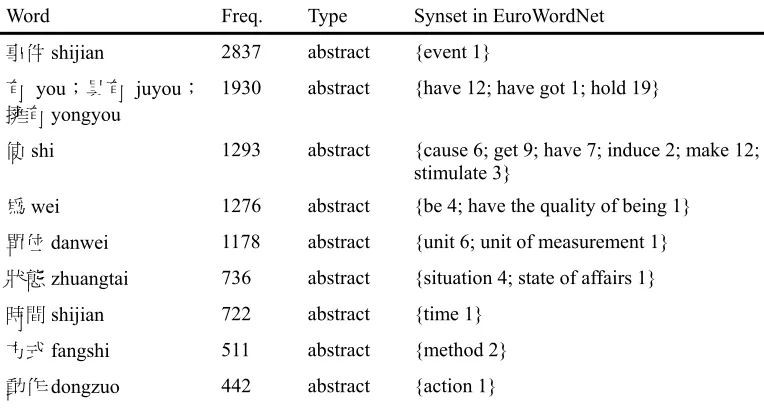
By extracting words that occur frequently in the glosses of the Chinese Wordnet, we obtained a candidate set of words representing base concepts in Chinese. We attempted to map each word extracted in the present study to a Base Concept in EuroWordNet, either concrete or abstract. Note that if a word has no equivalent in the set of Base Concepts in EuroWordNet, we simply translated the word into English. Moreover, those without an equivalent in the set of Base Concepts in EuroWordNet were classified on the basis of their semantic characteristics. Table 1 summarizes the results. Following Table 1, each category will be presented.
Table 1. The distribution of base concepts extracted in the present study
CATEGORY # %
match abstract 34 26.2%
concrete 24 18.5%
non-match
positions 7 5.4%
people 6 4.6%
organizations 6 4.6%
measurement 5 3.8%
other (abstract) nouns 28 21.5%
other abstract verbs 20 15.4%
TOTAL 130 100.0%
z Abstract concepts mapped to the Base Concepts of EuroWordNet
Word Freq. Type Synset in EuroWordNet
事件shijian 2837 abstract {event 1}
有 you;具有 juyou; 擁有yongyou
1930 abstract {have 12; have got 1; hold 19}
使shi 1293 abstract {cause 6; get 9; have 7; induce 2; make 12;
stimulate 3}
為wei 1276 abstract {be 4; have the quality of being 1}
單位danwei 1178 abstract {unit 6; unit of measurement 1}
狀態zhuangtai 736 abstract {situation 4; state of affairs 1}
時間shijian 722 abstract {time 1}
方式fangshi 511 abstract {method 2}
70 Chan-Chia Hsu & Shu-Kai Hsieh
活動huodong 382 abstract {activity 1}
關係guanxi 359 abstract {relation 1}
空間kongjian 357 abstract {space 1}
方向fangxiang 331 abstract {direction 7; way 8}
內容neirong 317 abstract {cognitive content 1; content 2; mental object 1}
改變gaibian 316 abstract {change 11}
結果jieguo 314 abstract {consequence 3; effect 4; outcome 2; result 3; upshot 1}
做zuo 314 abstract {act 12; do something 1; move 19; perform an action 1; take a step 2; take action 1; take measures 1; take steps 1)
知識zhishi 291 abstract {cognition 1; knowledge 1}
訊息xunxi 277 abstract {message 2; content 3; subject matter 1; substance 4}
發展fazhan 258 abstract {development 1}
特質tezhi 219 abstract {quality 1}
運動yundong 219 abstract {motion 5; movement 6}
情況qingkuang 205 abstract {situation 4; state of affairs 1}
形狀xingzhuang 204 abstract {form 1; shape 1}
能力nengli 186 abstract {ability 2; power 3}
給gei 179 abstract {furnish 1; provide 3; render 12; supply 6}
做出zuochu 171 abstract {act 12; do something 1; move 19; perform an action 1; take a step 2; take action 1; take measures 1; take steps 1}
態度taidu 160 abstract {attitude 3; mental attitude 1}
顏色yanse 155 abstract {color 2; coloring 2}
方法fangfa 153 abstract {method 2}
變化bianhua 151 abstract {alter 2; change 12; vary 1}
時段shiduan 146 abstract {amount of time 1; period 3; period of time
1; time period 1}
從事congshi 143 abstract {act 12; do something 1; move 19; perform
an action 1; take a step 2; take action 1; take measures 1; take steps 1}
Back to the Basic: Exploring Base Concepts from the Wordnet Glosses 71
z Concrete concepts mapped to the Base Concepts of EuroWordNet
Word Freq. Type Synset in EuroWordNet
物體wuti 1382 concrete {inanimate object 1; object 1; physical
object 1}
人ren 1353 concrete {human 1; individual 1; mortal 1; person 1;
someone 1; soul 1}
位置weizhi 598 concrete {location 1}
物品wupin 521 concrete {inanimate object 1; object 1; physical
object 1}
動物dongwu 518 concrete {animal 1; animate being 1; beast 1; brute
1; creature 1; fauna 1}
建築物jianzhuwu 511 concrete {building 3; edifice 1}
身體shenti 413 concrete {body 3; organic structure 1; physical
structure 1}
部份bufen 369 concrete {part 3; portion 2}
數量shuliang 369 concrete {amount 1; measure 1; quantity 1; quantum
1}
地方difang 336 concrete {place 13; spot 10; topographic point 1}
表面biaomian 329 concrete {surface 1}
地點didian 315 concrete {location 1}
團體tuanti 256 concrete {group 1; grouping 1}
植物zhiwu 235 concrete {flora 1; plant 1; plant life 1}
金錢jingqian 232 concrete {money 2}
文字wunzi 226 concrete {word 1}
食物shiwu 213 concrete {food 1; nutrient 1}
部位bufen 206 concrete {part 3; portion 2}
物質wuzhi 197 concrete {matter 1; substance 1}
作品zuopin 170 concrete {creation 3}
液體yiti 158 concrete {liquid 4}
區qu 158 concrete {part 9; region 2}
物wu 153 concrete {inanimate object 1; object 1; physical
object 1}
裝置zhuangzhi 146 concrete {device 2}
72 Chan-Chia Hsu & Shu-Kai Hsieh
z Positions
Word Freq. Translation
中zhong 1764 middle
上shang 573 up
後hou 277 back; behind
內nei 277 inside
以上yishang 243 above
下xia 192 down
正面zhengmian 155 front, facade
The seven words do not have an equivalent in the set of Base Concepts of EuroWordNet though their potential hypernyms such as weizhi and difang can be mapped to synsets such as {location 1} and {place 13; spot 10; topographic point 1}. We suggest that the seven concepts may be regarded as a set of basic locative concepts in Chinese. Generally, the set exhibits a degree of symmetry in the sense that some words (i.e., shang and xia; zhengmian and hou) form pairs.
It is noted that the word yishang is ambiguous. It can mean ‘above’ or ‘more than’, and the latter sense is not locative. However, since we assume that the ‘more than’ sense might metaphorically derive from the ‘above’ sense, yishang is assigned to the present category.
z People
Word Freq. Translation
姓xing 1025 name
他人taren 685 others
自己ziji 386 self
女子nuzi 174 woman
對方duifang 170 the other party
男子nanzi 164 man
Back to the Basic: Exploring Base Concepts from the Wordnet Glosses 73
z Organizations
Word Freq. Translation
機構jigou 314 institute
國家guojia 264 country
政府zhengfu 261 government
組織zuzhi 256 organization
大學daxue 221 university
學校xuexiao 140 school
Our method extracted more words denoting organizations and institutes than the EuroWordNet project. However, some words extracted in our experiment are not hierarchically high. For example, daxue is just a subcategory of the educational institute.
z Measurement
Word Freq. Translation
一yi 1264 one
計算jisuan 747 calculate
兩liang 541 two
個ge 918 a measure word
種zhong 404 kind, type
Measurement is an important dimension of semantic primitives. Wierzbicka (1996:44-47) has identified a few quantifiers as semantic primitives. Our experiment identified five words that are not included in the Base Concepts of EuroWordNet: yi and liang are quantifiers, and both are also identified in Wierzbicka (1996) (i.e., ONE and TWO); ge and zhong are common classifiers in Chinese; jisuan is a typical verb in the measurement domain.
We could further categorize the remaining 28 nouns that are not in the set of Base Concepts of EuroWordNet but were extracted in our design. However, that would be of no more significance than creating a miscellaneous category like this, for the remaining subcategories might contain as few as one or two members. For instance, we could create a category for perception, which is intuitively an important dimension. However, in the present study, a category for perception may include no more than shengyin and wundu.
74 Chan-Chia Hsu & Shu-Kai Hsieh
z Other (abstract) nouns
Word Freq. Translation
對象duixiang 5322 object; target
事物shiwu 797 event; object
範圍fanwei 525 range
程度chengdu 481 extent, degree
其他qita 454 other
行為xingwei 393 behavior
者zhe 334 someone; something
事shi;事情shiqing 330 thing; job; business
聲音shengyin 329 sound; voice
工具gongju 280 tool
條件tiaojian 252 condition
不同butong 233 difference
標準biaozhun 228 standard
文化wenhua 209 culture
功能gongneng 184 function
目標mubiao 177 goal
古代gudai 177 ancient times
系統xitong 170 system
參考點cankaodian 169 reference point
目的mudi 163 purpose
領域lingyu 161 field, domain
西元xiyuan 154 A.D.
情緒qingxu 152 emotion
生物shengwu 149 creature
心理xinli 145 mentality
地位diwei 143 status
溫度wendu 140 temperature
過程guocheng 138 process
Back to the Basic: Exploring Base Concepts from the Wordnet Glosses 75
Almost all of the members in this category are abstract concepts. The only exception is shengwu. Its literal translation would be “creature”, so shengwu can seemingly be mapped to the synset {animal 1; animate being 1; beast 1; brute 1; creature 1; fauna 1}. Actually, the two concepts are not the same. In English, creature refers to a living organism that can move voluntarily, as the gloss in WordNet states. On the other hand, shengwu in Chinese refers to any living organism, whether it can move voluntarily or not. Therefore, we decided not to map the two concepts together.
z Other (abstract) verbs
Word Freq. Translation
進行jinxing 940 proceed
用yong;使用shiyong 723 use
發生fasheng 539 happen, occur
產生chansheng 458 produce
位於weiyu 333 be located
達到dadao 311 achieve
製成zhicheng 308 be made into
得到dedao 294 get
感到gandao 244 feel
影響yingxiang 234 influence
移動yidong 234 move
預期yuqi 225 expect
接受jieshou 200 accept
開始kaishi 187 start
取得qude 184 gain
超過chaoguo 167 exceed
失去shiqu 161 lose
發出fachu 155 give off
作為zuowei 150 serve as
工作gongzuo 147 work (v.)
76 Chan-Chia Hsu & Shu-Kai Hsieh
5.
Discussion
Generally, as Table 1 shows, 72 words (55.4%) extracted from the glosses of the Chinese Wordnet have no equivalent in the set of Base Concepts in EuroWordNet. This suggests that our gloss-based approach can yield a very different set of base concepts from the set in EuroWordNet.
On the one hand, the 58 words that were identified in our experiment and could be mapped to an equivalent in EuroWordNet may be considered to represent concepts at the core of the mental landscape. These concepts can be singled out by different approaches, and they are prominent not only in the languages in EuroWordNet but also in Chinese. Therefore, the concepts represented by the 58 words may be regarded as basic in the mind.
On the other hand, words that were identified in our experiment but could not be mapped to any equivalent in EuroWordNet also reflect a certain degree of basicness in the mind. Like the Base Concepts in EuroWordNet, most of them are abstract and represent concepts hierarchically higher than basic level categories (cf. Section 2). Additionally, many of them (e.g., chengdu ‘extent’, fanwei ‘range’) are like basic domains (cf. Section 2), exhibiting a high degree of inclusiveness. Nevertheless, our gloss-based approach did obtain a few words representing sister concepts that are hierarchically lower, such as shang/xia ‘up/down’ and nanzi/nuzi ‘male/female’.
In effect, it is natural that base concept sets vary from approach to approach. The number of the concepts in the lexicon is considerably larger than the number of base concepts. Take the present study for example. There are 17,018 candidate words in our frequency wordlist, and we only identify 130 words as potential base concepts in Chinese. The potential base concepts scatter around the mental lexicon; when we take a different perspective, adopt a different method, and have a different focus, we are very likely to extract a completely different set of concepts. That is why a study like the present one is of great significance. To really touch on the basic core of the mental landscape, we need to try a wide variety of approaches. Concepts surviving in different approaches can be seen as basic in the mind. On the other hand, since the pool is always much larger than the target set, concepts identified only by a certain approach are still significant rather than random and can reflect a certain extent of basicness from a certain perspective.
Back to the Basic: Exploring Base Concepts from the Wordnet Glosses 77
concepts and their comparison may give a different picture accordingly. Second, the gloss language is an issue in a gloss-based study like the present one. As a matter of fact, many words in our frequency wordlist have a low frequency, and many of such words can be replaced by other words with a higher frequency (An, 2009:172-182). If that is done, there will be fewer words in our wordlist, and the frequencies of some words will become higher. Therefore, a different set of base concepts in Chinese could be yielded.
Intriguingly, our method identified 58 words that could be mapped to an equivalent in EuroWordNet. This number is exactly the same as that of Goddard’s (2002:14) “atoms of meaning”. Additionally, this number is not far from that of the SuperSenses in WordNet (i.e., 48). Though the contents of the sets vary from approach to approach and need further examination, there appears to exist a certain range regarding the number of base concepts in the lexicon.
Alternatively, in previous research, the most commonly used words are determined by word occurrence frequency, but frequency is heavily dependent on the corpus selected. If the corpus is not large enough, or not balanced, the result will not be accurate enough. Recent developments of distributional models in semantics have shown success in this aspect. For example, Zhang et al. (2004) propose a metric for the distribution of words in a corpus. This will be left for future research.
6.
Conclusion
Identifying the basic words that represent the core concepts is a crucial issue in lexicography, psycholinguistics, and language pedagogy. Recent NLP applications as well as ontologies also recognize the urgent need for the methodology for extracting and measuring the core concepts. In this paper, we have illustrated how glosses in a wordnet can be used to extract base concepts and provide evidence for basic conceptual underpinnings.
There is scope for the research to be extended in the direction of empirically-grounded evaluation of the results. We are also interested in putting the analysis in the contexts of multilingual wordnets. These are left as items for our future studies.
Acknowledgments
78 Chan-Chia Hsu & Shu-Kai Hsieh
References
An, H.-L. (2009). Studies of Chinese Gloss Language: Theories and Applications. Shanghai:
Xuelin. (安華林。《漢語釋義元語言:理論與應用研究》。上海:學林出版社。)
Atkins, B. T. S., & Rundell, M. (2008). The Oxford Guide to Practical Lexicography. Oxford: Oxford University Press.
Atserias, J., Villarejo, L., Rigau, G., Salgado, J. G., & Unibertsitatea, E. H. (2003). Integrating and porting knowledge across languages. In Proceeding of Recent Advances in Natural Language Processing, 31-37.
Bernard, L. L. (1941). The definition of definition. Social Forces, 19, 500-510.
Cristea, D., Puscasu, G., Postolache, O., Galiotou, E., Grigoriadou, M., Charcharidou, A., Papakitsos, E., Selimis, S., Stamou, S., Krstev, C., Pavlovic-Lazetic, G., Obradovic, I., Vitas, D., Cetinoglu, O., Tufis, D., Pala, K., Pavelek, T., Smrz, P., Koeva, S., & Totkov, G. (2002). Definition of the Local Base Concepts and Their Mapping with the ILI Records. Deliverable D.4.1, WP4, BalkaNet, IST-2000-29388.
Cruse, A. (1977). The pragmatics of lexical specificity. Journal of Linguistics, 13, 153-164. Cruse, A. (2000). Meaning in Language: An Introduction to Semantics and Pragmatics.
Oxford: Oxford University Press.
Cumming, G., Cropp, S., & Sussex, R. (1994). On-line lexical resources for language learners: Assessment of some approaches to word formation. System, 22, 369-377.
Dolch, E. W. (1936). A basic sight vocabulary. The Elementary School Journal, 36, 456-460. Gates, A. I. (1926). A Reading Vocabulary for the Primary Grades. New York: Teachers
College, Columbia University.
Goddard, C. (2002). The search for the shared semantic core of all languages. Meaning and Universal Grammar: Theory and Empirical Findings (Vol. I), ed. by C. Goddard & A. Wierzbicka, 5-40. Amsterdam: John Benjamins. 5-40.
Gruber, T. R. (1995). Toward principles for the design of ontologies used for knowledge sharing. International Journal of Human-Computer Studies, 43, 907-928.
Hindmarsh, R. (1980). Cambridge English Lexicon. Cambridge: Cambridge University Press. Huang, C.-R. (2008). Principles of Distinguishing and Describing Word Senses in Chinese (5th
ed.). Taipei: Academia Sinica. (黃居仁。《意義與詞義》系列《中文詞彙意義的區辨
與描述原則》第五版。臺北:中央研究院。)
Izquierdo, R., Suárez, A., & Rigau, G. (2008). Exploring the automatic selection of basic level concepts. In Proceedings of the International Conference on Recent Advances on Natural Language Processing.
Jarrar, M. (2006). Towards the notion of gloss, and the adoption of linguistic resources in formal ontology engineering. In Proceedings of the 15th International World Wide Web Conference, 497-503.
Back to the Basic: Exploring Base Concepts from the Wordnet Glosses 79
Landau, S. I. (2001). Dictionaries: The Art and Craft of Lexicography (2nd ed.). Cambridge: Cambridge University Press.
Langacker, R. W. (1987). Foundations of Cognitive Grammar (Vol. I). Stanford: Stanford University Press.
Lee, D. Y. W. (2001). Defining core vocabulary and tracking its distribution across spoken and written genres. Journal of English Linguistics, 29, 250-278.
Lew, R., & Dziemianko, A. (2006). A new type of folk-inspired definition in English monolingual learners’ dictionaries and its usefulness for conveying syntactic information. International Journal of Lexicography, 19, 225-242.
Lin, S.-Y. (2010). A Computational Study of the Basic Level Nouns in English. Unpublished doctoral dissertation, National Taiwan Normal University.
McCarthy, M. J. (1999). What constitutes a basic vocabulary for spoken communication? Studies in English Language and Literature, 1, 233-249.
McCarthy, M. J., & O’Dell, F. (1999). English Vocabulary in Use: Elementary. Cambridge: Cambridge University Press.
Miller, G. A., Beckwith, R., Fellbaum, C., Gross, D., & Miller, K. J. (1990). Introduction to WordNet: An on-line lexical database. International Journal of Lexicography, 3, 235-244.
Ogden, C. K. (1930). Basic English: A General Introduction with Rules and Grammar. London: Paul Treber.
Portner, P. H. (2005). What Is Meaning? Fundamentals of Formal Semantics. Malden: Blackwell.
Riemer, N. (2006). Reductive paraphrase and meaning: A critique of Wierzbickian semantics. Linguistics and Philosophy, 29, 347-379.
Riemer, N. (2010). Introducing Semantics. Cambridge: Cambridge University Press.
Rosch, E., Mervis, C., Gray, W., Johnson, D., & Boyes-Braem, P. (1976). Basic objects in natural categories. Cognitive Psychology, 8, 382-439.
Ungerer, F., & Schmid, H. J. (2006). An Introduction to Cognitive Linguistics. New York: Longman.
Vossen, P., Bloksma, L., Rodriguez, H., Climent, S., Calzolari, N., Roventini, A., Bertagna, F., Alonge, A., & Peters, W. (1998). The EuroWordNet Base Concepts and Top-Ontology. Deliverable D017D034D036 EuroWordNet LE2-4003.
West, M. (1953). A General Service List of English Words. London: Longman.
Wheeler, H. E., & Howell, E. A. (1930). A first-grade vocabulary study. The Elementary School Journal, 31, 52-60
Wierzbicka, A. (1972). Semantic Primitives. (Translated by A. Wierzbicka & J. Besemeres) Frankfurt: Athenäum Verlag.
80 Chan-Chia Hsu & Shu-Kai Hsieh
Zhang, H., Huang, C., & Yu, S. (2004). Distributional consistency: A general method for defining a core lexicon. Proceedings of the 4th International Conference on Language Resources and Evaluation, 1119-1222.
82 Chan-Chia Hsu & Shu-Kai Hsieh
point 12 possession 1 product 2 representation 3 surface 1
surface 4 (= surface 1)
symbol 2 way 4 word 1 worker 2 writing 4
84 Chan-Chia Hsu & Shu-Kai Hsieh
idea 2
improvement 1 increase 7 information 1 kill 5
knowhow 1 travel 1
magnitude relation 1 message 2
method 2 movement 6 need 5
need 6 (= need 5) path 3 (= course 7) phenomenon 1 production 1
property 2 (= attribute 1) psychological feature 1 quality 1 (= attribute 1) ratio 1
relation 1
relationship 1 (= relation 1) relationship 3 (= relation 1) remember 2
remove 2 represent 3 say 8 sign 3
situation 4 (= condition 5) social relation 1
space 1
spacing 1 (= space 1) spatiality 1 (= space 1) state 1 (= condition 5) structure 4
time 1 unit 6