Finding Relevant Concepts for Unknown Terms
Using a Web-based Approach
Chen-Ming Hung1 and Lee-Feng Chien1, 2
1. Institute of Information Science, Academia Sinica 2. Dept. of Information Management, National Taiwan University
Taipei, Taiwan
[email protected] and [email protected]
Abstract. Previous research on automatic thesaurus construction most focused on extracting relevant terms for each term of concern from a small-scale and domain-specific corpus. This study emphasizes on utilizing the Web as the rich and dynamic corpus source for term association estimation. In addition to extracting relevant terms, we are interested in finding concept-level information for each term of concern. For a single term, our idea is that to send it into Web search engines to retrieve its relevant documents and we propose a Greedy-EM-based document clustering algorithm to cluster them and determine an appropriate number of relevant concepts for the term. Then the keywords with the highest weighted log likelihood ratio in each cluster are treated as the label(s) of the associated concept cluster for the term of concern. With some initial experiments, the proposed approach has been shown its potential in finding relevant concepts for unknown terms.
1.
INTRODUCTION
It has been well recognized that a thesaurus is crucial for representing vocabulary knowledge and helping users to reformulate queries in information retrieval systems. One of the important functions of a thesaurus is to provide the information of term associations for information retrieval systems. Previous research on automatic thesaurus construction most focused on extracting relevant terms for each term of concern from a small-scale and domain-specific corpus. In this study, there are several differences extended from the previous research. First, this study emphasizes on utilizing the Web as the rich and dynamic corpus source for term association estimation. Second, the thesaurus to be constructed has no domain limitation and is pursued to be able to benefit Web information retrieval, e.g. to help users disambiguate their search interests, when users gave poor or short queries. Third, in addition to extracting relevant terms, in this study we are interested in finding concept-level information for each term of concern. For example, for a term “National Taiwan University” given by a user, it might contain some different but relevant concepts from users’ point of view, such as “main page of National Taiwan University”, “entrance examination of NTU”, “the Hospital of NTU”, etc. The purpose of this paper is, therefore, to develop an efficient approach to deal with the above problem.
In information retrieval researching area, extracting concepts contained in one text always plays a key role. However, in traditional way, if the text is too short, it is almost impossible to get enough information to extract the contained concepts. In this paper, utilizing the abundant corpora on the World Wide Web, we attempt to find the concepts contained in arbitrary length of topic-specific texts, even only a single term. For a single term, our idea is that to send it into Web search engines to retrieve its relevant documents, and a Greedy-EM-based document clustering algorithm is developed to cluster these documents into an appropriate number of concept clusters, with the similarity of the documents. Then the terms with the highest weighted log likelihood ratio in each clustered document group are treated as the label(s) of the associated concept cluster for the term of concern. To cluster the extracted documents into an unknown number of concept mixtures is important, because it is hard to know an exact number of concepts should be contained in a single term.
Compared with general text documents, a single term is much shorter and typically do not contain enough information to extract adequate and reliable features. To assist the relevance judgment between short terms, additional knowledge sources would be exploited. Our basic idea is to exploit the Web. Adequate contexts of a single term, e.g., the neighboring sentences of the term, can be extracted from large amounts of Web pages. We found that it is convenient to implement our idea using the existent search engines. A single term could be treated as a query with a certain search request. And its contexts are then obtained directly from the highly ranked search-result snippets, e.g., the titles and descriptions of search-result entries, and the texts surrounding matched terms.
with
α
in (0,1), where 11 |
{ , }
K t
K w C
θ
+θ
α
+
=
is the modeling of newly added mixtureC
K+1 and1
(
D
T,
K)
φ
θ
+ is the likelihood inC
K+1. IfL
K+1(
D
T)
<L
K(
D
T)
, then stop the allocation of new mixture; otherwise, reallocate a new one.3.2.2 Initialize Allocated Mixture
In [7], a vector space model, initializing the newly added mixture is to calculate the first derivation with respect to
α
and to assume that the covariance matrix is a constant matrix. However, in our proposed probability framework, it is much more complicated because of a large amount of word probabilities,|
{
}
tt k
w C
w
θ
∀
. Thus, we take the approximation ofα
in [6] asα =
0.5
for K=1 andα =
2 /(
K
+
1)
for2
K
≥
. The initialization of1
|
{
}
K t
t
w C
w
θ
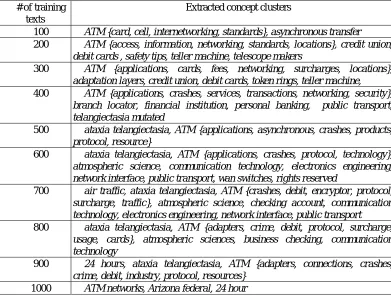
We assume that too many retrieved documents will cause noises, but too few won't contain enough information about this unknown term. Thus, the appropriate number of retrieved relevant documents has to be decided. “ATM” in dictionary has six hidden semantics, which are “Automated Teller Machine”, “Asynchronous Transfer Mode”, “Act of Trade Marks”, “Air Traffic Management”, “Atmosphere” and “Association of Teachers of Mathematics” respectively. Table 1 shows the bi-gram extracted concepts via number of retrieved texts.
Table 1: Extracted concept clusters in “ATM” with respect to different numbers of retrieved relevant terms
# of training texts
Extracted concept clusters
100 ATM {card, cell, internetworking, standards}, asynchronous transfer
200 ATM {access, information, networking, standards, locations}, credit union, debit cards , safety tips, teller machine, telescope makers
300 ATM {applications, cards, fees, networking, surcharges, locations}, adaptation layers, credit union, debit cards, token rings, teller machine,
400 ATM {applications, crashes, services, transactions, networking, security}, branch locator, financial institution, personal banking, public transport, telangiectasia mutated
500 ataxia telangiectasia, ATM {applications, asynchronous, crashes, products, protocol, resource}
600 ataxia telangiectasia, ATM {applications, crashes, protocol, technology}, atmospheric science, communication technology, electronics engineering, network interface, public transport, wan switches, rights reserved
700 air traffic, ataxia telangiectasia, ATM {crashes, debit, encryptor, protocol, surcharge, traffic}, atmospheric science, checking account, communication technology, electronics engineering, network interface, public transport
800 ataxia telangiectasia, ATM {adapters, crime, debit, protocol, surcharge, usage, cards}, atmospheric sciences, business checking, communication technology
900 24 hours, ataxia telangiectasia, ATM {adapters, connections, crashes, crime, debit, industry, protocol, resources}
1000 ATM networks, Arizona federal, 24 hour
Except the six hidden semantic clusters in ATM, some other concept clusters were also extracted, e.g. “Amateur Telescope Maker” because of “telescope makers” extracted and “Ataxia Telangiectasia Mutated” because of “ataxia teleangiectasia” extracted. One more interesting thing is that the more retrieved relevant documents not necessarily direct to the more extracted concept clusters (Figure 1). This phenomenon is caused from the extra noises extracted from the more relevant documents. The extra noises will not only worsen the performance of the greedy EM algorithm but also generate improper relevant terms from the clustered groups, which will not be considered as “good” categories manually. For each test term, considering the time cost and the marginal gain of extracted concepts, 600 relevant documents were retrieved from Web. Of course 600 relevant documents are not always appropriate for all cases, but for convenience, it was adopted.
4.2 Data Description
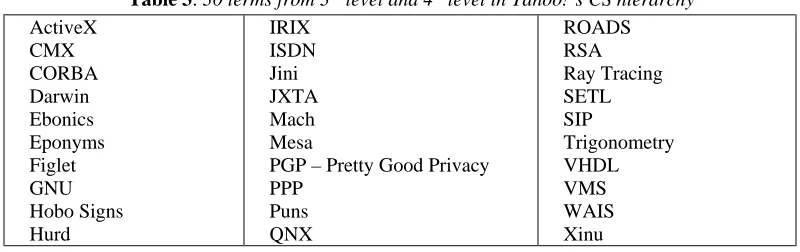
The experiments took the "Computer Science" hierarchy in Yahoo! as the evaluation. There were totally 36 concepts in second level in the "Computer Science" hierarchy (as in Table 2), 177 objects in the third level and 278 objects in fourth level, all rooted at the concept "Computer Science". We divided the objects in third-level and fourth-third-level into three groups: full articles, which were the Web pages linked from Yahoo!'s website list under the Computer Science hierarchy, short documents, which were the site description offered by Yahoo!, and text segments, which were the directory names. We randomly chose 30 text segments from the third-level plus the fourth-level objects. The 30 proper nouns are shown in Table 3.
4.3 Relevant-Concepts Extraction
In Section 3, the Greedy EM algorithm is treated as the unsupervised learning method which clusters retrieved relevant documents to extract hidden concepts for each test term.
Table 3: 30 terms from 3rd level and 4th level in Yahoo!’s CS hierarchy ActiveX
CMX CORBA Darwin Ebonics Eponyms Figlet GNU Hobo Signs Hurd
IRIX ISDN Jini JXTA Mach Mesa
PGP – Pretty Good Privacy PPP
Puns QNX
ROADS RSA Ray Tracing SETL SIP
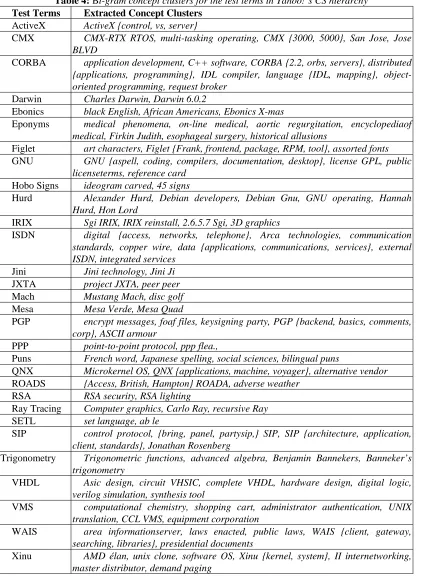
Table 4 shows the extracted bi-gram concept clusters for the 30 randomly chosen CS terms; this means that only bi-gram terms in the retrieved documents were extracted. The number of hidden concept clusters in each term was determined automatically by the Greedy EM algorithm.
Table 4: Bi-gram concept clusters for the test terms in Yahoo!’s CS hierarchy Test Terms Extracted Concept Clusters
ActiveX ActiveX {control, vs, server}
CMX CMX-RTX RTOS, multi-tasking operating, CMX {3000, 5000}, San Jose, Jose BLVD
CORBA application development, C++ software, CORBA {2.2, orbs, servers}, distributed {applications, programming}, IDL compiler, language {IDL, mapping}, object-oriented programming, request broker
Darwin Charles Darwin, Darwin 6.0.2
Ebonics black English, African Americans, Ebonics X-mas
Eponyms medical phenomena, on-line medical, aortic regurgitation, encyclopediaof medical, Firkin Judith, esophageal surgery, historical allusions
Figlet art characters, Figlet {Frank, frontend, package, RPM, tool}, assorted fonts
GNU GNU {aspell, coding, compilers, documentation, desktop}, license GPL, public licenseterms, reference card
Hobo Signs ideogram carved, 45 signs
Hurd Alexander Hurd, Debian developers, Debian Gnu, GNU operating, Hannah Hurd, Hon Lord
IRIX Sgi IRIX, IRIX reinstall, 2.6.5.7 Sgi, 3D graphics
ISDN digital {access, networks, telephone}, Arca technologies, communication standards, copper wire, data {applications, communications, services}, external ISDN, integrated services
Jini Jini technology, Jini Ji
JXTA project JXTA, peer peer
Mach Mustang Mach, disc golf
Mesa Mesa Verde, Mesa Quad
PGP encrypt messages, foaf files, keysigning party, PGP {backend, basics, comments, corp}, ASCII armour
PPP point-to-point protocol, ppp flea.,
Puns French word, Japanese spelling, social sciences, bilingual puns
QNX Microkernel OS, QNX {applications, machine, voyager}, alternative vendor
ROADS {Access, British, Hampton} ROADA, adverse weather
RSA RSA security, RSA lighting
Ray Tracing Computer graphics, Carlo Ray, recursive Ray
SETL set language, ab le
SIP control protocol, {bring, panel, partysip,} SIP, SIP {architecture, application, client, standards}, Jonathan Rosenberg
Trigonometry Trigonometric functions, advanced algebra, Benjamin Bannekers, Banneker’s trigonometry
VHDL Asic design, circuit VHSIC, complete VHDL, hardware design, digital logic, verilog simulation, synthesis tool
VMS computational chemistry, shopping cart, administrator authentication, UNIX translation, CCL VMS, equipment corporation
WAIS area informationserver, laws enacted, public laws, WAIS {client, gateway, searching, libraries}, presidential documents
Xinu AMD élan, unix clone, software OS, Xinu {kernel, system}, II internetworking, master distributor, demand paging
developed by Benjamin Bannekers. Again, our proposed approach caught that “Darwin” is not only a British Naturalist but also the name of graphical software.
Even though the experiment result shows encouraging performance, the result was still bothered by many duplicated and noisy aspects. For example, “CORBA” means “Common Object Request Broker Architecture”; however, “C++ software” and “application development” actually only provide vague or not necessary information about “CORBA”. This was caused by the “too much effort” of the Greedy EM algorithm, which clusters the retrieved mixtures into too many groups.
5. CONCLUSIONS AND FUTURE WORK
We have presented a potential approach to finding relevant concepts for terms via utilizing World Wide Web. This approach obtained an encouraging experimental result in testing Yahoo!’s computer science hierarchy. However, the work needs more in-depth study. As what we mentioned previously, choosing the word with the highest weighted log likelihood ratio as the concept of a clustered group after the Greedy EM algorithm does not provide enough representative. In addition, one concept usually contains many domains, e.g. “ATM” contains security, teller machine, transaction cost, and etc. Thus, distinguishing the extracted keywords into a certain concept still needs human intervention. On the other hand, in order to solve the problem of “too much effort” of the Greedy EM algorithm, we need to modify it with another convergence criterion.
References
[1] A. Jain, M. Murty, and P. Flynn. Data Clustering: A Review. In ACM Computing Surveys, 31(3), September 1999.
[2] C. C. Huang, S. L. Chuang and L. F. Chien. LiveClassifier: Creating Hierarchical Text Classifiers through Web Corpora, WWW (2004).
[3] E. Rasmussen. Clustering Algorithms. In Information Retrieval Data Structures and Algorithms, William Frakes and Ricardo Baeza-Yates, editors, Prentice Hall, 1992.
[4] E. Voorhees. The Cluster Hypothesis Revisited. In Proceedings of SIGIR 1985, 95-104.
[5] J. J. Verbeek, N. Vlassis and B. J. A. Krose. Efficient Greedy Learning of Gaussian Mixture Models.
Neural Computation, 15 (2), pp.469-485, 2003.
[6] J. Q. Li and A. R. Barron. Mixture Density Estimation. In Advances in Neurarl Information processing Systems 12, The MIT Press, 2000.
[7] N. Vlassis and A. Likas A Greedy Algorithm for Gaussian Mixture Learning. In Neural Processing Letters (15), pp. 77-87, 2002.
[8] P. Willett. Recent Trends in Hierarchic Document Clustering: A Critical Review. In Information Processing and Management, 24(5), 577-597, 1988.
[9] T. Joachims. A Probabilistic Analysis of the Rocchio Algorithm with TFIDF for Text Categorization. In