PEER EDITING USING WEB BASED INSTRUCTION: A QUANTITATIVE APPROACH
*,1
Vijayakumar, S. and
1
Research
2
Dean, School of Social Sciences and Humanities, B.S. Abdur Rahman University
ARTICLE INFO ABSTRACT
The impact of web based peer editing is
literature in writing pedagogy suggested that such kind of study is not carried out before. To investigate this phenomenon third semester students N=14 were randomly chosen with a control group of N=7 a
treatment. Both wrote an argumentative essay before the intervention. The control group was exposed to manual peer editing and the experimental group was subjected to the web
Both the groups’ resubmitted their revised essays. A paired sample‘t’ test was employed to measure the performance levels of the revised scripts. The results revealed that the experimental group outperformed the control group in t
sufficient and efficacious than hours spent on manual peer editing.
Copyright © 2015 Vijayakumar and Shahin Sultana.This
unrestricted use, distribution, and reproduction in any medium, provided the original work is properly cited.
INTRODUCTION
Technology is actively implemented in universities across India for classroom interaction. Instructors are embracing collaborative strategies to foster writing skills. There is no dearth of research in peer learning. According to Boud (1999) Peer learning involves participants learning from and with each other in both formal and informal ways. It includes mutual benefits and a sharing of knowledge, ideas and experience among participants. The emphasis is on learning rather than teaching. (p.4) seminal research has been carried out by researchers in this domain. Black, and M
Green, (2007.) Anderson, and Boud, (1996) Boud, Cohen, Sampson, J. (Eds.) (2014). Topping, K. J. (2005).However research in the area of web based peer editing is scarce. This paper makes an effort to address that lacunae in writing pedagogy. Nepomuceno (2011) remarks that among the four macro-skills of language, writing appears to be the most difficult. (p. 93). “Writing well in a second language would require higher cognitive skills to be able to write well” (Magno, 2009). Since accuracy in writing is a cognitively demanding guided peer editing in a web based environment will foster better writing skills. The efficacy of peer editing in a web based environment is tested using a pretest posttest experimental design.
*Corresponding author:Vijayakumar, S.,
Research Scholar, B.S. Abdur Rahman University
ISSN: 0975-833X
Vol.
Article History:
Received 25th September, 2015
Received in revised form
10th October, 2015
Accepted 27th November, 2015
Published online 30th December,2015
Citation: Vijayakumar, S. and Shahin Sultana, A
Journal of Current Research, 7, (12), 24535-24539
Keywords:
Peer Editing,
Technology Integration, Academic Writing, Web Based Instruction
RESEARCH ARTICLE
PEER EDITING USING WEB BASED INSTRUCTION: A QUANTITATIVE APPROACH
Vijayakumar, S. and
2Dr. Shahin Sultana, A.
Research Scholar, B.S. Abdur Rahman University
School of Social Sciences and Humanities, B.S. Abdur Rahman University
ABSTRACT
The impact of web based peer editing is an under researched area in L2 writing. International literature in writing pedagogy suggested that such kind of study is not carried out before. To investigate this phenomenon third semester students N=14 were randomly chosen with a control group of N=7 and an experimental group of N=7.Both the groups were subject to pretest, posttest treatment. Both wrote an argumentative essay before the intervention. The control group was exposed to manual peer editing and the experimental group was subjected to the web
Both the groups’ resubmitted their revised essays. A paired sample‘t’ test was employed to measure the performance levels of the revised scripts. The results revealed that the experimental group outperformed the control group in terms of conventions and style. Perhaps, a single online tool is sufficient and efficacious than hours spent on manual peer editing.
This is an open access article distributed under the Creative Commons use, distribution, and reproduction in any medium, provided the original work is properly cited.
Technology is actively implemented in universities across classroom interaction. Instructors are embracing collaborative strategies to foster writing skills. There is no dearth of research in peer learning. According to Boud (1999) Peer learning involves participants learning from and with each al and informal ways. It includes mutual benefits and a sharing of knowledge, ideas and experience among participants. The emphasis is on learning rather than teaching. (p.4) seminal research has been carried out by and MacKenzie, (2008) Boud, (1996) Boud, Cohen, and Topping, K. J. (2005).However research in the area of web based peer editing is scarce. This lacunae in writing agogy. Nepomuceno (2011) remarks that among the four ppears to be the most . (p. 93). “Writing well in a second language would ble to write well” cy in writing is a cognitively demanding guided peer editing in a web based environment will foster better writing skills. The efficacy of peer editing in a web based environment is tested using a pretest posttest
The implications of the study are dealt with in the final part of the paper.
Theoretical underpinning
The theoretical underpinning of the study is based on the principles of Peer assisted language learning. Peer Assisted language learning provides an ubiquitous learning environment that is initiated by collaboration and effective learning of contents. (Zhang, Jin, and Lin, 2005).
help the learners to improve their grades and retention and helps them to adapt to university life. (Ca
Hurne, 2004). Peer editing fosters deep engagement and deep learning. It also helps them to solidify their understanding. (Micari, Streitweiser and Light, 2006, p.270) “Students who spend more time on task especially with others, are more likely to learn, and in turn, more likely to stay.” (Tinto, 2006, p.3). Daiute (1985) conducted a com
writing with and without computers.
He found no difference both in quality or quantity of revision in student’s writing. The implication of his study is that CALL atmosphere does not bring discernible improvement in student’s writing. Strickland (1987) conducted a case study on similar lines. His findings were in stark contrast to Daiute’s findings as he found CALL intervention to be highly effective.
Available online at http://www.journalcra.com
International Journal of Current Research
Vol. 7, Issue, 12, pp.24535-24539, December, 2015
INTERNATIONAL
Vijayakumar, S. and Shahin Sultana, A.2015. “Peer editing using web based instruction: a quantit
24539.
z
PEER EDITING USING WEB BASED INSTRUCTION: A QUANTITATIVE APPROACH
School of Social Sciences and Humanities, B.S. Abdur Rahman University
an under researched area in L2 writing. International literature in writing pedagogy suggested that such kind of study is not carried out before. To investigate this phenomenon third semester students N=14 were randomly chosen with a control nd an experimental group of N=7.Both the groups were subject to pretest, posttest treatment. Both wrote an argumentative essay before the intervention. The control group was exposed to manual peer editing and the experimental group was subjected to the web based tool paper rater. Both the groups’ resubmitted their revised essays. A paired sample‘t’ test was employed to measure the performance levels of the revised scripts. The results revealed that the experimental group erms of conventions and style. Perhaps, a single online tool is sufficient and efficacious than hours spent on manual peer editing.
is an open access article distributed under the Creative Commons Attribution License, which permits
The implications of the study are dealt with in the final part of
The theoretical underpinning of the study is based on the principles of Peer assisted language learning. Peer Assisted language learning provides an ubiquitous learning environment that is initiated by collaboration and effective learning of Lin, 2005). Peer editing activities help the learners to improve their grades and retention and helps them to adapt to university life. (Capstick, Fleming and Peer editing fosters deep engagement and deep them to solidify their understanding. (Micari, Streitweiser and Light, 2006, p.270) “Students who spend more time on task especially with others, are more likely to learn, and in turn, more likely to stay.” (Tinto, 2006, p.3). Daiute (1985) conducted a comparative study on student writing with and without computers.
He found no difference both in quality or quantity of revision in student’s writing. The implication of his study is that CALL atmosphere does not bring discernible improvement in iting. Strickland (1987) conducted a case study on similar lines. His findings were in stark contrast to Daiute’s findings as he found CALL intervention to be highly effective. INTERNATIONAL JOURNAL OF CURRENT RESEARCH
Eldred and Toner (2003) echoed views similar to Strickland. They believed that CALL instruction has both pedagogical and epistemological significance. The studies reviewed above provide enough evidence to the fact that peer editing activities not only fosters collaboration but helps in effective learning.
MATERIALS AND METHODS
The research question that guided the study was To what extend will the web based peer editing activities enable the experimental group to improve their overall structure compared to the control group who are exposed to traditional classroom based peer editing? The study was conducted at B.S. Abdur Rahman University in south India. 14 students from Aeronautical engineering took part in the study comprising of 7 students from the control group and 7 students from the experimental group. The students were asked to write an argumentative essay on the topic “virtual classrooms and teacher based classrooms” They were supposed to argue which is better and why? The student’s first draft was collected. As a pair activity the student’s were asked to edit each other’s work. They were asked to edit for structure and language features. The students were asked to return their drafts after correction with specific comments to improve their drafts. The teacher again evaluated the scripts. He read the revised drafts aloud with comments.
[image:2.595.343.525.124.268.2]After that the students of the control group were given instruction and checklist on how to check the errors. A description on the kind of errors they have to look for is given below. After the instructional phase and peer editing activity they were made to rewrite their essays.
Fig. 1. Mind map of the Peer editing instruction given to the control group
[image:2.595.89.515.370.563.2]As the figure above exemplifies the students were instructed to look for appropriate spelling errors, grammar errors such as wrong use of tenses, articles and prepositions. They were also asked to check for appropriate punctuation, syntax, and sentence structure.
[image:2.595.95.513.418.793.2]On the other hand the experimental group was not given any check list and instructions. They were asked to type the revised essays in the word document. They exchanged the essays and peer edited using the web based on line tool paper rater. After peer editing the experimental group redrafted their scripts. Both the revised scripts of the control group and the experimental group were evaluated.
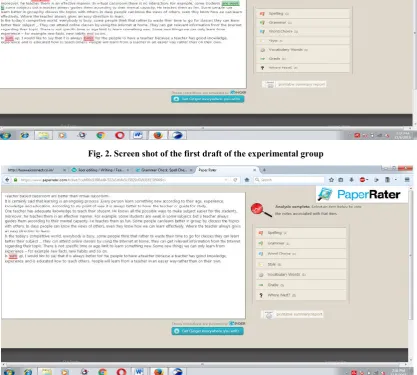
The instruction for the control group took place in the traditional classrooms. The instruction for the experimental study took place at the multimedia language lab which had 30 networked systems. The performance sample of the first draft and the peer edited draft of the experimental group is given below for evidence. The screen shots given above indicates the improvement in performance of the first draft and peer edited draft. The first draft given in screen shot 2 indicates a lot of spelling and grammatical errors. The peer edited draft given in screen shot 3 represents the evidence of improvement. As one could see there is only one error after peer editing. The efficacy of the web based peer editing is evident.
Data analysis and interpretation
The data was analyzed using SPSS version 17, and Microsoft Excel. The paired samples t-test is employed to compare the means of the pretest and post test scores. In this case it was used to test if the posttest conditions of two different conditions are the same. The first condition was class room peer editing and the second condition was web based peer editing. To test the efficacy of web based intervention a null hypothesis was formulated. The ‘t’ test significance was set at alpha value of 0.5
Null Hypothesis
There is no discernible difference in the performance of the control group which is exposed to class room peer editing compared to the experimental group which is exposed to web based peer editing.
Data analysis of the pretest scores of the control and the experimental group
The table one given above represents the tabulation of pretest marks of the control and experimental group. Column two represents the marks of the control group and column three represents the marks of the experimental group. The maximum score awarded is 10 and the minimum is 0.The fourth column indicates the score difference.
The next two columns stand for difference in mean deviation and standard deviation. The overall mean difference is 0.07. It is clear from the mean difference that the experimental group has not outperformed the control group. Hence it can be ascertained that there is homogeneity between the two groups. To increase the validity and test the null hypothesis a paired sample t test is conducted. The formula used to calculate the null hypothesis and the equation is given below.
Null Hypothesis
H0: UD = U1 - U2 = 0, where UD equals the mean of the
population of difference scores across the two measurements.
24537 International Journal of Current Research, Vol. 7, Issue, 12, pp.24535-24539, December, 2015
Table 1. Tabulation of pretest marks
S.No Control group Pretest Experimental Group Pretest Difference Dev (Diff - M) Sq. Dev
1 3.5 4 0.5 0.43 0.18
2 4 3.5 -0.5 -0.57 0.33
3 4.5 4.0 -0.5 -0.57 0.33
4 3 3.5 0.5 0.43 0.18
5 5 5.5 0.5 0.43 0.18
6 4.5 4 -0.5 -0.57 0.33
7 4 4.5 0.5 0.43 0.18
[image:3.595.92.511.457.546.2]M=0.07 S: 1.71
Table 2. Tabulation of post test marks
.No Control group Post test Experimental group Post test Difference Dev (Diff - M) Sq. Dev
1 5 6 1 -0.79 0.62
2 5.5 7 1.5 -0.29 0.08
3 5 7.5 2.5 0.71 0.51
4 4.5 7 2.5 0.71 0.51
5 6 8 2 0.21 0.05
6 5 7 2 0.21 0.05
7 5.5 6.5 1.0 -0.79 0.62
M: 1.79 S: 2.43
Table 3. Comparative analysis of all groups
Samples Control group-Pretest Experimental group-Pretest Control group-Pretest Experimental group-Pretest
Count 7 7 7 7
Sum 28.5 29 36.5 49
[image:3.595.98.502.576.663.2]Equation
T-Values of control group Significance level=0.05 Two tailed test. Post test-signifance
Difference Scores Calculations
Mean: 0.07
μ = 0
S2 = SS⁄df = 1.71⁄(7-1) = 0.29
S2M = S2⁄N = 0.29⁄7 = 0.04
SM = √S
2
M = √0.04 = 0.20
T-value Calculation
t = (M - μ)⁄SM = (0.07 - 0)⁄0.20 = 0.35
The value of t is 0.353553. The value of p is 0.735765. The
result is not significant at p ≤ 0.05.
The value of t for control group is 0.353553.
Explanation of results
The alpha value of 0.5 indicates a statistical difference between groups. But in this case the t value is only 0.3.Hence the null hypothesis that there is no statistical significance between the control groups who is exposed to class room peer editing is rejected.
Data analysis of the post test scores of the control and the experimental group
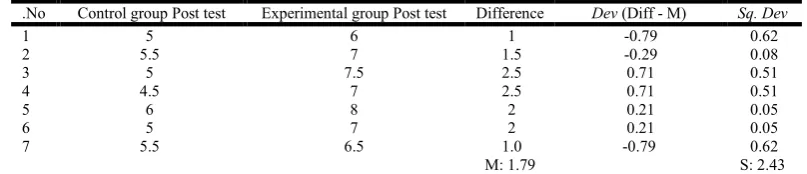
The table two represents the tabulation of posttest marks of the control and experimental group. Column two represents the posttest marks of the control group and column three represents the posttest marks of the experimental group. The fourth column indicates the score difference. The next two columns stand for difference in mean deviation and standard deviation. The overall mean difference is 1.79. It is clear from the mean difference that the experimental group has outperformed the control group. However the mean difference alone is not enough to arrive at a valid result. To increase the validity and test the null hypothesis a paired sample t test is conducted and a significance level was set at 0.5.The tabulation of results are given below.
Two tailed test.
Difference Scores Calculations
Mean: 1.79
μ = 0
S2 = SS⁄df = 2.43⁄(7-1) = 0.40
S2M = S2⁄N = 0.40⁄7 = 0.06
SM = √S2M = √0.06 = 0.24
T-value Calculation
t = (M - μ)⁄SM = (1.79 - 0)⁄0.24 = 7.43
The value of t is 7.426107. The value of p is 0.000307. The
Explanation of results
The alpha value of 0.5 indicates a statistical difference between groups. But in this case the t value is 7.43. Hence the null hypothesis that there is no statistical difference in experimental group who are exposed to web based peer editing is rejected. For easy understanding a comparative analysis of the mean average of both pre and post tests are given. The graphical representation of the performance is indicated in the chart given below. As exemplified in the table the number of samples is 7 for both control and experimental group. The sum represents the overall total of all seven candidates. The mean average of control and experimental groups for both pretest and post test is represented in the last column. The performance analysis is summarized in the graph below.
Limitations and suggestions for future study
The issue raised in the study was, “Does web based intervention for peer editing improve accuracy in writing? From the paired ‘t’ test the effectiveness of web based instruction is proved. However, the greatest limitation in the study its small sample size. A large sample size may yield different results. A delayed posttest would have made the study valid. The study was conducted at only one institution where the researcher works. This in another limitation in the study. A cross sectional study at different institutions with different geographical locations would produce an authentic result. The research instruments of this study were restricted to performance test. A more detailed study consisting of surveys, questionnaire and feedback would have increased its validity. There was only one web based tool i.e paper rater used in the study. The impact of other web based tools could be used. The efficacy of web-based feedback is also a least explored domain in writing pedagogy. Future studies could explore this domain.
REFERENCES
Anderson, G. and Boud, D. 1996. Extending the role of peer
learning in university courses. Research and Development
in Higher Education, 19, 15-19.
Black, F. M. and MacKenzie, J., 2008. Peer support in the first year, [online] Available at http://www.enhancement themes.ac.uk/documents/firstyear/PeerSupport_FinalReport .pdf. [Accessed 5 January 2011].
Boud, D. 1999. Situating academic development in
professional work: Using peer learning. The International
Journal for Academic Development, 4(1), 3-10.
Boud, D., Cohen, R., and Sampson, J. (Eds.). 2014. Peer
Capstick, S., Fleming, H. and Hurne, J., 2004. Implementing Peer Assisted Learning in Higher Education: The experience of a new university and a model for the achievement of a mainstream programme, [online] Available at: http://pal.bournemouth.ac.uk/ documents/ implmntng%20pal%20article61.pdf [Accessed 29 October 2015].
Daiute, Collette. 1985. "Do writers talk to themselves?" In The Acquisition of Written Language: Revision and Response, S. Freedman (Ed.), Norwood, New Jersey: Ablex, pp. 133-159.
Eldred, J. C., and Toner, L. 2003. Technology as teacher:
Augmenting (transforming) writing instruction. In
P.Takayoshi and B. Huot (Eds.), Teaching writing with
computers (pp. 33-54). Boston: Houghton Mifflin Co.
Green, A., 2007. Peer Assisted Learning: empowering first year engagement with a formal curriculum through the educative, [online] Available at: http://pal.bournemouth. ac.uk/documents/Alison%27s%20PAL%20research.pdf [Accessed 20 December 2014].
Magno, Carlo, 2009. Self-regulation and approaches to
learning in English composition writing: TESOL Journal
1(1). pp. 1-16.
Micari, M, Streitwieser, B. and Light, G., 2006.
Undergraduates Leading Undergraduates: Peer Facilitation
in a Science Workshop Program. Innovative Higher
Education, 30 (4), [online] Available at:
http://www.springerlink.com/content/y68516l240924727/f ulltext.pdf [Accessed 25 January 2014].
Nepomuceno, Matthew, M. 2011. Writing online using blogs
as alternative writing activity in tertiary ESL classes:
TESOL Journal 5, pp. 92-105.
Strickland, James. 1987. "Evaluating computer-tutors: a protocol study." Paper presented at the 38th Annual Meeting of the Conference on College Composition,. [ED 280 029]
Tinto, V., 2006. Taking Student Retention Seriously, [online]
Available at: http://www.mcli.dist.maricopa.edu/
fsd/c2006/docs/takingretentionseriously.pdf [Accessed 5 January 2014].
Zhang, G., Jin, Q., and Lin, M. 2005. A Framework of Social
Interaction Support for Ubiquitous Learning. Paper
presented at the 19th International Conference of
Advanced Information Networking and Applications,
March 28-30, 2005, Tamkang University, Taiwan.