Mining Transliterations from Wikipedia using Dynamic Bayesian
Networks
Peter Nabende
Alfa-Informatica, University of Groningen [email protected]
Abstract
Transliteration mining is aimed at building high quality multi-lingual named entity (NE) lexicons for improving performance in various Natural Language Processing (NLP) tasks in-cluding Machine Translation (MT) and Cross Language Information Retrieval (CLIR). In this paper, we apply two Dynamic Bayesian network (DBN)-based edit distance (ED) ap-proaches in mining transliteration pairs from Wikipedia. Transliteration identification re-sults on standard corpora for seven language pairs suggest that the DBN-based edit distance approaches are suitable for modeling translit-eration similarity. An evaluation on mining transliteration pairs from English-Hindi and English-Tamil Wikipedia topic pairs shows that they improve transliteration mining qual-ity over state-of-the-art approaches.
1 Introduction
Transliteration mining is aimed at addressing the problem of unknown words in NLP applications of which named entities (NEs) constitute the high-est percentage. Currently, there is growing inter-est in using automated methods to harness large amounts of correct multi-lingual named entities (NEs) from various ever accumulating Web-based data resources such as newspaper websites and on-line encyclopedia (most notably Wikipedia) with the aim of improving word coverage and the effec-tiveness of NLP systems such as MT and CLIR.
In this paper, we present the application of two DBN-based edit distance approaches in mining transliterations from Wikipedia. Our motivation to apply the DBN-based approaches for model-ing transliteration is founded on our observation of their successful application in NLP tasks (such as cognate identification (2005) and pronunci-ation classificpronunci-ation (2005)) which have require-ments similar to transliteration mining. While
transliteration mining currently demands new ap-proaches to complement or improve performance over existing methods, there was not yet any inves-tigation about the use of the DBN-based edit dis-tance approaches for mining transliteration pairs from ‘noisy’ data. The first approach is based on the classic HMM framework but models two ob-servation sequences (hence the name Pair HMM) instead of one observation sequence. The sec-ond approach is based on the representation and implementation of amemoryless stochastic trans-ducer (initially proposed by Ristad and Yianilos (1998) as a DBN model for learning string edit distance. We propose to evaluate the use of the two approaches in mining transliterations with re-spect to two subtasks. In the first subtask, we fol-low the same evaluation setup as that for a recent shared task on transliteration mining (Kumaran et al., 2010b) while using the same standard cor-pora. This first subtask ensures a comparison of the DBN model results against those for state-of-the-art systems that participated in the shared task since the DBN models are applied to the same standard transliteration corpora. In the second subtask, we investigate the possibility of applying proposed DBN models in mining transliterations from Wikipedia’s article content in addition to the Wikipedia paired topics.
2 Wikipedia
Wikipedia is a free Web-based multi-lingual en-cyclopedia with an ever increasing number of ar-ticles in over 270 languages. In some articles for each language Wikipedia, access is provided to pages about the same topic in other language Wikipedias. Figure 1 shows two Wikipedia arti-cles about the same topic, one in English titled as “Arab spring” while the other is in Arabic and is accessed using the Arabic Wikipedia inter-language link (WIL) which exists on the English page as shown.
Wikipedia IL
English page
Arabic page Corresponding titles
Figure 1: Two Wikipedia articles about the same topic but written using different writing systems.
Many studies have recently found it inexpensive to automatically construct multi-lingual lexicons by using only Wikipedia inter-language links. In the first subtask, we use Wikipedia topic pairs that have been identified from inter-language links to constitute the collection of raw data to which the DBN models are applied and evaluated for min-ing transliteration pairs. In the second subtask, we propose to extend the application of the DBN models beyond mining from only linked text to also mining from the unlinked text in comparable articles. We postulate that the possibility to apply DBN models in mining from noisy unlinked com-parable Wikipedia text would imply an extended use in mining transliterations from a variety of other similar sources where we expect to get many named entities such as from many emerging bilin-gual newspaper websites. In the following section, we introduce the concepts underlying the frame-work of DBNs and the models we have proposed to evaluate in mining transliteration pairs.
3 Dynamic Bayesian networks
The possibility to have random variables relate to time in a Bayesian network enables DBNs to represent probability distributions over a sequence of random variables comprising of observations that are related to an underlying sequence of hid-den states. A DBN model is formally defined as a pair hB0,B→i where B0 is a Bayesian net-work over an initial distribution over states, and
B→ is a two slice Temporal Bayes Net (2-TBN) (Murphy, 2002). It is the 2-TBN that is unrolled
a number of times to fit a given observation se-quence while providing the semantic definitions
of the DBN over the whole observation sequence. The structure of a DBN is a directed acyclic graph (DAG) where each node represents a domain vari-able of interest, and each directed arc represents the dependency between the two nodes it connects. The DBN framework already generalizes various methods including some of the common and suc-cessful methods in NLP such as HMMs. HMMs, being the simplest DBNs, provide a natural start-ing point for our investigation of the use of DBNs in mining transliteration pairs. The classic HMMs in particular have already been applied in detect-ing transliteration pairs from bildetect-ingual text. How-ever, because of space restrictions, we defer the introduction of HMMs in general and proceed to introduce the edit distance-based Pair HMMs for modeling transliteration similarity.
3.1 Pair HMMs
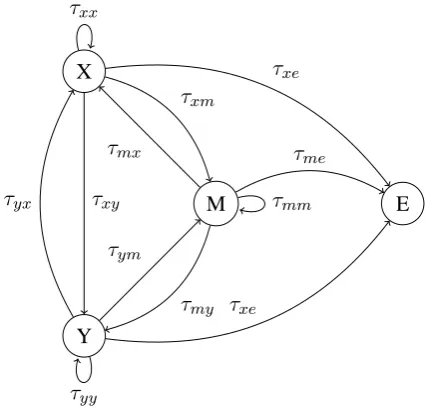
The Pair HMM approach is based on modifica-tions to a pairwise alignment finite state automaton (Durbin et al., 1998). In this paper, we build upon the Pair HMM structure proposed by Mackay and Kondrak (2005) to compute word similarity. Fig-ure 2 is a finite state representation of a Pair HMM similar to the one proposed by Mackay and Kon-drak (2005). The Pair HMM in Figure 2 models word similarity as an edit operation cost for mea-suring the similarity between two words. The edit operations are encoded in the edit operation states
M X
Y
E
τmm
τmx
τmy
τme
τxm
τxx
τxy
τxe
τym
τyy
τyx
τxe
which are denoted in Figure 2 by three nodes as follows: M (for emitting an aligned pair of sym-bols), X (for deleting a symbol from one word), and Y (for inserting a symbol) in the other word. The E node denotes the non-emitting end state. With respect to related work, we do not include a start state and instead assume that the edit oper-ation process starts in any of the edit states where the three starting parameters are defined to be the same as the transition parameters from the M state to one of the edit states including M. We base our application of the Pair HMMs on a number of re-quirements that were proposed by Nabende et al. (2010) in adapting Mackay and Kondrak’s word similarity Pair HMM for computing transliteration similarity. Specifically, we ensure the use of dis-tinct emission parameters in the deletion (X) and insertion (Y) states because of different writing systems. Nabende (2010c) also investigated the effect of transition parameter changes on identi-fying English-Russian transliteration pairs and the result was that transition parameters are important for computing transliteration similarity. With re-spect to this paper, we also conducted an inves-tigation on changes in transition parameters for seven language pairs and the conclusion was the same, that transition paramters are important for computing transliteration similarity. Therefore, the Pair HMMs we apply in transliteration min-ing are based on the finite state representation in Figure 2 but with different settings for transition parameters. In one setting we used only three tran-sition parameters where the trantran-sition parameter takes the same value for outward transitions from a given edit state. In the second setting, we used five transition parameters where we assume some symmetries in the source and target language. We used similar parameters for transitions to and from the deletion and insertion states as in Mackay and Kondrak (2005). That is, we used the same param-eter for staying in the X or Y state, another same parameter for moving from either X or Y to the end state, and the same parameter from the substi-tution state to the X or Y state. In the third set-ting, we used nine distinct parameters for transi-tions between the Pair HMM states. Apart from evaluating the effect of transition parameters, we also evaluated the use of different Pair HMM scor-ing algorithms includscor-ing the followscor-ing: the for-ward and Viterbi algorithms, and their combina-tion with a random Pair HMM to compute
log-odds ratios which we use as transliteration simi-larity estimates. The results for our preliminary in-vestigation showed a stable and better translitera-tion identificatranslitera-tion performance for the three differ-ent Pair HMMs when we compute the translitera-tion similarity estimates as log-odds ratios of the Pair HMM forward score and the random model score compared to the other scoring algorithms.
3.2 Transduction-based DBN models
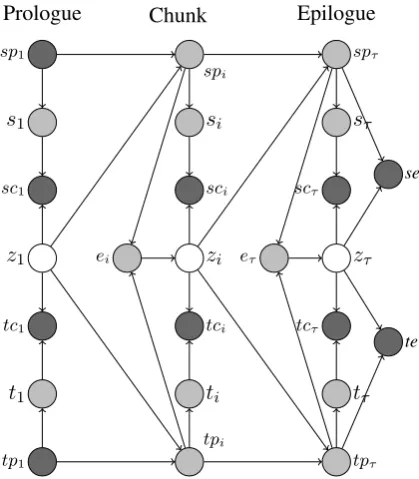
un-rolleda number of times to fit a given observation sequence as defined for a 2-TBN. Using the ASR-based notation, the initial, chunk and epilogue net-works that model the memoryless stochastic trans-ducer are as shown in Figure 3. The DBN template defined by the three networks in Figure 3 is also re-ferred to asmemoryless and context-independent
(MCI) since it models the memoryless stochastic transducer which is also context-independent in the sence that the edit operation variable has no local dependencies on the source and target char-acters, but has a global context dependency that allows it to generate the source and target strings.
In Figure 3, thespiandtpinodes refer to vari-ables used to track the current position in the source and target strings respectively. Thespiand
tpi combined with zi−1 capture the transition se-mantics in the network. The si and ti variables represent the current character in the source and target strings respectively. Thesci andtci nodes enforce consistency constraints by having a fixed observed value 1 where the only configuration of
z1
sc1
s1
sp1
tc1
t1
tp1
Prologue Chunk Epilogue
zi
sci
si
spi
tci
ti
tpi
ei zτ
scτ
sτ
spτ
tcτ
tτ
tpτ
eτ
se
te
Figure 3: Graphical representation for the MCI DBN template. Following the common conven-tion for representing graphical models, dark nodes represent observed variables which can be ei-ther deterministic or stochastic, gray nodes repre-sent deterministic hidden variables, and unshaded nodes represent hidden variables. Adapted from Filali and Bilmes (2005).
their parents is such that the source component of the edit operation variable zi is si or an empty symbol and the target component of zi is ti or an empty symbol , and that zi does not gener-ate (, ). ei denotes the ‘end’ variable which is a ‘switching’ parent ofzi and it is used to indicate when we are past the end of both the source and target strings; that is, whenspi > mandtpi > n wheremandnare the lengths of the source and tar-get strings respectively. Theseandtenodes repre-sent variables that ensure that we are past the end of the source and target strings respectively. Most of the edges in Figure 3 represent deterministic re-lationships between variables, more specifically, edges that are associated with position variables, consistency variables, character variables and end variables. For these, we use deterministic condi-tional probability tables. The emission probabili-ties that are used to generate the source and target strings are encoded in the edit operation variable
ziby way of dense conditional probability tables. In Nabende (2010a), three DBN model gener-alizations based on the MCI DBN model were adapted to compute transliteration similarity and identify transliterations between English and Rus-sian NEs. In the preliminary experiments in this paper, we evaluate the three DBN model gener-alizations that were adapted in Nabende (2010a) on the same seven language pairs that we used to evaluate several Pair HMMs as described in sec-tion 3.1 above. The three DBN model generaliza-tions represent different dependencies on the edit operation random variables including: edit oper-ationmemorydependencies that capture memory from previous edit states of a DBN model; con-textualdependencies of the edit operation variable on either source and / or target string elements; and dependencies that account for thelengthof the edit steps needed to represent an observation sequence.
3.3 Preliminary transliteration identification
experiments
Models e-b e-c e-h e-k e-r e-t eth Top-1 accuracy
Phm 93 68 89 86 89 83 62
Mci 87 30 75 72 98 65 35
Mem 89 49 72 57 89 72 49
Cs1 96 70 86 84 98 83 74
Cs2 96 80 86 85 97 85 79
Ct1 95 68 84 84 98 84 76
Ct2 96 82 86 86 98 86 85
Ls1 96 71 83 77 98 84 73
Ls2 95 70 85 81 98 80 70
Table 1: DBN model transliteration identification results involving seven language pairs. The row with Phm represents the best Pair HMM result per language pair. The remaining results are for the transduction-based models with Mci referring to the MCI DBN template in Figure 3. cs1 and ct1 refer to context-dependent DBN models whereZi depends on the current source (cs1) or target (ct1) character. In Cs2 and ct2,Zi depends on the cur-rent and previous characters.
English-Kannadda (e-k), English-Russian (e-r), English-Tamil (e-t), and English-Thai (eth). Ta-ble 1 shows the TI Top-1 accuracy results (out of 100%) for the transduction-based DBN models against the best Pair HMMs (represented by Phm) involving the seven language pairs. As Table 1 shows, the context-dependent DBN models gen-erally achieve a better performance compared to other DBN models. Table 1 also shows that Pair HMMs outperform the transduction-based DBN models in identifying transliterations between En-glish and Hindi, and between EnEn-glish and Kan-nada. Based on the TI Top-1 accuracy results in Table 1, we chose to evaluate the Pair HMMs and context-dependent DBN models in mining transliterations from Wikipedia.
4 Transliteration mining experiments
4.1 Experiments using NEWS 2010 shared
task Wikipedia data
We applied the best Pair HMMs and context-dependent DBN models from the preliminary TI experiments above to transliteration data provided for the NEWS 2010 shared task (Kumaran et al., 2010a) on mining single word transliteration pairs for three language pairs: Hindi, English-Russian, and English-Tamil. Two sets of data were
provided per language pair including: 1000 hand picked pairs of single NEs as seed data for training transliteration mining systems; and many noisy Wikipedia topic pairs obtained using Wikipedia inter-language links (WILs) as raw data. Our data pre-processing on the noisy Wikipedia topic pairs involved using simple regular expressions to fil-ter out most of the irrelevant entities including: characters from other writing systems; temporal and numeric expressions; and punctuation sym-bols. To reduce on data sparseness, we converted all characters in the English and Russian datasets to lowercase. After pre-processsing, the remain-ing number of Wikipedia topic pairs per language pair were as follows: 14620 (86.2%) for English-Hindi, 296053 (85.6%) for English-Russian, and 13249 (95.4%) for English-Tamil.
Evaluation setup and results
We used the seed datasets to train each Pair HMM and context-dependent DBN models. We trained each Pair HMM using the Baum-Welch expec-tation maximization algorithm and each context-dependent DBN model using a generalized ex-pectation maximization algorithm. We then ap-plied the trained models to compute translitera-tion similarity between candidate NEs from each Wikipedia topic pair. After the application of each model, we checked the similarity estimates assigned by the model to candidate translitera-tion pairs which enabled us to specify different threshold scores ranging from a low threshold for which the system suggests many candidate pairs as transliteration pairs to a high threshold where the system suggests very few candidate pairs as transliteration pairs. The transliteration mining re-sults from each model are evaluated using three related metrics: Precision (P), Recall (R), and F-score.
P= TP
TP+FP , R= TP TP+FN
F= 2×P×R
P+R
where TP, FP, and FN refer to true positives, false positives, and false negatives respectively.
dis-Model P R F PHMM3 FLO 0.930 0.976 0.952 PHMM3 IterT FLO 0.959 0.949 0.954
PHMM9 FL0 0.934 0.975 0.954 PHMM9 IterT FLO 0.936 0.976 0.955
CONs2 0.911 0.891 0.901
NEWS 2010 best result 0.954 0.895 0.924 Table 2: DBN model results against NEWS 2010 shared task results for English-Hindi. P refers to Precision, R to recall, and F to F-score.
crimination between true transliteration and non-transliteration pairs. Table 2 shows the results for the DBN models against the best shared task re-sult on the English-Hindi dataset. In Table 2, the Pair HMMs have in an F-score value that is better than that for the best shared task result while the CONs2 model also posts a promising result.
Table 3 shows the results for Pair HMMs and a context-dependent DBN model against the best shared task result on the English-Tamil dataset. The Pair HMMs again achieve a better F-score value compared to the best shared task result. However, the CONs2 model has a relatively poor performance than it did for English-Hindi above.
For the English-Russian dataset, we applied a context-dependent DBN model (Cont1) that mod-els the dependency of the edit operation variable
Zi on the current target character. Table 4 shows the results of Cont1 against the best shared task result and against those of a Pair HMM with nine distinct transition parameters that was also eval-uated during the shared task (Nabende, 2010b). For the English-Russian dataset, none of the DBN models achieved an F-score better than that of the shared task result. Table 4 shows that the context-dependent DBN models results in a better F-score over the Pair HMM using only the forward algo-rithm to compute transliteration similarity.
Model P R F
PHMM3 FLO 0.913 0.966 0.936 PHMM5 FLO 0.923 0.955 0.939
CONs2 0.790 0.852 0.820
NEWS2010 best result 0.923 0.906 0.914 Table 3: DBN model results against NEWS 2010 shared task results for English-Tamil.
Model P R F
Cont1 0.835 0.815 0.825
PHMM9 F NEWS2010 0.780 0.834 0.806 NEWS2010 best result 0.880 0.869 0.875 Table 4: DBN model results against NEWS 2010 shared task results for English-Tamil.
4.2 Experiments using Wikipedia’s article
content
For this set of experiments, we used Wikipedia inter-language links to automatically acquire seed data by restricting our search to only person names following the structured nature of information in Wikipedia infoboxes. For test data, we identi-fied some ten of the most visited pages during the month of August 2009 to serve as our source for mining transliterations. The data pre-processing steps here are similar to those described in the previous section. Our evaluation set comprised of 4811 English NEs and 9334 Russian NEs af-ter pre-processing. From the candidate NEs, we hand-picked 264 transliteration pairs to form the gold set.
We applied three Pair HMMs (PHMM3, PHMM5, and PHMM9) and a context-dependent DBN model to mine transliterations from English-Russian Wikipedia article text in a manner similar to how we applied them in mining transliterations from Wikipedia topic pairs. We trained the DBN models on the automatically acquired seed data and then applied the trained models to compute transliteration similarity between candidate NEs. All the Pair HMMs use the log-odds ratio involv-ing the forward algorithm to compute translitera-tion similarity. We evaluate the models at different cut-offs of the number of the top-ranked sugges-tions of transliteration pairs for each model. Table 5 shows theresults for the top ranked 200 sugges-tions per model. Table 5 shows that the
Model P R F
PHMM3 FLO 0.530 0.402 0.457 PHMM5 FLO 0.755 0.572 0.651 PHMM9 FLO 0.630 0.477 0.543 CONs1 0.760 0. 576 0.655
context-dependent DBN model achieves a slightly better F-score than the Pair HMMs for the first 200 suggestions of transliteration pairs using the mod-els. However, we found out that an increase in re-call resulted in a faster drop of precision for the context-dependent DBN model compared to the drop for the Pair HMMs.
5 Conclusions and future work
In this paper, we evaluated several DBN models in mining transliterations from Wikipedia. Pair HMMs achieved fair improvements in transliter-ation mining quality over state-of-the-art meth-ods for mining transliterations from English-Hindi and English-Tamil Wikipedia topic pairs. The re-sults also showed the possibility of applying the DBN approaches in mining transliteration pairs from comparable Wikipedia article content with context-dependent models performing better than the Pair HMMs on an English-Russian dataset.
As future work, we would like to evaluate more transduction-based DBN models in mining transliteration pairs from comparable Wikipedia content for other language pairs and on larger datasets than the ones used in this paper.
Acknowledgments
Research in this paper was funded through a sec-ond NPT Uganda project from 2007–2011.
References
Richard Durbin, Sean R. Eddy, Anders Krogh, and Graeme Mitchison. 1998. Biological Sequence Analysis: Probabilistic Models of Proteins and Nu-cleic Acids. Cambridge University Press, Cam-bridge, UK.
Karim Filali and Jeff Bilmes. 2005. A Dynamic Bayesian Framework to model context and mem-ory in edit distance learning: An application to pro-nunciation classification. Proceedings of the Asso-ciation for Computational Linguistics (ACL), Ann-Arbor, Michigan.
Grzegorz Kondrak and Tarek Sherif. 2006. Evalua-tion of several phonetic similarity algorithms on the task of cognate identification. Proceedings of the COLING-ACL Workshop on Linguistic distances, pp. 43–50, Sydney, Australia.
A Kumaran, Mitesh M. Khapra, and Haizhou Li. 2010. Whitepaper of NEWS 2010 Shared Task on Translit-eration Mining, Proceedings of the 2010 Named En-tities Workshop, pp. 29–38, Uppsala, Sweden.
A Kumaran, Mitesh M. Khapra, and Haizhou Li. 2010. Report of NEWS 2010 Transliteration Min-ing shared task. Proceedings of the 2010 Named Entities Workshop, pp. 21–28, Uppsala, Sweden.
Haizhou Li, A Kumaran, Vladmir Pervouchine, and Min Zhang. 2009. Report of NEWS 2009 Ma-chine transliteration shared task. ACL/IJCNLP 2009 Named Entities Workshop (NEWS 2009), Suntec, Singapore.
Haizhou Li, A Kumaran, Min Zhang, and Vladmir Pervouchine. 2010. Whitepaper of NEWS 2010 transliteration generation shared task. Proceedings of the 2010 Named Entities Workshop, pp. 12–20, Uppsala, Sweden.
Wesley Mackay and Grzegorz Kondrak. 2010. Com-puting Word and identifying cognates with Pair Hid-den Markov models. Proceedings of the ninth Con-ference on Computational Natural Language Learn-ing (CONLL 2005), pp. 40–47 Ann Arbor, Michi-gan.
Kevin P. Marphy. 2002.Dynamic Bayesian Networks: Representation, Inference and Learning. PhD The-sis, UC Berkeley, Computer Science Division.
Peter Nabende, J¨org Tiedeman, and John Nerbonne. 2010. Pair Hidden Markov model for named entity matching. Innovations and advances in computer sciences and engineering, pp. 497–502, Springer Heidelberg.
Peter Nabende. 2010. Applying a Dynamic Bayesian network framework to transliteration identification. Proceedings of the seventh International language resources and evaluation conference (LREC 2010), pp.244–251, Valletta, Malta.
Peter Nabende. 2010. Mining transliterations from Wikipedia using Pair HMMs. Proceedings of the 2010 Named Entities Workshop, ACL 2010, pp. 76– 80, Uppsala, Sweden.
Peter Nabende. 2010. Comparison of applying Pair HMMs and DBN models in transliteration identifi-cation. Proceedings of the 20th Computational Lin-guistics in Netherlands meeting, pp. 107–122, Am-sterdam, The Netherlands.
Eric S. Ristad and Peter N. Yianilos. 1998. Learning string edit distance. Trans. on Pattern Recognition and Machine Intelligence, 20(5):522–532.