Towards Fine-grained Citation Function Classification
Xiang Li Yifan He Adam Meyers Ralph Grishman
Computer Science Department New York University
{xiangli, yhe, meyers, grishman}@cs.nyu.edu
Abstract
We look into the problem of recogniz-ing citation functions in scientific liter-ature, trying to reveal authors’ rationale for citing a particular article. We intro-duce an annotation scheme to annotate ci-tation functions in scientific papers with coarse-to-fine-grained categories, where the coarse-grained annotation roughly cor-responds to citation sentiment and the fine-grained annotation reveals more about ci-tation functions. We implement a Maxi-mum Entropy-based system trained on an-notated data under this scheme to auto-matically classify citation functions in sci-entific literature. Using combined lex-ical and syntactic features, our system achieves the F-measure of67%.
1 Introduction
Citations in scientific papers serve different pur-poses, from comparing one work to another to acknowledging the inventor of certain concepts. Recognizing citation functions is important for un-derstanding the structure of a single scientific doc-ument as well as mining citation graphs within a document collection. Therefore, this task has attracted researchers from the fields of discourse analysis, sociology of science, and information sciences for decades (Teufel et al., 2006a).
Most of the existing research in this area fo-cused on the analysis of citation sentiment, which has achieved good accuracy (see, e.g., (Teufel et al., 2006a)). Citation sentiment analysis systems are usually able to identify positive, neutral, or negative opinions, but if we want to better under-stand the exact function of a citation, we need to
know not only whether the authors like the cita-tion, but also how the citation is used in a given context (Section 2).
In this paper, we try to reveal citation func-tions more accurately than simply classifying ci-tation sentiment. We first create a two level coarse-to-fine grained annotation scheme (Sec-tion 3). The coarse-level annotation corre-sponds roughly to sentiment categories, includ-ingPOSITIVE,NEGATIVE, andNEUTRAL. The fine-grained annotation scheme provides a more detailed description of citation functions, such as Significant, which asserts the importance of an article or a work, and Discover, which ac-knowledges the original discoverer/inventor of a method or material.
Using data annotated under this scheme, we train classifiers to determine citation functions, and experiment with features from lexical to syn-tactic levels (Section 4). We predict the fine-grained citation function at67% in F-measure in our experiments, which is at the same level as the coarse-grained citation sentiment classification (Section 5).
2 Related Work
The background for our work is in citation analy-sis. Applications of citation analysis include eval-uating the impact of a published literature through a measurable bibliometric (Garfield, 1972; Luukkonen, 1992; Borgman and Furner, 2002), analyzing bibliometric networks (Radev et al., 2009), summarizing scientific papers (Qazvinian and Radev, 2008; Abu-Jbara and Radev, 2011), generating surveys of scientific paradigms (Mo-hammad et al., 2009), among others. Correctly and accurately recognizing citation functions is a cornerstone for these tasks.
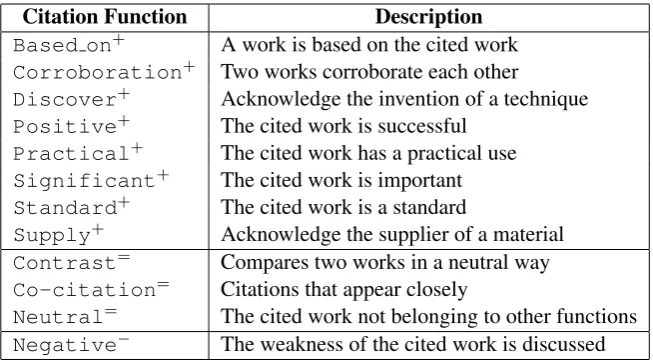
Citation Function Description Based on+ A work is based on the cited work Corroboration+ Two works corroborate each other
Discover+ Acknowledge the invention of a technique Positive+ The cited work is successful
Practical+ The cited work has a practical use Significant+ The cited work is important Standard+ The cited work is a standard
Supply+ Acknowledge the supplier of a material Contrast= Compares two works in a neutral way Co-citation= Citations that appear closely
Neutral= The cited work not belonging to other functions Negative− The weakness of the cited work is discussed
Table 1: Annotation Scheme for Citation Function: + represents POSITIVEsentiment, = represents NEUTRALsentiment, and−represents negative sentiment
Researchers have introduced several annotation schemes for citation analysis. The work of Teufel et al. (2006b) is the most related to ours. They pro-posed an annotation scheme for citation functions based on why authors cite a particular paper, fol-lowing Spiegel-R¨using (1977). This scheme pro-vides clear definition for some of the basic cita-tion funccita-tions, such as Contrast, but mainly concerns the citations that authors compare to or build upon, ignoring the relationship between two cited works. Sometimes the relationship between two cited works is also meaningful and important, from which we can know more about the functions and influences of one cited work on other works. For example, the cited work may be utilized or ap-plied by another cited work, which would be cap-tured by Practical in our annotation scheme but considered as neutral under their scheme. In addition, their annotation scheme does not explic-itly recognize milestone or standard work in a par-ticular research field, while our annotation scheme does through the Significant function. We continue to use these basic functions, but try to expand their scheme by incorporating more func-tions, such as acknowledgement and corrobora-tion, which reflects the attitude of the research community towards a citation.
Regarding the automatic recognition of cita-tion funccita-tions or citacita-tion categories, Teufel et al. (2006a) presented a supervised learning frame-work to classify citation functions mainly uti-lizing features from cue phrases. Athar (2011) explored the effectiveness of sentence structure-based features to identify sentiment polarity of
citations. Dong and Sch¨afer (2011) proposed a four-category definition of citation functions fol-lowing Moravcsik and Murugesan (1975) and a self-training-based classification model. Differ-ent from previous work that mainly classified ci-tations into sentiment categories or coarse-grained functions, our scheme, we believe, is more fine-grained. It is also worth noting that Teufel et al. (2006a), Athar (2011), and Dong and Sch¨afer (2011) all worked on citations in computational linguistics papers, but we investigate citations in biomedical articles.
3 Annotation
Citation Function Example
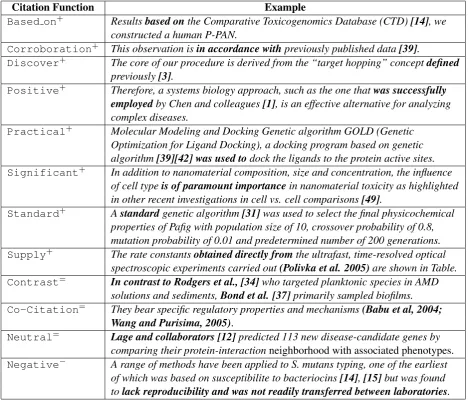
Based on+ Resultsbased onthe Comparative Toxicogenomics Database (CTD)[14], we constructed a human P-PAN.
Corroboration+ This observation isin accordance withpreviously published data[39].
Discover+ The core of our procedure is derived from the “target hopping” conceptdefined previously[3].
Positive+ Therefore, a systems biology approach, such as the one thatwas successfully
employedby Chen and colleagues[1], is an effective alternative for analyzing
complex diseases.
Practical+ Molecular Modeling and Docking Genetic algorithm GOLD (Genetic Optimization for Ligand Docking), a docking program based on genetic algorithm[39][42] was used todock the ligands to the protein active sites.
Significant+ In addition to nanomaterial composition, size and concentration, the influence of cell typeis of paramount importancein nanomaterial toxicity as highlighted in other recent investigations in cell vs. cell comparisons[49].
Standard+ Astandardgenetic algorithm[31]was used to select the final physicochemical properties of Pafig with population size of 10, crossover probability of 0.8, mutation probability of 0.01 and predetermined number of 200 generations.
Supply+ The rate constantsobtained directly fromthe ultrafast, time-resolved optical spectroscopic experiments carried out(Polivka et al. 2005)are shown in Table.
Contrast= In contrast to Rodgers et al., [34]who targeted planktonic species in AMD solutions and sediments,Bond et al. [37]primarily sampled biofilms.
Co-Citation= They bear specific regulatory properties and mechanisms(Babu et al, 2004;
Wang and Purisima, 2005).
Neutral= Lage and collaborators [12]predicted 113 new disease-candidate genes by comparing their protein-interactionneighborhood with associated phenotypes. Negative− A range of methods have been applied to S. mutans typing, one of the earliest
of which was based on susceptibilite to bacteriocins[14],[15]but was found
tolack reproducibility and was not readily transferred between laboratories.
Table 2: Citation Function Examples
an example for each function in Table 2 to illus-trate how it is defined.
Two annotators are trained to perform the anno-tation. The articles we work on are from the open access subset of PubMed, which consists of arti-cles from the biomedical domain. We require the annotators to mark citation functions, and point to textual evidence for assigning a particular func-tion.
4 Recognizing Citation Functions
We use the Maximum Entropy (MaxEnt) model to classify all citations into the above citation func-tion categories. We experiment with both surface and syntactic features. When parsing the context sentence, we replace each citation content with a <CITATION>symbol, in order to remove the contextual bias.
4.1 Surface Features
We capture n-grams, signal words collected by system developers, pronouns, negation words, and words related to formulae, graphs, or tables in the context sentence as surface level features.
• N-Gram Features use both uni-grams of the context sentence and the tri-gram context window that contains the citation.
• Signal Word Features check whether the text signals for a citation function (151 words/phrases in total, collected by system developers from dictionaries) appear in the context sentence.
NNP VBD DT NNS IN CD NNP JJ NN NNS CC VBD CITATION identified the promoters of 52 A. thaliana microRNA genes, and showed …
NSUBJ NSUBJ
Figure 1: POS and Dependency Features
• Negation Features fire if negation words (135 words in total) appear in the context sen-tence with its scope.
• FGT Featuresfire if words or structures like formula, graph, or table appear in the context sentence.
4.2 Syntactic Features
We capture more generalized or long-distance in-formation by taking advantages of syntactic fea-tures.
The Part-of-Speech Features use Part-of-Speech (POS) tags adds generalizability to surface level signals, e.g., “VERB with” covers signals like “experiment with” and “solve with”, which might indicate aPracticalfunction. We use a combination of POS tags and words in a two-word context window around the<CITATION>as fea-tures. In Figure 1, “VBD DT”, “identified DT”, and “VBD the” would be extracted.
The Dependency Features use the depen-dency structure of the context sentence to cap-ture grammatical relationships between a cita-tion and its signal words regardless of the dis-tance between them. We extract both dependency triples and dependency labels as features. In Fig-ure 1, if we extract dependency relations and la-bels attached to a <CITATION>, we would ob-tain “NSUBJ identified CITATION”, “NSUBJ”, and “NSUBJ showed CITATION” as dependency features. “NSUBJ showed CITATION” captures the long-distance relation between<CITATION>
and a signal word “showed”, which other features miss.
5 Experiments
From 91 annotated articles with total6,355 cita-tion instances, we train our model and test the per-formance through a 10-fold cross-validation pro-cedure, so that each fold randomly contains9(or 10) articles with their associated citation instances.
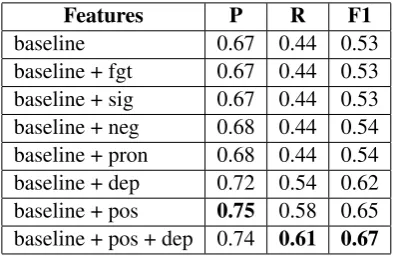
Features P R F1
baseline 0.67 0.44 0.53
baseline + fgt 0.67 0.44 0.53
baseline + sig 0.67 0.44 0.53
baseline + neg 0.68 0.44 0.54
baseline + pron 0.68 0.44 0.54
baseline + dep 0.72 0.54 0.62
baseline + pos 0.75 0.58 0.65
baseline + pos + dep 0.74 0.61 0.67
Table 3: Overall Performance Using Different Features: n-gram features (baseline), FGT tures (fgt), signal word features (sig), negation fea-tures (neg), pronoun feafea-tures (pron), dependency structure features (dep), and Part-of-Speech fea-tures (pos).
Table 3 shows the overall performance in Pre-cision (P), Recall (R), and F-measure (F1) by in-corporating different feature sets, at a99.8% con-fidence level according to the Wilcoxon Matched-Pairs Signed-Ranks Significance Test. If we ran-domly assign one of the citation function classes to each citation instance, the performance is only 3.8%in F-measure. In addition, a simple major-ity classifier assigns each citation with whichever class that is in the majority in the training set, also only obtaining F-measure of 42.2%. Our results clearly show that our MaxEnt system easily out-performs these two simple baseline classifiers.
We report macro-average numbers over all cita-tion funccita-tions, except for NEUTRAL:Neutral, which simply reflects that a work is cited without any particular information. We observe that sur-face features do not work well enough alone, as they cannot generalize beyond the signal knowl-edge observed in a relatively small training set. Syntactic features, on the other hand, can utilize linguistic knowledge to solve the problem, and lead to better results.
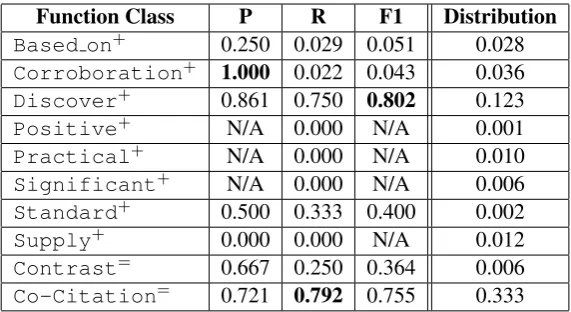
func-Function Class P R F1 Distribution
Based on+ 0.250 0.029 0.051 0.028
Corroboration+ 1.000 0.022 0.043 0.036
Discover+ 0.861 0.750 0.802 0.123
Positive+ N/A 0.000 N/A 0.001
Practical+ N/A 0.000 N/A 0.010
Significant+ N/A 0.000 N/A 0.006
Standard+ 0.500 0.333 0.400 0.002
Supply+ 0.000 0.000 N/A 0.012
Contrast= 0.667 0.250 0.364 0.006
Co-Citation= 0.721 0.792 0.755 0.333
Table 4: Performance and Distribution of Citation Function Classes
Citation Sentiment P R F1
coarse-grainedPOSITIVE 0.93 0.45 0.60 fine-grainedPOSITIVE 0.82 0.43 0.57
Table 5: Comparison of Coarse- and Fine-grained Citation Function Classification onPOSITIVE
tion prediction on more interesting POSITIVE functions in Table 5. We see that coarse-grained classification performs only slightly bet-ter. We suspect that each citation function in the POSITIVEcategory needs different signal infor-mation to identify, so a more fine-grained annota-tion scheme could lead to a stronger correlaannota-tion between a class label and its signals. This can explain the close performance between these two paradigms, although citation function prediction is more informative and harder.
We report performance and distribution in an-notated data for each citation function in Ta-ble 4. Note that the numbers in the “Distri-bution” column does not sum to 1, because we omit theNEUTRAL:Neutralcategory that does not carry information and some categories (e.g., Negative) that are too few (e.g., less than 5) in the corpus. We see that some of the functions (such as Discover) can perform much better than others. The major reason for the difference in performance is the imbalance distribution of ci-tation functions in the annotated corpus, which, in turn, results in the difference in prediction abil-ity of our classifier. In the extreme case, our sys-tem fails to find any positive instance for some of the categories because of the scarcity of training examples. In order to mitigate this problem, we plan to perform more function-specific annotation to obtain more data on current scarce functions.
6 Conclusion
In this paper, we introduced the task of citation sentiment analysis and citation function classifica-tion, which aims to analyze the fine-grained util-ity of citations in scientific documents. We de-scribed an annotation scheme to annotate citation functions in scientific papers into fine-grained cat-egories. We presented our Maximum Entropy-based system to automatically classify the cita-tion funccita-tions, explored the advantages of differ-ent feature sets, and confirmed the necessity of us-ing syntactic features in our task, obtainus-ing67% of final F-measure score.
For future work, we plan to explore more fea-tures and perform more citation function-specific annotation for scarce functions in the current an-notated corpus. Furthermore, we will also apply our annotation scheme and classification method in scientific literature from different domains, as well as investigate more elaborate machine learn-ing models and techniques.
Acknowledgement
References
Amjad Abu-Jbara and Dragomir Radev. 2011. Coher-ent Citation-Based Summarization of SciCoher-entific Pa-pers. In Proceedings of ACL 2011, Portland, Ore-gon, USA.
Awais Athar. 2012.Sentiment Analysis of Citations us-ing Sentence Structure-Based Features. In Proceed-ings of ACL-HLT 2011 Student Session, Portland, Oregon, USA.
Awais Athar and Simone Teufel. 2012. Detection of Implicit Citations for Sentiment Detection. In Pro-ceedings of ACL 2012 Workshop on Discovering Structure in Scholarly Discourse, Jeju Island, South Korea.
Awais Athar and Simone Teufel. 2012. Context-Enhanced Citation Sentiment Detection. In Pro-ceedings of NAACL-HLT 2012, Montreal, Canada.
Christine Borgman and Jonathan Furner. 2002. Schol-arly Communication and Bibliometrics. Annual Re-view of Information Science and Technology: Vol. 36.
Jean Carletta. 1996. Assessing Agreement on Classi-fication Tasks: The Kappa Statistic. Computational Linguistics, 22(2):249254.
Cailing Dong and Ulrich Sch¨afer. 2011. Ensemble-style Self-training on Citation Classification. In Pro-ceedings of IJCNLP 2011, Chiang Mai, Thailand.
Eugene Garfield. 1955. Citation Indexes for Science -A New Dimension in Documentation through - Asso-ciation of Ideas. Science, July 15, 1955: 108-111.
Eugene Garfield. 1965. Can Citation Indexing Be Automated?. Statistical Association Methods for Mechanized Documentation, Symposium Proceed-ings, Washington.
Eugene Garfield. 1972. Citation Analysis as a Tool in Journal Evaluation. Essays of an Information Sci-enties, Vol 1, p.527-544.
Terttu Luukkonen. 1992. Is Scientists’ Publishing Behaviour Reward-seeking?. Scientometrics, 24: 297319.
Saif Mohammad, Boonie Dorr, Melissa Egan, Ahmed Hassan, Pradeep Muthukrishan, Vahed Qazvinian, Dragomir Radev, and David Zajic. 2009. Using citations to generate surveys of scientific paradigms
In Proceedings of NAACL-HLT 2009, Boulder, Col-orado, USA.
Michael J. Moravcsik and Poovanalingam Murugesan. 1975. Some Results on the Function and Quality of Citations. Social Studies of Science, 5:8692.
Vahed Qazvinian and Dragomir R. Radev. 2008. Sci-entific Paper Summarization Using Citation Sum-mary Networks. In Proceedings of Coling 2008, Manchester, UK.
Dragomir R. Radev, Mark Thomas Joseph, Bryan Gib-son, and Pradeep Muthukrishnan. 2009. A Biblio-metric and Network Analysis of the field of Compu-tational Linguistics. Journal of the American Soci-ety for Information Science and Technology.
Ina Spiegel-R¨using. 1977. Bibliometric and Content Analysis. Social Studies of Science, 7:97113.
Simone Teufel, Advaith Siddharthan, and Dan Tidhar. 2006. Automatic classification of citation function. In Proceedings of EMNLP 2006, Sydney, Australia.