R E S E A R C H
Open Access
Adaptive sampling with Bayesian compressive
sensing in radar sensor networks and image
Wei Wang and Baoju Zhang
*Abstract
The theory of Bayesian compressive sensing is briefly introduced and the differential entropy for recovery signal is deduced. An evaluation index based on differential entropy is devised and the adaptive compressive sampling procedure without any prior information of the measured signals is presented in block manner. Numerical simulations on random step signal and real radar signal and 2D image verify that the proposed adaptive sampling algorithm has good performance. This novel algorithm offers great potential for adaptive compressive sampling in real-time radar signal and image.
Keywords:Adaptive sampling, Sparse Bayesian learning, Compressive sensing, Real-time signal sampling
Introduction
The emerging theory of compressive sensing (CS) has provided a new framework for signal acquisition and it has gained increased interests over the past few years. CS is an alternative to the Nyquist rate for the acquisi-tion of ‘sparse’signals. Consider a signal that is sparse in some basis (often using a wavelet-based transform cod-ing scheme). The basic idea of CS is projectcod-ing the high-dimensional signal onto a measurement matrix, which is incoherent with the sparsifying basis, resulting to a low-dimensional sensed sequence. Then with a relatively small number of appropriately designed projection mea-surements, the underlying signal may be recovered exactly [1,2]. In contrast to the common framework of first collecting as much data as possible and then dis-carding the redundant data by digital compression techniques, CS seeks to minimize the collection of re-dundant data in the acquisition step.
Despite the tremendous reduction in the number of observations required for provable success of CS methods, the traditional CS methods do suffer several drawbacks [3]. Typically, existing CS architectures are not adaptive and the number of samplings is determined before the tion process begins with no feedback during the acquisi-tion process on the improved quality [4]. Even more, in measuring signal, such as radar signal, where its interest is
time-varying, there may not be sufficient prior knowledge to decide appropriate CS observations.
To improve the limitations of traditional CS, several re-cent studies through the use of adaptive acquisition of CS observations have been proposed. A simple data-adaptive procedure based on iterative refocusing scheme was described in [3]. Although it did not require explicit know-ledge of the observation noise power and enjoy the benefit of lower implementation complexity, it did not provided proper index for determining the numbers of CS observa-tions. An algorithm called adaptive compressed sampling has been presented in [4]. While exploit wavelet tree struc-tures found in natural images to replace the‘universal’ ac-quisition of incoherent measurements, the approach based on wavelet transform limit its application. The sparsity adaptive matching pursuit (SAMP) was presented in [5]. It is a novel iterative greedy algorithm and can reconstruct signal without prior information of the signal sparsity. But, the experimental results confirmed that the SAMP was ap-propriate for reconstructing compressible sparse signal where its magnitudes were decayed rapidly. A Bayesian for-malism for estimating the underlying signal based on CS measurements, called Bayesian Compressive Sensing (BCS), was employed in [6,7]. It estimated“error bars”for underlying signal to give a measure of confidence in the inverted signal, but it did not move forward to propose adaptive sampling strategy.
Here, we further elaborate the BCS and present an index to determine how many samples are enough for * Correspondence:[email protected]
College of Physical and Electronic Information, Tianjin Normal University, Tianjin, China
faithful CS reconstruction without prior knowledge of underlying signal. The remainder of the article is orga-nized as follows. In the following section, the basics of BCS as needed for this article are summarized. In
Sec-tion “Adaptive compressive measurement procedure”,
we proposed our adaptive procedure and evaluation index. Example results are presented in Section“
Experi-mental demonstrate”. Conclusion and future work are
discussed in Section“Conclusion”.
Background of BCS
CS has received considerable attention recently. The theory of CS states that a signal may be captured with a small set of non-adaptive, linear measurements as long
as the signal is sparse in some basis (such as DCT, wave-let) [8,9]. We can write in matrix notation:
y¼Φxþn¼ΦΨθþn¼Θθþn ð1Þ
where Φ is a M×N measurement matrix, y2RM is the
vector of samples observed, and n is an M× 1 vector
that represents measurement noise and error. θ is the
transform coefficient vector of signal xunder orthonor-mal basis Ψ, i.e., θ=ΨT=x. When θ contains K≪N
non-zero elements, we need to acquire only M¼
O Kð logðN=KÞÞ random measurements to recover the signalx.
coefficients θ is defined a zero-mean Gaussian prior:
with αi the precision of a Gaussian density function
and α the hyper parameter considered as Gamma
prior:
pðαja;bÞ ¼Y
N
i¼1
Γ αð ija;bÞ ð3Þ
where a and b are the shape and scale parameters of
gamma distribution, respectively. So, the overall prior
on θ can be evaluated as
pðθja;bÞ ¼Y
where θi plays the role of observed data and
N θi0;αi1
is a likelihood function. Given the CS
observation y and the random measurement matrix Φ,
distribution: E xð Þ ¼Θμ;Cov xð Þ ¼ΘΣΘT. So, the
differ-ential entropy for x satisfies:
h xð Þ ¼ Z
p xð Þlogp xð Þdx¼1=2 logj j þΣ const ð7Þ
where const is independent of Θ. The differential
en-tropy h(x) provides a measure of uncertainty x, i.e., it gives a way to determine how many measurements are enough for faithful CS reconstruction. In this article, we will introduce an adaptive CS measurement
pro-cedure base on the h(x) for radar signal and 2D
image.
Adaptive compressive measurement procedure
In the theory of CS, the number of CS observations should be more than C Kð logðN=KÞÞ for the high preci-sion signal recovery. But, it would be much larger in reality, due to the unknown ofK—the sparsity of under-lying signal—in advanced. It enormously limits the appli-cation of CS in some other real-time signals.
In this article, an adaptive compressive sampling pro-cedure based on BCS and differential entropy h(x) has been proposed. The algorithm is as follows:
1. Construct measurement matrixΦ2RN×Nbased on Equation (1);
2. Use the firstprows ofΦto obtain CS
measurements y2RP, and solve theh1(x) based on Equation (7);
3. Use the nextqrows ofΦto obtain CS
measurements y2Rq, and solve theh2(x) based on Equation (7);
4. Established the adaptive evaluation indexSidð Þ ¼r
h xð Þ
Xr
i¼1
hið Þ x h xð Þ
, whereh xð Þ ¼ Xr
i¼1 hið Þx
r ;r≥2
5. CompareSid(r) with2which is the end tag. If Sidð Þr ≤E, put through the measurement and recover
the signalxfrom CS observation. If not, go back to step () and continually use the next newqrows ofΦ to obtain CS measurements y2Rq, and solve thehi (x), then go back to step 4.
In this algorithm, the signal acquisition is conducted
in a block manner with the block size q. The p is the
first block size of CS observations and a properpcan re-duce the measuring time. The adaptive evaluation index
Sid(r) deduced by the statistical feature of differential entropy h(x) is used to judge the uncertainty of the
recovered signal. The 2 is a small positive number for
procedure end tag and the measuring procedure would stop when evaluation indexSid(r) is less than2. That is, it can achieve high reconstruction accuracy at this mo-ment. Due to no prior knowledge of original signal used, this algorithm is adaptive in CS observations.
Meanwhile, the Sid(r) can be solved with the next
block CS observation acquired simultaneously, so it is real time and extremely applicable for radar signal measurement.
Experimental demonstrate
To illustrate the effectiveness of the proposed adaptive algorithm, we test its performances on random signal, ac-tual radar signal and 2D image. In the experiments, we chose random Gaussian matrix for measurement matrix
Φ, and ‘db4’ wavelet for orthonormal basis Ψ. We used the BCS package available online at http://people.ee. duke.edu/~lcarin/BCS.html, which we modified so that it would match the adaptive compressive measurement procedure. All the computations were run on a 3.20 GHz Inter Core i5 desktop PC with 2 GB RAM.
Random signals simulations
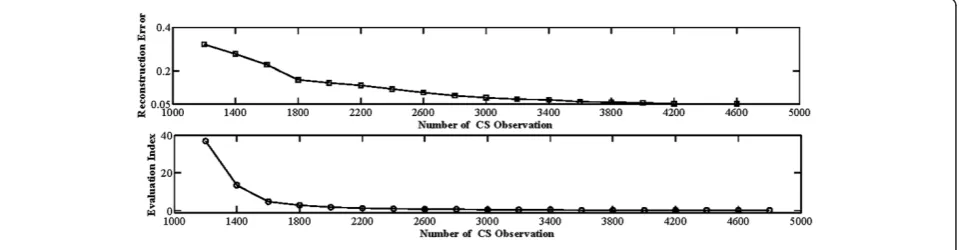
In Figure 1, we generated a step signal with random step position, step width, step amplitude, and the length Figure 5The chart of reconstruction error and evaluation index withp= 1000,q= 200.
N= 512. The waveform of random step signal and its wavelet transform coefficients are shown in Figure 1. It is clear that the coefficients are sparse and the signal can be measured with CS compressively.
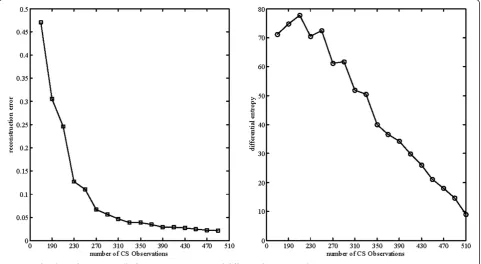
First, in the simulations, we tested whether the differ-ential entropy h(x) can be used to determine how many samplings are enough for faithful CS reconstruction dir-ectly or not. The varying trend of reconstruction error
Rerr¼ xx
0
ð Þ j j2
x
k k2 and the differential entropy h(x) were
showed in Figure 2 when p¼150;q¼20 , where x' is the recovery signal.
It is clearly showed that the differential entropy h(x) is fluctuant because of Bayesian estimation theory, and it has the different varying trend with reconstruction error. That is,
h(x) cannot be used as the adaptive evaluation index directly. Secondly, we study the performance of differentpand
q and depict the varying trend of reconstruction error
Rerr¼ xx
0
ð Þ j j2
x
k k2 and evaluation indexSid(r).
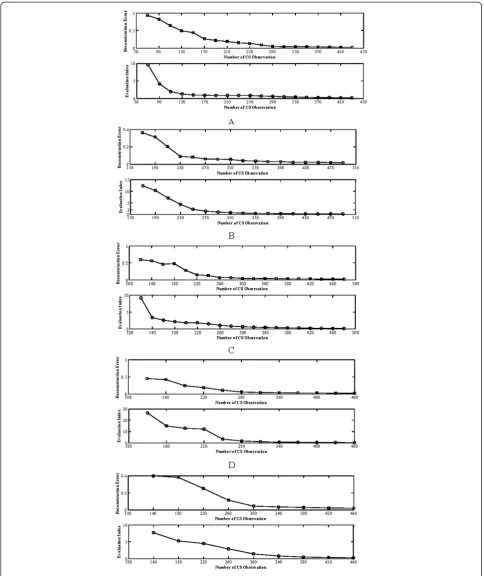
Figure 3A–E demonstrates the varying curve of
reconstruction errorRerrand evaluation indexSid(r) with
p¼50;100;150;q¼20 and q¼20;30;40;p¼100;
respectively. From the simulation results, it suggests that: (1) the curve of Rerr and Sid(r) has similar change trend. In other words, the evaluation index Sid(r) can adaptively reflect the reconstruction error with CS observations increasing, i.e., it can be used for stop tag
of CS measurement; (2) from Figure 3A–C and B,D,E,
respectively, we can see that there are good adaptive evaluation results with fewer p and q, i.e., with larger number of block CS observations. In other words, we can achieve better compression ratio with less number
of CS observation through favorable p and q. But, in
real-time measuring, the time consume should be con-sidered to select favorablepandq.
Real radar signals experiment
duration pulse) requires both a high sampling frequency and a large dynamic range. Currently available A/D con-version technology is a limiting factor in the design of ultra wideband radar systems, because in many cases the required performance is either beyond what is techno-logically possible or too expensive [12]. Moreover, radar sensor networks (RSN) have recently been considered to overcome the performance degradation of a single radar. Due to the expansion of data introduced to RSN, the compression of received data is a design challenge of fu-ture RSN. A topic addressed by the emerging field of CS is a radically new approach to solve these challenges.
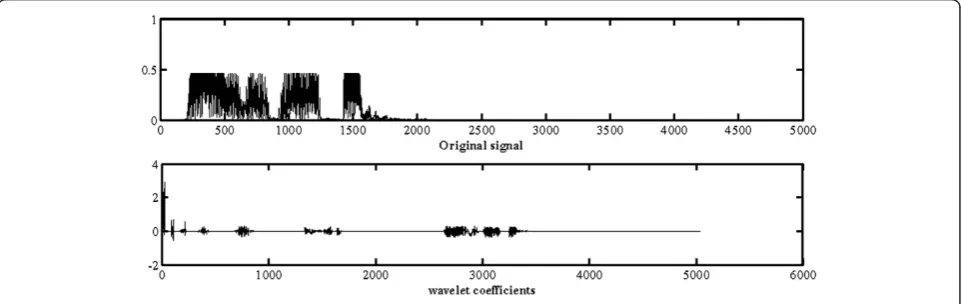
In this part, we use the adaptive CS algorithm to measure the real radar signal. The radar signal that we use the amplitude part and ten times amplified is shown in Figure 4. The figure also shows that only small amount of wavelet coefficients are non-zero, i.e., the radar signal is sparse and can be observed by CS. Figure 5 shows that the evaluation index can reflect the change trend of reconstruction error well with no prior knowledge about radar signal.
2D image experiment
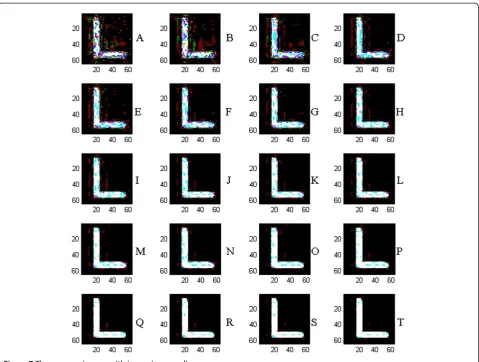
In the following experiment, the adaptive CS algorithm
was used to measure the 2D image which was white“L”
in black background and it has 64*64 pixels. From Figure 6, it can be showed obviously that the evaluation index has the similar varying trend with the reconstruc-tion error. So, the presented adaptive sampling algo-rithm could be used in 2D signal measurement too. The recovery images of each sampling step are displayed in Figure 6 and we can see that the recovery images are nearly the same with the numbers of CS observation in-creasing, especially in Figure 7 (M-T). It also demon-strates that results given in Figure 6.
Conclusion
We studied an adaptive CS algorithm based on BCS and devised an evaluation index constructed by differential entropy of estimated signal. The experimental results demonstrated that the procedure consistently effective for adaptive CS measurement.
However, there are some challenges to be overcome before an actual adaptive CS algorithm for real-time radar signal will become a reality. First, the fluctuation of stop tag should be analyzed due to the random obser-vation. Second, a faster recovery algorithm must be designed to handle real-world signal acquisition with sufficient computational efficiency.
Competing interests
Both authors declare that they have no competing interests.
Acknowledgment
The authors appreciate the CS research community in Duke University for their BCS code, it made the experiments in this article very convenient. This research was supported by the High Education Science & Technology Foundation Planning Project of Tianjin (20100716), the Tianjin Natural Science Foundation (10JCYBJC00400), and the Tianjin Younger Natural Science Foundation (12JCQNJC00400).
Received: 18 July 2012 Accepted: 24 July 2012 Published: 16 August 2012
References
1. Y. Rivenson, A. Stern, Compressed imaging with a separable sensing operator. IEEE Signal Process. Lett.16(6), 449–452 (2009)
2. L. He, L. Carin, Exploiting structure in wavelet-based bayesian compressive sensing. IEEE Trans. Signal Process.57(9), 3488–3497 (2009)
3. J. Haupt, R. Nowak, R. Castro,Adaptive sensing for sparse signal recovery, in Digital Signal Processing Workshop and 5 th IEEE Signal Processing Education Workshop(, Marco Island, FL, 2009), pp. 702–707
4. A. Averbuch, D. Shai, D. Shay, Adaptive compressed image sensing using dictionaries. SIAM J. Imag. Sci.5(1), 57–89 (2012)
5. T.T. Do, G. Lu, N. Nam et al., Sparsity adaptive matching pursuit algorithm for practical compressed sensing, inThe 42nd Asilomar Conference on Signals. Systems and Computers, Pacific Grove, CA10, 581–587 (2008) 6. J. Shihao, X. Ya, L. Carin, Bayesian compressive sensing. IEEE Trans. Signal
Process.56(6), 2346–2356 (2008)
7. S. Ji, D. Dunson, L. Carin, Multitask compressive sensing. IEEE Trans. Signal Process.57(1), 92–106 (2009)
8. E. Candès, T. Tao, Near-optimal signal recovery from random projections: universal encoding strategies. IEEE Trans. Inf. Theory52(12), 12 (2006) 9. E. Candès, M. Wakin, An introduction to compressive sampling—a sensing/
sampling paradigm that goes against the common knowledge in data acquisition. IEEE Signal Process. Mag.25(2), 21–30 (2008)
10. M.A. Herman, T. Strohmer, High-resolution radar via compressed sensing. IEEE Trans. Signal Process.57(6), 2275–2284 (2009)
11. J.H.G. Ender, On compressive sensing applied to radar. Signal Process.90(5), 1402–1414 (2010)
12. R. Baraniuk, P. Steeghs, inIEEE Radar Conference, inCompressive radar imaging(, Boston, MA, 2007), pp. 128–133
doi:10.1186/1687-1499-2012-257
Cite this article as:Wang and Zhang:Adaptive sampling with Bayesian compressive sensing in radar sensor networks and image.EURASIP Journal on Wireless Communications and Networking20122012:257.
Submit your manuscript to a
journal and benefi t from:
7 Convenient online submission 7 Rigorous peer review
7 Immediate publication on acceptance 7 Open access: articles freely available online 7 High visibility within the fi eld
7 Retaining the copyright to your article