Variability of solar/stellar activity and magnetic field and its influence on
planetary atmosphere evolution
Helmut Lammer1, Manuel G¨udel2, Yuri Kulikov3, Ignasi Ribas4, Teimuraz V. Zaqarashvili1,5, Maxim L. Khodachenko1,
Kristina G. Kislyakova6,7, Hannes Gr¨oller1, Petra Odert7, Martin Leitzinger7, Bibiana Fichtinger7, Sandro Krauss1,
Walter Hausleitner1, Mats Holmstr¨om8, Jorge Sanz-Forcada9, Herbert I. M. Lichtenegger1, Arnold Hanslmeier7,
Valery I. Shematovich10, Dmitry Bisikalo10, Heike Rauer11,12, and Malcolm Fridlund13
1Space Research Institute, Austrian Academy of Sciences, Schmiedlstr. 6, A-8042 Graz, Austria 2Institute for Astronomy, University of Vienna, T¨urkenschanzstr. 17, A-1180 Vienna, Austria 3Polar Geophysical Institute, Russian Academy of Sciences, Khalturina Str. 15, 183010 Murmansk, Russia
4Institut d’Estudis Espacials de Catalunya/CSIC, Campus UAB, Facultat de Ci`encies, Torre C5-parell-2a planta, 08193 Bellaterra, Spain 5Abastumani Astrophysical Observatory at Ilia State University, Kazbegi ave. 2a, Tbilisi, Georgia
6N. I. Lobachevsky State University, University of Nizhnij Novgorod, 23 Prospekt Gagarina, 603950 Nizhnij Novgorod, Russia 7Institut f¨ur Physik/IGAM, Universit¨at Graz Universit¨atsplatz 5, A-8010 Graz, Austria
8Swedish Institute of Space Physics, Box 812, SE-98128 Kiruna, Sweden
9Centro de Astrobiolog´ıa/CSIC-INTA, LAEFF Campus, P.O. Box 78, E-28691 Villanueva de la Ca˜nada, Madrid, Spain 10Institute of Astronomy, Russian Academy of Sciences, 48 Pyatnitskaya Str., 119017 Moscow, Russia 11Institut f¨ur Planetenforschung, Deutsches Zentrum f¨ur Luft- und Raumfahrt, Rutherfordstr. 2, 12489 Berlin, Germany
12Zentrum f¨ur Astronomie und Astrophysik, TU Berlin, Hardenbergstr. 36, D-10623 Berlin, Germany
13Research and Scientific Support Department, European Space Agency, Keplerlaan 1, 2200 AG, Noordwijk, The Netherlands (Received January 31, 2011; Revised April 6, 2011; Accepted April 7, 2011; Online published March 8, 2012)
It is shown that the evolution of planetary atmospheres can only be understood if one recognizes the fact that the radiation and particle environment of the Sun or a planet’s host star were not always on the same level as at present. New insights and the latest observations and research regarding the evolution of the solar radiation, plasma environment and solar/stellar magnetic field derived from the observations of solar proxies with different ages will be given. We show that the extreme radiation and plasma environments of the young Sun/stars have important implications for the evolution of planetary atmospheres and may be responsible for the fact that planets with low gravity like early Mars most likely never build up a dense atmosphere during the first few 100 Myr after their origin. Finally we present an innovative new idea on how hydrogen clouds and energetic neutral atom (ENA) observations around transiting Earth-like exoplanets by space observatories such as the WSO-UV, can be used for validating the addressed atmospheric evolution studies. Such observations would enhance our understanding on the impact on the activity of the young Sun on the early atmospheres of Venus, Earth, Mars and other Solar System bodies as well as exoplanets.
Key words: Young Sun, solar activity, solar proxies, solar wind, atmosphere evolution, ENAs, WSO-UV, PLATO.
1.
Introduction
The Sun has always played a major role in solar-planetary relations of planetary atmospheres. During the past decade the study of the history of our Sun and its influence on the evolution of Solar System planets has become an inter-disciplinary effort between stellar astronomy, astrophysics of star and planet formation, astrochemistry, solar physics, geophysics, planetology, as well as climatological science. The great importance of understanding the historical evolu-tion of our host star is obvious; the Sun’s radiative energy, the plasma outflow, and various forms of transient phenom-ena such as shock waves, high-energy particle events dur-ing flares, and Coronal Mass Ejections (CMEs) are key fac-tors in the formation and atmospheric evolution of the
plan-Copyright cThe Society of Geomagnetism and Earth, Planetary and Space Sci-ences (SGEPSS); The Seismological Society of Japan; The Volcanological Society of Japan; The Geodetic Society of Japan; The Japanese Society for Planetary Sci-ences; TERRAPUB.
doi:10.5047/eps.2011.04.002
ets including Earth’s biosphere (e.g., Lundinet al., 2007; Lammeret al., 2008, 2009).
The increase in solar luminosity over time and its cli-matological effect on Venus, Earth and Mars have been discussed by various authors in the past (e.g., Sagan and Mullen, 1972; Walker, 1975; Newman and Rood, 1977; Owen, 1979; Chassefi`ere, 1996; Guinan and Ribas, 2002; Lammeret al., 2003; Ribaset al., 2005; Tianet al., 2005; Kulikovet al., 2006, 2007; Cnossenet al., 2007). The early Sun, with a luminosity of about∼70% of that today, should have been too faint to prevent the early Earth and Mars from freezing. However, paleoclimate studies show that the young Earth always had liquid water and was therefore, typ-ically warmer than during recent times and possibly heated by greenhouse gases such as CO2, CH4, and H2O. Similar for Mars we know that our outer neighbor planet has traces of liquid H2O-flows on its surface which indicates that there was once a time when Mars had a denser atmosphere and a
warmer climate.
Besides the impact of the Sun on the planetary climate, solar radiation and particle fluxes play a tremendous role in the heating of the upper planetary atmospheres. The studies based on previous observation indicated that con-trary to a weaker total luminosity the young Sun was a far stronger source of energetic particles and electromagnetic radiation (e.g., Newkirk Jr., 1980; Skumanich and Eddy, 1981; Zahnle and Walker, 1982). These early studies are now more and more supported by a large number of mul-tiwavelength (X-ray, SXR, EUV, FUV, UV, optical) obser-vations of solar proxies which are a solid evidence that the early Sun was a much more active star than it is at present (e.g., Ribaset al., 2005).
If the young Sun was more active than today, one has to study the consequences this might have had for the de-velopment of the planetary environments, including the for-mation and evolution of planetary atmospheres and initial H2O inventories. To understand the impacts of the radiation and particle environment of the young Sun or other stars on early planets and their potential habitability one has to focus on the following two main subjects:
• Young stars rotate more rapidly and have an internal magnetic dynamo that is more efficient than that of the present-day Sun. This results in stronger surface magnetic fields and/or higher surface magnetic filling factors which induce enhanced “activity” in all its vari-ations, from larger surface spots to stronger, extended solar wind.
• The optical and infrared emissions of the young star largely control the planetary atmosphere and its re-lated climate. The X-ray, SXR, EUV photons as well as the interaction with high-energy particles and the solar/stellar wind lead to atmospheric modifications which can be observed by satellites.
In this article we focus on the evolution of the solar/stellar radiation, plasma and magnetic environment during the Sun’s (stars) life and its response on the upper atmospheres of terrestrial planets.
In Section 2 we discuss the latest research within the “Sun in time” project including uncertainties in stellar ro-tation periods, ages, radiation and plasma flow. Because the radiation and plasma history of our Sun can be sep-arated into a period of a more moderate decrease from present to about 4 Gyr ago and a very early extreme pe-riod of about 500 Myr after the young Sun arrived at the Zero-Age-Main-Sequence (ZAMS) we discuss its related radiation and plasma environment separately in Section 3 and Section 4. In Section 5 we discuss the latest theoret-ical findings on the impact of the extreme space weather of the young Sun on the evolution of the atmospheres of Venus, Earth and Mars and the consequences for terrestrial exoplanets orbiting stars with lower masses than the Sun. Finally we discuss in Section 6 a new innovative idea how one can test the atmospheric evolution theories addressed in Section 5 by transit observations of Earth-size exoplan-ets, which are exposed to higher SXR/EUV fluxes of dwarf stars.
2.
From “The Sun in Time” to “Stars in Time”
In our understanding of the past magnetic evolution of the Sun, solar analogs or the so-called solar proxies, Sun-like stars with different ages and activity levels play an impor-tant role. For stars with masses≤1.5MSunand ages of about a few 100 Myr, angular momentum loss by a stellar wind brakes rotation in a way that correlates very well with the stellar age (e.g., Soderblom, 2010). The only independent variable, the stellar age, then determines the rotation period and, through the internal magnetic dynamo, magnetic activ-ity at all levels of the stellar atmosphere, probably including characteristics of the stellar wind (Woodet al., 2002, 2005; G¨udel, 2007).
The age determination of a star is one of the most com-plex issues in stellar astrophysics. Besides the age-rotation relation stellar ages can be inferred from memberships in moving groups or stellar clusters, isochrones, chromo-spheric activity (CaII HK indices), and astroseismology (e.g., Soderblom, 2010). Therefore, at best, estimates are coming from a variety of indicators that are used over dif-ferent timescales. In this sense, it is very hard to associate error bars since systematic errors and not random errors are the dominating factors. Specifically for the rotation peri-ods, their relative uncertainty is proportional to the period itself since longer periods mean less active stars and are thus harder to monitor because of the smaller modulation ampli-tude. For the “Sun in Time” stars shown in Table 1 rotation periods are known to better than 5% in all cases. Forκ1Cet, for example, the rotation period which was determined by photometry with the MOST satellite has been determined to better than 1% (Walkeret al., 2007). However, for an inac-tive star likeβHyi, the determination is significantly poorer (around 10%) (Walkeret al., 2007).
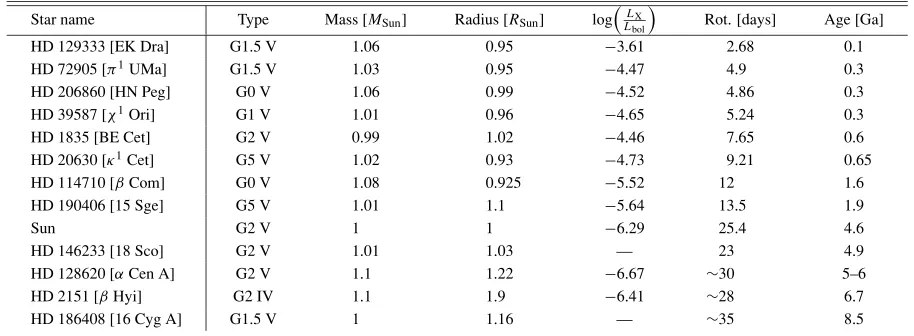
The observation of and detailed research on a series of near-solar-mass stars back to ages close to the ZAMS-age is therefore sufficient to reconstruct the history of our Sun and the interaction of its magnetic activity with its overall environment. This is the main goal of the so-called “Sun in Time” project which was established more than a decade ago by Dorren and Guinan (1994a, b). Table 1 shows a sample of very well observed and studied solar proxies and their main physical parameters.
Key studies within the “Sun in Time” project refer to the following main points:
• Photospheric (optical) and UV evolution with time to characterize level and extent of surface magnetic ac-tivity studied with IUE (Messina and Guinan, 2002, 2003; Dorren and Guinan, 1994a).
• The FUV studied with FUSE to infer transition-region magnetic activity (Guinanet al., 2003).
• To obtain information on coronal activity the EUV was studied with EUVE (Ayres, 1997; G¨udelet al., 1997; Audardet al., 1999; Ribaset al., 2005).
Table 1. Physical parameters and age-rotation relation of well observed and studied solar proxies in comparison with the Sun (after G¨udel, 2007).LX refers to a range of 0.1–2.4 keV as measured by the ROSAT satellite.
Star name Type Mass [MSun] Radius [RSun] log
• To measure the production of non-thermal particles in magnetic coronae the radio flux has been studied with the VLA (G¨udelet al., 1995a, b, 1997; Gaidoset al., 2000; G¨udel and Gaidos, 2001).
• Magnetic cycles of solar proxies (Messina and Guinan, 2002) are measured in the optical or in X-rays. Cycles were also studied forαCen A a G2V star (Robradeet al., 2005; Ayres, 2009) and HD 81809 (G2V+G9V) (Favataet al., 2004, 2008) stars.
• Differential rotation of the solar proxies as seen in stars spot measurements were studied by Messina and Guinan (2003).
The much stronger magnetic activity of the young Sun re-sulted in increased flaring activity, CMEs and denser and more energetic solar wind and particle fluxes. For the study of atmospheric evolution and related thermal and non-thermal escape processes the evolution of the X-ray, SXR and EUV flux is of particular interest, because it can ionize atmospheric species and dissociate molecules, that would otherwise be relatively inert, thereby initiating photochem-istry that can alter an atmosphere’s bulk composition as well as creating a class of radiation-dependent trace chemicals. Furthermore as a result of these photochemical processes, this wavelength range controls the temperature structure and expansion of the upper atmosphere and should have played an important role for large-scale atmospheric escape and isotopic fractionation on early Venus, Earth, and Mars. Because lower-mass stars are very common and hence may host rocky planets within their habitable zones, progress in this direction has started by expanding the “Sun in Time” project to time sequences of the high-energy emissions, CME activity, stellar winds, and flare activity to lower-mass K and M-type stars. These stars are far more numerous than the solar type stars, have long main-sequence lifetimes, and have become prime targets for ter-restrial planet searches in recent years. Because of the low luminosities, their habitable zones (e.g., Kastinget al., 1993; Lammeret al., 2009) can be quite close to the host stars. Because these dwarf stars have deeper outer con-vective zones than Sun-like stars and thus possess very ef-ficient magnetic dynamos, the expected enhanced X-ray,
SXR, EUV radiation environment combined with extreme space weather effects should play a major role in the devel-opment of the atmospheres and habitability on such planets (Scaloet al., 2007; Lammeret al., 2009).
3.
The Moderate Activity Period: Solar
Radia-tion, Plasma and Magnetic Environment From
the Present to 4 Gyr Ago
Ultraviolet emission from the Sun and late-type stars originates in magnetic chromospheric and transition-zone regions which have been heated to temperatures of∼104– 105 K. Based on spectral measurements obtained by IUE, Dorren and Guinan (1994a) have studied the evolution of ultraviolet (UV) line fluxes in detail and G¨udelet al.(1997) and Ribas et al.(2005) extended this research to X-rays, SXR and EUV. The relevant wavelengths for thermo-spheric heating are the “ionizing” ones ≤1000 ˚A (e.g., Hunten, 1993), which contain only a small fraction of the present solar spectral power. Planetary atmospheres are opaque to EUV radiation (100–920 ˚A), as in the case of Earth, due to photo-absorption by N2, O2and O, so that the optical depth of unity at 100 ˚A occurs at an altitude of about 130 km.
Molecular constituents such as molecular hydrogen, car-bon dioxide, molecular oxygen and N2 (Bakalian, 2006) can also be dissociated by relatively long wavelengths in the “Schumann-Runge” range of 1750–1300 ˚A, according to
O2+hν(λ <1750 ˚A)→O
3
P+O1D, (1)
CO2+hν(λ <1670 ˚A)→CO+O1D. (2) The solar SXR and EUV radiation with an intensity of
≥2 erg cm−2sec−1represents the predominant heat source for Earth’s upper atmosphere. Dissociation can also take place below the true dissociation limit due to excitation of molecules into a state which dissociates.
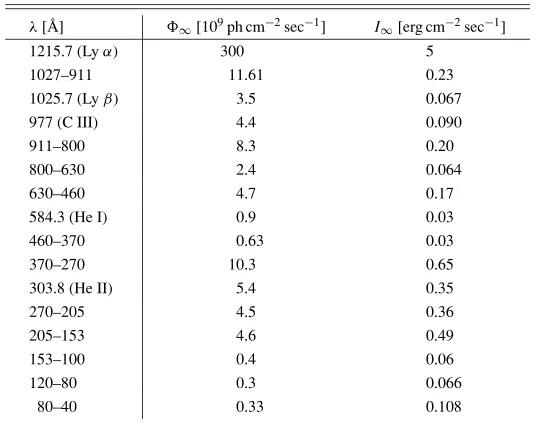
Table 2. Solar photon fluxes for moderate solar activity at 1 AU (Bauer and Lammer, 2004).
λ[ ˚A] ∞[109ph cm−2sec−1] I
∞[erg cm−2sec−1]
1215.7 (Lyα) 300 5
1027–911 11.61 0.23
1025.7 (Lyβ) 3.5 0.067
977 (C III) 4.4 0.090
911–800 8.3 0.20
800–630 2.4 0.064
630–460 4.7 0.17
584.3 (He I) 0.9 0.03
460–370 0.63 0.03
370–270 10.3 0.65
303.8 (He II) 5.4 0.35
270–205 4.5 0.36
205–153 4.6 0.49
153–100 0.4 0.06
120–80 0.3 0.066
80–40 0.33 0.108
Table 3. Solar minimum and maximum values compared to the intensity flux of medium solar activity cycle for X-ray, SXR, EUV, FUV and Lyman-alpha wavelength ranges.
Wavelength High solar activity Low solar activity
X-ray [1–20 ˚A] ∼2.6 ∼0.4
SXR [20–100 ˚A] ∼1.8 ∼0.7
EUV [100–912 ˚A] ∼1.5 ∼0.8
FUV [912–1180 ˚A] ∼1.3 ∼0.8
Lyman-α[1200–1300 ˚A] ∼1.3 ∼0.9
Shematovich, 2006; Lammeret al., 2006; Lichteneggeret al., 2009; Gr¨olleret al., 2010; Valeilleet al., 2010).
For H2, radiationλ <850 ˚A leads to either dissociation or ionization. Atomic hydrogen possesses a strong con-tinuum absorption cross section below 912 ˚A and strong Lyman-series lines, principally the intense Lyman-α line at 121.6 nm. On Earth, rocket and satellite observations have led to a detailed identification of the solar emission line spectrum; relatively accurate values for the intensities of these radiations have become available by now (e.g., Hall et al., 1969; Tobiska, 1993; Tobiska and Eparvier, 1998). Solar photon fluxes at Earth for moderate solar ac-tivity are summarized in Table 2. The solar photon flux
φ∞=λI∞/(hc)withhthe Plank constant andcthe speed
of light is used for the ionization process, while the SXR and EUV energy fluxI∞ =(hν)φ∞is relevant for heating of the upper atmosphere.
3.1 Short- and longtime variation of the short wave-length radiation
The solar photon fluxes vary over the 11 year solar cycle as well as over the≈27 day solar rotation period owing to magnetic field inhomogeneities. Additionally to the photon flux variation, also the solar intensity fluxes differ in phase with the solar cycle. The Solar Irradiance Platform (SIP)1, which produces full solar spectra for any observation date, can be used to obtain intensity fluxes in the SXR, EUV and FUV wavelength ranges. The results, representing quiet and
1http://www.spacewx.com/solar2000.html
active conditions on the Sun normalized to the average flux value, are listed in Table 3.
To understand the evolution of the solar radiation beyond activity levels which can be generated during high solar ac-tivity one has to analyze solar proxies which are observed in the “Sun in Time” project. As can be seen in Table 1, the sample of solar proxies contains stars that cover most of the Sun’s main sequence lifetime from ∼100 Myr to 8.5 Gyr. The observations, obtained with the space obser-vatories shown in Table 4, cover a wide range between 1 ˚A and 8300 ˚A.
One should note that the actual spectra covered the wave-length range 80–400 ˚A in the best cases but some stellar spectra were still noisy well below 400 ˚A, due to the high opacity of the interstellar medium at these wavelengths. Therefore, the flux in the EUV range (100–912 ˚A) given in Tables 5 and 7 was partly interpolated. The approach is explained in detail in Ribaset al.(2005). A promising alter-native to the interpolation was applied by Sanz-Forcadaet al.(2011) to a sample of stars with exoplanets: the X-rays and UV spectral information is used to calculate a model of the corona and transition region, the stellar layers where the XUV emission originates; this model is then used to syn-thetize the spectral energy distribution in the whole XUV range. The application of this approach to the two solar ancestors EK Dra andκ Cet shows less than 0.15 dex of disagreement with the EUV flux calculated by Ribaset al.
(2005).
Table 4. Space observatories and instruments used for the relevant observations within the “Sun in Time” project (G¨udel, 2007).
Space observatory λ[ ˚A] E[keV]
XMM-Newton [CCDs] 0.83–83 0.15–15
XMM-Newton [gratings] 6–38 0.33–2.1
ASCA [CCDs] 1.2–31 0.4–10
ROSAT 5.2–124 0.1–2.4
EUVE [gratings] 80–760 0.016–0.15
FUSE [gratings] 920–1180 —
HST [gratings] 1150–1730 —
IUE [gratings] 1150–1950 —
UBVRI [photometry] 3500–8300 —
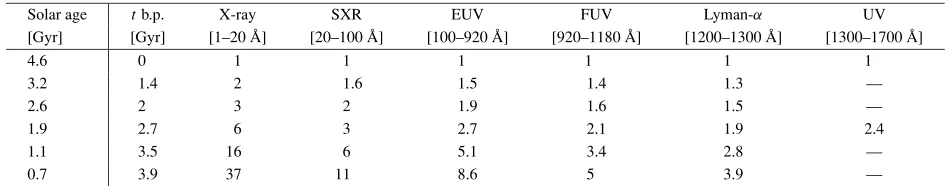
Table 5. Solar radiation flux enhancement as function of wavelength normalized to the present solar flux value from present to 3.9 Gyr ago (Ribaset al., 2005; G¨udel, 2007).
Solar age tb.p. X-ray SXR EUV FUV Lyman-α UV
[Gyr] [Gyr] [1–20 ˚A] [20–100 ˚A] [100–920 ˚A] [920–1180 ˚A] [1200–1300 ˚A] [1300–1700 ˚A]
4.6 0 1 1 1 1 1 1
3.2 1.4 2 1.6 1.5 1.4 1.3 —
2.6 2 3 2 1.9 1.6 1.5 —
1.9 2.7 6 3 2.7 2.1 1.9 2.4
1.1 3.5 16 6 5.1 3.4 2.8 —
0.7 3.9 37 11 8.6 5 3.9 —
also shows intermediate periodicities in the range of sev-eral months (Riegeret al., 1984) and∼2 years (Vecchioet al., 2010). These periodicities are explained in terms of a Rossby wave instability in the solar interior (Zaqarashviliet al., 2010a, b). Similar periodicities have been observed in other solar like stars (Massiet al., 1998). Recently, Lanzaet al.(2009) observed short term cyclic oscillations of the total spotted area on the photosphere of CoRoT-Exo-2a, which has been suggested to be caused by Rossby waves. The Rossby wave activity was probably enhanced in the early stage of solar evolution due to rapid rotation, therefore this aspect requires future detailed study.
The total high energy output of a stellar corona depends on the available magnetic energy and is therefore a conse-quence of the star’s dynamo operation. Younger and more rapidly rotating stars are more X-ray luminous. A similar behavior can be observed for UV and FUV radiation; the X-ray output decreases as the star ages and its rotation pe-riod increases. Table 5 lists the short wavelength radiation fluxes of the Sun as a function of stellar age between 0.7 and 4.6 Gyr. The fluxes are divided in six wavelength inter-vals are normalized to the present solar values. The radia-tion flux-age correlaradia-tion can be expressed by the following power laws (Ribaset al., 2005)
FX-ray =2.4t−1.92, (3)
FSXR=4.45t−1.27, (4)
FEUV=13.5t−1.2+4.56t−1.0, (5)
FFUV=2.53t−0.85, (6)
FLy-α=19.2t−0.72, (7) where F is the flux at 1 AU in erg cm−2 s−1 and t the stellar age in Gyr. As Ribaset al. (2005) give no power
laws for the evolution of fluxes longward of 1200 ˚A, we used their equation (2) and the observational data given in their table 6 to estimate the flux evolution between 1200– 1700 ˚A. Ribas et al. (2005) give observed emission line fluxes of six solar analogs (including the Sun), eight lines have wavelengths>1200 ˚A. The major flux contributor in the 1200–1300 ˚A range is the Lyman-αline (1216 ˚A), but unfortunately it has only been measured for three stars. As the flux of the Si III line (1206 ˚A) is negligible compared to Lyman-α, we use the Lyman-α power law as a proxy for the whole 1200–1300 ˚A range. The range between 1300–1700 ˚A, which approximately covers the important “Schumann-Runge” range, contains six strong emission lines. One can see from Table 3 that the Sun during its maximum solar cycle can be used as a proxy for the Sun when it had a similar flux in average quiet activity condi-tions∼1.5–2 Gyr ago.
3.2 The solar magnetic field
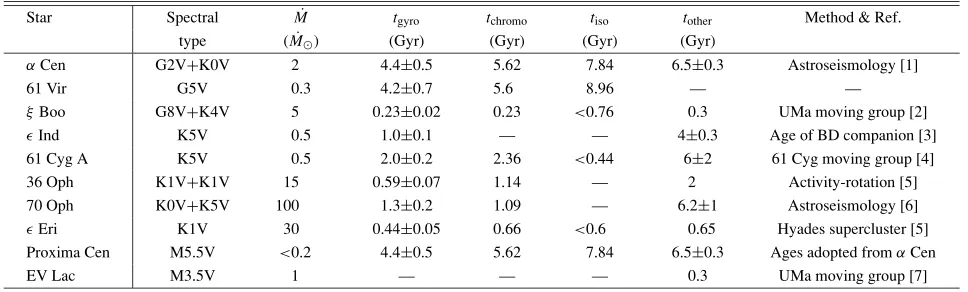
Table 6. Stars with mass loss rates determined from Lyαabsorption. Spectral types and mass loss rates taken from Woodet al.(2005). Ages determined via gyrochronology (tgyro), chromospheric activity (tchromo) and isochrones (tiso) were taken from Barnes (2007). Other ages (tother) are taken from the references in the last column ([1] Eggenbergeret al.(2004); [2] Soderblom and Mayor (1993); [3] Kinget al.(2010); [4] Eggen (1996); [5] DeWarf
et al.(2010); [6] Eggenbergeret al.(2008); [7] Monteset al.(2001)).
Star Spectral M˙ tgyro tchromo tiso tother Method & Ref.
type (M˙) (Gyr) (Gyr) (Gyr) (Gyr)
αCen G2V+K0V 2 4.4±0.5 5.62 7.84 6.5±0.3 Astroseismology [1]
61 Vir G5V 0.3 4.2±0.7 5.6 8.96 — —
ξBoo G8V+K4V 5 0.23±0.02 0.23 <0.76 0.3 UMa moving group [2]
Ind K5V 0.5 1.0±0.1 — — 4±0.3 Age of BD companion [3]
61 Cyg A K5V 0.5 2.0±0.2 2.36 <0.44 6±2 61 Cyg moving group [4]
36 Oph K1V+K1V 15 0.59±0.07 1.14 — 2 Activity-rotation [5]
70 Oph K0V+K5V 100 1.3±0.2 1.09 — 6.2±1 Astroseismology [6]
Eri K1V 30 0.44±0.05 0.66 <0.6 0.65 Hyades supercluster [5]
Proxima Cen M5.5V <0.2 4.4±0.5 5.62 7.84 6.5±0.3 Ages adopted fromαCen
EV Lac M3.5V 1 — — — 0.3 UMa moving group [7]
High-latitude appearance of Sun-spots could change the lar wind structure (possible interchange of fast and slow so-lar wind locations) and may also have affected the initia-tion latitudes of solar flares/CMEs. This could completely change the solar activity patterns, butterfly diagram and in-fluence of solar wind/CMEs on the Solar System. However, this would have happened in the very early stages of the so-lar evolution, when the Sun just arrived at the ZAMS. The solar rotation period was∼10 days 4 Gyr ago (see Table 1), which is faster than the nowadays Sun, but still slower than at the time when the young Sun arrived at the ZAMS. This rotation rate does not affect too much on appearance of sunspot and therefore the magnetic structure of solar atmo-sphere/corona probably has not changed significantly dur-ing the past 4 Gyr.
3.3 The time evolution of the solar wind
As a consequence of solar/stellar activity, plasma winds are ejected from the star but their detection in solar proxies is very difficult. Although the wind formation and accel-eration mechanisms are still not completely understood at the Sun, there is much evidence that magnetic fields play an important role for acceleration of the wind, for its heating, or for guiding the wind at least out to the Alfv´en radius at which the stellar wind speed reaches the value of the Alfv´en speed. Beyond the Alfv´en radius the stellar wind is super-Alfv´enic. One of the best indirect confirmation of the pres-ence of magnetized winds in young stars is their spin-down to slower rotation (as shown in Table 1) after their arrival at the ZAMS because the outward flowing plasma carries away angular momentum from the star.
Potential detection methods of stellar winds include the measurement of thermal radio emission from the plasma flow (Lim and White, 1996; Gaidoset al., 2000), and sig-natures of charge exchange in X-ray spectra (Wargelin and Drake, 2001). The most successful approach so far is an indirect method which makes use of the Lyman-α absorp-tion in astrospheres due to the interacabsorp-tion between stel-lar winds and the interstelstel-lar medium (ISM) (e.g., Wood, 2004). When stellar winds collide with the ISM, at further distance from the star, a termination shock where the wind is shocked to subsonic speeds is formed. The heliosphere is permeated by interstellar H I withT ∼ (2–4)×104 K
(Wood, 2004; Woodet al., 2005). Much of this gas is piled up between the heliopause and the bow shock producing a hydrogen wall that can be detected by UV observations as an absorption signature in the Lyman-α line. The ex-cess absorption from the Sun’s own hydrogen wall is, due to the deceleration of the ISM relative to the star, redshifted, while that of astrospheres are blueshifted. The measurable absorption depths are then compared with results from hy-drodynamic model calculations (Woodet al., 2005). We note that the the amount of astrospheric absorption scales with the wind ram pressure, and the stellar wind velocity has to be assumed to derive the mass loss rate (Wood and Linsky, 1998).
A systematic study of all derived mass-loss rates of main sequence stars which were observed with this method in-dicates thatd ML/dtper unit stellar surface correlates with stellar activity and hence the stellar X-ray surface flux FX (Woodet al., 2005)
d ML
dt ∝ F
1.34±0.18
X . (8)
If we extrapolate the above power law up to the observed X-ray saturation limit FXsat of Sun-like stars of about 2×
107erg cm−2 s−1, we would suggest that the mass loss of plasma from the youngest stars in Table 1 is about 1000 times larger compared to the present day Sun. However, recent observations indicate that this power law relation breaks down for the most active stars for which FX ≥ 8×10⁵erg cm−2s−1(Woodet al., 2005).
0.1 1.0 10.0 age [Gyr]
0.1 1.0 10.0 100.0
(dM/dt)/A [(dM/dt)
sun
/A
sun
]
Fig. 1. Mass loss rates normalized to stellar surface area as a function of age for stars in Table 6. The adopted mass loss rate of the Sun is 2×10⁻¹⁴M
yr−1. The shaded area denotes the evolutionM˙ ∝t−2.33±0.55derived from Eq. (3) andF
X∝t−1.74±0.34(Ayres, 1997) by Woodet al. (2005). The different symbols (circle, triangle, square, diamond) represent different age determination methods (tgyro,tchromo,tiso,tother; cf. Table 6).
1 2 3 4
time [Gyr] 0
200 400 600 800 1000
v [km/s]
1 2 3 4
time [Gyr] 0
200 400 600 800 1000
v [km/s]
0 50 100 150 200 250 300
n [cm
]
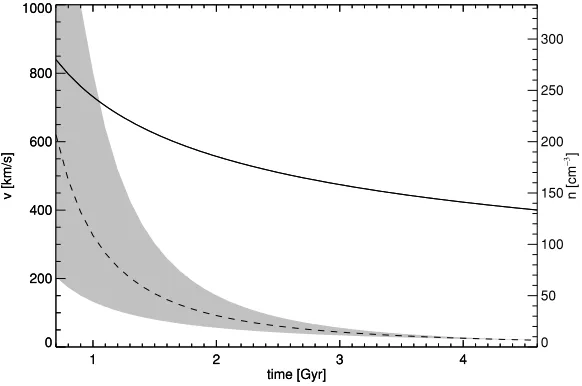
Fig. 2. Average stellar wind density (dashed line) and velocity (solid line) expected at 1 AU from present time (4.6 Gyr) to 0.7 Gyr, according to mass loss observations of Sun-like stars (Woodet al., 2005) and the power laws of Newkirk (1980). The shaded area represents to uncertainties of the solar wind density in time.
reliable determination of stellar ages. Figure 1 shows the stellar mass loss rates as a function of age. The mass loss rates are normalized to stellar surface area to simplify com-parison between stars with different spectral types, as well as two stars sharing the same astrosphere. Ages determined by different methods for the same star are indicated by dif-ferent symbols and connected by dotted lines. The shaded area denotes the mass loss evolution derived by Woodet al.(2005), who used their power law fit to the X-ray sur-face flux (cf. Eq. (3)) and the evolution of the X-ray flux (FX ∝ t−1.74±0.34) of Sun-like stars (Ayres, 1997) to con-struct the scaling M˙ ∝ t−2.33±0.55. As one can see from Fig. 1 stars at the lower age (i.e., high activity) limit indi-cate a mass loss which is about 100 times the present solar value, while the mass loss drops toward higher activity lev-els to about 10 times the solar value. We will discuss the
possible reason for this breakdown between X-ray activity and wind-mass loss relation in the next section in more de-tail.
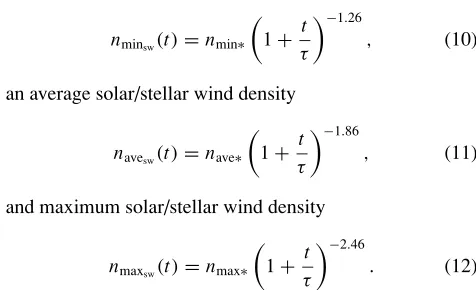
For studying the effect on planetary environments against solar/stellar wind induced non-thermal escape, the so-lar/stellar wind densitynsw and velocity vsw in the vicin-ity of a planet are key parameters. These parameters for a Sun-like star can be estimated as a function of the age from the observations discussed above, together with an empir-ical model for an age-dependence of the solar/stellar wind velocity (Newkirk Jr., 1980; Grießmeieret al., 2004, 2007; Lichteneggeret al., 2010)
vsw=v∗
1+ t
τ
−0.4
the minimum estimated solar/stellar wind density
an average solar/stellar wind density
navesw(t)=nave∗
and maximum solar/stellar wind density
nmaxsw(t)=nmax∗ 10−2Gyr according to Newkirk Jr. (1980) andt is the time in Gyr. Figure 2 shows the expected enhancement in solar wind density and velocity as function of age from present time back to about 3.9 Gyr ago.
The density scaling (Eqs. (5)–(7)) was derived from the measured mass loss rates from Woodet al. (2005), hence using M˙ =4πr2mpnswvsw, with proton massmp together with Eqs. (4)–(6) andr=1 AU yields a similar evolution of the mass loss rate as indicated by the shaded area in Fig. 1, valid for main-sequence G-type stars with an age of at least 0.7 Gyr (Grießmeieret al., 2007; Lichteneggeret al., 2010).
4.
The Extreme Period: The First 500 Myr After
the Sun’s Arrival at the ZAMS
The first 500 Myr after the origin of a terrestrial planet and the evolution of its host star to the ZAMS are the most crucial period for the development of a biosphere. Dur-ing this early evolutionary stage a star (includDur-ing the young Sun) is more active at short wavelengths and plasma out-flows can therefore remove a planet’s atmosphere or ini-tial water inventory. To understand how the atmospheres of terrestrial planets were affected by the young Sun it is of tremendous importance to gain more knowledge from astrophysical observations of magnetic properties, location of activity centers, radiation, plasma outflow (e.g., winds, CMEs), mass loss, and rotation periods, of very young so-lar proxies and stars with ages<500 Myr.
4.1 The magnetic field and plasma outflow of the early young Sun
The rotation period of the young Sun was much faster (∼few days) during the first 500 Myr after the arrival at the ZAMS, therefore the activity and magnetic field con-figuration was most likely quite different from the current appearance. Star-spots on the young solar analog EK Dra which rotates with a period of∼2.68 days are observed to be formed everywhere; from the low latitudes up to po-lar regions (Strassmeier, 2009). The young Sun probably had the same structure of active regions. The high latitude Sun-spots could change the structure of coronal magnetic fields as well as the formation of prominences, which might
lead to a predominant occurrence of flares and CMEs near the polar regions. The polar CMEs may propagate signif-icantly above the ecliptical plane, which may cause more convenient conditions for planetary evolution. However, not much is known about solar magnetic dynamo during that time. It is not well constrained what the duration of activity cycles was, and also the butterfly diagram and the other laws of current solar activity just after the arrival of the Sun at the ZAMS. Therefore, the understanding of so-lar influence on planets requires further modeling of soso-lar magnetic dynamos with all consequences in appearance of magnetic flux at the surface and in the possible structure of coronal magnetic field in the young Sun. This may be re-lated to the fact that very young stars rotate fast and their ac-tive regions appear therefore at high latitudes. Furthermore, if the magnetic field becomes more akin to a global dipole, then the escape of the stellar plasma may be more inhibited (Woodet al., 2005). Thus, a possibly preferred appearance of CMEs at polar regions during the fast rotating young Sun may lead to the propagation of shocks and magnetic ropes and clouds off the ecliptic plane before 4 Gyr ago, which might completely change the current picture of solar/stellar-planetary atmosphere-magnetosphere interaction processes (Zaqarashviliet al., 2011). All these questions need to be answered in order to understand the influence of the young Sun on Solar System dynamics after its arrival at the ZAMS.
4.2 X-ray to UV fluxes after the Sun arrived at the ZAMS
One can see from Table 1 that the “Sun in Time” sam-ple contains 6 nearby G0 V–G5 V stars (EK Dra,π1UMa, HN Peg, χ1 Ori, BE Cet, κ1 Cet) that have known rota-tion periods and well-determined temperatures, luminosi-ties, and metallicities which fall into the early age domain wheret ≤0.65 Gyr after the Sun’s arrival at the ZAMS.
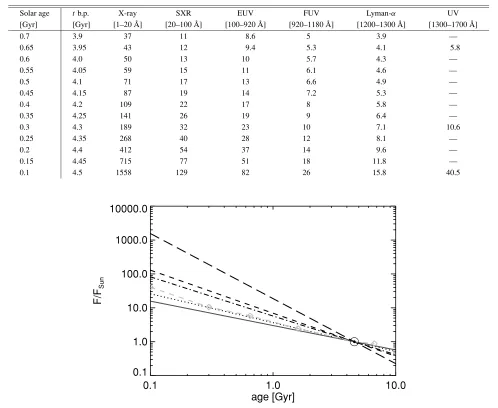
Table 7 shows similar as Table 5 integrated radiation en-hancement factors according to the analyzed data for vari-ous wavelength regions as a function of a stellar or solar age between 0.1–0.7 Gyr. As in Table 5 the fluxes are divided in six wavelength intervals and are normalized to the present solar values, calculated by using the power laws as given in Section 3.1. The sums of observed emission line fluxes, are used as proxies for the evolution in the full UV range. The evolution of the integrated fluxes is displayed in Fig. 3. Ac-cording to Ribaset al.(2005) the main uncertainties are the measurement error of the data, the calibration uncertainty of the various instruments and the intrinsic stellar variabil-ity which results in the total uncertainty of the power law slopes of≤0.1. The slope of the normalized fluxes becomes less steep with increasing wavelength, except for the 1300– 1700 ˚A interval. By comparing the data obtained from solar proxies with ages of about 4.6–0.7 Gyr (Table 5) with those which have ages<0.7 Gyr (Table 7) one can see that the up-per atmospheres of early Venus, Earth, Mars and Saturn’s satellite Titan should have been tremendously affected by X-rays, SXR and EUV radiation.
re-Table 7. Solar radiation flux enhancement as function of wavelength normalized to the present solar flux value during the first 500 Myr after the young Sun arrived at the ZAMS (Ribaset al., 2005; G¨udel, 2007).
Solar age tb.p. X-ray SXR EUV FUV Lyman-α UV
[Gyr] [Gyr] [1–20 ˚A] [20–100 ˚A] [100–920 ˚A] [920–1180 ˚A] [1200–1300 ˚A] [1300–1700 ˚A]
0.7 3.9 37 11 8.6 5 3.9 —
0.65 3.95 43 12 9.4 5.3 4.1 5.8
0.6 4.0 50 13 10 5.7 4.3 —
0.55 4.05 59 15 11 6.1 4.6 —
0.5 4.1 71 17 13 6.6 4.9 —
0.45 4.15 87 19 14 7.2 5.3 —
0.4 4.2 109 22 17 8 5.8 —
0.35 4.25 141 26 19 9 6.4 —
0.3 4.3 189 32 23 10 7.1 10.6
0.25 4.35 268 40 28 12 8.1 —
0.2 4.4 412 54 37 14 9.6 —
0.15 4.45 715 77 51 18 11.8 —
0.1 4.5 1558 129 82 26 15.8 40.5
0.1 1.0 10.0
age [Gyr] 0.1
1.0 10.0 100.0 1000.0 10000.0
F/F
Sun
Fig. 3. Evolution of the fluxes at 1 AU in different wavelength regimes (X-ray: 1–20 ˚A, long dashes; SXR: 20–100 ˚A, dashed line; EUV: 100–920 ˚A, dash-dotted line; FUV: 920–1180 ˚A, dotted line; Ly-α: 1200–1300 ˚A, grey solid line; UV: 1300–1700 ˚A, grey dashed line with diamonds) normalized to the present solar values. Power laws for the wavelength ranges were taken from Ribaset al.(2005). Line fluxes in the UV (1300–1700 ˚A) were summed up directly from observational data of strong emission lines (table 6 in Ribaset al., 2005).
gions, which would not imply a change in hardness. Observationally, spectral hardness has been character-ized in terms of the average electron temperature of the emitting stellar coronal plasma. While the solar coronal plasma shows characteristic temperatures in the 1–2 MK range (e.g., Pereset al., 2000), the overall trend for solar analogs with ages between 100 Myr and 5 Gyrs can be given as,
Tcor=0.34L0X.25 [K] (13)
whereTcoris the average coronal temperature in K andLXis the X-ray luminosity in erg s−1(G¨udelet al., 1997; G¨udel, 2007; Telleschiet al., 2005). For a young, near-ZAMS solar analog,Tcor≈10 MK, which results in considerably harder continuous X-ray radiation from these objects than from the present-day non-flaring Sun. This may be very important for modifying the photochemistry of early planetary atmo-spheres as the penetration depth is larger for high-energy
(harder) photons.
The cause of the hardening with increasing luminosity is an increasing population of coronal loops with maximum temperature around∼10 MK with increasing rotation of the star (e.g. Sanz-Forcadaet al., 2003). The nature of these loops is not clear in detail, but an attractive possibility is the operation of flares. For flares, a similar temperature-luminosity relation applies in X-rays (G¨udel, 2004). Sta-tistical studies during the past decade have addressed the problem of the occurrence rate of flares as a function of their total radiative energy (e.g., Audardet al., 2000; G¨udel
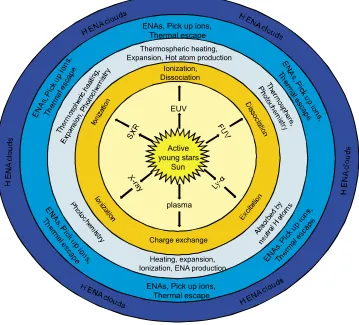
Fig. 4. Illustration of processes and response of upper atmospheres related to the radiation and plasma environment of active stars or the young Sun.
model is also supported by thecontinuouspresence of non-thermal electrons in extremely active young solar analogs (G¨udel, 2007) that are presumably accelerated by frequent flares. One would thus expect not only more intense X-rays in young solar analogs or around the young Sun itself, but also an increased level of flare-produced hard X-rays, gamma rays, ejected energetic particles and CMEs.
From this observational evidence one can expect that early planetary thermospheres should have been extremely hot and most likely expanded (Lammeret al., 2008; refer-ences therein). In Section 5 we will discuss the problems re-garding the “survival” or stability of planetary atmospheres during such extreme solar/stellar activity periods.
5.
Solar Activity Response of Planetary Upper
Atmospheres
In recent studies by Kulikovet al.(2006, 2007), Lammer
et al.(2006, 2008), Lundinet al.(2007), Tianet al.(2008a, b) and illustrated in Fig. 4 it was shown that enhanced so-lar EUV radiation and plasma (winds, CMEs) should result in permanent forcing of the upper planetary atmospheres, which can ionize, heat, expand, chemically modify, and erode it during the early phase of a planetary lifetime. In some cases the thermosphere may expand beyond an at-mosphere protecting magnetospheric shield. Highly irradi-ated terrestrial planets can thus be even in danger of being stripped of their whole atmospheres (Lundinet al., 2007; Lammeret al., 2009; Lichteneggeret al., 2010).
When the temperature of the thermosphere is large, a significant fraction of the light constituents of the upper atmosphere attain velocities above the escape value, and the thermosphere may even become non-hydrostatic and start to expand accompanied by adiabatic cooling to several planetary radii (Chassefi`ere, 1996; Tianet al., 2005, 2008a, b, 2009; Kulikovet al., 2007; Lammeret al., 2008).
On the basis of their energy source, we can separate two main escape categories: thermal escape and non-thermal es-cape. For thermal escape, atoms at the exobase level have more or less a Maxwellian velocity distribution that is de-termined by the exobase temperature. Particles with veloc-ities which are larger than the escape velocity of the planet can escape from the planet (e.g., Chamberlain, 1963). In extreme cases when the mean thermal energy of the major species at the exobase level (where the mean free path of the particles is comparable to the atmospheric scale height) exceeds their gravitational potential energy, thermal escape can be considered as “blow-off” ( ¨Opik, 1963). Assuming hydrostatic equilibrium, Kulikovet al.(2007) showed that terrestrial upper atmospheres exposed to enhanced EUV ra-diation of the early Sun could be heated to extremely high exobase temperatures which could be over 10 000 K. Tian
et al. (2008a, b) studied the response of thermospheres against high EUV fluxes in more detail and discovered that one can classify the thermosphere response into two ther-mal regimes.
equilib-Fig. 5. Thermospheric temperature profiles for a H-rich upper atmosphere of an Earth-like planet between the mesopause and exobase level for present day EUV (1 EUV), 2.5 EUV and 5 EUV. According to Tianet al.(2005); for an EUV flux which is 5 times that of the present Sun the exobase moves upward to about 7 Earth radii.
rium in which the bulk atmosphere below the exobase can be considered as static. This is the situation in the thermo-spheres of the Solar System planets today. However, if the Sun’s EUV flux or that of another star was/is much higher than that of the present Sun the thermosphere can enter a second regime.
In regime II the upper atmosphere becomes non-hydrostatic. In the hydrodynamic flow regime, the ma-jor gases in the thermosphere can expand very efficiently to several planetary radii above the planetary surface. As a result light atoms experience high thermal escape rates and expand to large distances (Tian et al., 2008a, 2009) where the whole atmosphere may be eroded by solar/stellar wind plasma flow related non-thermal escape processes (Khodachenkoet al., 2007; Lammeret al., 2007; Lundin
et al., 2007; Lichteneggeret al., 2010).
5.1 Hydrogen-rich upper atmospheres of terrestrial planets
Terrestrial planets may evolve through phases where their upper atmospheres are hydrogen-rich. There is some ev-idence from planetary formation theories that early Venus once lost its initial H2O inventory during an episode of a runaway and/or wet greenhouse effect via thermal and non-thermal atmospheric escape processes which could have been related to the form of “hydrodynamic” outflow. These extreme conditions may be reached in H-rich primordial thermospheres heated by the strong EUV flux of the young Sun (Sekiyaet al., 1980a, b; Watsonet al., 1981; Zahnle and Walker, 1982; Tianet al., 2005).
Sekiya et al. (1980a, b) and Watson et al. (1981) in their early works studied hydrodynamic conditions of H-rich thermospheres from early Earth or Venus due to so-lar EUV heating by applying idealized hydrodynamic equa-tions. From their thermospheric model Watsonet al.(1981) obtained exobase levels for an Earth which is exposed to EUV fluxes of∼5 times that of the present Sun of∼7 plane-tary radii. This result also agrees with hydrodynamic model
simulations for a H-rich early Earth thermosphere by Tianet al.(2005). An idea that EUV exposed upper atmospheres expand dynamically to larger distances is also confirmed by more sophisticated models such as that of Chassefi`ere (1996), and Tianet al.(2008a, b, 2009) which matched sub-sonic outflow solutions to Jeans boundary conditions at the exobase.
Figure 5 shows the thermospheric temperature profiles between the mesopause and exobase altitudes for a H-rich Earth-like planet which is exposed to 1 (present day), 2.5 and 5 times the present solar EUV flux value. One should keep in mind that we presented evidence in the previous sections that the EUV flux of the young Sun was much larger than 5 times that of the present Sun during the first 700 Myr after the Sun arrived at the ZAMS (see Table 7). During such stellar activity periods hydrogen-rich terrestrial planets may appear more as small gas giants with upper atmospheres which expand several tens of planetary radii.
5.2 Response of N2-rich atmospheres to high EUV fluxes
Fig. 6. Thermospheric temperature profiles between 100 km and the corresponding exobase levels for 1 (present), 3.3, 5.3, 7, 10 and 20 times higher EUV solar fluxes than today, applied to Earth with the present time atmospheric composition (Tianet al., 2008a; Lammeret al., 2008). One can see that the thermosphere switches in a non-hydrostatic regime forT≥8000 K and expands dynamically up to distances beyond 10 planetary radii.
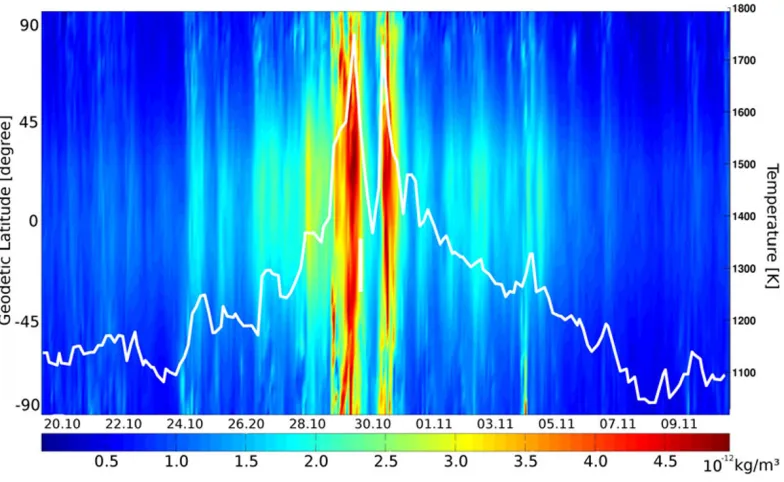
Fig. 7. Density impact of a X17.2 flare (Oct. 2003) observed by the GRACE satellite and temperature variation at orbit height is represented by the white curve (measurements taken at a local time of 16:19).
8000 K. For the Earth, these critical temperatures corre-spond to solar/stellar EUV flux values≥6 times that of the present Sun.
One can also see that the exobase distance which sep-arates the collision dominated thermosphere from the col-lisionless exosphere moves from ∼500 km up to ∼12.7 Earth-radii above the surface for a 20 EUV (4.2 Gyr ago) solar flux which would move about∼3.7 Earth-radii above the present-day average subsolar magnetopause location of
∼9 Earth-radii. Under such extreme SXR and EUV con-ditions the magnetosphere would not protect the upper at-mosphere, the planet experiences Venus or Mars-like solar
wind-atmospheric plasma interaction and as a result the ex-osphere could experience strong non-thermal escape.
Fig. 8. Thermospheric temperature profiles between the mesopause and the corresponding exobase levels for 1 (present), 30, 50, 70, 100 times higher EUV solar fluxes than today, expected at Saturn’s large satellite Titan with the present time atmospheric composition.
orbital distance between 470 km at the perigee and 520 km at the apogee. The period under investigation covered ten days before and after the so-called Halloween geomagnetic storm (X17.2 flare) in 2003 (Suttonet al., 2006). During this particular extreme solar event the upper atmosphere of the Earth was heated and as a result expanded with a den-sity increase at the satellites orbit of≈400% compared to that at quiet conditions (Shematovichet al., 2011). Related to that, also the temperature at the satellite position, calcu-lated using the “Jacchia-Bowman model” (Bowmanet al., 2008), increases significantly from ∼900 K up to∼1800 K. By applying a test-particle model to the expanded ther-mospheres given in Tianet al.(2008a) and a young solar wind which was about 100 times denser and twice as fast as today one obtains N+ ion pick up loss rates in the or-ders of∼1029–1030 s−1 (Lichteneggeret al., 2010). Due to the extended thermosphere-exosphere region the Earth’s entire current N2atmosphere (∼700 mbar) could have been stripped within a few million years.
In view of large uncertainties in the solar wind evolu-tion discussed in Secevolu-tion 3.3 Lichteneggeret al.(2010) esti-mated also the ion pick up loss rate of these N2atmospheres by assuming present-day solar wind parameters. Although the loss rates are about a factor 10 lower, Earth would have lost its present nitrogen atmosphere within some tens of million years at the latest when the EUV flux was>10 times from that of the present Sun. The main reason for these large escape rates is the EUV heated and expanded large solar wind plasma interaction area which is not protected beyond a present Earth-type magnetospheric shield.
Because the Earth’s nitrogen inventory is not lost, Lichtenegger et al. (2010) argued that these results indi-cate that the CO2 amount in the early N2-rich terrestrial atmosphere was at least two orders of magnitude higher than the present-time level. Such an amount was needed to confine the upper atmosphere after the onset of the geo-dynamo within the shielding magnetosphere and thus might have protected it from complete destruction.
However, the model simulation results show that planets with the size and mass≤of the Earth with even a 95% CO2 atmosphere would experience problems when the EUV flux reaches values which are≥30 time that of the present Earth (Tian, 2009; Lichteneggeret al., 2010). Moreover, photo-chemically produced low energy (“hot”) atoms and addi-tional thermospheric heating due to energetic solar/stellar particles could have additionally enhanced the atmospheric escape. On the other hand the expected initial CO2 reser-voir on early Earth was perhaps much larger compared to its nitrogen reservoir, so that a non-thermal loss to space of several bars of CO2during the first 100–300 Myr would have only slightly modified the CO2budget of the Earth.
Figure 8 shows the expansion of the second N2-type at-mosphere of a solar system body, namely Saturn’s large satellite Titan. As pointed out by Lammeret al.(2008) self consistent hydrodynamic models applied to Titan’s ther-mosphere would be needed to study the photochemistry changes due to the different solar flux in the past to exam-ine the modification in thermospheric temperature. Such studies are important for investigating to which distance the exobase could expand due to EUV heating by the young Sun and if Titan’s upper atmosphere could have reached classical hydrodynamic “blow-off” conditions or not.
5.3 Response of CO2-rich atmospheres to high EUV fluxes
densi-Fig. 9. Photochemically produced supra-thermal “hot” O atom density profiles at present Venus during low and high solar activity conditions compared with the bulk atmosphere.
ties for low solar activity (VEX solar conditions) are about a factor of 2–3 smaller than for high solar activity. Non-thermal hot O atoms populate the environment around the planet up to large distances where they can interact with the solar wind. This behavior indicates that higher EUV fluxes during the young Sun periods should have also resulted in denser hot O coronae around Venus and Mars, resulting in higher pick up loss rates.
Kulikovet al.(2006) studied the expected O+ ion pick up loss rates over Venus’ history by using EUV data from solar proxies discussed in Section 2 and a range of solar wind plasma densities and velocities which were expected for the young active Sun. These authors used a diffusive-gravitational equilibrium and thermal balance model, which was applied for a study of the heating of the early ther-mosphere by photodissociation and ionization processes, exothermic chemical reactions, and cooling by CO2 IR emission in the 15 μm band. The results of their study yield expanded thermospheres with exobase altitudes be-tween about 200 km for present EUV flux values and about 1700 km for 100 times higher EUV fluxes after the Sun ar-rived at the ZAMS. The exobase temperatures yield values of about 8000 K for the earliest EUV fluxes after the Sun arrived at the ZAMS.
However, one can expect that the high EUV flux will dis-sociate CO2 molecules in the thermosphere which results in less IR-cooling and in a possible non-hydrostatic upper atmosphere environment with high thermal escape rates for dissociated C and O atoms. By considering the uncertain-ties discussed on the solar wind parameters expected for the young Sun as discussed in Section 3.3, with the model dis-cussed in Kulikovet al.(2006) one obtains loss rate from a CO2-rich early Venus atmosphere which is equivalent to about 2–10 bars during the planets’ history. From the present knowledge of the stellar wind parameters discussed in this work we expect that the high mass loss cases shown in Kulikovet al.(2006), where Venus could have lost much more atmosphere than 10 bar over its livetime may be
over-estimations based on solar wind parameters which are too large.
If Venus evaporated its initial H2O inventory during that period, the planets upper atmosphere would have been hydrogen-rich (Chassefi`ere, 1996) as discussed in Section 5.1 and a dense hydrogen corona would have pro-tected the initial N2 and CO2 inventory from escape until the evaporated water inventory was lost by thermal and non-thermal escape processes.
Tian et al. (2009) and Tian (2009) applied an ad-vanced 1-D multi-component, hydrodynamic, planetary thermosphere-ionosphere model and a coupled electron transport-energy deposition model to Mars and CO2-rich atmospheres of “super-Earths”. With this model they could self-consistently calculate the ionization and excita-tion rates of thermospheric species together with the con-nected electron heating rates and related EUV heating ef-ficiencies. It was found that due to the high EUV fluxes (>10 times that of the present Sun) CO2 molecules can be dissociated so that less thermospheric IR-coolers are available which resulted in higher heating efficiencies and exobase temperatures compared to previous model simula-tions (Lammeret al., 2006; Kulikovet al., 2006). When extrapolating the model to early Mars, Tianet al. (2009) found that the exobase expands to∼900 km altitude and the exobase temperature reaches∼800 K for EUV flux val-ues which are about 10 times the present solar value. As one can see from Fig. 10, for higher EUV fluxes such as 20 times the present solar value the exobase moved to dis-tances of≥10000 km with exobase temperatures>2500 K. One main reason for the nonlinear response of the upper atmosphere to the EUV flux is that the main IR cooling agents such as CO2, are destroyed by the high SXR and EUV fluxes, so that thermospheric cooling becomes less ef-ficient.
ini-Fig. 10. Thermospheric temperature profiles for present day Mars between 100 km and the corresponding exobase levels for present time solar EUV flux values (1) (Fox and Ha´c, 2009) and the martian thermosphere when it is exposed to a 20 times higher EUV flux (∼4 Gyr ago according to Tian
et al.(2009)). The thermosphere temperature reaches∼3000 K and expands dynamically upward to distances of about 3 planetary radii.
Fig. 11. Thermospheric temperature profiles according to Tian (2009) for “super-Earths” with∼6 Earth masses and CO2-type atmospheres within orbits of M-star habitable zones between 100 km and the corresponding exobase levels when their thermospheres exposed to a 80, 200 and 800 times higher EUV flux.
tial CO2 inventories (e.g. Phillipset al., 2001) during the early Noachian when the EUV flux was even larger than 20 times of the solar value. Due to the EUV heating and ex-pansion of the upper atmosphere an early martian magnetic field could have not most likely protect the ion escape of C+ and O+ atoms which originated from dissociation of CO2 molecules. By applying the same test-particle model, as in the study of early Earth by Lichteneggeret al. (2010), to the upper atmosphere profiles and estimated martian mag-netopause distances as given in Dehantet al.(2007), we can show that the expanded thermosphere-exosphere can inter-act with the solar wind plasma which results in pick up C+ ion escape fluxes of>1011cm s−1before 4 Gyr ago.
Thus, due to the high activity of young Sun and the low gravity of Mars a dense early Noachian martian atmosphere
may not have built up during the first 300–400 Myr after the planet’s origin. A question remains when the outgassing rate was larger compared to the thermal and non-thermal neutral escape rates and what role impacts play in the for-mation or removal of the atmosphere (Phamet al., 2009). These processes may have played a role at the end of the Noachian so that a CO2atmosphere with a surface pressure of a few 100 mbars and a resulting warmer climate may have been established so that Mars warmed up sporadically
∼3.5–4 Gyr ago. However, such an accumulated CO2 at-mosphere should have been lost since about 4 Gyr ago by solar wind erosion (ion pick up, cold ion outflow), sputter-ing and photochemical hot atom escape after the martian magnetic dynamo stopped working.
Fig. 12. Illustration chart about the general approach and connections between observations and modeling efforts which should lead to the development of state-of-the-art thermosphere-exosphere models and to a better understanding of aeronomically related atmospheric evolution aspects for terrestrial planets.
Earth-mass hypothetical CO2-rich exoplanets. The results indicate that such atmospheres are stable against thermal escape, even for M stars’ EUV flux enhancements as large as 1000 compared to the present Sun. On the other hand one can see from Fig. 11 that the highly irradiated thermo-spheres of such planets may also expand to altitudes be-yond 10000 km above the planets surface. These results are in agreement with previous studies of Khodachenkoet al. (2007) and Lammer et al. (2007) who estimated the atmospheric erosion of CO2-rich exoplanets due to CME-induced ion pick up within close-in habitable zones of ac-tive M-type dwarf stars. They found that Earth-mass CO2-rich exoplanets that have no, or weak, magnetic moments may lose tens to hundreds of bars of atmospheric pressure, or even be stripped of their whole atmospheres due to CME-induced O+ ion pick up at orbital distances∼0.2 AU. Al-though the formation of magnetospheres and possible loca-tions of a magnetopause are not well known for such plan-ets, expanded atmospheres of “super-Earths” could have been subject to stellar wind erosion. However, one should note that previous studies focused either on thermal effects and escape (e.g., Tian et al., 2008a, 2009; Tian, 2009) or on non-thermal processes (e.g., Kulikov et al., 2006, 2007; Terada et al., 2009; Lichtenegger et al., 2010) al-though both processes are strongly coupled and should not be separately studied. As illustrated in Fig. 12, to under-stand really how planetary atmospheres can “survive” the extreme X-ray, SXR and EUV activity of their host stars af-ter they arrived at the ZAMS, one has to combine thermal and non-thermal upper atmosphere processes by developing a self-consistent multi-species ionospheric-thermospheric exosphere model which couples thermal and non-thermal processes, for studying hydrostatic and non-hydrostatic dy-namically expanding thermosphere-exosphere regions, in-cluding the investigation of the production of hot atoms, their collisional interaction and transport within highly EUV exposed thermosphere-exosphere regions, and their contribution to the thermospheric heat budget.
6.
Testing Atmosphere Evolution Scenarios via
UV-transit Observations of Earth-like
Exo-planets Orbiting Dwarf Stars
As discussed in the previous section, dynamically ex-panded thermospheres and related coronae should form if SXR and EUV fluxes≥5 EUV and light atoms such as hy-drogen populate the upper atmosphere, or if no IR-cooling molecules are present. As a consequence the upper atmo-sphere expands beyond a possible magnetospheric shield and hydrogen energetic neutral atoms (ENAs) are produced via charge exchange collisions between the atmosphere and charged solar/stellar wind particles (Lammeret al., 2011a, b). As discussed recently by Holmstr¨om et al. (2008), Ekenb¨acket al.(2010) and Lammeret al.(2011a) ENAs have been observed around all Solar System planets when a spacecraft was equipped with an accurate instrument.
Lammer et al. (2011b) pointed out that, the observa-tion and theoretical modeling of hydrogen and ENA-clouds around a terrestrial exoplanet would indicate that its ther-mosphere is not in hydrostatic equilibrium but experiences hydrodynamic expansion beyond its magnetospheric shield. Therefore, by observing planetary hydrogen clouds and re-lated ENA-coronae around transiting terrestrial exoplanets in UV (Lyman-αattenuation) we will learn more on how the early Solar System planetary atmospheres have evolved. Because transiting Earth-size exoplanets and their hydrogen clouds are too small relative to the size of Sun-like G-stars to detect them, Lammeret al.(2011b) proposed to study hy-drogen clouds around such planets within orbits of M dwarf stars. Due to the large number of M-type stars in our neigh-borhood (Scaloet al., 2007) and their small size and compa-rably long periods of strong stellar activity in X-rays, SXR, and EUV M dwarf stars may represent the most promising candidates for the detection of hydrogen clouds and related ENAs.
Fig. 13. Left side illustrates the size relation of exoplanets around the two M-stars EV Lacertae and Proxima Centauri with a transiting Earth analogue with an extended hydrogen atmosphere of 7REarth. Right side shows a preliminary model simulation of an extended hydrogen corona and stellar wind produced hydrogen ENAs around an Earth-size planet with an expanded hydrogen-rich thermosphere of 7REarth(Lammeret al., 2011b).
mainly composed of hydrogen and helium. According to Lammeret al.(2011b) such examples may be:
• dense hydrogen envelopes which remained from the primordial nebulae;
• hydrogen-rich thermospheres produced via dissocia-tion of CH4, NH3and H2O molecules;
• ocean planets or planets which evaporate their initial H2O reservoir;
• evaporation of H2O oceans due to cometary or aster-oidal impacts.
During this early stage in planetary evolution, heavy atmo-spheric species such as CO2, N2, etc. are most likely pro-tected from escape to space until the dense primordial hy-drogen envelope which populates the non-hydrostatic ther-mosphere is lost. The removal time of such hydrogen envelopes depends on the amount of available hydrogen, the SXR, EUV flux and plasma environment of the young host star. If this hypothesis is right, one can expect that hydrogen-rich upper atmospheres may be a common sce-nario at young terrestrial planets during tens or hundreds of Myr after their origin.
If we expect that similar processes produce hydrogen-rich thermospheres around many young terrestrial exoplan-ets, these bodies would produce huge planetary hydrogen coronae and related ENA clouds as observed around hot gas giants such as HD 209458b (Vidal-Madjaret al., 2003; Holmstr¨om et al., 2008; Ekenb¨ack et al., 2010) and HD 189733b (Lecavelier des Etangset al., 2010). Figure 13 shows an illustration of such transiting exoplanets and a modeled hydrogen cloud around an Earth-size test planet accordingly to Lammeret al.(2011b). As one can see from Fig. 13 the produced hydrogen atoms populate a wide area around the planetary environment and a huge fraction of the host star should be covered with the outward flowing
plan-etary hydrogen atoms and produced ENA-cloud during a transit.
Since the past years the search for Earth-like exoplanets around low-mass M-type stars has become one of the major activities in stellar astrophysics. Besides several ground-based search projects such as CRIRES, CARMENES, or HZPF (e.g., Lammeret al., 2011b; and references therein) ESA’s M3 candidate PLATO (PLAnetary Transits and Os-cillations of stars) will also be dedicated to detect transit-ing terrestrial exoplanets within and outside of habitable zones, and determine their basic parameters with unprece-dented accuracy (Catala and the PLATO team, 2009a, b). The PLATO mission has been selected for a definition study phase in the context of ESA’s Cosmic Vision 2015–2025 program as an M-class mission with foreseen launch in 2017–2024 (Stankovet al., 2010). The instrument concept of PLATO (Catala and the PLATO team, 2009a) consists of a multi-telescope approach. In total 32 refractive tele-scopes (pupil size about 120 mm each) are combined to produce highly photometrically accurate lightcurves cover-ing a wide dynamic range. In addition, two so-called fast telescopes with fixed color filters and higher read-out ca-dence are used for seismic studies of the brightest targets. PLATO is planned to be launched into an orbit around the L2 Lagrange point. Two target fields will be monitored for at least 2–3 years with high duty cycle. In a “step-and-stare” phase several fields will be monitored for shorter durations (2–5 months each). In total, PLATO will cover about 50% of the sky.
to a well-constrained age of planetary systems. Planetary radii will be determined from PLATO transit observations. Combined with a world-wide ground-based follow-up cam-paign to obtain radial velocity measurements, planet masses will be derived. However, previous transit searches have shown that well constrained stellar parameters are crucial to derive accurate planet parameters. PLATO therefore com-bines photometric transit search with astroseimology of the central stars of planetary systems. These astroseismologi-cal studies are further keys to obtain a well constrained age (goal: 10% accuracy; Kjeldsenet al., 2009) of stars, and therefore planetary systems.
The search will include planets of all orbital periods and with all physical sizes, with focus on bright central stars of solar type. PLATO will perform a full characterization of the observed very bright stars using seismic analysis. The highest priority sample, therefore, are about 20 000 dwarfs and sub-giants withmV ≤ 11 mag for which Earth-sized planets can be detected and accurate seismic analysis be performed. A smaller sample of very bright stars (mV≤ 8 mag) will provide targets for future spectral characteriza-tion of the detected planets. Finally, a large sample of stars (more than 245 000 cool dwarfs/subgiants with 11 mag<
mV<13 mag) will be monitored to detect terrestrial plan-ets, but without detailed astroseismology. What is inter-esting in the context of our work outlined in this section, PLATO will also search for exoplanets around more than 10 000 nearby M-type dwarfs (down tomV=15–16 mag), including planets within their habitable zones.
After the discovery of Earth-size exoplanets with PLATO, follow-up observations with the the upcoming World Space Observatory-UltraViolet (WSO-UV) mission could be carried out. The WSO-UV is an international space mission devoted to UV spectroscopy and imaging which is included in the Federal Space Program of the Russian Federation with a launch date around 2014–2015 (Shustovet al., 2009; Lammeret al., 2010). The observa-tory includes a 170 cm aperture telescope capable of high-resolution and long slit low-high-resolution spectroscopy, and deep UV and optical imaging and is designed for observa-tions in the UV-range (Shustovet al., 2009). The WSO-UV space observatory will be equipped with instruments which can carry out:
• High resolution spectroscopy of point sources in a wavelength range 1020–3200 ˚A by means of 2 high resolution echelle set ups with a sensitivity which is about 10 times better than that of the HST/STIS.
• Long-slit resolution spectroscopy in the 1020–3200 ˚A range.
• High resolution imaging in the 1500–2800 ˚A range with a field view of 1×1.
• High resolution imaging in the 2000–7000 ˚A range with a sensitivity which is about 3 times higher than the HST/ACS system.
• Molecular hydrogen mapping in extended, faint as-trophysical objects with a large field far UV (1150– 1900 ˚A) camera.
The WSO-UV’s core program will focus also on exoplan-etary atmospheres and astrochemistry in the presence of
strong UV radiation fields (G´omez de Castroet al., 2009; Shustov et al., 2009). In Lammer et al. (2011b) it was shown that it may be possible to observe transits in UV of Earth-size exoplanets with extended hydrogen coronae if they orbit around small stars.
Thus, transit follow-up observations of exoplanets dis-covered by ESA’s currently studied PLATO mission in the UV-range of terrestrial exoplanets around M-type stars with space observatories such as the WSO-UV would provide a unique opportunity to shed more light on the early evolu-tion of Earth-like planets, including those of our own Solar System. Moreover, as pointed out in Lammeret al.(2011a) observations of exoplanets with various ages, together with hydrogen cloud and ENA modeling efforts could be used for the reconstruction of the solar wind history as well as testing magnetic dynamo evolution scenarios of gas giants.
7.
Conclusions
By analyzing solar and astrophysical observations and phenomena we present strong evidence that the Sun and similar stars underwent much more active phases after they arrived at the ZAMS. The enhanced activity reveals itself in the form of strong high energy radiation emissions, frequent flares, and a denser and faster stellar wind. Results from the “Sun in Time” project suggest that the coronal X-ray and EUV emissions of the very young main-sequence Sun were
∼1550 and ∼80 times stronger than those of the present Sun, respectively. We showed that such an energy and par-ticle environment certainly had an impact on the origin and evolution of Solar System planets and their atmospheres. Due to the heating of the much higher solar/stellar SXR and EUV flux the planetary thermospheres and exobase lev-els extended to higher altitudes than at present time, which resulted in larger solar wind-atmosphere interaction areas, no protection of intrinsic magnetospheres, the production of huge hydrogen ENA-clouds and higher non-thermal escape rates. Under certain activity conditions of the young Sun or planetary host star hydrostatic equilibrium could not have been kept. Finally we addressed the possibility of study-ing the detection and follow-up observations of extended upper atmospheres around exoplanets by near future space observatories such as ESAs PLATO mission in combina-tion with the WSO-UV space telescope. Such observacombina-tions would enhance our knowledge regarding the interaction of the host star’s plasma environment and with Earth-like ex-oplanets itself, as well as shed light into the evolutionary stage of their atmospheres.