© 2015, IRJET ISO 9001:2008 Certified Journal
Page
1982
Estimation of speed and Parameter identification in Sensorless IM
drive By using Second order Sliding-mode Observer and
MRAS techniques
performance of sensor and sensorless IFO IM drives. In case of operation of drives with sensors, has good dynamic performance at high and medium speed operation. Where as at low speed operation, the performance of the drive is not satisfactory. To get satisfactory performance even at low speeds sensorless controlled IM drives with MRAS and Sliding mode observer is designed. Sensorless control has good dynamic response compared to drives with sensor. In a sensorless induction motor drive, A Stator current observer is designed based on the second-order sliding mode which is used as the reference model of the MRAS estimator. The phase angle error between the actual and estimated rotor flux vectors is used to tune the adaptive model of MRAS estimator. The sliding mode observer is insensitive to variation of stator resistance, rotor resistance and perturbation when the states arrive the sliding mode. By making full use of auxiliary sliding-mode surfaces, the proposed observer successfully reduces the chattering behavior. Furthermore, in order to improve the near zero speed operation, a parallel adaptive identification of stator resistance is designed based on derivatives of rotor flux and stator current.
Key Words:
Induction motors (IMs), model referenceadaptive system (MRAS) estimator, supertwisting
algorithm Sensorless control, second order sliding mode, parameter estimation, Low speed operation.
1.INTRODUCTION
Now-a-days induction motors (IM) have replaced DC motors in the industrial applications. High performance sensorless induction motor drives have attracted a great attention in industrial applications due to their
advantages such as low cost, less maintenance, and high reliability etc. The sensorless control helps to reduce the cost and resolves installing problems in many applications. There are many different ways to drive an induction motor. The Differences between them are the performance of motor and the cost of implementation. At present efforts are devoted to improve the performance of observer at low speeds, and to develop a robust observer against perturbations and variation of parameters.
Several methods have been proposed to estimate speed and flux of IM such as: Luenberger observer and kalman filter, high gain and adaptive observers, neural networks and signal injection, and sliding mode observer etc. Compared with the other methods, sliding mode techniques has attractive advantage of robustness to disturbances and insensitive to parameter variation when the sliding mode is reached. However, the chattering behavior, that is inherent in standard sliding mode techniques, is often an obstacle for practical applications if neglected. Higher order sliding mode is one of the solutions which does not compromise robustness and avoids filtering estimation considered by other methods.
© 2015, IRJET.NET- All Rights Reserved
Page 1983
varies, which is not the case in steady state. Since therotor inductance can be treated as a constant, the rotor time constant identification is equivalent to the identification. So far numerous online parameter estimation techniques have been proposed on the basis of existing speed estimation schemes, which are able to improve dynamic characteristics and noise immunity, as well as insensitivity to parameter variations. In this scheme, both rotor speed and rotor time constant can be estimated by a sliding function based on a second-order system.
Extended kalman filters (EKF) based estimation scheme has significantly increased the accuracy of the estimation of the estimation of the stator and rotor resistances However, they have no specific tuning criteria. Sliding mode observers are recognized for their robustness against parameter variations, yet they suffer from chattering behavior at the same. By using auxiliary sliding mode surface chattering behavior can be reduced.
2. SVM BASED INDIRECT VECTOR
CONTROLLED IM DRIVE
Several speed estimation techniques are available
,
for IM drives. In this case performance of indirect field oriented controlled IM drive specially at low speeds is studied. Simulink diagram of SVM based indirect vector controlled induction motor drive is shown in fig.1.Fig:1 Simulink diagram of IFO IM Drive
This proposed model has good dynamic performance and gives excellent results during high and medium speed operation. But When the drive is operated at low speeds performance of the drive is not satisfactory. To
overcome the above disadvantage, Sensorless Induction motor drive is designed by using second order sliding mode observer. Sliding mode observer is robust to perturbations and insensitive to parameter variation. In order to improve near zero speed operation, a parallel adaptive identification of stator resistance is designed based on derivatives of rotor flux and stator current.
2.2 Operation of drive at low speeds
Stator resistance estimation plays an important role in low speed estimation, since the mismatch between the actual value and set value may lead not only to a speed estimation error but also to system instability.
Fig:2 Estimted speed for reference speed of 10 rpm.
In this method, stator resistnace estiamtion is not possible, cosequently operation at low speeds may lead to unstable operation. An improved speed estimation method (especially at low speeds) by using MRAS estimator and sliding mode techiques is discussed in the following case.
3. SENSORLESS IM DRIVE BY USING MRAS
AND SLIDING MODE OBSERVER
3.1.second-order smo
The IM in stationary reference frame (α,β) in terms of stator current and rotor flux can be written as follows
© 2015, IRJET.NET- All Rights Reserved
Page 1984
And are respectively stator
currents, rotor fluxes, and statorvoltages is the
angularvelocity. are the stator and rotor
resistances. are respectively the stator and rotor inductance. the mutual inductance. σ is the leakage coefficient. is the rotor time constant.
3.2.supertwisting algorithm(STA)
Supertwisting algoritm is generally used in second order sliding mode observer. The finite time convergence and robustness of STA have been proved by geometrical methods, and the continuous stability of STA has been proved by Lyapunov methods.The simplest form of STA can be written as
where denotes the state variables, and δ are switching gains, and represents the perturburation terms. According to Levant and moreno and osorio, it is well known that the STA is robustly stable to
perturbations globally bounded by
For any positive constant L the gains are approximately selected.
3.3 STA-based observer
The third and fourth terms of (1) can be substituted into the first and second terms; thus(1) is rewritten as
cosidering a variable substitution
Where the intermediate variables Substituting
(4) into (3) yields
By applying the STA to the IM model (2), a current observer can be constructed as
Where the observations.
are respectively the gains of the primary and auxiliary sliding-mode surfaces. sgn() represents the
sign function. errors, which are
defined .
are treated as constants in the observer.
According to (4), there exists a simple relation between
the observations of rotor flux
…..(8)
where represents the estimated
results with the physicsl significance of “derivatives of rotor flux.”
3.4 proposed observer with perturbation
Equations (6) and (7) aredecoupled,so their distrubance characteristics can be analysed independently. Considering (6) only and taking parameter variation into consideration,we get the following form
The perturbation caused by variation of the stator parameter can be converted into Similarly, represents the perturbation caused by the variation of the rotor parameter.
According to STA, for every positive value of L there exist such gains that the observations of(9),i.e.,
© 2015, IRJET.NET- All Rights Reserved
Page 1985
mismatch between the actual value and set value maylead not only to a speed estimation error but also to system instability. On the other hand can still be treated as constant in (6) and (7) because it varies slowly compared to electrical signal. In discrete time, the kth observation error is calculated by e(k)=z(k)- where z(k) is real component, is estimated one. Thus, e(k-1) is the (k-1)th observation error, which is used to calculate the estimated .
Fig-3:Flowchart of discrete-time STA based observer If the gains are selected according to the conditions that they presented, the error states are ultimately bounded. In other words, the trajectories of system enter into a boundary layer in the victinity of the sliding mode and stay inside it forever. This algorithm is termed as supertwisting-like algorithm. For The continuous second-order SMO shown in (6) and (7) the discrete observer is obtained. The gains of the discrete STA based observer should satisfy the necessary and sufficient conditions for the existence of the sliding-mode hyperplane in discrete time. The conditons were obtained by using Lyapunov function.
The necessary and suficient conditions to ensure the sliding motion on the hyperplane are obtained
[e(k+1)-e(k)].sgn(e(k))<0
4 SPEED ESTIMATION SHEME
4.1.Standard MRAS speed estimator
MRAS speed estimation makes use of two machine models with different structures that estimate the same motor state. The motor states may be rotor flux, back emf
or reactive power etc. Choosing the rotor flux to be the
state, the estimation error can be
The phase angle error between actual and estimated rotor flux vectors is used to tune the speed as is illustrated in fig.4.
Fig-4:Block diagram of standard rotor based MRAS estimator.
4.2.Proposed MRAS speed estimator
In proposed estimator derivatives of rotor flux is used as state, an adaptive mechanism of speed based on these observations is required. For speed estimation, the output of reference model is regarded as equal to the actual rotor flux vector , and Hence
Eventually the estimation equation of rotorspeed is
where
(14)
Compared with the standard MRAS speed estimation, the proposed speed estimator eliminates the integrators, thus simplifying the system and avoiding the problems caused by integration.
4.3 Parallel identification
© 2015, IRJET.NET- All Rights Reserved
Page 1986
flux. In case of parallel estimation reference model andadjustable model exchange their roles.
Symbols and respectively stand for actual and estimated rotor flux vectors of voltage model The voltage model of IM can be written as
The observer equation is
When the estimation error trajectory reaches the sliding mode, we get Eventually the estimation of stator resistance obtaned as
where
is treated as constant in the STA-based observer because it changes much slower than electric signals such as stator voltage and current.
4.4.SSM scheme
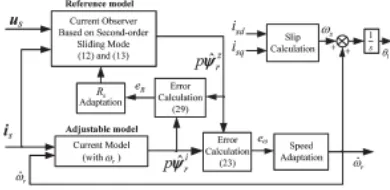
The proposed SSM sheme used in this paper is a combination of STA-based SMO and MRAS estimator which isnamed as SSM scheme. The configuration of the SSM scheme is shown in fig.5.
Fig-5:Block diagram of the proposed SSM scheme
Fig-6:simulink diagram of sensorless IM drive
Fig-7:Simulink diagram of controlling technique
TABLE 1 PARAMETERS OF THE IM DRIVE Parameter
Value
Parameter Value
Rated power(kw) 15 Stator resistance(Ω) 1.556 Rated voltage(V) 380 Rotor resistance(Ω) 1.31 Rated current(A) 18.5 Stator inductance(mH)0.156 Rated speed(rpm) 980 Rotor inductance(mH) 0.162 Rated frequency(Hz)
50
Mutual inductance(mH) 0.15
Number of poles 3 Inertia(kg- ) 0.06
© 2015, IRJET.NET- All Rights Reserved
Page 1987
Fig-8: Block diagram of sensorless IFO cintrolled IM drive5.SIMULATION RESULTS
The proposed scheme is verified by simulation. The Simulink model of sensorless indirct field oriented controlled IM drive is shown in fig.6.
The pulse width modulation (PWM) frequency is set to 10 kHz, which is the same frequency as the sampling rate of the SSM scheme. The motor phase voltages are reconstruced relying on the dc voltage and PWM duty cycles. The gains are set to
and
which satisfies the limits discussed in section2.
5.1 Low speed operation
The performance of parallel identification is tested in low speed operation. Which is shownin fig.9. In this case the machine is operating with a torque of 20-N.m load at speed 10 rpm, and the actual is sharply increased from 1.6 to 2.1ῼ at t=3sec, the estimated value keeps in step with the actual one, thus consequently eliminating the initial speed estimation error.
Fig-9: Speed estimation and stator resistance estimation at speed command of 10 rpm and sharp variation of stator resistance
5.2 Observability verification
The IM motor observability cannot be established in the particular case when the rotor fluxes and the speed are constant. Operation of drive in this case can be represented as unobservability curve. It is significant to verify the performance of the proposed SSM scheme in one point of the unobservability curve. The SSM scheme is teseted in open loop in order to achieve the particular case . The test rotor flux is set to 1.5 Wb, and the load is 50 Nm. According to the unobservability curve, an angular speed of -3.21 rps corresponds to the codition of loss of observability.
In fig.10 the IM is tested with an initial speed of 20 rps and a 50 Nm load (start at 0.5sec and ready at 0.7sec ), followed by a speed of 80 rps (from 2sec to 3 sec), then by a speed of -3.21rps (from 4sec to 5sec), and finally by a speed of 25 rps (from 6 to 7) . The simulation result show that the proposed scheme is stable under unobservable conditions.
Fig-10:Actual and estimated speeds under the codition of loss of observability
5.3 variation of
The robustness of the proposed observer is tested with sensorless control and a 10 Nm. At time t=3sec the give speed is changed from 9 to 18 rpm; meanwhile is changed from 1.3 to 1.7 ῼ during 0.2 sec. The
observations and are insensitive to
© 2015, IRJET.NET- All Rights Reserved
Page 1988
Fig-11: Observation results with variation.
5.4 High speed operation
Fig.12 contrasts the actual and estimated speeds during the acceleration process(150rpm-600rpm-1000rpm) with a 50 Nm load and sensorless control. By utilising the SSM scheme, the system operates stably, and the speed error is acceptable.
Fig-12:.Actual and estimated speeds at acceleration process (150 rpm-600 rpm-1000rpm).
6.CONCLUSION
The disadvantages of induction motor drives with sensors in low speed operation are overcomed by using sensorless control. Sensorless control has good dynamic performance, robust to perturbations and also insensitive to parameter variations. This paper presents a modified speed-sensorless control scheme based on second order sliding-mode STA and MRAS estimatior. The estimation scheme has been obtained by combinig a second order sliding mode current observer with a parallel speed and stator resistance estimator based on rotor flux based MRAS. Both the error in instantaneous phase position and the error in amplitudes are used respectively for speed estimation and estimation, thus ovecoming the problems of variation, paricularly for low speed operation.
The STA based observer is used as the reference model of the standard MRAS. Derivatives of rotor flux are obtained and designed as the states of MRAS, thus eliminating the integration. Moreover, by making full use of auxilary surfaces, the observations are insensitive to rotor
parameter perturbation and also the chattering behavior reduced at the same time. However, since the scheme is “Comparision of saliency based sensorless control
techniques for ac machines,” IEEE
Trans.ind.Appl.,vol.40,no.4,pp.1107-1115,Jul./Aug.2004. [2] Q.Gao, G. Asher, and M. sumner,”Sensorless position
and speed control of inductiom motors using
high-frequency injection and without offline
precommissioning,”IEEE
Trans.Ind.Electron.,vol.54,no.5,pp.2474-2481,oct.2007. [3] Z. Gao, L.Tumer, R.S. colby and B.Lepretter, ”A
frequency demodulation approach to induction motor speed detection,” IEEE Trans.Ind. Appl.,vol.47, no .4,pp.1632-1642,July/Aug.2011.
[4] V.Vasic, S.N. Vukosavic, and E. Levi, “A stator
resistance estimation scheme for speed sensorless rotor flux oriented induction motor drives,” IEEE Trans.Energy
convers.,vol. 18, no.4,pp.476-483, Dec.2003. [5] D.P. Marcetic and S.N. Vukosavic, “Speed sensorless ac
drives with the rotor time constant parameter update,” IEEE Trans.Ind.Electron.,vol. 54, no.5 pp.2618-2625, oct.2007.
[6] V.R. Jevremovic, V. Vasic, D.P. Marcetic, and B. Jeftenic, ”speed sensorles control of induction motor based on reactive power with rotor time constant identification,” IET Elect. Power Appl.,vol. 4, no.6, pp.462-473, Jul. 2010. [7] L. Kyo-Beum and F. Blaabjerg, “Reduced order
© 2015, IRJET.NET- All Rights Reserved
Page 1989
[9] M. Barut, S. Bogosyan, and M. Gokasan, “Experimentalevaluation of braided EKF for sensorless control of induction motors,” IEEE Trans.Ind. Electorn.,vol.55, no.2, pp. 620-632, Feb.2008. [10] M.S Zaky, M.M. Khater S.S. Shokralla, and H.A. Yasin, ”Wide speed range estimation with online parameter identification scheme of sensorless induction motor drives,” IEEE Trans. Ind. Appl.,vol. 42, no.3, pp. 694-701, May/Jun.2006.
[11] Z. Zhang, H.S Xu L.Y. Xu and L.E .Helian, “sensorless direct field oriented control of three phase induction motors based on “sliding mode” for washing machine drive applications, “ IEEE Trans. Ind. Appl.,vol. 42, no.3, pp. 694-701, May /Jun.2006. [12] S. Solvar, V. Le, M. Ghanes, J-P. Barbot and G.
Santomenna, “sensorless second order sliding mode observer for induction motor, ” in Proc. IEEE CCA, Yokohama, Japan, 2010, pp. 1933-1938.
BIOGRAPHIES
M. Anka Rao is a Assistant Professor in EEE Department at JNTUA Anantapur. His areas of interest are Power Electronics, Electrical Drives.
Dr.M. Vijaya Kumar is a Professor in EEE Department and also served as a Director of Admissions at JNTUA Anantapur, Andhra Pradesh. His areas of interest are ElectricalMachines, Electrical Drives, Microprocessors and power Electronics.
B. Mukteswari currently pursuing M. Tech in Power and industrial drives at JNTUA Anantapur, Andhra
Pradesh. Her areas of