scroll down to view the document itself. Please refer to the repository record for this item and our policy information available from the repository home page for further information.
Author(s):Shamou, M; Saidpour, Hossein; Perryman, Roy
Title:Developing lean six sigma framework for use in small and medium enterprises
Year of publication:2010
Advances in Computing and Technology
The School of Computing, Information Technology and Engineering, 5th Annual Conference 2010
218
DEVELOPING LEAN SIX SIGMA FRAMEWORK FOR USE
IN SMALL AND MEDIUM ENTERPRISES
Shamou, M, Saidpour, H and Perryman, R
School of Computing, Information, Technology and Engineering, University of East London [email protected], [email protected]
Abstract: Previous researches in manufacturing operations concluded that the best opportunities for improvement are achieved when the manufacturing system is designed from the top down and from customer to the supplier. The most effective manufacturing system designs is the one that consider the whole product value stream rather than just shop-floor activities. Although the lean deployment is a critical success factor, yet there is no holistic or a step by step approach to the deployment process. The lack of a framework that provides a systematic practical approach to lean implementation is increasingly becoming an issue for manufacturing organisations and professionals. This paper presents an attempt to develop a framework that can be used to develop a lean manufacturing system in small and medium enterprises (SME). The framework is based on lean six sigma principles of efficiency, speed, reduced waste and high quality.
1. Introduction:
In manufacturing organisations, the
manufacturing function has great potential and ability to contribute to achieving strategic goals; therefore it should be given the same importance as other business functions in the organisation (Skinner, 1969). By understanding the full potential of manufacturing it can change from a tool for implementing decisions taken by other functions into a function that take a proactive role in shaping the business strategy and provide the organisation with a sustainable competitive advantage (Gilgeous et al, 1999).
2. Problem statement:
Unlike large organisations, SMEs did not get enough attention for implementation of
manufacturing methodologies and
technologies (Gunasekaran et al, 1998).
Although the lean transformation process is a critical success factor, yet there is no holistic approach to the lean transformation process. Henley business transformation framework was used as a frame of reference despite the fact that it is very basic, other lean and TPS researchers only provided bullet points (Ahrens, 2006).
Kilpatrick (1997) reported that despite the rich literature on lean manufacturing principles, a general lack of focus on the system level issues is visible, also there is no clear integration between the three levels of production: system, cell and machine. Kilpatrick also believe there is a need to investigate at all three levels the issues that prevent successful implementation of lean manufacturing (Kilpatrick, 1997).
this field to fill that gap by providing a framework for manufacturing organisations and professionals that can be used to facilitate implementation of lean. The lean six sigma methodology presented by Shamou and Arunachalam (2009) is chosen as the favourite methodology that the framework will be based on because of its advantage over traditional lean.
3. Benefits of integrating lean and
six sigma:
Lean six sigma is a methodology that aims to maximise shareholder value by achieving the fastest rate of improvement in customer satisfaction, cost, quality, process speed and flexibility. Lean focus on process speed and waste removal while six sigma focuses on the removal of process variation that leads to defects (George, 2002). Lean and six sigma together provide the tools and techniques to solve problems and achieve significant improvements across the company faster. The lean six sigma can provide benefits that cannot be secured if lean and six sigma are
applied in isolation (Arthur, 2007).
Examples of those benefits are:
1- Companies can double their speed
without working harder.
2- Quality can be improved by 50% or
more by reducing defects and variations.
3- Profits increase as a result of eliminating
the cost of fixing problems.
Furthermore, combining lean and six sigma enables achieving improvement at lower cost (Bevan et al, 2005).
4. Small and medium enterprises:
Small and medium enterprises (SMEs) manufacturers are characterised by the following feature:
Limited investment power. Low to high production volumes Medium to high product variety Use manual or semi automated equipments.
Moderate to high operator skills.
These features are considered when the framework is designed to ensure that SMEs are able to use and benefit from the frame work to improve their business prospect.
5. The lean six sigma framework
features:
The framework objective is to provide a systematic step by step approach to the lean six sigma implementation process. The
framework use knowledge and data
collected from empirical study and literature review to formulate logical relationship between system components, show correct sequence of events and identify necessary tools and techniques. The framework
process also enhances communication
between company functions, prevents
conflicting decisions and provides a mean for performance measurement. The lean and six sigma manufacturing concepts are used in the framework because they provide best manufacturing practices (George, 2002). The system approach is adopted to ensure a
rational link exists between system
Advances in Computing and Technology
The School of Computing, Information Technology and Engineering, 5th Annual Conference 2010
220
than the manufacturing system (Black, 1991).
6. Framework objectives:
The lean six sigma framework aim in providing an implementation process that can be used by manufacturing professionals to establish a manufacturing system for SMEs that is effective in achieving business objectives. The objectives are:
Build manufacturing system that support business objectives.
Ensures optimum manufacturing
performance.
Provide step by step implementation process.
Show links between top level business objectives and shop floor activities. Emphasize importance of manufacturing operations and shop floor activities in achieving business objectives.
Provide clear understanding of the lean six sigma process and deployment.
7. Background:
The first author had carried out an empirical study in 2008 about effectiveness of lean and six sigma implementation in SMEs, the study included 26 lean manufacturers and six sigma users from US, UK, Holland, Germany, Spain and China. The most important conclusions from the study are:
1- Understanding lean fundamental
principles is a critical success factor.
2- Effective and successful lean
implementation can only be achieved with a structured framework that link lean principles to business objectives, describe sequence of events and identify correct tool and techniques.
3- It is important to create a formula that
links operation parameters to
manufacturing performance indicators.
4- Successful lean transformation can only
be achieved if support functions are fully integrated using a value stream approach.
The data analysis showed a close link between achievement of business and operation objectives. Vaughn et al (2002) also pointed to the importance of low level activities at operation level in achieving top
level business objectives
The manufacturing complexity is also considered. It is obvious that manufacturing complexity increases lead time and might affect quality. To eliminate the complexity in order to improve stability and scheduling reliability, process design must be simplified to tackle static complexity, and controls measures must be applied to tackle dynamic complexity (Flowers and Cheng, 2008). Figure 1 show the resulting new lean six sigma framework.
8. Framework structure:
Building a manufacturing system on best practice reduces the risks and instability faced by manufacturing system based on unstable market trends (Vaughn et al, 2002). With that in mind the framework adopted
typical business objectives for SME
manufacturers.
The framework is made up of two main phases:
Phase1: Establishing the foundation for the manufacturing system.
Phase 2: Achieving stability.
Phase one is broken down into 3 parts:
prerequisites, operation strategy and
also indicated by the direction of the arrows shown in the framework drawing. For phase 1, because organisation‘s objectives are cascaded top bottom, the framework start at the top and moves need to be completed before the ones below them. Conversely, phase 2 starts at bottom and moves upwards since achievement of objectives begins at the lowest level in the shop floor; this means activities at the bottom are prerequisite for activities above them. The framework also works from the left to the right which means Phase1 should be completed before phase2 is started. Similarly, for phase2, stage 1 must be in place before stage 2 is started and so on. The most popular tools and techniques used at each sub stage are shown at the bottom.
8.1. Business objective:
The business objectives for the organisation need to be identified first because business
objectives are the reason why the
organisation exists. For SMEs, business objectives are the highest level objectives in the organisation, they have direct influence on manufacturing strategy.
The business objectives set the targets of the
manufacturing facility based on its
capabilities, potentials and future directions. A lean survey carried out by The Manufacturer in 2002, showed that the most important business objective sought by lean manufacturers are: increasing profitability,
increasing customer satisfaction and
winning competitive edge.
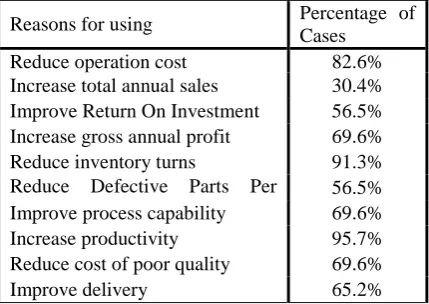
The empirical study conducted by the first author in 2008 – 2009 has revealed similar results presented in Table1.
Reasons for using Percentage of Cases
Reduce operation cost 82.6% Increase total annual sales 30.4% Improve Return On Investment 56.5% Increase gross annual profit 69.6% Reduce inventory turns 91.3% Reduce Defective Parts Per
Million
56.5% Improve process capability 69.6% Increase productivity 95.7% Reduce cost of poor quality 69.6%
[image:5.595.309.524.109.261.2]Improve delivery 65.2%
Table 1: Why companies use lean manufacturing
The above list contains business and manufacturing strategy objectives. The business objectives can be classified into 4
common categories that SMEs
manufacturers try to achieve: High profit margin
High Return On Investment Bigger market share
High customer satisfaction
These are the business objective the lean six sigma framework is based on.
8.2. Manufacturing strategy:
For manufacturing strategy to support business objectives, strategy planners need to be aware of strengths and weaknesses of competition, different market forces, gaps & opportunities and customer requirements. Formation of manufacturing strategy is
critical for manufacturing companies
Advances in Computing and Technology
The School of Computing, Information Technology and Engineering, 5th Annual Conference 2010
222
Fig.1. The lean six sigma framework
S tage 1 : I mprov e qua li ty S tage 2 : I ncr e a s e c a pac ity S tage 3 : Re duce l e a d time S tage 4 : I ncr e a s e fle x ibil ity S tage 5 : Cont inuousl y i mprov e P re re quis ites Ope ra tion s trate gy Infra s tructu re M a nuf a c tu ring s trate gy Ope ra tion s trate gy • Re du ce co st • I m prov e q ua lity • Re du ce in ve nto rie s • I ncr ese ca pa city • Re du ce le ad tim e • I ncr ea se flex ibili ty • Co ntin uo usly im prov e
Golas are cascaded top down
Tools a nd tec hniques (lea n s ix s igma ) - Po ke Y o ke , S u cce siv e I n sp e ctio n , S P C, T P M - Cell u lar m a n u fa ctu ri n g , P roce ss d e sig n , T P M , O E E , S m a ll b a tch e s - VS M , S M E D, Fa cil ity la yo u t - Ka n b a n - Grou p T e ch n o log y, S M E D, Mult i-skil led w o rkers - KA IZE N, S ix S ig m a A ch iev e co n tiu o u s m a te ri a l f low Red u ce co m p let ion t im e / In cr e a se e q u ipm e n t a va ila b ility L o w I n ve n to ry M a nuf a c tu ring s trate gy a c hie v e d L o w co st A ch iev ing S ta b ility M a teri a ls re s ourc ing S o u rce m a te ri a ls a n d e n su re su p p lie rs are a b le to p rov ide m a te ri a ls a s sp e cif ied (q u a n tity , q u a lity , co st, freq u e n cy ). Implem en tatio n is a bo tto m u p p rocess Qu ick resp o n se t o m a rket ch a n g e s a n d cu sto m e r de m a n d s Logis tics s y s tem Org a n ise th e lo g istics sy ste m req u ir e d f o r tran sp o rting m a te ri a ls a n d p rod u cts Fac il ity a nd e quipme nt la y out L a yo u t fa cil ity a n d e q u ipm e n t, p rod u ctio n ce lls Cust o m e r/m a rket d e m a n d is st a b le a n d p rod u ct h a s m e d ium t o lo n g lif e cy cle. P rod u ct to b e m a n u fa ctu rd is fu lly d e ve lop e d a n d ide n tif ied A ll m a te ri a ls req u ir e d a re id e n tif ied a n d ca n b e su p p lie d a cco rding to t h e sp e cif icat ion s req u ir e d . A ll e q u ipm e n t n e e d e d a re id e n tif ied a n d a va ila b le fo r pu rcha se B u ild ing f o u n d a tio n Hi g h Ca p a city S h o rt lea d t im e Human re s ourc e s Org a n ise m a n p o w e r reso u rces Busi nes s obj e c tiv e s • Hig h p rof it m arg in • Hig h Re tu rn O n I nv estm en t • B ig ge r m arket sh are • Hig h cu sto m er sat isf actio n Ope ra tion s trate gy • Re du ce co st • I m prov e q ua lity • Re du ce in ve nto rie s • I ncr ese ca pa city • Re du ce le ad tim e • I ncr ea se flex ibili ty P roduct s trate gy • P rod ucts to b e m ad e • P rod uct co m plex ity • P rod uct lif e cy cle • P rod uct va ria nts Res ourc e s trate gy • P roce ss t o b e u se d • E qu ipm en t a nd to ols • P roce ss ca pa bil ity • I de ntif y m ate ria ls n ee de d • V olum es t o b e p rod uce d • Nu m be r of o pe rato rs ne ed ed • O pe rato r’s skill s n ee de d Im p rov e m e n t P rojec ts Ope ra tion c once pt s • E lim ina te d ef ects • Re du ce p roce ss cy cle tim e/in cr ea se a va ila b ility • I m prov e m ate ria l f low • P ull • I ncr ea se st af f a nd e qu ipm en t a bil ity to d o d if fe ren t job . • Me asu re p erf orm an ce a ga inst ta rg et a n d a d just . P roc ure me nt of e quipme nt P u rcha se req u ir e d e q u ipm e n t Ph ase 2: R u n n in g th e o p er ati o n Ph ase 1: Estab li sh in g th e fo u n d ati o n E lim ina te d e fe cts (Im p rov e FT T ) Busi nes s obj e c tiv e a c hie v e d Im p rov e st a ff a n d e q u ipm e n t flex ibili ty - Facili ty la yo u t - Cell u lar De sig n
- 5S - Va
between functions and different management levels; it can also prevent
decision conflicts (Miltenburg, 1995).
Furthermore, manufacturing strategy enable the organisation to use their capabilities wisely to compete, ensure capabilities are fully utilised, identify any needs to strengthen the operation capabilities and sets priorities for improvement projects.
The manufacturing strategy generates three types of data outputs:
1- Product development strategy:
These are the data required by research and development department to design the product to be manufactured such as Products type, complexity, life cycle, Product variants.
The product development stages should be completed before considering developing the manufacturing system. These data will be used as inputs for the prerequisites section of phase1.
2- Resource strategy:
These are the data needed in the infrastructure section to plan all the resources needed to physically produce the product, such as Process, Equipment and tools, Process capability, Volumes to be produced, Number of operators needed and Operator‘s skills needed.
These data will be used in the infrastructure section of phase 1.
3- Operation strategy:
These are the manufacturing strategy objective that will be needed to develop the operation.
The most common operation strategy objectives for lean manufacturers are: reduce cost, improve quality and improve delivery (Womack and Jones, 2000; George, 2002; Ahrens 2006). Increasing flexibility has been identified an additional key
objective. The same lean survey conducted by The Manufacturer in 2002, showed that the most important operation objective sought by lean companies are: cost reduction improving delivery, improving
productivity, improving quality, and
reducing inventories.
Comparing these data to Table 1 and sorting in categories we end up with the following five groups of common operation strategy objectives:
Reduce cost Improve quality Reduce inventories Increase capacity Reduce lead time Increase flexibility
These strategy objectives are then used to identify operation concepts and tools & techniques in the operation strategy section of phase1.
9. Phase1: Establishing the foundation:
Phase1 of the framework is about
establishing the foundation for the
manufacturing system, this phase is broken down into three sections: prerequisites, operation strategy and infrastructure, they should be completed in their numbering order.
The three sections of this phase are explained below:
1- System Prerequisites:
Advances in Computing and Technology
The School of Computing, Information Technology and Engineering, 5th Annual Conference 2010 224
therefore customer demand and duration must understood. The product life cycle must be long enough to justify capital
investment in equipment and other
resources. All materials required to make the product must also be fully specified and found to be available in the market with the specifications identified during product development stage such as quality, volumes, cost, and frequency of delivery. Process technology and equipment required to make the product also must be specified and found to be available in the market.
2- Operation strategy:
Operation strategy needs to be established before installing the infrastructure.
The main objective of the framework is to set up an efficient manufacturing system that enables the organisation to run a profitable operation and stay competitive (Vaughn et al, 2002), and the manufacturing operation is the backbone of this system. The framework promotes a process oriented
operation strategy that integrates
organisation functions and departments and sets operation performance targets. It also provides the guidelines, objectives and targets at operation level.
The details needed here are: operation type, cost, capacity, quality and flexibility targets. Now using the manufacturing strategy elements for SMEs identified above and by utilising the Quality Function Deployment tool (QFD) the operation strategy elements that support them are identified as:
Improve quality Increase capacity Reduce lead time Increase flexibility Continuously improve
To achieve the operation strategy, the elements are broken down further to identify
the operation concepts and policies that support them which are:
Eliminate defects
Reduce process cycle time Improve material flow Pull
Increase staff and equipment ability to do different job.
Measure performance against target and adjust
3- Infrastructure:
The operation strategy section must be completed before starting this stage; this is because operation strategy dictates activities in this section. Before the organisation commit themselves to purchasing or hiring site, new equipments, sourcing materials and hiring human resources, they need to study their operation strategy and understand process, quality, flexibility and setup time
requirements, as these requirements
determines the type of equipments they need to purchase. The need for reducing cost, eliminating waste and continuity of material
flow influence facility layout and
agreements with suppliers.
There are five key elements in this section to be executed in the numbering order:
1- Facility and equipment layout
2- Procurement of equipment
3- Materials sourcing
4- Logistics system
5- Human resources
10. Phase 2: Running operation:
10.1. Stage 1: Improve quality:
The performance measure is the first time through (FTT) which can be defined as percentage of items processed right first time. The target set for this is 99.5%, as per the benchmarking data produced by the DTI which are shown in Table 2.
Household & General Products Sector (2000–2002 data) Supply Chain Management Average* Top 25% Delivery reliability (%) 98.0 + 99 Ex-stock availability (%) 99.0 + 99.8
Total stock turns 20 28
People Management Training on job (days):
Existing employees 9 10
New employees 22 25
Annual absenteeism (%) 4.1 3.0
Process Repeatability
Scrap rate (%) 2.7 + 1.0
OEE (for the best line) 72.0 85.0 Right first time at final test (%) 96.0 99.5 Flexibility
Average component set-up time
(mins) 30 + 15
Average assembly set-up time (mins) 15 + 10
* This column contains the mean performance level; however where the + symbol appears the median figure has been given as the best indicator of the central tendency. © Copyright Dr Marek Szwejczewski.
Table.2: Benchmarking data for the household and general product sector (DTI Manufacturing Report, 2000 – 2002)
10.2. Stage 2: Increase capacity:
In stage 2, the company need to ensure that they have enough capacity to achieve maximum expected customer demand plus 15% reserve capacity, i.e. maximum expected customer demand should be 85% of full equipment capacity (Black, 1991), if that is not the case, the company need to follow steps described in stage 2 until the
target is achieved. The techniques and tools
that could be utilised to achieve this target are shown in Fig.1 Stage 2.
10.3. Stage 3: Reduce lead time
Reducing lead time means the manufacturer is able to repeat their value adding process
more frequently and hence generate more profit. The target for this is that the ratio of value adding time to overall lead time should be 25% or higher (George, 2000). To achieve this, stage 1 and 2 must be completed successfully. The techniques and tools that could be utilised to achieve this target are shown in Fig.1 Stage 3.
10.4. Stage 4: Improve flexibility
To increase flexibility companies need to make sure their equipment are easy to set up to produce different product variant as and when the customer need them. The time needed to perform the set up should be as minimum as possible such that it does not cause equipment availability issues, the target for this is a single digit figure (Shingo, 1988), the benchmarking data from DTI shown in table 2 has set the target for this as 10 minutes.
The same goes for human resources; operators must be multi skilled and able to make/process all different types of product variants.
The lean six sigma framework has introduced the two concepts of equipment flexibility index and operator flexibility index to measure equipment and operator flexibility respectively.
The Equipment Flexibility Index (EFI) is given by the following equation:
) 1 ( ... ... ... ...
*AST
N PPT EFI
Where:
PPT is Planned Production Time N is the number of equipment setups AST is Average Setup Time
The lean six sigma objective is to increase EFI, and that is by following two approaches:
1- Reduce the average setup time.
Advances in Computing and Technology
The School of Computing, Information Technology and Engineering, 5th Annual Conference 2010 226
The lean six sigma target for EFI is 25.
The Operator Flexibility Index (OFI) is given by the following equation:
) 2 .( ... ... ... ... M
A OFI
Where:
A is the average no of training elements completed by operator
M is the total no of training elements.
OFI represents flexibility of operators to do different jobs which they have learned through training that split into different training elements.
The lean six sigma objective is to increase OFI to a target value of 1.
10.5. Stage 5: Continuously improve
This stage represents the correction and fine tuning of all the work completed in the previous phases and stages. The high competition in today‘s manufacturing industry makes continuous improvement imperative for manufacturer to survive
(Shamou and Arunachalam, 2008).
Continuous improvement is required for any manufacturing system as long as it is active (Vaughn et al, 2002), it simply never ends (Womack and Johns, 2000). Lean six sigma has introduced use of simulation as a continuous improvement aid because it is expected to help achieving results faster and first time, this in turn saves the user from
following traditional trial and error
approaches which can take longer and consume considerable resources.
Simulation should be carried out early before the physical implementation work begins. Once the process design or change is adjusted based on simulation result, a trial run can be carried out to validate the new process or change, final corrections and adjustments may be required depending on
trial runs results before the new process or change is finally implemented (Barber et al,
2003). Once the new process is
implemented, future changes may be
required as part of the continuous
improvement culture of the lean six sigma methodology (Fig.3).
For continuous improvement initiatives to
succeed they need top management
champions support (Morgan, 2006).
The major tools used at this stage are Kaizen
six sigma and simulation.
Fee
d
b
a
c
k
r
e
s
u
lt
s
Fee
d
b
a
c
k
r
e
s
u
lt
s
Fee
d
b
a
c
k
r
e
s
u
lt
s
Evaluate results
Improved process based on simulation results
Validate improved process using field trials
Implement validated process
Monitor new process performance
Continuosly improve process New process
design
Simulate new process Useframework to design or improve a proces
Fig.3. The lean six sigma continuous improvement journey
11. Conclusion
The lean six sigma framework provides an implementation plan for lean six sigma methodology.
there is no risk involved in using the framework to design a manufacturing facility for any product.
Because the framework process outcome is based on business and manufacturing
objectives, if these objectives are
significantly changed, the whole
manufacturing system has to be reviewed. The tools and practices noted in the framework are the major ones that are proved and verified in practice and hence recommended. However they are not the only ways to achieve top-level objectives.
13. References
1- Vaughn A., Fernandes P, Shields J.,
Manufacturing System Design
Framework Manual. Product of the
Manufacturing Systems Team of the Lean Aerospace Initiative. Massachusetts Institute of Technology. 2002.
2- Black T., The Design of the Factory with
a Future. McGraw-Hill, New York, New York, 1991.
3- Monden Y., Toyota Production System:
An Integrated Approach to Just-in-Time,
3rd Edition, Engineering and
Management Press, 1998.
4- Miltenburg J., Manufacturing Strategy:
How to Formulate and Implement a Winning Plan, Productivity Press, Portland, Oregon, 1995.
5- Monden Y., Toyota Production System:
Practical Approach Production
Management, Industrial Engineering and Management Press, Norcross, GA, 1983.
6- Kilpatric A., Lean manufacturing
principles: A comprehensive framework for improving production efficiency,
Massachusetts Institute of Technology, MA, 1997.
7- Gilgeous V., Gilgeous M., A framework
for manufacturing excellence, Integrated
Manufacturing Systems, 10/1, 1999, pp 33–44.
8- Skinner, W., Manufacturing: the missing
link in corporate strategy, Harvard
Business Review, May-June pp. 136-45, 1969.
9- Gunasekaran A., Ceceill P.,
Implementation of productivity
improvement strategies in a small
company, Technovation, 18(5) 1998, pp.
311-320.
10- Shamou M., Arunachalam S.,
Challenges facing modern manufacturing
industry. Conference proceedings,
Fascinating Advancements in
Mechanical Engineering FAME 08. Sivakasi, 2008.
11-Morgan, J., The lean Six Sigma
improvement journey, Catalyst
Consulting Limited. Heronswood Press Limited, 2006.
12-Shamou M., Arunachalam S., Integrating lean and six sigma for optimum manufacturing performance, Conference proceedings, Advances in computing and technology 09, 2009, pp. 49 – 59.
13-Barber K., Dewhurst F., Burns R., Rogers J., Business-process modelling
and simulation for manufacturing
management: A practical way forward.
Business Process Management Journal
Vol. 9 No. 4, 2003 pp. 527-542.
14-Flowers M., Cheng K., A theoretical
model in measuring global
manufacturing complexity and its
potential applications. Conference
proceeding, Cardiff University, 2008. 15-The lean manufacturing survey report
2002. The Manufacturer, 2002, pp.6-7.
16-George M., Lean six sigma, combining