R E S E A R C H
Open Access
Coding to reduce the interference to
carrier ratio of OFDM signals
Besma Smida
Abstract
In this paper, we propose a simple approach to reduce the sensitivity of OFDM system to the carrier frequency offset (CFO). The main idea is to choose a well-known channel code and to rotate each coordinate by a fixed phase shift such that the maximum inter-carrier interference (ICI) taken over all sub-carriers is minimized. This approach is based on a geometric interpretation of the peak interference to carrier ratio (PICR) of OFDM signals. Simulation results show that a reduction in PICR of 7 dB can be easily achieved. Furthermore, we addressed the fundamental limit of the proposed technique by providing both an exact and an approximate lower bound of PICR of phase-shifted binary codes. The bounds are applied to some codes: non-redundant binary code, BCH codes, and Reed-Muller codes. Simulation results demonstrated that phase-shift designs approach lower bounds and are resilient to CFO change.
Keywords: OFDM, PIRC, Coding
1 Introduction 1.1 Motivations
Orthogonal frequency-division multiplexing (OFDM) is a multicarrier modulation technique that has been implemented for many high-speed wireless and wireline applications. Indeed, the orthogonal properties among subcarriers of OFDM lead to high spectral efficiency and excellent ability to cope with multipath fad-ing environment. Since the spectra of the subcarriers are overlapping, an accurate frequency-synchronization technique is needed. Due to oscillator inaccuracies and non-ideal transmitter/receiver synchronization, the orthogonal properties are easily broken down and result in errors due to frequency offsets. It is well-known that the carrier frequency offset (CFO) reduces the useful signal power and creates inter-carrier interference (ICI) [1, 2].
1.2 Related works
Two main approaches have been proposed in the litera-ture to mitigate the ICI problem caused by the CFO. One approach is to estimate and remove the frequency offset [3–6]. In this approach, the frequency-offset estimation is generally performed in two steps: coarse frequency-offset estimation, which estimates the partial frequency
Correspondence: [email protected]
University of Illinois at Chicago, Chicago, IL, USA
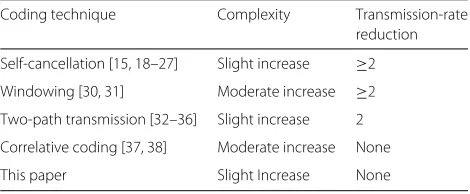
offset that is a multiple of the subcarrier spacing andfine frequency-offset estimation, which estimates the remain-ing part of the offset. There exist several CFO estimation techniques, e.g., training based methods [7–12], and semi-blind or semi-blind methods [3, 13]. Another approach is to use coding1 to reduce the sensitivity of the OFDM sys-tem to frequency offsets [14–17]. The coding approach is generally adopted after the removal of coarse CFO and hence assumesfineresidual CFO. A large range of coding techniques has been developed in recent years and can be classified as follows (see Table 1):
• Self-cancellation: A simple and effective method— known as the ICI self-cancelation scheme—was proposed by Zhao and Haggman in [18] and later generalized in [15, 19], where polynomial coding in the frequency domain is used to mitigate the effect of frequency offset. In this method, copies of the same data symbol are modulated onr adjacent sub-carriers using specific weights. This method can reduce the ICI at the price of lowering the transmission rate by a factorr. To further improve the ICI self-cancellation performance, many researchers proposed more efficient mapping (optimized weighting coefficients) for the redundant data symbol modulated over adjacent or non-adjacent subcarriers [20–27]. The weights are designed such that, at the receiver, the ICI at each subcarrier is reduced when a frequency
Table 1Coding techniques to reduce OFDM systems sensitivity to frequency shifts
Coding technique Complexity Transmission-rate
reduction
Self-cancellation [15, 18–27] Slight increase ≥2
Windowing [30, 31] Moderate increase ≥2
Two-path transmission [32–36] Slight increase 2
Correlative coding [37, 38] Moderate increase None
This paper Slight Increase None
offset is present. Note that ICI self-cancellation techniques can be regarded as a coding scheme, where only the codewords with low ICI are used, this key idea was first proposed in [28, 29].
• Windowing: Seyedi and Saulnier [30] showed that the polynomial coding in the frequency
domain—used by ICI self-cancellation schemes—is equivalent to using windowing in time domain. They hence used windowing at both the transmitter and the receiver to generalize and improve
self-cancellation schemes. Recently, Real and
Almenar [31] used windowing at the transmitter only allowing a reduction of the receiver complexity without any performance degradation. The windowing methods reduce ICI sensitivity
significantly but they lower the transmission rate and increase the complexity of the transceiver.
• Two-path transmission: The two-path transmission method halves the spectral efficiency similar to ICI self-cancellation techniques in [18]. However, unlike ICI self-cancellation method, two-path transmission method transmits the data copies in two
concatenated OFDM blocks. The first path
represents the standard OFDM signal and the second one is formed by a conjugate of the first path [32, 33]. This approach was generalized in [34–36] by
introducing phase rotation and space-time coding.
• Correlative-coding: Contrary to all previous coding techniques, that reduce the sensitivity to CFO at the price of reducing the transmission rate, the
correlative coding method do not reduce the data rate [37, 38]. This method is based on frequency-domain Partial-response Coding (PRC). PRC were originally proposed in the time domain to reduce the sensitivity of single-carrier systems to time offset.
The PRC does not sacrifice spectral efficiency but needs a maximum-likelihood sequence estimator (MLSE) thus increasing the receiver complexity. An interesting combination of correlative-coding and self-cancellation was proposed in [39].
1.3 Our contributions
The intend of this paper is to reduce the sensitivity of OFDM systems to CFO without reducing the
transmission rate. Our technique is inspired by the following key observation: all current wireless OFDM systems include forward-error-correction or channel codes to reduce the probability of error. Indeed, the forward-error-correction or channel codes have been studied and used for controlling errors in data trans-mission for the last half century (since Shannon 1948 landmark paper). Sathananthan and Tellambura related ICI reduction to channel coding and showed the capability of any forward-error correction code to reduce the errors caused by the ICI in [14]. We propose here to extend the role of those codes in OFDM systems. The main idea is to rotate each coordinate of the channel code by a fixed phase-shift such that the maximum carrier inter-ference taken over all sub-carriers is minimized. Clearly, the phase-shifted version of the code has the same error correcting capability, rate, decoding complexity as the original code. But it has lower maximum ICI and this reduction comes with no reduction of the spectral effi-ciency of the system. We proposed a simple technique— phase-shift—to reduce the sensitivity of OFDM system to CFO in [40]. This paper is an extension of this work—it provides an analytical evaluation of the proposed technique.
The key departure of our research from prior works on CFO effect reduction is that (a) we provide a geomet-ric interpretation of the peak interference to carrier ratio (PICR) of OFDM signals, (b) we propose a simple phase-shift approach to reduce the sensitivity of OFDM to fine frequency offset, (c) we analyze the fundamental limit of the proposed technique and obtain a lower bound of the PICR of phase-shifted binary codes which we evaluate for non-redundant binary code, BCH codes, and Reed-Muller codes, and (d) we numerically evaluate phase-shift designs and prove their resilience to CFO change.
2 Statement of the problem 2.1 Notations and preliminaries
An OFDM signal is the sum of many independent signals modulated onto sub-channels of equal band-width. The OFDM transmitter applies the inverse discrete Fourier transform (IDFT) operation and sends the sym-bol sequence to the RF chain. The transmitted signal at timetmay be represented as the real part of the complex envelope
Sc(t)= N−1
n=0
cnexp(j2π(f0+nfs)t) for 0≤t≤Ts,
(1)
lengthNis the modulating data sequence. We refer tocas codeword of codeCthat maps blocks ofkinput bits into blocks ofN symbols. The element of the vectorc,cn, are typically taken from a constellationQ. In this paper, we assume an equal energy constellationQ(i.e., all the points inQ have the same energy such as MPSK). We assume that Sc(t) is transmitted on an additive white Gaussian noise (AWGN) channel. The receiver receives the sig-nalR(Sc(t))perturbed by noise and performs the inverse operations: the RF chain at the receiver down-converts, processes the received data. The receiver then applies a discrete Fourier transform (DFT) to generate estimate of
c. Finally it extracts the block of input bits by applying a suitable error-correction algorithm. The received signal sample for thekth subcarrier after DFT can be written as
yk =ckb0+
wherenk is a complex Gaussian noise sample. The first term in the right-hand side of (2) represents the desired signal. The ICI term, attributable to the CFO, on thekth subcarrier is expressed byIk. The ICI coefficientsbk are given by [29]
whereεis the normalizedfinefrequency offset defined as a ratio between the fine frequency offset and the subcar-rier spacing (i.e.|ε| ≤ 12). We note thatIkis a function of bothcandε. In the following, we will list the main prop-erties of the the ICI coefficientsbk. Those properties give insights into the ICI interferenceIkand will be used in the rest of the paper.
1. Without frequency error (ε=0),bkreduces to the unit impulse sequencebk =δ[k].
2. The coefficientb0depends onεbut is independent ofk. In other words, all subcarriers experience the same degree of attenuation and rotation of the wanted component.
3. bk=bN+k, so if we consider anN modulo
numbering−kmaps toN−k. This property is easy to prove and is used in [20] to propose a repetition code that reduces the ICI.
4. All the coefficientsbkfork=0slowly vary withk, bk+1bk, the slow varying nature ofbkis the key motivation for self ICI cancelation [19]. This property will be used here to derive a more practical (approximate) lower bound of PICR of phase-shifted binary codes.
5. Under the assumption of small normalized frequency offset (|ε| 1), the coefficientsbkbecame
6. The average power of the inter-carrier interference is derived as [1]
whereE[.]denotes the expected value over the distribution of data.
3 Peak interference to carrier ratio evaluation
In this section, we provide a geometric interpretation of the maximum ICI taken over all sub-carriers that explic-itly incorporates the distance between the codewords c
and some specific points. Based on this interpretation, we will propose a simple phase-shifted approach to reduce the sensitivity of OFDM systems to CFO.
3.1 PICR definition
Sathanannthan and Tellambura [28, 29] defined the peak interference to carrier ratio (PICR) as the maximum interference-to-signal ratio for any subcarrier:
PICR(c,ε)= max 0≤k≤N−1
|Ik|2 |b0ck|2
. (5)
It specifies the worst-case ICI on any subcarrier. Large Ikvalue cause high bit errors in subcarriers. Therefore, to reduce ICI effects, PICR should be minimized [29]. Here we also define the PICR of a codeCas the maximum PICR over all codewords inC
PICR(C,ε)=max{PICR(c,ε) | ∀c∈C}. (6)
Note that the expression of PICR is similar to the
peak-to-mean envelope power ratio (PMEPR) that is
consid-ered as measure of the fluctuation of the OFDM signal2 PMEPR(c)=max0≤t≤1|Scc(t)2|2.
3.2 PICR geometric representation
We rewrite PICR(C,ε)as
We refer to J(k,ε)as the maximum interference-to-signal ratio of code C on subcarrier k and focus on its computation. The next theorem provides a geometric interpretation of the PICR per subcarrier [40].
is determined by the distance between the codewordsc∈C
and the pointswkand jwk, where
wk=
b∗−k,. . .,b∗−1, 0,b∗1,. . .,b∗N−1−k. (8)
IfCis a cyclic code then
PICR(C,ε)=J(0,ε). (9)
The value of J(0,ε) is determined by the distance between the codewordsc ∈ Cand the two pointsw0and jw0.
ProofFor any vectorsx = (x0,x1,. . .,xN−1) andy = (y0,y1,. . .,yN−1), letx.y = N−1i=0 xiy∗i denote the inner product ofxandy. Using the identities
||x−y||2 = ||x||2+ ||y||2−2R(x.y), ||x−jy||2 = ||x||2+ ||y||2−2I(x.y), we derive the following equalities
||c−wk||2 = ||c||2+ ||wk||2−2R(Ik), ||c−jwk||2 = ||c||2+ ||wk||2−2I(Ik).
where c =[c0,. . .,cN−1]. Without loss of generality, we assume that the elements of Q have unit amplitude (|cn|2=1, 0≤n≤N−1) then||c||2=N.3
Using properties 3 and 6 of the ICI coefficients, we get ||wk||2 = N−1−kl=−k,l=0|bl|2 = N−1l=1 |bl|2 = 1− |b0|2. Hence, we rewriteJ(k,ε)as follows:
J(k,ε)=max c∈C
|Ik|2
|b0|2=
max c∈C
1 |b0|2
RIk2+IIk2,
=max c∈C
N+1−|b0|2−||c−wk||2
2
+N+1− |b0|2− ||c−jwk||2
2
4|b0|2
.
(10)
Let c+ denote the codeword for which J(k,ε) is attained,c+maximizes
N+1− |b0|2− ||c−wk||2 2
+N+1− |b0|2− ||c−jwk||2 2
,
among all the codewords. So for each k, the value of
J(k,ε)is determined by the distance between the code-wordsc∈Cand the pointswkandjwk.
The proof of the second part of Theorem 3.1 is based on the definition of cyclic code. For every codewordc =
[c0,. . .,cN−1]∈cyclic codeC, the word [c−k,. . .,cN−k−1] obtained by a cyclic shift ofkcomponents is again a code-word. In addition, based on property 3 of the coefficients bn,wk is obtained bykleft cyclic shift of the element of w0. If we assume that the PICR(C,ε)is reached for the subcarrierk=0 and codeck+, then we have just to shift the codewordck+by kto find a codewordc0+and it is easy to prove that the interference generated for the sub-carrier 0 and codec0+is equals to PICR(C,ε). Hence, the PICR(C,ε)is also reached for the subcarrierk=0.
The geometric interpretation of Theorem 3.1 is simple but important because it explicitly states that the value of PICR(C,ε)is determined by the distance between the codewords c ∈ C and the points wk and jwk, k = 0,. . .,N −1. Furthermore for cyclic code, the value of PICR is only function of the distance between the code-words and the two pointsw0andjw0. This representation leads to an understanding of the value of PICR(C,ε)and how to reduce it through phase-shift approach which is described in the following Section 4.
4 PICR reduction
4.1 Phase-shift technique: illustration
Theorem 3.1 provides a geometric interpretation of the value of PICR. Based on this interpretation, we propose a simple approach that was originally proposed by Jones and Wilkinson [41, 42] and further developed by Tarokh, Jafarkhani and Paterson [43, 44] to reduce PMEPR. The idea is to take a code with good BER performance and to rotate each coordinate of the code by a fixed phase-shift such that the maximum PICR evaluated for all codewords is minimized. For the purpose of illustration, we assume a unit amplitude constellation; thus all the codewords are points on the N-dimensional complex sphere of radius √
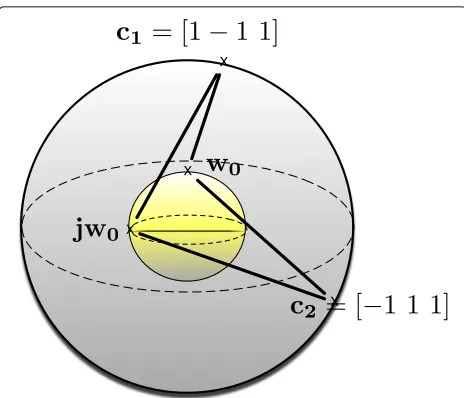
N. The phase-shifts may reduce the PICR by reduc-ing/increasing the distance between the codewords and the pointswkandjwk,k= 0,. . .,N−1. For cyclic code, we just focus on the distance between the codewords and the pointsw0andjw0only. Our design will shift the code-words without changing the distance between them as illustrated in Fig. 1. So it leaves the error-correcting prop-erties of the code unchanged. In addition, we can use the standard decoding algorithm of the original code after the received signals are rotated back.
The reduction of interference for OFDM can now be tackled as follows: For a given codeC, the reducing phase-shift problem is to find offsetv=[v0,. . .,vN−1]∈ZN2hsuch
that PICR(Cv,)is minimized, whereCv = {ejπv/2 h
c|c ∈
Fig. 1Illustration of the geometric interpretation of PICR. We plot two codewords on the sphereN=3. By rotating the codewords over the sphere (through phase-shift) we can change the distance between the codewords and the two pointsw0andjw0
4.2 Phase-shift technique: range
This section is dedicated to prove that phase-shift designs are robust to CFO change. The optimum offset v mini-mizes the PICR for a range of frequency offset (not for a specific frequency offset value). To do so we need the following proposition.
Proposition 4.1LetCbe a code of length N defined over an equal energy constellation Q. Letε1 andε2 be small normalized frequency offsets (|ε1| 1and|ε2| 1). If the offsetv∈ZN2hminimizes PICR(Cv,ε1)that it minimizes PICR(Cv,2)too.
ProofThe proof is based on the fifth property of the coefficientsbn. We rewrite the PICR(C,ε2)as
PICR(C,ε2)= max 0≤k≤N−1,c∈C
|Ik(ε2)|2 |b0(ε2)ck|2
where Ik(ε2) is the inter-carrier interference on thekth subcarrier andb0(ε2)is the ICI coefficient on the desired signal evaluated for normalized CFO ofε2as in Eq. (2). Using the property 5 of the ICI coefficients, we have
PICR(C,ε2) = max 0≤k≤N−1,c∈C
|Ik(ε2)|2 |b0(ε2)ck|2
,
||sin(πε2)b0(ε2)|2 sin(πε1)b0(ε1)|2
max 0≤k≤N−1,c∈C
|Ik(ε1)|2 |b0(ε1)ck|2
,
= |sin(πε2)b0(ε2) sin(πε1)b0(ε1) |
2PICR(C,ε 1).
Hence, the offsetv∈ ZN2h, that minimizes PICR(Cv,ε1), minimizes PICR(Cv,2) too. Therefore, there is no need to search for an offsetvspecific to each carrier frequency offset. The simulation results will show in Section 6 that the optimum set of shifts, derived for ε = 0.1, reduce the inter-carrier interference for awiderange of CFO (0< ε <0.5).
5 Minimum PICR for phase-shifted binary code
Motivated by the previous design of phase-shifts, we would like to know how much PICR reduction can be achieved. In particular, in our framework, similar to that of Schmidt’s [45], we consider the following question. For a given binary codeB, letBvbe the phase-shifted version ofB, what is
min
Bv∈Eh(B)PICR(Bv,).
We provide a lower bound and an approximated lower bound for this limit. The bounds are used to evaluate the optimality of our design.
5.1 Main results
Our lower bound in the spirit of Schmidt’s [45] will be expressed in terms of the covering radius of the binary codeBdefined below.
DefinitionThe covering radius of a codeB ⊆ {1,−1}N is defined to be
ρ(B)max x∈ZN
2
min
b+∈B+wtH(b+x).
where each codewordb+∈ B+is associated with a code-wordb ∈ B(where b+i = bi+12 ), wtH(b)is the Hamming weight of a binary vector b. We now state our main result.
Theorem 5.1Given a binary code B ⊆ {1,−1}N with covering radiusρ(B), then if h>1
min
C∈Eh(B)PICR(C,)≥
1 8|b0|2
2N−2|b0|2−2 N−1
i=1
(1−|bi|)2−λ (N+2ρ(B)) +2
,
whereλ = bmax22h−2sin2
π
2h
, bmax = maxi=0|bi|and [x]+=max(x, 0).
If|| 1then
min
C∈Eh(B)PICR(C,)
1 8|b0|2
2N−2|b0|2−2 N−1
i=1
(1−|bi|)2−λavg(N+2ρ(B)) +2
where λavg = bavg22h−2sin2
The proof of Theorem 5.1 is provided in Appendix. The preceding lower bound is a decreased function ofh. The corollary below states the asymptotic lower bound for
h→ ∞.
ProofSimilarly to [45], we used
limh→∞22h−2sin2
5.2.1 Non-redundant BPSK signaling
The code{1,−1}N is a binary code without redundancy,
ForN =16 andN =64 the PICR approximated lower bounds are 0.10 and 0.22, respectively. Since the PICR for non-redundant binary code are 0.19 (N = 16) and 0.50 (N =64), the maximum PICR reduction of the proposed phase-shift designs is 3 dB for non-redundant code.
5.2.2 Reed-Muller codes
In the following we inspect codes that are equivalent to first order Reed-Muller codes of length 2m,RM(1,m).
Corollary 5.4For h > 1and N = 2m, the PICR of a 2h-ary PSK code equivalent to RM(1,m) is at least
min
Proof It was proved in [46] that
2m−1−2(m−1)/2≤ρ(RM(1,m))≤2m−1−2m/2−1.
5.2.3 Binary primitive BCH codes
Next we present the lower bounds on the PICR of codes that equivalent to binary primitive t-error-correcting BCH codes,B(t,m).
Corollary 5.5For h > 1and N = 2m −1, the PICR of a2h-ary PSK code equivalent to t-error-correcting BCH codes,B(t,m)is at least
Proof The authors of [47] proved that there exists anmo depending ontsuch thatρ(B(t,m))=2t−1 for allm≥ mo.
6 Numerical results
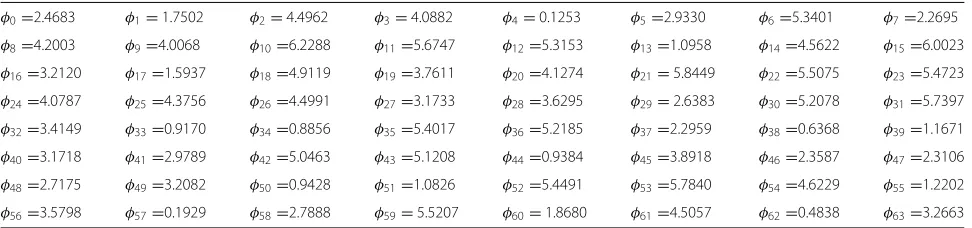
Table 2Optimum phase shifts for BCH(64,10) in radians
φ0=2.4683 φ1=1.7502 φ2=4.4962 φ3=4.0882 φ4=0.1253 φ5=2.9330 φ6=5.3401 φ7=2.2695
φ8=4.2003 φ9=4.0068 φ10=6.2288 φ11=5.6747 φ12=5.3153 φ13=1.0958 φ14=4.5622 φ15=6.0023
φ16=3.2120 φ17=1.5937 φ18=4.9119 φ19=3.7611 φ20=4.1274 φ21=5.8449 φ22=5.5075 φ23=5.4723
φ24=4.0787 φ25=4.3756 φ26=4.4991 φ27=3.1733 φ28=3.6295 φ29=2.6383 φ30=5.2078 φ31=5.7397
φ32=3.4149 φ33=0.9170 φ34=0.8856 φ35=5.4017 φ36=5.2185 φ37=2.2959 φ38=0.6368 φ39=1.1671
φ40=3.1718 φ41=2.9789 φ42=5.0463 φ43=5.1208 φ44=0.9384 φ45=3.8918 φ46=2.3587 φ47=2.3106
φ48=2.7175 φ49=3.2082 φ50=0.9428 φ51=1.0826 φ52=5.4491 φ53=5.7840 φ54=4.6229 φ55=1.2202
φ56=3.5798 φ57=0.1929 φ58=2.7888 φ59=5.5207 φ60=1.8680 φ61=4.5057 φ62=0.4838 φ63=3.2663
Muller (RM). We note that Pyndiah [48] has proposed a simple soft-input soft-output (approximated MAP) decoder for BCH codes, based on Chase algorithm, that gives excellent BER performance. RM codes achieve capacity on erasure channels and reduce PMEPR [49, 50]. For the BPSK case, we have optimized the phase-shifts by finding a local minima of PICR(C,ε). Once the optimal phase-shifts were computed, they were rounded to 8-PSK, and 16-PSK phase-shifts. The PICR was then calculated for the rounded phase shifted. The optimal set of shifts for BCH(64,10) are given in Table 2. The reduction in PICR is 2.56 dB, it decreases to 1.99 and 1.39 dB for 16-PSK and 8-16-PSK, respectively. The optimal set of shifts for RM(1,6) are given in Table 3. The reduction in PICR is 7.10 dB; it decreases to 6.28 and 5.86 dB for 16-PSK and 8-PSK, respectively. The numerical results show that a fixed phase-shift applied to code coordinates reduces the ICI, and that most of the gain can be obtained by using 8-PSK and 16-8-PSK type phase-shifts. The phase-shift design reduce the PICR from 0.255 (BCH) and 0.519 (RM) to 0.14 and 0.098, respectively. These values approaches the lower bound in Corollary 5.4 and Corollary 5.5.
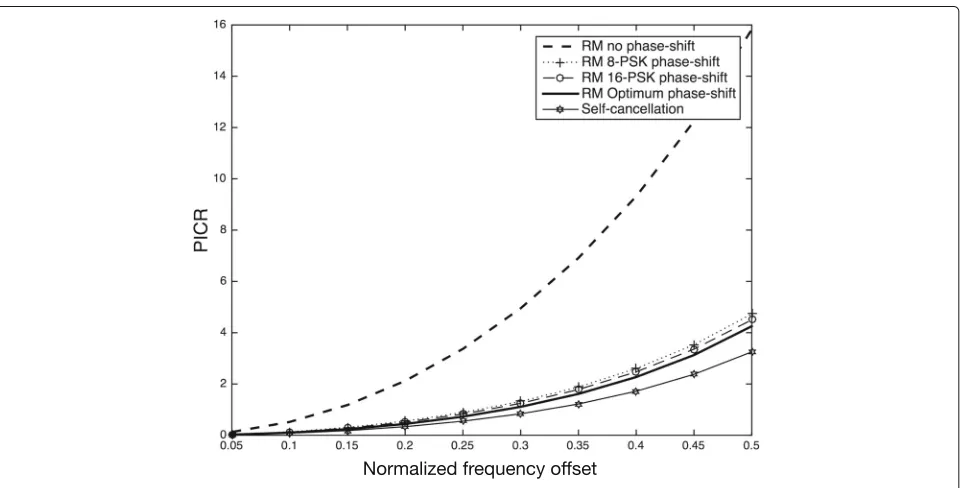
Furthermore, we use the same set of phase-shifts with various CFO (0 < ε < 0.5). The PICR results shown in Figs. 2 and 3 prove that the optimum set of shifts, derived forε = 0.1, reduce the inter-carrier interference for a wide range of CFO. For the purpose of comparison, we also plot the PICR with a self-interference cancellation that reduces the transmission-rate by half [18]. In fair-ness, we implemented the self-cancellation technique over
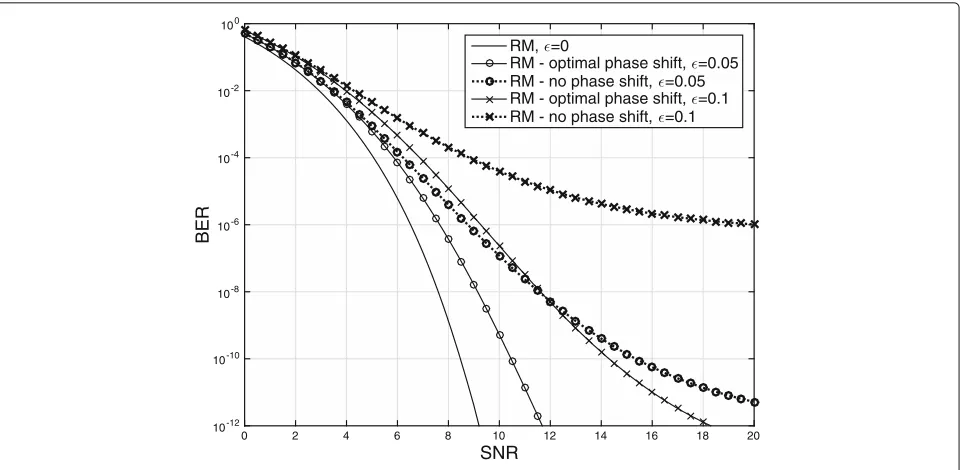
the non-redundant data sequences (no channel coding). The simulation results prove that our simple phase-shift designs are very competitive - especially when applied to codes with high large covering radius like RM codes. To illustrate the impact of our phase-shift technique on the bit error rate (BER), we consider RM(1,6) code and BPSK modulation. The BER vs. signal to noise ratio (SNR) performance with and without phase-shifts are shown in Fig. 4. Note that the phase-shift technique improves the performance at BER 10−6 by 10 dB for normalized frequency offset=0.1.
7 Conclusions
In this paper, we proposed an interference reduction scheme to mitigate the effects of CFO in OFDM system. We provided a geometrical interpretation of PICR(C,ε), the PICR ofC. To reduce PICR, we focused on a simple phase-shift approach. The idea is to take a code with good BER performance and to rotate each coordinate of the code by a fixed phase-shift such that the maximum PICR taken over all codewords is minimized. This shift leaves unchanged the error-correcting properties of the code. In addition, we can use the standard decoding algorithm of the original code after back rotation of the received sig-nals. Simulation results show that a reduction of 7 dB can freely be obtained.
We also study the fundamental limit of the proposed technique by providing an approximated lower bound of the PICR. The bound is applied to some codes: non-redundant binary code, BCH codes, and Reed-Muller
Table 3Optimum phase shifts for RM(1,6) in radians
φ0=1.5620 φ1=4.5390 φ2=3.5491 φ3=0.3789 φ4=2.9522 φ5=4.9135 φ6=1.9776 φ7=3.7244
φ8=3.7291 φ9=5.2304 φ10=3.8296 φ11=2.8186 φ12=5.5612 φ13=4.4629 φ14=3.4743 φ15=6.1346
φ16=4.7435 φ17=1.3264 φ18=3.1416 φ19=0.1649 φ20=4.9018 φ21=2.6437 φ22=5.8063 φ23=0.9283
φ24=4.0979 φ25=3.9276 φ26=5.6677 φ27=5.7450 φ28=3.8378 φ29=1.3179 φ30=4.9345 φ31=5.4689
φ32=0.0817 φ33=3.2805 φ34=2.8142 φ35=5.0262 φ36=5.0639 φ37=1.0568 φ38=0.8457 φ39=2.9594
φ40=5.7340 φ41=5.5270 φ42=3.2478 φ43=3.5318 φ44=1.1401 φ45=1.7986 φ46=2.3697 φ47=0.3248
φ48=4.5588 φ49=1.6792 φ50=0.0914 φ51=6.2392 φ52=1.8721 φ53=1.1146 φ54=3.4850 φ55=6.2436
Fig. 2PICR of 2h-ary PSK code equivalent to BCH(64,10)
codes. It is demonstrated that our phase-shift designs approach our bound.
Endnotes
1One more approach uses signal processing, such as
time and frequency equalization, to reduce the sensi-tivity of OFDM systems to frequency offset. Although
efficient, signal processing techniques usually increase the complexity of the transceiver (see [16] and references therein).
2The authors of [29] have noted that despite the
similar-ities between PICR and PMEPR, the PICR problem differs from PMEPR issue in several ways.
SNR
0 2 4 6 8 10 12 14 16 18 20
BER
10-12 10-10 10-8 10-6 10-4 10-2 100
RM, =0
RM - optimal phase shift, =0.05 RM - no phase shift, =0.05 RM - optimal phase shift, =0.1 RM - no phase shift, =0.1
Fig. 4BER vs. SNR of RM(1,6) code with and without phase-shifts
3In the case of non-uniform energy constellation, like
QAM, J(k,ε)will be determined for each energy level and then minimized over all the levels.
Appendix
Proof of Theorem 5.1
The proof follows along the lines of [45]. Based on Eq. (7), we have
PICR(C,ε)≥J(0,ε) (11)
Using the following inequality
x2+y2 = 1 2
(x+y)2+(x−y)2
≥ 1
2(x+y)
2, x,y ∈R
and Eq. (10), we get
PICR(c,ε)≥ 1 8|b0|2
2N+2−2|b0|2− ||c−w
0||2− ||c−jw0||2 2
(12)
We need some preliminaries in order to prove Theorem 5.1. If we assume that elements ofC have unit energy, It is straightforward to establish that
||c−w0||2=1+ N−1
i=1
(1− |bi|)2+4 N−1
i=1
|bi|sin2 ∠
bi−∠ci 2
(13)
and
||c−jw0||2=1+ N−1
i=1
(1− |bi|)2+4 N−1
i=1
|bi|sin2 ∠
bi−∠ci
2 +
π
4
(14)
where |x| and∠x are the amplitude and the angle ofx, respectively. LetZ2h denote the ring of integers modulo 2h. We definec
iandbi∈ Z2h as: 2πci
2h ∠ciand 2π2hbi ∠bi. Note that whenhtends to the infinity the phases can be approximated with arbitrary high probability.
Schmidt showed in [45] that
sin2
wπ
2h
≤ 2h 4 sin
2 π
2h
w
forh>1 andw=0, 1,. . ., 2h−1. Based on this result, we get
||c−w0||2≤1+ N−1
i=1
(1− |bi|)2+2hsin2 π
2h
N−1
i=1
|bi|min
bi−ci, 2h−bi+ci
, (15)
and
||c−jw0||2≤1+ N−1
i=1
(1− |bi|)2+2hsin2 π
2h
N−1
i=1
|bi|min
bi−ci−2h−2, 2h−bi+ci+2h−2
.
We now use the previous results to derive a lower bound
Note that this lower bound is not always tight. There-fore, since all the coefficientsbkslowly vary withk,bk+1 bk(if|| 1), we derived this approximated lower bound very good approximations to the PICR lower bound yet analytically tractable. We use Definition 12 and Lemma 13 in [45] to derive
wtL
The authors declare that they have no competing interests.
Received: 22 March 2016 Accepted: 7 January 2017
References
1. T Pollet, MV Bladel, M Moeneclaey, Ber sensitivity of OFDM systems to carrier frequency offset and Wiener phase noise. IEEE Trans. Commun. 43(2/3/4), 191–193 (1995). doi:10.1109/26.380034
2. K Sathananthan, C Tellambura, Probability of error calculation of OFDM systems with frequency offset. IEEE Trans. Commun.49(11), 1884–1888 (2001). doi:10.1109/26.966051
3. JJ van de Beek, M Sandell, PO Borjesson, Ml estimation of time and frequency offset in OFDM systems. IEEE Trans. Signal Process.45(7), 1800–1805 (1997). doi:10.1109/78.599949
4. U Tureli, D Kivanc, H Liu, Experimental and analytical studies on a high-resolution OFDM carrier frequency offset estimator. IEEE Trans. Veh. Technol.50(2), 629–643 (2001). doi:10.1109/25.923074
5. MJF-G Garcia, O Edfors, JM Paez-Borrallo, Frequency offset correction for coherent OFDM in wireless systems. IEEE Trans. Consum. Electron.47(1), 187–193 (2001). doi:10.1109/30.920438
6. M Luise, M Marselli, R Reggiannini, Low-complexity blind carrier frequency recovery for OFDM signals over frequency-selective radio channels. IEEE Trans. Commun.50(7), 1182–1188 (2002).
doi:10.1109/TCOMM.2002.800819
7. PH Moose, A technique for orthogonal frequency division multiplexing frequency offset correction. IEEE Trans. Commun.42(10), 2908–2914 (1994). doi:10.1109/26.328961
8. TM Schmidl, DC Cox, Robust frequency and timing synchronization for OFDM. IEEE Trans. Commun.45(12), 1613–1621 (1997).
doi:10.1109/26.650240
9. M Morelli, U Mengali, An improved frequency offset estimator for OFDM applications. IEEE Commun. Lett.3(3), 75–77 (1999).
doi:10.1109/4234.752907
10. M Morelli, U Mengali, Carrier-frequency estimation for transmissions over selective channels. IEEE Trans. Commun.48(9), 1580–1589 (2000). doi:10.1109/26.870025
11. J Lei, T-S Ng, A consistent ofdm carrier frequency offset estimator based on distinctively spaced pilot tones. IEEE Trans. Wirel. Commun.3(2), 588–599 (2004). doi:10.1109/TWC.2004.825350
12. Y Li, H Minn, N Al-Dhahir, AR Calderbank, Pilot designs for consistent frequency-offset estimation in OFDM systems. IEEE Trans. Commun. 55(5), 864–877 (2007). doi:10.1109/TCOMM.2007.896105
13. U Tureli, H Liu, MD Zoltowski, OFDM blind carrier offset estimation: Esprit. IEEE Trans. Commun.48(9), 1459–1461 (2000). doi:10.1109/26.870011 14. K Sathananathan, C Tellambura, inISCAS 2001. The 2001 IEEE International
Symposium on Circuits and Systems (Cat. No. 01CH37196). Forward error correction codes to reduce intercarrier interference in OFDM, vol. 4, (Sydney, 2001), pp. 566–569
15. J Armstrong, Analysis of new and existing methods of reducing intercarrier interference due to carrier frequency offset in OFDM. IEEE Trans. Commun.47(3), 365–369 (1999). doi:10.1109/26.752816 16. AF Molisch, M Toeltsch, S Vermani, Iterative methods for cancellation of
intercarrier interference in OFDM systems. IEEE Trans. Veh. Technol.56(4), 2158–2167 (2007). doi:10.1109/TVT.2007.897628
17. P Singh, OP Sahu, in2015 IEEE International Conference on Computational Intelligence & Communication Technology. An overview of ICI self cancellation techniques in OFDM systems, (Ghaziabad, 2015). pp. 299–302
18. Y Zhao, SG Haggman, inProceedings of Vehicular Technology Conference -VTC. Sensitivity to Doppler shift and carrier frequency errors in OFDM systems-the consequences and solutions, vol. 3, (Atlanta, 1996), pp. 1564–1568
19. Y Zhao, SG Haggman, Intercarrier interference self-cancellation scheme for OFDM mobile communication systems. IEEE Trans. Commun.49(7), 1185–1191 (2001). doi:10.1109/26.935159
20. K Sathananthan, RMAP Rajatheva, SB Slimane, Cancellation technique to reduce intercarrier interference in OFDM. Electron. Lett.36(25), 2078–2079 (2000). doi:10.1049/el:20001456
21. YH Peng, YC Kuo, GR Lee, JH Wen, Performance analysis of a new ICI-self-cancellation-scheme in OFDM systems. IEEE Trans. Consum. Electron.53(4), 1333–1338 (2007). doi:10.1109/TCE.2007.4429221 22. A Singh, A Sharma, in2015 International Conference on Advances in
Computer Engineering and Applications. ICI cancellation in OFDM by phase rotated data transmission, (Ghaziabad, 2015), pp. 952–956
23. K Sathananthan, CRN Athaudage, B Qiu, inProceedings. ISCC 2004. Ninth International Symposium on Computers And Communications (IEEE Cat. No. 04TH8769). A novel ICI cancellation scheme to reduce both frequency offset and IQ imbalance effects in OFDM, vol. 2, (Alexandria, 2004), pp. 708–713
25. T Shu-Ming, H Yu-Shun, A novel ICI self-cancellation scheme for OFDM systems. Int. J. Commun. Syst.24(11), 1496–1505 (2011)
26. MW Wen, X Cheng, X Wei, B Ai, BL Jiao, in2011 IEEE Global Telecommunications Conference - GLOBECOM. A Novel Effective ICI Self-Cancellation Method, (Houston, 2011), pp. 1–5
27. TL Liu, WH Chung, SY Yuan, SY Kuo, ICI self-cancellation with cosine windowing in OFDM transmitters over fast time-varying channels. IEEE Trans. Wirel. Commun.14(7), 3559–3570 (2015).
doi:10.1109/TWC.2015.2408325
28. K Sathananthan, C Tellambura, inIEEE 54th Vehicular Technology Conference. VTC Fall 2001. Proceedings (Cat. No. 01CH37211). New ICI reduction schemes for OFDM system, vol. 2, (Atlantic City, 2001), pp. 834–838
29. K Sathananthan, C Tellambura, Partial transmit sequence arid selected mapping schemes to reduce ICI in OFDM systems. IEEE Commun. Lett. 6(8), 313–315 (2002). doi:10.1109/LCOMM.2002.802067
30. A Seyedi, GJ Saulnier, General ICI self-cancellation scheme for OFDM systems. IEEE Trans. Veh. Technol.54(1), 198–210 (2005).
doi:10.1109/TVT.2004.838849
31. O Real, V Almenar, in2008 IEEE International Conference on Wireless and Mobile Computing, Networking and Communications. OFDM ICI Self-Cancellation Scheme Based on Five Weights, (Avignon, 2008), pp. 360–364
32. HG Yeh, CC Wang, inIEEE 60th Vehicular Technology Conference, 2004. VTC2004-Fall. New parallel algorithm for mitigating the frequency offset of OFDM systems, vol. 3, (Los Angeles, 2004), pp. 2087–2091
33. HG Yeh, YK Chang, B Hassibi, A scheme for cancelling intercarrier interference using conjugate transmission in multicarrier communication systems. IEEE Trans. Wirel. Commun.6(1), 3–7 (2007).
doi:10.1109/TWC.2007.04541
34. CL Wang, YC Huang, Intercarrier interference cancellation using general phase rotated conjugate transmission for OFDM systems. IEEE Trans. Commun.58(3), 812–819 (2010). doi:10.1109/TCOMM.2010.03.080288 35. HG Yeh, K Yao, in2012 IEEE Global Communications Conference
(GLOBECOM). A parallel ICI cancellation technique for OFDM systems, (Anaheim, 2012), pp. 3679–3684. doi:10.1109/GLOCOM.2012.6503688 36. M Wen, X Cheng, L Yang, B Jiao, in2013 IEEE Global Communications
Conference (GLOBECOM). Two-path transmission framework for ICI reduction in OFDM systems, (Atlanta, 2013), pp. 3716–3721
37. Y Zhao, JD Leclercq, SG Haggman, Intercarrier interference compression in OFDM communication systems by using correlative coding. IEEE Commun. Lett.2(8), 214–216 (1998). doi:10.1109/4234.709435 38. H Zhang, Y Li, Optimum frequency-domain partial response encoding in
OFDM system. IEEE Trans. Commun.51(7), 1064–1068 (2003). doi:10.1109/TCOMM.2003.814203
39. JY Yun, SY Chung, YH Lee, Design of ICI canceling codes for OFDM systems based on capacity maximization. IEEE Signal Process. Lett.14(3), 169–172 (2007). doi:10.1109/LSP.2006.884035
40. B Smida, in2011 IEEE Global Telecommunications Conference - GLOBECOM. Reduction of the Peak Interference to Carrier Ratio of OFDM Signals, (Houston, 2011), pp. 1–5. doi:10.1109/GLOCOM.2011.6133563 41. AE Jones, TA Wilkinson, SK Barton, Block coding scheme for reduction of
peak to mean envelope power ratio of multicarrier transmission schemes. Electron. Lett.30(25), 2098–2099 (1994). doi:10.1049/el:19941423 42. AE Jones, TA Wilkinson, inVehicular Technology Conference, 1996. Mobile
Technology for the Human Race., IEEE 46th. Combined coding for error control and increased robustness to system nonlinearities in OFDM, vol. 2, (1996), pp. 904–9082. doi:10.1109/VETEC.1996.501442
43. V Tarokh, H Jafarkhani, On the computation and reduction of the peak-to-average power ratio in multicarrier communications. IEEE Trans. Commun.48(1), 37–44 (2000). doi:10.1109/26.818871
44. KG Paterson, V Tarokh, On the existence and construction of good codes with low peak-to-average power ratios. IEEE Trans. Inf. Theory.46(6), 1974–1987 (2000). doi:10.1109/18.868473
45. KU Schmidt, On the peak-to-mean envelope power ratio of phase-shifted binary codes. IEEE Trans. Commun.56(11), 1816–1823 (2008).
doi:10.1109/TCOMM.2008.060652
46. T Helleseth, T Klove, J Mykkeltveit, On the covering radius of binary codes (corresp.) IEEE Trans. Inf. Theory.24(5), 627–628 (1978).
doi:10.1109/TIT.1978.1055928
47. SG Vladuts, AN Skorobogatov, Covering radius for long BCH codes. Probl. Inf. Transm.25(1), 28–34 (1989)
48. RM Pyndiah, Near-optimum decoding of product codes: block turbo codes. IEEE Trans. Commun.46(8), 1003–1010 (1998).
doi:10.1109/26.705396
49. M Sabbaghian, Y Kwak, B Smida, V Tarokh, Near shannon limit and low peak to average power ratio turbo block coded OFDM. IEEE Trans. Commun.59(8), 2042–2045 (2011).
doi:10.1109/TCOMM.2011.080111.090356
50. E Abbe, A Shpilka, A Wigderson, Reed x2013;muller codes for random erasures and errors. IEEE Trans. Inf. Theory.61(10), 5229–5252 (2015). doi:10.1109/TIT.2015.2462817
Submit your manuscript to a
journal and benefi t from:
7 Convenient online submission
7 Rigorous peer review
7 Immediate publication on acceptance
7 Open access: articles freely available online
7 High visibility within the fi eld
7 Retaining the copyright to your article