R E S E A R C H
Open Access
Performance analysis and power allocation for
multi-hop multi-branch amplify-and-forward
cooperative networks over generalized fading
channels
Mohammadali Mohammadi
*, Mehrdad Ardebilipour, Zahra Mobini and Ramezan-Ali Sadegh Zadeh
Abstract
In this article, efficient power allocation strategies for multi-hop multi-branch amplify-and-forward networks are developed in generalized fading environments. In particular, we consider the following power optimization schemes: (i) minimizing of the all transmission powers subject to an outage constraint; and (ii) minimizing the outage
probability subject to constraint on total transmit powers. In this study, we first derive asymptotically tight
approximations for the statistics of the received signal-to-noise ratio (SNR) in the system under study with maximal ratio combining and selection combining receiver. With the statistical characterization of the received SNR, we then carry out a thorough performance analysis of the system. Finally, the asymptotic expression of the outage probability is used to formulate the original optimization problems using geometric programming (GP). The GP can readily be transformed into nonlinear convex optimization problem and therefore solved efficiently and globally using the interior-point methods. Numerical results are provided to substantiate the analytical results and to demonstrate the considerable performance improvement achieved by the power allocation.
1 Introduction
Recently, it has been shown that the throughput, coverage, and battery life of resource-constrained wireless ad hoc networks can be increased through the use of multi-hop relay transmission [1,2]. The main idea is that commu-nication is achieved by relaying the information from the source to the destination through the use of many intermediate terminals in between. In a hop multi-branch transmission system, a source communicates with the destination through several multi-hop branches, each of which consists of multiple intermediate relay nodes. As a result, the destination node can receive multiple independent copies of the same signal and can achieve diversity without the need to install multiple antennas at the source node or the destination node. On the other hand, emerging wireless applications, e.g., wireless sen-sor and ad hoc networks, have an increasing demand for small devices having limited battery lifetimes. For a more
*Correspondence: [email protected]
Department of Electrical Engineering, K. N. Toosi University of Technology, Tehran, Iran
efficient use of the power resources, the problem of opti-mally distributing the power among the source node and the relay nodes has drawn great attention from wireless service providers and academia.
Over the past decade, a considerable effort in the lit-erature has been devoted to the performance analysis of cooperative relay systems. In particular, the perfor-mance of dual-hop amplify and forward (AF) networks has widely been analyzed in [3-5] and [6-10] for sin-gle and multiple relay scenarios, respectively. Multi-hop multi-branch AF network has also been investigated in a few recent works [11-14]. Specifically, Ribeiro et al. [11] studied the symbol error probability of these net-works for a class of fading models, whose probability density functions (pdf ) have non-zero values at the ori-gin, including Rayleigh and Rician fading channels, when the average signal-to-noise ratio (SNR) is sufficiently large. Renzo et al. [13] exploit the Moment Generating Func-tion (MGF)-based approach for performance analysis of multi-hop multi-branch networks over fading channels.
Amarasuriya et al. [14] proposed a new class of upper bounds on the end-to-end SNR of a multi-hop sys-tem and then derived an asymptotic expression for the symbol error rate (SER) of the multi-hop multi-branch set-up in independent and identically distributed (i.i.d.) Nakagami-m fading conditions. Common to all afore-mentioned studies is the simplified assumption that all hops and also all diversity paths have the same fading conditions. However, due to the wide spatial distribu-tion of the relay nodes in a practical wireless system, the hops may undergo different kinds of fading conditions. In the ensuing text, we refer to this set-up as generalized fading environments. Note, moreover, that resource allo-cation is assumed to be fixed in these works. In other words, all theses works provide complicated bounds on the performance metrics such as outage probability [11], SER [14], or numerical methods [13], which render the practical solutions for the resource allocation problem impossible.
Management of available radio resources plays a key role in improving the performance of wireless networks. Many research efforts have been devoted to investigate the performance improvement of relay networks by optimally allocate the radio resources [15-17]. It is worth men-tioning that dual-hop relaying scheme is typically consid-ered in the aforementioned studies and power-optimized multi-hop relaying is only studied in [17]. To the best of the authors’ knowledge, the ultimate benefit of power control in multi-hop multi-branch networks has not been studied in the existing literature. One main goal of this article is to fill this important gap.
In this article, we develop efficient power allocation frameworks for multi-hop multi-branch networks in gen-eralized fading environments. In particular, our power allocation schemes aimed at: (i) minimizing the trans-mitter powers subject to an outage constraint; and (ii) minimizing the outage probability subject to constraint on total transmit powers. Thanks to the asymptotically tight approximation of the outage performance, that we develop for both maximal ratio combining (MRC) and selection combining (SC) receivers, we can formulate the original optimization problems using geometric program-ming (GP). The GP can readily be transformed into non-linear convex optimization problem and therefore solved efficiently and globally using the interior-point methods [18,19].
The remainder of this article is organized as follows. Section 2 describes the system model. Section 3 studies the asymptotic performance evaluation of the multi-hop system. Section 4 presents the asymptotic analysis of the multi-hop multi-branch system. The problem formulation for power optimization is given in Section 5. Simulation and numerical results are presented in Section 6, followed by the conclusions in Section 7.
2 System model
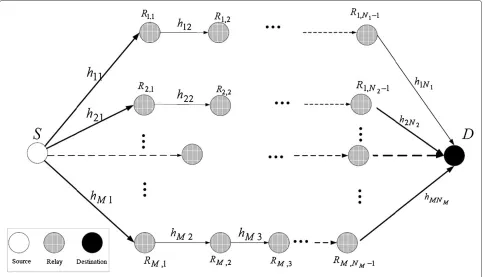
Consider a generalized cooperative system withM diver-sity branches and{Ni}Mi=1hops for each branch as shown
in Figure 1. We denoteRi,j(1≤i≤Mand 1≤j≤Ni−1)
as thejth relay in theith branch andhin(1 ≤n ≤Ni) as
the channel coefficient for thenth hop in theith branch. We assume that the distance between relay clusters (hop) is much larger than the distance between the nodes in any one cluster. Therefore, the channel gains of the hops are independently but not necessarily identically distributed (i.n.i.d).
When AF relaying is employed, the relay nodeRi,j
ampli-fies the signal received from the preceding terminal by a factorAijgiven by
(Aij)2=
Pij Pi(j−1)|hij|2+σn2
, 1≤i≤M, 1≤j≤Ni−1,
(1)
where σn2is the power of additive white Gaussian noise (AWGN)a and Pi0 is the source transmission power in
branch i. Let we denote the instantaneous SNR of the jth hop of the ith branch byγij = |hij|2Pi(j−1)/σn2. The received SNR of theith branch is given by [20]
γi=
which can be well approximated by [20]
γi≈
especially for sufficiently large values of SNR.
While a number of different distributions are possible for fading amplitudes, we choose here the generalized Gamma distribution, whose pdf is [21]
fh(x)=
where (·) is the gamma function defined in [22,
Eq.(8.310.1)], mis the fading parameter, υ is the shape parameter and:=βυmis the power-scaling parameter. In what follows, we will use the shorthand notationX ∼ G(a,b)to denote thatXfollows generalized Gamma dis-tribution with parametersaandb. With a proper choice of three parametersm, β andυ the generalized Gamma distribution can represent a wide variety of distributions including the Rayleigh (m=υ =1), Nakagami-m(υ=1),
Weibull (m = 1), log-normal (m → ∞,υ = 0), and
AWGN (m → ∞,υ = 1) cases. We also mention that
Figure 1System model.Generic cooperative (multi-hop multi-branch) wireless system.
approximation if the shape parameterυ =1 and the rela-tionship m ≈ (2KK++1)12 between the Rician factor K and the fading figuremholds [23]. The pdf ofγijthen can be
expressed as [24]
fγij(γ )=
ξ
ij
¯ γij
mijυij υ
ij
(mij)
γυijmij−1exp
−
ξ
ij
¯ γij
γ υij
,
(5)
where ξij = (mij + 1/υij)/ (mij) and γ¯ij =
E{|hij|2}Pi(j−1)/σn2, withE{·}being the expectation operator.
3 Asymmetric multi-hop system
In this section, we study the performance of the asym-metric multi-hop systems. We first derive the asymptotic statistics of the received SNR at the destination. Then, we obtain closed-form expressions for the outage probability and the average SER of the system under the high SNR assumption.
3.1 Statistics of the end-to-end SNR
To analyze the performance of the multi-hop system, we need statistical characterization of its end-to-end SNR. In this section, we derive the cumulative distribution func-tion (cdf ), pdf and MGF of the received SNR.
Although the expression given in (3) forγiis more
math-ematically tractable than the one given in (3), the statistics
ofγiin (3) are unknown for an arbitrary number of hops.b
In order to keep a tractable analysis, we use the upper bound ofγiin (3) as [25],
γi≤γi=minγi1,. . .,γiNi, i=1,. . .M. (6) The following proposition summarizes the results on statistics ofγiin the high-SNR regime.
Proposition 1. Letγij ∼ G
mij,
γ¯
ij
ξij
υij
, j = 1,. . .,Ni, be the independent hop SNRs for the ith branch. The asymptotic cdf ofγiis then given by
Pγi(γ )≈
Ni
j=1
1 (mij+1)
(
mij+1/υij)
(mij)
υijmij
×
γ ¯ γij
υijmij
+o(γ¯ij−(υijmij+1)). (7)
The pdf and the MGF ofγiare, respectively, given by
pγi(γ )≈
Ni
j=1
υij
(mij)
(
mij+1/υij)
(mij)
υijmij 1
¯ γij
γ ¯ γij
υijmij−1
Mγi(γ )≈
Proof. : See Proof of Proposition 1 in Appendix.
3.2 Performance analysis
With the statistical characterization of the received SNR derived in previous section, we can carry out a thorough performance analysis of the multi-hop system. We focus in what follows on outage probability and average SER performance measures.
3.2.1 Outage probability
The outage probability is one of the most commonly used performance measures in wireless systems. The outage probability in a multi-hop AF system is defined as the probability that the end-to-end instantaneous received SNR falls below a predetermined threshold γth. This
threshold is a protection value of the SNR, above which the quality of service is satisfactory. Therefore, the outage probability is given by the Pr(γi < γth), which can easily
be calculated by evaluating the cdf of γi at γth.
Conse-quently, asymptotic expression for the outage probability of the considered system over asymmetric fading channels can be obtained using (7) as
Pout≈ For the special case of i.i.d Nakagami-mfading where mij=mi,γ¯ij= ¯γi, andυij=1, (7) is reduced to
which is consistent with the result obtained in [14].
3.2.2 SER
In addition to the outage probability, the average SER, is another standard performance criterion of cooperative diversity systems. The derived MGF can be used to eval-uate the average SER of the multi-hop AF system under M-PSK andM-QAM. The average SER ofM-PSK can be
that have constellation sizeM = 2k with an evenk, the average SER is given [26] as
Pe=
Closed-form solutions for (12) and (13) in the general case seem analytically intractable.c However, using the available software packages such as Mapel and Mathemat-ica this evaluation can be performed easily for a required degree of accuracy. The numerical results and simulation results are discussed in Section 6.
4 Asymmetric multi-hop multi-branch system
In this section, we study the performance of the multi-hop multi-branch AF systems in generalized fading chan-nels. The destination node combines the received signals from different paths. Specifically, we examine two differ-ent combining techniques: MRC and SC [26]. With MRC, the received signals from multiple diversity branches are cophased, weighted, and combined to maximize the
out-put SNR.d MRC provides the maximum performance
improvement relative to all other combining techniques by maximizing the SNR of the combined signal. How-ever, MRC also has the highest complexity of all combin-ing techniques since it requires knowledge of the fadcombin-ing amplitude in each signal branch. As such we consider MRC as an important theoretical benchmark to quan-tify the performance of the considered network. SC is often used in practice as an alternative technique because of its reduced complexity relative to the optimum MRC scheme. In its conventional form, SC diversity only pro-cesses one of the diversity branches, specifically, the one determined by the receiver to have the highest SNR. The most important reason behind the popularity of the SC is the simplicity in implementation and decrease in resource requirement and complexity at the receiver, while still achieving full diversity.
4.1 Statistics of combined SNR
4.1.1 MRC
MRC is the optimum combining scheme in the absence of interference [26, Ch .11]. The total SNR at the output of the MRC combiner is simply given by
γMRC≤γMRC=
M
i=1
γi. (14)
To obtain the statistics of γMRC, i.e., sum of several independent variables, we need the following lemma. Lemma 1. Let us consider a finite set of an arbitrary and independent nonnegative random variables (RV) X= {x1,. . .,xM}, whose pdf ’s, pxk(·) k = 1,. . .,M, tends to
pxk = akγ
tk +o(γtk+)forγ →0+and >0. If the RV
zkis defined as
zkx1+x2+ · · · +xk k=1,. . .,M
then the cdf of zkcan be expressed as
Pzk(γ )=Dkγ
Proof.: See Proof of Lemma 1 in Appendix.
The following propositions summarize the results for the cdf and MGF ofγMRCfor high-SNR regime.
Proposition 2. Let γi, i = 1,. . .,M, be independent branch SNRs. The asymptotic cdf and MGF of theγMRCin generalized fading environments are, respectively, given by
PγMRC(γ )≈
Proof.: Using Lemma 1 and employing the result for
the product of two series [27, Eq. (10)] gives, after some manipulation, the desired result in (16a).
The MGF ofγMRCcan directly be found from
MγMRC(s)=sL(PγMRC(γ )), (17)
whereL(·)denotes the Laplace transform. Therefore, sub-stituting the cdf given in (16a) into (17) and usingL(xν)= (ν+1)/sν+1, the MGF given in (16b) is achieved.
4.1.2 SC
Instead of using MRC, which requires exact knowledge of the all CSIs, a system may use SC which simply requires SNR measurements. Indeed, SC is considered as the least complicated receiver [26, Ch. 11]. The total SNR at the output of the SC combiner is given by
γSC≤γSC=max(γ1,. . .,γM). (18)
The following proposition gives the cdf and the MGF of γSC.
Proof. : If the branches fade independently, the cdf of the
Using the result in [27, Eq. (10)] for the product of two series, the desired result given in (21b) is derived.
The MGF ofγSC can be obtained following the same procedure used to obtain (16b).
4.2 Performance analysis
In this section, the outage probability and the SER are derived for the MRC and SC receivers.
4.2.1 Outage probability
Using (16a) and (21b), the asymptotic outage probability of the system with MRC and SC receivers can readily be obtained as
Note that the asymptotic SER is found by substituting our results for the asymptotic MGF in (16b) and (19b) into (12) and (13), respectively, for the MRC and SC receiver with M-PSK and M-QAM. However, seeking a closed-form solution to (12) and (13) is intractable due to the integration over θ. To avoid this integration, we invoke the accurate approximations in [28, Eq. (34)] and [28, Eq. (36)] to get the asymptotic SER forM-PSK and M-QAM, respectively.
4.2.3 Diversity order
By defining the diversity order as d = limγ¯→∞ − log(Pout)/log(γ )¯ , one can easily check that MRC and SC
receiver attain diversity order
d=
Note that although both MRC and SC schemes achieve the same diversity order, the MRC scheme achieves an additional coding gain.
5 Power allocation for multi-hop multi-branch cooperative system
In this section, two effective transmit power allocation schemes are described. The power allocation scheme which tends to minimize the total power of the sys-tem is developed in Section 5.2. A suboptimal scheme is proposed in Section 5.3 aimed at minimizing the outage probability. In the sequel, a brief introduction of GP for application to be discussed in the next two sections on power control problems is given.
5.1 GP
GP is well-investigated class of nonlinear, non-convex optimization problems, which can be turned into a con-vex optimization problem [18]. Hence, a local optimum of a GP problem is also a global optimum, which can always be calculated efficiently using interior-point methods [29]. The polynomial time complexity of the interior-point methods, their high speed in practice, and availability of large-scale software solvers make GP more appealinge (please see GP in Appendix for details on GP). We show that the corresponding optimization problems can be for-mulated as GP and thus optimal power allocation (OPA) can be obtained using the convex optimization tech-niques.
5.2 Minimizing the total transmit power
the individual transmitter powers and subject to a maxi-mum allowed outage probability at the destination, we form the optimization problem asf
minimize
andPmaxij are, respectively, the minimum and maximum transmission power for the corresponding node which can be the same or different for rely nodes. Note that PoutMRCin (23) is a nonlinear function of the powers, which yields a posynomial upper bound inequality constraint for the optimization problem in (23). With MRC receiver at the destination, the optimization problem in (23) can be expressed as
of posynomials is also a posynomial [18]. Moreover, the inequality constraints (24b) and (24c) are monomial and the constraint in (24d) is a posynomial. Therefore, the optimization problem in (24) is a GP in the variables Pij, i=1,. . .,M, j=0,. . .,Ni−1. By using the
interior-point methods for GP we can solve the power allocation problem in (24).
5.3 Minimizing the outage probability
In this section, we explore the power allocation policy aimed at minimizing the outage probability. The problem
formulation (24) can readily be modified to minimize the asymptotic outage probability as
minimize PMRCout , (25a)
subject to 1
It is obvious that the optimization problem (25) belongs to the class of GP problems and can efficiently be solved by using the interior-point methods.
5.3.1 Analytical results for a single-relay cooperative network
In this section, we provide an analytical approximation of optimum power allocation for a three-node coopera-tive network, with a source S, a relay R, and a destination D. This analysis provides some insight for the formulated problem in section 5.3. We denote byP1andP2the
trans-mitted power from source and relay, respectively. The optimization problem in (25) is then given by
minimize C1
where C1 and C2 are positive constants, capturing the
fading effects of the links. Since the fading parameters generally take non-integer values, solving (26) does not yield closed-form expressions forP1andP2. Nevertheless,
the optimization problem defined in (26) includes, as spe-cial case, the Rayleigh fading environment. In this case, the power allocation problem is reduced to
minimize 1
pared to R–D link. Denoting the optimal source and relay powers byP∗1andP2∗, respectively, and defining,α∗= P∗1
From (28) we observe that
values indicate that it is better to spend most of the power in broadcast phase.
2. When the relay is located midway between the source and destination, optimum value ofP1is
∼(2/3)PTwhich means that 66% of power should
be spent in the broadcast phase and 33% of power should be dedicated to the relay terminal in the relaying phase. These values indicate that it is better to spend most of the power in broadcast phase. 3. when relay is close to the source,P1andP2are found
to be∼0.5PTindicating that equal power allocation
(EPA) is nearly optimal.
Note that the same observations have been reported in [30,31] for a three-node cooperative network.
5.4 Discussion on the implementation of power allocation schemes
The two proposed power allocation schemes are com-puted in a centralized manner at the destination. Cen-tralized implementation of power allocation schemes requires a central controller to collect the information of all wireless links in order to find an optimal solution, and distribute the solution to the corresponding wireless nodes. Hence, information exchange plays a crucial role in implementing the resource optimization process. Use-ful information can be the Use-full channel state information, or partial channel state information (e.g., average channel realizations), or some other quantized/codebook-based limited-rate feedback information.
The implementation of our proposed power alloca-tion schemes requires that the destinaalloca-tion has the infor-mation about the channel statistics rather than the instantaneous CSIs. Since the first-order and second-order statistics vary much slower than the instanta-neous CSIs, the overhead is significantly reduced. The remaining, but most challenging task is keeping the amount of feedback overhead information, exchanged within the network, at a reasonable level. For this pur-pose, the destination determines the power coefficients. These coefficients are then quantized at the receiver and sent back to the transmitters over a low-rate feed-back link [32]. Therefore, the signaling overhead is much lower than that of the conventional centralized methods.
6 Simulation results
In this section, we provide numerical results corroborat-ing the analysis developed in the previous sections. It is assumed that the relays and the destination have the same value of noise power. We plot the performance curves in terms of outage probability and average SER versus the normalized average SNR per hop. We also setγth=3 dB.
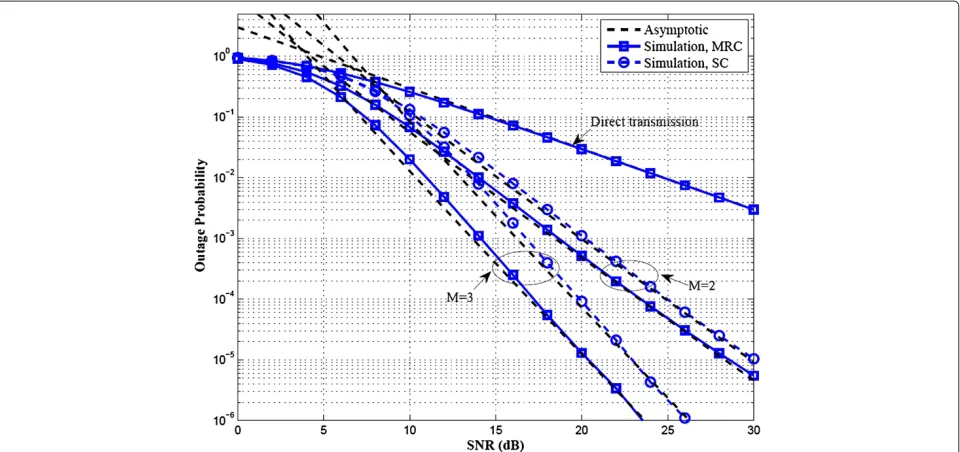
Figure 2 plots the exact and asymptotic outage prob-ability of a generic cooperative system in the context of various scenarios. Specifically, the outage probabil-ity of two and three branches AF network have been plotted for MRC and SC receivers. Moreover, the out-age performance of direct transmission is also depicted as the baseline for comparison. In our simulations, the
direct channel (first branch) is assumed to be Rayleigh
fading channel corresponding to m11 = 1. By
con-trast, the dual-hop link (second branch) is assumed to be consisted of Nakagami-m fading channels associated with m21 = 1.1 andm22 = 1.6. Moreover, the
triple-hop channel (third branch) is assumed to be consisted of Rician and Nakagami-m fading channels associated
with K = 5 dB and m32 = 0.9 and m33 = 3. The
validity of our asymptotic results in (21a) and (21b) are attested to in the figure, where the asymptotic curves cor-rectly predict the diversity order and the array gain of the exact SER.
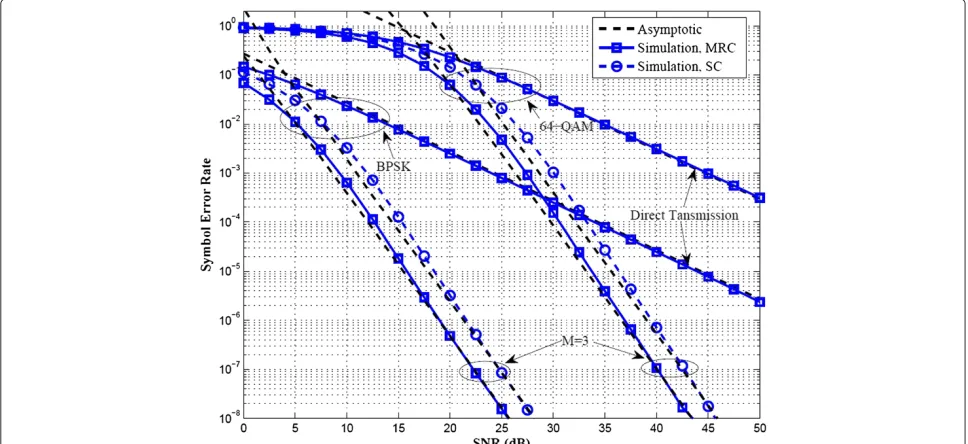
In Figure 3, we evaluated the SER performance of the cooperative wireless systems, when assuming both BPSK and 64-QAM baseband modulation schemes. These figure also demonstrate the accuracy of the asymptotic SER evaluated with the aid of the MGF of the received SNR in comparison with the SER obtained by simula-tions. Note that the corresponding curves are plotted only for direct transmission and M = 3 branches case, to avoid entanglement. The results of Figure 3 shows that the asymptotic SER is very accurate especially in high SNR region. Note that our observation of the outage per-formance of 8-QAM and 16-QAM modulations, which for the sake of clarity are not shown in Figure 3, reveals that the asymptotic SER matches the exact results in higher SNR values, as the modulation order increases. We interpret this behavior as a consequence of approx-imation, used in [28] to derive the closed-form SER expressions.
Next, we compare the performance of the optimum and EPA, with the latter equally distributing the power among all the relay nodes. Figure 4 shows the outage per-formance of the proposed OPA scheme in (25) in the context of various scenarios. Specifically, in our
simula-tions, we considerM = 2 and M = 3 branches cases,
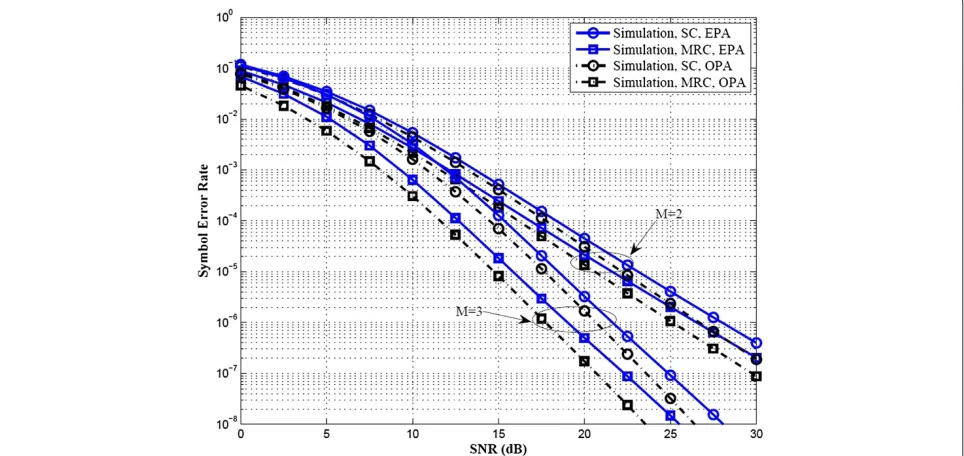
where channels undergo the same statistical process as that in Figure 2. Curves for 16-QAM modulation are plotted for SC and MRC receivers, while corresponding curves from analysis are plotted only for M = 2, to avoid entanglement. We observe that the power allocation shows significant improvement in performance compared to those of a system with EPA. Moreover, the gap in per-formance increases further with increase in SNR values and the number of branches. Note that, instead of mini-mizing the outage probability in (25), we can minimize the SER performance of the system. Figure 5 shows a com-parison between the equal power and OPA schemes for multi-hop multi-branch system using BPSK modulation. SER Curves for SC and MRC receivers are plotted and channels undergo the same statistical process as that in Figure 2.
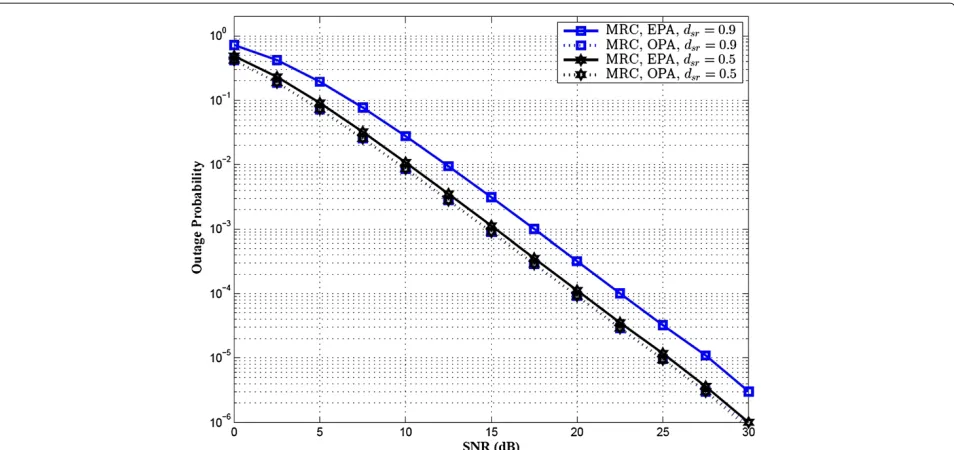
Figure 6 shows a comparison of the outage probability of the single-relay cooperative system for two different relay positions: relay is midway between the source and the des-tination, and relay is located closed to the destination. In this figure, we assume that E(|hSD|2) = SD = 1/dsdα,
E(|hSR|2) = SR = 1/dαsr, and E(|hRD|2) = RD =
1/dαrd, wheredsd,dsr, anddrdare, respectively, the source–
destination, source–relay, and relay–destination distances
Figure 4Outage probability for EPA and OPA.Outage probability versus the SNR performance of the cooperative wireless systems using 16-QAM modulation for two power allocation schemes: EPA and proposed power allocation in 25a. In this figure, channels undergo the same statistical process as that in Figure 2. Asymptotic bounds have been obtained using (21a) and (21b) for MRC and SC receiver, respectively.
and α is the path loss exponent. We also set α = 3. The solid curves are the outage probability with EPA and the dotted curves are the outage probability with OPA in (28). Clearly and as expected, for these two relay place-ments, EPA does not give the best performance. More-over, the OPA is more suitable to be utilized in single-relay
cooperation networks in which relay is located close to the destination.
7 Conclusion
We investigated the performance of hop multi-branch AF relay systems in generalized fading environment
Figure 6Comparison of the outage probability of the cooperative system using EPA and the OPA in two relay position.Comparison of the outage probability of the cooperative system for QPSK modulation using EPA and the OPA in two configurations: (1) relay is located close to the destination, (2) relay is located midway between the source and destination. In this setup both direct channel and relay channel experience Rayleigh fading.
with MRC and SC receivers. A range of closed-form results has been derived for both the statistics of the output SNR and the asymptotic performance of the system under study. We substantiated the tightness of such asymptotic expressions and the accuracy of our theoretical analysis using simulation results. More-over, we developed two power allocation strategies for further improving the cooperation. The first strategy sought to minimize the total transmit power; the sec-ond strategy aimed at minimizing the outage probabil-ity, which was parameterized by the total power avail-able to the relay nodes and the source node. We found that the OPA shows significant improvement in per-formance when relay nodes are asymmetrically placed at fixed locations when compared to a system with EPA.
Endnotes
aWe assume that the noise power is identical in all
receiv-ing nodes. Note that this assumption is not essential and can easily be relaxed, but at the cost of complicating the derived expressions without providing additional insight.
bWe notice that closed-form expressions for the statistics
of γi are given in [3] and [4] for the special case of an
AF dual-hop system in Nakagami-mand Rayleigh fading channels, respectively.
cIn [35], an accurate approximation has been presented
for the SER withM-PSK modulation.
dIn this study, we assume that the receiver estimates the
channel perfectly from training. A discussion of channel estimation techniques is beyond the scope of this article and the reader is referred to [36,37] for the details.
eThere are several high-quality software downloadable
from the Internet, which are widely used to solve the GP using interior-point methods (e.g., the MOSEK package and the CVX package).
fNote that we consider the MRC combiner in the
pro-posed power allocation schemes. However, for the SC combiner, we can follow the same procedure to get the optimized transmitted powers.
Appendix
Proof of Proposition 1
Assuming that the received SNR’s from different diver-sity branches are independent, the cdf of the received SNR in (6) is given by
Pγi(γ )=Pr(min
γi1,. . .,γiNi≤γ ) (a)
= 1−
Ni
j=1
mij,
ξ
ij
¯
γijγ
υij
(mij)
, (29)
Pγi(γ )=1−
[33, Appendix II] we get
Ni
By approximating the exponential term in the right-hand side of the inequality with the first two terms of the well- known Taylor series, for high SNRs (1/γ¯ij →0), the
cdf in (31) is further simplified as
Pγi(γ )≈
Our simulation results in Section 6 show that fork=0, a fairly tight asymptotic bound for the outage probability of the multi-hop system is achieved. The reason is that the outage probability is proportional to 1/(γ¯ij)k and thus for
sufficiently high values of SNRs decays very fast withk≥ 1. Therefore, substitutingξijinto (32), settingk = 0, and
using the fact that(1+z)=z(z)[34] the desired result in (8) is achieved.
Proof of Lemma 1
Let we define
k is defined in (15d). To prove the proposition, we will
use mathematical induction. Clearly, Lemma 1 holds for n=1 andn=2, i.e.,
where (a) follows by induction assumption. Therefore, the closed-form cdf in (15a) is valid for n = k, which completes the proof.
GP
In this section, we give a brief review of the GP and refer the reader to [18, Ch. 4] for details.
Letx1,. . .,xnbenreal positive variables andxdenotes
the vector of n variables. We define a monomial as a function off :Rn++→R: monomials is called a posynomial function, which has the form
Minimizing a posynomial subject to posynomial upper bound inequality constraints and monomial equality con-straints is called GP. Therefore, a GP in standard form in x=[x1,. . .,xn] is given as
minimize f0(x),
subject to fi(x)≤1 i=1,. . .,m, gi(x)=1, i=1,. . .,p
With a logarithmic change of variables as yi = logxi
(or equivalentlyxi = exp(yi)which enforces the
positiv-ity constraint onxi) we can turn the GP in (38) into the
following equivalent problem inx
minimize logf0(exp(y1),. . ., exp(yn)),
subject to logfi(exp(y1),. . ., exp(yn))≤1 i=1,. . .,m,
loggi(exp(y1),. . ., exp(yn))=1, i=1,. . .,p,
(38)
which is a convex problem, since the objective function and the inequality constraint functions are all convex and the equality constraint functions are affine (note that the log-sum-exp function is convex [18]).
Competing interests
The author declare that they have no competing interests.
Acknowledgements
This work is supported in part by the Ministry of Industries and Mines of Iran.
Received: 10 June 2012 Accepted: 12 February 2013 Published: 12 June 2013
References
1. R Pabst, B Walke, D Schultz, P Herhold, H Yanikomeroglu, S Mukherjee, H Viswanathan, M Lott, W Zirwas, M Dohler, H Aghvamia, D Falconer, GP Fettweis, Relay-based deployment concepts for wireless and mobile broadband radio. IEEE Commun. Mag.42, 80–89 (2004)
2. E Morgado, I Mora-Jiménez, JJ Vinagre, J Ramos, AJ Caamaño, End-to-end average BER in multihop wireless networks over fading channels. IEEE Trans. Wirel. Commun.9(8), 2478–2487 (2010)
3. MO Hasna, MS Alouini, Harmonic mean and end-to-end performance of transmission systems with relays. IEEE Trans. Commun.52(1), 130–135 (2004)
4. MO Hasna, M-S Alouini, End-to-end performance of transmission systems with relays over Rayleigh-fading channels. IEEE Trans. Wirel. Commun. 2(6), 1126–1131 (2003)
5. TA Tsiftsis, GK Karagiannidis, PT Mathiopoulos, SA Kotsopoulos, Nonregenerative dual-hop cooperative links with selection diversity. EURASIP J. Wirel. Commun. Netw.2006, 1–8 (2006)
6. MD Renzo, F Graziosi, F Santucci, A comprehensive framework for performance analysis of dual-hop cooperative wireless systems with fixed-gain relays over generalized fading channels. IEEE Trans. Wirel. Commun.8(10), 5060–5074 (2009)
7. MD Renzo, F Graziosi, F Santucci, Channel capacity over generalized fading channels: a novel MGF-based approach for performance analysis and design of wireless communication systems. IEEE Trans. Veh. Technol. 59(1), 127–149 (2010)
8. C Conne, M-C Ju, Z Yi, H-K Song, I-M Kim, SER analysis and PDF derivation for multi-hop amplify-and-forward relay systems. IEEE Trans. Commun. 58(8), 2413–2424 (2010)
9. HQ Huynh, SI Husain, J Yuan, A Razi, H Suzuki, Performance analysis of multibranch dual-hop nonregenerative relay systems with EGC in Nakagami-mchannels. EURASIP J. Wirel. Commun. Netw.2010(2010) 10. F Yilmaz, M-S Alouini, A unified MGF-based capacity analysis of diversity
combiners over generalized fading channels. IEEE Trans. Commun.60(3), 862–875 (2012)
11. A Ribeiro, X Cai, GB Giannakis, Symbol error probabilities for general cooperative links. IEEE Trans. Wirel. Commun.4(3), 1264–1273 (2005) 12. MD Renzo, F Graziosi, F Santucci, A comprehensive framework for
performance analysis of cooperative multi-hop wireless systems over Log-Normal fading channels. IEEE Trans. Commun.58(2), 531–544 (2010) 13. MD Renzo, F Graziosi, F Santucci, A unified framework for performance
analysis of CSI-assisted cooperative communications over fading channels. IEEE Trans. Commun.57(9), 2551–2557 (2009)
14. G Amarasuriya, C Tellambura, M Ardakani, Asymptotically-exact performance bounds of AF multi-hop relaying over Nakagami fading. IEEE Trans. Commun.59(4), 962–967 (2011)
15. MO Hasna, MS Alouini, Optimal power allocation for relayed
transmissions over Rayleigh-fading channels. IEEE Trans. Wirel. Commun. 3(6), 1999–2004 (2004)
16. R Annavajjala, PC Cosman, LB Milstein, Statistical channel
knowledge-based optimum power allocation for relaying protocols in the high SNR regime. IEEE J. Sel. Areas Commun.25(2), 292–305 (2007) 17. G Farhadi, NC Beaulieu, Power-optimized amplify-and-forward multi-hop
relaying systems. IEEE Trans. Wirel. Commun.8(9), 4634–4643 (2009) 18. HS Boyd, L Vandenberghe,Convex Optimization. (Cambridge University
Press, Cambridge, MA, 2004)
19. M Chiang, C-W Tan, DP Palomar, D O’Neill, D Julian, Power control by geometric programming. IEEE Trans. Wirel. Commun.6(7), 2640–2651 (2007)
20. MO Hasna, M-S Alouini, Outage probability of multihop transmission over Nakagami fading channels. IEEE Commun. Lett.7(5), 216–218 (2003) 21. MD Yacoub, inProceedings of the IEEE PIMRC. Theα−μdistribution: a
general fading distribution (Portugal, September 2002), pp. 629–633 22. IS Gradshteyn, IM Ryzhik,Table of Integrals, Series and Products, 7th edn.
(Academic Press, New York, 2007)
23. R Vaughan, JB Andersen,Channels, Propagation and Antennasf or Mobile Communications. (IEE, London, UK, 2003)
24. S Ikki, MB Ahmed, inProceedings of the IEEE GLOBECOM 2007. Performance analysis of dual-hop relaying communications over generalized Gamma fading channels (Washington, DC, USA, November 2007), pp. 3888–3893 25. MO Hasna, inProceedings of the 10th IEEE International Conference on
Electronics, Circuits, and Systems, vol. 2. Average BER of multihop communication systems over fading channels, (December 2003), pp. 723–726
26. MK Simon, MS Alouini,Digital Communication over Fading Channels, 2nd edn. (Wiley, New York, NY, 2005)
27. TQ Duong, VNQ Bao, H-J Zepernick, On the performance of selection decode-and-forward relay networks over Nakagami-mfading channels. IEEE Commun. Lett.13(3), 172–174 (2009)
28. N Yang, PL Yeoh, M Elkashlan, IB Collingsc, Z Chen, Two-way relaying with multi-antenna sources: beamforming and antenna selection. IEEE Trans. Veh. Technol.61(6), 3996–4008 (2012)
29. Y Nesterov, Nemirovsky A, inStudies in Applied Mathematics, vol. 13. Interior-point polynomial methods in convex programming (SIAM Philadelphia, PA, 1994)
30. H Ilhan, I Altunbas, M Uysal, inProceedings of the IEEE VTC Spring. Cooperative diversity for relay-assisted inter-vehicular communication (Singapore, May 2008), pp. 605–609
31. MM Fareed, M Uysal, BER-optimized power allocation for fading relay channels. IEEE Trans. Wirel. Commun.7(6), 2350–2359 (2008) 32. DJ Love, Heath Jr. R W, VKN Lau, D Gesbert, BD Rao, M Andrews, An
overview of limited feedback in wireless communication systems. IEEE J. Sel. Areas Commun.26(8), 1341–1365 (2008)
33. S Kandukuri, S Boyd, Optimal power control in interference-limited fading wireless channels with outage-probability specifications. IEEE Trans. Wirel. Commun.1(1), 46–55 (2002)
34. M Abramowitz, IA Stegun,Handbook of Mathematical Functions With Formulas, Graphs, and Mathematical Tables, 9th edn. (Dover, New York, 1970)
35. MR McKay, A Zanella, IB Collings, M Chiani, Error probability and SINR analysis of optimum combining in Rician fading. IEEE Trans. Commun. 57(3), 676–687 (2009)
36. CS Patel, GL Stüber, Channel estimation for amplify and forward relay based cooperation diversity systems. IEEE Trans. Wirel. Commun.6(6), 2348–2356 (2007)
37. G Huang, Y Wang, J Coon, inIEEE PacRim. Performance of multi-hop decode-and-forward and amplify-and-forward relay networks with channe estimation, (August 2011), pp. 352–357
doi:10.1186/1687-1499-2013-160