R E S E A R C H
Open Access
Coexistence of identical synchronization,
antiphase synchronization and inverse full
state hybrid projective synchronization in
different dimensional fractional-order
chaotic systems
Adel Ouannas
1, Xiong Wang
2, Viet-Thanh Pham
3*, Giuseppe Grassi
4and Toufik Ziar
5*Correspondence: [email protected] 3Modeling Evolutionary Algorithms Simulation and Artificial Intelligent, Faculty of Electrical & Electronics Engineering, Ton Duc Thang University, Ho Chi Minh City, Vietnam
Full list of author information is available at the end of the article
Abstract
The topic related to the coexistence of different synchronization types between fractional-order chaotic systems is almost unexplored in the literature. Referring to commensurate and incommensurate fractional systems, this paper presents a new approach to rigorously study thecoexistenceof some synchronization types between
nonidenticalsystems characterizedby different dimensionsanddifferent orders. In particular, the paper shows thatidentical synchronization(IS),antiphase
synchronization(AS), andinverse full state hybrid projective synchronization(IFSHPS) coexist when synchronizing a three-dimensional master system with a
fourth-dimensional slave system. The approach, which can be applied to a wide class of chaotic/hyperchaotic fractional-order systems in the master-slave configuration, is based on two new theorems involving the fractional Lyapunov method and stability theory of linear fractional systems. Two examples are provided to highlight the capability of the conceived method. In particular, referring to commensurate systems, the coexistence ofIS,AS, andIFSHPSis successfully achieved between the chaotic three-dimensional Rössler system of order 2.7 and the hyperchaotic four-dimensional Chen system of order 3.84. Finally, referring to incommensurate systems, the
coexistence ofIS,AS, andIFSHPSis successfully achieved between the chaotic three-dimensional Lü system of order 2.955 and the hyperchaotic four-dimensional Lorenz system of order 3.86.
MSC: 34H10; 26A33; 34A08
Keywords: coexistence of synchronization types; fractional-order systems; chaos synchronization; commensurate and incommensurate systems; nonidentical systems
1 Introduction
By starting from the milestone by Pecora and Carroll [1], over the last years, great efforts have been devoted to the study of chaos synchronization in dynamical systems described byinteger-orderdifferential equations and difference equations [2]. Given two systems in the master-slave configuration, the objective in chaos synchronization is to make the response system variables synchronized in time with the corresponding drive system
ables. At the beginning, Pecora and Carroll introduced the concept of complete ( identi-cal)synchronization(IS), but, year after year, different types of synchronization have been proposed in the literature, for continuous- and discrete-time systems [3–10]. For exam-ple, inprojective synchronization(PS) the response system variables are scaled replicas of the drive system variables [11]. When the scaling factor is ‘–1’,antiphase synchronization
(AS) is obtained. On the other hand, when the scaling factor is different for each drive system variable,full state hybrid projective synchronization(FSHPS) is achieved [12]. Re-cently, in [13, 14] a synchronization scheme has been presented, where each drive system state synchronizes with a linear combination of response system states. Since drive system states and response system states have been inverted in [13, 14] with respect to theFSHPS, the scheme has been calledinverse full state hybrid projective synchronization(IFSHPS). Additionally, recent papers have investigated the coexistence of several synchronization types when synchronizing two chaotic systems both in integer-order differential systems and discrete-time systems [15–17]. In particular, the approach developed in [15] has illus-trated a rigorous study to prove the coexistence of some synchronization types between discrete-time chaotic (hyperchaotic) systems.
Besides integer-order systems, attention has been recently focused on systems described byfractional-orderdifferential equations [18, 19]. Researches in the literature have shown that fractional-order systems, as generalizations of well-known integer-order systems, are characterized by chaotic dynamics [20, 21]. These systems include the fractional Lorenz system, the fractional Chua system, the fractional Rössler system, the fractional Chen system, and the fractional Lü system [22–26]. Specifically, researches have shown that chaos is achievable when the system order is less than 3, whereas hyperchaos can be ob-tained when the system order is less than 4. Referring to synchronization, studies have shown that chaotic fractional-order systems can also be synchronized [27]. However, dif-ferently from integer-order systems, few synchronization types have been introduced for fractional-order systems. Moreover, most of the approaches are related to the synchro-nization ofidenticalfractional-order systems. Very few methods for synchronizing non-identicalfractional-order chaotic systems have been illustrated [28–30]. Additionally, the topic related to the coexistence of different synchronization types between fractional-order systems is almost unexplored [31, 32].
Based on these considerations, this paper presents a new approach to rigorously study the coexistence of some synchronization types between fractional-order systems char-acterizedby different dimensionsanddifferent orders. In particular, the paper shows that
identical synchronization(IS),antiphase synchronization(AS), andinverse full state hybrid projective synchronization(IFSHPS) coexist in the synchronization of a three-dimensional master system with a four-dimensional slave system. The approach presents the remark-able feature of being both rigorous and applicremark-able to a wide class of commensurate and incommensurate fractional-order systems of different dimensions and different orders. It is worth noting that the proposed approach is more general than those illustrated in [31, 32] because, among other things, it guarantees the coexistence of three different synchro-nization types (instead of only two types, as in [31, 32]). This increased complexity pro-vides a deeper insight into the synchronization phenomena between systems described by fractional differential equations.
co-existence ofIS,AS, andIFSHPSin fractional-order systems is illustrated. In Section 4, by exploiting fractional Lyapunov stability theory the coexistence ofIS,AS, andIFSHPS
between two commensurate fractional-order systems of different dimensions is proved. Additionally, by using the stability theory of fractional linear systems, in Section 5, the coexistence ofIS,AS, andIFSHPS between two incommensurate fractional-order sys-tems of different dimensions is illustrated. Referring to numerical examples, at first the coexistence ofIS,AS, andIFSHPSbetween the chaotic fractional-order commensurate Rössler system and the hyperchaotic fractional-order commensurate Chen system is suc-cessfully achieved. Note that the Rössler system is a three-dimensional system of order 2.7, whereas the Chen system is a four-dimensional system of order 3.84. An additional numerical example illustrates the coexistence ofIS,ASandIFSHPSbetween the chaotic fractional-order the incommensurate Lü system and the hyperchaotic fractional-order in-commensurate Lorenz system. Note that the Lü system is a three-dimensional system of order 2.955, whereas the Lorenz system is a four-dimensional system of order 3.86. All the numerical examples prove the capability of the proposed approach in successfully achiev-ing the coexistence ofIS,AS, andIFSHPSbetween chaotic and hyperchaotic systems of different dimensions for both commensurate and incommensurate fractional-order sys-tems. Finally, in Section 6, the advantages and the novelty of the conceived approach with respect to those existing in the literature are discussed in detail.
2 Basic concepts
In the following, some basic concepts on fractional derivatives and on the stability prop-erties of fractional linear/nonlinear systems are briefly illustrated.
Definition 1([33]) The Caputo fractional derivative is defined as follows:
Dptx(t) =Jm–pxm(t) with 0 <p≤1, (1)
wherem= [p] (i.e.,mis the first integer that is not less thanp),xmis themth-order
deriva-tive in the usual sense, andJq(q> 0) is theqth-order Riemann-Liouville integral operator defined by
Jqy(t) = 1
(q)
t
0
(t–τ)q–1y(τ)dτ, (2)
wheredenotes the gamma function [34–36].
Now we state a well-known theorem on the stability of fractional linear systems.
Theorem 1([37]) Let
Dpit xi(t) = n
j=1
kijxi(t), i= 1, 2, . . . ,n, (3)
be a fractional linear system where pi(i= 1, 2, . . . ,n)are rational numbers between0and1, whereas Dpit is the Caputo fractional derivative of order pi.Assume that pi=
αi
rational numbers between0and1,then system(3)is asymptotically stable,provided that all the rootsλof the equation
detdiagλMp1,λMp2, . . . ,λMpn–K= 0 (4) satisfy the condition|arg(λ)|> π
2M,where K= (kij)n×n.
Now we report a theorem on fractional nonlinear systems.
Theorem 2([38, 39]) Consider the fractional nonlinear system DptX(t) =F
X(t), (5)
where X(t)∈Rn, 0 <p< 1,Dp
t is the Caputo fractional derivative of order p,and F:Rn→ Rn.If there exists a positive definite Lyapunov function V(X(t))such that Dp
tV(X(t)) < 0for all t> 0,then the trivial solution of system(5)is asymptotically stable.
Starting from previous theorem, we can give the following lemma.
Lemma 1([40]) We have: 1
2D
p t
XT(t)X(t)≤XT(t)Dpt
X(t). (6)
3 Problem formulation
Referring to synchronization, let
Dpit xi(t) = 3
j=1
aijxj(t) +fiX(t), i= 1, 2, 3, (7)
be the master system, whereX(t) = (x1(t),x2(t),x3(t))Tis the state vector, (aij)∈R3×3are
constant parameters,fi:R3→Rare nonlinear functions, andDpit is the Caputo fractional
derivative of orderpi(i= 1, 2, 3) with 0 <pi< 1. Moreover, let
Dqit yi(t) =gi
Y(t)+ui, i= 1, 2, . . . , 4, (8) be the slave system, whereY(t) = (y1(t),y2(t), . . . ,y4(t))Tis the state vector,gi:R4→Rare nonlinear functions,Dpit is the Caputo fractional derivative of orderqi(0 <qi< 1), andui
are controllers to be designed (i= 1, 2, . . . , 4).
Based on the master-slave synchronizing system described by (7)-(8), we can give the following definition of coexistence of different synchronization types.
Definition 2 Identical synchronization(IS),antiphase synchronization(AS), andinverse full state hybrid projective synchronization(IFSHPS) coexist in the synchronization of the master system (7) and the slave system (8) if there exist controllersui(1≤i≤4) and real numbers (α31,α32,α33,α34) such that the synchronization errors
e2(t) =x2(t) ––y2(t), and (9)
4 Coexistence of IS, AS, and IFSHPS for commensurate systems
In this section, we focus ourselves on the coexistence ofIS,AS, andIFSHPSfor com-mensurate chaotic (hyperchaotic) systems. First, we prove a new theorem. Afterward, we illustrate in detail an application involving the chaotic fractional-order Rössler system (as a master system) and the hyperchaotic fractional-order Chen system (as a slave system).
We assume thatq1=q2=q3=q4=q. The Caputo fractional derivative of orderqof the error system (9) can be derived as
Dqte1(t) =D
On the other hand, the error system (10) can be rewritten in compact form as
Dqte(t) =Ae(t) +R–α×U, (11)
Now we can prove a new theorem.
Theorem 3 Identical synchronization(IS),antiphase synchronization(AS),and inverse full state hybrid projective synchronization(IFSHPS)coexist in the synchronization of the master system(7)and the slave system(8)if the control law is selected as follows:
(u1,u2,u3)T=J–1×R+Ce(t), (12)
u4= 0, (13)
whereJ–1is the inverse matrix of
and C∈R3×3 is a suitable control matrix such that(A–C)is a negative definite ma-trix.
Proof By exploiting (13) the error system (11) becomes
Dqte(t) =Ae(t) +R–J×(u1,u2,u3)T. (14)
By applying the control law proposed in (12) to (14), the resulting error dynamics are described by
Dqte(t) = (A–C)e(t). (15)
If the candidate Lyapunov function is chosen asV(e(t)) = 12eT(t)e(t), then the time Caputo fractional derivative of orderqalong the trajectory of system (14) is described as
DqtVe(t)=1 2D
q t
eT(t)e(t). (16)
By applying Lemma 1 to equation (16) it follows that
DqtV
e(t)≤eT(t)Dqte(t). (17)
By (15) it results in
DqtV
e(t)≤eT(t)(A–C)e(t) < 0. (18)
From Theorem 2 it can be readily deduced that the zero solution of system (15) is globally asymptotically stable. Consequently,IS,AS, andIFSHPScoexist in the synchronization of the master system (7) and the slave system (8). Now, we give an example to illustrate how the previous theoretical framework can be ef-fectively applied. In particular, the chaotic fractional-order commensurate Rössler system is considered as the master system [41]
⎧ ⎪ ⎪ ⎨ ⎪ ⎪ ⎩
Dptx1= –(x2–x3), Dptx2=x1+αx2, Dptx3=x3(x1–γ) +β.
(19)
As shown in [39], a chaotic attractor is found in (19) when (α,β,γ) = (0.4, 0.2, 10) and
p= 0.9 (see Figure 1). By taking these parameters, the linear part of the master system (19), according to equation (7), is given by
A=
⎛ ⎜ ⎝
0 –1 1 1 0.4 0 0 0 –10
⎞ ⎟
Figure 1 Different plots of the chaotic attractor of the commensurate fractional Rössler system (19).
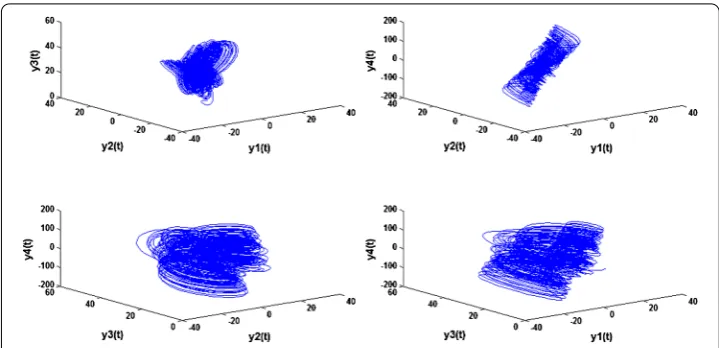
Figure 2 Different plots of the hyperchaotic attractor of the commensurate fractional Chen system (21).
The hyperchaotic fractional-order commensurate Chen system is considered as the slave system [42]
⎧ ⎪ ⎪ ⎪ ⎪ ⎪ ⎨ ⎪ ⎪ ⎪ ⎪ ⎪ ⎩
Dqty1=a(y2–y1) +y4+u1, Dqty2=dy1+cy2–y1y3+u2, Dqty3= –by3+y1y2+u3, Dqty4=ky4+y2y3+u4,
(21)
whereU= (u1,u2,u3,u4)Tis the vector controller. According to [40], system (21) exhibits
hyperchaotic behavior whenq= 0.96, (a,b,c,d,k) = (35, 3, 12, 7, 0.5), and (u1,u2,u3,u4) =
By selecting the scaling parameters
the error system between the master system (19) and the slave system (21) becomes
e1=x1–y1,
e2=x2– (–y2), (23)
e3=x3– (2y1+ 3y2+ 4y3+ 5y4).
Successively, we derive the following matrices:
J= IFSHPS coexist in the synchronization of the master system (19) and the slave system (21). For example, by selecting the control matrix
C=
it can be readily verified that (A–C) is a negative definite matrix. By exploiting matrix (25) it follows from Theorem 3 that the control inputs can be written in the form (12)-(13) as
u1=e1+D0.96x1– 35(y2–y1) –y4,
Figure 3 Time behaviors of the synchronization errorse1,e2, ande3between systems (19) and
(21).
dynamics are described as follows:
⎧ ⎪ ⎪ ⎨ ⎪ ⎪ ⎩
D0.96e1= –e1, D0.96e
2= –4e2, D0.96e3= –10e3.
(28)
Besides the theoretical results illustrated, to show by numerical simulations that the co-existence is effectively achieved, the fractional Euler integration method has been used to solve the systems (19) and (21) with the control inputs described in (27). The initial val-ues of the master system and the slave system are [x1(0),x2(0),x3(0)] = [0.5, 1.5, 0.1] and
[y1(0),y2(0),y3(0),y4(0)] = [2, 2, –1, 1], respectively. Based on (23), the initial states of the error system are [e1(0),e2(0),e3(0)] = [–1.5, 3.5, –10.8]. The time behaviors of the errors
ei (i= 1, 2, 3) are shown in Figure 3, clearly indicating that synchronization is effectively
achieved between systems (19) and (21). Specifically, by considering the errors in (23), it can be concludedidentical synchronization(IS),anti-phase synchronization(AS) and
inverse full state hybrid projective synchronization (IFSHPS) coexist when synchroniz-ing the chaotic fractional-order commensurate Rössler system (19) and the hyperchaotic fractional-order commensurate Chen system (21).
5 Coexistence of IS, AS, and IFSHPS for incommensurate systems
In this section, we analyze the coexistence ofIS, AS, andIFSHPSfor incommensurate chaotic (hyperchaotic) systems. A new theorem, tailored for synchronizing incommen-surate systems, is first proved. Successively, an example involving the chaotic fractional-order Lü system (as a master system) and the hyperchaotic fractional-fractional-order Lorenz system (as a slave system) is described in detail.
We first assume thatq1=q2=q3. Then, the Caputo fractional derivative for orderqi, 1≤i≤3, of the error system (10) can be derived as
Dq1
t e1(t) =D q1
t x1(t) –g1
Y(t)–u1,
Dq2
t e2(t) =Dqt2x2(t) +g2
Y(t)+u2, (29)
Dq3
t e3(t) =D q3
t x3(t) –D q3
t
4
j=1 j=3
α3jyj(t)
To synchronize the master system (7) and the slave system (8), we assume thatu4= 0 and
α33= 0. Then, the error system (29) can be rewritten in compact form as
Dqtˆe(t) =Ae(t) +T–diag(1, –1,α33)× ˆU, (30)
Now we can give a new theorem for synchronizing incommensurate systems.
Theorem 4 Given the error system(29)between the master system(7)and the slave system
(8),identical synchronization(IS),antiphase synchronization(AS),and inverse full state hybrid projective synchronization(IFSHPS)coexist if the following control law is taken:
ˆ
provided that the feedback gain matrix L∈R3×3is selected so that all rootsλof the equation
detdiagλMq1,λMq2,λMq3+L–A= 0 (33)
satisfy the condition|arg(λ)|> π
2M,where M is the least common multiple of the denomi-nators of qi,i= 1, 2, 3.
Proof By applying the control law (32) to the error system of the form (30), the resulting error dynamics are described by
Dqtˆ= (A–L)e(t). (34)
If the feedback gain matrixLis chosen so that all rootsλof equation (33) satisfy the condi-tion|arg(λ)|> π
2M, then by Theorem 1 we can conclude that the zero solution of the error
system (34) is globally asymptotically stable. Consequently, IS,AS, andIFSHPScoexist between systems (7) and (8). Now we give an example to illustrate how the previous theoretical framework for in-commensurate systems can be effectively applied. In particular, as a master system, we consider the chaotic fractional-order incommensurate Lü system [43]
Figure 4 Different plots of the chaotic attractor of the incommensurate fractional Lü system (35).
As shown in [41], a chaotic attractor (see Figure 4) is found in the incommensurate system (35) when (α,β,γ) = (36, 3, 20) and (p1,p2,p3) = (0.985, 0.99, 0.98). The linear part of the
master system (35) is given by
A=
⎛ ⎜ ⎝
–36 36 0 0 20 0 0 0 –3
⎞ ⎟
⎠. (36)
The incommensurate hyperchaotic fractional-order Lorenz system is selected as the slave system [42]
⎧ ⎪ ⎪ ⎪ ⎪ ⎪ ⎨ ⎪ ⎪ ⎪ ⎪ ⎪ ⎩
Dq1
t y1=a(y2–y1) +y4+u1, Dq2
t y2=cy1–y2–y1y3+u2, Dq3
t y3= –by3+y1y2+u3, Dq4
t y4=ry4+y2y3+u4.
(37)
Note that the uncontrolled system (37) exhibits hyperchaotic behavior when (q1,q2,q3,q4) = (0.94, 0.96, 0.97, 0.99) and
(a,b,c,r) =
10,8 3, 28, –1
.
(38)
Different plots of the hyperchaotic attractor are reported in Figure 5. By selecting the scal-ing parameters
(α31,α32,α33,α34) = (2, 1, 4, –1) (39)
the error system between the master system (35) and the slave system (37) becomes
Figure 5 Different plots of the hyperchaotic attractors of the incommensurate fractional Lorenz system (37).
e2=x2– (–y2), (40)
e3=x3– (2y1+y2+ 4y3–y4).
By Theorem 4 there exists a gain matrixL∈R3×3such thatIS,AS, andIFSHPScoexist between systems (35) and (37). For example, if the control matrixLis selected as
L=
then we can readily verify that the roots of the equation
detdiagλ0.94M,λ0.96M,λ0.97M+L–A= 0 (42)
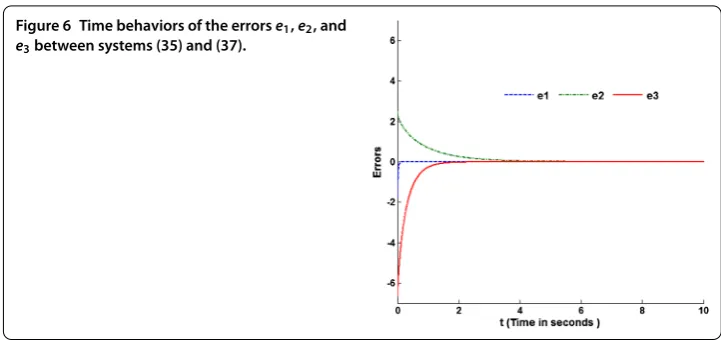
Figure 6 Time behaviors of the errorse1,e2, and
e3between systems (35) and (37).
indicating that synchronization is successfully achieved between systems (35) and (37). The error system can be described as follows:
⎧ ⎪ ⎪ ⎨ ⎪ ⎪ ⎩
D0.94e1= –36e1, D0.96e2= –e2,
D0.97e3= –3e3.
(45)
The fractional Euler integration method has been used to numerically solve systems (35) and (37) with control inputs given by (44). The initial values for the master and slave sys-tems are [x1(0),x2(0),x3(0)] = [0.2, 0.5, 0.3] and [y1(0),y2(0),y3(0),y4(0)] = [2, –2, 1, –1], re-spectively. Based on (40), the initial states of the error system (45) are [e1(0),e2(0),e3(0)] = [–1.8, 2.5, –6.7]. The time behaviors of the errors ei (i= 1, 2, 3) are shown in Figure 6, clearly indicating that synchronization is effectively achieved between systems (35) and (37). Specifically, by considering the errors in (40) it can be concluded thatidentical syn-chronization (IS), antiphase synchronization(AS), and inverse full state hybrid projec-tive synchronization (IFSHPS) coexist when synchronizing the chaotic fractional-order incommensurate Lü system (35) and the hyperchaotic fractional-order incommensurate Lorenz system (37).
6 Discussion
The aim of this section is to highlight the novelty introduced by the present approach. First of all, it is worth analyzing the results achieved so far in the literature on the same topic, that is, the coexistence of some synchronization types in different dimensional fractional-order chaotic systems. This topic is almost unexplored in the literature [31, 32]. For example, in [31] the authors have presented a hybrid synchronization method for fractional-order systems, which is a combination of only two synchronization types, that is, generalized synchronization and inverse generalized synchronization. Our approach is more general than that in [31], since it guarantees the coexistence of three different synchronization types, that is,identical synchronization(IS),antiphase synchronization
ap-plied to incommensurate systems, besides the fact that it allows the coexistence of only two synchronization types. Our approach is more general than that in [32], since it can be applied to both commensurate and incommensurate systems (see Theorems 3 and 4, respectively), besides the fact that it guarantees the coexistence of three different synchro-nization types (instead of only two, as in [32]).
Based on previous considerations, it should be clear that the method proposed herein provides a contribution to the topic related to the coexistence of some fractional syn-chronization types, since it guarantees the coexistence of three different synsyn-chronization types for both commensurate and incommensurate fractional-order systems of different dimensions and different orders. This increased complexity related to both the number of synchronization types and the capability to synchronize chaotic dynamics with hyper-chaotic ones and provides a deeper insight into the synchronization phenomena between systems described by fractional differential equations.
7 Conclusions
In this paper, we have presented a new approach to rigorously study the coexistence of some synchronization types between fractional-order chaotic systems characterizedby different dimensionsanddifferent orders. The paper has shown thatidentical synchro-nization(IS),antiphase synchronization(AS), andinverse full state hybrid projective syn-chronization(IFSHPS) coexist when synchronizing a three-dimensional master system with a fourth-dimensional slave system. It has been shown that the approach presents the remarkable feature of being both rigorous and applicable to a wide class of commensu-rate and incommensucommensu-rate systems of different dimensions and orders. All the numerical examples reported through the paper have clearly highlighted the capability of the pro-posed approach in successfully achieving the co-existence ofIS,AS, andIFSHPSbetween chaotic and hyperchaotic systems of different dimensions for both commensurate and in-commensurate fractional-order systems. These examples of coexistence have included the chaotic commensurate three-dimensional Rössler system of order 2.7, the hyperchaotic commensurate four-dimensional Chen system of order 3.84, the chaotic incommensurate three-dimensional Lü system of order 2.955, and the hyperchaotic incommensurate four-dimensional Lorenz system of order 3.86. Finally, we would stress that the topic related to the coexistence of synchronization types in fractional-order systems is almost unex-plored in the literature. We feel that the additional features introduced by the conceived approach, related to both the number of coexisting synchronization types and the capa-bility to synchronize chaotic dynamics with hyperchaotic ones, provides a deeper insight into the synchronization phenomena between systems described by fractional differential equations.
Acknowledgements
The authors acknowledge Prof. GuanRong Chen, Department of Electronic Engineering, City University of Hong Kong, for suggesting many helpful references.
Funding
The author Xiong Wang was supported by the National Natural Science Foundation of China (No. 61601306) and Shenzhen Overseas High Level Talent Peacock Project Fund (No. 20150215145C).
Competing interests
Authors’ contributions
AO and VTP suggested the model. AO, XW, VTP, GG, and TZ helped in results interpretation and manuscript evaluation. XW, GG, and TZ helped to evaluate, revise, and edit the manuscript. XW, GG, and TZ supervised the development of work. AO and VTP drafted the article. All authors read and approved the final manuscript.
Author details
1Department of Mathematics, University of Larbi Tebessi, Tebessa, Algeria.2Institute for Advanced Study, Shenzhen
University, Shenzhen, China.3Modeling Evolutionary Algorithms Simulation and Artificial Intelligent, Faculty of Electrical & Electronics Engineering, Ton Duc Thang University, Ho Chi Minh City, Vietnam. 4Dipartimento Ingegneria Innovazione, Università del Salento, Lecce, Italy.5Department of Material Sciences, University of Tebessa, Tebessa, Algeria.
Publisher’s Note
Springer Nature remains neutral with regard to jurisdictional claims in published maps and institutional affiliations.
Received: 29 September 2017 Accepted: 12 January 2018
References
1. Carroll, TL, Pecora, LM: Synchronizing chaotic circuits. IEEE Trans. Circuits Syst.38(4), 453-456 (1991)
2. Wen, G, Grassi, G, Feng, Z, Liu, X: Special issue on advances in nonlinear dynamics and control. J. Franklin Inst.352(8), 2985-2986 (2015)
3. Wang, XF, Chen, GR: Synchronization in small-world dynamical networks. Int. J. Bifurc. Chaos12, 187-192 (2002) 4. Cao, JD, Li, HX, Ho, DWC: Synchronization criteria of Lur’s systems with time-delay feedback control. Chaos Solitons
Fractals23, 1285-1298 (2005)
5. He, WL, Qian, F, Cao, JD, Han, QL: Impulsive synchronization of two nonidentical chaotic systems with time-varying delay. Phys. Lett. A375, 498-504 (2011)
6. Pourdehi, S, Karimaghaee, P, Karimipour, D: Adaptive controller design for lag-synchronization of two non-identical time-delayed chaotic systems with unknown parameters. Phys. Lett. A375, 1769-1778 (2011)
7. Rehan, M: Synchronization and anti-synchronization of chaotic oscillators under input saturation. Appl. Math. Model.
37, 6829-6837 (2013)
8. Wu, A: Hyperchaos synchronization of memristor oscillator system via combination scheme. Adv. Differ. Equ.2014, 86 (2014)
9. Pecora, LM, Carroll, TL: Synchronization of chaotic circuits. Chaos25, 097611 (2015)
10. Abrams, DM, Pecora, LM, Motter, AE: Introduction to focus issue - patterns of network synchronization. Chaos26, 094601 (2016)
11. Manieri, R, Rehacek, J: Projective synchronization in three-dimensional chaotic systems. Phys. Rev. Lett.82(15), 3042-3045 (1999)
12. Hu, M, Xu, Z, Zhang, R: Full state hybrid projective synchronization in continuous-time chaotic (hyperchaotic) systems. Commun. Nonlinear Sci. Numer. Simul.13(2), 456-464 (2008)
13. Ouannas, A, Grassi, G: Inverse full state hybrid projective synchronization for chaotic maps with different dimensions. Chin. Phys. B25(9), 090503 (2016)
14. Ouannas, A, Azar, AT, Ziar, T: On inverse full state hybrid function projective synchronization for continuous-time chaotic dynamical systems with arbitrary dimensions. Differ. Equ. Dyn. Syst. (2017).
https://doi.org/10.1007/s12591-017-0362-x
15. Ouannas, A, Grassi, G: A new approach to study the coexistence of some synchronization types between chaotic maps with different dimensions. Nonlinear Dyn.86(2), 1319-1328 (2016)
16. Ouannas, A: Co-existence of various synchronization-types in hyperchaotic maps. Nonlinear Dyn. Syst. Theory16(3), 312-321 (2016)
17. Ouannas, A, Azar, AT, Vaidyanathan, S: New hybrid synchronization schemes based on coexistence of various types of synchronization between master-slave hyperchaotic systems. Int. J. Comput. Appl. Technol.55(2), 112-120 (2017) 18. Pinto, CMA: Strange dynamics in a fractional derivative of complex-order network of chaotic oscillators. Int. J. Bifurc.
Chaos25(1), 1550003 (2015)
19. Ugurlu, E, Baleanu, D, Tas, K: Regular fractional differential equations in the Sobolev space. Fract. Calc. Appl. Anal. (2017). https://doi.org/10.1515/fca-2017-0041
20. Cafagna, D, Grassi, G: On the simplest fractional-order memristor-based chaotic system. Nonlinear Dyn.70(2), 1185-1197 (2012)
21. Cafagna, D, Grassi, G: Fractional-order systems without equilibria: the first example of hyperchaos and its application to synchronization. Chin. Phys. B24(8), 080502 (2015)
22. Grigorenko, I, Grigorenko, E: Chaotic dynamics of the fractional Lorenz system. Phys. Rev. Lett.91, 034101 (2003) 23. Li, CP, Deng, WH, Xu, D: Chaos synchronization of the Chua system with a fractional order. Physica A360, 171-185
(2006)
24. Li, C, Chen, G: Chaos and hyperchaos in fractional order Rössler equations. Physica A341, 55-61 (2004) 25. Lu, JG, Chen, G: A note on the fractional-order Chen system. Chaos Solitons Fractals27, 685-688 (2006) 26. Deng, WH, Li, CP: Chaos synchronization of the fractional Lü system. Physica A353, 61-72 (2005)
27. Wu, GC, Baleanu, D, Huang, LL: Chaos synchronization of the fractional Rucklidge system based on new Adomian polynomials. J. Appl. Nonlinear Dyn. (2017). https://doi.org/10.5890/JAND.2017.09.006
28. Ouannas, A, Al-sawalha, MM, Ziar, T: Fractional chaos synchronization schemes for different dimensional systems with non-identical fractional-orders via two scaling matrices. Optik127(20), 8410-8418 (2016)
29. Ouannas, A, Grassi, G, Ziar, T, Odibat, Z: On a function projective synchronization scheme for non-identical fractional-order chaotic (hyperchaotic) systems with different dimensions and orders. Optik136, 513-523 (2017) 30. Ouannas, A, Abdelmalek, S, Bendoukha, S: Coexistence of some chaos synchronization types in fractional-order
31. Ouannas, A, Azar, AT, Vaidyanathan, S: A robust method for new fractional hybrid chaos synchronization. Math. Methods Appl. Sci.40(5), 1804-1812 (2017)
32. Ouannas, A, Azar, AT, Vaidyanathan, S: A new fractional hybrid chaos synchronization. Int. J. Model. Identif. Control
27(4), 314-323 (2017)
33. Caputo, M: Linear models of dissipation whoseqis almost frequency independent. Geophys. J. R. Astron. Soc.13, 529-539 (1967)
34. Oldham, KB, Spanier, J: The Fractional Calculus. Academic Press, New York (1974) 35. Podlubny, I: Fractional Differential Equations. Academic Press, New York (1999)
36. Samko, SG, Klibas, AA, Marichev, OI: Fractional Integrals and Derivatives: Theory and Applications. Gordon & Breach, Amsterdam (1993)
37. Matignon, D: Stability results of fractional differential equations with applications to control processing. IMACS, IEEE-SMC, Lille, France (1996)
38. Gorenko, R, Mainardi, F: Fractional calculus: integral and differential equations of fractional order. In: Carpinteri, A, Mainardi, F (eds.) Fractals and Fractional Calculus in Continuum Mechanics. Springer, New York (1997) 39. Li, Y, Chen, Y, Podlubny, I: Stability of fractional-order nonlinear dynamic systems: Lyapunov direct method and
generalized Mittag-Leffler stability. Comput. Math. Appl.59, 1810-1821 (2010)
40. Chen, D, Zhang, R, Liu, X, Ma, X: Fractional order Lyapunov stability theorem and its applications in synchronization of complex dynamical networks. Commun. Nonlinear Sci. Numer. Simul.19, 4105-4121 (2014)
41. Li, C, Chen, G: Chaos and hyperchaos in fractional order Rössler equations. Physica A341, 55-61 (2004) 42. Li, T-Z, Wang, Y, Luo, M-K: Control of fractional chaotic and hyperchaotic systems based on a fractional order
controller. Chin. Phys. B23(8), 080501 (2014)
43. Deng, W, Li, C, Lü, J: Stability analysis of linear fractional differential system with multiple time delays. Nonlinear Dyn.