The Hebrew FrameNet Project
Avi Hayoun, Michael Elhadad
Dept. of Computer ScienceBen-Gurion University Beer Sheva, Israel
{hayounav,elhadad}@cs.bgu.ac.il Abstract
We present the Hebrew FrameNet project, describe the development and annotation processes and enumerate the challenges we faced along the way. We have developed semi-automatic tools to help speed the annotation and data collection process. The resource currently covers 167 frames, 3,000 lexical units and about 500 fully annotated sentences. We have started training and testing automatic SRL tools on the seed data.
Keywords:FrameNet, Hebrew, frame semantics, semantic resources
1. Introduction
Recent years have seen growing interest in the task of SemanticRoleLabeling (SRL) of natural language text (sometimes called “shallow semantic parsing”). The task is usually described as the act of identify-ing thesemantic roles, which are the set of semantic properties and relationships defined over constituents of a sentence, given a semantic context.
The creation of resources that document the realiza-tion of semantic roles in natural language texts, such as FrameNet (Fillmore and Baker, 2010; Ruppenhofer et al., 2010) and PropBank (Kingsbury and Palmer, 2002) have advanced the field of semantic analysis no end and have allowed the development of learning algo-rithms for automatically analyzing the semantic struc-ture of text.
Shallow semantic analysis has been shown to con-tribute to the advancement of a wide spectrum of nat-ural language processing tasks, ranging from informa-tion extracinforma-tion (Surdeanu et al., 2003) and quesinforma-tion answering (Shen and Lapata, 2007), to machine trans-lation (Wu and Fung, 2009) and abstractive summa-rization (Melli et al., 2005).
1.1. FrameNet
FrameNet (Fillmore and Baker, 2010; Ruppenhofer et al., 2010) is a human-annotated linguistic resource with rich semantic content based on the linguistic the-ory ofFrame Semanticsproposed by Fillmore (1982). FrameNet defines a formal structure for semantic frames, and various relationships between and within them.
Each frame contains a list of frame-evoking words which also serve as the predicates of events described by the frames. These words are calledFrameEvoking
Elements (FEEs) or LexicalUnits (LUs). Addition-ally, each frame defines a list of event-participants and a list of constraints on and relationships between these participants. The participants are calledFrame
Elements (orFEs).
Finally1, and perhaps most importantly, FrameNet contains human-annotated examples of realizations of
frames and their structures in natural language.
1.2. FrameNet in Other Languages
The original FrameNet project has been adapted and ported to multiple languages. The most active interna-tional FrameNet teams include the Swedish FrameNet (SweFN) covering close to 1,200 frames with 34K LUs (Ahlberg et al., 2014); the Japanese FrameNet (JFN) with 565 frames, 8,500 LUs and 60K annotated ex-ample sentences (Ohara, 2013); and FrameNet Brazil (FN-Br) covering 179 frames, 196 LUs and 12K anno-tated sentences (Torrent and Ellsworth, 2013). Inspired by the ideas developed by the Swedish FrameNet++ project (Friberg Heppin and Voionmaa, 2012) and by Petruck (Petruck, 2005; Petruck, 2009) and Boas (Boas, 2011), we have started the develop-ment of a Hebrew FrameNet, a semi-automatic trans-lation of the English FrameNet.
In this paper, we present this new resource, the meth-ods we used to develop it and the specific linguistic issues we faced while addressing frame annotations in a morphologically rich language like Hebrew.
In the rest of this paper, we first present the linguis-tic resources and supporting infrastructure used as a starting point for the project. We then discuss the process adopted to develop the Hebrew FrameNet re-source, the tools developed, and how we addressed the linguistic issues we faced. Finally, we present the cur-rent state of the project and discuss future work. The project includes a collaborative web-based anno-tation tool2 which supports browsing, annotating and searching the Hebrew FrameNet. We are starting to train and test automatic Hebrew SRL systems on the annotated data that we are collecting.
2.
Starting Points
The Hebrew FrameNet project is built on wide-coverage Hebrew linguistic resources that have been
1The FrameNet resource encodes additional
informa-tion, such as inter-frame relationships and standard lexical patterns of the realization of frames in natural language, but these details are beyond the scope on this paper.
developed in the past 15 years. We rely on the Hebrew lexicon described by Itai and Wintner (2008) and a Hebrew corpus, which contains about 1.75M sentences (an expansion of the Corpus of Contemporary Hebrew (Itai and Wintner, 2008)). We annotated all sentences using current state of the art automatic Hebrew an-notators: a morphological analyzer and disambigua-tor (Adler and Elhadad, 2006; Tsarfaty and Goldberg, 2008), a POS tagger (Goldberg et al., 2008) and a syn-tactic parser (Goldberg and Elhadad, 2010). As part of this annotation effort, we used the Hebrew POS tagset (Netzer et al., 2007; Adler et al., 2008) together with this toolset (see Section 4.3.).
3.
Development and Annotation
Processes
Following the ideas of and initial analysis described in (Boas, 2011; Petruck, 2005; Petruck, 2009), we used the English FrameNet (version1.5.1) as a basis to cre-ate the Hebrew project. We use the semantic frames as found in the original FrameNet, including definitions, participant roles, inter-role and inter-frame relation-ships as a language neutral pivot representation. We describe the key design decisions we have adopted:
1. which frames to annotate;
2. how to select lexical units;
3. how to select exemplar sentences for each frame;
4. how to adapt the annotation to the specific He-brew rich morphology configurations.
3.1. Initial Frame Selection
Two options have been considered in the past for se-lecting an initial subset of candidate frames for annota-tion: domain-based selection (Candito et al., 2014) and based selection. We opted for the frequency-based approach - aiming for large coverage.
We selected a subset of 200 of the most frequently used frames as candidates for annotation. We esti-mated frame frequency by inspecting the top 5K most commonly used words in contemporary American En-glish3. We then searched FrameNet for frames in which the most popular words participate as lexical units (LUs). This is obviously a noisy process but provides a basis for ranking.
The decision to use English word-frequency, as opposed to Hebrew word-frequency, was a practical one, driven by three main factors:
1. The English data is readily available in the form of the FrameNet database itself.
2. Selecting the most frequent Hebrew words and mapping them to English LUs and frames is a much slower manual process; it is sometimes very difficult to disambiguate similar frames. For ex-ample, should say.v be an LU of the Frame
3As reported in the Word Frequency Data corpushttp:
//www.wordfrequency.info/free.asp(Davies, 2010)
Spelling_and_pronouncing, the frame
Com-municationor both?
3. Mapping words directly to Hebrew frames may have resulted in a sparse dataset, meaning we would have many frames with few LUs, as opposed to a smaller set of complete frames.
To verify that the frame frequency we estimated in the English FrameNet corresponds to similar coverage in contemporary Hebrew, we estimated the coverage of our corpus by the LUs of the selected English frames. We found a coverage of roughly 66%, sufficient to val-idate this approach.
3.2. Lexical Unit Selection
As neither the English FrameNet project nor the He-brew lexicon we use contain word sense information4, there was no direct way of automatically mapping En-glish LUs to corresponding Hebrew terms.
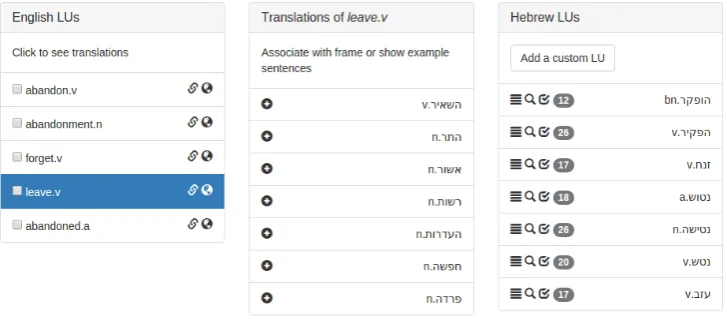
To accelerate the manual process of adding Hebrew LUs to frames, we collected nearly 49K translation pairs for most lexical units occurring in the English FrameNet from online lexicographic resources. We then introduced lookup procedures as part of the on-line annotation tool we developed for the project (see Figure 1).
In order to populate a given frame with Hebrew LUs, annotators may select an English LU, for which our system suggests the available translations, and select the most appropriate translation. This translation pair selection is stored as a form of word sense disambigua-tion in the system. Addidisambigua-tionally, annotators can add as LUs words which were not found in the translation suggestions as they see fit.
3.3. Exemplar Sentence Selection
The next step in the annotation process is the selection of exemplar sentences per LU for each frame.
To assist in this step, we prepared a corpus of 1.75M sentences collected from a variety of Modern Hebrew sources (newspapers, blogs, Wikipedia, medical re-sources) and pre-processed these sentences with auto-matic full morphological analysis and autoauto-matic syn-tactic parsing, as described in Section 2..
Annotators can access this annotated corpus from the Hebrew FrameNet annotation tool through a full text search interface, where annotators can search for lex-ical items irrespective of morphologlex-ical inflection and refine the query by specifying part of speech, morpho-logical features (number, gender, person etc.), and syn-tactic context (e.g., word appearing as the subject of a specific verb).
We apply the syntactic diversification algorithm of Borin et al. (2012) to the search result set, so that the top N sentences presented to each annotator ex-hibit a wide range of syntactic constructs and lexical items, allowing annotators to quickly create a range of syntactic examples for a single semantic concept.
4FrameNet LUs do have definitions, but they are not
Figure 1: A list of automatic translations of the LUleave.v suggested as LUs for the Hebrew implementation of theAbandonmentframe.
3.4. Exemplar Sentence Annotation
The final stage in the annotation process of a single Frame consists of annotating occurrences of frame el-ements with their roles within the selected exemplar sentences (see Figure 2).
While the exemplar sentences are annotated with syn-tactic information, we do not rely on this structure at the semantic annotation stage, as this information is added automatically, and is not reliable enough. As a result, our annotators must select spans of text to fill the various roles encoded in the semantic frame definition, as opposed to annotating syntactic struc-tures, a method employed by some other projects (Erk et al., 2003; Candito et al., 2014). We are planning to compare the annotation decisions made during manual annotation with the spans predicted by the automatic parsing tools and present this information as a review-ing / quality control tool in the future.
4. Hebrew-Specific Issues
We identified the following issues specific to Hebrew in our initial annotation effort.
4.1. Multi-word Lexical Units
The English FrameNet project contains several multi-word LUs (MWLUs), such as give up.vand turn in.v, which are annotated as contiguous units. In Hebrew, we found many complex morphological and syntactic
variants of MWLUs. For example, while
ער לזמ mazal ra bad luck
is a contiguous unit, the LU
רשק רצי yatzar kesher
contacted
in both
of the following sentences illustrates the wide range of discontinuous constructions we observed:
1. ודוד dudu David
רשק רצי yatzar kesher
contacted
םירזייח םע im chayzarim
aliens .
2. אוה
hu He
רשק םתיא רצי yatzar itam kesher
contacted them
90-ה תונשב be’shnot ha-90
in the ’90s .
We decided to enable annotation of discontinuous units - but distinguish between LUs that must appear as contiguous (marked by a binary flag in the multi-word LU) and those that can be broken apart.
4.2. Role-Bearing Phrases Embedded in
Morphology
Due to the rich morphology of Hebrew, a role-bearing phrase can be embedded as a morpheme in another word in the text. For example, consider this sentence from theIngestionframe:
יתלכא akhalti
I ate
חופת tapuach an apple
.
If the first-person singular pronoun suffix ית in the wordיתלכאwere a separate token, the correct annota-tion would be:
לכא akhal
Ate [
ית ti I
Ingestor] [
חופת tapuach an apple
In-gestibles]. ��� ��
The Agent is instead embedded in another token, since the subject is actually realized as a morpheme of the verb. This issue is somewhat similar to that of compound words in Swedish (Heppin and Gronos-taj, 2012). In Hebrew, however, the compounding of role-bearing elements is limited to pronouns, and more closely resembles the same issue in Spanish, Italian and some other Latin-derived languages.
As a result, instead of adding an extra annotation layer5, like in the SweFN project, we decided to fol-lowed Petruck’s recommendation; borrowing from the Spanish FrameNet project, we annotate such roles as “externally constructionally null instantiated” (ECNI) (Subirats, 2009).
lim-Figure 2: An exemplar sentence for the LU v.לכא achal ate.v
in the frame Ingestion.
4.3. What Units can Evoke Frames: POS
Tagset
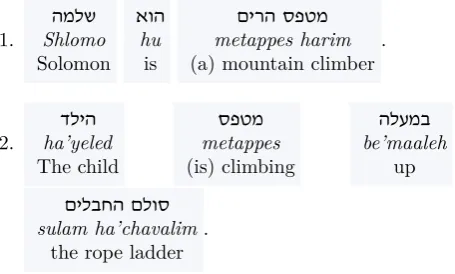
Traditionally, verbs, nouns, adjectives and preposi-tions are considered as candidate LUs (Fillmore et al., 2002). However, as discussed by Adler et al. (2008), part-of-speech tagsets must sometimes be modified for different languages. In the case of Hebrew, we use the Beinoni tag, which occupies a middle place between noun and verb and is most closely related to particip-ial forms. From a semantic point of view, according to traditional descriptions, Hebrew Beinoni forms do not denote a fixed state, but activities, in contrast to nouns and adjectives. As an example, consider the dif-ference between the semantic information carried by the wordספטמ in the following sentences:
1.
המלש Shlomo Solomon
אוה hu
is
םירה ספטמ metappes harim (a) mountain climber
.
2.
דליה ha’yeled The child
ספטמ metappes (is) climbing
הלעמב be’maaleh
up
םילבחה םלוס sulam ha’chavalim
the rope ladder .
We distinguish between these two usages of the word, and annotate the predicate-denoting form as Beinoni - and thus as a frame-evoking lexical unit.
4.4. Word Segmentation
Due to word formation rules in Hebrew, word segmen-tation is a difficult task (Goldberg and Elhadad, 2013). For example, the word לצב is ambiguous and can be
ited to verbs, we are likely to add additional annotation layers in the future and adapt annotation practices more similar to those of SweFN.
read either as a single word (onion) or two (לצ-בin the shade). As part of our pre-processing pipeline, we use Goldberg and Elhadad’s text segmentation method, which achieves about 94% accuracy on the data we evaluated. To address the potential errors in annota-tion, we enable manual annotation of text spans that fall within a single sequence of non-space letters.
5. Semi-Supervised Dataset Expansion
Fürstenau and Lapata (2012) presented a semi-supervised method for automatically expanding the FrameNet corpus, using structural alignment of dependency-parse trees. They reported a success rate of approximately 33% of the projected annotations as completely correct. We implemented this algorithm in the Hebrew FrameNet tool to assist annotators; man-ual annotations are used to seed automatic annotations of candidate sentences from the Hebrew Wikipedia. We computed Word2Vec word embeddings on the He-brew corpus, taking into account syntactic relations in the dependency trees as opposed to n-grams following (Levy and Goldberg, 2014). Candidate sentences are extracted using a lexical similarity measure, based on the computed word embeddings.The rate of fully accurate annotation projections in our pipeline is∼10%, much lower than the reported statis-tics in the English setting. Due to the relatively low accuracy of the automatic projection method, the pro-jected annotations are manually reviewed before being accepted into the Hebrew FrameNet corpus.
5.1. Error Analysis
An additional issue uncovered is that of word am-biguity. Some LUs are highly ambiguous in our Hebrew dataset. Since the alignment method con-siders lexical similarity to be twice as important as syntactic similarity, such ambiguity often leads to a high rate of false positives in the resulting pro-jected annotations. A good example of this is the LU
הלע Ala boarded
in theBoard_vehicleframe. In addition
to “boarded”, this word can also mean either “climbed” or “immigrated”. This ambiguity results in projec-tions of Board_vehicle annotations onto sentences which should be tagged as examples of another frames, such asChange_position_on_a_scale(of which
climb.v is an LU).
We are in the process of testing various ideas to im-prove the results of this method by addressing the is-sues found in the error analysis. Bases on the success in the English setting, we expect it to significantly ac-celerate the annotation effort in the future.
6.
Software Tools and Infrastructure
As in other FrameNet projects, openness is a driv-ing principle which influences architectural decisions (Forsberg, 2011). Accordingly we used freely available software tools and linguistic resources and published a well-documented API to access the Hebrew FrameNet. Our semantic annotation data is stored in a Mon-goDB6database, while our corpus, along with all mor-phological and syntactic data are stored in an Elastic-Search7 cluster. The annotation tool is built on mod-ern web technologies and is accessible through a REST API endpoint.Additionally, the full annotation process, from the as-signment of LUs to frames to the final annotation of exemplar sentences, is recorded in our database, while the annotation decisions are all subject to a review stage, before being finalized in a collaborative process.
7.
Project Status and Future work
7.1. Project Status
As of October 2015, Hebrew FrameNet contains 3K LUs across167frames, with an average of18LUs per frame.
Of the 3K LUs, 43% are verbs, 46% are nouns, 7% are adjectives, 2% are adverbs. The final 2% are filled by other POS types (modal, copula, etc.).
There are423annotated exemplar sentences across66 LUs, with an average of6.41sentences per LU. Before starting a more intense annotation campaign, we are now reviewing the linguistic issues faced during the initial annotation trial and assessing the potential to speed up annotation with semi-supervised expansion.
6https://www.mongodb.org/
7https://www.elastic.co/products/elasticsearch
7.2. Future Work
This work provides a basis on which an automatic SRL system for the Hebrew language can be constructed. We are investigating the current state-of-the-art En-glish SRL system (Roth and Lapata, 2015) as a start-ing point.
We are planning to apply the ideas put forth by Boas (2005) as a form of evaluation for automatic SRL sys-tems in multiple languages. We use an aligned Hebrew-English corpus and estimate the accuracy of an auto-matic annotator by comparing the annotations of an English SRL system with those produced by the He-brew system. The HeHe-brew annotation is deemed cor-rect when we verify that the same frames are identified across the English and Hebrew sides of an aligned sen-tence pair, and that the assigned roles can be aligned across languages using lexical alignment methods. We have collected an additional 600K sentence pairs over the corpus of Tsvetkov and Wintner (2012) and pre-pared a syntactically annotated version of this cor-pus. We are also investigating whether presenting such aligned sentences as part of the manual annotation process helps in the annotation process.
8.
Conclusion
We presented the development process and the cur-rent status of the Hebrew FrameNet project. Us-ing the Berkeley FrameNet as a basis and adoptUs-ing a frequency-based approach to annotation, we are on our way to constructing a frame-semantic lexicon for the Hebrew language and assessing how this resource can be used to develop automatic SRL tools for Hebrew.
References
Adler, M. and Elhadad, M. (2006). An unsuper-vised morpheme-based hmm for hebrew morpholog-ical disambiguation. In Proceedings of the 21st In-ternational Conference on Computational Linguistics and the 44th annual meeting of the Association for Computational Linguistics, pages 665–672. Associa-tion for ComputaAssocia-tional Linguistics.
Adler, M., Netzer, Y. D., Goldberg, Y., Gabay, D., and Elhadad, M. (2008). Tagging a hebrew corpus: the case of participles. InLREC. Citeseer.
Ahlberg, M., Borin, L., Dannélls, D., Forsberg, M., Toporowska Gronostaj, M., Friberg Heppin, K., Jo-hansson, R., Kokkinakis, D., Olsson, L.-J., and Upp-ström, J. (2014). Swedish framenet++ the beginning of the end and the end of the beginning.
Boas, H. C. (2005). Semantic frames as interlingual representations for multilingual lexical databases. In-ternational Journal of Lexicography, 18(4):445–478.
Borin, L., Forsberg, M., Heppin, K. F., Johansson, R., and Kjellandsson, A. (2012). Search result diver-sification methods to assist lexicographers. In Pro-ceedings of the Sixth Linguistic Annotation Workshop, pages 113–117. Association for Computational Lin-guistics.
Candito, M., Amsili, P., Barque, L., Benamara Zi-toune, F., De Chalendar, G., Djemaa, M., Haas, P., Huyghe, R., Yannick Mathieu, Y., Muller, P., et al. (2014). Developing a french framenet: Methodology and first results.
Davies, M. (2010). The corpus of contemporary amer-ican english as the first reliable monitor corpus of en-glish. Literary and Linguistic Computing, 25(4):447– 464.
Erk, K., Kowalski, A., and Pado, S. (2003). The salsa annotation tool. InProceedings of the Workshop on Prospects and Advances in the Syntax/Semantics Interface, pages 1–4. Citeseer.
Fillmore, C. J. and Baker, C. (2010). A frames ap-proach to semantic analysis. The Oxford handbook of linguistic analysis, pages 313–339.
Fillmore, C. J., Baker, C. F., and Sato, H. (2002). The framenet database and software tools. InLREC.
Fillmore, C. J., (1982). Frame semantics, pages 111– 137. Hanshin Publishing Co., Seoul, South Korea.
Forsberg, M. (2011). Green resources in plain sight: opening up the swefn++ project. NEALT PRO-CEEDINGS SERIES VOL. 13, page 7.
Friberg Heppin, K. and Voionmaa, K. (2012). Practical aspects of transferring the english berke-ley framenet to other languages. In SLTC 2012 The Fourth Swedish Language Technology Conference Lund, October 24-26, 2012 Proceedings of the Con-ference, pages 28–29.
Fürstenau, H. and Lapata, M. (2012). Semi-supervised semantic role labeling via structural align-ment. Comput. Linguist., 38(1):135–171, March.
Goldberg, Y. and Elhadad, M. (2010). An efficient algorithm for easy-first non-directional dependency parsing. InHuman Language Technologies: The 2010 Annual Conference of the North American Chapter of the Association for Computational Linguistics, pages 742–750. Association for Computational Linguistics.
Goldberg, Y. and Elhadad, M. (2013). Word segmen-tation, unknown-word resolution, and morphological agreement in a hebrew parsing system.Comput. Lin-guist., 39(1):121–160, March.
Goldberg, Y., Adler, M., and Elhadad, M. (2008). Em can find pretty good hmm pos-taggers (when given a good start). InACL, pages 746–754.
Heppin, K. F. and Gronostaj, M. T. (2012). The rocky road towards a swedish framenet-creating swefn. InLREC, pages 256–261.
Itai, A. and Wintner, S. (2008). Language resources for hebrew. Language Resources and Evaluation, 42(1):75–98.
Kingsbury, P. and Palmer, M. (2002). From treebank to propbank. InIn Language Resources and Evalua-tion.
Levy, O. and Goldberg, Y. (2014). Dependencybased word embeddings. In Proceedings of the 52nd An-nual Meeting of the Association for Computational Linguistics, volume 2, pages 302–308.
Melli, G., Wang, Y., Liu, Y., Kashani, M. M., Shi, Z., Gu, B., Sarkar, A., and Popowich, F. (2005). Descrip-tion of squash, the sfu quesDescrip-tion answering summary handler for the duc-2005 summarization task. safety, 1:14345754.
Netzer, Y., Adler, M., Gabay, D., and Elhadad, M. (2007). Can you tag the modal? you should. In Proceedings of the 2007 Workshop on Computational Approaches to Semitic Languages: Common Issues and Resources, pages 57–64. Association for Compu-tational Linguistics.
Ohara, K. (2013). Toward constructicon building for japanese in japanese framenet. Veredas: Frame Se-mantics and Its Technological Applications, 17(1):11– 28.
Petruck, M. R. (2005). Towards hebrew framenet. Kernerman Dictionary News, 13:12.
Petruck, M., (2009). Typological Considerations in constructing a Hebrew FrameNet, pages 183–208. Mouton de Gruyter, Berlin.
Roth, M. and Lapata, M. (2015). Context-aware frame-semantic role labeling. Transactions of the As-sociation for Computational Linguistics, 3:449–460.
Ruppenhofer, J., Ellsworth, M., Petruck, M. R. L., Johnson, C. R., and Scheffczyk, J. (2010). FrameNet II: Extended Theory and Practice. Technical report, International Computer Science Institute in Berkeley, 09.
Shen, D. and Lapata, M. (2007). Using semantic roles to improve question answering. In EMNLP-CoNLL, pages 12–21.
Subirats, C. (2009). Spanish framenet: A frame-semantic analysis of the spanish lexicon. Multilingual FrameNets in Computational Lexicography. Methods and Applications, Mouton de Gruyter, Berlin/New York, pages 135–162.
the 41st Annual Meeting on Association for Computa-tional Linguistics-Volume 1, pages 8–15. Association for Computational Linguistics.
Torrent, T. T. and Ellsworth, M. (2013). Behind the labels: criteria for defining analytical categories in framenet brasil.Veredas: Frame Semantics and Its Technological Applications, 17(1):44–65.
Tsarfaty, R. and Goldberg, Y. (2008). Word-based or morpheme-based? annotation strategies for modern hebrew clitics. InLREC.
Tsvetkov, Y. and Wintner, S. (2012). Extraction of multi-word expressions from small parallel corpora. Natural Language Engineering, 18(04):549–573.