Particle Filtering Equalization Method for a Satellite
Communication Channel
St ´ephane S ´en ´ecal
The Institute of Statistical Mathematics, 4-6-7 Minami Azabu, Minato-ku, Tokyo 106-8569, Japan Email:[email protected]
Pierre-Olivier Amblard
Groupe Non Lin´eaire, Laboratoire des Images et des Signaux (LIS), ENSIEG, BP 46, 38402 Saint Martin d’H`eres Cedex, France Email:[email protected]
Laurent Cavazzana
´
Ecole Nationale Sup´erieure d’Informatique et de Math´ematiques Appliqu´ees de Grenoble (ENSIMAG), BP 72, 38402 Saint Martin d’H`eres Cedex, France
Email:[email protected]
Received 23 April 2003; Revised 23 March 2004
We propose the use of particle filtering techniques and Monte Carlo methods to tackle the in-line and blind equalization of a satellite communication channel. The main difficulties encountered are the nonlinear distortions caused by the amplifier stage in the satellite. Several processing methods manage to take into account these nonlinearities but they require the knowledge of a training input sequence for updating the equalizer parameters. Blind equalization methods also exist but they require a Volterra modelization of the system which is not suited for equalization purpose for the present model. The aim of the method proposed in the paper is also to blindly restore the emitted message. To reach this goal, a Bayesian point of view is adopted.Priorknowledge of the emitted symbols and of the nonlinear amplification model, as well as the information available from the received signal, is jointly used by considering theposteriordistribution of the input sequence. Such a probability distribution is very difficult to study and thus motivates the implementation of Monte Carlo simulation methods. The presentation of the equalization method is cut into two parts. The first part solves the problem for a simplified model, focusing on the nonlinearities of the model. The second part deals with the complete model, using sampling approaches previously developed. The algorithms are illustrated and their performance is evaluated using bit error rate versus signal-to-noise ratio curves.
Keywords and phrases:traveling-wave-tube amplifier, Bayesian inference, Monte Carlo estimation method, sequential simulation, particle filtering.
1. INTRODUCTION
Telecommunication has been taking on increasing impor-tance in the past decades and thus led to the use of satellite-based means for transmitting information. A major imple-mentation task to deal with such an approach is the atten-uation of emitted communication signals during their trip through the atmosphere. Indeed, one of the most important roles devoted to telecommunication satellites is to amplify the received signal before sending it back to Earth. Severe technical constraints, due to the lack of space and energy available on board, can be solved thanks to special devices, namely, traveling-wave-tube (TWT) amplifiers [1]. A com-mon model for such a satellite transmission chain is depicted inFigure 1.
Although efficient for amplifying tasks, TWT devices suf-fer from nonlinear behaviors in their characteristics, thus im-plying complex modeling and processing methods for equal-izing the transmission channel.
The very first approaches for solving the equalization problem of models similar to the one depicted in Figure 1
Emitted signal e(t) Emission filter
Emission noise ne(t)
Satellite Input
multiplexing TWTA
Output multiplexing
Multipath fading channel
Reception noise nr(t)
Received signal r(t) Figure1: Satellite communication channel.
e(t)
Transmission chain r(t)
Volterra filter rˆ(t) + −
LMS
Figure2: Identification of the model depicted inFigure 1with a Volterra filter.
Blind equalization methods have thus to be considered. These methods often need precise hypothesis with the emit-ted signals: Gaussianity or circularity properties of the proba-bility density function of the signal, for instance [7]. Recently, some methods make it possible to identify [8] or equalize [9,10,11] blindly nonlinear communication channels un-der general hypothesis. These blind equalization methods as-sume that the transfer function of the system can be modeled as a Volterra filter [12,13].
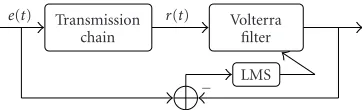
However, for the transmission model considered here, a Volterra modelization happens to be only suitable for the task of identification and not for a direct equalization. For instance, a method based on a Volterra modelization of the TWT amplifier and a Viterbi algorithm at the receiver stage is considered in [14]. Such an identification method can be easily implemented through a recursive adaptation rule of the filter parameters with a least mean squares approach (cf.
Figure 2). The mean of the quadratic error (straight line) and its standard deviation (dotted lines) are depicted inFigure 3
for 100 realizations of binary phase shift keying (BPSK) sym-bol sequences, each composed of 200 samples. Similarly, the equalization problem of the transmission chain 1 can be con-sidered with a Volterra filter scheme, adapted with a recursive least squares algorithm as depicted inFigure 4. However, in
5 4.5 4 3.5 3 2.5 2 1.5 1 0.5 0
0 20 40 60 80 100 120 140 160 180 200 Time index
Quadr
atic
er
ror
Figure3: Identification error, scheme ofFigure 2.
e(t) Transmission chain
r(t) Volterra filter LMS −
Figure 4: Equalization of the model depicted inFigure 1with a Volterra filter.
this case, the error function happens not to converge show-ing that the Volterra filter is unstable and that the system is not invertible with such modelization.
seems interesting to fully exploit the analytical properties of the nonlinearities induced by TWT amplifiers through para-metric models of these devices [1]. Sequential Monte Carlo methods, originally developed for the recursive estimation of nonlinear and/or non-Gaussian state space models [17,18], are well suited for reaching this goal. The field of communi-cation seems to be particularly propitious for applying par-ticle filtering techniques, as shown in the recent literature of the signal processing community [15,19] and this issue and of the statistics community (see [20,21], [16, Section 4]). Such Monte Carlo approaches were successfully applied to blind deconvolution [22], equalization of flat-fading chan-nels [23], and phase tracking problems [24], for instance.
The paper is organized as follows. Firstly, models for the emitted signal, the TWT amplification stage, and the other parts of the transmission chain are introduced inSection 2. A procedure for estimating the emitted signal is considered in a Bayesian framework. Monte Carlo estimation techniques are then proposed inSection 3for implementing the com-putation of the estimated signal under the assumption of a simpler communication model, focusing on the nonlinear part of the channel. This approach uses analytical formu-lae of the TWT amplifier model described inSection 2and sampling methods for estimating integral expressions. The method is then generalized inSection 4for building a blind and recursive equalization scheme of the complete transmis-sion chain. The sequential simulation algorithm proposed is based on particle filtering techniques. This approach makes it possible to process the data in-line and without the help of a learning input sequence. The performance of the algo-rithm is illustrated by numerical experiments in Section 5. Finally, some conclusions are drawn inSection 6. Details of the Monte Carlo approach are given inAppendix A.
2. MODELING OF THE TRANSMISSION MODEL
The model of the satellite communication channel depicted inFigure 1is roughly the same as the one considered for var-ious problems dealing with TWT amplifiers devices (cf., e.g., [2]). The different stages of this communication channel are detailed below.
2.1. Emission stage
The information signal to transmit is denoted bye(t). It is usually a digital signal composed of a sequence ofNesymbols
(ek)1≤k≤Ne. The signal is transmitted under the analog form
e(t)=
Ne
k=1
ekI[(k−1)T,kT[(t), (1)
whereT denotes the symbol rate andIΩ(·) is the indicator
function of set Ω. Symbolsek are generated from classical
modulations used in the field of digital telecommunication, like PSK or quadratic amplitude modulation (QAM), for in-stance. In the following, the case of 4-QAM symbols is con-sidered. Each symbol can be written as
ek=exp
ıφk
, (2)
where the sequence of samples (φk)1≤k≤Ne is independently and identically distributed from
U{π/4,3π/4,5π/4,7π/4}, (3)
where UΩ denotes the uniform distribution on the setΩ. The signal is emitted through the atmosphere to the satellite. The emission process is modeled by a Chebyshev filter. This class of filters admits an IIR representation and their param-eters, particularly their cutofffrequency, depend on the value of symbol rateT [2]. A detailed introduction to Chebyshev filters is given in [25], for instance. In the present case, the emission filter is assumed to be modeled with a 3 dB band-width equal to 1.66/T. The emitted signal is altered during its trip in the atmosphere by disturbance signals. These phe-nomena are modeled by an additive corrupting noisene(t),
which is assumed to be Gaussianly, independently, and iden-tically distributed:
ne(t)∼NCC
0,σ2
e
, (4)
where NCC0,σ2
e
is a complex circular Gaussian distribu-tion, with zero-mean and variance equal toσ2.
Remark1. The amplitude of signal (1) is adjusted in practice at the emission stage in order to reach a signal-to-noise ratio (SNR) roughly equal to 15 dB during the transmission.
2.2. Amplification
After being received by the satellite, the signal is amplified and sent back to Earth. This amplification stage is processed by a TWT device. A simple model for TWT amplifier is an instantaneous nonlinear filter defined by
z=rexp(ıφ)−→Z=A(r) expıφ+Φ(r), (5)
whererdenotes the modulus of input signal. Amplitude gain and phase wrapping can be modeled by the following expres-sions:
A(r)= αar
1 +βar2, (6)
Φ(r)= αpr2 1 +βpr2.
(7)
These formulae have been shown to model various types of TWT amplifier device with accuracy [1]. Figures5and6 rep-resent functions (6) and (7) for two sets of parameters esti-mated in [1, Table 1] from real data and duplicated inTable 1. Curves with straight lines represent functions obtained with the set of parameters of the first row ofTable 1. The ones with dashed lines represent functions obtained with the other set of parameters.
1.2 1 0.8 0.6 0.4 0.2 0
0 0.5 1 1.5 2 2.5 3
Modulus of input signal
A
m
plitude
gain
Figure5: Amplitude gain (6) of TWT models.
1 0.9 0.8 0.7 0.6 0.5 0.4 0.3 0.2 0.1 0
0 0.5 1 1.5 2 2.5 3
Modulus of input signal
Phase
w
ra
pping
Figure6: Phase wrapping (7) of TWT models.
Signal processing in the satellite also performs the task of multiplexing. The devices used for this purpose are modeled by Chebyshev filters. Tuning of their parameters is given in [2], for instance. In the present case, filters at the input and at the output of the amplifier are assumed to have bandwidths equal, respectively, to 2/Tand 3.3/T.
2.3. Reception
The transmission of the signal back to Earth is much less powerful than at the emission stage. This is mainly due to se-vere technical constraints because of the satellite design. The influence of the atmospheric propagation medium is then modeled by a multipath fading channel [26, Section 11], with one reflected path representing an attenuation of 10 dB in this case: z(t) → z(t) +αz(t−∆). Moreover, the signal is still corrupted by disturbance signals, modeled by an additive noise signalnr(t), Gaussianly, independently, and identically
Table1: Parameters of (6) and (7) measured in practice.
αa βa αp βp
2 1 4 9.1
2.2 1.2 2.5 2.8
distributed:
nr(t)∼NCC
0,σ2
r
. (8)
This noise is always much more intense than at the emission stage. This is mainly due to the weak emission power avail-able in the satellite. The received signal, denoted asr(t), is sampled at rateTs.
2.4. Equalization
The goal of equalization is to recover emitted sequence (ek)1≤k≤Ne from the knowledge of sampled sequence (r(jTs))1≤j≤Nr. The equalization method proposed in this paper consists in estimating symbol sequence (φk)1≤k≤Ne by considering itsposteriordistribution conditionally to se-quence (r(jTs))1≤j≤Nrof samples of the received signal:
pφk
1≤k≤Ner
jTs
1≤j≤Nr
. (9)
To reach this goal, a Bayesian estimation procedure is consid-ered with the computation ofmaximum a posteriori(MAP) estimates [27].
Remark2. Bayesian approaches have already been success-fully applied in digital signal processing in the field of mobile communication. In [28], for instance, autoregressive models and discrete-valued signals are considered.
The computation of the estimates is implemented via Monte Carlo simulation methods [16,29]. As the complete transmission chain is a complex system, a simpler model fo-cusing on the nonlinear part of the channel is considered in the following section, where Monte Carlo estimation ap-proaches are introduced. These estimation techniques will be used in the equalization algorithm for the global transmis-sion chain inSection 4.
3. MONTE CARLO ESTIMATION METHODS
As a first approximation, to focus on the nonlinearity of the model, only a TWT amplifier is considered in a transmission channel corrupted with noises at its input and output parts as shown in Figure7.
The received signalr(t) is assumed to be sampled at sym-bol rateT. The problem is then to estimate a 4-QAM sym-bolφa prioridistributed from (3) with the knowledge of the model depicted inFigure 7(cf. relations (4), (6), (7) and (8)), and information of a received sampler. A Bayesian approach is developed [27] by considering theposteriordistribution
e(t)
Figure7: Simple communication channel with TWT amplifier.
and its classical MAP estimate. The method proposed in the following consists in estimating values of distribution (10) thanks to Monte Carlo simulation schemes [29] using re-lations (6) and (7) which model nonlinearities of the TWT amplifier in a parametric manner.
3.1. Estimation with known parameters
In order to further simplify the study, parameters of the transmission channel depicted inFigure 7are firstly assumed to be known. In the sequel, the coefficients of expressions (6) and (7) are denoted by the symbol TWT. This information is taken into account in theposteriordistribution (10) thus becoming
pφA,σe, TWT,σr,r
, (11)
whereAdenotes the amplitude of the emitted signal. From Bayes’ formula, the probability density function of this dis-tribution is proportional to
prA,φ,σe, TWT,σr
×pφA,σe, TWT,σr
. (12)
Thepriordistribution at the right-hand side of the above ex-pression reduced top(φ), which is given by (3). The problem is then to compute the likelihood
prA,φ,σe, TWT,σr
. (13)
Indeed, this formula can be viewed (cf.Appendix A) as the following expectation:
with respect to the random variablex which is Gaussianly distributed:
x∼NCCAexp(ıφ),σ2
e
. (15)
Considering a sequence of samples (x)1≤≤N independently
and identically distributed from (15), a Monte Carlo approx-imation of (14) is given by
which is accurate for a numberNof samples large enough. References [29, 30] provide detailed ideas and references about Monte Carlo methods. To illustrate such an approach, approximation (16) is computed for the emitted symbolφ=
π/4 and the values of TWT amplifier parameters given by
Table2: Estimates of (11), SNRe=10 dB, SNRr =3 dB, 100
real-the first row ofTable 1. AmplitudeAof the emitted signal equals 0.5 and variances of transmission noises are such that SNRe =10 dB and SNRr =3 dB. One hundred realizations
are simulated and, for each, a sequence (15) of 100 samples is considered.Table 2gives mean values obtained from (16) and their standard deviations.
The error of the estimated values (16) of probabilities (11) might seem quite large as the standard deviations can be reduced providing a larger number of samples. In the se-quel, we are only interested in obtaining rough estimates of (11), enabling comparison of mean values for differentφas shown inTable 2. Thus, even with a reduced number of sam-ples (15), it is possible to estimate accurately the MAP esti-mate of (11).
Performance of the Monte Carlo estimation method is then considered with respect to SNR at the input and out-put of the amplifier (cf.Figure 7). The bit error rate (BER) is computed by averaging the results obtained with a MAP approach. Statistics of the Monte Carlo estimates (16) of dis-tribution (11) are computed with 100 realizations of symbol sequences composed of 1, 000 samples each. For each esti-mate, sequences (15) composed of 100 samples are consid-ered. The results of these simulations for SNRe taking
val-ues 10, 12, and 15 dB are depicted in Figure 8 and curves from the bottom to the top are associated to decreasing SNRe.
The Bayesian approach and its Monte Carlo implemen-tation make it possible to estimate the emitted signal with accuracy for a wide range of noise variances (cf. Figure 8). However, the estimation method described previously re-quires the knowledge of the model parameters. For many ap-plications in the field of telecommunication, it is necessary to assume these parameters unknown. It is the case for non-stationary transmission models and for communication in noncooperative contexts like passive listening, for instance. The equalization problem of the simplified model depicted inFigure 7is now tackled in the case where the parameters (A,σe, TWT,σr) of the transmission channel are assumed to
be unknown.
3.2. Estimation with unknown parameters
10−1
10−2
BER
3 4 5 6 7 8 9 10
SNR (dB) SNRe=15 dB
SNRe=12 dB SNRe=10 dB
Figure 8: Mean BER values for MAP estimates of signals ver-sus SNRr in dB, model of Figure 7 with known parameters
(A,σe, TWT,σr), for various SNRevalues.
in dealing with the joint distribution of all the parameters of the model
pφ,A,σe, TWT,σrr
. (17)
This method makes it possible theoretically to jointly esti-mate the emitted symbols and the parameters of the trans-mission channel by implementing MAP and/or posterior mean approaches. The probability density function of dis-tribution (17) being generally very complex, Markov chain Monte Carlo (MCMC) simulation methods [29,30] can be used to perform these estimation tasks. Such an approach is developed in [31] particularly for equalizing the complete transmission chain depicted inFigure 1. However, results ob-tained with this method happen not to give accurate esti-mates of the model parameters in practice. Indeed, MCMC methods are generally useful for estimating various models in the field of telecommunication [28,32].
Another approach consists in considering a marginalized version of distribution (10) with respect to the parameters of the model:
p(φ)=
pφ,A,σe, TWT,σrr
dA,σe, TWT,σr
. (18)
Such a technique, called Rao-Blackwellization in the statistics literature, for example, [33,34], makes it possible to improve the efficiency of sampling schemes (see [20,21], [16, Section 24]). From Bayes’ formula, the integrand of expression (18) is proportional to
prφ,A,σe, TWT,σr
×pφ,A,σe, TWT,σr
. (19)
Assuming that symbols and the model parameters are inde-pendent, expression (18) is proportional to
p(φ)×
prφ,A,σe, TWT,σr
pA,σe, TWT,σr
×dA,σe, TWT,σr
.
(20)
From the study of the previous case, the likelihood term in the integrand can be computed via a Monte Carlo estimate of expression (14) with a sequence of samples (15). An ap-proach to estimate (18) is then to consider the integral ex-pression in (20) as the expectation
Ep(A,σe,TWT,σr)
prφ,A,σe, TWT,σr
(21)
which is estimated via a Monte Carlo approximation of the following form:
1
Np Np
k=1
prφ,Ak,σe(k), TWTk,σr(k)
, (22)
where (Ak,σe(k), TWTk,σr(k))k=1,...,Npis a sequence of sam-ples independently and identically distributed from theprior distribution
pA,σe, TWT,σr
. (23)
Remark3. The algorithm for sampling distribution (17) in-troduced in [31] requires also the setting ofpriordistribution (23).
The model of the parameters includes generallyprior in-formation thanks to physical constraints. For instance, the TWT amplifier is assumed to work in the amplificative part of its characteristic (cf.Figure 5). Thus, as a first rough ap-proximation, it can be assumed thatA∼U[0,1]a priori. This
parameter is also tuned such that SNReequals 15 dB during
the emission process (cf.Remark 1) implying the constraint
σe =0.2A. In a less strict case, it is sufficient to assume that
σe ∼ U[0.01,0.5]. The parameters (αa,βa,αp,βp) of the TWT
amplifier are supposed to be independent of other variables of the system and also to be mutually independent. From the values introduced inTable 1, an adequatepriordistribution is
αa,βa,αp,βp
∼U[1,3]×U[0,2]×U[1,5]×U[2,10]. (24)
The extremal values of the downlink transmission noise vari-anceσrcan be estimated with respect topriorranges of values
defined above. A uniformU[0.1,1.1]priordistribution forσris
Table3: Estimates of (10), SNRe=10 dB, SNRr =3 dB, 100
real-izations.
φ p(φ|r)
π
4 0.61±0.21
3π
4 0.23±0.20
5π
4 0.05±0.03
7π
4 0.12±0.14
SNRe =10 dB and SNRr =3 dB. One hundred estimations
are simulated and for each realization, sequences of 100 sam-ples
Ak,σe(k), TWTk,σr(k)
1≤k≤Np (25)
are drawn from distribution (23). For each sequence, as in the case where the model parameters are known, approxima-tions (16) are computed from sequences (25) composed of 100 samples each.Table 3shows the mean values of the es-timated (22) and their standard deviations computed from these simulations.
As for the previous case, where parameters (A,σe, TWT,
σr) are known, we are only interested in obtaining rough
mean values of Monte Carlo estimates of the MAP expres-sion (10) and thus do not consider larger sample sizes for reducing the standard deviation of these estimates.
Performance of this Monte Carlo estimation method is now considered with respect to uplink and downlink SNR. As previously, BERs are computed by averaging results ob-tained with a MAP approach for the Monte Carlo estimate (22) ofposteriordistribution (10). One hundred realizations of 1 000-symbol sequences are considered for each value of SNR. For every Monte Carlo estimate, sequences (25) and (15) are composed of 100 samples. The results of simulations for SNReequal to 10, 12, and 15 dB are depicted inFigure 9.
Curves from the bottom to the top are associated to a de-creasing uplink SNR. As a comparison, the estimated mean values of BER in the case where the parameters of the TWT amplifier are known are represented with dashed lines.
Performance is not much corrupted in the case where model parameters are unknown. Thus, considering the poste-riordistribution of interest (18), marginalized with respect to these parameters, seems to be a good strategy for tackling the equalization problem. An in-line simulation method based on the Monte Carlo estimation techniques previously devel-oped is proposed hereinafter for realizing the equalization of the complete transmission chain depicted inFigure 1.
4. PARTICLE FILTERING EQUALIZATION METHOD
4.1. Transmission model
Equalizing the complete satellite communication channel de-picted inFigure 1is a difficult problem as it requires taking
10−1
10−2
BER
3 4 5 6 7 8 9 10
SNR (dB) SNRe=10 dB
SNRe=12 dB
SNRe=15 dB
Figure 9: Mean BER values for MAP estimates of signals versus SNRr in dB, model ofFigure 7with unknown/known parameters
(A,σe, TWT,σr) (straight/dashed lines), for various SNRevalues.
into account several phenomena:
(1) effects of the filters modeling, emission, and multi-plexing stages;
(2) attenuation of the received signal mainly due to multi-ple paths during the downlink transmission;
(3) correlation induced by filters and emission and fading models.
An equalization method is proposed for this model within a Bayesian estimation framework [27]. It consists in considering the posteriordistribution of the sampled sym-bols conditionally to the sequence of the received samples:
pejTs
1≤j≤Nrr
jTs
1≤j≤Nr
. (26)
An estimation procedure is then implemented by computing the MAP estimate of distribution (26). Monte Carlo estima-tion methods developed in the previous paragraphs can be slightly modified in order to take into account the parame-ters of the complete transmission chain (cf. points (1) and (2) above).
The correlation of the samples at the receiver stage mainly comes from the linear filters in the channel. In fact, this problem yields to the estimation of parameter p: the number of received samples per symbol rate p = T/Ts, as
parameters of Chebyshev filters at the emission and multi-plexing stages depend on its value.
Computing the correlation of the received samples makes it possible to give an estimate ofp[31] in the case where this quantity is an integer, and thus to estimate the parameters of the filters. In the sequel, we consider that this is the case, assuming that a proper synchronization processing has been performed at the receiver stage. This task can also be achieved via Monte Carlo simulation methods [24]. This parameterp
pt(x)
t
x
t+ 1
Time
Figure10: Formal updating scheme of a particle filter.
An MCMC simulation scheme [29, 30], for the batch processing of received data, was studied in [31]. A sequen-tial simulation method for sampling the distribution (26) is now introduced, as many applications in the field of telecom-munication require in-line processing methods when data is available sequentially.
4.2. Sequential simulation method
A sequential method for sampling distribution (26) can be implemented via particle filtering techniques [15,16]. The wide scope of this approach, originally developed for the re-cursive estimation of nonlinear state space models [17,18,
20,21], is well suited for the sampling task of this equaliza-tion problem. The basic idea of particle filtering is to generate iteratively sequences of the variables of interest, each of them denoted as a “particle,” here written as
x0(i),x1(i),. . .,xt(i)
1≤i≤M (27)
such that particles (xt(1),. . .,xt(M)) at timetare distributed
from the desired distribution, denoted aspt(x). This goal can
be reached with the use of two “tuning factors” in the algo-rithm:
(i) the way the particles are propagated or diffused,
xt(i) → xt+1(i), in the sampling space, namely, the
choice of a proposal or candidate distribution; (ii) the way the distribution of particles (xt(1),. . .,xt(M))
approximates the target distributionpt(x): by affecting
a weightwt(i) to each particle depending on the
pro-posal distribution, and updating these weights with an appropriate recursive scheme.
These two tasks are illustrated inFigure 10, where each “ball” stands for a particulext(i) whose weight is represented by the
length of an associated arrow.
Such recursive simulation algorithm is referred to as se-quential importance sampling or particle filtering in the liter-ature [16,18,20,21] of Monte Carlo methods. A good choice of the candidate distribution generally makes it possible to reduce the computational time of the sampling scheme, as
(1) Initialization. Sampleφ0(i)∼U{π/4,3π/4,5π/4,7π/4},
set the weightsw0(i)=1/Mfori=1,. . .,M, set j=1.
(2) Importance sampling. Diffuse, propagate the particles by drawing
φj(i)∼p
φjφj−1(i)
(28)
fori=1,. . .,M, and actualize the paths
φ0(i),. . .,φj(i)
=φ0(i),. . .,φj−1(i),φj(i)
.
(3) Compute, update the weights
wj(i)=p
rjTechφj(i)
×wj−1(i), (29)
and normalize them:wj(i)=wj(i)/Mk=1wj(k).
(4) Selection/actualization of particles. ResampleM particles (φ0(i),. . .,φj(i)) from the set
(φ0(i),. . .,φj(i))1≤i≤Maccording to their weights
(wj(i))1≤i≤Mand set the weights equal to 1/M.
(5) j← j+ 1 and go to (2).
Algorithm1: Equalization algorithm.
explained in the next paragraph. Such Monte Carlo simula-tion scheme is now proposed to tackle the sequential sam-pling of distribution (26).
4.3. Equalization algorithm
In the present case, phase samplesφj=φ(jTs) of the emitted
signal are directly sampled. The simulation scheme which is considered is the bootstrap filter [15,16,17,18] and is given inAlgorithm 1.
The important sampling and computation steps (28) and (29) are detailed hereinafter.
The information brought by parameterp, number of re-ceived samples per symbol duration, is taken into account via the proposal distribution (28). Indeed, candidates for particlesφj(i) can be naturally sampled from the following
scheme:
(i) Setφj(i)=φj−1(i) with probability 1−1/ p;
(ii) Sampleφj(i)∼U{π/4,3π/4,5π/4,7π/4}with probability 1/ p.
This sampling scheme is very simple and can easily be improved by considering φkp(i) ∼ U{π/4,3π/4,5π/4,7π/4} and
φkp+s(i) = φkp(i) for 1 ≤ k ≤ p−1, for instance.
The computation of weights (29) is realized by using sim-ilar Monte Carlo approaches to the ones introduced previ-ously, including filters and their parameters in expressions (14) and (18). In this respect,Algorithm 1can be seen as a Rao-Blackwellized particle filter [20,21] where the parame-ters of the channel, considered here as nuisance parameparame-ters, are integrated out. This generally helps to lead to more robust estimates in practice [16,33,34].
A crucial point in the implementation of particle fil-tering techniques lies in the resampling stage, step (4) in
Algorithm 1. As the computations for sampling the candi-dates (28) and updating the weights (29) can be performed in parallel, the resampling step gives the main contribu-tion in the computing time of the algorithm as its achieve-ment needs the interaction of all the particles. This stage is compulsory in practice if one wants the sampler to work efficiently. This is mainly due to the fact that the sequen-tial importance sampling algorithm without resampling in-creases naturally the variance of the weights (wj(i))1≤i≤M
with time [20,22,35]. In such case, only a few particles are af-fected nonnegligible weights after several iterations, implying a poor approximation of the target distribution and a waste of computation.
To limit this effect, several approaches can be considered [15]. One consists in using very large numbers of particlesM
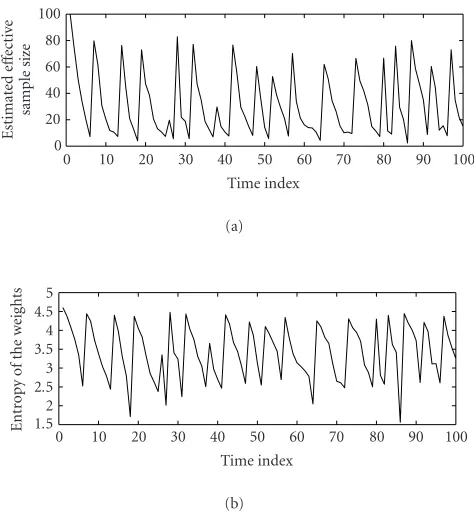
and/or in performing the resampling step for each iteration [17,18]. However, resampling too many times often leads to severe sample impoverishment [16,20,21]. Other meth-ods, also aiming at minimizing computational and memory costs, consist in using efficient sampling schemes for diff us-ing the particles [20] and performing occasionally the resam-pling stage when it seems to be needed [15,21]. When to perform resampling can be decided by measuring the vari-ance of weights via the computation of the effective sam-ple size M/(1 + var(wj(i))), whose one estimate is given by
1/Mi=1w2j(i) [15, 16,21,35]. In this case, the resampling
stage can be performed each time the estimated effective sample size is small, measuring how the propagation of the particles in the sampling space is efficient. This quantity equalsMfor uniformly weighted particles and equals 1 for degenerated cases where all the particles have zero weights except one.
It is also possible to compute the entropy of the weights, describing “how far” the distribution of the weights is from the uniform distribution. Indeed, the entropy is maximized for uniform weights and minimized for the degenerated con-figurations as mentioned above. In this sense, the entropy of weights quantifies the information of the samples and measures the efficiency of representation for a given popu-lation of particles. This approach is adopted in [24,36], for instance, and also in our algorithm as follows. Step (4) of
Algorithm 1 is therefore replaced by the computing of en-tropy of the weights
Hwt(1),. . .,wt(M)
and a resampling/selection step is processed only if the
con-100
Figure11: (a) Estimated effective sample size (ESS) and (b) entropy (H) of the weights for one realization of the particle filtering algo-rithm,M=100 particles, resampling performed when ESS≤M/10 orH≤logM/2.
holds, assuming that λis a threshold value set by the user. To show that the estimated effective sample size and en-tropy lead to similar results for the resampling task, their values for one realization of the algorithm are depicted in
Figure 11.
Also, the resampling step can be performed via different techniques [18,21]. In the sequel, we use the general multi-nomial sampling procedure [16,18].
As the variable of interestφis distributed from a set of discrete values, using large numbers of particlesMhappened to be unnecessary. Simulations have shown that several dozens are sufficient for the problem considered here. This is also the case for other Monte Carlo simulation methods used for estimating telecommunication models [37]. More-over, the degeneracy phenomenon is not really a nuisance in the present case as the simulation algorithmAlgorithm 1is only used in a MAP estimation purpose and not for com-puting mean integral estimates as (18) and (A.4), for in-stance.
10−1
10−2
10−3
BER
−3 −2 −1 0 1 2 3
SNR (dB)
Figure12: Mean±standard deviation (straight/dotted lines) of the BER values for MAP estimates of signals versus SNRrin dB, model
ofFigure 1for SNRe=12 dB.
5. NUMERICAL EXPERIMENTS
The equalization method was run for 100 realizations of se-quences of 1 000 samples for each value of SNR at the receiver stage and for SNR equal to 12 dB at the emission stage. The number of received samples per symbol rate is p = 8. The channel model is depicted inFigure 1.
(a) The amplifier model is described inSection 2.2where parameters are set as the first row ofTable 1.
(b) The fading channel is composed of one delayed traject of 3 samples (∆= 3Ts; cf.Section 2.3) and 10 dB
at-tenuated in comparison with the principal trajectory.
For each realization, the emitted symbol sequence is esti-mated by considering the MAP trajectory computed from a Monte Carlo approximation of the distribution (26) with
M = 50 particles (27). Weights (29) are computed with the help of Monte Carlo estimation techniques introduced inSection 3.2, considering sequences of 100 samples. In our simulations, the value for threshold (31)λ=0.1 gave accept-able estimation results. The mean values (straight lines) and their associated variances (dotted lines) of the BER of MAP estimates are depicted inFigure 12.
The equalization algorithm was also run for different val-ues of uplink SNR: 10 dB and 15 dB. The mean valval-ues of the BER computed from the estimated phases are depicted in
Figure 13. Curves from the bottom to the top are associated to a decreasing SNRe.
One of the advantages of the proposed equalization method is its robustness with respect to nonstationarities of the transmission channel. This property comes from the MAP estimation procedure considering the distribution (18) marginalized with respect to channel parameters. Simula-tions including perturbaSimula-tions of the parameters of the trans-mission chain lead to similar results to those presented in Figures 12 and13. On the other hand, in case of
dysfunc-10−1
10−2
10−3
10−4
BER
−3 −2 −1 0 1 2 3 4 5
SNR (dB) SNRe=15 dB
SNRe=12 dB SNRe=10 dB
Figure13: Mean BER values for MAP estimates of signals versus SNRrin dB, model ofFigure 1for various SNRevalues.
tion in devices of the amplifier and/or of the filters or if sud-den change of noise intensities happens during the trans-mission, the estimation method remains almost insensitive to these changes. The approach currently developed cannot thus be used for diagnostic purposes, as it is the case for cer-tain methods based on neural networks [4]. An interesting hybrid approach is proposed in the conclusion to cope with this task.
In order to compare the performance of the equaliza-tion method, BERs computed from the MAP estimates of the symbols are compared with ones obtained with signals esti-mated by an equalizer built from a 2-10-4 multilayer neural network, using hyperbolic tangents as activation functions [3]. The mean values (straight lines) and standard deviations (dotted lines) of BER computed from Monte Carlo MAP es-timates are represented in Figures14and15. The mean val-ues of BER computed from signals estimated with the neural network method are depicted in dashed lines.
The two methods give similar results for this configura-tion. Nevertheless, an important and interesting characteris-tic of the sequential Monte Carlo estimation method is that it does not require any learning sequence for equalizing the transmission chain, contrary to approaches based on neu-ral networks. The proposed method is thus efficient in the context of blind communication. A calibration step is at least necessary in order to estimate the number of received sam-ples per symbol rate. This tuning can be realized in a simple manner by computing the correlation of the received sam-ples.
6. CONCLUSION
10−1
10−2
10−3
10−4
BER
−3 −2 −1 0 1 2 3
SNR (dB)
Figure14: Mean±standard deviation (straight/dotted lines) of the BER values for MAP estimates of signals versus SNRrin dB, model
ofFigure 1for SNRe=15 dB. Means of the BER values for the signals estimated with neural networks are depicted in dashed lines.
transmitted through a satellite communication channel. The approach takes explicitly into account the nonlinearities in-duced by the amplification stage in the satellite thanks to a Bayesian estimation framework implemented via Monte Carlo simulation methods. This approach enables to estimate recursively the distribution of interest, namely, theposterior distribution of the variables, marginalized with respect to the parameters of the transmission chain.
An advantage of this approach is that it is robust to non-stationarities of the channel. On the contrary, the method cannot detect these nonstationarities and thus be employed to predict some dysfunction of transmission devices, as it is the case for certain neural networks approach. Therefore, it seems interesting to use Markov chain and/or sequential Monte Carlo methods to train appropriate neural networks models. This approach was successfully applied in the field of statistical learning, for instance [16, Section 17].
As for many particle-filtering-based methods, the imple-mentation of the sampling algorithm is generally demanding in terms of computing time, if compared to classical nonsim-ulation approaches, especially for tackling problems arising in the field of digital communication [19].
However, an advantage of the proposed Monte Carlo equalization method is that it does not require the knowl-edge of any learning input sequence in order to update the equalizer parameters. To the best of our knowledge, it seems at the moment the only method for achieving di-rectly the blind equalization task of such transmission chan-nel. This blind property can be of premium importance in the framework of communication in noncooperative con-text. This is the case in passive listening, for instance, or when transmission of learning sequences cannot be com-pleted correctly because of intense noises during the trans-mission.
10−1
10−2
10−3
BER
−3 −2 −1 0 1 2 3
SNR (dB)
Figure15: Mean±standard deviation (straight/dotted lines) of the BER values for MAP estimates of signals versus SNRrin dB, model
ofFigure 1for SNRe=15 dB. Means of the BER values for the signals estimated with neural networks are depicted in dashed lines.
APPENDICES
A. MONTE CARLO ESTIMATION OFPOSTERIOR DISTRIBUTIONp(φ|A,σe, TWT,σr,r)
As stated inSection 3.1, the problem is to compute likelihood (13). A solution consists in integrating this expression with respect toy, the amplified signal (cf.Figure 7):
pr,yA,φ,σe, TWT,σr
dy. (A.1)
From Bayes’ formula, this expression is proportional to
pry,A,φ,σe, TWT,σr
pyA,φ,σe, TWT,σr
dy.
(A.2) As downlink transmission noise is assumed to be Gaussian (cf. (8)), the likelihood is yielding
pry,σr
∝exp
−|r−y|2
σ2
r
. (A.3)
The right probability density function in integral (A.2) can be computed by marginalizing it with respect tox, the signal to amplify (cf.Figure 7):
pyA,φ,σe, TWT,σr
=
py,xA,φ,σe, TWT,σr
dx
∝
pyx,A,φ,σe, TWT,σr
×pxA,φ,σe, TWT,σr
dx.
The signal yis entirely determined by the signalxfrom re-lations (6) and (7). The left probability density function in integral (A.4) thus equals
pyx,A,φ,σe, TWT,σr
=δy−TWT(x). (A.5)
The right probability density function in expression (A.4) yields
as the uplink transmission noise is assumed to be Gaussian (cf. (4)). Expression (13) is thus proportional to
and the above formula can be viewed as an expectation
E
This work was partly supported by the research program BLISS (IST-1999-14190) from the European Commission. The first author is grateful to the Japan Society for the Pro-motion of Science and the Grant-in-Aid for Scientific Re-search in Japan for their funding. The authors thank P. Comon and C. Jutten for helpful comments and are grate-ful to the anonymous reviewers for their helpgrate-ful suggestions which have greatly improved the presentation of this paper.
REFERENCES
[1] A. A. M. Saleh, “Frequency-independent and frequency-dependent nonlinear models of TWT amplifiers,” IEEE Trans. Communications, vol. 29, no. 11, pp. 1715–1720, 1981. [2] S. Bouchired, M. Ibnkahla, D. Roviras, and F. Castani´e, “Equalization of satellite mobile communication channels us-ing RBF networks,” inProc. IEEE Workshop on Personal In-door and Mobile Radio Communication (PIMRC ’98), Boston, Mass, USA, September 1998.
[3] G. J. Gibson, S. Siu, and C. F. N. Cowen, “Multilayer percep-tron structures applied to adaptive equalisers for data com-munications,” inProc. IEEE Int. Conf. Acoustics, Speech, Signal Processing (ICASSP ’89), vol. 2, pp. 1183–1186, Glasgow , UK, May 1989.
[4] M. Ibnkahla, N. J. Bershad, J. Sombrin, and F. Castani´e, “Neural network modeling and identification of nonlinear channels with memory: algorithms, applications, and analytic models,” IEEE Trans. Signal Processing, vol. 46, no. 5, pp. 1208–1220, 1998.
[5] M. Ibnkahla, J. Sombrin, F. Castani´e, and N. J. Bershad, “Neu-ral networks for modeling nonlinear memoryless communi-cation channels,”IEEE Trans. Communications, vol. 45, no. 7, pp. 768–771, 1997.
[6] C. You and D. Hong, “Blind equalization techniques using the complex multi-layer perceptron,”Proc. IEEE Global Telecom-munications Conference (GLOBECOM ’96), pp. 1340–1344, November 1996.
[7] S. Prakriya and D. Hatzinakos, “Blind identification of LTI-ZMNL-LTI nonlinear channel models,” IEEE Trans. Signal Processing, vol. 43, no. 12, pp. 3007–3013, 1995.
[8] S. Prakriya and D. Hatzinakos, “Blind identification of lin-ear subsystems of LTI-ZMNL-LTI models with cyclostation-ary inputs,” IEEE Trans. Signal Processing, vol. 45, no. 8, pp. 2023–2036, 1997.
[9] G. B. Giannakis and E. Serpedin, “Linear multichannel blind equalizers of nonlinear FIR Volterra channels,” IEEE Trans. Signal Processing, vol. 45, no. 1, pp. 67–81, 1997. [10] G. Kechriotis, E. Zervas, and E. S. Manolakos, “Using
re-current neural networks for adaptive communication chan-nel equalization,” IEEE Transactions on Neural Networks, vol. 5, no. 2, pp. 267–278, 1994.
[11] G. M. Raz and B. D. Van Veen, “Blind equalization and iden-tification of nonlinear and IIR systems-a least squares ap-proach,”IEEE Trans. Signal Processing, vol. 48, no. 1, pp. 192– 200, 2000.
[12] H. Kantz and T. Schreiber, Nonlinear Time Series Analysis, vol. 7 ofCambridge Nonlinear Science Series, Cambridge Uni-versity Press, Cambridge, UK, 1997.
[13] H. Tong, Non-linear Time Series: a Dynamical System Ap-proach, vol. 6 ofOxford Statistical Science Series, Oxford Uni-versity Press, Oxford, UK, 1990.
[14] J. Y. Huang, “On the design of nonlinear satellite CDMA re-ceiver,” M.S. thesis, Institute of Communication Engineer-ing, College of Engineering and Computer Science, National Chiao Tung University, Hsinchu, Taiwan, June 1998. [15] M. S. Arulampalam, S. Maskell, N. Gordon, and T. Clapp, “A
tutorial on particle filters for online nonlinear/non-Gaussian Bayesian tracking,” IEEE Trans. Signal Processing, vol. 50, no. 2, pp. 174–188, 2002.
[16] A. Doucet, N. De Freitas, and N. Gordon, Eds., “Statistics for engineering and information science,” inSequential Monte Carlo Methods in Practice, Springer, New York, NY, USA, 2001.
[17] N. Gordon, D. Salmond, and A. F. M. Smith, “Novel approach to nonlinear/non-Gaussian Bayesian state estimation,” IEE proceedings F, Radar and Signal Processing, vol. 140, no. 2, pp. 107–113, 1993.
[18] G. Kitagawa, “Monte Carlo filter and smoother for non-Gaussian nonlinear state space models,” Journal of Compu-tational and Graphical Statistics, vol. 5, no. 1, pp. 1–25, 1996. [19] E. Punskaya, A. Doucet, and W. J. Fitzgerald, “On the use
and misuse of particle filtering in digital communications,”
Proc. European Signal Processing Conference (EUSIPCO ’02), September 2002.
[20] A. Doucet, S. Godsill, and C. Andrieu, “On sequential Monte Carlo sampling methods for Bayesian filtering,”Statistics and Computing, vol. 10, no. 3, pp. 197–208, 2000.
[22] J. S. Liu and R. Chen, “Blind deconvolution via sequential imputations,” Journal of the American Statistical Association, vol. 90, no. 430, pp. 567–576, 1995.
[23] R. Chen, X. Wang, and J. S. Liu, “Adaptive joint detection and decoding in flat-fading channels via mixture kalman fil-tering,”IEEE Transactions on Information Theory, vol. 46, no. 6, pp. 2079–2094, 2000.
[24] P.-O. Amblard, J.-M. Brossier, and E. Moisan, “Phase tracking: what do we gain from optimality? Particle filtering vs. phase-locked loops,” Signal Processing, vol. 83, no. 1, pp. 151–167, 2003.
[25] A. V. Oppenheim and R. W. Schafer,Discrete-Time Signal Pro-cessing, Prentice-Hall Signal Processing Series, Prentice-Hall, Englewood Cliffs, NJ, USA, 1989.
[26] C. Meyr, M. Moeneclaey, and S. A. Fechtel, Digital Commu-nication Receivers, Wiley Series in Telecommunications and Signal Processing, John Wiley & Sons, New York, NY, USA, 1995.
[27] J. M. Bernardo and A. F. M. Smith, Bayesian Theory, Wiley Series in Probability and Mathematical Statistics, John Wiley & Sons, Chichester, UK, 1994.
[28] T. Clapp and S. J. Godsill, “Bayesian blind deconvolution for mobile communications,” inProc. IEE Colloquium on Adaptive Signal Processing for Mobile Communication Systems, vol. 9, pp. 9/1–9/6, London , UK, October 1997.
[29] C. P. Robert and G. Casella, Monte Carlo Statistical Methods, Springer-Verlag, New York, NY, USA, 1999.
[30] W. R. Gilks, S. Richardson, and D. J. Spiegelhalter, Markov Chain Monte Carlo in Practice, Interdisciplinary Statistics, Chapman & Hall, London, UK, 1996.
[31] S. S´en´ecal and P.-O. Amblard, “Blind equalization of a non-linear satellite system using MCMC simulation methods,”
EURASIP Journal on Applied Signal Processing, vol. 2002, no. 1, pp. 46–57, 2002.
[32] R. Chen and T. H. Li, “Blind restoration of linearly degraded discrete signals by Gibbs sampling,” IEEE Trans. Signal Pro-cessing, vol. 43, no. 10, pp. 2410–2413, 1995.
[33] G. Casella and C. Robert, “Rao-blackwellisation of sampling schemes,”Biometrika, vol. 83, no. 1, pp. 81–94, 1996. [34] J. S. Liu, W. H. Wong, and A. Kong, “Covariance structure
of the Gibbs sampler with applications to the comparisons of estimators and augmentation schemes,” Biometrika, vol. 81, no. 1, pp. 27–40, 1994.
[35] A. Kong, J. S. Liu, and W. H. Wong, “Sequential imputations and Bayesian missing data problems,”Journal of the American Statistical Association, vol. 89, no. 425, pp. 278–288, 1994. [36] D. T. Pham, “Stochastic methods for sequential data
assimila-tion in strongly nonlinear systems,”Monthly Weather Review, vol. 129, no. 5, pp. 1194–1207, 2001.
[37] P. Cheung-Mon-Chan and E. Moulines, “Global sampling for sequential filtering over discrete state space,” EURASIP Jour-nal on Applied SigJour-nal Processing, vol. 2004, no. 15, pp. 2242– 2254, 2004.
St´ephane S´en´ecalreceived the M.S. degree in electrical engineering in 1999 and the Ph.D. degree in statistical signal process-ing in 2002 from Institut National Polytech-nique de Grenoble, France. He is now a Re-search Associate at the Institute of Statistical Mathematics, Japan. His research interests include stochastic simulation methods and their applications in signal processing and modeling.
Pierre-Olivier Amblard was born in Di-jon, France, in 1967. He received the Ing´enieur degree in electrical engineering in 1990 from the ´Ecole Nationale Sup´erieure d’Ing´enieurs Electriciens de Grenoble, In-stitut National Polytechnique de Grenoble (ENSIEG, INPG). He received the DEA de-gree and the Ph.D. dede-gree in signal pro-cessing in 1990 and 1994, respectively, both from the INPG. Since 1994, he has been
Charg´e de Recherches with the Centre National de la Recherche Scientifique (CNRS), and he is working in the Laboratoire des Im-ages et des Signaux (LIS, UMR 5083), where he is in charge of the Groupe Non Lin´eaire. His research interests include higher-order statistics, nonstationary and nonlinear signal processing, and ap-plications of signal processing in physics.