Volume 2008, Article ID 541410,13pages doi:10.1155/2008/541410
Research Article
Zero-Forcing and Minimum Mean-Square Error Multiuser
Detection in Generalized Multicarrier DS-CDMA Systems for
Cognitive Radio
Lie-Liang Yang1and Li-Chun Wang2
1School of Electronics and Computer Science, University of Southampton SO17 1BJ, UK
2Department of Communications Engineering, National Chiao Tung University, Hsinchu 300, Taiwan
Correspondence should be addressed to Lie-Liang Yang,[email protected]
Received 30 April 2007; Revised 15 September 2007; Accepted 17 November 2007
Recommended by Luc Vandendorpe
In wireless communications, multicarrier direct-sequence code-division multiple access (MC DS-CDMA) constitutes one of the highly flexible multiple access schemes. MC DS-CDMA employs a high number of degrees-of-freedom, which are beneficial to design and reconfiguration for communications in dynamic communications environments, such as in the cognitive radios. In this contribution, we consider the multiuser detection (MUD) in MC DS-CDMA, which motivates lowcomplexity, high flexibility, and robustness so that the MUD schemes are suitable for deployment in dynamic communications environments. Specifically, a range of low-complexity MUDs are derived based on the zero-forcing (ZF), minimum mean-square error (MMSE), and interfer-ence cancellation (IC) principles. The bit-error rate (BER) performance of the MC DS-CDMA aided by the proposed MUDs is investigated by simulation approaches. Our study shows that, in addition to the advantages provided by a general ZF, MMSE, or IC-assisted MUD, the proposed MUD schemes can be implemented using modular structures, where most modules are indepen-dent of each other. Due to the indepenindepen-dent modular structure, in the proposed MUDs one module may be reconfigured without yielding impact on the others. Therefore, the MC DS-CDMA, in conjunction with the proposed MUDs, constitutes one of the promising multiple access schemes for communications in the dynamic communications environments such as in the cognitive radios.
Copyright © 2008 L.-L. Yang and L.-C. Wang. This is an open access article distributed under the Creative Commons Attribution License, which permits unrestricted use, distribution, and reproduction in any medium, provided the original work is properly cited.
1. INTRODUCTION
Recently, there has been an increasing interest in cognitive and software defined radios in both the research and industry communities, as is evidenced, for example, by [1–4] as well as by the references in them. The cognitive radio equipped with flexible software defined architectures aims at the intel-ligent wireless communications, which is capable of sensing its environment, learning from the environment, and adap-tively responding to the environment, in order to achieve high-efficiency and high-flexibility wireless communications anytime, anywhere, and in anyway. In cognitive and software defined radios, a highly efficient and flexible multiple access scheme that is suitable for online reconfigurations is highly important.
In broadband wireless communications, multicarrier code-division multiple access (CDMA) scheme has received
wide attention in recent years [5–12]. This is because mul-ticarrier CDMA schemes employ a range of advantages, which include low intersymbol interference (ISI) due to invoking serial-to-parallel (S-P) conversion at the trans-mitter, low implementation complexity of carrier modula-tion/demodulation for the sake of using fast Fourier trans-form (FFT) techniques, and so forth. In multicarrier CDMA systems, frequency diversity may be achieved by repeating the transmitted signal in the frequency(F)domain with the aid of several subcarriers [5,7–9]; multiple transmit/receive an-tennas may be deployed, in order to achieve the spatial di-versity [6,13] and/or to increase the capacity of the mul-ticarrier CDMA systems [14]. In comparison with the pure DS-CDMA using only time(T)domain spreading and pure
MC-CDMA using only F domain spreading, it has been
S
eri
al
-to-p
ara
ll
el
co
n
ver
te
r
b(qk)
b(2k)
ck(t) cos(2π f12t)
cos(2π f11t)
cos(2π f1pt)
× ×
× ×
Symbol durationTs=qTb
b(1k)
. .
. ..
. . . . Data
Tb
1
2
p
Sk(t)
U=pq
Figure1: Transmitter schematic block diagram of thekth user in the generalized MC DS-CDMA systems.
highest number of degrees-of-freedom [5] for reconfigura-tions; these properties may render the MC DS-CDMA a versatile multiple access scheme that is suitable for cogni-tive and software-defined radios. Note that the orthogonal frequency-division multiplexing, code-division multiplexing (OFDM-CDM) scheme [16], which employs bothTdomain andFdomain spreadings, may also constitute a high-flexible scheme that is suitable for reconfigurations.
Multiuser detection (MUD) in the context of various multicarrier CDMA schemes has been widely investigated, as seen, for example, in [17–21]. This contribution mo-tivates low-complexity, high-reliability, and low-sensitivity MUD in the MC DS-CDMA operated under the cogni-tive radio. This is because in a highly dynamic wireless communications environment, such as in cognitive radio, low-complexity, high-reliability, and robustness to impfect knowledge due to, for example, channel estimation er-ror are extremely important. Specifically, in this contri-bution we investigate the zero-forcing MUD (ZF-MUD) and minimum mean-square error MUD (MMSE-MUD) in the MC DS-CDMA systems. Various alternatives for im-plementation of the ZF-MUD and MMSE-MUD are pro-posed. To be more specific, in this contribution three types of ZF-MUDs and four types of MMSE-MUDs are pro-posed. The ZF-MUDs include the optimum ZF-MUD (OZF-MUD), suboptimum ZF-MUD (SZF-(OZF-MUD), as well as the interference cancellation aided suboptimum ZF-MUD (SZF-IC). The MMSE-MUDs include the optimum MMSE-MUD (OMMSE-MUD), suboptimum MMSE-MUD type I and II (SMMSE-MUD-I, SMMSE-MUD-II) and the interference cancellation aided suboptimum SMMSE-MUD-II (SMMSE-IC). From our study it can be shown that in MC DS-CDMA systems both the ZF-MUDs and MMSE-MUDs have the modular structures that are beneficial to implementation and reconfiguration. Furthermore, in this contribution the bit-error rate (BER) performance of the MC DS-CDMA systems employing the proposed various MUDs is investigated by simulations. From our study and simulation results, it can be shown that among these MUDs, the SZF-MUD, SZF-IC, and
the SMMSE-MUD-II, SMMSE-IC, constitute the promising MUD schemes that can provide the following advantages.
(i) Low complexity. The complexity of these MUDs is in the order of the single-user matched-filter- (MF-) based detector, when the active users in the MC DS-CDMA system are maintained unchanged.
(ii) High efficiency. Both SZF-MUD and
SMMSE-MUD-II are capable of mitigating efficiently the multiuser interference (MUI), although their achievable BER performance is worse than that of their correspond-ing OZF-MUD and OMMSE-MUD. However, when an IC-stage is invoked following the SZF-MUD or SMMSE-MUD-II, the SZF-IC or SMMSE-IC is ca-pable of achieving the near single-user BER bound achieved by the MC DS-CDMA supporting single-user.
(iii) Robust to imperfect channel knowledge. In the above four types of MUDs, the time-variant channel impulse responses (CIRs) are only invoked in linear operations as in MF-assisted detection. No channel-dependent matrices need to be inverted. Hence, we can be implied that these MUDs should have a similar sensitivity as the MF detector to the channel estimation errors. (iv) High-flexibility. Due to the modular structures and
the relative independence among the modules, these MUDs are highly flexible. For example, if some of the subcarriers are sensed with high interference temper-ature, these MUD algorithms can be readily modified to adapt the environment, as can be seen in our forth-coming discourses.
2. SYSTEM DESCRIPTION
In this section, the considered MC DS-CDMA system is described in the context of the transmitted signal, channel model, receiver, as well as the representation of the received discrete signals. Let us first describe the transmitter of the MC DS-CDMA system.
2.1. Transmitted signals
The transmitter schematic diagram of the kth user in the considered MC DS-CDMA is shown inFigure 1. As shown inFigure 1the initial data stream having a bit duration of Tb is first serial-to-parallel (S-P) converted toqnumber of
lower-rate substreams. Hence, the new bit duration after the S-P conversion or the symbol duration isTs=qTb. Each of
theqlower-rate substreams is spread byck(t) of thekth user’s
signature sequence. As shown inFigure 1, each of theq sub-streams is transmitted bypnumber of subcarriers, in order for achieving apth order frequency diversity. Hence, the total number of subcarriers required by the MC DS-CDMA sys-tem isU= pq. Based onFigure 1, the transmitted signal of userkcan be expressed as
sk(t)=
be a random variable taking values of +1 or−1 with equal probability, whilePτ(t) represents the rectangular waveform.
In (1)ck(t) represents the spreading code assigned to the
kth user, which is the same for all theU = pqnumber of subcarriers. The spreading sequenceck(t) can be expressed
asck(t) =
∞
j=−∞c(jk)ψ(t− jTc), wherec(jk) assumes values
of +1 or−1, whileψ(t) is theTdomain chip waveform of the spreading sequence, which is defined over the interval [0,Tc) and normalized to
Tc
0 ψ2(t)dt = Tc. Furthermore,
Ne =Ts/Tc = qTb/Tcis defined as the spreading factor on
each of the subcarriers. Finally, in (1)φ(i jk)represents the
ini-tial phase associated with the carrier modulation with respect to the subcarrier determined by (i,j) in (1).
In the considered MC DS-CDMA, we assume that the subcarrier signals are configured so that the subcarrier sig-nals are orthogonal with each other at the chip-level. This condition can be achieved, for example, by letting the spacing between two adjacent subcarriers beΔ=1/TcorΔ=2/Tc
[7,8,11]. We assume that the bandwidth of each subcarrier signal is configured to be sufficiently narrow in comparison with the coherence bandwidth of the wireless channel, so that each subcarrier signal experiences flat fading. As shown in [5], this configuration can be implemented by changing the total number of subcarriersqp, the spacing between two ad-jacent subcarriers and/or the number of bitsqinvoked in the S-P conversion. Furthermore, we assume that the subcarri-ers are arranged in such a way that the subcarrisubcarri-ers conveying
the same data bit, as shown inFigure 1, are separated as far away as possible, in order to achieve possibly the highestF domain diversity. Note that, in our simulations we assume for simplicity that the subcarriers conveying the same data bit experience independent fading.
Let us assume that the MC DS-CDMA system supports
K number of users, which communicate with one
com-mon base-station (BS) synchronously. The average power re-ceived from each user at the BS is also assumed to be the same. Furthermore, we assume that the MC DS-CDMA sig-nals experience frequency-selective Rayleigh fading, but each of the subcarrier signals experiences flat Rayleigh fading. Consequently, when K signals obeying the form of (1) are transmitted over the above-mentioned channels, the received baseband equivalent signal at the BS can be expressed as
R(t)=
whereh(ilk)represents the channel gain with respect to theilth subcarrier of thekth user, whilen(t) is the complex base-band equivalent Gaussian noise, which has mean-zero and a single-sided power spectral-density ofN0per real dimension. Note that, without loss of any generality, in (2) the initial phases of the subcarriers have been absorbed into the chan-nel gains.
2.2. Representation of the received signal
The receiver structure for detection of the MC DS-CDMA signal is shown in Figure 2. The receiver first executes the multicarrier demodulation, which can usually be imple-mented by the FFT techniques [22]. Following the multi-carrier demodulation, a chip waveform matched-filter (MF) with the T domain impulse response ψ∗(Tc −t) is
em-ployed by each of the subcarrier branches. Finally, as shown inFigure 2, the chip waveform MFs outputs are sampled at the chip-rate in order to provide the discrete observations for detection.
According toFigure 2, it can be shown that thenth obser-vation with respect to the first transmitted MC DS-CDMA symbol and theuvth subcarrier can be expressed as
yuv,n= 2PNeTc
R(t)
Figure2: The receiver block diagram of the MC DS-CDMA systems using time-limited chip waveforms.
whereNuv,nrepresents the Gaussian noise given by
Nuv,n= 2PNeTc
which is Gaussian distributed with mean-zero and a variance ofσ2/2=N
0/2Ebper real dimension.
From (4) we notice that there is no inter-carrier interfer-ence (ICI), yielding that there is no interferinterfer-ence among the bits transmitted on different subcarriers. Hence, it is suffi -cient for us to consider the detection of theK bits—each of which is transmitted by one of theKusers—transmitted on the samepnumber of subcarriers. Specifically, in our forth-coming discourse we consider the detection of theuth bits of theKusers, which are transmitted by the subcarriers indexed by fu1,fu2,. . .,fup.
Let us now represent the observations in (4) in some de-sired forms, so that they can be conveniently applied in our forthcoming derivations. Let us define
yuv=
Then,yuvcan be represented
yuv=
Then,yucan be expressed as
yu=
where⊗represents theKronecker product[23] operation.
Furthermore, if we define
bu=
Then, (9) can alternatively be represented as
yu=
HuC
bu+nu, u=1, 2,. . .,q, (11)
where (HuC) represents theKhatri-Rao product between
HuandC.
In summary, in (11)yuis apNe-length observation
vec-tor, Huis a (p×K)-dimensional matrix due to the fading
channels experienced by the subcarrier signals of theKusers, Cis a (Ne×K) matrix contributed by the spreading sequences of theKusers,bucontainsKbinary bits to be detected and,
finally,nuis thepNe-length Gaussian noise vector distributed
associated with mean zero and a covariance matrix ofσ2I
pNe,
whereIpNeis a (pNe×pNe) identity matrix.
Additionally, it can be shown that (7) can also be written as
yuv=CHuvbu+nuv, v=1, 2,. . .,p,u=1, 2,. . .,q, (12)
whereHuvis a diagonal matrix expressed as
Huv=√1
As shown in (11), the spreading code matrixCis certain once the users’ spreading codes are given. The matrixHu
de-noting the CIRs is known, once the channels are estimated. Let us now consider the multiuser detection in the MC DS-CDMA, which are derived based on (9), (11), or (12).
3. ZERO-FORCING MULTIUSER DETECTION
In this section, we consider the ZF-MUDs in the MC DS-CDMA system. These ZF-MUDs are capable of removing fully the MUI at the cost of enhancing the background noise [24]. We assume for ZF-MUD that the BS receiver employs the knowledge aboutCandHu. Let us consider first the
op-timum ZF-MUD, that is, the OZF-MUD.
3.1. Optimum zero-forcing multiuser detection
yqp
Figure3: Schematic block diagram for implementation of the OZF-MUD in MC DS-CDMA systems.
performance than the SZF-MUD that will be derived later in Section3.2. However, its implementational complexity is much higher than that of the SZF-MUD.
The decision variable vector forbuin the context of the
OZF-MUD can be expressed as
zu=WHuyu, u=1, 2,. . .,q, (14)
where, according to (11), it can be readily shown that the weight matrixWuin ZF sense can be denoted as
Wu=
[23], whererepresents theHadamard product operation [25], the above equation can be denoted as
Wu=
In (16), the matrix required to be inverted, that is, (HH
uHuRc), is a (K×K) matrix, which may be efficiently
computed due to the following reasons. Firstly,Rcis a (K×K)
time-invariant matrix, which can be computed once for all. Secondly, althoughHH
uHuis a (K×K) time-variant matrix,
it is only required to be updated at the level of fading rate of the wireless channels experienced by the subcarrier signals. Finally, the Hadamard product betweenHH
uHuandRc
con-stitutesK2straightforward complex multiplications. Upon applying (16) into (14), the decision variable vec-tor can be written as
zu=
Therefore, when substituting (18) into (17), we obtain
zu=
divided into pMF operations corresponding to the p num-ber of subcarriers conveyingbuand one ZF operation, which
multiplies a (K×K) matrix of [(HH
uHuRc)]−1on the MFs’
outputs. In summary, the OZF-MUD can be implemented by the schematic block diagram as shown inFigure 3.
3.2. Suboptimum zero-forcing multiuser detection
yqp yup yu2 yu1 y11
Zero-forcing
R−1 c CT Zero-forcing
R−1 c CT Zero-forcing
R−1 c CT Zero-forcing
R−1 c CT Zero-forcing
R−1 c CT
HH
11
HH u1
HHu2
HH up
HH
qp xq
xu x1
MRC
· · · · · · · · ·
Figure4: Schematic block diagram for implementation of the SZF-MUD in MC DS-CDMA systems.
combined in order to form a final decision variable. Specif-ically, when the SZF-MUD following this design philosophy is considered, for theuth data vectorbutransmitted by theK
users, the decision variable vector in the context of theuvth subcarrier can be formed as
zuv=WHuvyuv, u=1, 2,. . .,q;v=1, 2,. . .,p, (20)
whereWuv is a (Ne ×K) weight matrix for processing the
observation vectoryuvof (12). After the MUD operation of
(20), the psubcarrier signals conveyingbuare then
coher-ently combined to form the final decision variable, which can be expressed as
zu=
p
v=1
TH
uvzuv, u=1, 2,. . .,q, (21)
where the matrixTuvis a postprocessing matrix carrying out
the coherent combining, such as the maximal ratio combin-ing (MRC).
It can be shown that, for the SZF-MUD using MRC, the weight matrix in ZF sense and the postprocessing matrix can be chosen as
Wuv =C
CTC−1=CRc−1, Tuv=Huv. (22)
Upon substituting (12), (20), and (22) into (21), the decision variable vector forbucan be expressed as
zu=
p
v=1
TH
uvRc−1CTyuv
= p
v=1
HHuvHuvbu+
p
v=1
HHuvR−c1CTnuv, u=1, 2,. . .,q.
(23)
Note that sinceHuvdefined in (13) is a diagonal matrix,
ex-plicitly, the SZF-MUD is capable of removing fully the MUI and achieving aFdomain diversity order ofp.
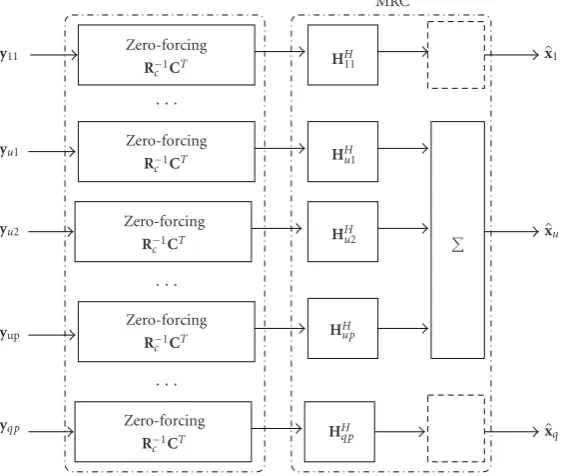
In summary, the SZF-MUD can be implemented by the schematic block diagram ofFigure 4. As shown in (22) and
Figure 4, the weight matrixWuv for the SZF-MUD is
time-invariant and is common to any of theqpsubcarriers. Hence, it can be computed “once for all,” provided that the active users maintain unchanged. In this case, the proposed SZF-MUD having the processing matrices in (22) in fact has an implementational complexity that is similar to the single-user MF receiver. However, if the state of the active single-users changes rapidly, the weight matrix Wuv for the SZF-MUD
is also required to be updated correspondingly. In this sce-nario, the proposed SZF-MUD having the processing matri-ces in (22) will have a higher complexity than the single-user MF receiver. Furthermore, when comparing Figure 4with
Figure 3, we can see that the time-variant channel matrices are invoked in the inverse operations inFigure 3for the OZF-MUD, but not invoked in the inverse operations inFigure 4
for the SZF-MUD. InFigure 4the channel-dependent time-variant matrices are only invoked in the linear processing as in the single-user MF-based receiver. Hence, we may be im-plied that the SZF-MUD will be more robust than the OZF-MUD to the channel estimation errors. However, as our sim-ulation results inSection 6shown, the error performance of the MC DS-CDMA using the SZF-MUD is much worse than that of the MC DS-CDMA using the OZF-MUD.
operations are subcarrier-by-subcarrier independent. Except the sum operation, the MRC operations are also subcarrier-by-subcarrier independent. Explicitly, the modular struc-tures of the OZF-MUD and SZF-MUD as shown in Figures3
and4are beneficial to implementation and reconfiguration in practice. For example, in a dynamic communications envi-ronment such as in cognitive radio, when certain frequency bands are occupied and some of the subcarriers in the MC DS-CDMA are sensed having high interference temperature,
the OZF-MUD inFigure 3 and the SZF-MUD in Figure 4
can be correspondingly reconfigured in order to adapt to the changed environment. Specifically, for the OZF-MUD as shown inFigure 3, the subcarrier branches having the high interference temperature can be directly deleted from the re-ceiver. However, the matrices implementing the ZF opera-tions must be updated by removing the CIRs corresponding to the subcarriers having the high interference temperature. By contrast, the SZF-MUD as shown inFigure 4can be up-dated simply by deleting the subcarrier branches having the high interference temperature, that is, by setting the corre-sponding observation vectors in the form ofyuv to the zero
vectors.
3.3. Interference cancellation aided suboptimum zero-forcing
The error performance of the MC DS-CDMA using the SZF-MUD may be significantly enhanced by employing a stage of IC following the SZF-MUD, yielding the SZF-IC. Our simu-lation results inSection 6show that the MC DS-CDMA using SZF-IC is capable of achieving the near single-user BER per-formance. Furthermore, since the channel-dependent opera-tions at the IC stage are also linear operaopera-tions, we can be im-plied that the IC should be similarly robust as the SZF-MUD to the channel estimation errors.
The SZF-IC can be operated as the following steps.
Step 1. SZF-MUD operation generates the decision variable vectorzu(u=1, 2,. . .,q) as shown in (23).
where sign(x) is a sign-function.
Step 3. Fork=1, 2,. . .,K, the IC is carried out, yielding
yuv(k)=yuv−CHuvbub(uk)=0
, (25)
wherebu(b(uk)=0) is the result after settingb(uk)=0 inbu.
Step 4. Forming the decision variable again forbu(k)as
Having derived various ZF-MUDs in this section, let us now turn to consider the MMSE-MUDs.
4. MMSE MULTIUSER DETECTION
In this section, the MMSE-MUDs for detection of the MC DS-CDMA signals are derived. Specifically, one optimum MUD (OMUD), two suboptimum MMSE-MUDs (SMMSE-MMSE-MUDs) and one IC-aided SMMSE-MUD, that is, SMMSE-IC, are considered. It can be shown that these MMSE-MUDs are capable of mitigating efficiently the MUI while suppressing the background noise. Let us first consider the OMMSE-MUD.
4.1. Optimum MMSE multiuser detection
The OMMSE-MUD is derived based on (11) and it jointly processes the observations without regarding to the spe-cific subcarriers. The OMMSE-MUD is capable of achiev-ing a better BER performance than both the SMMSE-MUDs, which will be derived in Sections4.2and4.3.
The decision variable vector for the OMMSE-MUD can be expressed as
zu=WHuyu, u=1, 2,. . .,q, (27)
where the optimum weight matrix in MMSE sense can be expressed as
Wu=R−yu1Ryubu (28)
withRyubeing a (pNe×pNe) auto-correlation matrix ofyu,
which, according to (11), is given by
Ryu=
into (28), the weight matrix in the context of the OMMSE-MUD can be expressed as
Wu=
Therefore, when the receiver employs no knowledge about the interfering users including their signature sequences and CIRs, except for the desired user, the receiver has to invert a matrix of size (pNe×pNe)-dimensional, as seen in (31).
In this case, the complexity of the OMMSE-MUD might be extreme, when the product ofpNeis high.
which shows that the OMMSE-MUD is only required to in-vert a (K×K) matrix.
Finally, upon substituting (32) into (27) and following the steps from (17) to (19), the decision variable vector in the context of the OMMSE-MUD can be represented as
zu=
Equation (33) shows that, when the receiver employs the knowledge about all theK active users, the OMMSE-MUD can be implemented by two stages: the first-stage implements the correlation operation in the context of each of the sub-carriers. By contrast, the second-stage carries out a MMSE-based interference suppression in order to mitigate the MUI. The complexity of the OMMSE-MUD represented by (33) is dominated by the inverse of a (K×K) matrix as seen in (33). The OMMSE-MUD of (33) can be implemented by the schematic block diagram as shown inFigure 3, which is for the OZF-MUD. For the OMMSE-MUD, the ZF operation of (HH
uHuRc)−1 in Figure 3 should be replaced by the
MMSE-based operation of [(HH
uHuRc) +σ2IK]−1. Let us
now consider the SMMSE-MUDs.
4.2. Suboptimum MMSE multiuser detection: type I
As the SZF-MUD derived in Section3.2, the MMSE-MUD can also be implemented first in the context of each of the qp subcarriers, and then by combining the signals across the subcarriers conveying the same data bits of theKusers. This type of MMSE-MUDs forms the class of suboptimum MMSE-MUDs (SMMSE-MUDs). Below two SMMSE-MUD schemes are derived, namely MUD-I and II. In this subsection, we consider the SMMSE-MUD-I, while the SMMSE-MUD-II is discussed in Section4.3.
In the context of the SMMSE-MUD-I, when the MMSE detection principle is applied for each of the subcarriers, the decision variable vector forxucan be expressed as
zu=
whereyuvis the observation vector from theuvth subcarrier,
which is given by (12), andWuvis the optimum weight
ma-trix for theuvth subcarrier, which can be expressed as
Wuv=R−yuv1Ryuvbu, (35)
whereRyuvrepresents the autocorrelation matrix ofyuv, while
Ryuvbu represents the cross-correlation matrix between yuv
andbu. With the aid of (12), it can be readily shown that optimum weight matrixWuvcorresponding to theuvth
sub-carrier can be expressed as
Wuv=
The SMMSE-MUD-I having the weight matrix of (38) does not require the knowledge about the interfering users, since the autocorrelation matrixRyuv in (36) and the
cross-correlation matrixRyuvbuin (37) may be estimated from the
observations obtained at theuvth subcarrier. It can also be implemented adaptively or even blindly [20]. However, when the receiver employs the knowledge about the interfering users, thematrix inverse lemmacan be invoked, which can modify the weight matrix of (38) to
Wuv=CHuv
In this case the SMMSE-MUD-I is required to invert a (K×
K) matrix for each of thepqsubcarriers.
Finally, when substituting (12) and (39) into (34), the decision variable vector for the SMMSE-MUD-I can be ex-pressed as
When comparing the weight matrix of (32) for the
OMMSE-MUD and the weight matrix of (39) for the
I, it can be known that the SMMSE-MUD-I may have a complexity, which is even higher than that of the OMMSE-MUD. As seen in (32), the OMMSE-MUD only needs to invert a (K×K) matrix in order to detectbu. By
con-trast, as shown in (39), the SMMSE-MUD-I has to invertp matrices of size (K×K). Furthermore, our simulation results inSection 6show that the BER performance of the SMMSE-MUD-I is worse than that of the OMMSE-MUD.
As shown in (36) the autocorrelation matrix Ryuv in
the SMMSE-MUD-I is time-variant, it should be estimated within a time-duration when the corresponding channels re-tain unchanged. Hence, the average taken for estimatingRyuv
as shown in (36) is a short-term average. Instead, the au-tocorrelation matrixRyuv may be estimated using the
long-term average, yielding the SMMSE-MUD-II, which is now discussed in the next subsection.
4.3. Suboptimum MMSE multiuser detection type II
Hence, in MUD design it is often preferable to include a rela-tively lower number of channel-dependent operations, espe-cially, the channel-dependent matrix-inverse operation. Fur-thermore, from (38) and (39) we can be implied that the high-complexity of the SMMSE-MUD-I is mainly because the matrices need to be inverted are time-variant due to us-ing the short-term average. When the long-term average is applied for estimatingRyuv, we can obtain
Ryuv = SMMSE-MUD-II can be expressed as
Wuv=p
Consequently, the decision variable vector zu can be
ex-pressed as
From (43) we can observe that in the SMMSE-MUD-II the matrices required to be inverted are time-invariant, and the MRC is achieved through multiplying the ZF-MUD’s output with the channel-dependent matrixHH
uv. Since only
the MRC operation invokes the time-variant CIR matrices, the SMMSE-MUD-II hence should have the same robustness to the channel estimation errors as the single-user MF detec-tor. Furthermore, in (43) the matrices need to be inverted are only required to compute once, provided that the active users maintain unchanged. Therefore, the SMMSE-MUD-II can be implemented with a complexity that is also similar to that of the single-user MF detector.
The schematic block diagram for the SMMSE-MUD-II can be represented byFigure 4, which is for the SZF-MUD, after replacing the ZF-operation of R−1
c CT by the
MMSE-related operation ofΩRc+pσ2IK
−1
CT.
Above three types of MMSE-MUDs have been derived. As our simulation results inSection 6shown, the SMMSE-MUD-II achieves the worst BER performance among these MMSE-MUDs. However, the BER performance of the SMMSE-MUD-II can be significantly improved, when a stage of IC is employed following the SMMSE-MUD-II de-tection, yielding the so-called SMMSE-IC. Specifically, the SMMSE-IC can be implemented in the same way as the SZF-IC—which has been discussed in Section3.3—by replacing the first-stage of ZF detection in the SZF-IC by a first-stage of SMMSE-MUD-II assisted detection for the SMMSE-IC. Therefore, the algorithm for the SMMSE-IC is not stated here in detail.
5. IMPLEMENTATION CONSIDERATION
According to our analysis in Sections3and4, we can find that all the proposed MUD schemes, which include OZF-MUD, SZF-MUD and SZF-IC in the ZF family as well as OMMSE-MUD, SMMSE-MUT-I, SMMSE-MUD-II and SMMSE-IC in the MMSE family, can be implemented in modular struc-tures, such as, shown in Figures3and4. As we mentioned previously, the modular structures of the MUDs are benefi-cial to implementation and reconfiguration in practice, espe-cially, when dynamic communications environments such as cognitive radios are considered. In cognitive radios the com-munications environments might be highly dynamic, diff er-ent frequency bands may experience different interference temperature, which itself may also be time-variant. In order to achieve high-efficiency communications in the dynamic communications environments, it is desirable that the trans-mission signalling as well as the detection algorithms can be reconfigured conveniently and also with a low impact on the overall system.
Due to the multi-band structure, MC DS-CDMA explic-itly constitutes one of the signalling schemes that are well suitable for cognitive radios. In the MC DS-CDMA sup-ported cognitive radios, when some frequency bands being used are sensed with high interference, their corresponding subcarriers may be turned off. By contrast, when some other frequency bands, which have not been used yet, are sensed with low interference, their corresponding subcarriers can be activated in order to improve the overall bandwidth ef-ficiency of wireless communications.
Table1: Comparison of the OZF-MUD (19), SZF-MUD (23), and the SZF-IC in Section3.3.
OZF-MUD SZF-MUD SZF-IC Complexity O(K2) O(N
e) O(Ne)
Error performance Near-best Worst Best Sensitivity to channel
High Low Low
estimation error Flexibility for
Low High High adaptation
B
it
error
ra
te
10−5
10−4
10−3
10−2
10−1
1
0 5 10 15 20 25 30
SNR per bit (dB)
ZF-MUD:Ne=31
p=1
p=2
p=4
p=8
Single-user bound
OZF-MUD:K=31
SZF-MUD:K=31
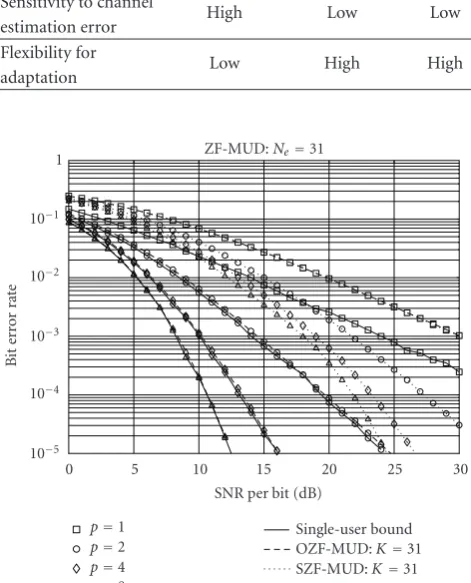
Figure5: BER versus average SNR per bit performance for the MC DS-CDMA using Gold-sequences and having aTdomain spreading factor ofNe =31, when communicating over frequency-selective
Rayleigh fading channels.
In summary, the comparison among the ZF-related MUDs is summarized in Table 1, while that among the MMSE-related MUDs is summarized inTable 2. Note that, in these tables the complexity denotes the complexity per sym-bol per user. For example, for the OZF-MUD and OMMSE-MUD as shown in (19) and (33), both of them need to com-pute the inverse of a time-variant (K×K) matrices, which has a complexity ofO(K3), whereO(·) means proportional to. Therefore, the complexity per symbol per user is of or-derO(K3/K) = O(K2). By contrast, for the SZF-MUD of (23), SZF-IC in Section 3.3, SMMSE-MUD-I of (43) and SMMSE-IC in Section 4.3, since the inverse matrices are time-invariant, the highest complexity comes from the mul-tiplication of a (K×Ne) matrix with aNe-length vector, that
is, fromCTy
uv. Hence, when the number of multiplications
is counted, the complexity per symbol per user is of order O(KNe/K)=O(Ne).
Let us now illustrate a range of performance results for all the MUD schemes considered in this contribution.
6. PERFORMANCE RESULTS
In this section, we show a range of BER performance re-sults for the MC DS-CDMA systems using the MUD schemes considered in this contribution, when communicating over frequency-selective Rayleigh fading channels. For conve-nience, the parameters shown in the figures are summarized as follows:
(i) SNR per bit: signal-to-noise ratio (SNR) per bit; (ii) Ne:Tdomain spreading factor per subcarrier;
(iii) p: number of subcarriers conveying a data bit; (iv) K: number of users supported by the MC DS-CDMA.
In our simulations, theTdomain spreading sequences were chosen from the family of Gold-sequences of lengthNe=31.
Furthermore, for comparison, the single-user (BER) bound achieved by the corresponding MC DS-CDMA system sup-porting single user is also shown in the figures.
Figure 5 shows the BER performance of the MC DS-CDMA system using both the OZF-MUD and SZF-MUD and supporting K = 31 users, when communicating over frequence-selective fading channels. From the results of
Figure 5we can observe that, when the Gold-sequences are employed for spreading, the OZF-MUD is capable of achiev-ing the near sachiev-ingle-user BER performance, when the number of subcarriers conveying a data bit isp=2, 4, or 8, or when theF-domain diversity order is p = 2, 4, and 8. However, when without using theF-domain diversity corresponding top=1, the OZF-MUD cannot achieve the near single-user BER performance. Instead, as shown inFigure 5, at the BER of 10−3the BER performance of the OZF-MUD is more than 5 dB worse than the single-user BER performance. As shown inFigure 5, although the SZF-MUD does have the capability to suppress the MUI, its achievable BER performance is sig-nificantly worse than that achieved by the OZF-MUD, when theF-domain diversity order is higher than one. Whenp=1 both the OZF-MUD and SZF-MUD achieve the same BER performance, since in this case the OZF-MUD is equivalent to the SZF-MUD.
The BER versus SNR per bit performance of the MC DS-CDMA using the SZF-IC is shown inFigure 6in conjunction with the BER performance of using the SZF-MUD and the single-user BER bound. As shown in Figure 6, when a IC-stage is applied following the SZF-MUD, the near single-user BER performance can always be achievable regardless of theF domain diversity order, even when the MC DS-CDMA sup-portsK=Ne=31 users, that is, when the MC DS-CDMA is
fully loaded.
Table2: Comparison of the SMMSE-MUD-I (39), SMMSE-MUD-II (42), and the OMMSE-MUD (32).
OMMSE-MUD SMMSE-MUD-I SMMSE-MUD-II SMMSE-IC
Complexity O(p3Ne3)/K(no CIRs), O(pNe3)/K(no CIRs), O(N
e) O(Ne)
O(K2) (CIRs) O(pK2) (CIRs)
Error performance Near-best Medium Worst Best
Sensitivity to channel estimation error High High Low Low
Flexibility for adaptation Low Low High High
B
it
error
ra
te
10−5
10−4
10−3
10−2
10−1
1
0 5 10 15 20 25 30
SNR per bit (dB)
ZF-MUD:Ne=31
p=1
p=2
p=4
p=8
Single-user bound
OZF-MUD:K=31
SZF-IC:K=31
Figure6: BER versus average SNR per bit performance for the MC DS-CDMA using Gold-sequences and having aTdomain spreading factor ofNe =31, when communicating over frequency-selective
Rayleigh fading channels.
SMMSE-MUD-II as well as the single-user BER bound are considered, also when theF-domain diversity order is p =
1, 2, 4, 8, respectively. From the results of Figures 7 and 8, explicitly, the MUD-I outperforms the SMMSE-MUD-II, and the OMMSE-MUD outperforms both the SMMSE-MUD-I and SMMSE-MUD-II, when considering the achievable BER performance. As shown inFigure 7, the BER performance achieved by the OMMSE-MUD is very close to the single-user BER bound, when p = 2, 3, 4. By contrast, both the OMMSE-MUD and
SMMSE-MUD-I achieve the same BER performance when p = 1.
Fur-thermore, when p = 1, as shown in Figure 8, the BER performance of the SMMSE-MUD-II is slightly worse than that achieved by the SMMSE-MUD-I or by the OMMSE-MUD.
Finally, the BER performance of the SMMSE-IC is de-picted inFigure 9in conjunction with the BER of the cor-responding SMMSE-MUD-II and the corcor-responding single-user BER bound. As can be seen in Figure 9, when an IC-stage is applied following the SMMSE-MUD-II detection, the MC DS-CDMA system is capable of achieving the near single-user BER performance.
B
it
error
ra
te
10−5
10−4
10−3
10−2
10−1
1
0 5 10 15 20 25 30
SNR per bit (dB)
MMSE-MUD:Ne=31
p=1
p=2
p=4
p=8
Single-user bound
SMMSE-MUD-I:K=31
OMMSE-MUD:K=31
Figure7: BER versus average SNR per bit performance for the MC DS-CDMA using Gold-sequences and having aTdomain spreading factor ofNe =31, when communicating over frequency-selective
Rayleigh fading channels.
In other words, the results of Figures6and9show that, when an IC-stage is employed after either the SZF-MUD or the SMMSE-MUD-II, the MC DS-CDMA system is capable of achieving a BER performance that is only achievable by the optimum MUD based on the ML principles [24]. How-ever, as our analysis in Sections3.3and4.3shown, both the SZF-IC and SMMSE-IC have an implementational complex-ity that is significantly lower than that of the ML-aided MUD, whose complexity is exponentially proportional to the num-ber of users [24].
7. CONCLUSIONS
B
it
error
ra
te
10−5
10−4
10−3
10−2
10−1
1
0 5 10 15 20 25 30
SNR per bit (dB)
MMSE-MUD:Ne=31
p=1
p=2
p=4
p=8
OMMSE-MUD:K=31
SMMSE-MUD-I:K=31
SMMSE-MUD-II:K=31
Figure8: BER versus average SNR per bit performance for the MC DS-CDMA using Gold-sequences and having aTdomain spreading factor ofNe =31, when communicating over frequency-selective
Rayleigh fading channels.
B
it
error
ra
te
10−5
10−4
10−3
10−2
10−1
1
0 5 10 15 20 25 30
SNR per bit (dB)
MMSE-MUD:Ne=31
p=1
p=2
p=4
p=8
Single-user bound
SMMSE-MUD-II:K=31
SMMSE-IC:K=31
Figure9: BER versus average SNR per bit performance for the MC DS-CDMA using Gold-sequences and having aTdomain spreading factor ofNe =31, when communicating over frequency-selective
Rayleigh fading channels.
mitigating efficiently the MUI. Our study shows that the ZF-MUDs and MMSE-ZF-MUDs in MC DS-CDMA can usually be implemented using modular structures, where most modules are independent of each other. Moreover, our study shows that the SZF-MUD, SZF-IC, MUD-II, or SMMSE-IC has a fully subcarrier-by-subcarrier independent modular
structure, where each of the modules may be reconfigured without effect on the others. Due to its high-flexibility for both transmission and detection, we may conclude that the MC DS-CDMA aided by a proposed high-flexibility MUD constitutes one of the promising candidates for dynamic communications environments such as in cognitive radios.
ACKNOWLEDGMENT
The author would like to acknowledge with thanks the finan-cial assistance from EPSRC of UK.
REFERENCES
[1] J. Mitola III, “The software radio architecture,”IEEE Commu-nications Magazine, vol. 33, no. 5, pp. 26–38, 1995.
[2] J. Mitola III and G. Q. Maguire Jr., “Cognitive radio: making software radios more personal,”IEEE Personal Communica-tions, vol. 6, no. 4, pp. 13–18, 1999.
[3] S. Haykin, “Cognitive radio: brain-empowered wireless com-munications,”IEEE Journal on Selected Areas in Communica-tions, vol. 23, no. 2, pp. 201–220, 2005.
[4] N. Devroye, P. Mitran, and V. Tarokh, “Limits on communi-cations in a cognitive radio channel,”IEEE Communications Magazine, vol. 44, no. 6, pp. 44–49, 2006.
[5] L.-L. Yang and L. Hanzo, “Multicarrier DS-CDMA: a multiple access scheme for ubiquitous broadband wireless communi-cations,”IEEE Communications Magazine, vol. 41, no. 10, pp. 116–124, 2003.
[6] L.-L. Yang and L. Hanzo, “Performance of broadband multi-carrier DS-CDMA using space-time spreading-assisted trans-mit diversity,”IEEE Transactions on Wireless Communications, vol. 4, no. 3, pp. 885–894, 2005.
[7] S. Kondo and L. B. Milstein, “Performance of multicarrier DS CDMA systems,”IEEE Transactions on Communications, vol. 44, no. 2, pp. 238–246, 1996.
[8] E. A. Sourour and M. Nakagawa, “Performance of orthogo-nal multicarrier CDMA in a multipath fading channel,”IEEE Transactions on Communications, vol. 44, no. 3, pp. 356–367, 1996.
[9] G. Xiang and T. S. Ng, “Performance of asynchronous orthog-onal multicarrier CDMA system in frequency selective fading channel,”IEEE Transactions on Communications, vol. 47, no. 7, pp. 1084–1091, 1999.
[10] L.-C. Wang and C.-W. Chang, “On the performance of multi-carrier DS-CDMA with imperfect power control and variable spreading factors,”IEEE Journal on Selected Areas in Commu-nications, vol. 24, no. 6, pp. 1154–1165, 2006.
[11] L.-L. Yang and L. Hanzo, “Performance of generalized multi-carrier DS-CDMA over Nakagami-mfading channels,”IEEE Transactions on Communications, vol. 50, no. 6, pp. 956–966, 2002.
[12] L.-L. Yang, “Time-hopping multicarrier code-division multi-ple access,”IEEE Transactions on Vehicular Technology, vol. 56, no. 2, pp. 731–741, 2007.
[13] V. Tarokh, N. Seshadri, and A. R. Calderbank, “Space-time codes for high data rate wireless communication: performance criterion and code construction,”IEEE Transactions on Infor-mation Theory, vol. 44, no. 2, pp. 744–765, 1998.
[15] L.-L. Yang and L. Hanzo, “Software-defined-radio-assisted adaptive broadband frequency hopping multicarrier DS-CDMA,”IEEE Communications Magazine, vol. 40, no. 3, pp. 174–183, 2002.
[16] S. Kaiser, “OFDM code-division multiplexing in fading chan-nels,”IEEE Transactions on Communications, vol. 50, no. 8, pp. 1266–1273, 2002.
[17] J. Namgoong, T. F. Wong, and J. S. Lehnert, “Subspace mul-tiuser detection for multicarrier DS-CDMA,” IEEE Transac-tions on CommunicaTransac-tions, vol. 48, no. 11, pp. 1897–1908, 2000. [18] S. L. Miller and B. J. Rainbolt, “MMSE detection of multicar-rier CDMA,”IEEE Journal on Selected Areas in Communica-tions, vol. 18, no. 11, pp. 2356–2362, 2000.
[19] J.-Y. Baudais, J.-F. H´elard, and J. Citerne, “An improved lin-ear MMSE detection technique for multi-carrier CDMA sys-tems: comparison and combination with interference can-cellation schemes,”European Transactions on Telecommunica-tions, vol. 11, no. 6, pp. 547–554, 2000.
[20] X. Wang and H. V. Poor,Wireless Communication Systems— Advanced Techniques for Signal Reception, Prentice-Hall, En-glewood Cliffs, NJ, USA, 2003.
[21] L.-L. Yang, W. Hua, and L. Hanzo, “Multiuser detection as-sisted time- and frequency-domain spread multicarrier code-division multiple-access,”IEEE Transactions on Vehicular Tech-nology, vol. 55, no. 1, pp. 397–405, 2006.
[22] L. Hanzo, L.-L. Yang, E.-L. Kuan, and K. Yen, Single- and Multi-Carrier DS-CDMA, John Wiley & Sons and IEEE Press, New York, NY, USA, 2003.
[23] H. L. V. Trees,Optimum Array Processing, Wiley Interscience, New York, NY, USA, 2002.
[24] S. Verdu, Multiuser Detection, Cambridge University Press, Cambridge, UK, 1998.
[25] H. Lutkepohl, Handbook of Matrices, John Wiley & Sons, Chichester, UK, 1996.
[26] S. Gray, M. Kocic, and D. Brady, “Multiuser detection in mismatched multiple-access channels,”IEEE Transactions on Communications, vol. 43, no. 12, pp. 3080–3089, 1995. [27] S. Glisic and P. Pirinen, “Wideband CDMA network sensitivity