A Socio-Technical Approach to Designing and
Evaluating Industry-Oriented Applications
Shah Jahan Miah
a, John G. Gammack
band Don V Kerr
aa
Informatics Group, Faculty of Business, University of the Sunshine Coast, Queensland,
Australia
Email: [email protected], [email protected]
b
School of Information Technology, Murdoch University, Perth, Australia
Email: [email protected]
Abstract. Over the past few years many views have emerged that maximize the utilization of design research in Information Systems (IS) application development. A recent insightful debate in the IS community has suggested two major design views in IS research: a) a pragmatic technical artifact orientation, and b) a theory-grounded user and meta-artifact focus. The first (pragmatic design-based) view focuses on explicit knowledge and on a step-by-step methodology for innovative artifact design and building. The second (theory-grounded) view more broadly emphasizes meta-artifact design in IS development and a more prescriptive guidance approach that is grounded in design research. The debate between these two views leads to the question: which method is more suitable for Decision Support System (DSS) design? This study evaluates such an IS application through both the utility of the pragmatic and the socio-technical design research views. This helps create a methodological foundation for industry-oriented DSS design and evaluation. The findings suggest that both positions have merit, but the latter view of design science is more suitable for industry-oriented DSS design.
Key words: Socio-technical view, DSS, and Design research.
1
Introduction
cycles of activities, within his original formulation, that illustrate both the rigor and the relevance of design research to IS design. Both would accept that the “primary interest of Information Systems lies in IT applications” (Iivari, 2007: 55), but if “Information Systems as a design science builds IT meta-artifacts that support the development of concrete IT applications” (Iivari, 2007: 56), it would require
a stronger grounding in prescriptive theories. This echoes Venable‟s (2006) argument that more theory is needed to show how IS design may be improved through providing a stronger prescriptive foundation for practitioner guidance.
Over the past few years, three main directions of design science research have been investigated. These are conceptualization of the design research theory (McKay and Marshall, 2007; Gregor and Jones, 2007), theory building for enhancing the understanding of design science methodology (Hevner et al., 2004; Iivari, 2007; Venable, 2006) and adaption of design research in IS (Purao and Storey, 2008; Botts, Schooley and Horan, 2008). The third direction (Purao and Storey, 2008; Botts et al., 2008, Muntermann, 2009) helps enhance our knowledge of the application of design science within a development context. Our argument in this paper focuses on aspects of design science looking at IS adoption and evaluation.
Carlsson (2006; 2007) indicated that design research should develop practical knowledge for the design and realization of IS initiatives by which IS can be seen as socio-technical systems rather than just technology-centred artifacts design..Socio-technical design can be seen as a complex design process that includes interaction between the technical and social systems in order to encompass the totality of the design (Mumford, 1995). Socio-technical design has a relatively short history in information systems with Orlikowski (2000) being a major proponent of the need to include all aspects (including the people) when evaluating the adoption of information systems. The hope with this type of complete analysis is that the context and relevance of the information system is more understood and accounted for.
An example of the problem of relevance and context can be found in a paper by Mackrell, Kerr and von-Hellens (2009) that describes the social acceptance aspects of an IT artifact, namely a decision support system (DSS) developed for the cotton industry called CottonLOGIC. These authors examined the development and adoption of CottonLOGIC through a socio-technical lens as described by Orlikowski (1992). For example, findings from Mackrell et al. (2009) indicated that evaluation of the IT artifact alone can be misleading. The CottonLOGIC example showed a high level of DSS usage, but the usage was not as the developers intended. Many users were using the land use and fertilizer application recording functions of the software as the primary reason for use, not the DSS component as was the original intention of the developers. End users could have used far better software for that purpose but used CottonLOGIC because it was available on their computer. This is a good example of the “technology-in-practice” theory described by Orlikowski (1992) and provides a
reason to look at artifact development and evaluation as an adaptation within a human or social-oriented system.
can a broader view of design research (socio-technical design) contribute in an application design context of DSS development and evaluation?”
The paper is structured as follows. The next section gives a detailed background of the distinctions in the views of design science research and how the research question was outlined. Section 3 discusses the method used in the study. Section 3 includes a description of the relevant literature. Section 4 presents a methodological foundation of the study. Section 5 provides details of the industry-oriented DSS design. Section 6 discusses the use of different design science theories in a context of DSS design and evaluation. Then, section 7 describes the key lessons that have been learnt from the DSS development research conducted under the design science paradigm. Finally, the concluding remarks section summarizes the findings and how the research question was addressed, by showing that Hevner‟s pragmatic approach should be reconciled with the more prescriptive theoretical position characterized by Iivari.
2
Background
The influential work of Simon (1996), articulated in his book The Sciences of the Artificial, contended that artificial sciences are established on how to design or construct artifacts. Simon‟s work on the view of design science has influenced IS researchers, as IS research has positioned itself between technological , organizational and managerial viewpoints (Carlsson, 2006; Orlikowski and Iacono, 2001). A growing interest in design research is now evident in the global IS community (Vaishnavi and Kuechler, 2007) and is more widely described in some other operations research. However, many authors have argued that knowledge of IS in design science research shows a lack of discussion of what is and what is not included within the current body of design science knowledge. For example, Carlsson (2006) and McKay and Marshall (2005) suggested that Hevner et al. (2004) (along the lines of studies by Walls, Widmeyer and Sawy, 1992, 2004; March and Smith, 1995; Cao, Crews and Lin,2006) conceptualized design science knowledge as a technology centered design science that concerned itself with the IT artifact design and specifically about the technical innovation. However, McKay et al. (2008) suggest that this conceptualization excludes the surroundings of the design artifact and shows a lack of understanding about IS artifacts design in an organizational context, where there are many soft factors, including human and social components, that need to be considered.
2.1 Positivist design science vs. constructivist design science
McKay and Marshall (2005: 5) offer a distinction between the positivist and constructivist paradigms by providing the definitions of science from both views: “science is defined through its methods for determining knowledge from the world” and “sciences are defined through more generally to the systematic and disciplined accumulation of a coherent body of knowledge”. This implies that the first
view of science says that the knowledge must be accumulated by the relevant scientific methods, whereas the second view says that the knowledge must be systematically generated through the applications of scientific methods. The view considered as positivism is exemplified by Walls et al. (1992; 2004), March and Smith (1995), Hevner et al. (2004), and Cao et al. (2006). On the other side, Carlsson (2006), McKay and Marshall (2005; 2007), and Venable (2006) tend to support a broader view of sciences through a constructivist view.
Table 1 below shows the position of these views. This analysis indicates a focus on multiple and contextual realities in problem investigation, constrained in the practical design, progressively refined and focused on utility and shared understanding (Gregg et al. 2001; Vaishnavi and Kuechler, 2007). This guidance can be significant to illustrate the current differentiation in using design science knowledge for IS design.
Assumptions /views Positivist Interpretive Design Science
Ontology one single reality: knowable, probabilistic
multiple realities; socially constructed
multiple, contextually situated alternative world-states, socio-technologically enabled Epistemology objective:
dispassionate, detached observer of truth
subjective, i.e. values and knowledge emerge from the researcher-participant interaction
knowing through making:
objectively constrained construction within a context,
iterative circumscription reveals meaning
Methodology observation: quantitative, statistical
participation: qualitative, hermeneutical, dialectical
developmental: measures the impact of the artifact on the composed systems
Table 1: The major research assumptions in design science (adapted from Gregg et al., 2001)
2.2 IS artifacts vs. IT artifacts (Iivari 2007 vs. Hevner 2007)
An insightful understanding of design science can be viewed through the paradigmatic analysis by Iivari (2007). As a counter, a commentary paper by Hevner (2007) analyzes the design relevance through a personification of three related cycles of relevant actions.
Design research “…seeks to create innovations that define the ideas, practices, technical capabilities,
and products through which the analysis, design, implementation, management, and use of information systems can be effectively and efficiently accomplished.” (Hevner et al., 2004: 76). This
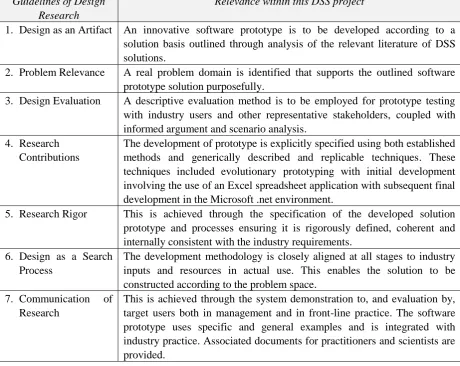
understanding can be helpful in guiding straightforward IT artifact design under this definition, because the main focus is in designing a new IT solution. In addition, Hevner et al. (2004) suggested that design science research must talk about the creation of an innovation and purposeful development for a specific problem domain. As such, the aforementioned authors recommended seven guidelines to help researchers in effectively conducting design science research.
Iivari (2007: 56) argued that “The primary interest of Information Systems lies in IT applications and therefore Information Systems as a design science should be based on a sound ontology of IT artefacts and especially of IT applications”. Further to this, Iivari (2007) argued that the IS in design
science builds from IT meta-artifacts that can support concrete IT application development. This implies that a collection of innovative IT artifacts can reinforce quality by creating effective designs to meet the needs of the users as well as being able to fulfil the process, users and situational requirements within organizations.
theories through the utilization of an artifact design, when an artifact is seen from a collective innovation perspective as a socio-technical design. We will be looking at the relevant components of this view of design science as a guiding principle for DSS artifact design.
In the light of the above discussion, we further extend our initial research question by adding a sub-question: What are the components of the design science method that are the key guiding principles for evaluating a DSS artifact in our context? To elaborate on this we discuss the relevant literature and methodology of our DSS design evaluative analysis in the following sections and subsequently show that a socio-technical design research view can fulfil the collective requirements of artifact design. Thus, the aim is to extend this design science understanding to our DSS development research.
3 Review of the relevant literature
IS design can be considered a socio-technical activity that looks at technology development and how it fits into the social system, with the object of benefiting the organization and its users (Iivari, 1991). Hirschheim and Iivari (1989) have identified this socio-technical activity and have related it to IS theory as either “technical systems with social implications or social systems only technically implemented”. In addition, Kling (2007) suggested that IS design should consider both the technical
and human-oriented perspectives in order to enhance the relevance of the design. Further categorization of the different approaches to IS design was conducted by Hirschheim and Klein (1989), in which they proposed four different philosophical paradigms to guide IS design research. These paradigms are: Functionalism, Social Relativism, Neohumanism and Radical Structuralism. According to Hirschheim and Klein (1989), Social Relativism is concerned with understanding the social systems from the perspective of the participants and takes the view that reality is not “an absolute but is socially constructed” (Hirschheim and Klein, 1989:1205). Mumford (1995) also suggested that the use of technology has clear social implications. These studies suggest that IS design should emphasize the key elements of the social systems in order to capture user and process needs. Orlikowski and Barley (2001), cited in Mackrell et al. (2009), reinforced the need for the approach, suggesting that “technologies are simultaneously a social and physical artefact” (Mackrell et al.
2009:144) in that users shape the “implications of technologies” and its properties. The research
strongly suggests that a combination of technologies and the human actor‟s reaction to the technology is of paramount importance in IS design and evaluation.
Under the socio-technical approach, many researchers argue that a user-focused approach is useful as a means of evaluating a user‟s active involvement in the development process (Checkland and Scholes, 1990; Mumford, 1995. The socio-technical framework has been used to construct DSS in the past, and examples of the approach can be found in the literature, for example Cox (1996). In addition, researchers such as Clarke, Coakes and Hunter (2003) have focused on the transfer-of-technology point of view when looking at IS and in particular DSS design, and they have identified industry-oriented DSS as a “socio-technical innovation”. In agricultural DSS development, McCown
(2001), Mackrell et al. (2009) and others have emphasized the value of both approaches. McCown (2002) introduced the socio-technical approach in his analysis of 12 DSS developed for rural industries in Australia. The socio-technical approach gained greater acceptance with the realization that the adoption rate of DSS was very low across a wide range of developed applications. For instance, Hayman and Easdown (2002) examined a standard DSS developed in the agricultural context and found that its adoption was low due to the lack of what they called „soft system thinking‟.
These authors defined „soft system thinking‟ as a way of engaging farmers with specific reference to
were used; 2) the DSS was being developed by researchers with the intention of discovering data relationships but not focusing on the practical solutions required by end-users; and 3) the DSS developers used their own problem solving strategies involving theoretical knowledge rather than trying to understand that farmers use practical knowledge for their problem solving. Walker (2002) argued that the non-adoption of the developed DSS often occurs due to perceived irrelevance, inflexibility and/or inaccessibility of the application by users. In addition there may be a lack of confidence by end-users in the use of the application. These views are also supported by Kerr (2004). Another factor reported by Fountas et al. (2006) suggests that farmers will most likely use information in ways not fully understood by researchers or advisors, and this is based on their unique experience and familiarity with their farm. Current DSS technologies do not support options that could enhance outcomes related to the above mentioned factors, nor do they allow farmers to use their own knowledge within the context of their specific problem. The indications lead to an appealing issue for addressing DSS design and evaluation within the socio-technical nature of the development.
Existing DSS evaluation methods focus on outcome and process oriented evaluation measures, and help identify benefits using criteria inherent within the developed DSS (Phillips-Wren,
Mora,
Forgionne and Gupta,
2009). These criteria emphasize the decision making role of the user only and not other social factors such as a desire to use the system as intended or the skill levels of the user (Wang and Forgionne, 2006). Even the latest evaluation model (Phillips-Wren et al., 2009) offers features for assessing decision support mechanisms only, rather than evaluating the DSS development as a whole. The design science concepts address this gap for designing and evaluating artifacts within social or natural settings, as design science theory supports broader requirements of evaluating the entire DSS development process both from user and process viewpoints (McKay and Marshall, 2007). The following sections will thus present the theoretical context of design science in order to support this need.4
Research method
For a DSS project to be relevant to the problem domain and therefore evaluated as being useful, development should represent the views of decision makers within the social and organizational context. Reasonably the evolutionary prototyping method has become the most popular method for DSS development, as this approach should aim to improve the decision process and outcomes for the decision maker, who should have a clear analytical understanding of the target decision task and support strategies for solving the problem (Arnott, 2006). Based on a behavioral design science and theory of congnitive bias, Arnott (2006) suggested that guidance be given to address DSS development needs.
directions. Through this principle, our aim in this study is to promote the utility of the socio-technical design science principles in IS design and evaluation, in particular for DSS.
The attempt is to identify the importance of using a design science framework to guide DSS development and evaluation through the use of two different schemes. The first is to examine the DSS development against established theories in the design science. The second is to identify the most relevant components in terms of the design artifact that relate to DSS design. The first aspect can be operationalized by using the dominant methodologies in design theories and frameworks by Hevner et al. (2004 and 2007) and Iivari (2007). This evaluation will look at a broader and diverse set of circumstances in design and will go beyond a technology-oriented design viewpoint. For the second aspect we apply the key components of socio-technical design science as defined by McKay et al. (2008). These components relate to problem solving, the product, the process, the intention, the planning, communication, user experience, the value of the artifact and professional practice. We therefore revisit our design findings through an evaluation that determines the key and essential components in socio-technical design method.
5
Industry-oriented DSS development
March and Smith (1995) define the IT/IS artifacts as system architecture, systems designs or software prototypes that are designed to demonstrate the applicability of the developed solution. In a recent study, Muntermann (2009) developed and evaluated a DSS solution based on a design-science research paradigm. That study was conducted using design science guidelines, and the solution prototype was evaluated by assessing the design value, offered to potential customers, based on Hitt and Brynjolfsson‟s (1996) evaluation framework. That evaluation framework is limited to the three broad dimensions of IT value, namely, does IT:
help increase productivity
improve business performance and
create value for users?
Beyond this work, we adapt Hevner‟s and Iivari‟s frameworks to guide and evaluate the industry-oriented DSS solution design outlined. In this section we aim to show that an IT artifact (in our problem context) can be pragmatically developed and effectively evaluated by employing Hevner‟s seven principles. At the same time we offer a prescriptive design methodology that is grounded in rigorous prior theory and is relevant in a practical sense.
orders for institutional buildings. In this DSS the two main components were a knowledge base and a decision support shell. The shell provided decision support through a process of building hierarchy, ratings and analytical-control rating techniques. However, the shell-based approach had limited options for modifying with both changing requirements from users and from a business perspective. These examples emphasize the need for flexibility in development with the ultimate aim of producing IT artifacts that can be evaluated as being useful to the currency of the problem domain.
In this study, we briefly describe the development of a method for industry-oriented DSS design which both addressed the requirements from an industry practitioner‟s perspective and accommodated industry oriented changes (for a more detailed description see Miah, Kerr and Gammack, 2009). We consider that this approach to development will lead to better outcomes for the final product because it involves a considered, staged approach based on design science principles. We will use this example as a test bed for the evaluation approach we are proposing. The problem domain chosen in this example is a rural industries problem related to the dairy industry, namely, milk protein enhancement from milking cows. This problem context was chosen because one of the authors had a great deal of experience in the area and an industry partner was able to be recruited to assist with development of the prototype. In addition, the problem domain was consided an appropriate test bed for the concerns outlined above because the decision making environment was rapidly changing with internal and external business oriented situations and there was a specific need to optimize decisions. The design solution was prototyped and thoroughly evaluated, and its generic utility for other domains was assessed by applying the design research guidelines shown later in this paper.
The example solution was based on a design platform, on which industry experts could build target-specific applications. For the milk enhancement prototype development, knowledge acquisition consisted of successful knowledge extraction and elicitation from multiple experts and this resulted in the identification of six main components (factors) relating to the problem domain. These six factors limited a farm‟s ability to maximize their potential with respect to milk protein and were used as building blocks for the problem ontology. The milk protein example solution had two functions: firstly it allowed domain experts to build a knowledge base using established, peer-reviewed parameters, and secondly, it allowed end users to build their own decision support tool based on their own personal contextual settings from their own farm.
The generic system consists of three key modules, namely, a base module, a problem ontology module and an expert system development module. The base module holds the decision making parameters table that is populated and maintained by the domain expert through the expert system development module, while the problem ontology module allows for the development of a particular decision making context. For example, a farmer (end-user) can nominate a level of milk protein increase based on his/her available resources.
6
Design research
Hevner et al. (2004 :76) stated that “the design science paradigm seeks to extend the boundaries of human and organisational capabilities by creating new and innovative artefacts”. In the design
Guidelines of Design Research
Relevance within this DSS project
1. Design as an Artifact An innovative software prototype is to be developed according to a solution basis outlined through analysis of the relevant literature of DSS solutions.
2. Problem Relevance A real problem domain is identified that supports the outlined software prototype solution purposefully.
3. Design Evaluation A descriptive evaluation method is to be employed for prototype testing with industry users and other representative stakeholders, coupled with informed argument and scenario analysis.
4. Research Contributions
The development of prototype is explicitly specified using both established methods and generically described and replicable techniques. These techniques included evolutionary prototyping with initial development involving the use of an Excel spreadsheet application with subsequent final development in the Microsoft .net environment.
5. Research Rigor This is achieved through the specification of the developed solution prototype and processes ensuring it is rigorously defined, coherent and internally consistent with the industry requirements.
6. Design as a Search Process
The development methodology is closely aligned at all stages to industry inputs and resources in actual use. This enables the solution to be constructed according to the problem space.
7. Communication of Research
This is achieved through the system demonstration to, and evaluation by, target users both in management and in front-line practice. The software prototype uses specific and general examples and is integrated with industry practice. Associated documents for practitioners and scientists are provided.
Table 2: Hevner et al.(2004: 83)‟s seven guidelines for design research
The outcomes from the seven guidelines can provide a step-by-step map of activities that are essential in conducting design research. Apart from this, it is important to conduct design research by having a sound ontology and epistemology of the design artifacts or knowledge process.
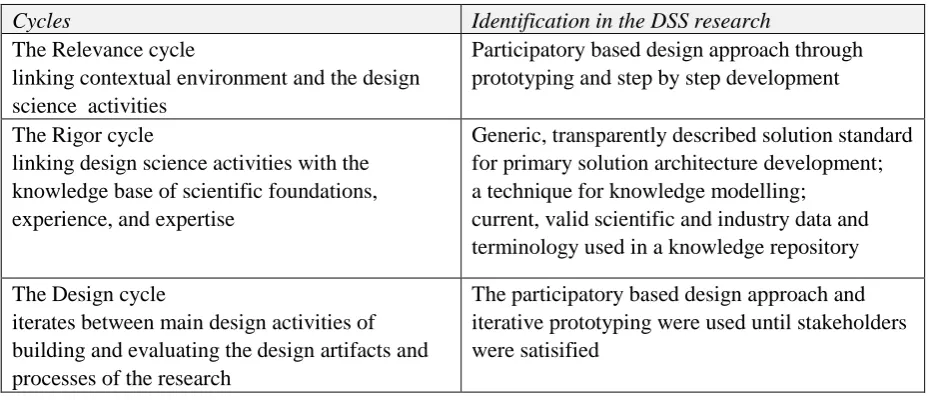
The guidelines of Hevner et al. (2004), however, appeared to be deficient, by not identifying a diverse range of IS design activities and influences and, by extension, evaluation from a social and organizational view (which is the obvious reality for the industry-oriented application design). In fact, the guidelines focus mainly on technical factors for artifact design. Clearly, in this case, there is a need for constructive research methods in artifact design as described by Iivari (2007). In response, Hevner (2007) analyzed design research through three related cycles of activities to distinguish the position of design research from other research paradigms. We now describe the DSS development process through these activity cycles.
Cycles Identification in the DSS research
The Relevance cycle
linking contextual environment and the design science activities
Participatory based design approach through prototyping and step by step development
The Rigor cycle
linking design science activities with the knowledge base of scientific foundations, experience, and expertise
Generic, transparently described solution standard for primary solution architecture development; a technique for knowledge modelling;
current, valid scientific and industry data and terminology used in a knowledge repository
The Design cycle
iterates between main design activities of building and evaluating the design artifacts and processes of the research
The participatory based design approach and iterative prototyping were used until stakeholders were satisified
Table 3: The three cycles of design research (adapted from Hevner, 2007)
The cycles of the activities illustrate the key performance indicators of design research and proved a good way to monitor and assess the research process. Although the cycles link the science and practical actions oriented to the problem domain, they do not address the requirements for identifying the nature of the knowledge needed. We still need to know what type of knowledge that is either acquired or produced as outcomes from design research to support a sound ontology in an IS design context.
Carlsson (2007) explained that Hevner‟s et al. (2004) work, as well as similar works by March and Smith (1995), Cao et al. (2006) and Walls et al. (1992), only offer methodologies for innovating new IT artifacts design. Similar discussions can be seen in a recent study by McKay, Marshall and Heath (2008).
McKay et al. (2008) conceptualized the design of IS artifacts into ten dimensions: problem solving, product, process, intention, planning, communication, user experience, value, professional practice, and service. This view encourages us to rethink our whole DSS development activities in a broader way, because it is important that an IS design should be evaluated from these cross-disciplinary viewpoints in an industry situation where the processes can be viewed as „open systems‟, so many soft
factors are involved, and many of these can contribute to IS failure (Montealegre and Keil, 2000; McKay and Marshall, 2007). The „open systems‟ theory is “a set of concepts and relationships that describes the properties and behaviours of the things called systems – organisation, groups and people … systems can be viewed as unitary wholes composed of parts or subsystems; they serve to integrate the parts into a functioning unit” (Waddell, Cummings and Worley, 2008:81). This open
As indicated earlier, our findings suggest that the emphasis needs to be placed on the problem domain in terms of the pre-design activities rather than only on the solution design relating to a specific problem. This is because most of the time during DSS development, the solutions need to be outlined from an unstructured or semi-structured specific-problem space and the decision makers subjective preferences (Kerr, 2004). One of the most significant design decisions is to allow for contextual situations. As such, the conceptualization of the design at an early stage is relevant to DSS problem solving and eventual evaluation. As Boland, Collopy, Lyytinen and Yoo (2008) indicate, it is a means of ordering the problem world and is a way of defining problems, meeting users‟ needs and desired improvements.
Mackrell et al. (2009) demonstrated that user experience was important in developing DSS applications and how design is created and how it added value for target users. In their study, the DSS was assumed to be used as designed, but in fact many end-users were using the system differently to the intended purpose. In our DSS study we have introduced a method that has the potential to create a different, more useful approach to DSS design. As defined in McKay et al. (2008), design should be valued by the target users, and this has been achieved and reviewed through the target users‟ feedback through evolutionary prototyping. Wangelin (2007), (cited in McKay et al. 2008), describes design in terms of its professional practices. That is an attitude to a problem in which the designer‟s prior knowledge and experiences can be useful and can be applied to design development to address problem situations. Our DSS design was informed through an established design theory called „tailorable design theory‟ (Germonprez, Hovorka and Collopy, 2007). This is where a design is categorized into two states, namely: primary design, the professional solution model to address the problem, and secondary design, the user‟s tailorable options. In using this approach, users can modify primary features in order to adapt the system into their problem context.
Iivari (2007) proposed an ontology framework for the design science based on Popper‟s (1978) „three worlds‟ views, in which the nature of design artifacts, consciousness, mental states of artifacts and human social actions on artifacts can be described as part of IS design. Table 4 illustrates the identification of the activities in our DSS development project.
Explanation Examples Identification in our DSS research
Nature of design artifacts
Evaluation of IT artifacts against natural phenomena
Industry experts ensured the correctness of the decision making rules evaluated with their practice-based knowledge
Consciousness and mental states
Evaluation of IT artifacts against perceptions, consciousness and mental states
The proposed DSS solution has been evaluated with key decision makers and the industry higher authorities
Human social actions Institutions Theories • IT artifacts • IT applications • meta IT artifacts
Evaluation of organizational information systems New types of theories made possible by IT artifacts
Evaluation of the performance of artifacts comprising embedded computing
The proposed solution has been standardized with the other similar known IS solutions
Table 4: Ontology of design science (adapted from Iivari, 2007)
Iivari (2007) described the epistemology of design science research by three types of knowledge: conceptual knowledge, in terms of creating concepts or constructs, descriptive knowledge, in terms of observational facts, and prescriptive knowledge, in terms of design product and process or rules-based knowledge. We focused on the conceptual knowledge creation in our DSS project because a new conceptual solution model is being evaluated within the real industry context. Iivari (2007) also described the importance of using constructive research methods for guiding the process of building IT meta-artifacts to solve real industry problems. Accordingly, we developed a constructive development method by combining a domain ontology development view with prototyping under the participatory design approach. Iivari (2007) maintained that IS development in design science is not value-free and, whilst our development was superficially a „means to an end‟, the design environment structure was inherently value-free, in that it provided a meta-artifact to support development of user-centric and industry-specific IS applications.
7
Key lessons
Iivari (2007: 55 and 56) maintained that IS, as a design science research, “builds IT meta-artefacts that support the development of concrete IT applications and the resulting IT meta-artefacts essentially entail design product and design process knowledge”. Throughout the analysis we found
that DSS applications development for industry was effectively a meta-artifact design as it involves design knowledge from a range of viewpoints such as product, process, problem solving and decision maker‟s need. As such, the design process, product or problem solving knowledge should be clearly demonstrated before the development. In addition, Purao and Storey (2008) argued that effective IS design requires not only innovative design methods in use, but also willingness of developers to incorporate the innovations into their design practices. This approach should be useful in any industry-oriented IS design where the key users/decision makers are those who may decide how the design needs to work and what context of use is required for the design. Key lessons learned from this analysis concern the use of a broader methodological view for IS development under a design science research paradigm. This is important for DSS development specifically as the focus is on the decision makers‟ needs as well as processes, problem solving method in use, and its outcomes.
The DSS development strategy should also address an industry context and the requirements for a complete view of solution development and evaluation. Hevner et al. (2004) and Hevner (2007), when included with other similar studies (March and Smith, 1995; Cao et al., 2006; and Walls et al., 1992), address the technical requirements for design rather than focusing on a complete view of how the IT design artifacts will be implemented, instantiated and evaluated within a real organizational context. However, studies such as Iivari (2007), McKay et al. (2008), and Carlsson (2007) suggest the need for a comprehensive and relevant view for addressing the requirements of effective DSS development within an industry context. In our example, we used the ten dimensions of artifact design as they can be seen as checkpoints to address design and evaluation needs, not only from an engineering angle, but also from a human and social perspective, under a socio-technical paradigm.
8
Concluding remarks
new IT artifacts are designed. This view shows clear and defined activity-based guidance for innovative artifacts design. However, we consider the second view to be more appropriate for DSS development and evaluation as it leads to a socio-technical appreciation within the artefect design. This is vital in order to have a product that is relevant in an organizational and social context. The socio-technical view in design science enables a broader development context providing diversity for the innovation of a complete solution that can add value to the organization and its people. The application of this approach is significant for such development in which human-centric views need to be implemented. This understanding can contribute to the body of design science knowledge, especially for addressing the requirements of industry-oriented DSS development.
The research question for this study was “How can a broader view of socio-technical design science contribute in a DSS application design and evaluation?” We have addressed this question by
identifying a multifaceted approach to design science that captures both the engineering requirements of the design as well as the socio-technical aspects that are important when human-centric views need to be considered (as is the case with most DSS applications). If a soley technical, engineering approach is taken, we are in danger of an increasing numbers of end-users either not using the developed systems or using the system in a different way to that intended by the developers (as indicated by Mackrell et al., 2009). The work undertaken by Orlikowski (2000) is still relevant in this area and the „technology-in-practice‟ model epitomizes a primary concern of DSS development,
namely, the use of applications as intended or, even more importantly, whether systems are used at all.
One aim of this paper was to position DSS development research within the design science paradigm. We identify key socio-technical components that are vital to evaluate and design DSS application. Arnott and Pervan (2008) suggested that DSS development research needs to improve its quality and relevance. In light of this we have described how the socio-technical view within design science addresses this need. By relating Hevner‟s three cycles to the calls for a more solid theoretical foundation for design science, we have shown how the pragmatic requirements can be accommodated within a larger, socio-technical design that attends to the meta-artifactual areas identified by Iivari (2007) and Carlsson (2007).
References
Arain, F.M. and Pheng, L.S. (2006). “Knowledge-based decision support system for management of variation order for institutional building projects”, Automation in Construction, 15: pp. 272-291.
Arnott, D. (2004). “Decision support systems evolution: framework, case study and research agenda”, European Journal of Information Systems,13: pp. 247-259.
Arnott, D. (2006). “Cognitive biases and decision support systems development: a design science approach”, Information Systems Journal, 16: pp. 55–78
Arnott, D. and Pervan, G. (2008). “An assessment of DSS design science using the Hevner, March, Park, and Ram guidelines”, The 4th Biennial ANU Workshop on Information Systems Foundations, Information Systems Workshop, Australian National University, Canberra, Australia, pp. 1-22
Botts, N., Schooley, B. and Horan, T.A. (2008). “Learning object development and repository design for digital government instruction”, The Proceedings of the 41st Hawaii International Conference on System Sciences, USA: pp. 1-10.
Cao, J., Crews, J.M. and Lin, M. (2006). “Interactions between system evaluation and theory testing: a demonstration of the power of a multifaceted approach to information systems research”, Journal of Management Information Systems, 22 (4): pp. 207-235.
Carlsson, S.A. (2006). “Design science research in information systems: a critical realist perspective”, 17th Australasian Conference on Information Systems, 6-8 Dec, Adelaide, Australia. (URL: http://www.ejbrm.com/vol3/v3-i2/v3-i2-art1-carlsson.pdf, Accessed: 12 Dec, 2009).
Carlsson, S.A. (2007). “Developing knowledge through IS design science research: for whom, what type of knowledge, and how?,” Scandinavian Journal of Information Systems, 19 (2): pp. 75-86.
Checkland, P. B. and Scholes, J. (1990). “Soft Systems Methodology in Action”, West Sussex, England: John Wiley & Sons, Ltd.
Clarke, S., Coakes, E. M. and Hunter, G. (2003). “Socio-technical and human cognition elements of information systems”, Idea Group Inc (IGI).
Cox, P.G. (1996). “Some Issues in the Design of Agricultural Decision Support Systems”, Agricultural Systems, (52): pp. 355-381.
Davenport, T.H. and Harris, J.G. (2007). “Competing on analytics: the new science of winning”, Harvard Business School Publishing Corporation, USA.
Fountas, S., Wulfsohn, D., Blackmore, B.S., Jacobsen, H.L., and Pedersen, S.M. (2006). “A model of decision-making and information flows for information-intensive agriculture”, Agricultural Systems, (87:2):pp. 192-210.
Germonprez, M., Hovorka, D. and Collopy, F. (2007). “A theory of tailorable technology design”, Journal of the Association for Information Systems, (8): pp. 351–367.
Gregg, D., Kulkarni, U.R. and Vinze, A.S. (2001). “Understanding the philosophical underpinnings of software engineering research in information systems”, Information Systems Frontiers, 3 (2): pp. 169-183.
Gregor, S. and Jones, D. (2007). “The anatomy of a design theory”, Journal of the Association for Information Systems (8:5): pp. 312.
Hayman, P.T. and Easdown, W.J. (2002). “An ecology of a DSS: reflections on managing wheat crops in the North-eastern Australian grains region with WHEATMAN”, Agricultural Systems, (74): pp. 57-77
Hevner, A. (2007). “A Three Cycle View of Design Science Research”, Scandinavian Journal of Information Systems, 19 (2): pp. 87-92.
Hevner, A. (2008). “Design science research in information systems: try-cycles and hula hoops”, Key note, The 4th Biennial ANU Workshop on Information Systems Foundations, Information Systems Workshop, Australian National University, Canberra, Australia. Hevner, A., March, S., Park, J. and Ram, S. (2004). “Design science in information systems
research”, MIS Quarterly, 28 (1): pp. 75-105.
Hirschheim, R and Klein, H.K. (1989). “Four paradigms of information systems development”, Communication Journal of ACM, 32 (10): pp. 1199-1216.
Hitt, L.M. and Brynjolfsson, E. (1996). “Productivity, business profitability, and consumer surplus: three different measures of information technology value”, MIS Quarterly, 20 (2): pp. 121–142.
Iivari, J. (2007). “A paradigmatic analysis of information systems as a design science”, Scandinavian Journal of Information Systems, 19 (2): pp. 39-64.
Kerr, D.V. (2004). “Factors influencing the development and adoption of knowledge based decision support systems for small, owner operated rural businesses”, Artificial Intelligence Review, 22 (2): pp 127-147.
Kerr, D. and Winklhofer, H. (2006). “The effect of rapid rural industry changes on the development of a decision support system for dairy farmers in Australia”, Computers and Electronics in Agriculture, 50: pp. 61-69.
Kling, R. (2007). “What is social informatics and why does it matter?”, The Information Society, 23: pp. 205–220.
Mackrell, D., Kerr, D. and von Hellens, L. (2009). “A qualitative case study of the adoption and use of an agricultural decision support system in the Australian cotton industry: the socio-technical view”, Decision Support Systems, 47: pp. 143-153.
March, S.T. and Smith, G. (1995). “Design and natural science research on information technology”, Decision Support Systems, 5 (4): pp. 251-266.
McKay, J. and Marshall, P. (2005). “A review of design science in information systems, Proceedings of the Australasian Conference on Information Systems, B. Campbell, J. Underwood and D. Bunker (eds.), Sydney, Australia, pp. 1-11.
McKay, J. and Marshall, P. (2007). “Science, design and design science: seeking clarity to more design science forward to information systems”, The 18th Australasian Conference on Information Systems, Sydney, pp. 1-11.
McKay, J., Marshall, P. and Heath, G. (2008). “An exploration of the concept of design in information systems”, The 4th Biennial ANU Workshop on Information Systems Foundations, Information Systems Workshop, Australian National University, Canberra, Australia.
Miah, S.J. (2008). “An ontology based design environment for rural decision support”,Unpublished PhD Thesis, Griffith University, Brisbane, Australia.
Miah, S.J., Kerr, D. and Gammack, J. (2006a). “Development of a design environment for end users to build the target-relevant decision support tools in rural industry”, Proceedings of the QualIT2006 International Conference, 27-29 Nov 2006, Brisbane, Australia, pp.75-85. Miah, S.J., Kerr, D. and Gammack, J. (2006b). “A design environment ontology for
stakeholders-developed decision support tools in the Australian dairy industry”, Proceedings of the 17th Australasian Conference on Information Systems (ACS‟2006), 6-8 Dec 2006, Adelaide, Australia (URL: http://aisel.aisnet.org/acis2006/16, Accessed on September 21, 2010)
Miah, S.J., Kerr, D. and Gammack, J. (2009). “A methodology to allow rural extension professionals to build target-specific expert systems for Australian rural business operators”, Journal of Expert Systems with Applications, (36): pp. 735-744.
Miah, S.J., Kerr, D., Gammack, J. and Cowan, R.T. (2008). “A generic design environment for the rural industry knowledge acquisition”, Knowledge Based Systems, 21: pp. 892-899. Miller, W.R. (2004). “Definition of Design”, (URL:
http://static.userland.com/rack4/gems/wrmdesign/DefinitionOfDesign1.doc, Accessed: September 20, 2010).
Montealegre, R. and Keil, M. (2000). “Deescalating information technology projects: lessons from Denver international airport”, MIS Quarterly, 24 (3): pp. 417-447.
Muntermann, J. (2009). “Towards ubiquitous information supply for individual investors: a decision support system design”, Decision Support Systems, 47: pp. 82-92.
Orlikowski, W. (1992). “The duality of technology: rethinking the concept of technology in organisations”, Organisation Science, 3 (3): pp. 398–427.
Orlikowski, W. (2000). “Using technology and constituting structures: a practice lens for studying technology in organizations”, Organization Science, 11 (4): pp. 404–428. Orlikowski, W. and Baroudi, J. (1991). “Studying Information Technology in Organizations:
Research Approaches and Assumptions”, Information Systems Research, 2(1): pp. 1-28. Orlikowski, W. and Iacono, C. (2001). “Desperately seeking the "IT" in IT research – a call to
theorizing the IT artifact”, Information Systems Research 12 (2): pp. 121-134.
Phillips-Wren, G., Mora, M., Forgionne, G.A. and Gupta, J.N.D. (2009). “An integrative evaluation framework for intelligent decision support systems”, European Journal of Operational Research, 195: pp. 642- 652.
Popper, K. (1978). Three Worlds, the Tanner Lectures on Human Values, delivered at the University of Michigan, Department of Philosophy, Potsdam, Germany.
Purao, S. and Storey, V.C (2008). “Evaluating the adoption potential of design science efforts: the case of the APSARA”, Decision Support Systems, 44: pp. 369-381.
Samaras, G.D., Matsatsins, N.F. and Zopounidis, C.A. (2008). “Multicriteria DSS for stock evaluation using fundamental analysis”, European Journal of Operational Research, 187: pp. 1380-1401.
Simon, H. (1996). The Sciences of the Artificial, Third Edition. Cambridge, MA, MIT Press. Vaishnavi, V. and Kuechler, W. (2007). “Design research in information systems,” Online
materials, 2007. (URL:http://www.isworld.org/Researchdesign/drisISworld.htm, Accessed: Feb 20, 2010).
Venable, J.R. (2006). “The role of theory and theorising in design science research”,
Proceedings of the DESRIST Conference, School of Information Systems, Curtin University of Technology, Perth, Western Australia.
(URL::http://ncl.cgu.edu/designconference/DESRIST%202006%20Proceedings/2A_1.pdf Accessed: July, 20 2010)
Waddell, D.M., Cummings, T.G. and Worley, C.G. (2008). Organisation Development and Change Asia Pacific”, Third Edition, Cengage Learning, Australia.
Walker, D.H. (2002). “Decision support, learning and rural resource management”, Agricultural Systems, (73): pp.113-127.
Walls, J.G., Widmeyer, G.R. and El Sawy, O.A. (1992). “Building an information system design theory for vigilant EIS”, Information Systems Research, 3 (1): pp. 36-59.
Walls, J.G., Widmeyer, G.R. and El Sawy, O.A. (2004). “Assessing information system design theory in perspective: how useful was our 1992 initial rendition?”, Journal of Information Technology Theory and Application, 6 (2): pp. 43-58.
Wangelin, E. (2007). “Matching bricolage and hermeneutics: a theoretical patchwork in progress”, Design Semiotics in Use, SeFun International Seminar, Helsinki, Finland. Wang, Y. and Forgionne, G. (2006). “A decision-theoretic approach to the evaluation of