1277 | P a g e
Improved Fuzzy C-Means Algorithm for Background
Removal
Suhas Katkar
1, M.M.Raste
21,2
Department of Electronics & Telecommunication Engineering
Annasaheb Dange College of Engineering and Technology, Ashta (India)
ABSTRACT
Background removal is an application of image segmentation. There are many methods for image segmentation.
In this paper, Fuzzy C-Means (FCM) is used for the image segmentation. In this paper, the clusters centroid is
given as input from the histogram of the image. These inputs are updated and passed through FCM algorithm to
get segmented images. The segmented images are added to remove the background part with the black color.
The morphological operation is performed on the background removed image to improve the quality.
Keywords
-
Fuzzy C-means Clustering, Fuzzy C-Means Algorithm, Image Segmentation,
Background Removal.
I. INTRODUCTION
Background removal is an important technique to analyze objects contained in an image. That’s why; it has
wide range of application such as robot vision, object recognition, medical image processing, image analysis,
remote sensing and geographical information system [1, 2, 3]. Although a lot of techniques have been defined
for background removal but it is still a challenge because of overlapping intensities, low contrast of images and
noise perturbation. Although the FCM algorithm usually performs well with non-noise images, it is still weak in
imaging noise, outliers and other imaging artefacts. This may be caused by two aspects: one is the usage of the
non-robust, Euclidean distance function which is not robust under noise perturbations, and the other does not
pertain to any information about spatial context [4].
The cluster analysis divides the input data into groups or clusters depends on some similarity criterion. Some
similarity measures are distance, connectivity, and intensity. The hence performed partition enables human
being in more quantitative decision making and understanding [5].
The benefit of using similarity measure is to attain the more accurate clusters formation. Two types of clustering
methods are there for the formation of clusters: First one is Hard Clustering and the other one is Soft/Fuzzy
Clustering. In case of Hard Clustering, the input data is divided into a number of different clusters, where each
element of input data belongs to exactly one cluster whereas in case of soft clustering, the input data elements
belongs to more than one clusters with a degree of some membership value. Areas of applications of fuzzy
cluster analysis include data analysis, pattern recognition, background removal and image segmentation [6, 7].
There are many clustering algorithms such as K-means, ISODATA, and Fuzzy c-means (FCM). FCM is one of
the partition based clustering algorithms used for background removal. The FCM algorithm has the following
1278 | P a g e
1. Number of groups need to identify in the resultant image.2. By changing the set of initial centroids for grouping, the resulting image will change. [8]
II. FUZZY C-MEANS ALGORITHM
Fuzzy C-means (FCM) clustering algorithm is a partition-based clustering algorithm where, each pixel in the
image has a membership value associated to each cluster, ranging between 0 and 1. This membership value
measures how much the pixel belongs to that particular cluster. It is an iterative partitioning method that
produces ideal c-partitions and cluster centers which are centroids. The FCM algorithm minimizes generalized
function ‘J’ and is calculated as follows,
Where, X= {X1, X2, X3…XN} be the pixels in an image, n is the number of pixels, Cj is the center of cluster j, k
is the number of clusters, µij is the degree of membership of Xi in the cluster j, m is the weighting exponent
where m ϵ [1, ∞]. Let V= {V1, V2…VK} be the set of cluster centers then the detailed FCM algorithm is as given
below,
1. Randomly select k cluster centers.
2. Create a random fuzzy membership uij such that the sum of all membership function is unity that is
3. Compute each cluster centroid Vi
4. Update the membership matrix U(k) to U(k+1) using U(k+1)=[µ(k+1)ij]
Where, ni is the number of pixels belonging to the cluster of centroid Ci and Xj is the pixels belonged to cluster
Ci.
5. If ||U(k)-U(k+1)||< Threshold then stop, otherwise return to step 3.
The time complexity of the algorithm is O(N) where N is the number of pixels in the image. However, the FCM
algorithm suffers from several disadvantages; such as priori specification of number of clusters, huge execution
time due to its iterative nature and Different choice of µij leads to different local minima ‘J’, which could lead to
poor results. Different combination of centroids and random selection will give different results [9].
III. PROPOSED METHODOLOGY
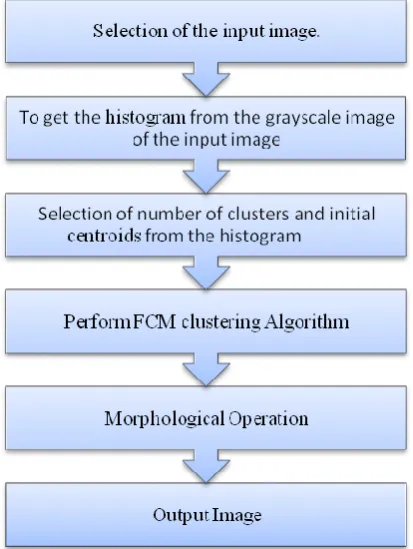
The proposed methodology includes the selection of image. The selected image is converted into grayscale
image. This grayscale image is used to find the histogram which is helpful in selection of cluster centroid. The
1279 | P a g e
vary from image to image. All the selected centroids update its location to the suitable position by using themembership function. These updated cluster centroids is used in FCM algorithm for clustering purpose. The no.
of clusters is equal to the no. of centroids selected from the histogram. The suitable clustered images are added
to get the desired result. The clusters related to object in the image remain as it are and the rest clusters pixel
values is brought to zero for background removal purpose. 2-D median filtering and image filling is performed
as morphological operation to get the enhanced and better output. The morphological operations are performed
to the resultant image for clearer and better quality.
Figure 1: Block diagram of Proposed Method
IV. RESULTS AND DISCUSSIONS
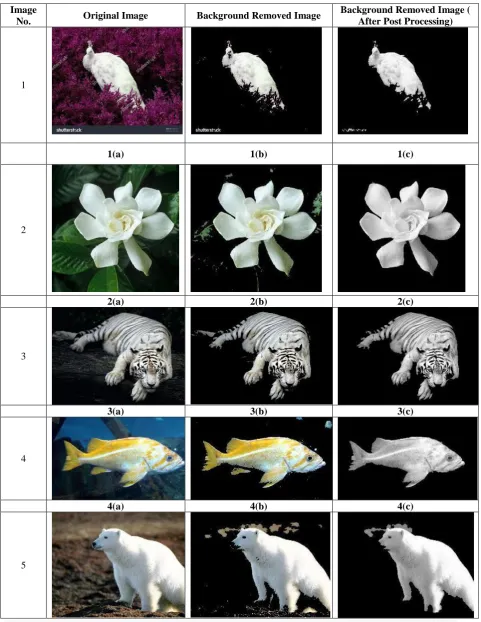
The table below describes completely the results of method proposed in the paper. Experimentation on eight
different images namely peacock, flower, tiger, fish, bear, yellow flower, parrot and elephant for background
removal was carried out. All these eight images are having different backgrounds. In this paper, we have
focused mainly on the background part. This is the reason to select different images with different backgrounds.
The column of table is showing original, background removed and post-processed background removed image.
The first image is itself a raw image on which above methodology is implemented. The second image is the
background removed image and the third image is the image after post-processing of background removed
image. It has been analyzed that the third image is black and white image. It is so because the post processing
gives best results for binary images. That is the reason the post processing is performed on the background
removed image after converting it into binary image. It has been observed that the some part of the desired
portion of image is also removed. This is because those missed pixels belong to the undesired cluster. The
1280 | P a g e
background removal purpose. This method is finding its suitability in the entertainment field, military purposesand many other applications.
Table 1: Experimental results performed on eight images
Image
No. Original Image Background Removed Image
Background Removed Image ( After Post Processing)
1
1(a) 1(b) 1(c)
2
2(a) 2(b) 2(c)
3
3(a) 3(b) 3(c)
4
4(a) 4(b) 4(c)
1281 | P a g e
5(a) 5(b) 5(c)
6
6(a) 6(b) 6(c)
7
7(a) 7(b) 7(c)
8
8(a) 8(b) 8(c)
V. CONCLUSION
It is concluded that above proposed FCM algorithm is better suitable for background removal and image
segmentation purpose. The results show that the proposed method is clearly removes the background part of the
image to get the object. In addition, the proposed clustering algorithm is relatively fast and accurate. The
different kind of images supports the methodology. The above results are showing the capability of the proposed
method.
VI. FUTURE SCOPE
The above method is further improved for the adaptive methodology. In adaptive methodology, any kind of
images can be considered and the selection of different algorithm will be done as per the image. It will improve
the segmented image quality.
REFERENCES
[1] A. Singh, Review article digital change detection techniques using remotely-sensed data. International
journal of remote sensing, 10(6), 1989, 989-1003.
[2] K S Chuang, HLTzeng, S Chen, J Wu, T J Chen, Fuzzy c-means clustering with local information and
1282 | P a g e
[3] K.S.Chuang, H. L. Tzeng, S. Chen, J. Wu,, & T. J. Chen, Fuzzy c-means clustering with spatialinformation for image segmentation. computerized medical imaging and graphics, 30(1), 2006, 9-15.
[4] Y. Zheng, B. Jeon, D. Xu, Q. M. Wu, & H. Zhang, Image segmentation by generalized hierarchical fuzzy
C-means algorithm. Journal of Intelligent & Fuzzy Systems, 28(2), 2005, 961-973.
[5] R. Xu, & D. Wunsch, Clustering (Vol. 10). ( John Wiley & Sons, 2008)
[6] P. Berkhin, A survey of clustering data mining techniques. Grouping multidimensional data, 25, 2006, 71.
[7] S. Krinidis, & V. Chatzis, A robust fuzzy local information C-means clustering algorithm. IEEE
Transactions on Image Processing, 19(5), 2010, 1328-1337.
[8] D. L. Pham, & J. L.Prince, An adaptive fuzzy C-means algorithm for image segmentation in the presence of
intensity inhomogeneities. Pattern recognition letters, 20(1), 1999, 57-68.
[9] A. Pugazhenthi, G. Sreenivasulu, & A. Indhirani, Background removal by modified fuzzy C-means
clustering algorithm. In Engineering and Technology (ICETECH), 2015 IEEE International Conference