66 | P a g e
EFFECT OF LIME SLUDGE ON STRENGTH OF
CONVENTIONAL CONCRETE
Md. Mujtaba
1, Maqsoodalimalik
2, KushagraTiwari
3, MahtabAlam
4(
1,2,3,4Civil Engineering, NIET, Greater Noida, Uttar Pradesh, India)
ABSTRACT
Conventional concrete is the mixture of cement , sand , aggregates and water which is used for various
construction purposes. Production of constituents of . Conventional concrete causes high carbon emission in
atmosphere .so we will partially replace its constituents with lime sludge In this experiment we will be testing
strength of conventional
concretecube by replacing cement and sand with lime sludge at different percentage of replacement . We will
betesting flexuralas well as compressive strength of concrete cube after curing it with H2SO4 and HCL individually for 28 daysBy carrying different tests and comparing the results , we will find the optimal
replacement percentage which will give better strength results than conventional concrete cube , percentage at
which flexural strength , compressive strength and durability is maximum
keywords :
compressive strength,concrete, flexural strength,lime sludge
I.INTRODUCTION
Lime sludge is the residual waste obtained from sugarcane, acetylene, soda ash industries. Around 4.5 million
tons of
lime sludge is generated from these industries which causes serious disposal issues .Open disposal of lime
sludge also promotes environmental pollution . These residual waste could be beneficially used for various
purposes like stabilization of soil and improving strength of concrete by partial replacement of sand .Lime
sludge behave like cement because of silica and magnesium properties, which improves the setting of concrete.
So it could be used as partial replacement of sand in concrete. In context of low availability of non renewable
energy resources coupled with the requirement of large amount of energy for building material , the importance
of using industrial waste cannot be underestimated. It will cut down carbon emission and also will save energy.
The lime sludge obtained from sugar factory normally contains calcium carbonate and small amount of free
lime. Hence lime sludge can be utilized in concrete and in construction industry. In this work, it has been
planned to use it in concrete with the partial replacement of sand by using lime sludge added as an additional
ingredient in different proportions to enhance the binding property of concrete
The experimental studies are conducted for durability characteristics of concrete and flexural strength of
67 | P a g e
2. MATERIALS USED
Cement
cement is a binding material in concrete which is used is used in all building elements .Generally ordinary
Portland cement is used
Sand
sand is either round or angular grains and often foundmixes in various gradation of fineness. Specific gravity
of sand is 2.64. It constitutes about 26% of total volume
Course Aggregate
These are inert or chemically inactive materials which form the bulk of cement concrete. The aggregates are
bound together by means of cement. It constitutes about 41% of cost of concrete
Water
Portable water is used for this work .Excess of acidity or alkalinity in water is to be avoided .It should be free
from oils,acids , organic and inorganic impurities
Lime sludge
Solid residue is obtained from various industries .Free lime is being added in sugar processing for cleaning the
juice. The residue obtained along with some soil and cane pith is called lime sludge . It contains small
percentage of free lime whichhas binding property
3. SCOPE OF PRESENT INVESTIGATION
One of the major challenges of our present society is the protection of environment . Due to growing
structures cement and natural aggregates availability is relatively reduced . Some of important elements in this
respect are the reduction of consumption of energy and natural raw materials. These topics are getting
considerable attention under sustainable development nowadays
Recently good attempts has been made for successful utilization of various industrial by products like lime
sludge , fly ash in concrete
In addition to this , an alternative source of potential replacement of natural aggregates in natural concrete has
gained good attention due to reduction in sources . As a result there is increased need to identify
substitutesmaterials to aggregates and cement in the production of concrete
The work is mainly focused on finding the effect of lime sludge on strength of conventional concrete as partial
replacement of cement and fine aggregates which helps to reduce some percentage of environmental effects and
reduce the impact of waste materials on environment
4. OBJECTIVES
To find out the percentage use of admixture feasible for construction
To compare the results of various tests conducted on concrete at different proportions by using lime sludge
68 | P a g e
safe construction
To study the influence of hardened properties of concrete such as compressive strength and quality and
grading of concrete when lime sludge is used in the concrete mixes to reduce the cost of concrete
production
5. PREVIOUS WORKS AND THEIR RESULTS
5.1.Detailed investigation on concrete using lime sludge from sugar industry
By Marimuthu and Jose Ravindra Raj
They used M20 grade of concrete with mix ratio 1:1.5:3 . The sand is replaced by0% to 30% with an increment
of 5% The properties studied included durability test such as acid resistance and flexural strength for various
percent ofreplacement of sand by lime sludge For flexural strength test prism of standard size was casted and
cured for 28 days
and test is done as per IS 516: 1956 specifications and results obtained are shown in table below
Table 5.1.1( average flexural strength at different percent replacement )
69 | P a g e
Graph 5.1.2Average compressive strength of concrete different % replacement of cement with limesludge (H2SO4 curing)
5.2 study of effect of lime sludge and silica fume on strength of concrete
By vijay pal and Er. R P Mahla,OITMhissar , Haryana , India
They studied effect of lime sludge and silica fume at different % replacement on strength of conventional
con-crete The quantity of different ingredients was determined by making 6 cubes so that 3 cubes are tested after 7
days and 3 cubes were tested after 28 dayFirst ofall, cubes with ingredients determined above were casted and
then sand was partially replaced by lime sludge. First 10percent of lime sludge was added as partial replacement
of fine aggregate and then 20 percent of sludge was added as partial replacement of fine aggregate.In order to
study the compressive strength when lime sludge and silica fume were partially added as a replacement of fine
aggregate and silica fume respectively, the cubes containing different quantities of lime sludge and silica fume
were casted and kept for curing for 7 and 28 days. The test was conducted on UTM (Universal Testing
Ma-chine) and following results were obtained.
70 | P a g e
5.3Durability and strength character of concreteusing lime sludge and fly ash as partial replacement offine aggreagate
By S. Sudha, Sree Rama Engineering College, Tirupathi, Andhrapradesh
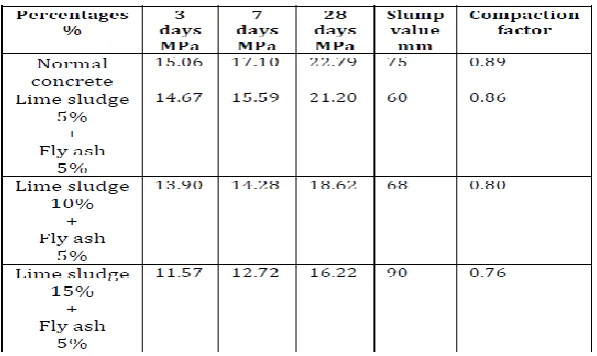
In this study, concrete cubes have been cast by replacing fine aggregate (0% and 5%) with fly ash and cement
with (0%, 5%, 10% and 15%) lime sludge. The method adopted in this investigation was as per the IS code
spe-cifications.compressive strength of these cube is tested after 3, 7 and 28 days and following results were
ob-tained
Table 5.3.1 compressive strength of cube for 3,7 and 28 days
6. CONCLUSION
From these experiments, following conclusion could be drawn
Using waste materials like lime sludge saves non renewable energies as well as reduces carbon
emis-sions
It also solves disposal problems of lime sludge in open land which causes pollution
6.1 Optimal replacement for lime sludge in concrete shows following results
Flexural behavior of 15% replacement is found to be good
Durability property is good at 5%, 10%, 15%
71 | P a g e
Compressive strength is found to be maximum at 15% lime sludge replacement when cured withH2SO4
Compressive strength is found to be maximum at 10% lime sludge replacement when cured with HCL
6.2 Optimal replacement when replaced by silica fume and lime sludge
Compressive strength is maximum in conventional concrete but it decreases as lime sludge and silica
fume is added
It again increases nearer to its maximum value at 20 % lime sludge and 20 % silica fume
6.3Optimal replacement when replaced by fly ash and lime sludge
Compressive strength is maximum at 0% fly ash and 0% lime sludge
Compressive strength is nearer to its maximum value at 5% lime sludge and 5% fly ash replacement
Further addition or replacement reduces its compressive strength
REFRENCES
[1]. S. Sudha “Durability and strength character of concrete using lime sludge and fly ash as partial replacement of fine aggregate” International Research Journal Of Engineering and Technology
(IR-JET)Volume 03 issue:07( july 2016)e-ISSN: 2395 p-ISSN: 2395-0072
[2]. Marimuthu and Jose Ravindra Raj .”Detailed investigation on concrete using lime sludge from sugar
industry”International Journal of Engineering and Management Research, page number :253-256
,Volume 07, issue :2(march – april 2017) ISSN (ONLINE): 2250-0758, ISSN (PRINT): 2394-6962
[3] Vijay Pal1 ,Er. R.P. Mahla2.” Study of Effect of Lime Sludge and Silica Fume on Strength of Concrete”
International Journal of Technical Research (IJTR) Volume 05, issue :2 (july –august 2016)ISSN
2278-5787
[4]. G.Shivanath,EArumugam and V.Murugesan “utilization of industrial effluent treatment plant sludge as
partial replacement for cement in concrete”Journal of industrial pollution control ISSN (0970-2083)
[5] Nafsalkhaleel, T Ramasamy “the use of lime sludge and cement for the production of green
brick”International Journal on Application in Civil and Environmental Engineering Volume 01 issue :1
(january2015 )