The MUonE experiment
UmbertoMarconi1,∗
1Via Irnerio, 46 40126 Bologna, Italy
Abstract. The precision measurement of the anomalous magnetic moment
g−2 of the muon at present exhibits a 3.5σ deviation between theory and experiments. In the next few years it will be measured to higher precisions at Fermilab and J-PARC. The theoretical prediction can be improved by reducing the uncertainty on the leading hadronic correctionaHLO
µ to theg−2. Here we
present a new approach to determineaHLO
µ with space-like data, by means of a
precise measurement of the hadronic contribution to the effective electromag-netic couplingα, exploiting the elastic scattering of 150 GeV muons (currently available at CERN North area) on atomic electrons of a low-Z target. The direct measurement ofaHLO
µ in the space-like region will provide a new independent
determination and will consolidate the theoretical prediction of the muong−2 in the Standard Model. It will allow therefore a firmer interpretation of the measurements of the future muong−2 experiments at Fermilab and J-PARC.
1 Introduction
The discrepancy between the experimental value of the muon anomalous magnetic mo-mentaµ = (g−2)/2 and the Standard Model (SM) prediction, ∆aµ∼(28±8)×10−10 is a long standing issue in particle physics [1, 2]. The current accuracy of the SM predic-tions,∼5×10⁻¹⁰, are limited by strong interaction effects, at the low energy scale implied. However by using analyticity and unitarity, it was shown [3] that the leading-order (LO) hadronic contribution to the muong-2,aHLOµ , can be computed via a dispersion integral of the hadron production cross section ine+e−annihilation at low-energy. The present error on aHLO
µ ,∼4×10⁻¹⁰ or slightly better, with a relative accuracy of 0.6%, constitutes the main uncertainty of the SM prediction [2]. Alternative evaluations ofaHLO
µ can be obtained with QCD lattice calculations [4]. The current lattice QCD results are not yet competitive with the dispersive approach via time-like data, with errors that are expected to decrease significantly in the next few years [5]. TheO(α3) hadronic light-by-light contribution,aHLbLµ , which has the second largest error in the theoretical evaluation, contributing with an uncertainty of (2.5– 4)×10−10, cannot at present be determined from data and its calculation relies on the use of specific models [6–8].
The error achieved by the BNL E821 experiment [9],δaExpµ =6.3×10⁻¹⁰, corresponding to 0.54 ppm, is dominated by the available statistics. New experiments at Fermilab and J-PARC, aiming at measuring the muong-2 to a precision of 1.6×10⁻¹⁰ (0.14 ppm), are in
preparation [10, 11].
Together with the experimental plans, an improvement on the value of the LO hadronic contribution is highly desirable. The proposal described here is to determineaHLOµ from a measurement of the effective electromagnetic couplingαin the space-like region, where the vacuum polarization is expectd to be a smooth function of the squared momentum transfer. In this approach the hadronic contribution to the running ofαcan be measured by means of the t-channelµ−eelastic scattering process, from whichaHLOµ can be determined directly [12]1.
2 Measuring the Hadronic Leading contribution with space-like
data.
For the calculation of the hadronic leading contributionaHLO
µ with thet-channel approach an alternative formula to the dispersion integral [3, 16] can be exploited [13, 17], namely:
aHLOµ = α π
Z 1
0
dx(1−x)∆αhad[t(x)], (1)
where∆αhad(t) is the hadronic contribution to the running of the fine-structure constant,
eval-uated at
t(x)= x
2m2
µ
x−1 <0, (2)
that is the space-like (negative) squared four-momentum transfer of the process. In contrast with the dispersive integral, the integrand of Eq. (1) is a smooth functin and free of resonance poles. Fig. 1 (left) shows ∆αhad, and for comparison∆αlep, as a function of the variables
xand t. The range x ∈ (0,1) corresponds tot ∈ (−∞,0), with x = 0 for t = 0. The expected integrand of Eq. (1), calculated with the routinehadr5n12[18], which uses time-like hadroproduction data and perturbative QCD, is plotted in Fig. 1 (right). The peak of the integrand occurs atxpeak'0.914 (corresponding totpeak' −0.108 GeV2) and∆αhad(tpeak)'
7.86×10⁻⁴(see Fig. 1 (right)).
We propose to use Eq. (1) to determine aHLO
µ by measuring the running ofαusing the CERN muon beam of energyEµ =150 GeV, colliding on electron at rest of a fixed target. This technique is similar to the one used for the measurement of the pion form factor, as described in [19].
It looks very appealing for the following reasons:
• It is at-channel process, making the dependence ontof the differential cross section pro-portional to|α(t)/α(0)|2:
dσ dt =
dσ0
dt
α(t)
α(0)
2
, (3)
wheredσ0/dtis the effective Born cross section, including virtual and soft photons,
anal-ogously to Ref. [20], where small-angle Bhabha scattering at high energy was considered. The vacuum polarization effect, in the leading photont-channel exchange, is incorporated in the running ofαand gives rise to the factor|α(t)/α(0)|2.
• Given the incoming muon energyEµthetvariable is related to the energy of the scattered electronEe0or its angleθethrough:
t=(pµ−p0µ)2=(pe−p0e)
2=2m2
e−2meEe0, (4)
s=(p0µ+pe0)2=(pµ+pe)2 =m2µ+m2e+2meEµ, (5)
1The method has been originally proposed [13] by using Bhabha scattering data. A method to determine the
0.001 0.01 0.1 1 10 100
0.2 0.4 0.6 0.8 1
0.55 2.98 10.5 35.7 1
↵i ✓ x 2m 2µ x 1 ◆ ⇥ 10 4 x
|t|(10 3GeV2)
i= had
i= lep
0 1 2 3 4 5 6 7
0 0.2 0.4 0.6 0.8 1
0 0.55 2.98 10.5 35.7 ∞
(1 − x ) · ∆ αhad x 2m 2µ x − 1 × 10 5 x
|t|(10−3GeV2)
Figure 1. Left:∆αhad[t(x)]×104(red) and, for comparison,∆αlep[t(x)]×104(blue), as a function of
xandt(upper scale). Right: the integrand (1−x)∆αhad[t(x)]×105as a function ofxandt. The peak
value is atxpeak'0.914, corresponding totpeak' −0.108 GeV2.
Electron scattering angle (mrad)
0 10 20 30 40 50
Muon scattering angle (mrad)
0 1 2 3 4
5 Muon beam momentum = 150 GeV
= 0.1 GeV
e
x = 0.1, E = 0.5 GeV
e
x = 0.2, E = 1.4 GeV
e
x = 0.3, E = 2.9 GeV
e
x = 0.4, E = 5.5 GeV
e
x = 0.5, E = 9.8 GeV
e
x = 0.6, E = 17.8 GeV
e
x = 0.7, E = 35.0 GeV
e
x = 0.8, E = 88.5 GeV
e
x = 0.9, E = 130.7 GeV
e
x = 0.928, E
x = 0.932 = 139.5 GeV
e
E
Figure 2. The relation between the muon and electron scattering angles for 150 GeV incident muon
beam momentum. Blue triangles indicate reference values of the Feynman’sxand electron energy.
Ee0=me1+r
2cos2θ
e 1−r2cos2θ
e
, θe=arccos
1 r s E0 e−me E0
e+me
, (6)
• ForEµ =150 GeV, it turns out thats'0.164 GeV2 and−0.143 GeV2 <t <0 GeV2. It implies that the region ofxextends up to 0.93, while the peak of the integrand function of Eq. (1) is at xpeak = 0.914, corresponding to an electron scattering angle of 1.5 mrad, as visible in Fig. 1 (right).
• The angles of the scattered electron and muon are correlated as shown in the Fig. 2, drawn for incoming muon energy of 150 GeV. This constraint is extremely important to select elastic scattering events, rejecting background events from radiative or inelastic processes and to minimize systematic effects in the determination oft. Note that for scattering angles of (2–3) mrad there is an ambiguity between the outgoing electron and muon, as their angles and momenta are similar, to be resolved by means ofµ/ediscrimination.
• The boosted kinematics allows the same detector to cover the whole acceptance. Many systematic errors,e.g.on the efficiency, will cancel out (at least at first order) in the relative ratios of event counts in the high and lowq2regions (signal and normalization regions).
Assuming to use a muon beam of 150 GeV with an average intensity of ∼ 1.3 × 10⁷ muon/s, with a running time of 2×10⁷ s/yr, and using 30 experimental points in x (supplemented with large|t|contributions that can be derived from pQCD), we estimate the statistical sensitivity of this experiment on the value ofaHLOµ to be∼0.3%. Such a beam is available at the CERN North Area.
3 Detection technique
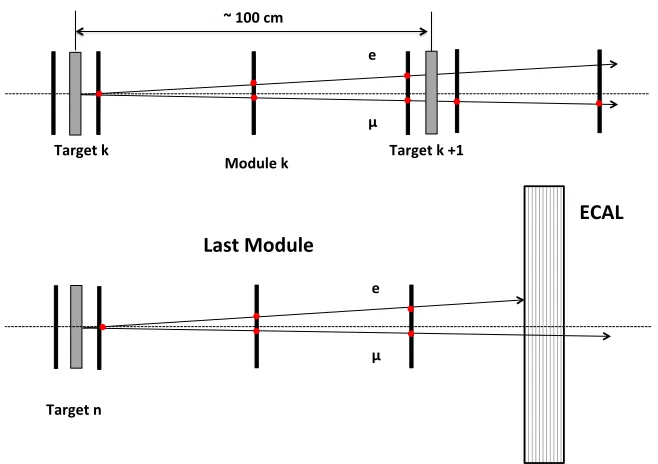
The CERN muon beam M2 presents ideal characteristics to perform the measurement. The beam intensity is in average of about 50 MHz. The whole material budget required to reach the integrated luminosity and the required statistical precision in two years of data taking must be order of 60 cm. In order to minimize multiple scattering and to have high radiation length the target must be of low-Zmaterial. The idea is to use a segmented target of 2 cm thin layers, distributed in 30 identical modules. Each detection module has the length of 1 m, a transverse surface of 10×10 cm2and consists of a target of Beryllium coupled to three stations
e
μ
Target k Target k +1 Module k
~ 100 cm
e
μ
Target n
Last Module
ECAL
Figure 3. Scheme of a possible detector layout. (a) The detector is a modular system. Each module
consists of a low-Ztarget (Be or C) and three silicon tracking stations within the distance of 50 cm. (b) To perform theµ-e discrimination in the case of small scattering angles (with bothθµandθebelow 5
mrad) the detector is equipped with an electromagnetic calorimeter and a muon detector.
4 Considerations on systematic uncertainties
Significant contributions of the hadronic vacuum polarization to the µe → µedifferential cross section are essentially restricted to electron scattering angles below 10 mrad, corre-sponding to electron energies above 10 GeV. The net effect of these contributions is to in-crease the cross section by a few per mille. To get a relative precision below 1% in the determination ofaHLOµ requires high statistics, a high level of control of systematic uncertain-ties. Goal of experiment is equivalent to a determination of the differential cross section with ∼10 ppm systematic uncertainty at the peak of the integrand function (c f. Fig. 1).
A crucial requirement is to keep the detection efficiency highly uniform over the entire q2range and over all the detector components. This motivates the choice of a purely angular measurement: an acceptance of tens of mrad can be covered with a single sensor of modern silicon detectors, positioned at a distance of about one meter from the target.
Another imporant requirement is measuring very preciselly the muon maen beam energy. By reverting the two body elastic scattering kinematics we can reach the precision of few MeV. It implies the need to control the longitudinal positions of the sensors stations to 10-100µm.
We aim to control stematic effects within the experiment itself. In this respect the pro-posed modularity of the apparatus will help. Test with jus couple of modules planned at CERN in 2021 could provide a proof-of-concept of the proposed method.
5 Conclusions
The experiment MUonE presented to determine the leading hadronic contribution to the muon
g-2, by scattering high-energy muons on atomic electrons of a low-Ztarget through the pro-cessµe→µe, is primarily based on a precise measurement of the scattering angles of the two outgoing particles as theq2of the muon-electron interaction can be directly determined by the electron (or muon) scattering angle. An advantage of the muon beam is the possibility of em-ploying a modular apparatus, with the target subdivided in subsequent layers. A low-Zsolid target is preferred in order to provide the required event rate, limiting at the same time the effect of multiple scattering as well as of other types of muon interactions (pair production, bremsstrahlung and nuclear interactions). The normalization of the cross section is provided by the very sameµe → µeprocess in the low-q2 region, where the effect of the hadronic
corrections onα(t) is negligible. Such a simple and robust technique has the potential to keep systematic effects under control, aiming at reaching a systematic uncertainty of the same or-der as the statistical one. For this purpose a preliminary detector layout has been described. On the theoretical side, the radiative corrections at NNLO accuracy have to be considered in full detail and a Monte Carlo event generator able to match fixed order NNLO predictions with resummation given by the Parton Shower technique is needed. By considering a beam of 150 GeV muons with an average intensity of∼1.3×10⁷muon/s, currently available at the CERN North Area, a statistical uncertainty of∼0.3% can be achieved onaHLOµ in two years of data taking. A test performed using a single detector module, exploiting the muon beam facility, could provide a validation of the proposed method.
References
[1] T. Blum, A. Denig, I. Logashenko, E. de Rafael, B. Lee Roberts, T. Teubner and G. Ve-nanzoni, arXiv:1311.2198 [hep-ph].
[2] F. Jegerlehner, EPJ Web Conf.118(2016) 01016; F. Jegerlehner, Acta Phys. Polon. B49, 1157 (2018). [3] C. Bouchiat, L. Michel, J. Phys. Radium 22 (1961) 121;
L. Durand, Phys. Rev.128(1962) 441 [Erratum-ibid.129(1963) 2835]; M. Gourdin, E. De Rafael, Nucl. Phys. B10(1969) 667.
[4] C. Aubin, T. Blum, Phys. Rev. D75(2007) 114502;
P. Boyle, L. Del Debbio, E. Kerrane, J. Zanotti, Phys. Rev. D85(2012) 074504; X. Feng, K. Jansen, M. Petschlies, D.B. Renner, Phys. Rev. Lett.107(2011) 081802; M. Della Morte, B. Jager, A. Juttner, H. Wittig, JHEP1203(2012) 055;
T. Blumet al., Phys. Rev. Lett.116(2016) no.23, 232002;
B. Chakraborty, C. T. H. Davies, P. G. de Oliviera, J. Koponen and G. P. Lepage, arXiv:1601.03071 [hep-lat];
M. Della Morteet al., JHEP1710, 020 (2017);
M. Krstic Marinkovic, talk at Lattice 2018, 22-28 July 2018, East Lansing, MI, USA. [5] T. Blum, M. Hayakawa, T. Izubuchi, PoS LATTICE2012(2012) 022;
B. Chakraborty, C. Lehner, R. Van de Water, talks at ICHEP 2016, https://indico.cern.ch/event/432527/contributions/speakers
[6] M. Knecht, A. Nyffeler, Phys. Rev. D65(2002) 073034; K. Melnikov, A. Vainshtein, Phys. Rev. D70(2004) 113006; J. Prades, E. de Rafael, A. Vainshtein, arXiv:0901.0306 [hep-ph]. F. Jegerlehner, A. Nyffeler, The Muong-2, Phys. Rept.477(2009) 1; A. Nyffeler, Phys. Rev. D79(2009) 073012.
[7] F. Jegerlehner, A. Nyffeler, Phys. Rept.477(2009) 1. [8] A. Nyffeler, arXiv:1710.09742 [hep-ph].
[9] G. W. Bennettet al.(Theg-2 Collaboration), Phys. Rev.D73(2006) 072003. [10] J. Grangeet al.[Muong-2 Collaboration], arXiv:1501.06858 [physics.ins-det]. [11] N. Saito [J-PARCg-2/EDM Collaboration], AIP Conf. Proc.1467(2012) 45.
[12] G. Abbiendi, C. M. Carloni Calame, U. Marconi, C. Matteuzzi, G. Montagna, O. Nicrosini, M. Passera, F. Piccinini, R. Tenchini, L. Trentadue and G. Venanzoni, Eur. Phys. J. C (2017) 77 139.
[13] C. M. Carloni Calame, M. Passera, L. Trentadue and G. Venanzoni, Phys. Lett. B746
(2015) 325
[14] A.B. Arbuzov, D. Haidt, C. Matteuzzi, M. Paganoni and L. Trentadue, Eur. Phys. J. C
34(2004) 267.
[15] G. Abbiendiet al.[OPAL Collaboration], Eur. Phys. J. C45(2006) 1. [16] F. Jegerlehner, Springer Tracts Mod. Phys.226, 2008.
[17] B.E. Lautrup, A. Peterman, E. de Rafael, Phys. Rept.3(1972) 193. [18] S. Eidelman and F. Jegerlehner, Z. Phys. C67(1995) 585;
F. Jegerlehner, Nucl. Phys. Proc. Suppl.181-182(2008) 135 [19] S. R. Amendoliaet al., Phys. Lett. B146(1984) 116;
S. R. Amendoliaet al.[NA7 Collaboration], Nucl. Phys. B277(1986) 168.
[20] A.B. Arbuzov, V.S. Fadin, E.A. Kuraev, L.N. Lipatov, N.P. Merenkov, L. Trentadue, Nucl. Phys. B485(1997) 457;
[21] B.F.L. Wardet al., Phys. Lett.B450(1999) 262; S. Actiset al., Eur. Phys. J. C66 (2010) 585-686.
[22] K.E. Eriksson, Nuovo Cimento19(1961) 1029; A.I. Nikishow, Sov. Phys. JETP (1961) 1929; K.E. Eriksson, B. Larsson and G.A. Rinander, Nuovo Cimento 30(1963) 1434; P. Van Nieuwenhuizen, Nucl. Phys. B28(1971) 429; T. V. Kukhto, N. M. Shumeiko and S. I. Timoshin, J. Phys. G13(1987) 725; D. Y. Bardin and L. Kalinovskaya, DESY-97-230, hep-ph/9712310; N. Kaiser, J. Phys. G37(2010) 115005.
[23] M. Alacevichet al., work in progress.
[24] G. Balossiniet al., Nucl.Phys. B758 (2006) 227-253. [25] P. Mastroliaet al., JHEP 1711 (2017) 198.
[26] S. Di Vitaet al., JHEP1809, 016 (2018).
[27] C.M. Carloni Calameet al., JHEP 1107 (2011) 126; Nucl. Phys. Proc. Suppl. 225-227 (2012) 293
[28] M. Fael, arXiv:1808.08233 [hep-ph]; M. Fael and M. Passera, work in progress.
[30] E. Derman and W.J. Marciano, Ann. Phys. 121 (1979) 147; G. D’Ambrosio, Lett. Nuovo Cim. 38 (1983) 593; J.C. Montero, V. Pleitez and M.C. Rodriguez, Phys. Rev.D58(1998) 097505.
[31] Einstein A.,Phys. Rev. A13199912; Fermi E., Phys. Rev. A699991666. [32] Newton I. preprint INFN 8181.
![Figure 1. Left: ∆αhad[t(x)] × 104 (red) and, for comparison, ∆αlep[t(x)] × 104 (blue), as a function ofx and t (upper scale)](https://thumb-us.123doks.com/thumbv2/123dok_us/8004735.1329976/3.482.58.433.65.252/figure-left-ahad-comparison-alep-function-upper-scale.webp)