10 | P a g e
Emotion Recognition System: An android based visual
training system for Autistic children
Lavlesh Mishra
1, Ajay Upadhyay
2, Dr. Ravendra Singh
31,2,3
Department of Computer Science & Information Technology
Faculty of Engineering and Technology MJP Rohilkhand University, Bareilly, (India)
ABSTRACT
In this paper we have presented a method to develop emotion-aware solutions forAutistic
children.Emotion-aware apps could significantly increase the childrenunderstanding of their emotions and it could also help their
carers or educators to better understand the children and make betterinformeddecisions.Most autistic children
are visual learners and mobile technology appeals to them. We are proposing an android/smartphone based
visual training system which could be a quite effective system for autistic children to help them with their
therapies and treatments.
Keywords—Image processing; Autism spectrum disorders (ASD); emotion detection; image
training; facial expression detection; Emotion recognition system;Emotion-Awareness;
I. INTRODUCTION
Autism is a deep rooted and formative handicap, it influences how individuals see the world and associate with
others. It's a typical issue in youngsters, extremely introverted individuals see, hear and feel the world
distinctively to the next individuals. Mentally unbalanced individuals experience issues with translating both
verbal and non-verbal dialect like motions or manners of speaking. They may discover hard to get it:
Facial expressions
Tone of voice
Jokes and sarcasm
Autistic children often have difficulty „reading‟ other people – recognizing or understanding other‟s feelings and
intentions and expressing their own emotions. Autism spectrum disorders (ASD) are characterized by
social-interaction difficulties, communication challenges and a tendency to engage in repetitive behaviors.Over the
years, different diagnostic labels have been used, such as autism, autism spectrum disorder (ASD), autism
spectrum condition (ASC), classic autism, Kanner autism, pervasive developmental disorder (PDD),
11 | P a g e
II. PREVIOUS WORK
Autism was first depicted by Leo Kanner in 1943, in an exemplary article that included contextual analyses of
11 kids. Its current with us from numerous decades and these clutters have ruined existences of many
individuals. There have been a great deal of research in this field and various specialists and researchers have
done their commitments to create medicines for youngsters with a mental imbalance. These incorporate
behavioral mediations, formative intercessions and intellectual behavioral mediations. While each program
depends on an alternate logic.
Autistic children find even the quick social condition unusual and vast. They are frequently said in some sense
to 'treat individuals and questions alike'. Wing and Gould (1979) in their epidemiological investigation of
extremely hindered mentally unbalanced kids draw out the scope of socially impeded conduct: from add up to
withdrawal through latency to dull irritating. Ruler's (1984) audit of work on peer association in extremely
introverted youngsters features the low level of social ability even in capable mentally unbalanced kids, in spite
of changes because of intercession. A photo of evidently obstinate social debilitation develops in the clinical
follow-up investigations of a mental imbalance (e.g. Kanner, 1971; Kanner, Rodriguez, and Ashenden,
1972)and in the as yet rare experimentalinvestigations (e.g. Attwood, 1984; Martini, 1980).
Keeping in mind the end goal to clarify the particular weaknesses of youth autism it is essential, at that point, to
consider the hidden psychological systems free of IQ (Frith, 1982; Hermelin and O'Connor, 1970; Rutter, 1983).
Up until this point, no one has had any thought of how to describe such components in even semi computational
terms. Premack and Woodruff (1978) characterized hypothesis of psyche as the capacity to attribute mental
states to oneself and to others. The capacity to make derivations about what other individuals accept to be the
situation in a given circumstance enables one to foresee what they will do. This is obviously a urgent part of
social abilities. There is developing confirmation for the capacity to credit mental states to others, and its
improvement from the second year of life onwards(Bretherton, McNew, &Beeghly-Smith, 1981; MacNamara,
Baker, & Olson,1976; Shantz, 1983; Shultz, Wells, &Sarda, 1980; Shultz &Cloghesy, 1981).
III. PROPOSED WORK
Individuals with ASD experience issues communicating emotion and conveying how they feel, and medications
accessible till now are by giving them ability preparing treatments, for example, intellectual conduct treatments,
dialect preparing treatments and so forth. Most autistic kids are visual students and portable innovation advances
to them. We are proposing an android based visual preparing framework that could essentially build the kids'
comprehension of their emotions and could likewise help their caretakers or teachers to better comprehend the
youngsters and settle on better educated choices.
An interactive android application can be developed which classifies the emotions / facial expressions in an
image captured by the device‟s camera.
Flow of the proposed method is as follows:
Step 1: Capture image using the camera or take from gallery (Media Access)
Step 2: Face detection stage
12 | P a g e
Step 4: Emotion classification stage
Step 5: Display the classified emotions
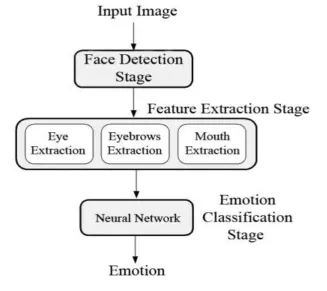
We are proposing a useful method to build up an android application utilizing above given system, in initial step
we will require a picture as info that can be taken either from gadget's camera or from the put away pictures. At
that point we need to identify the face in the info picture, that should be possible utilizing various strategies,
there are some standard APIs also which can do likewise for us. Next errand is the element extraction in the
recognized face. Highlights are fundamentally any data that can be removed from a picture and can be utilized
for the computational reason, different highlights in a face can be eyes, mouth, eyebrows and so forth. The last
stage is characterization of the emotions. This is the hardest piece of the whole task in which we require a
classifier that can be created by utilizing either a neural system approach or bolster vector machine (SVM)
approach. The stream graph is given underneath as:
Figure 1 Flow Diagram
Step 1. Media Access (Google API)-
That is android face detection API it provides media access and web camera access. After getting media access
the system for emotion recognition is divided into 3 stages: face detection stage, feature extraction and emotion
classification. After locating the face with the use of a face detection algorithm, the knowledge in the symmetry
and formation of the face combined with image processing techniques are used to process the face region to
13 | P a g e
Step 2- Face detection-
To detect one or more faces in an image and get back face rectangle for where in the image the face is. For the
recognition of the face we have used Eigen faces which is a set of Eigen Vectors in computer vision for the
recognition of faces. Firstly, we have extracted the features with the help of PCA(Principle component analysis)
feature Extraction and then classification through support vector machine for automated Emotion classification.
Step 3- Harr cascade feature
extraction-Haarcascade is a feature based cascade classifier. It is an efficient object detection method using boosting
cascade of simple features. Normally we have an image in the form of pixels but we can define the direction of
face as combination of vectors. It provides more detail and utility. Now we train a cascade function with a lot of
positive and negative images.
Step 4- Emotion Detection using Canny Edge Detection Algorithm-
Edge detection is basically finding out boundaries within the object. Canny edge detector is an edge detection
operator that uses a multi stage algorithm to detect a wide range of edges in an image. To implement canny edge
detection algorithm, we can latest Oxford Microsoft Project API. In computing a grayscale image or digital
image is in which the value of each pixel is single sample. For example: Black and white image,
Grayscale = (R+G+B)/3
new Grayscale= (.3R+.5G+.1B)
After gray scale conversion now we have an image in just one channel of color that need 8 bit to represent. For
example: Black (000) & white(111). After gray scaling, we need to feed the gray scaled image to the canny edge
detector.
1. Mark all edges only once with low error rate.
2. We have already done gray scale conversion so now we have. performed Gaussian Filter to smooth the
image in order to remove the noise and uncertain edges.
3. Find out intensity gradient (G) and direction gradient (alpha).
4. Suppression.
5. Apply double threshold to determine the potential image.
6. On the bases of above calculation, it will provide check the facial expression for example mouth-smile,
face-sad etc.
Step 5- Emotion classification-
In this step the result of the canny edge detector is fed to the emotion classifier, again that can be done using
latest Oxford Microsoft Project API, which provides a prebuilt classifier for emotion detection and results the
14 | P a g e
IV. CONCLUSION
This paper exhibited advancement of a customized App for cell phones and tablets. It goes for helping autistic
kids comprehend their emotions utilizing cell phones, sensors and outward appearance acknowledgment
programming/APIs. Understanding and overseeing emotions is essential for autistic kids since it affects how
well they incorporate into society. We trust that utilizing sensors and versatile innovations can possibly help
them, and their carers in their day by day lives.
V.ACKNOWLEDGEMENT
This research paper is made possible through the help and support from everyone, including: parents, teachers,
family, friends, and in essence, all sentient beings. Especially, please allow us to dedicate our acknowledgment
of gratitude towards Dr. Ravendra Singh for his support and encouragement.
REFERENCES
[1.] Leo Kanner, Alejandro Rodriguez, Barbara Ashenden “How far can autistic children go in matters of social
adaptation?” Journal of autism and childhood schizophrenia January 1972, Volume 2, Issue 1, pp 9–33
[2.] American Psychiatric Association (1980). Diagnostic and statistical manual of mental disorders (3rd ed.)
Washington DC American Psychiatric Association.
[3.] SimonBaron-CohenAlanM.LeslieUtaFrithDoes the autistic child have a “theory of mind” ?MRC Cognitive
Development Unit, London, UKVolume 21, Issue 1, October 1985, Pages 37-46.
[4.] P Michel, “Support Vector Machines in Automated Emotion Classification”, CS.CMU.EDU, 2009.
[5.] M Turk, A Pentland, “Eigenfaces for recognition”, Journal of cognitive neuroscience, 1991.
[6.] Lorna Wing, Judith Gould “Severe impairments of social interaction and associated abnormalities in
children: Epidemiology and classification” Journal of Autism and Developmental Disorders, March 1979, Volume 9, Issue 1, pp 11–29
[7.] Valerie GayEmail author, Peter Leijdekkers “Design of emotion-aware mobile apps for autistic children”
Health and Technology, May 2014, Volume 4, Issue 1, pp 21–26
[8.] WathsalaNayomiWidanagamaachchi“Facial Emotion Recognition witha Neural Network Approach”
University of Colombo School of Computing.
[9.] IJIRST –International Journal for Innovative Research in Science & Technology| Volume 1 | Issue 6 |