OPTIMAL RESERVOIR OPERATION USING
GENETIC ALGORITHM- CASE STUDY
Akanksha Thorat
1, Mahesh Dhikale
2, Nikita Thorat
3,
Sagar Durdhavle
4, Varsha Murkute
5, Sangita Pawar
61,2,3,4,5
Civil Department, Matoshri Collage of Engineering and Research Centre,
Nashik, Maharashtra, (India)
6
Post Graduate Student, Department of Civil Engineering, Government College of Engineering,
Aurangabad-431005, Maharashtra, (India )
ABSTRACT
Application of optimization techniques for determining the optimal operating policy of reservoirs is a major issue in water resources planning and management. In this paper we study the Gangapur Dam reservoir water by Genetic Algorithm (GA) is consider at various level related to optimal reservoir operation and com-pare this result according to sudden condition. The main aim of the present study is to develop a policy for optimizing the release of water for the purpose of irrigation. The months considered are from January to December for fifteen years from year 2015to 2016. The decision variables are monthly releases for irrigation from the reservoir and initial storages in reservoir at beginning of the month. The constraints considered for this optimization are the bounds for the releases and reservoir capacity.
Keywords: Gangapur Dam, Genetic Algorithm, Lingo, Optimization, Reservoir Operation, Single
Objective
I. INTRODUCTION
Water is the most important requires for all living creatures after oxygen. Life and health of all beings
containing human, plants and animals, depends on water. Therefore, nowadays, water is known as human
treasure. Although 75 percent of planet earth is composed of water, but only one percent of the fresh water is
usable. In spite of the fact that the amount of usable water (drinking water) on earth is limited, but this
insignificant amount is not spread on the earth uniformly. This limitation is one of the most important and
essential challenges in countries with arid and semi-arid regions.
On one hand, limited access to water resources and on the other hand, human need for water, necessitates the
proper management strategies. Taking into aims like providing water, controlling floods, hydro power
production, tourism, etc. dams are designed and constructed in order to resolve such problems. Providing water
for municipal, agricultural and industrial consumption is one of the main purposes for reservoir operation and
planning. In most countries, agricultural purposes have the highest water level consumption. So, optimal
reduced waste water and increasing the level of yield of production and gaining sustaining development in
agriculture.
Use of Genetic Algorithm (GA) in determining the optimal reservoir operation policies, is receiving significant Attention from water resources engineers. A large number of works has been reported on the application of GA
for various complex reservoir problems Sonaliya and Suryanarayana [1] developed a GA model. This policy has
been developed for release of water from the Ukai reservoir project for the purpose of irrigation. Nagesh kumar
and Shrinivasa [2] presented a genetic algorithm (GA) model for obtaining an optimal operating policy and
optimal crop water allocations from an irrigation reservoir. Sharif and Wardlaw [3] presented genetic algorithm
approach for optimization of multi reservoir systems for a case study in Indonesia and its results were compared
with those of discrete differential dynamic programming. Wardlaw and Sharif [4] evaluated several
formulations of a genetic algorithm for four reservoir, deterministic, finite-horizon problem. Chang and Chen
[5] applied two types of genetic algorithms, namely, real-coded and binary coded and applied to the
optimization of a flood control reservoir model Savic and Walters [6] developed a computer model GANET that
involves the application of an area of Evolutionary Computing, better known as Genetic Algorithms, to the
problem of least-cost design of water distribution networks
In the present study, a GA model has been used for optimum reservoir operation. The objective of this study is
to minimize the squared deviation of monthly irrigation demand deficit along with squared deviation of mass
balance equation. The decision variables used are the release for irrigation demand from the reservoir and initial
storage in each month. The constraints used for this optimization are bounds for the releases and reservoir
capacity.
II. STUDY AREA
The area selected for the present study is the catchment area of the Gangapur dam, this dam is near village in
Godawadi and is 10 km from nashik city. This is earthen type dam constructed in between 1954-1963. The total
catchment area of the dam is 357.4 sq. The total dam length is 3810m and max. Height of dam 36.57m.the total
gross storage of the dam215.88MCM. (7624MCFT).and total live storage is 203.76MCM (7200MCFT) the
length of the water weir is 102m. There are total 9 radial gate of size (9.15*6.10m) having discharge capacity of
2294 Cumec (81013Cusec). The dam has two canal, the left bank canal is 64km long and right bank canal is
30km.the total irrigable area of these dam is 15960ha.
III. METHODOLOGY
In this project report, all with these different optimization techniques we selected Genetic Algorithm technique
for analyzing the Gangapur dam releases in this phase-1.
Model Development
In the present study, the fitness function of the GA model is minimizing the squared deviation of monthly
irrigation demand and squared deviation in mass balance equation. The objective function is given by equation
12 12
2 2
( 1)
1 1
(
t t)
(
t t t t t)
t t
R
D
S
S
I
R
E
.… (1)Where,
Rt =Monthly irrigation release for the month„t‟.
Dt = Monthly downstream irrigation demand for the month„t‟.
St = Initial storage in the beginning of month„t‟.
St+1 = Final storage at the end of month „t‟.
It = Monthly inflow during the period „t‟, and
Et= Monthly evaporation loss from the reservoir during the month „t’.
The above fitness function of GA model is subjected to the following constraints and bounds,
A. Release constraint.
The irrigation release during any month should be less than or equal to the irrigation demand in that month and
this constraint is given by
Rt ≥ Dt, t = 1, 2, 3, 4 .… (2)
B. Storage constraint.
The reservoir storage in any month should not be more than the capacity of the reservoir, and should not be less
than the dead storage. Mathematically this constraint expressed as:
Smin ≤St and
St ≤ Smax; t = 1, 2, 3, 4 .… (3)
Where,
Smin = Dead Storage of the reservoir in MCM and
Smax = Maximum capacity of the reservoir in MCM.
IV. RESULTS AND DISCUSSION
To apply Genetic algorithm (GA) to the given formulated model, the data of inflow, demand, actual releases by
all the outlets, evaporation loss from reservoir used in MCM. The important input variables in present Genetic
Algorithm formulation model study are the monthly inflows into the reservoir system and monthly irrigation
demands for all the month of hydraulic year 2015 to 2016.The main objective of the study is to compute the
quantity of water that should be released to meet the monthly irrigation demand. Since, the fitness function is
based on the monthly irrigation demands (Dt) and monthly inflow in the reservoir (It), so releases from the reservoir for irrigation purpose (Rt), and initial storage (St) in the reservoir for monthly time period are chosen as decision variable. Thus eight decision variables are considered for a year 2015-2016.After applying GA to the
above formulated model the following results are generated which gives the releases by GA and that we
Table 1: Shows that the values of actual releases, demand and releases by GA for year 2015-16
Month Jun July Aug Sept Oct Nov Dec Jan Feb Mar Apr May
Actual
Releases,
MCM
6.183 8.9 8.47 28.59 89.29 76.25 70.30 76.8 28.41 23.35 24.15 6.98
Releases
By GA,
MCM
5.283 7.0 6.33 26.43 87.30 74.22 69.8 74.30 25.30 22.11 23.15 5.98
Demand,
MCM
5.25 6.9 5.89 25.44 86.90 73.12 68.8 73.29 24.85 21.89 22.15 4.98
Table 1. Shows the value of the actual releases from reservoir, demand for downstream and releases calculated
by Genetic Algorithm for all the months for the hydraulic year 2015-16. From the values of releases by using
Genetic Algorithm technique, it can be shows that for all the months of hydraulic year 2015-16, the demands are
completely satisfied.
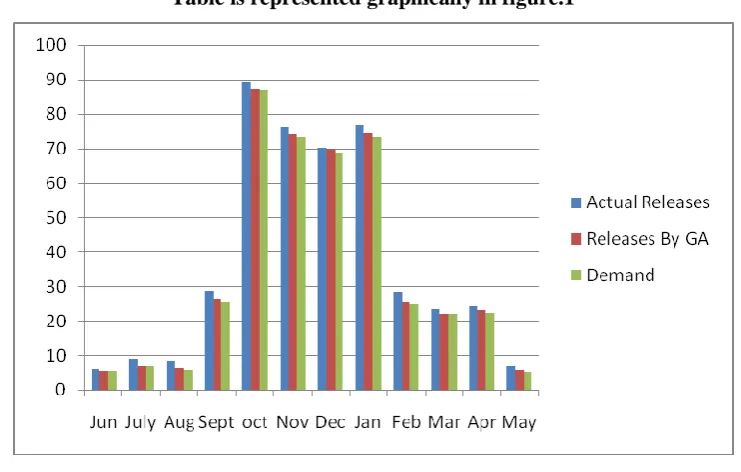
Table is represented graphically in figure.1
Fig 1 Actual Releases by GA And Demand For Year 2015-16
Fig1. shows the value of the actual releases from reservoir, demand for downstream and releases calculated by
Genetic Algorithm for all the months for the hydraulic year 2015-16. From fig 1 it shows that the releases for all
months calculated by GA is less than actual releases from reservoir and to satisfy the demands. So, the
calculated releases for all the months of hydraulic year 2015-16 are the optimal releases. The amount of
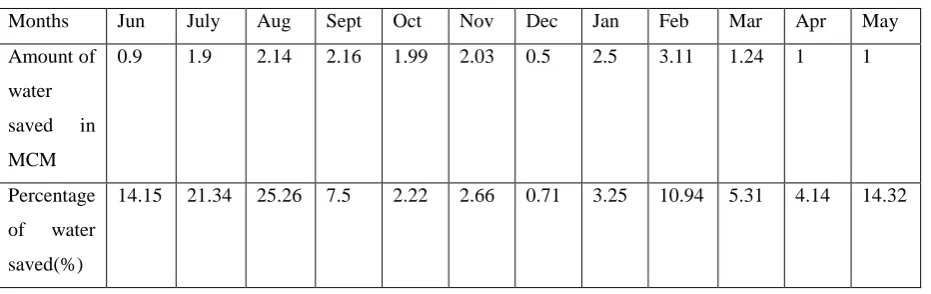
Table 2: Amount of water saved in MCM and in percentage for the year 2015-16
Months Jun July Aug Sept Oct Nov Dec Jan Feb Mar Apr May
Amount of
water
saved in
MCM
0.9 1.9 2.14 2.16 1.99 2.03 0.5 2.5 3.11 1.24 1 1
Percentage
of water
saved(%)
14.15 21.34 25.26 7.5 2.22 2.66 0.71 3.25 10.94 5.31 4.14 14.32
Table 2 shows that the amount of saved water in MCM and in percentage for all the months respectively for the
hydraulic year 2015-16. In month of july and august 1.9 and 2.14 MCM of water is saved respectively, Which
shows that the maximum water saved in percentage in the months of July and August i.e., 21.34% of water is
saved from the actual release in July and similarly almost 25.26% of water is saved from the actual release in
August to fulfil the demand.
V. CONCLUSION
An optimization process has been developed for release of water from the Gangapur dam project for the purpose
ofIrrigation. The releases developed by Genetic algorithm satisfied completely the irrigation demands for all the
months of hydraulic year 2015-16 i.e. the maximum amount of water saved in the month of August is 2.14
MCMand the minimum amount of water saved in the month of December is 0.5 MCM for year 2015-16
respectively.The maximum and minimum amount of water saved in Percentage in the months of August and
December for year 2015-2016 is 25.26% and 0.71% respectively. Thus, an optimal releases obtained by Genetic
Algorithm, are less than actual releases for almost all the twelve months, which leads to saving considerable
amount of water.
VI ACKNOWLEDGEMENT
Many lives and destinies are destroyed due to the lack of proper guidance, directions and opportunities. It is in
this respect we feel that we are in much better condition today due to continuous process of motivation and
focus provided by our teachers in general. The process of completion of this project was a tedious job and
requires care and support at all stages. We would like to highlight the role played by individuals towards this.
We would like to express our sincere thanks, with deep sense of gratitude to my project co-guide Prof. Pawar
S.V. and guide Prof. Pawar S.V. Head of Department Prof. U. P. Naik, for their keen interest in our project. They have been a pillar of strength right through the commencement of work till the preparation of this report,
so we could surmount the difficulties that came across during completion of this project work. We are extremely
grateful to the honorable principal Dr. G. K. Kharate for providing us the opportunity and infrastructure to
Prof. Pawar S.V. who helped us in respect to project work. We are also thankful to all visible and invisible hands which helped us to complete this project with a feeling of success.
REFERENCES
[1] S. Sonaliya and Dr. T.M.V. Suryanarayana, “Optimal reservoir operation using Genetic algorithm: A case
study of Ukai Reservoir project”, International journal of Innovative Research in science, Engineering
and Technology, 3(6), 2014, 13681-13687.
[2] K. S. Raju and D. N. Kumar, “Irrigation Planning using Genetic Algorithms” J. of Water Resources
Management, 18, 2004, 123-129.
[3] M. Sharif and R. Wardlaw “Multi reservoir systems optimization using genetic algorithms: Case study,”
J. Computer in Civil Engineering, 14(4), 2000,255–263.
[4] R. Wardlaw and M. Sharif, “Evaluation of genetic algorithms for optimal reservoir system operation”,
Journal of Water Resources Planning and Management ASCE, 125, 1999, 25–33.
[5] F.H. Chang and L. Chen, “Real-coded genetic algorithm for rule-based flood control reservoir
management”, Water Resources Management, 12, 1998, 185–198.
[6] D.A. Savic and G.A. Walters, “Genetic Algorithms for the Least-cost Design of Water Distribution