INTERALLELIC COMPLEMENTATION AT THE sh LOCUS IN MAIZE AT THE ENZYME LEVEL1
PREM S. CHOUREYZ AND OLIVER E. NELSON
Department of Genetics, University of Wisconsin, Madison, Wisconsin 53706 Manuscript received July 5 , 1978
Revised copy received September 25, 1978
ABSTRACT
EMS-induced sh mutants and their heterozygotes were examined for the enzyme, sucrose synthetase, which has previously been shown to be coded by the Sh locus. Complementing heterozygotes have a wild-type phenotype, but show no hybrid protein band after starch gel electrophoresis. The existence of a heteromeric complex, however, is inferred from the two-fold elevation in sucrose cleavage activity in the complementing heterozygotes as compared to the mutant homozygotes. The observations on complementation described here are unique, as the elevation in the activity of this reversible enzyme is noticed only in one direction (uiz, sucrose cleavage) of the reaction and not the other
(sucrose synthesis).
HE shrunken-I (sh-2) mutation on chromosome 9 in maize, when homozy- Tgous, leads to a shrunken or collapsed phenotype of the kernel owing to a reduced starch content in the endosperm. This mutation is highly tissue specific in its expression and no other part of the plant is affected. SCHWARTZ (1960) observed that the sh mutation is also associated with a complete loss of a major protein designated as the Sh protein. Evidence was presented to show that this protein is under the control of S h locus. CHOUREY and SCHWARTZ (1971) obtained six new sh mutants through the use of ethyl methanesulfonate
(EMS)
; these mutants produced a protein that reacted with an antiserum against the Sh pro- tein (were CRM+) and showed the presence of Sh protein on starch gels after electrophoresis. Electrophoretic mobility alterations in this protein in two of the EMS-induced sh mutants support the hypothesis that the S h locus is the structural gene for the Sh protein. The remaining four mutants produce Sh proteins that are not electrophoretically distinguishable from the protein present in S h / S h / S h endosperms. When sh-F or sh-C are crossed with sh-S, the PIkernels are phenotypically normal. Restoration of the normal phenotype in the hybrids was attributed to interallelic complementation ( CHOUREY 1971). The heterozygotes showed two parental protein bands, and no hybrid band was seen after starch-gel electrophoresis.
The research was supported by the College of Agricultural and Life Sciences, University of Wisconsin-Madison and
Present address: Department of Plant Pathology, USDA/SEA University of Florida, Gainesville, Florida 32611. by Grant 15422 from the Public Health Service. This is paper No. 2249 from the Laboratory of Genetics
318 P. S. C H O U R E Y A N D 0. E. N E L S O N
Complementation among these sh mutants at the phenotypic level was com- plete, but the extent of the interaction at the enzyme level could not be measured at that time since the enzymic deficiency of the sh mutation was not known. Recently we have been successful in showing that the Sh protein is the enzyme, sucrose synthetase, on the basis of the following criteria ( CHOUREY and
NELSON
1976): (1) Endosperms of five sh mutations of spontaneous independent origin were observed to have less than 10% of normal sucrose synthetase activity. More recently analyses (CHOUREY and
NELSON
1978) of these five, as well as three more such sh mutants, using newly defined optimal assay conditions have shown that the mutants have 5 % or less enzyme activity as compared to normal. Evidence was also presented to show that the residual enzyme activity in the mutant endosperms was independent of the sh locus. (2) A linear relationship was observed between the number of S h alleles in endosperm tissue and the amount of sucrose synthetase activity, and (3) the purified Sh protein obtained from the normal endosperm possessed sucrose synthetase activity. Biochemical as well as genetic data show that both sucrose synthesis and sucrose cleavage can be catalyzed by the same sucrose synthetase protein in maize (TSAI 1974;CHOUREY and NELSON 1976). The present communication concerns analyses at the enzyme level of some of the EMS-induced sh mutants and their hybrids.
MATERIALS A N D METHODS
The EMS-induced sh mutants used in this study, sh-C, sh-F and sh-S, have been described previously (CHOUREY and SCHWARTZ 1971). The nonmutant ( S h ) allele assayed is that present i n the inbred W22. The reference allele at the locus, sh-R, was also placed in the W22 back- ground by repeated backcrossing. Developing kernels of various genotypes were harvested at 22 and 34 days after pollination, frozen on dry ice and stored at -20". The embryo and pericarp were removed from the kernel prior to homogenization with buffer. A classification of normal and shrunken kernels from segregating 34-day-old ears was done by cutting the frozen kernels into two halves along the embryo axis. The two phenotypes were easily distinguishable as the normal kernels were filled with starch, while the mutants showed a distinct cavity filled with ice. Starch-gel electrophoresis of the endosperm proteins was done by squeezing the juice from the thawed endosperms onto a piece of filter paper to be inserted in the gel. The electrophoretic procedure, staining, and destaining of the gels was done as described by SCHWARTZ (1960). Thawed endosperms were homogenized after mixing equal parts by endosperm and chilled 0.01 M Tris maleate buffer (pH 7.0). This mixture was strained through two layers of cheese- cloth and centrifuged at 30,000
x
g for 90 min. The supernatant fraction was dialyzed over- night against the extraction buffer. The preparation thus obtained (referred to as a crude preparation) was used as the enzyme source for routine assays.Enzyme activity was assayed in the direction of sucrose synthesis as well as sucrose cleavage. The reaction mixture for sucrose synthesis contained 60 amoles of glycine-NaOH huffer (pH 9.0), 2 $moles MgSO,, 10 pmoles fructose, 2 amoles uridine diphosphate glucose (UDPG), and
1, 5 or 10 a1 of crude enzyme preparation from various genotypes in a total volume of 0.4 ml. The control tubes lacked UDPG. The reaction was carried out at 30" f o r 15 min, followed by the addition of 0.1 ml of 10 N NaOH. The mixture was boiled in a water bath for 12 min to destroy the unreacted fructose. The sucrose formed was then measured by the method of ROE
(1934). The reaction mixture for sucrose cleavage consisted of 64 pmoles MES buffer (pH 6.0),
INTERALLELIC COMPLEMENTATION I N M A I Z E 319
stituted the control. The tubes were incubated in a 30" water bath f o r 15 min, and the reaction was terminated by adding NELSON'S reagent (1944) for the assay of reducing sugars.
The pH optima were measured using the following buffers: Acetate (pH 4.5 and 5.5), Acetate and MES (2-N Morpholino ethane sulfonic acid) (pH 6.0), HEPES (N-2-hydroxyethyl piper- azine-N-2 ethane sulfonic acid) and phosphate (pH 7.0) HEPES and Tris-HC1 (pH 8.0), glycyl- glycine and Tris-HCl (pH 9.0) and CHES (cyclohexylaminoethane sulfonic acid) (pH 10.0). Whenever two buffers for a given pH were used, the data from the buffer giving the greater activity have been included in Figures 1A and 1B.
RESULTS
The sucrose synthetase activity in 22-day-old endosperms of various genotypes is shown in Table 1. The enzyme preparation was assayed for both sucrose syn- thesis and for sucrose cleavage. The mutants sh-F and sh-C showed approxi- mately the same amount of activity in either direction, as does the sh-R mutant. The sh-S mutant also had sucrose cleavage activity similar to that of the other mutants. However, this mutant is different from all the other s h mutants in the sucrose synthesis reaction. It has 30% as much enzyme activity as normal. Hybrids obtained by intercrossing the EMS-induced mutants were also exam- ined, and the results are shown in Table 1. Maize endosperm is a triploid tissue receiving two genomes from the female and one from the male. The endosperm genotypes in Table 1 and 2 are designated accordingly. The enzyme activity in the direction of sucrose synthesis in heterozygotes seems to depend upon the number of sh-S alleles in the endosperm. The endosperm preparation of the sh-S
mutant shows that enzyme activity exceeds that of either complementing or noncomplementing heterozygotes. The picture, however, is entirely different when the same enzyme preparations are analyzed for sucrose cleavage. An approximate two-fold increase as compared to the parents is observed in the complementing hybrids. The noncomplementing hybrid sh-F/sh-F/sh-C, on the other hand, in comparison to the parents shows roughly the same level of enzyme
TABLE 1
Sucrose synthetase activity in 22-day-old endosperms of normal, EMS-induced shrunken mutants and their hybrids
Synthesis (pH 9.0) Cleavage (pH 6.0)
Genotype Phenotype Sp. act.* % Sp. act.* %
+/+/+
(W22)sh-R/sh-R/sh-R (W22)
sh-C/sh-C/sh-C sh-S/sh-S/sh-S sh-F/Sh-F/sh-F sh-F/Sh-F/sh-C sh-F/h-F/sh-S sh-S/sh-S/sh-P sh-C/sh-C/sh-S sh-S/sh-S/sh-C normal mutant mutant mutant mutant mutant normal normal normal normal 994.0 48.5 63.9 4.9.9 301 .O
74.7 148.9 235.0 135.8 254.0 100 4.88 6.43 5.02 30.30 6.92 14.98 23.64 13.66 25.55 1555.0 78.5 91.9 66.6 73.2 115.7 158.5 184.0 160.0 155.5 100 5.058 5.91 4.28 4.71 7.38 10.19 11.83 10.29 10.80
320 P. S. CHOUREY A N D 0. E. NELSON
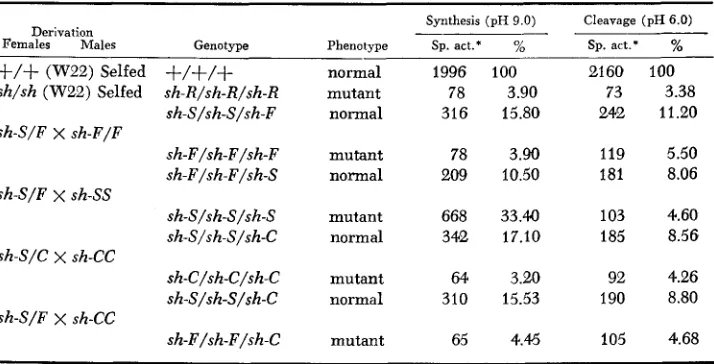
TABLE 2
Sucrose synthetase aciivity i n 34-day-old endosperms of specified genotypes
Synthesis (pH 9.0) Cleavage (pH 6.0)
Derivation I -
Females Males Genotype Phenotype Sp. act.* % Sp. act: %
+/+
(W22) Selfed+/+/+
sh/sh (W22) Selfed sh-R/sh-R/sh-Rsh-S/sh-S/sh-F
sh-F/sh-F/sh-F sh-F/sh-F/sh-S
sh-S/sh-S/sh-S sh-S/sh-S/sh-C
sh-C/sh-C/sh-C sh-S/F X sh-F/F
sh-S/F
x
sh-SSsh-S/C X sh-CC
sh-S/sh-S/sh-C sh-S/F X sh-CC
sh-F/sh-F/sh-C
normal mutant normal
mutant normal
mutant normal
mutant normal
mutant
1996 100 78 3.90 316 15.80
78 3.90 209 10.50
668 33.40 342 17.10
64 3.20 310 15.53
65 4.45
2160 100 73 3.38 242 11.20
119 5.50 181 8.06
103 4.60 185 8.56
92 4.26 190 8.80
105 4.68
* Specific activity: nmoles of sucrose or reducing sugar synthesized per mg of protein per min.
activity for the sucrose synthesis, but a slight elevation is noticed for the sucrose cleavage reaction. This increase in the noncomplementing hybrid was critically examined at the 34-day-old stage of development by comparing the complement- ing and noncomplementing heterozygotes segregating on the same ear (Table 2), thus minimizing any variation due to the genetic background. This was done in the following manner: The plants raised from the sh-S/sh-F heterozygote were pollinated by sh-C pollen. This led to a 1 : 1 segregation for plump sh-S/sh-
S/sh-C and shrunken sh-F/sh-F/sh-C endosperms due to complementing and
noncomplementing heteroallelic combinations, respectively. It was also possible to compare complementing heterozygous and parental homozygous kernels on the same ear by backcrossing the heterozygote to one of the parental types. The plump and shrunken phenotypes can be readily identified at 34-day stage, but not at 22-day stage of development. The noncomplementing heterozygote does not show the same level of sucrose cleavage activity as the complementing het- erozygote (Table 2 ) . The noncomplementing hybrid has similar levels of activity to the parental homozygotes. The complementing hybrids, on the other hand, show a consistent two-fold increase in sucrose cleavage activity as com- pared to the homozygous mutant endosperms segregating on the same ear. The enzyme activity in the direction of sucrose synthesis at the 34-day stage shows the same pattern as seen at the 22-day stage, i.e., SSS
>
SSF or SSC>
FFS.
INTERALLELIC COMPLEMENTATION I N MAIZE 321
TABLE 3
Sucrose synthetase activity expressed as % of the normal 22-day-old endosperm in mixtures of
crude preparations of sh-S, sh-F and sh-C endosperms (designated below
as S, F and C, respectively)
Mixture (v/v) Sucrose synthesis Sucrose cleavage
2S:lF 23.10 5.39
2F:lS 15.21 5.22
2s:ic
23.82 5.452C:lS 14.80 5.85
The levels of sucrose synthesis activity in the mixtures are similar to the cor- responding hybrid (Table 1 ). However, the analysis of sucrose cleavage activity shows that the mixtures are similar to the donor homozygotes and no elevation in enzyme activity is observed, as in the case of hybrids.
The pH optima were determined using crude preparations of 22-day-old endo- sperms of various genotypes and are shown in Figure 1A and
B.
The highest amount of activity for sucrose synthesis and sucrose cleavage reactions was seen at pH 9.0 and p H 6.0, respectively, for all four sh mutants and sh-S/F and sh-S/Chybrids. The normal endosperm preparation also has the same p H optimums for the two reactions (CHOUREY and NELSON 1978).
DISCUSSION
The EMS-induced mutants, sh-F and sh-C, are similar to the reference allele,
sh-R, as regards the amount of sucrose synthetase activity in both the forward and backward reactions. No protein has yet been identified as being coded by the sh-R allele, and the residual enzyme activity present in all mutants has been attributed to another locus in the genome (CHOUREY and NELSON 1976). The alleles sh-F, sh-C, and sh-S, on the other hand, each specify a protein that is readily identifiable by gel electrophoresis ( CHOUREY and SCHWARTZ 1971 )
.
The sh-F allele codes for a protein that has a slightly faster electrophoretic mobility than the Sh protein. The protein coded by the sh-C allele, however, is electro- phoretically indistinguishable from the Sh protein. It seems highly probable that these alleles are coding f o r enzymatically inactive proteins. The sh-S mutant is unique among the sh mutants analyzed so far. Though it is indistinguishable in terms of enzyme activity from the rest of the sh mutants when examined for sucrose cleavage, it has nearly 30% of the normal endosperm’s activity for the sucrose synthesis reaction. This mutant specifies a protein with a slower electro- phoretic migration rate than the Sh protein (CHOUREY and SCHWARTZ 1971).322
250
0 E
OJ
.-
c
2
200-
a
E
E
'3;
150-0 \
c
.-
Q)
-
E
2
100-e
c
Y 0
a
W cn
U 3 cn
5 0 -
P. S. C H O U R E Y ANI) 0. E. NELSON
-
6.0 7.0 8
.O
9.0 10.0v)
Q:
U (3
3
v)
3
W
n
a
4.5 5.5 6.0 7.0 8.0 8.5
INTERALLELIC COMPLEMENTATION I N M A I Z E 323
possible that the enzyme has different active sites for synthesis and cleavage functions, and a single amino acid alteration in the enzyme has affected one site more than the other. A simples interpretation would be that the conforma- tion of the enzyme, due to an alteration in its primary structure, is changed. Such an alteration can lead to widely diverse effects.
Complementation at the phenotypic level in certain heteroallelic combinations is complete as the F, kernels are indistinguishable from the normal S h kernels (CHOUREY 1971). At the enzyme level in the complementing hybrids, an in- crease in enzyme activity is observed only when the sucrose cleavage reaction is measured. A two-fold increase in the specific activity of the enzyme is seen in such hybrids as compared to the parental types. This constitutes nearly 10%
activity in the heterozygotes as compared to the wild type endosperms at the 22-day stage of development. No such elevation in enzyme activity is seen when crude preparations of the homozygotes are mixed and assayed together. Lack of such an in vitro complementation using undenatured enzymes is presumably due to the fact that interallelic complementation involves, in the majority of the cases, interaction of subunits of the polymeric proteins and not the native proteins (cf., FINCHAM 1966). This interaction leading to the formation of a hybrid enzyme is believed to be the molecular basis for the restoration of the normal phenotype in complementing heterozygotes ( SCHLEISSINGER and LEVIN- THAL 1963; CODDINGTON and FINCHAM 1965;
KIDA
and CRAWFORD 1974). Inter- allelic complementation has, however, led to varying amounts of enzyme activity in the heterozygotes. ULLMANN and PERRIN (1970) observed a range of 0.1 to25
%
of the wild-type &galactosidase activity in the complementing merozy- gotes of E . coli. Recently, GELBERT, MCCARRON and CHOVNICK (1976) also observed a range of<
1 to 16% of the wild-type xanthine dehydrogenase activity in the complementing hybrids of rosy mutants in Drosophila melanogaster.Speculation on the wide variation and small percent increases in the enzyme activity over mutant activity (leading to a normal phenotype in complementing heterozygotes) observed will have to1 take the possible labile nature of the hybrid protein into consideration. A greater deviation between the in vitro and
in
uiuoenzyme levels is more likely in complementing heterozygotes than in the wild type. The lack of the hybrid protein band after gel electrophoresis of the com- plementing sh heterozygote extracts may be indicative of the labile nature of the heteromeric complex and has been discussed in the earlier communication ( CHOUREY 1971 )
.
Sucrose synthetase in immature normal maize kernels has recently been demonstrated to be a polymeric protein, and the homomeric tetramer form is believed to be the predominant form (Su and PREISS 1978). Preliminary studies (unpublished) done by us have also suggested that maize sucrose synthetase is a tetramer. In view of these observations, the lack of ahybrid protein band is interesting, but not surprising. ULLMANN, JACOB and
324 P. S. CHOUREY A N D 0. E. NELSON
MONOD ( 1 968) observed that the enzyme produced due to a complementary interaction differs from the wild-type enzyme in tightness and stability of its tertiary folding. EDWARDS, HOPKINSON and
HARRIS
( 1 978) have recently inves- tigated the factors that can lead to dissociation of the hybrid isozymes on electro- phoresis. They demonstrated the dissociation of the heteromeric form of super- oxide dismutase with increasing temperature during electrophoresis, showing that temperature has a critical influence on the appearance of the hybrid enzyme after electrophoresis.It
is interesting that the increases in the enzyme activity with complementa- tion is observed only for the sucrose cleavage reaction and not for sucrose synthesis. The enzyme activity for the latter function shows noncomplementa- tion, and the activity levels in the heterozygotes show a dependence on the num- ber of copies of the S allele present. Similar levels of activity are also obtained when crude preparations of the homozygotes are mixed in the corresponding ratios.No biochemical information concerning the heteromeric complex is available at the present time to support spewlation as to how this differential effect in enzyme activity in the complementing heterozygote is attained. W e have shown previously (CHOUREY and NELSON 1976) that the starch deficiency of the sh
mutant is due to the loss of the Sh locus-coded sucrose synthetase activity. These observations on enzyme activity in complementing heterozygotes substantiate the hypothesis of several inrestigators who have suggested that in viuo sucrose synthetase catalyzes the first step in the transformation of sucrose to starch (see CHOUREY and NELSON 1976). The phenotypically normal kernels of the com- plementing heterozygotes appear to form as much starch as do nonmutant ker- nels. The restoration of normal phenotype in complementing heterozygotes appears to be correlated with enhanced activity for sucrose cleavage, and we interpret this observation as genetic evidence substantiating the hypothesis that the
in
uiuo role of sucrose synthetase in storage tissues is the cleavage of sucrose.LITERATURE CITED
CHOUREY, P. S., 1971
CHOUREY, P. S. and 0. E. NELSON, 1976
Interallelic complementation at the S h , locus in maize. Genetics 68:
The enzymatic deficiency conditioned by the shrunken- I mutations in maize. Biochem. Genetics 14: 1041-1055. -, 1978 Studies on sucrose synthetase in the developing endosperms and embryos of normal and shrunken genotypes. Maize Genet. Coop. Newsletter 52: 125-127.
Ethyl methanesulfonate induced mutations of the Shl protein in maize. Mutation Res. 12: 151-157.
Proof of hybrid protein formation in a case of interallelic complementation in Neurospora crassa. J. Mol. Biol. 12: 152-161.
Dissociation of 'hybrid' isozymes on electrophoresis. Nature 271 : 84-87.
434-442.
CHOUREY, P. S. and D. SCHWARTZ, 1971
CODDINGTON, A. and J. R. S . FINCHAM, 1965
EDWARDS, Y. H., D. A. HOPKINSON and H. HARRIS, 1978
FINCHAM. J. R. S., 1966
GELBART, W., M. MCCARRON and A. CHOVNICK, 1976
Genetic Complementation. W. A. Benjamin Inc., New York.
INTERALLELIC COMPLEMENTATION I N MAIZE 325
KIDA, S. and I. P. CRAWFORD, 1974 Complementation in uitro between mutationally altered B, subunits of Escherichia coli tryptophan synthetase. J. Bacteriol. 118: 551-559.
NELSON, N., 1944 A photometric adaptation of the Lomogyi method for the determination of glucose. J. Biol. Chem. 153: 375-380.
ROE, J. H., 1934 A colorimetric method for the determination of fructose in blood and urine. J. Biol. Chem. 107: 15-22.
SCHLESINGER, M. J. and c . LEVINTHAL, 1963 Hybrid protein formation of Escherichia coli alkaline phosphatase leading to in vitro complementation. J. Mol. Biol. 7: 1-12.
SCHWARTZ, D., 1960 Electrophoretic and immunochemical studies with endosperm proteins of
maize mutants. Genetics 45: 1419-1427.
SU, J. and J. PREISS, 1978 Purification and properties of sucrose synthetase from maize kernels. Plant Physiol. 61 : 389-393.
TSAI, C. Y., 1974 Sucrose-UDP glucosyltransferase i n Zea mays endosperm. Phytochem. 13 : 885-891.
ULLMAN, A. and D. PERRIN, 1970 Complementation in /3-galactosidase. pp. 143-172. In: The Lactose Operon. Edited by J. R. BECKWITH and D. ZIPSER. Cold Spring Harbor Laboratory, Cold Spring Harbor, New York.
On the subunit structure of wild type versus complemented p-galactosidase of Escherichia coli. J. Mol. Biol. 32: 1-13.